
This is the 2001-2003 page of the Shigeru Miyamoto Archive.
| 1983-1996 | 1997-1998 | 1999-2000 | 2001-2003 | 2004-2007 | 2008-2009 |
| 2010-2011 | 2012-2013 | 2014-2015 | 2016-2017 | 2018-2023 | 2024-2027 |
| Lost, Suspected, Incomplete, Unscanned, Untranslated |
2001
1101.com: The Legend of Zelda: Oracle of Seasons and Oracle of Ages, Nintendo Power: A Hero for All Ages (Partially untranslated from Japanese)
Publication Date: February 6, 2001 to April 11, 2001
Subject(s): The Legend of Zelda: Oracle of Seasons and Ages
Format: Transcribed interview
People: Unnamed 1101.com interviewer, Yoshiki Okamoto, Yoshifumi Yamashita, Shigeru Miyamoto
Japanese Links: https://www.1101.com/nintendo/nin20/nin20_1.htm
https://www.1101.com/nintendo/nin20/nin20_2.htm
https://www.1101.com/nintendo/nin20/nin20_3.htm
https://www.1101.com/nintendo/nin20/nin20_4.htm
https://www.1101.com/nintendo/nin20/nin20_5.htm
https://www.1101.com/nintendo/nin20/nin20_6.htm
https://www.1101.com/nintendo/nin20/nin20_7.htm
Japanese Archive Links: https://web.archive.org/web/20010212001054/https://www.1101.com/nintendo/nin20/nin20_1.htm
https://web.archive.org/web/20010221214727/http://www.1101.com/nintendo/nin20/nin20_2.htm
https://web.archive.org/web/20260316100057/https://www.1101.com/nintendo/nin20/nin20_3.htm
https://web.archive.org/web/20010407084109/http://www.1101.com/nintendo/nin20/nin20_4.htm
https://web.archive.org/web/20010407084541/http://www.1101.com/nintendo/nin20/nin20_5.htm
https://web.archive.org/web/20010407085537/http://www.1101.com/nintendo/nin20/nin20_6.htm
https://web.archive.org/web/20240218120028/https://www.1101.com/nintendo/nin20/nin20_7.htm
Scans:


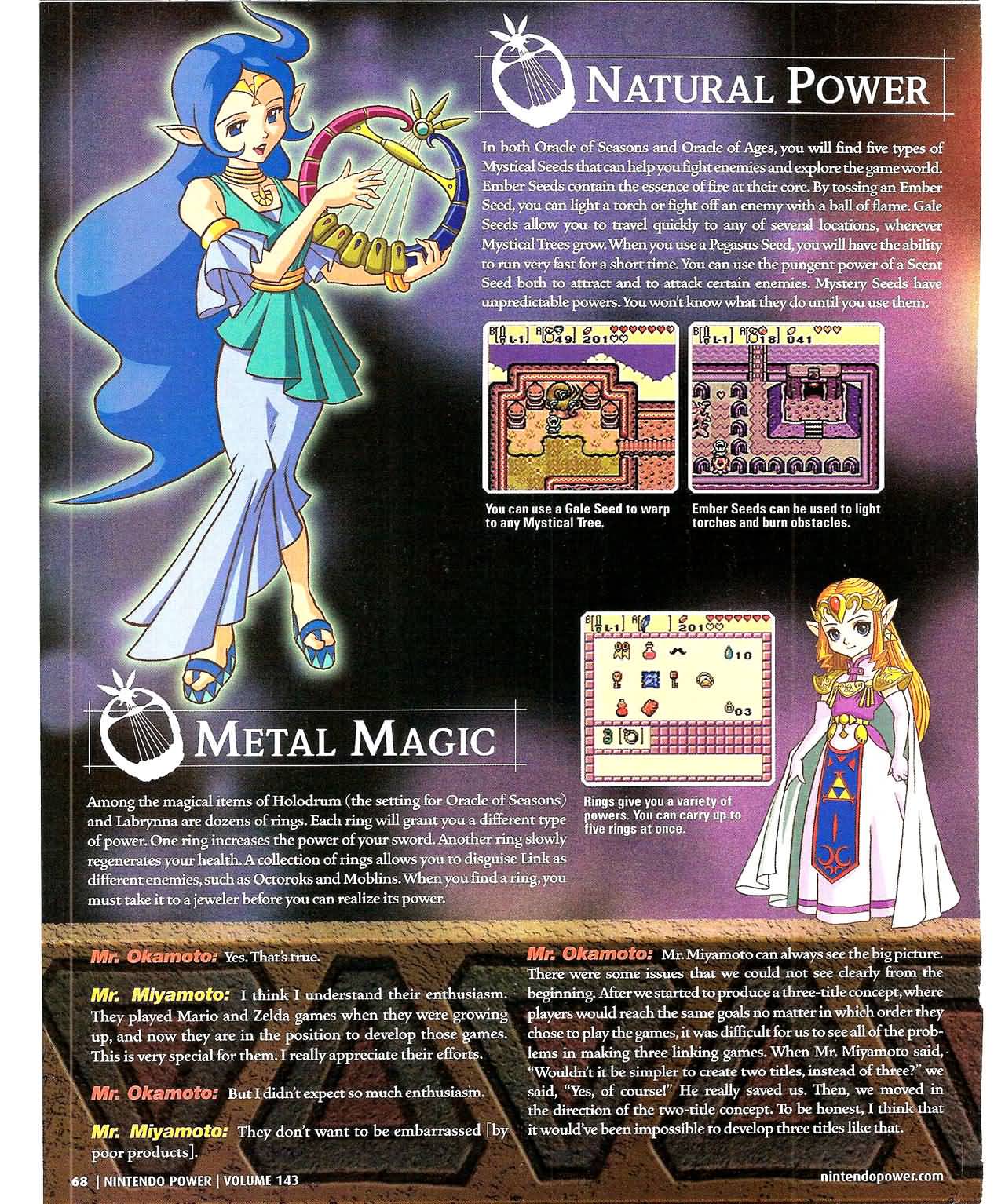

Notes: This interview originally appeared on Shigesato Itoi’s website 1101.com and a translated version of part of it was later published in Nintendo Power. Scans by Retromags.
Summary: He exercises twice a week and his wife has been telling him to walk to work. He rode a mountain bike disguised to look like junk to work today.
He trusted the team enough to leave them alone.
They wanted to release The Legend of Zelda: Oracle of Ages and The Legend of Zelda: Oracle of Seasons a long time ago, and they considered adding something extra for when they are put into a Game Boy Advance since it was coming out soon, but that would have taken more time. It will come out just before the Game Boy Advance since that was delayed.
The team making the Oracle games grew up playing Mario and The Legend of Zelda games, so it’s special for them to be working on the Oracle games.
Yoshiki Okamoto gave him a development schedule that was unbelievable, saying they could bang the games out. He was relieved when they didn’t end up making that game. Mr. Okamoto said he needed eight months to make three games.
It’s more fun to launch both Oracle games at the same time, and they can test them together this way.
Thumb Candy: The History of Computer Games
Publication Date: March 31, 2001
Subject(s): Joining Nintendo, Donkey Kong’s name, Mario’s design
Format: Interview (dubbed, subtitled)
People: Iain Lee, Shigeru Miyamoto
Video: https://www.youtube.com/watch?v=WFN9UBTlc_I&t=2272s
Notes: Iain Lee, the host of this documentary, wrote about his experience meeting Mr. Miyamoto in issue 82 of Retro Gamer. The footage was filmed in Nintendo’s Kyoto offices and the film crew was there for about an hour.
Summary: He joined Nintendo because he had heard they made children’s playground equipment.
He wanted to make a funny gorilla, not a scary one, which is why it’s called Donkey Kong. He had heard that “donkey” in English meant “foolish”. Everyone in the United States thought it was a weird name.
Mario wears a hat because he couldn’t make his hair move realistically, and he has a mustache because he couldn’t do the mouth the way he wanted. The overalls help you see his arms move.
[Playing Mario Bros. with Iain Lee]
He hasn’t played Mario Bros. in about 10 years. He stayed up all night practicing.
Famitsu (The Legend of Zelda: Oracle of Seasons and Ages, untranslated from Japanese)
Publication Date: April, 2001
Subject(s): The Legend of Zelda: Oracle of Seasons and Ages
Format: Transcribed interview
People: Unknown Famitsu interviewer, Yoshiki Okamoto, Shigeru Miyamoto
Scans:
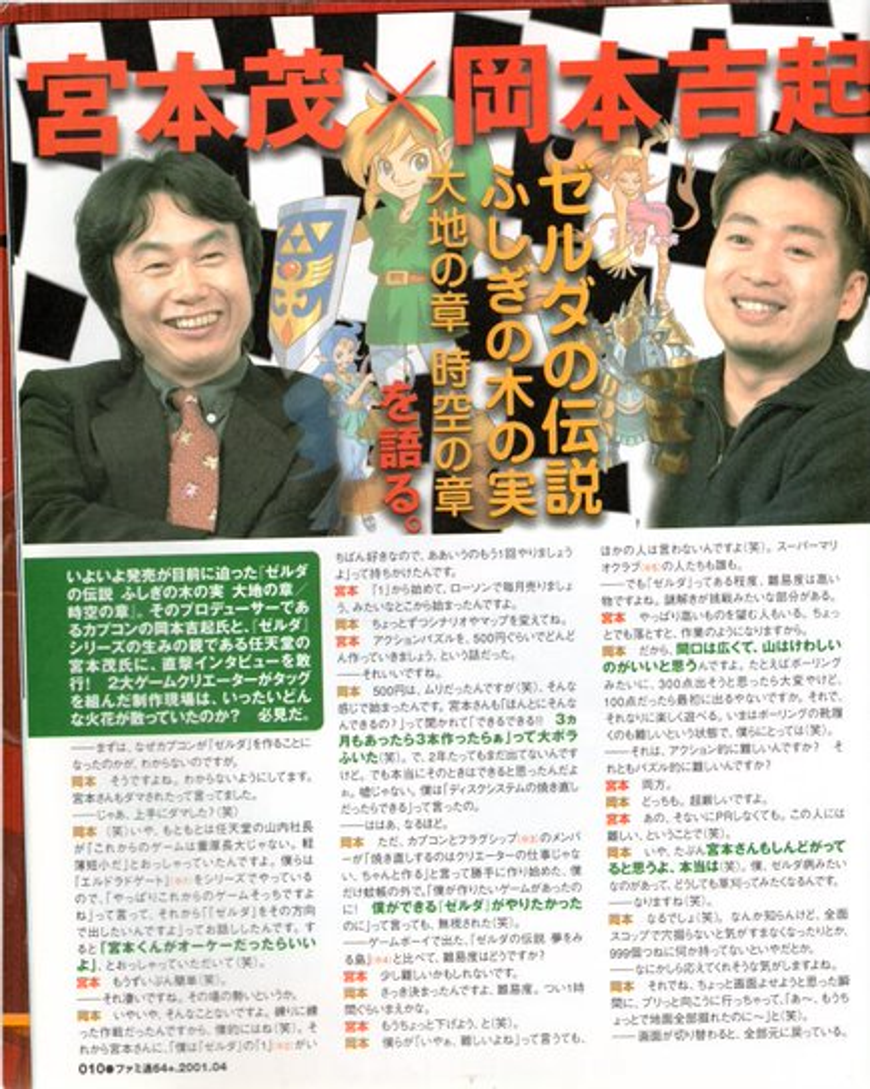


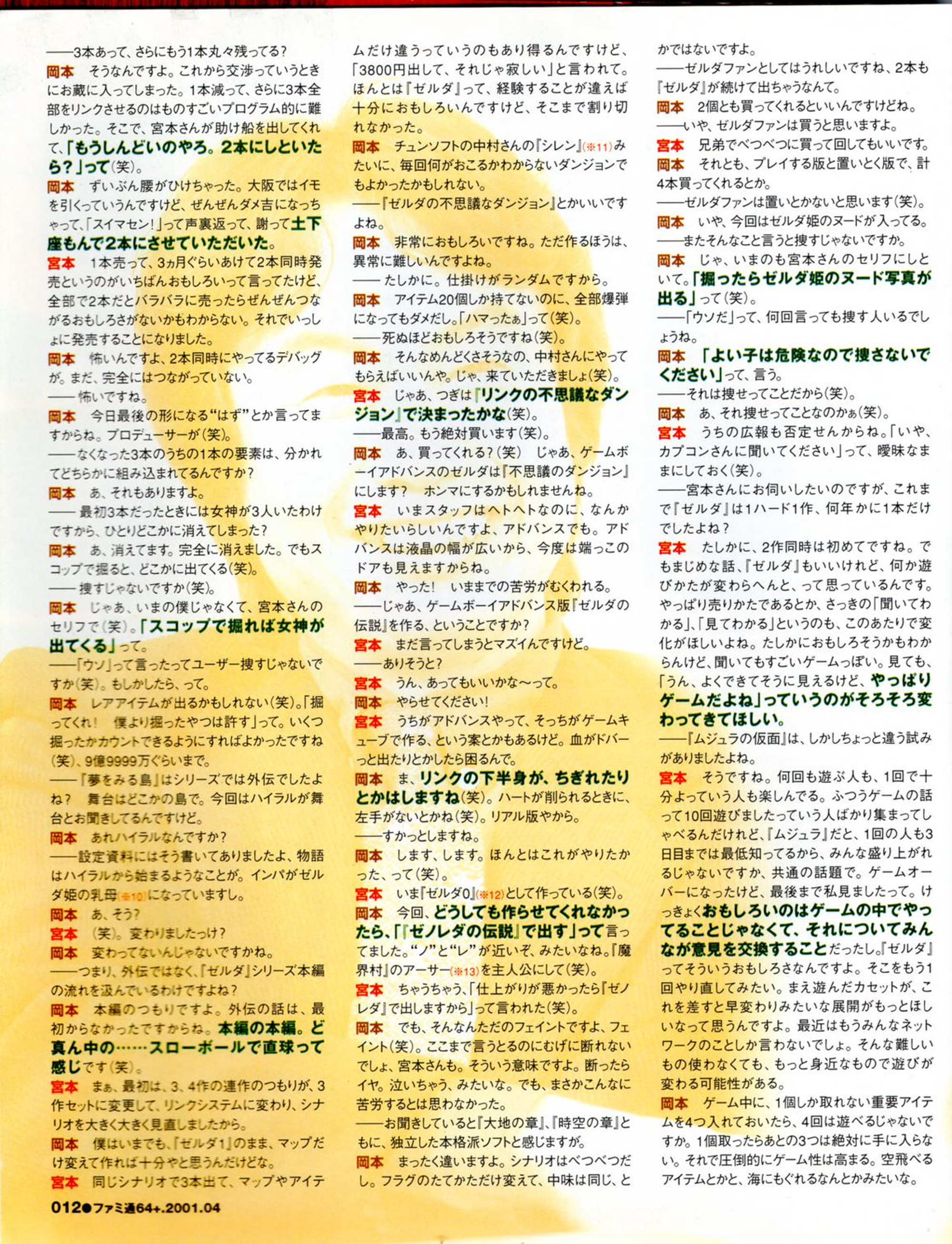
Notes: I believe Instrutilus is being given credit for the scans here.
Nintendo Dream (untranslated from Japanese)
Publication Date: May, 2001
Subject(s): GameCube, Game Boy Advance
Format: Essay, transcribed interview
People: Shigeru Miyamoto
Japanese Archive Link: https://archive.org/details/64-dream-february-2000-02-600dpi-ozidual/64Dream%202000%2002%20%28J%20OCR%29/mode/1up
Scan:
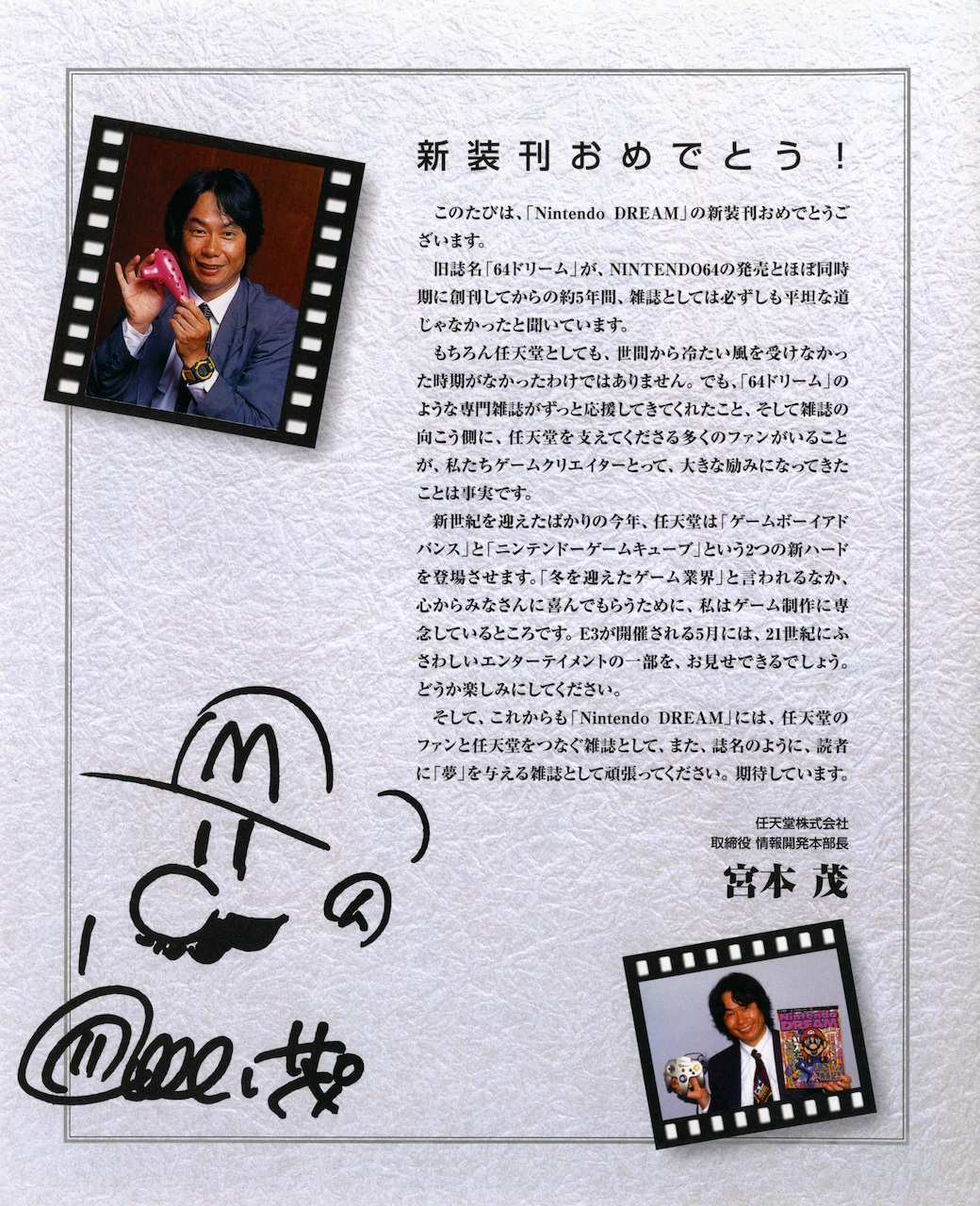
Notes: Scan by ozidual.
Nintendo of America: E3 2001
Publication Date: May 17-19, 2001
Subject(s): Nintendo GameCube (14:52), Super Smash Bros. Melee (16:01), Luigi’s Mansion (20:08), Pikmin (43:19)
Format: Presentation/demonstration (spoken English, live translator)
People: Peter Main, Colin Reed, Bill Trinen (translator), Shigeru Miyamoto
Video:
Notes: Uploaded by YouTube user CruznMJD Productions.
Summary: He says he would like to introduce everyone to their new baby, the GameCube. Like all babies it’s small and can make a lot of noise. There was a lot of discussion about which character should appear on the GameCube at launch.
[Super Smash Bros. Melee trailer plays]
Tomorrow you will be able to play Super Smash Bros. Melee on the show floor.
[Luigi’s Mansion trailer plays]
Luigi won a mansion in a contest, but it was haunted. A suspicious doctor tells him he needs to get rid of the ghosts to save Mario.
The WaveBird is a wireless controller, you can use it 30 feet away. The angle of the grip on the GameCube’s control stick may feel tight, but it ensures you have a natural angle of interaction. You will never press the wrong button. The C buttons from the N64 have been integrated into a control stick. The L and R buttons click when you press them in all the way. The controller may seem complicated, but it will seem simple when you get your hands on it. Rumble is built in.
GameCube discs can hold 1.5 gigabytes.
[He starts playing Luigi’s Mansion]
It’s dark, so Luigi uses a flashlight. You use the light to startle ghosts, then suck them up. You can spray water with the L button, a little bit or a lot. You can use the Game Boy Advance as a controller for the GameCube.
They have been challenging themselves to come up with something unique.
[Pikmin trailer plays]
Colin Reed was the main programmer, and he’s here today. He is going to use the WaveBird to play. The theme is based off of a group of ants. The main character crashed on this planet and needs the Pikmin’s help. The Pikmin work in groups, like ants. You can store Pikmin in their nest. The three colors represent different natures, the leaf bud and flower forms have different characteristics. When you get home and look in your back yard you may find Pikmin there.
Core Magazine: Shigeru Miyamoto: One on One, GameSpot: Miyamoto discusses GameCube development
Publication Date: May 17-19, 2001 (assumed)
Subject(s): Influences, inspiration, GameCube, Luigi’s Mansion, Pikmin, names of Nintendo characters
Format: Q & A
People: N’gai Croal, Members of the press and E3 attendees, Shigeru Miyamoto
Link: https://www.gamespot.com/articles/miyamoto-discusses-gamecube-development/1100-2764656/
Archive Links: https://web.archive.org/web/20010712224944/http://www.coremagazine.com/news/4261.php3
Notes: Despite the Core Magazine title, this was a group Q & A session, not a one on one interview. The GameSpot article has the wrong date, but I’m pretty sure it’s covering the same event.
Summary: He was influenced by art school and Space Invaders to get into game design. When making a new game he draws on his industrial design background and tries to make something never seen before.
Working on larger projects means being a producer overseeing people. This can make it difficult to make changes, which is mainly why he avoids cinema features.
Moving from the Nintendo 64 to the GameCube was not as hard as going from the Super Nintendo to the N64. His input on the GameCube consisted of pointing out the limitations of the N64. Developing for the GameCube is so easy that there will be more titles, he is working on 30 of them. To make the next big leap developers need maximize research.
Luigi’s Mansion and Pikmin came from trying to make games without jumping, wanting to make a Luigi game, and doing a game about gardening.
The name “Zelda” came from wanting an eternal female name, and a friend suggested Zelda because of F. Scott Fitzgerald’s wife. “Kong” has an ape connotation and “Donkey” is associated with stupid. Mario was a carpenter in Donkey Kong and a plumber in Super Mario Bros.
When he said that Mario needed to grow up he meant that his design would be updated for the GameCube. Mario’s design was too focused on children, but Mario is for everyone.
Extended Play
Publication Date: May, 2001 (assumed)
Subject(s): GameCube
Format: Interview (dubbed)
People: Unnamed Extended Play interviewer, Adam Sessler, Shigeru Miyamoto
Video:
Notes: There is little information about episodes of Extended Play from this era, but this covers E3 2001 so it likely aired soon after. Uploaded by YouTube user Craig Spurlock.
Summary: The GameCube is the best in terms of balance and power. If they only focused on graphics and sound it would spoil the joy. They’re working hard on unique games.
IGN: Shigeru Miyamoto Roundtable: Part I, N64 Magazine: Shigsy Speaks
Publication Date: IGN: June 11, 2001, N64 Magazine: August, 2001
Subject(s): Starting at Nintendo, Metroid Prime
Format: Q & A
People: Unnamed members of the press and E3 attendees, Shigeru Miyamoto
Link: https://www.ign.com/articles/2001/06/11/shigeru-miyamoto-roundtable-part-i
Archive Link: https://web.archive.org/web/20230126174927/https://www.ign.com/articles/2001/06/11/shigeru-miyamoto-roundtable-part-i
Scans:


Notes: This seems to be the same E3 2001 roundtable event as Core Magazine’s Shigeru Miyamoto: One on One, but with more answers. I will only be summarizing what wasn’t mentioned there. I also came across this N64 Magazine version later, and I am including the whole thing in this entry even though this is part one of two of the IGN article. Scans by Out of Print Archive.
Summary: When he joined Nintendo he worked on designing the housings for arcade machines.
His parents were strict teachers but his mother supported him going to art school. They were disappointed that kids lost studying time playing his games.
He uses a lot of memo cards, posting them on the wall. He creates visually and then consults with other designers. Doodling helps him focus his ideas.
It’s hard to pick a favorite game of his, but Donkey Kong was impactful and set his path.
The team working on Metroid is the best team for the job. In discussions it came up that first-person might be the best way to go, but that’s not final. Lately there has been a focus on creating a game that matches the market. They try to avoid situations where a team isn’t given the right game.
The criticism from Japan is a lot worse than the U.S.
He doesn’t spend his free time playing games. He likes to play guitar, build things, and work in his garden.
IGN: Shigeru Miyamoto Roundtable: Part II
Publication Date: June 12, 2001
Subject(s): Online multiplayer, Pikmin, designing hardware, emulators, influences
Format: Q & A
People: Unnamed members of the press and E3 attendees, Shigeru Miyamoto
Link: https://www.ign.com/articles/2001/06/12/shigeru-miyamoto-roundtable-part-ii
Archive Link: https://web.archive.org/web/20230126181416/https://www.ign.com/articles/2001/06/12/shigeru-miyamoto-roundtable-part-ii
Notes: This is part two of two.
Summary: He has tried to push multiplayer forward. They are looking at massive multiplayer experiences. The environment is different in different countries, with phone charges and internet service providers. Interacting with others is more fun than interacting with a computer.
Artificial intelligence will never be able to replace people. Computers don’t have likes and dislikes.
Game developers don’t have time to come up with new ideas. He wishes they had more freedom to get new ideas out there.
When he said Mario needs to grow up he meant his design needs to change. Mario should appeal to all ages.
The idea of Pikmin is based on a group of ants. They took pictures around his neighborhood for the backgrounds. The Pikmin can build bridges, tear down walls, and build fortresses. They have different abilities if you pluck them as a leaf, bud, or flower. He wants people to go for a walk and look for Pikmin.
He needs to know the capabilities of the hardware he uses, what causes it to slow down. He tells the hardware designers where the limitations lie and how they can be fixed. They’ve been planning for the Game Boy to link with a console since the Nintendo 64.
Nintendo has been working on emulators. There is a Nintendo Entertainment System emulator in Animal Crossing, you can go into your house in the game and play Nintendo Entertainment System games. It’s an issue that they can’t guarantee how a third party game will work on an emulator, that’s why Animal Crossing only includes first party games.
There weren’t any other serious game designers when he started, so he doesn’t really have any influences. The word play of Japanese comics and cartoons influenced him. He has a lot of great directors working under him.
The Electric Playground: E3 2001 Spectacular! Electric Playground S6:E13
Publication Date: June 13, 2001
Subject(s): Pikmin
Format: Interview (dubbed)
People: Tommy Tallarico, unnamed translator, Shigeru Miyamoto
Video:
Summary: He has been gardening recently, and has noticed many creatures and plants. This led him to come up with Pikmin, which are half animal and half plant.
Los Angeles Times: The King of Donkey Kong
Publication Date: July 12, 2001
Subject(s): Technology
Format: Transcribed interview
People: David Colker, Bill Trinen (translator), Shigeru Miyamoto
Link: https://www.latimes.com/archives/la-xpm-2001-jul-12-tt-21192-story.html
Archive Link: https://web.archive.org/web/20230218002225/https://www.latimes.com/archives/la-xpm-2001-jul-12-tt-21192-story.html
Notes: This article is oddly formatted, with descriptions of his various devices appearing all over.
Summary: They used Macintosh and Windows computers at work until a few years ago when they stopped using Macintoshes. He has a Compaq Presario and Sony Vaio. They use a program called Inspiration a lot.
He has a Sharp personal digital assistant for memos and addresses. He keeps his schedule on Now Up-to-Date.
He looks at the prices of PC cards, NASA’s home page, and pages about places he wants to visit. He looks at satellite images, trying to find Nintendo of America’s headquarters in Seattle.
He doesn’t have a cell phone, they take your freedom. He also doesn’t have a GPS.
He has a Sega Dreamcast at home.
He has a 16 year old boy and 14 year old girl. They like playing The Legend of Zelda.
IGN: Miyamoto Controller Demo
Publication Date: July 19, 2001
Subject(s): GameCube’s controller
Format: Demonstration
People: Unnamed members of the press, Shigeru Miyamoto
Link: https://www.ign.com/articles/2001/07/19/miyamoto-controller-demo
Archive Link: https://web.archive.org/web/20201112041959/https://www.ign.com/articles/2001/07/19/miyamoto-controller-demo
Notes: Mr. Miyamoto references “the show floor” so this was likely during E3. There was a video of this demonstration, but it has been lost.
Summary: The GameCube’s control stick is on the left. The angle may seem tight at first.
The A button is big and in the center. Most ideal games will just use the control stick and A button, but for those that need more the B, X, and Y buttons are around it. You’ll never press a wrong button.
The C buttons from the N64 have been turned into a control stick. These are mainly used for camera control. It’s harder to use A, B, X, and Y while using the C stick so you’ll use L, R, and Z more often. You can press L and R all the way down.
There is also a plus control pad and the start button. It will seem simple when you get your hands on it. There is a rumble feature built in.
Edge: Inside..Nintendo Co Ltd
Publication Date: August, 2001
Subject(s): E3 2001, Nintendo employees, modesty, budgets, third party developers, being recognized, punctuality, swimming, being recognized, technology
Format: Transcribed interview
People: Unnamed Edge interviewer, Hiroki Izumi, Satoru Iwata, Shigeru Miyamoto
Scans:


Notes: This interview took place shortly after E3 2001, at Nintendo’s Kyoto offices. Scans by mattandi.
Summary: They were worried they weren’t doing enough for E3 and that the visitors wouldn’t appreciate it, but then they received a lot of applause. Sometimes they think they need to turn everything on its head every few years. They hope every game surprises people.
It’s important that Nintendo has capable and creative people. If they know their capacity and ability early on they can plan.
Nintendo is a modest company, they don’t like showing off, but they are also willing to spend a lot of money on state of the art equipment. People in the video game industry are worried about costs because they don’t know what they’ll get if they spend a certain amount of money. They don’t worry about that at Nintendo. They don’t tell developers they have a certain budget, or that they should make a game that is like another successful game.
Nintendo let third parties make Famicom and Nintendo Entertainment System sports games. That was something they couldn’t do themselves. Now, there are genres no one else but Nintendo can make. Third parties are going to make games in many genres for the GameCube. Hiroshi Yamauchi hates when Nintendo is called a toy for elementary school children. They’ve never made a Mario game for children, they always want to widen their audience.
It’s embarrassing when he’s recognized at Akihabara arcades and game stores.
He can’t be punctual, he doesn’t like to work within exact constraints. He wanted to quit after three months at Nintendo because he hated coming in at the same time every day. It felt like it would be better to die.
Sometimes he gets to work at 8:45 AM, but usually it’s more like 10:00 AM or 11:00 AM. Then he works until 11:00 PM or midnight. He used to play pachinko to clear his head, but now he swims. Even if he has a meeting with Nintendo’s president he’ll say he has to go swim. After work he plays games with children or plays guitar. He almost never finishes a song, which his family hates.
While he was working on The Legend of Zelda: Ocarina of Time he was invited to do a lecture at his alma mater. He went to a convenience store and the person working there asked what he was doing there since he was supposed to be working on Ocarina of Time. He invited the employee to the lecture.
Game developers continue to be honest and try to make the best game possible, but players are taking that for granted. This is something he tries to tell young developers.
They are becoming slaves to state of the art technology. Developers feel like they have to use everything, and they don’t improve gameplay. People think games with good graphics and sound are good games.
They decide what third party developers can make games in Nintendo’s franchises on a case-by-case basis. They have a limited number of employees, and they want to work on something new. Players want to play sequels to their favorite games.
IGN: Spaceworld 2001: Miyamoto Talks on Mario Sunshine, Marionette, 100 Marios,
Nintendo World Report: The FULL Miyamoto Roundtable transcript
Publication Date: August 22, 2001
Subject(s): The Legend of Zelda: The Wind Waker, Kirby Tilt ‘n’ Tumble 2, online gaming, Luigi’s Mansion, Marionette, Game Boy Advance’s screen
Format: Q & A
People: Billy Berghammer, Justin Keeling, Adam Krause, unnamed members of the press, Shigeru Miyamoto
https://www.nintendoworldreport.com/news/6503/the-full-miyamoto-roundtable-transcript
Notes: This was the last Space World, which took place August 24-26. This roundtable Q & A took place before it officially opened.
Summary: He’s not ready to talk about The Legend of Zelda: The Wind Waker, he wants to focus on games coming out soon. He’s been working on The Legend of Zelda: Oracle of Seasons and Oracle of Ages and it made him wonder what Link’s ideal age is. He wants to pursue a more grown-up The Legend of Zelda game.
When an arcade game gets rave reviews there will be several games that copy it. Only the enthusiasts can tell the difference between them. He hates how the most sought after people are the ones with better technology and skills, not the ones with new ideas. That’s why he told his staff they should have more freedom. People were looking forward to the more realistic looking Link from an earlier demo. Since he doesn’t want to hurt those people’s feelings he is focused on making The Wind Waker as unique as possible.
The Kirby Tilt ‘n’ Tumble 2 demo was GameCube game with a Game Boy Advance cartridge used just for the tilt sensor. It should also include a communication feature so you can play it on the Game Boy Advance. When they sell the cartridge with the tilt function third parties will be able to use it.
Nintendo is skeptical of the business part of online games. He can’t say he isn’t interested in online games. People saying “online online online” can’t think of any other way to make games. They are preparing to expand into online gaming. Online games are a type of communication game, and Animal Crossing is a communication game.
They were going to show Metroid Prime at Space World, but he wasn’t satisfied with the controls and sound. They plan to release it within a year. They give suggestions to Retro studios, have conferences, and sometimes face to face meetings.
Ideally people will buy a GameCube game and the Game Boy Advance game it can connect to.
He doesn’t want to talk too much about or show too much from Super Mario Sunshine. Given the name they have to sell it during the summer. Mario has a mysterious gadget on his back. Yoshiaki Koizumi is deeply involved with it.
Luigi’s Mansion is more complex than the ideal of the A button and the analog stick. If they had released Super Mario Sunshine first people wouldn’t be having trouble with the controls.
They are doing a lot of experiments. Some of Super Mario 128’s technology has gone into Pikmin. Maybe they will show more of Super Mario 128 later.
Marionette is still being worked on. It’s not a Mario game, it’s about controlling a marionette. It will be simple and complicated.
It’s technologically possible to have Mario and Luigi together, they are always talking about it.
In the future there may be changes to the GameCube controller, making buttons larger or smaller.
He was a bit disappointed that Super Mario Sunshine was not a launch title, he was busy with Pikmin and some people really wanted to release Luigi’s Mansion.
The Game Boy Advance’s screen is due to a balance between price and gameplay. They are encouraging developers to use brighter images. It would more expensive if there was a backlight.
Super Mario Sunshine Space World 2001 Reveal
Publication Date: August 23, 2001
Subject(s): Super Mario Sunshine
Format: Presentation (live translator)
People: Yasuhiro Minagawa (translator), Shigeru Miyamoto
Video:
Notes: The title and description of this video make it sound like it is from Nintendo World Report but I could not find this video on their YouTube channel. Uploaded by YouTube user Archive64.
Summary: He has the promo and will show us.
SPOnG: Nintendo Elvis Talks of GameCube Controller and Possibly a Mario and Luigi Team Up
Publication Date: August 30, 2001
Subject(s): GameCube controller, Mario and Luigi co-op
Format: Transcribed interview
People: Nintendo Elvis(?), Shigeru Miyamoto
Notes: The circumstances of this interview are unclear, other than taking place at Space World.
Summary: They fine tuned the GameCube controller. The size and placement of the buttons have changed the most. They nearly perfected the design. They may not need a D-pad in the future.
They’ve talked about a game where Mario and Luigi can play cooperatively. Mario appears near the end of Luigi’s Mansion.
Nintendo Online Magazine (Reported on by DidYouKnowGaming, partially untranslated from Japanese)
Publication Date: September, 2001
Subject(s): GameCube, Pikmin
Format: Transcribed interview
People: Reported on by DidYouKnowGaming, Unknown Nintendo Online Magazine interviewer, Shigeru Miyamoto
Video: https://www.youtube.com/watch?v=z5aI0uja4Yo&t=853s
Japanese Archive Links: https://web.archive.org/web/20221026124236/https://www.nintendo.co.jp/nom/0109/mi_inter/index.html
https://web.archive.org/web/20221026133248/https://www.nintendo.co.jp/nom/0109/mi_inter/page02.html
https://web.archive.org/web/20221026133249/https://www.nintendo.co.jp/nom/0109/mi_inter/page03.html
https://web.archive.org/web/20221026133247/https://www.nintendo.co.jp/nom/0109/mi_inter/page04.html
Translator: Jacob Newcomb for DidYouKnowGaming
Notes: Nintendo Online Magazine was a section of the official Japanese Nintendo website. DidYouKnowGaming translated this interview and the linked video discusses some of it.
Summary: Pikmin are born and die, it’s a deep game.
Unknown Post-Space World presentation Q & A (untranslated from Japanese)
Publication Date: September 15th, 2001 or later (filmed August 23, 2001)
Subject(s): GameCube
Format: Interview
People: Unknown members of the press, Shigeru Miyamoto
Video: https://www.youtube.com/watch?v=5OnKgflNhdw
Notes: This seems to be some kind of news report about the GameCube. It describes the system as having been released on September 14th, so this was published some time after that. It shows footage of the August 23 GameCube reveal at Space World and then a Q & A session described as taking place afterwards. There were quite a few Q & As at E3 and Space World this year, many covering similar ground, but as far as I can tell this is the only documentation of this particular one.
Please do not click the link in the video description, it will try to get you to download a file. Uploaded by YouTube user 気ままにゲームライフ.
Famitsu (Pikmin)
Publication Date: October 27, 2001
Subject(s): Pikmin, how people play games
Format: Transcribed interview
People: Unknown Famitsu interviewer, Shigeru Miyamoto
Link: https://www.zeldadungeon.net/wiki/Interview:Famitsu_October_27th_2001
Archive Link: https://web.archive.org/web/20140821073439/http://www.zeldadungeon.net/wiki/Interview:Famitsu_October_27th_2001
Summary: People say that games are getting worse when they see sales numbers go down. But people don’t buy games because there aren’t games they want to play.
People use to try to beat a stage every day, but get tired eventually. An example of a game that is fun and doesn’t make you tired is Animal Crossing. It might not be for goal-oriented players, but it is for people who aren’t looking for a challenging game.
A Pikmin day lasts 15 minutes, but you can waste it, so it’s a casual game. Ideally people who don’t play video games will hear about it and try it out.
It’s more important to kids to that they play together, it doesn’t matter what it is. The important thing isn’t how good a game is. There’s a danger in targeting a core group for years.
Pikmin has less action than Mario, but more than Animal Crossing. He wanted to make an action game where you aren’t directly involved. He was half producer and half director of Pikmin, just like with The Legend of Zelda: Ocarina of Time.
Mainichi Shimbun (reported on by NintendoWorldReport)
Publication Date: Reported on November 20, 2001
Subject(s): GameCube sales, launch titles, online games, influential games
Format: Transcribed interview
People: Reported on by Max Lake, Unknown Mainichi Shimbun interviewer, Shigeru Miyamoto
Link: https://www.nintendoworldreport.com/news/6756/miyamoto-speaks-with-mainichi
Archive Link: https://web.archive.org/web/20230815225626/https://www.nintendoworldreport.com/news/6756/miyamoto-speaks-with-mainichi
Translator: Fennec Fox for Video Senki
Notes: This is a report about a translation that Fennec Fox did for their website of a Mainichi Shimbun interview with Shigeru Miyamoto. There is no archive of the page on Fennec Fox’s Video Senki website nor is there is an archive I can find on Mainichi Shimbun’s website. This may not be the entire interview.
Mainichi Shimbun is a Japanese newspaper.
Summary: He wanted the GameCube to sell better. Pikmin has sold enough to get another printing.
They can’t rely on the pattern of launching every system with a Super Mario or The Legend of Zelda game. They have to try new things. They have to change since the industry is slowing. They have to get more people interested in video games.
Games are a form of communication, that’s why they are selling the Mobile Adapter GB. They can’t make an online game until more homes have the Internet. An issue with online gaming is maintaining servers. Online games aren’t fun enough to sell two or three million copies.
He has a lot of secret ideas for online games. He is alarmed by companies that ran out of ideas and turned to online games. People should ask themselves if online games are the pinnacle of gaming.
Some think Nintendo will be in trouble when online games become more popular, but they have communication games.
It’s vital for players of his games to be creative and think about what they’re doing.
It’s important to try to do something that no one else can do. Game designers have to have a unique perspective, solve tough problems, and work hard every day.
Samba de Amigo left a big impression on him. Pac-Man was the first game where he saw effort in its design. When he saw it he felt like he’s found his calling in life.
Pikmin: Nintendo Gamecube, The Official Nintendo Player’s Strategy Guide
Publication Date: December 3, 2001 (approximate)
Subject(s): Pikmin
Format: Transcribed interview
People: Unnamed Nintendo Power interviewer, Masamichi Abe, Shigefumi Hino, Colin Reed, Shigeru Miyamoto
Archive Link: https://archive.org/details/PikminOfficialPlayersGuide
Scans:


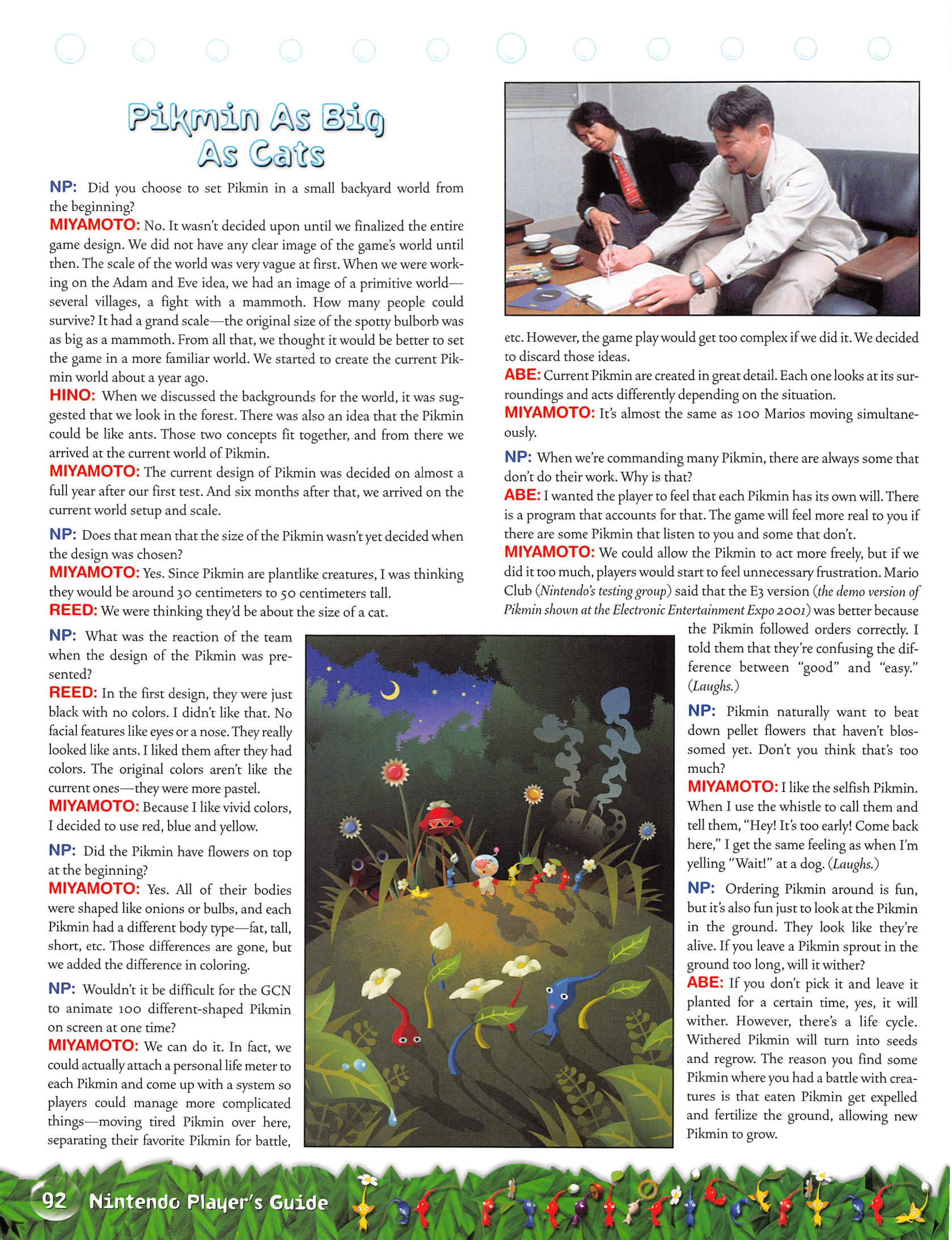
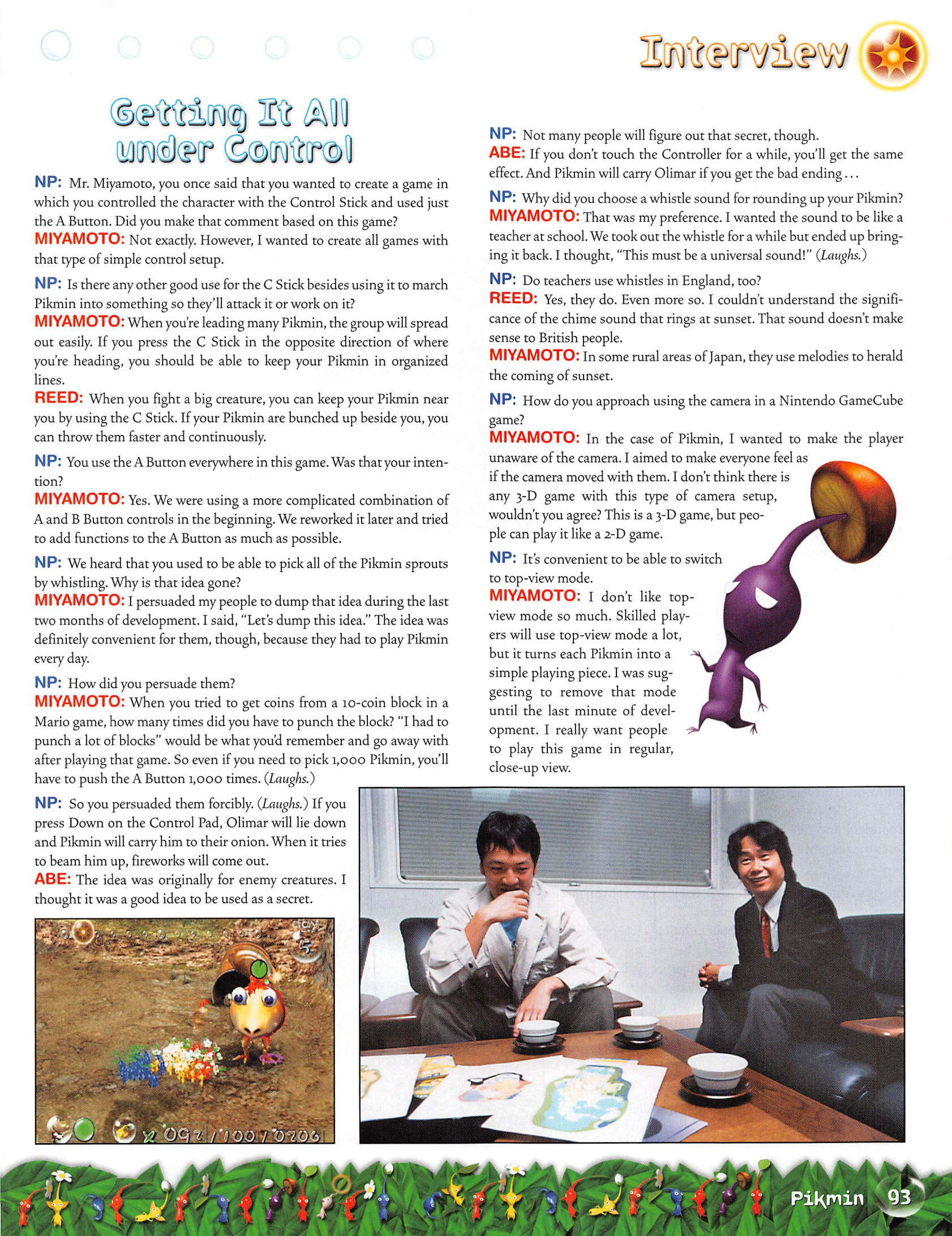
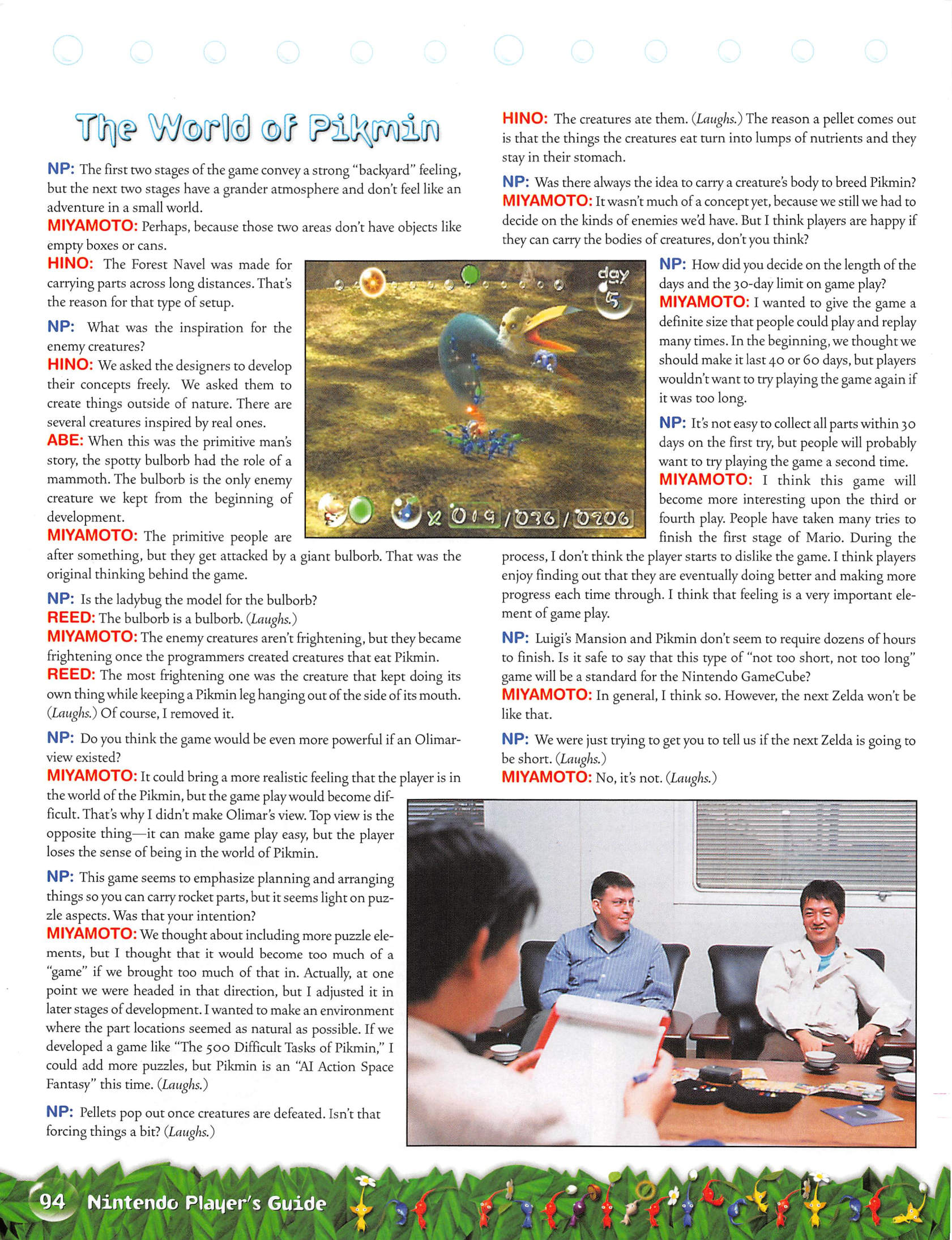

Notes: Various book selling websites give this a release date of January 1, 11 months before the game was released in North America. I don’t know the exact date this was released, but it must be close to Pikmin’s release date. This player’s guide was made by Nintendo Power. Scans by fauwf.
Summary: He was responsible for the game design of Pikmin. He combined the work of the two directors, and came up with some ideas.
His one request while they were making the GameCube was to animate objects. His people had 10 to 20 characters in mind, but he was thinking more like Super Mario 128. He still wants to make a game out of Super Mario 128, though he used some of its ideas for Pikmin.
Rather than plants early tests had characters named Adam and Eve. At first the idea was to watch their lives, you could be god and make them fight or have children. The problem was figuring out the goal of the game.
In the last half of the Nintendo 64’s life they thought about new concepts of what a game could be. The teams that worked on Yoshi’s Story and 1080° Snowboarding formed the foundation of the Pikmin team. He asked them to make a game that was nothing like Mario. He wanted to make a game for regular gamers and people who haven’t played a game before.
Even though you only control Olimar it feels like you’re moving the Pikmin.
They didn’t decide that they were small until they finished the game design. The Adam and Eve prototype was a primitive world. He originally thought of the Pikmin as 30 to 50 centimeters tall. He chose red, blue, and yellow because he likes vivid colors. They used to be shaped like bulbs and had different shapes like fat or tall.
The GameCube is powerful to show health bars for each Pikmin and for systems that separate your tired or favorite Pikmin, but they removed things like that because they were too complex.
Mario Club testers liked the E3 demo version better because the Pikmin always did what they were told. That would be easier, but not as good.
Pressing the C stick in the direction opposite of your movement will keep your Pikmin organized in lines.
Pikmin used to use the A and B buttons for different things, but they simplified it to mostly use A.
Within the last two months of development he had whistling to pick sprouts removed. You had to punch a 10 coin block in Mario 10 times.
He didn’t want the player to think of the camera. There may not be another 3D game with a camera like this. The top-view camera is good for skilled players, but turns the Pikmin into playing pieces, so he wanted to remove it. A first-person camera would be immersive but difficult to play.
They considered adding more puzzles, but it would become too much of a game if they did. He wanted the locations of the ship parts to be natural.
The game lasted 40 to 60 days originally, but if it was that long players would only want to play once. The game becomes more interesting the third or fourth time. Doing better each time is an important part of gameplay.
He came up with challenge mode when thinking of casual play. He considered a two player mode with red Pikmin versus blue Pikmin, too.
He’d like Pikmin to be as popular as Mario, he has lots of ideas he didn’t implement.
Famitsu (Yuji Naka interview)
Publication Date: December 28, 2001
Subject(s): Sega, Nintendo, competition, game development
Format: Transcribed interview
People: Unknown Famitsu interviewer, Yuji Naka, Shigeru Miyamoto
Link: https://shmuplations.com/miyamotoxnaka/
Archive Link: https://web.archive.org/web/20150717055658/http://shmuplations.com/miyamotoxnaka
Translator: shmuplations
Summary: He’s talked with Yuji Naka before, but this is their first proper face-to-face meeting.
The players decide who is leading or catching up. Sega overtook Nintendo in America.
There were a lot of games that imitated Mario, but Sonic was unique and had personality. It was made by people who understood what games are about.
Nintendo is like Namco, they both spend a lot of time doing the final tune-up. They have a saying: “it takes five years to build your brand, but only two to ruin it.”
He thinks every game company has people working late into the night. They have impossible deadlines at Nintendo. He has to reassure employees who ask if they have time to add new things. They feel like if a game feels rushed they’ll be ashamed.
Making games has become easier now. When making Super Mario 64 there was an idea in a planning document about Mario climbing a flagpole and doing a handstand at the top. That would have taken weeks to animate in 2D, but it took about four days.
In 3D you have a sense of being there. He wanted to make a 3D Zelda game to see that world.
Mr. Naka was proactive in testing the GameCube to Game Boy Advance connectivity.
A The Legend of Zelda and Mario game are being made, but he’s not directly involved. You can see what they did with The Legend of Zelda: The Wind Waker when he wasn’t around. He has some disagreements, but he likes the new direction.
Yuji Naka has a great work ethic. A high quality game sets a standard, and Mr. Naka is one of the few people who can make such a game. They can add Sonic to Super Smash Bros. anytime.
CNBC (reported on by Cloudchaser Nintendo, possibly incomplete)
Publication Date: Unknown (reported on December 31, 2001
Subject(s): GameCube to Game Boy Advance connectivity, GameCube releases, online gaming
Format: Transcribed interview
People: Reported on Stryder Kennset, unknown CNBC interviewer, Shigeru Miyamoto
Archive Link: https://web.archive.org/web/20020124041150/http://nintendo.cloudchaser.com/news/index.php?view=375
Summary: When everyone looks at the same screen during multiplayer the best player gets an advantage. GameCube to Game Boy Advance connectivity means that won’t happen, and it opens the door for new types of gameplay.
Most people who have a GameCube also have a Game Boy Advance.
Unlike the Nintendo 64, GameCube releases will not slow down over time. There should be 20-30 first and second party games by Christmas.
Online gaming isn’t profitable yet, but that doesn’t mean they’ll never make any. It won’t be a priority until it’s profitable.
2002
Unknown (Super Mario Sunshine)
Publication Date: 2002
Subject(s): Super Mario Sunshine
Format: Transcribed interview
People: Yoshiaki Koizumi, Takashi Tezuka, Shigeru Miyamoto
Link: https://shmuplations.com/mariosunshine/
Archive Link: https://web.archive.org/web/20221204024721/https://shmuplations.com/mariosunshine/
Translator: shmuplations
Notes: The shmuplations article contains two interviews, the first is covered in a Nintendo.com entry, this one covers the second.
Summary: He didn’t give any directions at the beginning. He trimmed the non-Mario stuff from the ideas Koizumi and others gave him.
The staff would tell him to write down what Mario is when they had arguments. People only understood when things are going smoothly. He has an intuitive sense of Mario-ness and Zelda-ness. In Mario you polish your action skills, in Zelda games you become more familiar with the world. You play with the environment in both. The centerpiece of Mario is action, and anyone can play them. Zelda requires exploration or else you won’t see most of the game and there isn’t as much action.
It’s fun to find your own way to shines in Super Mario Sunshine, using the different moves. The difficulty and puzzles aren’t important because it’s you can play freely. The freedom made it difficult to balance, but they tried to avoid putting up walls to restrict the player.
The gameplay is looser in 3D, you don’t die if you misjudge a pixel. Adjusting the camera is more prioritized than precision.
He’ll be happy if parents and children bond over Super Mario Sunshine.
Dengeki GC
Publication Date: January, 2002
Subject(s): GameCube sales, sequels, online games, Pikmin
Format: Transcribed interview
People: Unnamed Dengeki GC interviewer, Shigeru Miyamoto
Link: https://www.zeldadungeon.net/wiki/Interview:Dengeki_GC_January_2002
Archive Link: https://web.archive.org/web/20130426142359/http://www.zeldadungeon.net/wiki/Interview:Dengeki_GC_January_2002
Summary: The GameCube sold less than he expected. They outsold the PlayStation 2 when Pikmin released. Nintendo competes with PlayStation and Xbox in the sense that people have to choose between them, but as to the games they’re making there is no competition.
The teams working on Super Mario Sunshine and The Legend of Zelda: The Wind Waker know that they can’t do something wrong. They want to release a game a month next year. He’d like to just make new games, but people want to play things like Super Smash Bros. Sequels that only appeal to people who have played the previous game limit themselves to other’s expectations. It’s like you’ve stopped fighting.
He hopes others make use of the GameCube and Game Boy Advance connectivity. If the Nintendo e-reader takes off they’ll be able to release games on paper, ROM, and disc.
Localizing a game for every part of the world is difficult. Online game localization much harder. Making such games would be like giving up on making games for the entire world. He has no interest in making them, even if Nintendo does.
They are discussing making a Pikmin sequel in six months. He has lots of ideas he couldn’t fit into the first and it would work well as a series. He’d like to use Pikmin in other games, they are between Mario and Pokémon in scale.
Nintendo Dream (reported on by DidYouKnowGaming, partially untranslated from Japanese)
Publication Date: January, 2002
Subject(s): Pikmin
Format: Transcribed interview
People: Reported on by DidYouKnowGaming, unknown Nintendo Dream interviewer, Shigeru Miyamoto
Video: https://www.youtube.com/watch?v=z5aI0uja4Yo&t=520s
Archive Link: https://archive.org/details/nintendo-dream-2002-01-vol-064-600dpi-ozidual/Nintendo%20Dream%202002%2001%20v064%20%28J%20OCR%29/
Scans:


Translator: Jacob Newcomb for DidYouKnowGaming
Notes: The video covers a portion of the translated interview. Scanned by ozidual.
Summary: When he was a child he would put ants on a leaf boat and send them down the river, and he wanted to make a game like that.
Pikmin is a game where it’s not clear who is evil or good.
They could only manage 30 Pikmin on the N64, so they moved development to the GameCube. They had 300 for a while, but it was hard to manage.
There were originally more puzzles and each Pikmin had an individual name.
Shigeru Miyamoto and Shigesato Itoi Conversation about Pikmin (Untranslated from Japanese)
Publication Date: January 21, 2002 to June 26, 2002
Subject(s): Pikmin
Format: Transcribed interview
People: Shigesato Itoi, Shigeru Miyamoto
Japanese Links: https://www.1101.com/nintendo/pikmin/01.html
https://www.1101.com/nintendo/pikmin/02.html
https://www.1101.com/nintendo/pikmin/03.html
https://www.1101.com/nintendo/pikmin/04.html
https://www.1101.com/nintendo/pikmin/05.html
https://www.1101.com/nintendo/pikmin/06.html
https://www.1101.com/nintendo/pikmin/07.html
Japanese Archive Links: https://web.archive.org/web/20020628025045/https://www.1101.com/nintendo/pikmin/01.html
https://web.archive.org/web/20020628025242/https://www.1101.com/nintendo/pikmin/02.html
https://web.archive.org/web/20211130190145/https://www.1101.com/nintendo/pikmin/03.html
https://web.archive.org/web/20211130181736/https://www.1101.com/nintendo/pikmin/04.html
https://web.archive.org/web/20211130193402/https://www.1101.com/nintendo/pikmin/05.html
https://web.archive.org/web/20220703025429/https://www.1101.com/nintendo/pikmin/06.html
https://web.archive.org/web/20250929115252/https://www.1101.com/nintendo/pikmin/07.html
Notes: The title is a machine translation.
Computer and Video Games: London Roundtable, SPOnG: Miyamoto Reveals all in Exclusive Interview!, Shigeru Miyamoto Interview Part 2: The most complete interview anywhere on the web
Publication Date: February 1, 2002 (Computer and Video Games), February 22, 2002, February 25, 2002 (SPOnG)
Subject(s): Triforce, third parties, game length, Nintendo in Europe, Hiroshi Yamauchi’s retirement, GameCube Game Disc
Format: Q & A
People: Unnamed members of the press, Shigeru Miyamoto
Links: https://www.zeldadungeon.net/wiki/Interview:London_Roundtable_February_1st_2002
https://spong.com/article/2920/Miyamoto-Reveals-all-in-Exclusive-Interview
Archive Links: https://web.archive.org/web/20140814042847/http://www.zeldadungeon.net/wiki/Interview:London_Roundtable_February_1st_2002
Notes: The Zelda Dungeon page contains the whole article, but does not cite Computer and Video Games as the source. NintendoWorldReport‘s report on this does, but only contains an excerpt. The original interview on CVG’s website is lost. I came across the SPOnG version of the interview, which describes this as being with seven journalists, months later and added some details from it to the summary.
Summary: Triforce is an arcade board made by Nintendo, Namco, and Sega. Capcom and others will use it. It uses the CPU and graphics chip of the GameCube. Games made for Triforce will be readily available for GameCube. The name is from The Legend of Zelda and represents the three companies coming together. There will be an announcement about Triforce arcade games in March or April.
He tries not to comment on other developer’s work. Star Wars games sell very well in America and Star Wars: Rogue Squadron II: Rogue Leader is much better than previous Star Wars games. He appreciates games like Resident Evil.
Third parties sometimes make games more childish to try to sell more on Nintendo platforms. They ask them to make something suited for Nintendo and they mistakenly think this means something childish, but what they mean by that is to make something unique.
When you beat Luigi’s Mansion, that’s it. With Pikmin some people will quit after beating it, and others will play levels over and over. He hopes everyone plays Pikmin 3 times. They don’t want to increase the size of their development teams to maximize play time, they want to make unique games. Super Mario Sunshine will be like Pikmin in that it will encourage people to play it again and again.
They delayed the GameCube’s European launch to make sure they made enough. There will be 20 games and 500,000 GameCubes on day one, and in two months they want to sell 1 million GameCubes in Europe. He wants everyone, young to old, to enjoy the GameCube. The GameCube has the best performance for developers, it’s compact, and it’s the cheapest. They will start with violet and black GameCubes, then introduce orange.
They have almost decided what drastic change to make to Mario Kart for GameCube. The series is occupying a lot of his time.
Nintendo makes hardware to make software. Video games are mainstream. He was scolded by a mentor for describing himself as an artist on his businesses card.
There will be more applications that use GameCube to Game Boy Advance connectivity.
They’ve all learnt a lot from Hiroshi Yamauchi and he doesn’t know what will happen now that he’s retired. They may be more free in their development now. Please don’t print that.
Making a game playable online won’t necessarily make it more interesting. Making online games can become a trap for a game developer, you can’t go back once you make one. You have to do maintenance. Only about 20% of European homes will have broadband by 2005, they can’t afford to target that market. Not all games will be online in the future.
In Japan people think that role-playing games dominate the industry, but it’s really just Final Fantasy and Dragon Quest.
Games should be judged on how they play, not on their appearance.
They’ve talked with SquareSoft about releasing games on Nintendo systems again.
He and Mr. Iwata have been visiting Europe to talk to Europeans and their needs. They set up a localization facility.
People in the games industry have an inferiority complex. Parents are comfortable with Disney movies, but less so with Nintendo games.
Game consoles that can play DVDs will break and need repairing. Even small children can handle a GameCube. The mini discs the GameCube provide copyright protection. Some game developers feel threatened to make realistic looking games.
Power Unlimited (partially untranslated from Dutch)
Publication Date: May, 2002 (reported on February 16, 2002)
Subject(s): The Legend of Zelda: The Wind Waker, Super Mario Sunshine
Format: Transcribed interview
People: Reported on by unnamed Cloudchaser Nintendo staff and unnamed the GIA staff, Jurjen Tiersma, Shigeru Miyamoto
Link: http://archive.thegia.com/news/0202/n16d.html
Archive Links: https://web.archive.org/web/20020225094800/http://nintendo.cloudchaser.com/news/index.php?view=510
https://web.archive.org/web/20220401233247/http://archive.thegia.com/news/0202/n16d.html
Dutch Archive Link: https://web.archive.org/web/20020424003608/http://www.gamesen.nl/pages/nieuws.asp?id=5434
https://archive.org/details/pu30jaar
Scans:
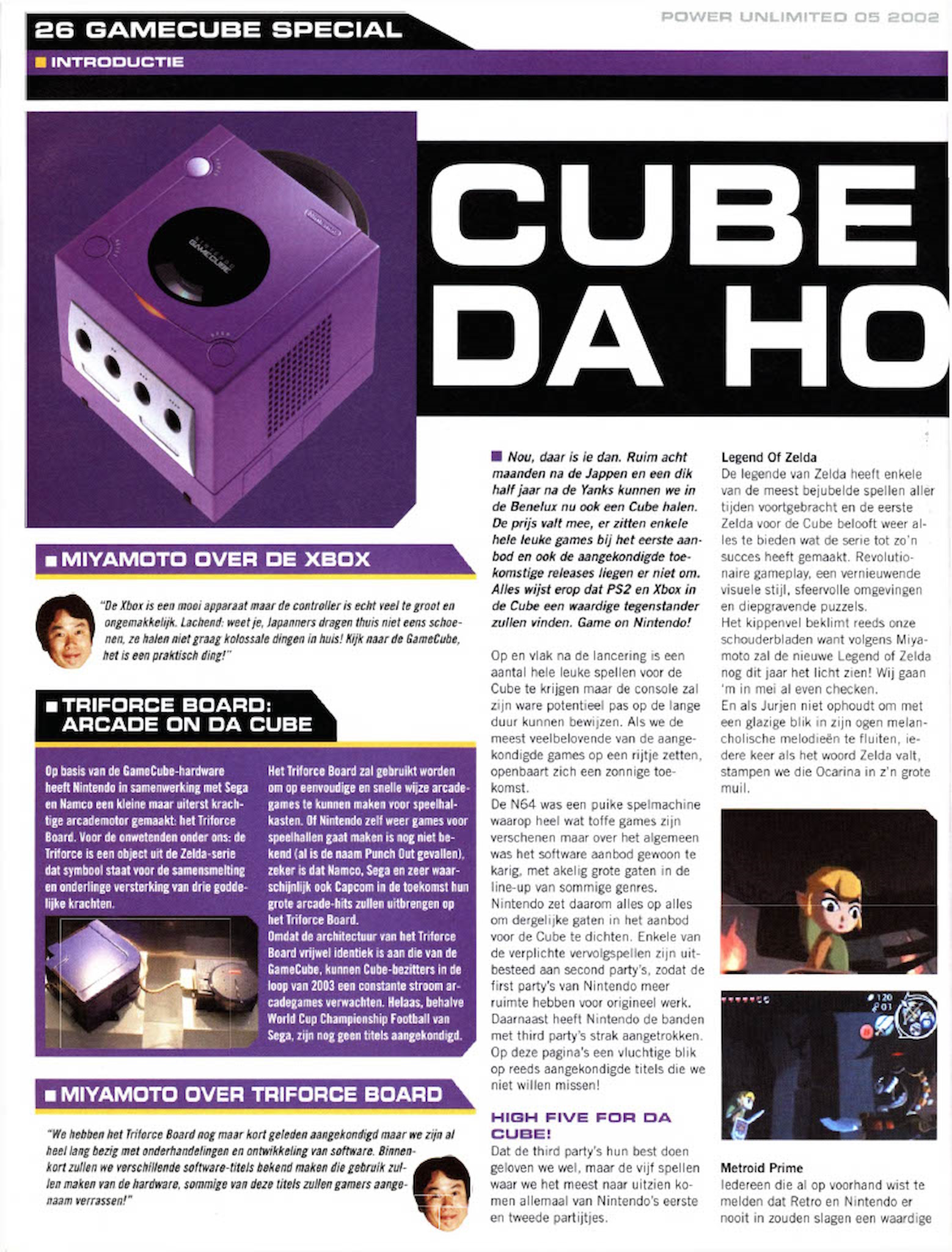
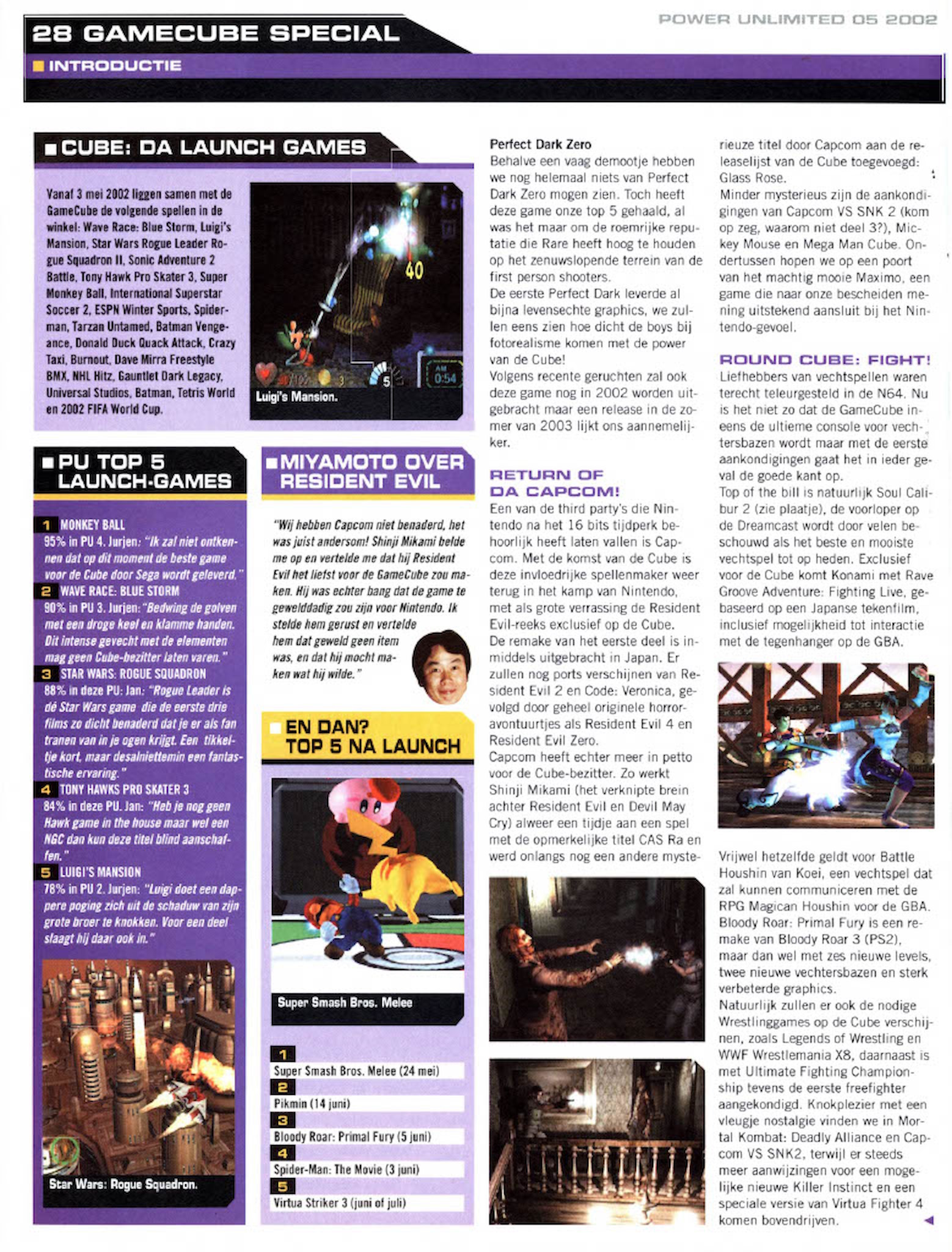
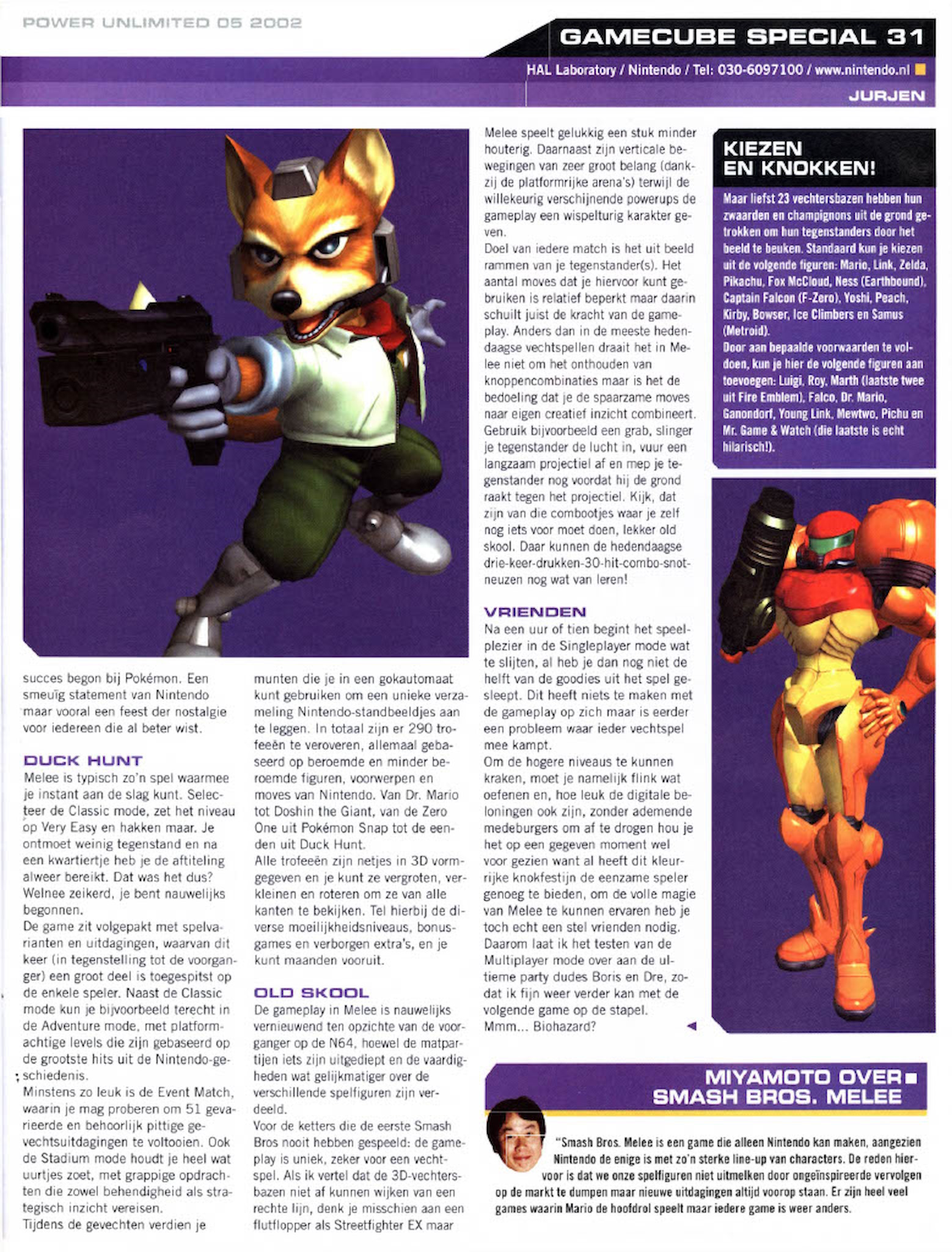
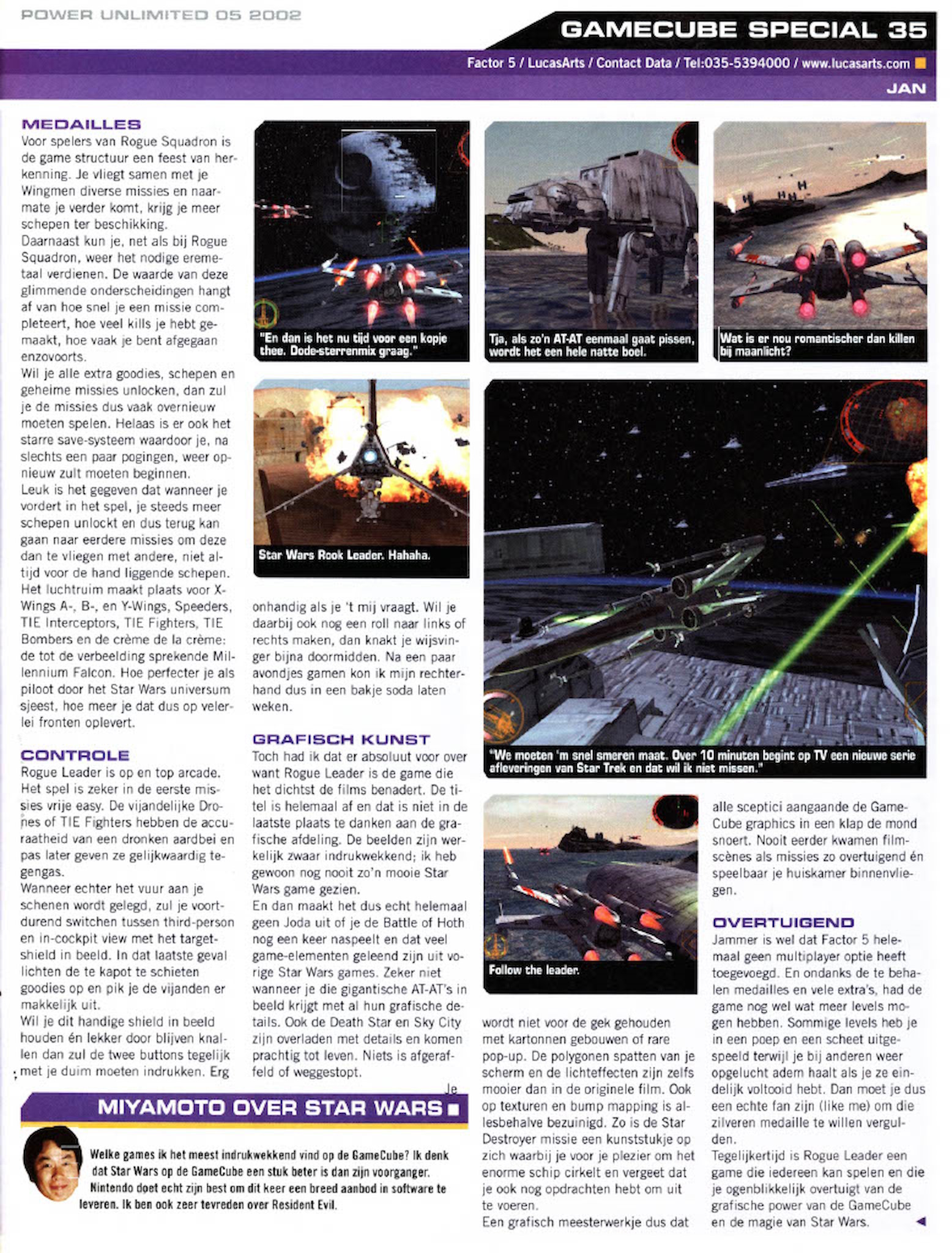
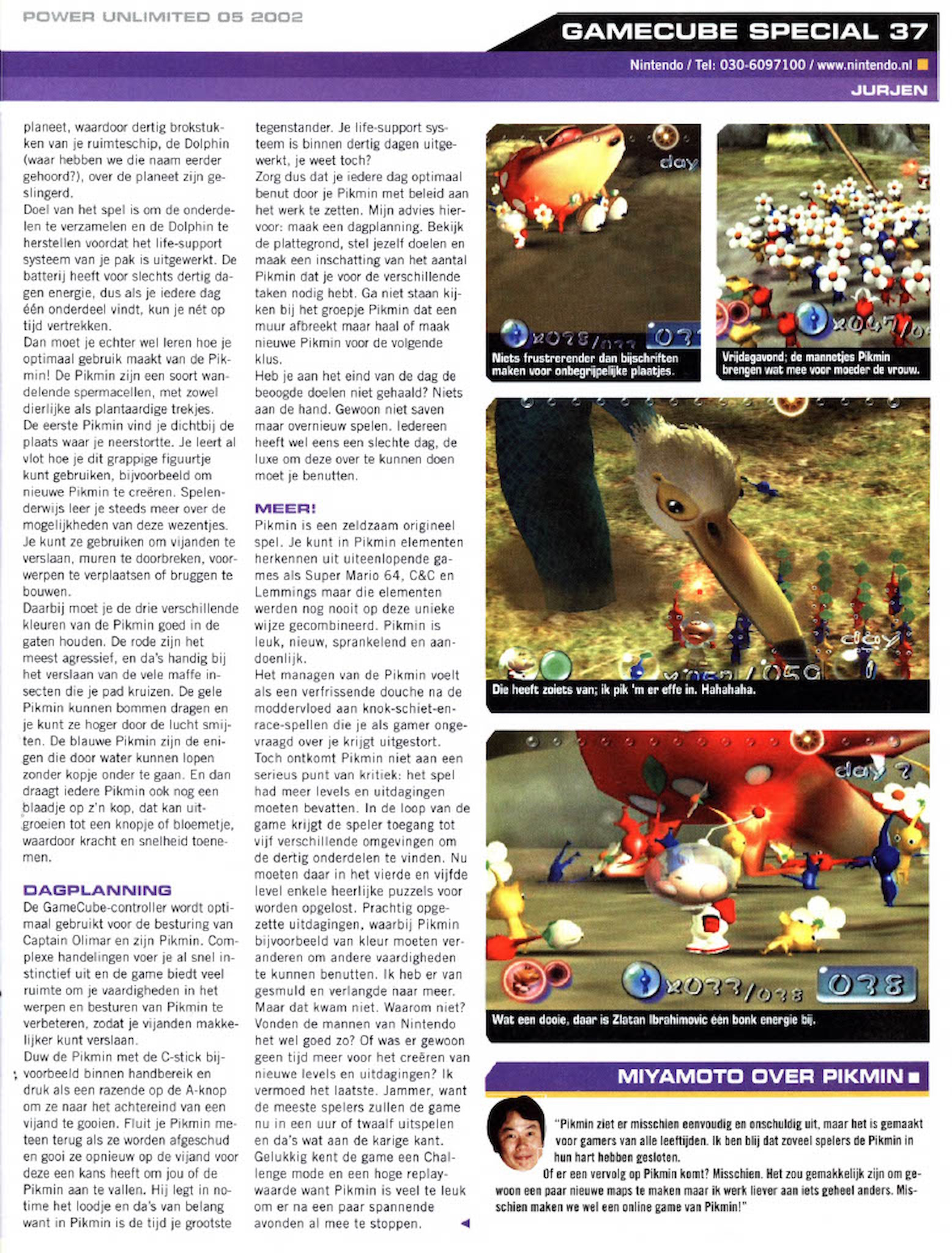
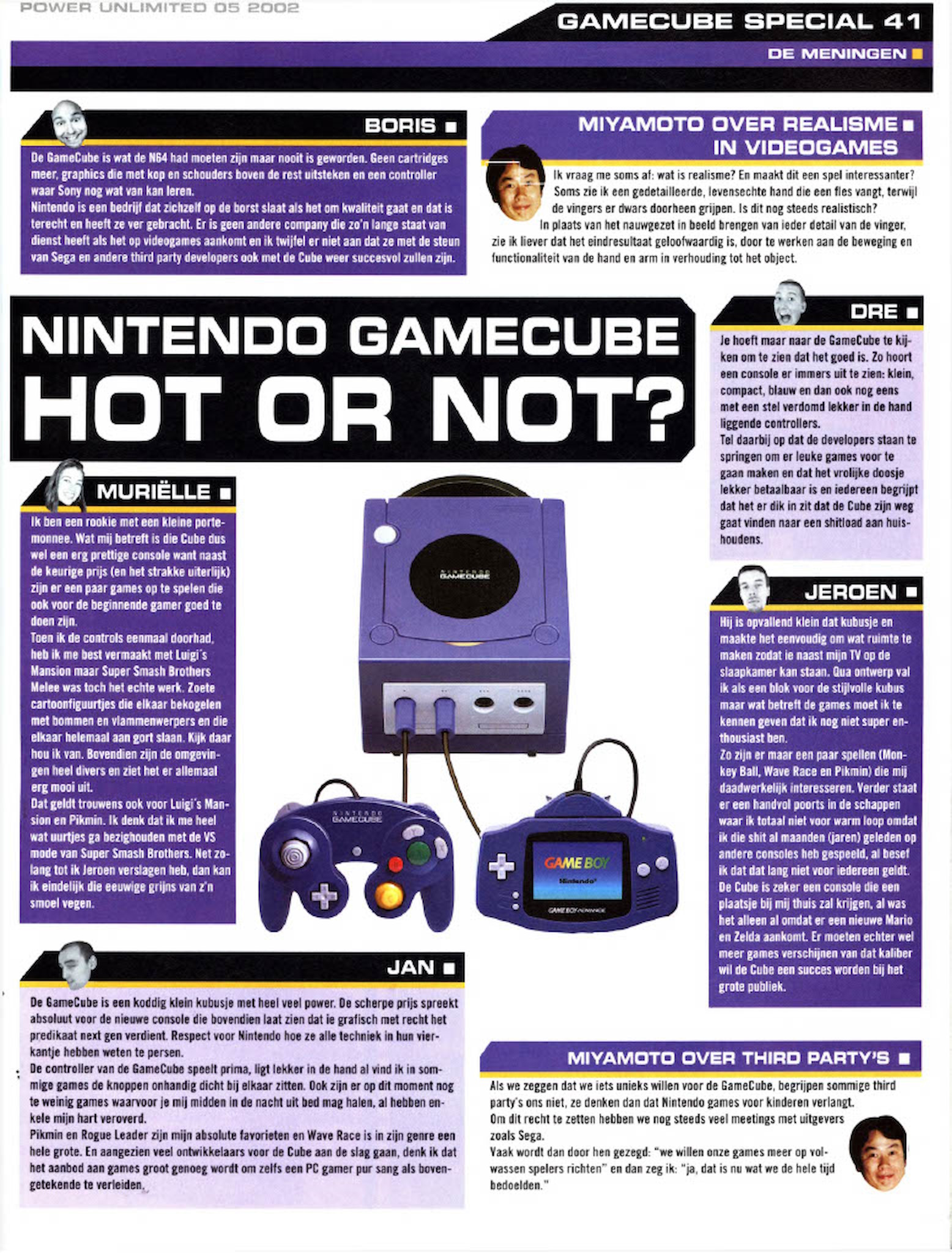
Translator: Rahul Choudhury for the GIA
Notes: These are two English reports about Jurjen Tiersma’s post on his website about the interview that he conducted for Dutch magazine Power Unlimited. The magazine itself had bits of the interview all over the magazine, next to an image of Mr. Miyamoto’s head.
Summary: The Legend of Zelda: The Wind Waker will keep its cel shading, though Link’s eyes have been adjusted. Talking about games is part of the gameplay now. People will understand it once they’ve played it at E3.
Mario’s “backpack” in Super Mario Sunshine is a water gun used to clean paint. The controls are like Super Mario 64’s. The game will release in Europe in 2002.
Videogame.it: Interview to Shigeru Miyamoto, the mother of Mario
Publication Date: February 18, 2002
Subject(s): Luigi’s Mansion, Super Mario Sunshine
Format: Transcribed interview
People: Giorgio Baratto, Shigeru Miyamoto
Notes: Despite being an Italian outlet, Videogame.it released an English version of this interview. This interview took place at Nintendo’s Italian offices.
Summary: They wanted to introduce something new with the GameCube. You can play as Luigi in Luigi’s Mansion until Super Mario Sunshine comes out.
The small size of the GameCube lets you move it room to room easily. You can move it from the living room to the bedroom, or to a friend’s. He was the first to put four buttons on the right-hand side of a controller, and now Sega, Sony, and Microsoft have done that too. With the GameCube the player immediately knows the big green one is the most important.
A console has to follow fun and simplicity to be successful. It costs a lot of money to make graphics now, for little gain. Only expert gamers and picky journalists will notice, and it won’t improve the game.
He has no problems with creativity, he has hundreds of ideas. Many developers nowadays focus on what they found fun to play growing up, which causes them to make similar games. They want to let young developers make games at Nintendo, unhindered from their memories. The hardware engineers should be the ones thinking about the hardware, not the designers.
More manufacturers is good for the consumers, because prices go down. Games will move towards simple fun. We won’t see fast changes anymore, things will change slowly.
In 2005 only 20% of European families will have broadband. The Legend of Zelda: Ocarina of Time sold 6 million copies, making such a game for the online audience would make less money. Games cost a lot of money to make now so they have to carefully consider the benefits and drawbacks.
Video games used to be made for kids, now adults play too. The GameCube is for everyone.
They used mini-DVDs for the GameCube to keep the console small, because it can find data more quickly, and to make piracy more difficult.
He doesn’t consider himself an artist, that would be insulting to real artists.
FragZone: Shigeru Miyamoto skulle kunna kallas Mr. Videogame han är mannen bakom bland annat Mario, Donkey Kong och Zelda.
Publication Date: February 19, 2002
Subject(s): GameCube launch, Super Mario Sunshine, Resident Evil 4, online play
Format: Transcribed interview
People: Unnamed FragZone interviewer, Satoru Iwata, Shigeru Miyamoto
Link: https://www.nintendoworldreport.com/news/7026/swedish-game-site-shigeru-miyamoto-interview
Swedish Archive Link: https://web.archive.org/web/20020228233711/http://console.fragzone.se/view.php?id=7138
Translator: Zenith_II
Notes: FragZone was a Swedish gaming website.
Summary: Metroid Prime was made for him, it has a bit more American action. People say Nintendo just makes Mario and Zelda games, they have to show diversity at the launch of the GameCube. Super Mario Sunshine is somewhat of a sequel to Super Mario 64 but is unique. They have more titles for older gamers than ever before. Mario is not made for kids, they make games for everyone.
Games are for fun, and violence is one way to go. They have to be careful since games are interactive. Age ratings are important.
Shinji Mikami considered GameCube the best place for Resident Evil 4 but worried it was too violent. He told Mr. Mikami that was no concern. When you make a game for several consoles it doesn’t live up to its fullest potential.
New features like online play make it harder to reach casual players. About 20% of households will have broadband by 2005. Online play should not be the only part of a game, just an ingredient. They are waiting for the right time.
He’s mainly a producer since he has to look after so many games, but sometimes he gets to be a director.
Gameplay is the most important, he puts the smallest priority on story.
They went with smaller discs to lower costs, and they load quickly.
Mario is hard working, but not smart or attractive, so there may be some similarity with him.
He drives a Nissan Serena.
Overgame.com: Miyamoto in Paris!
Publication Date: February 20, 2002
Subject(s): Realistic Zelda games, Sega, Xbox, Pikmin, his children
Format: Transcribed interview
People: Bliss, Shigeru Miyamoto
Link: https://www.nintendoworldreport.com/news/7037/miyamoto-interview-in-paris
Archive Link: https://web.archive.org/web/20140911110038/http://www.nintendoworldreport.com/news/7037/miyamoto-interview-in-paris
French Archive Link: https://web.archive.org/web/20020307041645/http://www.overgame.com/page/article.asp?artic_id=17721
Translator: Cloudchaser Nintendo
Notes: Cloudchaser was a gaming website, but I could not find this interview on their archived website. Overgame was a French outlet that had the original article.
Summary: He’s seen the Zelda petition, but making a realistic Zelda would cause issues with GameCube and Game Boy Advance connectivity. Making movement look good is more important than realism.
He drew cartoons, made puppets, and played Space Invaders as a child.
He can talk about game design with Sega’s developers, like Yuji Naka, now that they are no longer making game consoles.
He has been asked to join other companies, but he doesn’t know that he’d be able to make innovative products anywhere else but Nintendo.
The Xbox’s D-pad is large and uncomfortable.
His games are for everyone. He’s glad Pikmin has touched people’s hearts.
He’s not working on a Pikmin sequel right now. There will never be a black Pikmin.
His children do not test upcoming games. After Pikmin was announced his children realized it was named after a guitar pick. His children beat him at Super Smash Bros. Melee.
Ananova: Nintendo aiming for a million European GameCube sales in two months
Publication Date: February 22, 2002
Subject(s): GameCube’s European launch, Mario Kart: Double Dash
Format: Transcribed interview
People: Unnamed Ananova interviewer, Shigeru Miyamoto
Archive Link: https://web.archive.org/web/20020222224535/http://www.ananova.com/entertainment/story/sm_527735.html
Summary: Nintendo is delaying the GameCube launch in Europe until May so that they will have 500,000 ready. They plan to sell 1 million GameCubes in Europe within two months of launch. There will be 20 launch titles.
After some meetings they have made drastic changes to Mario Kart: Double Dash. Sonic the Hedgehog could be a driver.
IGN: Nintendo Roundtable
Publication Date: February 28, 2002
Subject(s): Animal Crossing, The Legend of Zelda: The Wind Waker, Hiroshi Yamauchi’s retirement
Format: Q & A
People: Unnamed members of the press, Bill Trinen (translator), Satoru Iwata, Shigeru Miyamoto
Link: https://www.ign.com/articles/2002/02/28/nintendo-roundtable
Archive Links: https://web.archive.org/web/20121014015153/http://www.ign.com/articles/2002/02/28/nintendo-roundtable
Notes: This seems to be the “informal breakfast meeting” covered in the second half of the March 5, 2002 Nintendo Power Magazine Interviews Shigeru Miyamoto and Satoru Iwata entry. I summarized that one first, so this entry will only cover what it didn’t have.
Summary: Animal Crossing has a lot of text, four or five times that of a role-playing game, there are over 300 characters.
Most games that remain Japan-exclusive will likely be anime tie-ins.
The Legend of Zelda: The Wind Waker will release by the end of the year. He doesn’t want to show it off without letting people play it because then the discussion becomes about the graphics.
Hiroshi Yamauchi has said he is going to retire this year, but also hasn’t shared his plans. He will not be Yamauchi’s successor.
They have no plans to make arcade games.
D.I.C.E. Summit 2002 Bruno Bonnell, Brian Farrell, Satoru Iwata, Larry Probst, Shigeru Miyamoto
Publication Date: February 28-March 1, 2002
Subject(s): Localization, Kirby’s color, PAL versions of games, names
Format: Interview (live translator)
People: Doug Lowenstein, Paul Provenzano, Bruno Bonnell, Brian Farrell, Larry Probst, Bill Trinen (translator), Satoru Iwata, Shigeru Miyamoto
Video:
Notes: Mr. Miyamoto refers to “the latest Zelda” when talking about localization. At the time this would have been The Legend of Zelda: Oracle of Seasons and Ages, but it seems a bit more likely he was talking about The Legend of Zelda: Majora’s Mask since Flagship made the Oracle games.
Summary: Nintendo has been focusing on localizing into five languages. They often use humor that is difficult to translate from Japanese, so localization is very important. Using kanji characters requires a lot more memory than European alphabets. They’ve been preparing tools early on in development to make localization easier.
With the latest Zelda game they had the translator finish the game before starting on localization so they’d better understand it. After a game has been localized in English they do other European languages. There’s a place in Germany where it’s all done. The localizers have to be able to get through the game. They spend a lot of time making sure they understand the game.
When working on Kirby they were told that he looked like stomach medicine, so they changed him to be white.
Starting with the Super Nintendo Entertainment System, processing power of PAL versions of games dropped by 20%, causing them to retool games to make them feel how they were supposed to.
He tries to reach universal human emotions in his games, which is why The Legend of Zelda is as popular as it is. Although the relationship between a child and parent varies around the world, the relationship between a man and woman or with a pet varies less. He tries to focus on the more universal relationships.
Mario is known around the world. Nintendo of America laughed at him for coming up with the name Donkey Kong, but people will accept a quirky name if the game is fun. Donkey Kong doesn’t sound weird anymore. There are some names in the Mario series that are different outside of Japan, and he kind of regrets that. When he’s working on a name for a game now he talks to people from different markets. He asks for their patience if they say it sounds weird.
They try to make sure jokes in The Legend of Zelda make their way to other languages, and if they don’t you can talk to his translator. Paper Mario is a game with a very good localization, with rewritten jokes.
He’s a fan of Disney characters and considered making his characters with four fingers. Donkey Kong has five because he’s close to human. Pikmin have three.
Sometimes when Western games use Eastern settings they use a strange mix of different cultures.
GameSpot: Shigeru Miyamoto and Satoru Iwata Q&A
Publication Date: Unknown (interview took place February 28-March 1, 2002)
Subject(s): Portrayal of death in Pikmin, quality versus quantity, Luigi’s Mansion, Super Mario Sunshine, The Legend of Zelda: The Wind Waker, future Pikmin games
Format: Transcribed interview
People: Ricardo Torres, Satoru Iwata, Shigeru Miyamoto
Link: https://www.gamespot.com/articles/shigeru-miyamoto-and-satoru-iwata-qanda/1100-2852135/
Notes: This interview was conducted during the 2002 DICE Summit, which ran February 28th to March 1st. The date on this article is incorrect.
Summary: Nintendo makes games for everyone. They had a lot of discussions whether they should say that Pikmin “die” and if they should show them drowning. Nintendo has a group for issues like this, since reactions can vary around the world to this kind of thing. He has to argue on behalf of his games. Making something like Grand Theft Auto III is unthinkable, it’s not something Nintendo would make.
Making good games is more important than making a lot. The Nintendo 64 didn’t have as many games as they would have liked, but there will be more games on the GameCube.
The second half of the year will have lots of third-party releases for the GameCube, almost too many. They weren’t able to launch all of the first and second party games in the first half of the year that they wanted. Some were delayed due to the terror attack in the United States.
There is pressure when people ask for a certain number of areas or certain number of minutes of cinematic scenes in a The Legend of Zelda game.
Rare is independent, Nintendo takes more of a producer role with them. With Retro it’s more of a cooperative effort. They helped Param with the programming and the budget of Doshin the Giant.
Luigi’s Mansion and Animal Crossing are mostly being handled by younger developers. The director of Luigi’s Mansion wanted more time to put more into the game, he has some regrets.
Super Mario Sunshine is meant as a continuation and expansion of Super Mario Sunshine. The director wants to add so many new things that he’s had to tell him that it’s ok if it’s a bit more like Super Mario 64.
The graphics of The Legend of Zelda: The Wind Waker haven’t changed much from the Space World demo.
His idea is for the GameCube and Game Boy Advance Zelda games to be similar and to be part of a greater Zelda world.
Since just making a game 3D doesn’t stand out anymore they have the choice of whether to make a game 2D or 3D. Luigi’s Mansion and Pikmin are almost 2D games.
He’d like to do more with Pikmin since it was well received. There are a lot of ways to expand on it, like Pikmin Online. That’s just an idea, he doesn’t want to see that all over the Internet.
GameCube press conference (untranslated from French)
Publication Date: March, 2002 (approximate)
Subject(s): GameCube
Format: Q & A
People: Unnamed members of the press, unknown translator, Shigeru Miyamoto
Videos: https://www.youtube.com/watch?v=JzTQBlDicKE
https://www.youtube.com/watch?v=sDrZy8q21DY
Notes: This press Q & A is described as taking place a few months before the release of the GameCube in Europe. Uploaded by YouTube user PhilFro.
Club Nintendo (reported on by IGN)
Publication Date: March 1, 2002 (approximate)
Subject(s): E3 demos, Metroid Prime, Mario Kart: Double Dash
Format: Transcribed interview
People: Reported on by Dan Ekman, unknown Club Nintendo interviewer, Shigeru Miyamoto
Link: https://www.ign.com/articles/2002/03/01/more-euro-miyamoto-rumblings
Archive Link: https://web.archive.org/web/20230319231436/https://www.ign.com/articles/2002/03/01/more-euro-miyamoto-rumblings
Notes: Club Nintendo was a name used for many poorly-documented European language official Nintendo magazines. This interview seems to be from the Swedish version, and was available online for subscribers.
Summary: Super Mario Sunshine, The Legend of Zelda: The Wind Waker, and Metroid Prime will be playable at E3 2002. They want to have a playable Mario Kart: Double Dash demo.
Metroid Prime development is going well, they have a teleconference with Retro Studios once a week. It will please Japanese, American, and European players.
IGN: Interview: Shigeru Miyamoto and Satoru Iwata
Publication Date: March 4, 2002
Subject(s): 1080° Avalanche, online gaming, Super Mario Sunshine, Metroid Prime, The Legend of Zelda: The Wind Waker, game scale
Format: Transcribed interview
People: Matt Casamassina, Fran Mirabella, Satoru Iwata, Shigeru Miyamoto
Link: https://www.ign.com/articles/2002/03/04/interview-shigeru-miyamoto-and-satoru-iwata
Archive Link: https://web.archive.org/web/20160506101737/http://www.ign.com/articles/2002/03/04/interview-shigeru-miyamoto-and-satoru-iwata
Summary: Left Field Productions is not working on 1080° Avalanche anymore, Nintendo has taken over. Giles Goddard will be helping.
They will jump into online gaming when they feel ready. It will be easy to bring Mario Kart online when there is a viable business model.
They’re keeping details of Super Mario Sunshine a secret until E3. The water gun on Mario’s back is important. They’re making a bright vibrant world.
He hasn’t heard of Fire Emblem 64 in a long time. It’s an important franchise and they’re always thinking about how to continue it.
Metroid Prime is more an exploration game than a first-person shooter. This means Samus has to explore tight areas, and it’s easier to use a first-person camera for that. She’ll be using her trademark items and the game will include cutscenes. They want to make sure the perspective switching is easy.
They aren’t showing The Legend of Zelda: The Wind Waker right now because they want people to play it, rather than judging it on its looks. The artists decided to go for the cel shaded look.
They’re getting more third-party support with the GameCube, but they are focused on making games everyone can enjoy, including older audiences.
There’s lots of gameplay to Super Smash Bros. Melee and Pikmin.
It costs more money and time to make games as graphics improve, but people still want games at regular intervals. There are still big games like Star Fox Adventures and Animal Crossing. Game designers have to decide on the appropriate scale of a game.
Camelot wants to make a role-playing game for the GameCube, but they haven’t heard what stage they might be in.
Nintendo Power: Nintendo Power Magazine Interviews Shigeru Miyamoto and Satoru Iwata
Publication Date: March 5, 2002
Subject(s): Localization, Cubivore: Survival of the Fittest, Kirby Tilt ‘n’ Tumble, 1080° Avalanche, Rare, Star Fox Adventures
Format: Transcribed interview
People: Unnamed Nintendo Power interviewer, Satoru Iwata, Shigeru Miyamoto
Archive Links: https://web.archive.org/web/20020311173326/http://www.nintendo.com/news/news_articles.jsp?articleId=6353
Notes: This doesn’t seem to have appeared in the magazine. This interview was conducted at the first annual DICE Summit.
Summary: Nintendo of America’s opinion is one of the most important considerations for deciding what will be localized. Cubivore: Survival of the Fittest has a distinct style and strange graphics that may serve as a barrier. Nintendo of America does focus tests and they have children test games in Japan.
Kirby Tilt ‘n’ Tumble contains Tilt Sensor technology and will allow players to download data from the GameCube. You can get additional play out of Animal Crossing with a Game Boy Advance.
1080° Avalanche will be as close as possible to the original game. It will feel like being on a real mountain.
Rare is more independent, they don’t have to worry about them and they are very happy with them.They sent some people to check up on Star Fox Adventures. He thought it was very similar to Zelda at first, but they have been working to make sure it is distinct.
He used to tell his children silly bedtime stories he made up himself. He would describe strange animals.
[The following is from an informal breakfast meeting with the gaming press.]
He is happy with Pikmin, but the tension makes it difficult for people unfamiliar with gaming.
They are evaluating whether to localize Cubivore: Survival of the Fittest and Doshin the Giant.
Creativity is a competition with yourself, not others. Other companies make things more beautiful, but it’s all things you’ve seen before. Some try to create franchises like Nintendo’s, but they like to make the unexpected.
Competitors try to make them look like they only appeal to kids, but they are focused on games for all ages.
Nintendo was more kid focused during the Nintendo 64 era.
Extended Play: Shigeru Miyamoto on the Art of Creating Games
Publication Date: March 8, 2002
Subject(s): Being an early game designer, how he starts with a new game, internet opinions, making games you want to make
Format: Interview (dubbed)
People: Unnamed Extended Play interviewer, Bill Trinen (translator), Shigeru Miyamoto
Link: https://www.nintendoworldreport.com/news/7092/miyamoto-talks-to-extended-play
Archive Links: https://web.archive.org/web/20170211072057/https://www.nintendoworldreport.com/news/7092/miyamoto-talks-to-extended-play
Notes: The video posted on Facebook is, unfortunately, edited, but does contain the full interview.
Summary: When he started at Nintendo almost 30 years ago there wasn’t much in the way of video games. Most games were made by technical people. He was an artist who designed their first video game, Donkey Kong.
He doesn’t design games with a story in mind. He starts with experiments. Mario started as some blocks on a screen that they made jump and bounce around. The basics of what is fun is the most important. He watches people play Mario and move the controller around.
With his larger role at Nintendo there are a lot of games he’s not directly involved with. He comments on them. When one person oversees all of the games some of the uniqueness and flavor can be lost.
With the internet there are a lot more opinions coming in. Game designers and producers are under a lot of pressure to make the kind of games that people want, which can limit their creativity. When you make something you should start with what you want to make, rather than what other people want.
IGN: Interview: F-Zero AC/GC
Publication Date: March 28, 2002
Subject(s): F-Zero GX, F-Zero AX
Format: Q & A
People: Takaya Imamura, Toshihiro Nagoshi, Yukio Sugino, Shigeru Miyamoto
Archive Links: https://web.archive.org/web/20020408105429/http://cube.ign.com/articles/356/356325p1.html
https://web.archive.org/web/20020330100518/http://cube.ign.com/articles/356/356325p2.html
Summary: Toshihiro Nagoshi used to be their rival. It’s exciting how his team’s work style is so different.
F-Zero is more of a racing series than a driving series. The handling feels good and the cars get faster and faster.
F-Zero is well suited to an arcade. It will be the solution to the problem Japanese arcades are having.
IGN: Nintendo Promises Big 2002
Publication Date: March 28, 2002
Subject(s): Future sales, releasing more games
Format: Transcribed interview
People: Unnamed journalists, Satoru Iwata, Shigeru Miyamoto
Link: https://www.ign.com/articles/2002/03/28/nintendo-promises-big-2002
Archive Link: https://web.archive.org/web/20230901182524/https://www.ign.com/articles/2002/03/28/nintendo-promises-big-2002
Notes: This interview is described as being a conference call. I could not find the Bloomberg News story that this article credits.
Summary: The second year of a system is usually when sales reach a peak.
The Legend of Zelda: The Wind Waker and Super Mario Sunshine will be playable at E3.
They will release several times more games than usual in the next year.
Nintendo Power(?)
Publication Date: April, 2002
Subject(s): Creative process, GameCube, Game Boy Advance, Pikmin
Format: Q & A
People: Nintendo Power readers, Shigeru Miyamoto
Link: https://www.zeldadungeon.net/wiki/Interview:Nintendo_Power_April_2002
Archive Link: https://web.archive.org/web/20140813170754/http://www.zeldadungeon.net/wiki/Interview:Nintendo_Power_April_2002
Notes: Zelda Dungeon’s source for this interview was the now-defunct Miyamoto Shrine, which labeled this as being from Nintendo Power. However, it does not appear in the magazine and seemingly never appeared on Nintendo Power’s website. The 17 questions all come from Europe, while Nintendo Power was a North American magazine, so the true source is unknown.
Summary: He often plays around with the controller until he comes up with a fascinating way to use it.
There are currently about 30 people working on Super Mario Sunshine.
Online gameplay can be fun, but it is only one factor.
There are currently no plans for Waluigi.
He came up with Pikmin when, while working on a game system, at one point there were many small creatures on screen which moved like ants. He wanted the Pikmin characters to appeal to a wide age range.
He does not see much of a difference between Japanese and European gamers.
The Z button may be difficult to control sometimes.
N-Zone: Miyamoto’s Big Plans For A Small (untranslated from German)
Publication Date: April, 2002
Subject(s): GameCube
Format: Transcribed interview
People: Unknown N-Zone interviewer, Satoru Iwata, Shigeru Miyamoto
Archive Link: https://archive.org/details/n-zone-archive-dvd/2002/NZ_0402/page/n5/mode/2up
Scans:


Notes: N-Zone is a Nintendo-focused German magazine. They released a DVD in 2022 with scans of all their past issues. It is stated that Mr. Miyamoto made a surprise trip to Germany and the interview appears to have taken place in an office. The title is a machine translation.
High Score! The Illustrated History of Electronic Games
Publication Date: April 27, 2002
Subject(s): Donkey Kong, Super Mario Bros., inspiration
Format: Transcribed interview
People: Rusel DeMaria, Johnny Lee Wilson, Shigeru Miyamoto
Archive Link: https://archive.org/details/highscoreillustr0000dema/ (you may be able to borrow this book)
Notes: It’s not clear how this interview was conducted. There are headings like “On the Origins of Mario” which probably represent questions, and then a passage about that topic written in first person.
Summary: Before working on Donkey Kong he designed posters for the sides of arcade machines. There was a Nintendo competition for a new game to replace an old one and he submitted several ideas for Donkey Kong. He wanted a name that meant “silly gorilla”. His dictionary said “donkey” meant “silly”, and apes were called “kong” in Japan.
He couldn’t show Mario’s hair moving when he jumped, so he gave him a hat. He wanted Mario to continue to be used in future games so he was given vague characteristics like being middle-aged with a strong sense of justice, and not handsome. He wanted a big Mario for Super Mario Bros., but it didn’t feel big enough so they made a small Mario to make big Mario feel bigger. Donkey Kong Jr. used some of the ideas they weren’t able to use in Donkey Kong. Donkey Kong 3 was designed with the Game & Watch game Green House, so they decided not to use Mario.
They tried to use the full capabilities of the Famicom when making Super Mario Bros. They kept some programming errors as secrets. Getting multiple coins from a block and walking on the ceiling were unintended, but they decided to keep them. They didn’t know about Minus World until after the game was released.
He doesn’t get inspired by playing other people’s games. His favorite game that he didn’t make is Pac-Man.
He feels great joy when he completes a game, especially the time when he saw Nintendo employees playing Donkey Kong.
3D games allow players to feel like they are in a game and allow for more animations to be made. They are also harder to play because of the camera.
The movement of ants and the ecology of plants inspired him to make Pikmin. People think Pikmin is unique, but he thinks it’s not unique enough.
He has too many ideas for games to single one out. He may need more advanced technology to realize some of them.
The Legend of Zelda was made with the concept of a miniature garden that could fit in a drawer. He makes games that make the player more creative. Players have to take the route they think is best. Another element is feeling Link grow over time. This is the biggest difference with role-playing games, which use stats to show growth.
Game Informer: The Best Of The Best
Publication Date: May, 2002
Subject(s): Online gaming, making a great game, influences
Format: Transcribed interview
People: Unnamed Game Informer interviewer, Shigeru Miyamoto
Scan:

Notes: Game Informer interviewed several speakers from the 2002 DICE Summit, which ran February 28th to March 1st. Scan by Retromags.
Summary: Online gaming won’t be the end of single-player games. It is just one genre among many. It’s a bit strange that so many game developers are so focused on online games. Online play can make a game more fun, but so can adding another player to a single-player game. You can lose sight of being creative by focusing on online play.
Making a great game isn’t about doing what’s trendy or popular. You need to incorporate your own personality into the game. If you walk your own path the only pressure is what to do if you run into a dead end.
If you want to be a game developer, don’t just play games. Do other activities. It will help you creatively. Having a technical skill is important, too.
If he could change the industry he might make it so you don’t have to sit in front of the television to play.
He wasn’t influenced by video games when he started because there weren’t really any before then. When he saw Space Invaders he was impressed that you could see a pixel collide with another and then disappear. Pac-Man was the first time that design came to life for him. Live stage performances in Japan influenced him. He used to draw manga and that influenced him as well.
Electronic Gaming Monthly: Miyamoto Sheds Some Light on Mario Sunshine/Miyamoto Gets Primed for Metroid
Publication Date: May, 2002
Subject(s): Super Mario Sunshine, Metroid Prime
Format: Transcribed interview
People: Chris Johnston, Kraig Kujawa, Shigeru Miyamoto
Scans:


Notes: Scans by Retromags.
Summary: It’s taken so long for them to make a sequel to Super Mario 64 because they need to have a fresh new idea first.
Mario will have a new device on his back in Super Mario Sunshine. The jump between 64 and Sunshine will be like the jump between Super Mario Bros. 3 and Super Mario World.
Mario Sunshine has a tropical theme. They hope to release it during the summer in Japan.
The water tank may not be the only thing Mario puts on.
Since Metroid is about shooting things in narrow passageways they thought a first-person view would make sense. It’s not like PC first-person shooters, though. Actually, he doesn’t play those kinds of games so he shouldn’t say that.
There’s a lot of exploration and items from the Metroid series like the grapple beam.
Things have been going well with Retro Studios, they talk on the phone often. They have good artists.
The Japanese Metroid team is working on the music of Metroid Prime and also Metroid Fusion. There’s no plans currently for Metroid Prime and Fusion to connect with the GameCube – Game Boy Advance link cable.
Nintendo of America: E3 2002
Publication Date: May 22-24, 2002
Subject(s): Super Mario Sunshine (26:09), The Legend of Zelda: The Wind Waker (31:19), The Legend of Zelda: A Link to the Past and Four Swords (39:16)
Format: Presentation/demonstration (live translator)
People: Satoru Iwata, Yoshiki Okamoto, Toshihiro Nagoshi, Yoichi Haraguchi, Bill Trinen (translator), Shigeru Miyamoto
Video:
Notes: I am not entirely certain the Namco representative during Four Swords is Yoichi Haraguchi, it is difficult to hear. There is a small bit at the end of this video where the people who made this video meet with Mr. Miyamoto. Uploaded by YouTube user NintendoNWRExclusive.
Summary: [Super Mario Sunshine trailer plays]
Mario can do several of the same actions as in Super Mario 64, but there are also new ones. Mario can wash sludge away with water. You can stand on a leaf in water and use water pressure to push Mario around.
[The Legend of Zelda: The Wind Waker trailer plays]
The newest Zelda game looks unique and has a realistically expressive nature. Link can pick up and use the weapons of defeated enemies. You can also play Zelda with four Game Boy Advances.
[Yoshiki Okamoto, Toshihiro Nagoshi, and Yoichi Haraguchi come on stage to play Four Swords]
The player who collects the most rupees is the winner. It’s about cooperation and competition.
Kikizo: Shigeru Miyamoto Unseen/Extended 2002 Interview Feature, ft. Satoru Iwata & Takashi Tezuka, GameSpot: Miyamoto on Animal Crossing, Miyamoto on Mario, Zelda, and Metroid, Nintendo Q&A with Shigeru Miyamoto
Publication Date: May 22-24, 2002
Subject(s): The Legend of Zelda: The Wind Waker, Metroid Prime, Super Mario Sunshine, Animal Crossing
Format: Q & A
People: Shane Satterfield, unnamed members of the press, Bill Trinen (translator), Satoru Iwata, Takashi Tezuka, Shigeru Miyamoto
Links: https://www.gamespot.com/articles/miyamoto-on-animal-crossing/1100-2868095/
https://www.gamespot.com/articles/miyamoto-on-mario-zelda-and-metroid/1100-2868422/
https://www.gamespot.com/articles/nintendo-qanda-with-shigeru-miyamoto/1100-2868824/
Archive Links: https://web.archive.org/web/20200416094519/https://www.gamespot.com/articles/miyamoto-on-animal-crossing/1100-2868095/
Video:
Notes: Despite being from 2002 this footage is available in 1440p resolution. This video was taken for Kikizo. The first GameSpot article’s date is off by several years. Uploaded by YouTube user Adam Doree.
Summary: He likes being called on by directors to help because he gets to be involved with a lot of games, at different points of development.
The cel shading in The Legend of Zelda: The Wind Waker brings out expressions on Link’s face. They’re trying to make it look and feel like a cartoon. There are two action buttons now, so it’s easier to push or climb a block.
He’s been a producer for Metroid Prime since the beginning. Three members of Nintendo Entertainment Analysis & Development are working closely with Retro Studios. When he first met with them they had other projects going on, so they’ve been working on Metroid Prime for two and a half years. The team is made up of huge Metroid fans. Some people are worried about Metroid into 3D, but Metroid games are about exploration and for exploring an alien world 3D is best. The implausibility of the morph ball has bothered him before, but he was surprised how good it looks in a realistic 3D game. A big element is scanning things.
You’ll collect shines in Super Mario Sunshine. You choose a level and then a scenario. The biggest difference between Sunshine and Super Mario 64 was that there wasn’t a lot going on in a Mario 64 level. Mario can use a water pump to hover or spray water. People will be able to come up with their own routes through levels.
Becoming a dad hasn’t changed his game design.
He gets deeply involved with different projects at different times, which means he gets to experience more. Metroid Prime looks realistic, Super Mario Sunshine is colorful, and The Legend of Zelda: The Wind Waker looks cartoony. It’s been fun to be involved in all of those games.
Games are for more than hardcore gamers. Some people have an interest in games, but be turned off by the complexity and difficulty. Animal Crossing has no difficulty level. Takashi Tezuka and other directors who worked on Super Mario World 2: Yoshi’s Island thought about what kind of unique game they could make.
There’s a problem in Japan with games being sold after they are beaten, and people buying used games. Most games are designed with a goal, and when players accomplish that goal, they sell the game.
Animal Crossing is a vast tool, with a year long calendar. You can play for a few minutes a day. Up to four people can play, an entire family. He made his kids play it on Christmas so they could see the event. They originally planned for it to be an online game, but they realized not everyone would be able to play it if it was.
He thinks the Triforce arcade board will allow four player link play.
Alternative-Reality: E3 2002
Publication Date: May 22-24, 2002 (recorded)
Subject(s): Super Mario Sunshine, online games
Format: Interview
People: Antonio Jodice, an unnamed interviewer, Bill Trinen (translator), Shigeru Miyamoto
Video: https://www.youtube.com/watch?v=q6tjrr_wnOw
Notes: This interview was uploaded to YouTube by Antonio Jodice many years after it occurred. The outlet he is working for cannot be heard clearly, but according to this article Antonio worked for an outlet called “Alternative-Reality”, and this interview was his “debut”.
Summary: He doesn’t get to spend time on the E3 show floor because people ask him for signatures.
They look for ways to take new technology and apply it to games.
With Super Mario Sunshine they were experimenting with drawing and erasing pictures, and that eventually turned into graffiti, and giving Mario a water pack.
Mario will get new abilities through the game and can eventually ride on Yoshi. The player has a lot of freedom to run around and they hope players will find new and better ways to do things as they play more.
The “M” you see is made by the fake Mario, but everyone blames Mario.
Nintendo is making a new Mario Kart. Online games limit the potential audience to perhaps one-fifth. He wants everyone to play his games, so he doesn’t ever see releasing an online-only game. When you play Mario Kart it’s fun to be in the same room as the people you’re playing with, but it may not be the kind of game suited to online play. Animal Crossing may be more suited to online play. Please take a look at Animal Crossing, that’s a good game.
Nintendo Power: Nintendo Power interviews Mr. Iwata and Mr. Miyamoto
Publication Date: May 24, 2002 (website), July, 2002 (magazine)
Subject(s): GameCube, Game Boy Advance, The Legend of Zelda: The Wind Waker, Super Mario Sunshine
Format: Transcribed interview
People: Unnamed Nintendo Power interviewer, Satoru Iwata, Shigeru Miyamoto
Scans:


Notes: The website only contains a portion of the interview. This interview took place at E3 2002. Scans by Retromags.
Summary: They had to find a kind of expression that fit Zelda and went with cel shading after many ideas. Cel shading is a trend, but Zelda is creating an entire cartoon world, rather than applying cel shading to an existing world. The characters have cartoon expressions and animations. This is the very first Zelda story.
The GameCube is a well balanced machine. People ask if Super Mario Sunshine has 120 stars like Super Mario 64, but that’s not how to measure a game. There is more to do in Sunshine. Designers compare games they are making to games they have played and try to make them huge, but they remember games they have played as larger than they were. They want to make games people play multiple times, like Pikmin.
Their focus next year is on uniqueness and innovation, including more connectivity between the Game Boy Advance and GameCube.
AP News: Game Creator Appeals to the Kid Within
Publication Date: May 24, 2002
Subject(s): Making characters, designing for non-gamers, E3
Format: Transcribed interview
People: Anthony Breznican, Shigeru Miyamoto
Notes: This interview took place at E3 2002.
Summary: He doesn’t make characters for children, he wants to draw out the child in adults.
A big problem is people making games for gamers, it makes gaming less inviting. You have to innovate to reach people who don’t play games.
During E3 every year he gets to feel like a rock star.
Nintendo World Report: Mario Kart Progressing
Publication Date: May 30, 2002
Subject(s): Mario Kart: Double Dash
Format: Transcribed interview
People: Johnathan Metts, Shigeru Miyamoto
Link: https://www.nintendoworldreport.com/news/7436/mario-kart-progressing
Archive Link: https://web.archive.org/web/20170211031924/http://www.nintendoworldreport.com/news/7436/mario-kart-progressing
Notes: This article is about a roundtable event from around May 23, but the roundtable Q & A documented here does not cover Mario Kart: Double Dash, so there may have been another roundtable at E3 in 2002.
Summary: The next Mario Kart is under development. It could have been shown at E3, but they wanted to focus on games coming out in the next year. Screenshots would have given away what kind of game it’s going to be.
GamePro: Exclusive Interview: Shigeru Miyamoto
Publication Date: June, 2002
Subject(s): The Legend of Zelda: The Wind Waker, online gaming, Pikmin, Metroid Prime, Kirby Tilt ‘n’ Tumble 2
Format: Transcribed interview
People: Unnamed GamePro interviewer, Shigeru Miyamoto
Link: https://www.zeldadungeon.net/wiki/Interview:GamePro_April_1st_2002
Archive Link: https://web.archive.org/web/20140814043613/http://www.zeldadungeon.net/wiki/Interview:GamePro_April_1st_2002
Scans:


Notes: Scans by Retromags.
Summary: He’s been asked about The Legend of Zelda: The Wind Waker’s graphics quite a bit lately. He’d like to talk about it more after people have had the chance to play it. He’s read lots of opinions on the Internet. Beautiful graphics don’t make a game fun, and games are starting to look the same as they all try to look realistic. It wouldn’t be a Zelda game if it looked like everything else.
Playing with others is fun whether you’re playing online or not. Giving a game online features doesn’t make it better. Online games are just another genre. They can enter that market when they wish, the GameCube is capable of it. There aren’t enough people online yet, and Nintendo wants to appeal to a wide audience.
Making an online game is easy, but keeping it going isn’t. He wants to work on the next game right after he finishes one. It doesn’t sound fun to do online upkeep. Animal Crossing would be a great online game.
He’s glad Pikmin appealed to a wide age range, and he’d like to keep making Pikmin games. Nothing is competing with it.
Super Mario Sunshine will be structured similarly to Super Mario 64. Mario will have a water gun on his back.
Metroid Prime won’t be just another first-person shooter, it will keep everything that makes Metroid great. It will focus on exploration.
Animal Crossing uses Game Boy Advance connectivity, but it will take a while to localize. Kirby Tilt ‘n’ Tumble 2 will use a tilt-sensor to control the game on the GameCube.
He wishes there were more games that didn’t have an astounding presentation that were still fun to play for people who aren’t good at games.
Lewiston Morning Tribune: The Game Boy
Publication Date: June 5, 2002
Subject(s): Childhood activities, criticism
Format: Transcribed interview
People: Janis Campbell, Shigeru Miyamoto
Scan:

Notes: This interview is described as taking place on the phone when Mr. Miyamoto was in the United States.
Summary: As a child he liked to play outside, read manga, and make puppets.
Nintendo’s 3D games are like the puppets he used to make.
People were honest if they didn’t like something he made during college.
Icons: Miyamoto
Publication Date: June 16, 2002
Subject(s): Childhood, Donkey Kong, The Legend of Zelda, Nintendo 64, GameCube
Format: Interview (dubbed)
People: Unknown Icons interviewer, Bill Trinen (translator), Shigeru Miyamoto
Video:
Notes: Icons aired on G4 and each episode was a short documentary about a game, company, character, or person related to video games. Mr. Miyamoto was interviewed for this episode, with Bill Trinen doing the dub and most likely the translation. Uploaded by YouTube user G4Icons.
Summary: He made puppets as a child, and in middle school he drew comic books. He thought it would be great if he had an illness that caused no pain which required him to be at the hospital so he could draw comics all day.
When joined Nintendo his goal was to make toys.
They intended to use Popeye when they started work on Donkey Kong.
Exploring the mountains as a child lingered in his memory and he used those experiences when he started making games. He has wanted to shock, surprise, and bring joy to people through the things he makes since he was a child.
Donkey Kong is special to him because that was the first time he was recognized for game design. Games were mostly made by technical people, it was the first time a designer made a game.
Mario is very expressive, as children are.
He realized that there was more to Super Mario Bros., and wondered if there was intervention from above. It was the first game to be a huge hit around the world.
He visited Skywalker Ranch and talked with George Lucas.
The directors and assistants he’s worked with are making their own games now. It’s important that they still work together.
He plays the banjo, but not as often as he used to.
His children are limited in how much they can play video games, it’s important that they have lots of different experiences.
The Legend of Zelda comes from the idea of exploring a maze and getting lost. It started from remembering his childhood experiences exploring. The Legend of Zelda was the first Japanese role-playing game that sold well overseas.
The Nintendo 64 allowed them to make games in three dimensions.
At first the GameCube didn’t sell quite as well in Japan as they expected, but it caught up by the end of the year. He’d rather focus on how to bring enjoyment to players than the competition.
He’s taken more managerial roles at Nintendo, but he wants to continue to work on games.
Mario is a funny old guy that appears on the cutting edge of technology.
They want to make things that people will never expect.
Play: Shigeru Miyamoto on Super Mario Sunshine
Publication Date: July, 2002
Subject(s): Super Mario Sunshine
Format: Transcribed interview
People: Michael Hobbs, Shigeru Miyamoto
Scan:

Notes: This interview took place at E3 2002.
Summary: Super Mario Sunshine is like an expanded Super Mario 64, but the big difference is that there’s more going on in each level.
They also added a water pump as a mode of transportation. There are many difficult to reach items, but players have freedom to find their own way to get them.
Mario Sunshine is more about having the freedom to have fun your own way than being a strategic game.
Nintendo.com: Meet the Creators of Super Mario Sunshine
Publication Date: July 19, 2002
Subject(s): Super Mario Sunshine
Format: Q & A
People: Unnamed Nintendo Power and Nintendo Dream interviewer, unnamed members of the press, Takashi Tezuka, Yoshiaki Koizumi, Shigeru Miyamoto
Links: https://www.zeldadungeon.net/wiki/Interview:Nintendo_Power_August_9th_2002
https://shmuplations.com/mariosunshine/
Archive Links: https://web.archive.org/web/20021009223449/http://www.nintendo.com/games/gamepage/developerinfo.jsp?gameId=824
https://web.archive.org/web/20221204024721/https://shmuplations.com/mariosunshine/
Translator: shmuplations
Notes: This was a group Q & A event that took place in Japan. Zelda Dungeon credits Nintendo Power, but it didn’t appear in the magazine, it was translated and posted to Nintendo.com. Japanese magazine Nintendo Dream also covered this event, which shmuplations translated.
Summary: Takashi Tezuka has been working with him since Super Mario Bros., and Yoshiaki Koizumi worked on Super Mario 64. When they work on games that are part of a series he feels it’s important to minimize downtime. Producers and directors sometimes do more than their title would suggest.
By summer of 2001 they had the movement of Super Mario Sunshine down, but it felt like something was missing. They were being conservative and they have been returning to the diversity that Super Mario 64 had.
They always try to create a new challenge with each Mario game. They want to use the full extent of the hardware. When they first showed Super Mario Sunshine they didn’t show F.L.U.D.D. because they didn’t want the idea to be stolen. Since then they’ve made the game more like Super Mario 64. He somewhat regrets making Super Mario Sunshine similar to Super Mario 64 because it may not attract people who have stopped playing video games.
He wanted to include the levels without F.L.U.D.D. because that kind of gameplay represents Mario’s roots. There should be simple obstacle courses like this in every Mario game, the ones that make you die 200 times but you still have fun.
Mario moves as players want him to and get attached so they don’t want to sell their game. They make games for everyone, no matter their age.
They have to show that they can take advantage of innovations to show their superiority. If they don’t have movie sequences their competitors might say they aren’t able to. He wants people who haven’t played a game for 10 years to try Super Mario Sunshine. These people might have trouble understanding it on the first day, but they will understand its charm on the second day. He wants all kinds of people to enjoy Mario games, but Sunshine was too hard for the average player. A player who hasn’t played a game in a decade is going to have no idea what’s going on.
There may be apprehension about the GameCube controller, but it feels wrong to use anything else for them at Nintendo. It’s easier and more comfortable than the Nintendo 64 controller. The GameCube’s controller will be standard in 10 years.
They experimented with drawing and erasing graffiti, but the drawing part was very taxing on the GameCube. The younger staff always want to do something new.
Super Mario Sunshine was made with a new system that will make it faster to develop games. It runs at 30 frames per second but it feels like more. There are lots of characters in the game and they will reuse the models for future games.
Delfino Plaza originally had human tourists, but it felt weird for Mario to talk to them.
Some people like semi-automatic camera systems and some don’t. They are making games where the L button shows a 180º view.
3D action games are hard for returning players. Super Mario Sunshine may not appeal to casual gamers.
Super Mario Sunshine is kind of a breakthrough. Even though he’s very good for his age he still has trouble moving characters in 3D. Hovering makes the game smooth, but because it could make the game too easy they added the levels without F.L.U.D.D.
They wanted to use water because the GameCube is very good at reproducing it.
They had discussions about Mario using tools, and his clothing. There used to be sightseers in the game, but it felt strange to have Mario encounter regular humans.
Electronic Gaming Monthly: E3 Wrap-Up
Publication Date: August, 2002
Subject(s): Nintendo in 2002
Format: Transcribed interview
People: Shigeru Miyamoto
Scan:

Notes: This quote probably came from a larger group interview during E3, but I couldn’t find it anywhere else. Scan by Retromags.
Summary: Their characters will go to work in new games this year.
IGN: Interview: Shigeru Miyamoto, Hyper: It’s a Me Miyamoto!
Publication Date: August 16, 2002/September, 2002
Subject(s): The Legend of Zelda: The Wind Waker, Super Mario Sunshine, online multiplayer, Game Eye
Format: Transcribed interview
People: Steve Polak, Shigeru Miyamoto
Link: https://www.ign.com/articles/2002/08/16/interview-shigeru-miyamoto
Archive Link: https://web.archive.org/web/20160322135300/http://www.ign.com/articles/2002/08/16/interview-shigeru-miyamoto
Scans:


Notes: Hyper magazine claims this interview as their own, while IGN credits Steve Polak as a “contributor”. The magazine version moves the last answer to the beginning of the interview. This interview took place during E3 2002, which took place May 22–24. The Game Eye was a peripheral for the Game Boy Advance that was similar to the Game Boy Camera, but it was never released. Console Variations has a page about it. Scans by Doc eggfan.
Summary: For The Legend of Zelda: The Wind Waker they wanted to challenge themselves and make Link more expressive.
His role has broadened as more people are required to make a game, but he still has time for creative input. Many times he will work with a director and hammer out problems, sometimes he has a different perspective since he’s not directly involved with the game.
He has to show a game at E3 every year even if he doesn’t have a Super Mario 64 every year. Making Super Mario Sunshine has been fun and the GameCube makes development easier. He hopes to show some more experimental games next year.
They are looking to further explore things like the 100 Marios demo and the Game Eye.
An online game requires a lot of maintenance and there is pressure to keep making new content. He would like to explore online games, but he also wants to make sure they are “just right”. They showed communication games at E3, like Animal Crossing. You can take these kinds of games with you on the Game Boy Advance, and have the world change as different players do things. This is a kind of multiplayer game. Their Triforce Arcade boards off another kind of multiplayer, the game you’re playing can change because of you and your friend’s decisions.
They weren’t thinking of Gauntlet when they were making The Legend of Zelda: A Link to the Past & Four Swords. They wanted to make a fast cooperative game.
They are working closely with a lot of second party developers, but they don’t have the same insight Nintendo does. They don’t have the time to hire and train new people, so it makes sense to work with partners. These second parties are mostly being financed by Nintendo, so they are almost subsidiaries.
A game designer should play games, but it’s also important to consider the broader world of entertainment. This is important to getting inspiration.
Nintendo doesn’t focus on being #1. If they make fun games then success will follow.
Nintendo Book Winter 2002: Miyamoto on Zelda
Publication Date: Unknown (reported on September 25, 2002)
Subject(s): The Legend of Zelda: The Wind Waker
Format: Presentation
People: Shigeru Miyamoto
Link: http://www.zeldalegends.net/index.php?n=interviews&id=2002-09-25-nbook-miya-tww&m=html
Notes: This is Zelda Legends preserving some kind of DVD with Mr. Miyamoto that was translated by Planet GameCube. The video footage does not seem to have been preserved.
Summary: The Legend of Zelda was about a child around age 10 going on an adventure. He wanted to make a series where players use their heads.
There has been controversy over the cel shading of The Legend of Zelda: The Wind Waker, especially in Europe. Link was cool and handsome in The Legend of Zelda: Ocarina of Time. Once people got to play it they enjoyed it.
The theme is having fun once you start playing. You’ll have fun and experience a sense of adventure. The controls are easy even though you can do complicated things. The gaming industry uses The Legend of Zelda as the basis for action games.
Another person can participate by giving maps and hints via the Game Boy Advance. They want sisters giving their brothers advice.
They will launch The Wind Waker by Christmas in Japan. Video games are one of the few types of media made in Japan and spread throughout the world. Japanese players have the merit of playing first.
Electronic Gaming Monthly: Star Fox Adventures preview
Publication Date: October, 2002
Subject(s): Star Fox Adventures
Format: Transcribed interview
People: Unknown Electronic Gaming Monthly interviewer, Shigeru Miyamoto
Scan:
 :
:
Notes: It sure seems like there should be more to this interview, but I couldn’t find anything. It’s possible it was cut from a previous Electronic Gaming Monthly interview with Mr. Miyamoto. Scan by Retromags.
Summary: Star Fox Adventures controls like first-party Nintendo games. You’ll get the same feeling from it as those other games.
NTSC-UK: Shigeru Miyamoto Interview
Publication Date: October 20, 2002
Subject(s): The Legend of Zelda: The Wind Waker, Super Mario, cell phone gaming
Format: Transcribed interview
People: Ben Bufton, Yasuhiro Minagawa (translator), Eiji Aonuma, Shigeru Miyamoto
Link: https://bordersdown.net/content/533-Shigeru-Miyamoto-Wind-Waker-Interview-2006
Archive Links: https://web.archive.org/web/20140303090415/https://www.bordersdown.net/content/533-Shigeru-Miyamoto-Wind-Waker-Interview-2006
Summary: He worked on Super Mario Bros. and The Legend of Zelda at the same time. They shared many developers who would say something was a Mario idea or a Zelda idea. The ideas were separated by which game they were appropriate for.
He wanted The Legend of Zelda: The Wind Waker to have natural movement. They cut two stages, but some still feel the game is too long.
It’s important to create an illusion of exploring Hyrule.
It was harder to transition Mario to 3D than Zelda. Mario became not for everyone. Mario has to be fun to control, but not everyone kept feeling comfortable with it.
He’d like to make games that can be enjoyed by a whole family. It’s not unusual for a mother and child to play The Wind Waker in Japan. They included features so that others can participate.
He lets his kids play two hours of games a day, but only after their homework.
Some cell phones are catching up with the Game Boy Advance. He thinks it’s better to have both, doing what they each do best.
Nintendo Official Magazine: Q & A
Publication Date: November, 2002
Subject(s): Super Mario Sunshine, making successful games
Format: Transcribed interview
People: Unnamed Nintendo Official Magazine interviewer, Shigeru Miyamoto
Scan:
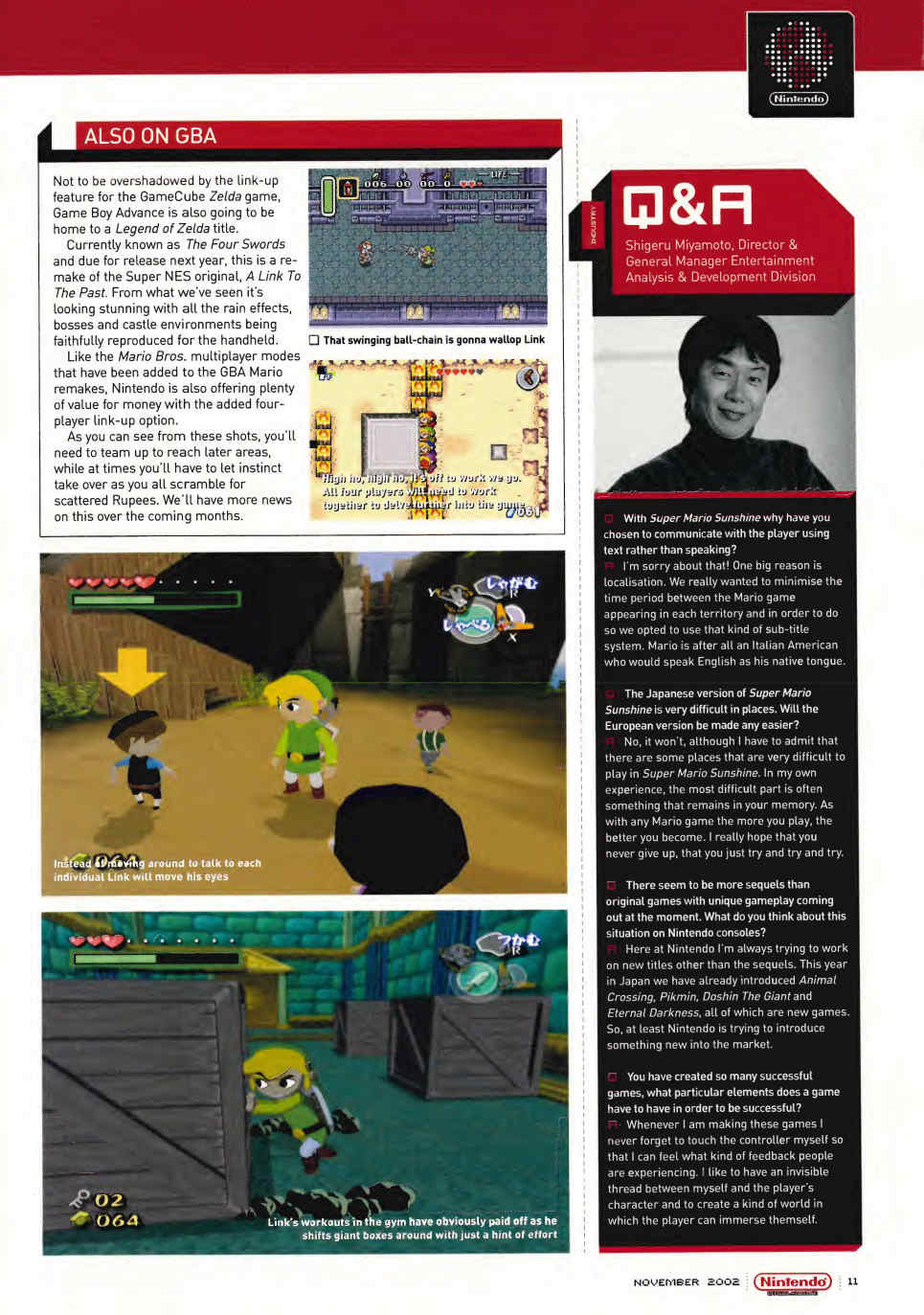
Notes: Scans by Out of Print Archive.
Summary: One reason there isn’t voice acting in Super Mario Sunshine is to keep localization times down.
Super Mario Sunshine’s European release won’t be easier than the Japanese version. Don’t give up, you’ll get better the more you play.
They’re always trying to make new games at Nintendo. This year they’ve released Animal Crossing, Pikmin, Doshin the Giant, and Eternal Darkness.
To make successful games he likes to have an invisible thread between the player and the character they are controlling, and to create immersive worlds.
IGN: Metroid Prime Roundtable QA, Electronic Gaming Monthly: Afterthoughts: Metroid Prime
Publication Date: November 15, 2002/February, 2003
Subject(s): Metroid Prime, Retro Studios, 2D versus 3D, GameCube and Game Boy Advance connectivity
Format: Q & A
People: Unnamed IGN interviewer, Unnamed Electronic Gaming Monthly interviewer, unnamed members of the press, Steve Barcia, Mark Pacini, Karl Deckard, Michael Mann, Tim O’Leary (translator), Kensuke Tanabe, Shigeru Miyamoto
Link: https://www.ign.com/articles/2002/11/15/metroid-prime-roundtable-qa
Archive Link: https://web.archive.org/web/20121210130105/http://www.ign.com/articles/2002/11/15/metroid-prime-roundtable-qa
Scans:


Notes: This Q & A took place at Nintendo of America’s Redmond, Washington headquarters where four people from Retro Studios and two from Nintendo teleconferenced in while representatives from various press outlets asked questions. Scans by Retromags.
Summary: It’s been a long journey getting Metroid Prime released in the United States, they’ve been working on the game for about three years. They’ve never worked with a foreign development team to this degree before.
Retro Studios had plans for their own game, but Nintendo convinced them to make a Metroid title. Retro Studios has a lot of talented artists, but they weren’t sure how it would turn out since it’s different from what they’re used to.
Retro had to get used to the long hours that Japanese developers are used to. The Japanese media has accepted Metroid Prime, they don’t see it as foreign.
Four years ago he saw tests of different projects that Retro Studios was working on. His first impression was that they could make a Metroid game. He’s been asked by Americans about a new Metroid game for a long time. They had been thinking about it all through the Nintendo 64 era, but couldn’t come up with any ideas.
Steve Barcia from Retro had the idea of numbering the e-mails sent between Retro and Nintendo to keep track of which had been responded to. They sent people from Japan to Texas to work with Retro.
He wanted to make a cool game that looked good. There was some opposition from people who thought Metroid should stay a 2D series and shouldn’t be first-person. They decided to call it an exploration game instead of a jumping game. They did some experiments with third-person, which led to the Morph Ball.
They had to avoid their preconceived notions of what a first-person game is like, and do what was good for a Metroid game.
In a 2D game it’s more clear whether you can make a jump or what you can shoot. The developers found new ways to make 3D exploration fun.
He’d give Metroid Prime a 12 out of 10.
3D games are hard for people new to games because they are hard to control, it’s hard to see, and it’s hard to look at the map. Metroid Prime is very accessible, though, it’s not too hard.
There shouldn’t be as long of a wait for the next Metroid game.
They want GameCube and Game Boy Advance connectivity to provide a different type of game play and in-game bonuses. People with Metroid Fusion and Metroid Prime will be able to get something special.
His favorite enemy is the Alpha Beetle, it was the first enemy they saw working and he realized they could build off of it.
He wanted a lot of cutscenes since you don’t see Samus very often. You can also see her reflection in places.
He’s proud of how many particle effects they managed to include while keeping 60 frames per second.
They put a lot of work into making an immersive audio experience.
GamePro: Interview With Nintendo’s Shigeru Miyamoto and Eiji Aonuma, Nintendo Power: The Masters Speak
Publication Date: December 6, 2002
Subject(s): The Legend of Zelda: The Wind Waker
Format: Q & A
People: Fennec Fox, unnamed members of the press, Eiji Aonuma, Shigeru Miyamoto
Scans:


Notes: This press Q & A took place at an unnamed conference and was not published in the magazine. This interview is also available here. A somewhat abridged version also appeared in Nintendo Power, which is where the scans are from. Scans by Retromags.
Summary: A two and a half year gap between The Legend of Zelda games is pretty fast considering they redid the graphics. While The Legend of Zelda: The Wind Waker has been released in Japan, Metroid Prime has not. The Wind Waker has more story and characters than other Zelda games so it will take longer to localize. He was the producer and Eiji Aonuma was the director.
The direction and script writing happened after The Legend of Zelda: Majora’s Mask was finished, but they were experimenting with graphics before then.
They have wanted to use wind as a mechanic for a while.
With disc-based media they could make characters with their own behavior and routines.
People stop worrying about the graphics once they are playing the game. It’s for children and adults. When a game is realistic it’s jarring when something unrealistic happens.
Link’s proportions were just as important as the graphical style. If they made a more action-heavy game then the proportions wouldn’t work. Nintendo is trying to do something different and appeal to everyone, not to make kid’s games.
He was worried so many returning items would make The Wind Waker feel old, but adding too many new ones will confuse inexperienced players.
The Legend of Zelda: Ocarina of Time Master Quest didn’t require anything from the 64DD so porting it to the GameCube wasn’t an issue. They wanted to make Ocarina of Time Master Quest accessible to more people, but weren’t sure how. They haven’t decided how it will be distributed outside of Japan. Ocarina of Time on GameCube runs at four times the resolution of the original.
They considered having Link’s eyes change color to red during battles. His eyes were black originally, but they experimented with other colors, and some pre-release screenshots show them that way.
Many people don’t have much time to play games and he doesn’t want to hear that Zelda seems too long. Several events can be done out o order, and you don’t have to do all of them.
There aren’t enough developers at Nintendo for everything they want to do, so they use second parties sometimes.
Weekly Playboy (reported on by Nintendo World Report and GameForms, partially untranslated from Japanese)
Publication Date: December 10, 2002 (approximate)
Subject(s): GameCube sales, Pikmin 2, Super Mario Sunshine, Super Mario 128
Format: Transcribed interview
People: Reported on by Rick Powers and J.T. Kauffman, unknown Weekly Playboy interviewer, Shigeru Miyamoto
Link: https://www.nintendoworldreport.com/news/8097/miyamoto-confirms-two-sequels
Archive Link: https://web.archive.org/web/20140911112904/http://www.nintendoworldreport.com/news/8097/miyamoto-confirms-two-sequels
Website screenshot:

Scans:


Notes: The scans are by Cheesemeister3k and the magazine was bought by DrLavaYT for use in this video about Super Mario 128. The screenshot of the GameForms article is also from DrLavaYT.
Summary: Super Mario Sunshine sold less than one million in Japan, and 2.5 million worldwide. Some think it’s too hard, but he doesn’t think that’s why it sold like that. It was an evolution of Super Mario 64. There weren’t enough new and unique games to sell many GameCubes.
Brand names are important to selling consoles but he still wants to make new things.
A lot of games use cel shading, but nothing animates like The Legend of Zelda: The Wind Waker. The enemies have expressions, too. It’s the most extravagant The Legend of Zelda game.
They are working on Pikmin 2 and the Super Mario 128, which has something that Super Mario Sunshine didn’t.
2003
Unknown (discussion with Yasumi Matsuno)
Publication Date: 2003
Subject(s): Game development, reputation, Bow-lingual
Format: Transcribed interview
People: Yasumi Matsuno, Shigeru Miyamoto
Link: https://shmuplations.com/matsunoxmiyamoto/
Archive Link: https://web.archive.org/web/20190722180021/http://shmuplations.com/matsunoxmiyamoto
Translator: shmuplations
Notes: This is more of a discussion than an interview and I have no idea where it originally appeared.
Summary: You’re more critical of a game when you aren’t working on it. It’s important to have a producer with that vantage, and who knows the original aim of the game. You can see things clearly at the end of development that the people working on the game wouldn’t be able to.
After the planning phase he lets things progress on their own. He checks in from time to time. Developers show him when they have things working. Then he spends six to 10 months in the development rooms. He’s looking for something new and signs off on things when they are original enough. As long as the story doesn’t contradict existing canon it’s fine.
The developers don’t fight him, partly because of his age. He has a reputation for flipping tables and going on a rampage, but that’s more of a joke that helps people feel better when their work is scrapped.
By the end of development of a game you make compromises, calculating your hours of sleep and the time you can spend with your family.
When everyone is on the same page about why they’re making a game it becomes easy to trim away the excess. Sometimes developers will see everything as important towards the end, but you have to ask yourself what’s truly essential. He tells the staff they’ll understand the cuts when they play the game six months from now.
He remains detached so that he can see clearly. A huge planning document will be full of conceits, but he doesn’t tell developers not to write so many details. You can’t tell a person to only include the important parts.
He tells the designers of Mario levels to start by deciding the size of the level. New gameplay elements should be used four times within a level. First in a safe place to experiment with, then a place to play with it, then a place to apply their knowledge in a new way, and finally a place where it’s taken to the extreme. If they get stuck he tells them to work on something else for a while.
Bow-lingual and Taiko no Tatsujin got his attention last year, and before that Samba de Amigo. Those are the games the industry needs. Bow-lingual’s appeal can be summed up in a sentence, unlike most of his games. He’s resigned himself to making what fans want from long-running series. He’d like to broaden the game industry.
Producers have to stop the tendency to put more and more resources into the graphics. He’s been telling his staff not to work too hard on things so that they don’t run out of space. If they go too far it eats into someone else’s efforts.
It’s scary to think about how the staff sees him, and some are scared to talk to him. Sometimes he makes a joke and it ends up in the game because someone thought he was serious.
Unknown Extended Play Interview
Publication Date: 2003?
Subject(s): Working on The Legend of Zelda, what makes Zelda games fun, The Legend of Zelda: The Wind Waker’s graphics
Format: Interview
People: Unnamed Extended Play interviewer, Eiji Aonuma, Shigeru Miyamoto
Link: https://www.zeldadungeon.net/wiki/Interview:Extended_Play_March_21st_2003
Archive Link: https://web.archive.org/web/20140821014906/http://www.zeldadungeon.net/wiki/Interview:Extended_Play_March_21st_2003
Video: https://www.youtube.com/watch?v=zsg5virsGQA
Notes: The Zelda Dungeon link combines two interviews, this entry is about the first one on that page.
Summary: They started work on The Legend of Zelda around the same time they started on Super Mario Bros. With Mario, players could look at the screen and know what to do, whereas with Zelda the player wouldn’t know what to do next.
The basic element that makes Zelda games fun hasn’t changed over the years, the idea that the player is visiting and experiencing the Zelda world.
Once people play The Legend of Zelda: The Wind Waker they forget about the graphics.
Wired: Why Nintendo Won’t Grow Up
Publication Date: January 1, 2003
Subject(s): Rules, targeting an adult audience, Grand Theft Auto, video games versus movies
Format: Transcribed interview
People: Zev Borow, Shigeru Miyamoto
Link: https://www.wired.com/2003/01/nintendo-4/
Archive Link: https://web.archive.org/web/20230901033751/https://www.wired.com/2003/01/nintendo-4/
Notes: This interview took place at E3 2002, which ran May 22–24. The quote about Grand Theft Auto also appears a year and a half later in another interview from The Sydney Morning Herald, unattributed.
Summary: He often thinks about the rules of games. There’s a rule on Japanese trains where if a pregnant or elderly person boards the train, you give them your seat. He tells his children to consider their actions. Throwing a cigarette out a window could have unknown effects.
There have been some instances where non-gamers became interested in gaming.
For several years he’s been thinking about whether Nintendo should target an adult audience.
Grand Theft Auto’s subject matter is not always appropriate. Being more realistic does not necessarily make a game better.
Video games don’t have an edge over movies, they have to do things that movies can’t do. Most importantly, they have to be fun.
Video games are still a young form of media.
He wants to create entertainment that has mystery. He has a dog that he is training, but really, the dog is training him.
Zelda no Video
Publication Date: February 19, 2003
Subject(s): The Legend of Zelda, The Legend of Zelda: Ocarina of Time, influences, Kirby’s Dream Course, taking The Legend of Zelda 3D, puzzles, upending the tea table, Gunpei Yokoi
Format: Interview
People: Yasuhiro Nagata, Shigeru Miyamoto
Video: https://www.youtube.com/watch?v=QGDznMLLyIo&t=3006s
Translator: Zentendo
Notes: This is an updated and expanded DVD version of HISTORY of ZELDA『ゼルダの伝説』の過去から未来へ. You can read more about it on Zelda Wiki. Thank you to makgameadv for information about this video.
This video was translated by members of the now defunct Zentendo and the also defunct Zelda Informer had the rights to upload it to YouTube. Uploaded by YouTube user NintendoPrime.
Summary: [At a GameCube press conference]
They’ve changed the style for The Legend of Zelda: The Wind Waker.
[Being interviewed]
He was inspired by Black Onix and Ultima. Ideally he’d have no influences. The characters getting stronger over time was fun in those games, but he didn’t find them fun to play.
He started making miniature garden games. He started working on Super Mario Bros. at about the same time as The Legend of Zelda. You could save data with the Famicom Disk System, so you had your own miniature garden.
They had to think about how to translate The Legend of Zelda into 3D while letting the player feel free. Sometimes as an adult you revisit an area that you thought was huge as a child, like a street, and you realize there’s barely even any room for cars. He wanted to include something like that. There are some narrow areas in The Legend of Zelda: Ocarina of Time that you revisit later.
His favorite Zelda game has to be The Legend of Zelda: Link’s Awakening, even though he wasn’t very involved with it. Takashi Tezuka directed it. They improved the most on the spot when making Zelda II: The Adventure of Link. They did everything they could within the technical limitations. The Famicom Disk System was at its limit.
When working on Ocarina of Time, being able to make a 3D game world and improving on the concept of a miniature garden, the staff could look at the map designs and feel like they had been there. They continued development with the idea that just looking at the scenery was a great value. Ocarina of Time also has the most Zelda-like music theme, which immerses the player. They were able to use real instruments for the first time. He wanted to have something you could ride. The story is a bit romantic, which isn’t like other Zelda games.
Talking about puzzles is like a hole in the ground. You can understand everything if you wait, but you’ll get nervous if you fall in. He wasn’t satisfied how when you bomb a wall there is suddenly a hole there. A cloud of smoke obscured this in The Legend of Zelda, and you heard the classic chime. You have to pay more attention to details as your expressive force increases. They should make harder puzzles.
He was glad they could include things like cutting grass. He thought it would be funny to include it The Legend of Zelda: A Link to the Past. You can swing your sword in different directions in Ocarina of Time, and cutting signs shows this off. He didn’t tell anyone to make the signs float on the water.
He doesn’t mean to upend the tea table a lot.
Gunpei Yokoi would study a game for a week and then expose its weak points succinctly. He does the same now. He didn’t think Kirby’s Dream Course was fun enough. To make it more elaborate they added control over the vertical angle. It wasn’t fun because there was no magic when you hit the ball. The developers were against his changes.
Everyone enjoys solving problems. They feel happiness being creative, and it’s important for video games to encourage this. They don’t always have to be hard. When you find an item in a brick in Super Mario Bros. it makes you think that there may be items in other bricks. It makes the player take an active part in the game.
He wasn’t completely satisfied with Ocarina of Time. He’d have liked two more years to make it perfect. He’d like to make Zelda forever.
Power Unlimited/GameKings (reported on by IGN, untranslated from Dutch)
Publication Date: Unknown (reported on February 24, 2003)
Subject(s): The Legend of Zelda: The Minish Cap
Format: Transcribed interview
People: Reported on by unnamed IGN staff, Jurjen Tiersma, Niels ‘t Hooft, Eiji Aonuma, Shigeru Miyamoto
Link: https://www.ign.com/articles/2003/02/24/miyamoto-confirms-new-zelda
Archive Link: https://web.archive.org/web/20150716132806/http://www.ign.com/articles/2003/02/24/miyamoto-confirms-new-zelda
https://archive.org/details/pu30jaar
Scans:
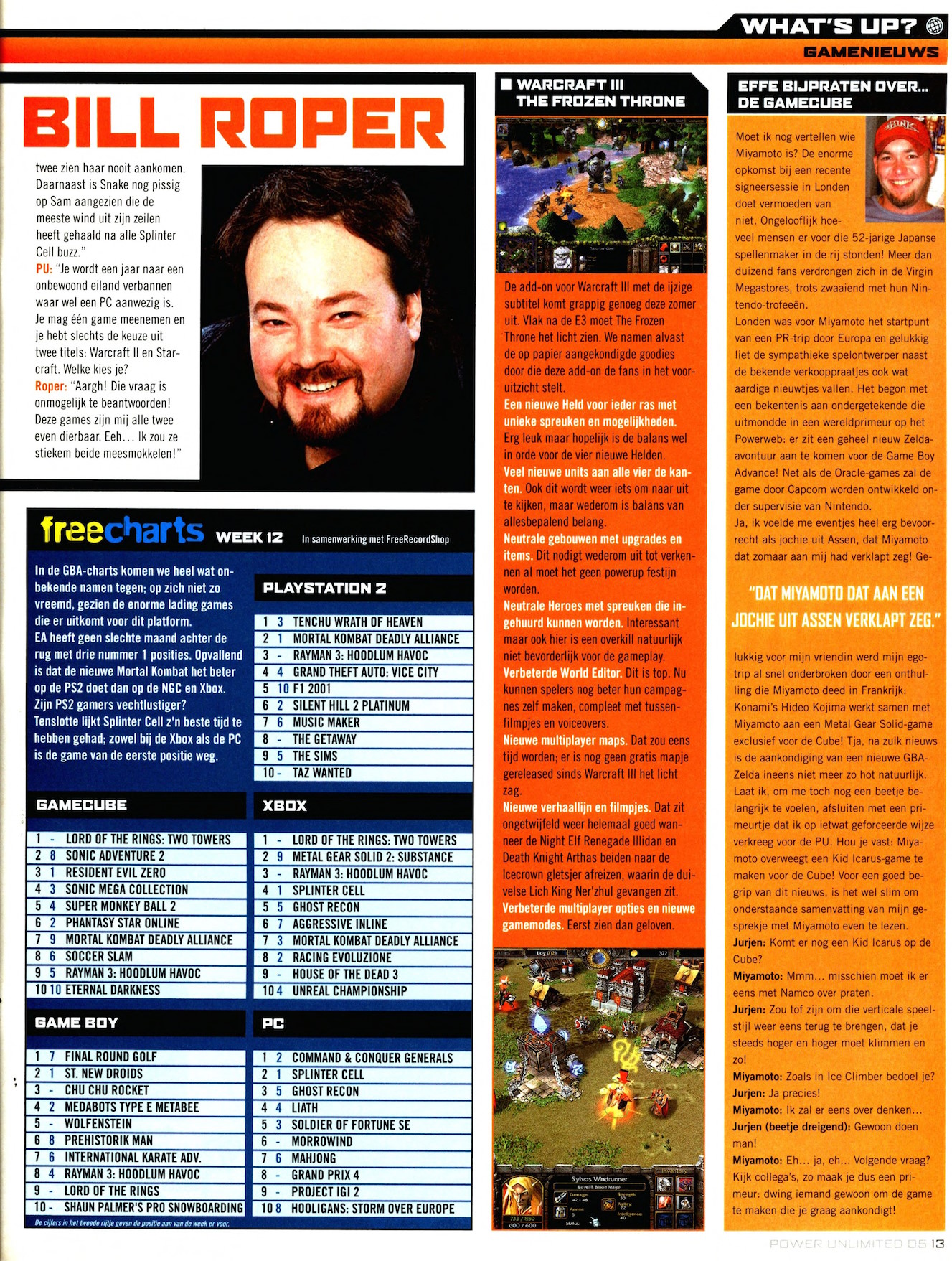
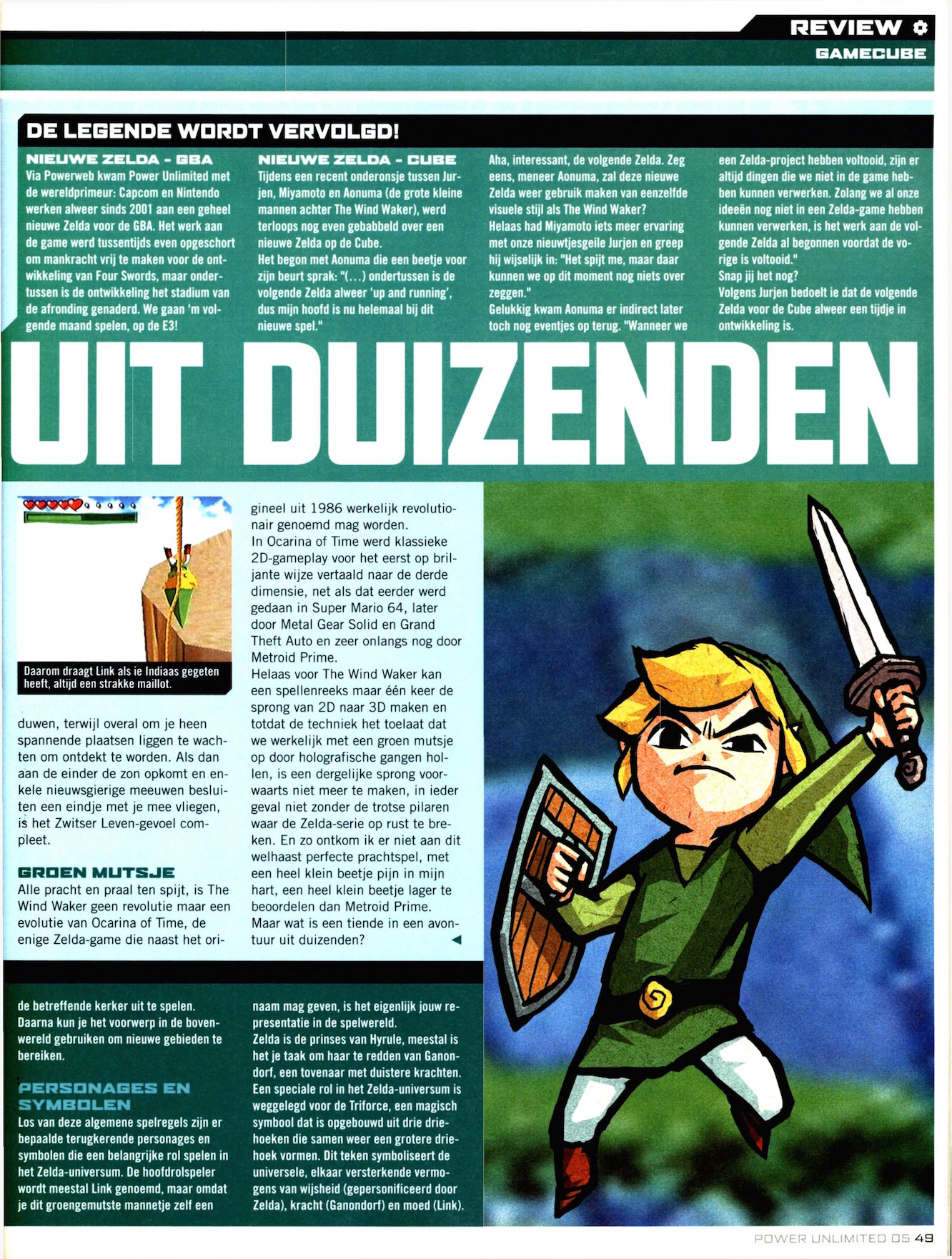
Notes: This article appears to be a translation of this Dutch article. Mr. Miyamoto gave an hour long interview to Dutch journalists, which was reported on in the magazine Power Unlimited and the TV show Gamekings.
Summary: The Legend of Zelda: The Minish Cap will be developed by Capcom, under supervision by Nintendo.
There will be more GameCube and Game Boy Advance games at E3.
Game Kult: Shigeru Miyamoto : l’interview (untranslated from French)
Publication Date: February 26, 2003
Subject(s): The Legend of Zelda: The Wind Waker
Format: Q & A
People: Puyo, unnamed members of the press, Eiji Aonuma, Shigeru Miyamoto
French Link: https://www.gamekult.com/actualite/shigeru-miyamoto-l-interview-23783.html
French Archive Link: https://web.archive.org/web/20191129121203/https://www.gamekult.com/actualite/shigeru-miyamoto-l-interview-23783.html
Notes: This Q & A session took place in Paris and lasted an hour.
Kikizo Archives: Shigeru Miyamoto Roundtable 2003
Publication Date: February 27, 2003
Subject(s): The Legend of Zelda: The Wind Waker
Format: Q & A
People: Unnamed members of the press, John Tyrell, Yasuhiro Minagawa (translator), Eiji Aonuma, Shigeru Miyamoto
Link: http://archive.videogamesdaily.com/news/200302/005.asp
Archive Link: https://web.archive.org/web/20130507125336/http://archive.videogamesdaily.com/news/200302/005.asp
Notes: Zelda Dungeon also has a write-up from this event, but does not say what outlet it is from. I have included material from both sources. The NGC Magazine – Miyamoto in London entry also covers this event, but I summarized it first and it didn’t include all of the questions so I am only including what wasn’t covered there. This Q & A took place after Mr. Miyamoto’s appearance at London’s Virgin Megastore on February 21, 2003
Summary: They decided on a sailing boat in The Legend of Zelda: The Wind Waker so players could control the wind. They also wanted to focus on technology other than graphics.
They weren’t trying to create shock waves with The Wind Waker’s art style, they just wanted to make something new. They had had the issue of a more realistic Link not making sense in the world.
It takes so long to make game engines now, it would be helpful to him as a producer to reuse them. He hopes they reuse The Wind Waker’s engine.
Hayao Miyazaki makes movies that appeal to adults and children. He is a good example of realistic graphics not being necessary to appeal to a wide audience. If everyone bandwagons onto something popular it will have a negative effect on the industry.
He tries to always be involved in non-game activities. It’s important to make friends with people in other industries. He likes playing musical instruments and gardening. He has serious conversations with dog trainers about what “dog” means.
If you make games for several platforms you can’t take advantage of their unique features. Only Nintendo can provide some experiences. They are releasing the Game Boy Player this year so you can play Game Boy Advance games on the TV.
Nintendo has more game franchises than anyone else and most of their teams are making sequels.
He has no concerns about Link being in Soulcalibur II. Namco did a good job characterizing him.
EGM’s Unofficial GameCube Guide: The Legend of Zelda
Publication Date: March, 2003 (approximate)
Subject(s): The Legend of Zelda: The Wind Waker
Format: Transcribed interview
People: Unknown Electronic Gaming Monthly interviewer, Shigeru Miyamoto
Archive Link: https://archive.org/details/egms-unofficial-game-cube-guide-march-2002/
Scans:


Notes: It seems very unlikely that Electronic Gaming Monthly got an exclusive interview for this supplemental publication that mostly features reused reviews of GameCube games. I searched for these quotes elsewhere but came up empty. There is a quote at the beginning of this feature that supposedly took place on stage at E3 2002 that I can’t find in a recording of the event.
Scans by HubzAlt.
Summary: They tried to turn The Legend of Zelda: The Wind Waker into a cartoon so that a parent might think their child was watching cartoons but then look again and realize they were controlling the cartoon. They’ve come a long way from The Legend of Zelda: Ocarina of Time.
The world is immersive despite the cel shading. It adds more than it takes away.
Wind will be important in The Wind Waker, you’ll be sailing and have to pay attention to what direction it’s blowing.
Picking up an enemy’s weapon is integral to the gameplay.
GameSpot: Nintendo Roundtable Q&A
Publication Date: March 3, 2003
Subject(s): The Legend of Zelda: The Wind Waker, Stage Debut, HAL Labs, Rare
Format: Q & A
People: Unnamed GameSpot interviewer, Unnamed members of the press, Eiji Aonuma, Shigeru Miyamoto
Link: https://www.gamespot.com/articles/nintendo-roundtable-qanda/1100-2911896/
Archive Link: https://web.archive.org/web/20230208182036/https://www.gamespot.com/articles/nintendo-roundtable-qanda/1100-2911896/
Notes: This was held at the 2003 DICE Summit, February 27-28.
Summary: You need a lot of space to come up with new ideas. He comes up with ideas while working. He’s been spending time with the new family dog lately for balance.
He can’t imagine adult Link with cel shading.
He has lots of ideas that wouldn’t be commercial successful, like Stage Debut. They had three or four people working on it for a few years, but couldn’t turn them it into a product. It was still cheaper than developing a Zelda game for a month.
They still don’t see online games as having a successful business model.
70 to 80% of first party games will have GameCube and Game Boy Advance connectivity.
HAL Labs have gotten bigger and are working on more projects. He likes to joke about Sonic being in Super Smash Bros.
Nintendo is working on a Donkey Kong game. They won’t let Rare being bought by Microsoft open any holes in their library. They disagreed with Rare on the future.
Metro: Shigeru Myamoto [sic]
Publication Date: March 17, 2003
Subject(s): Being 50, technological advancements
Format: Transcribed interview
People: Unnamed Metro interviewer, Shigeru Miyamoto
Link: https://metro.co.uk/2003/03/17/shigeru-myamoto-637239/
Archive Link: https://web.archive.org/web/20150626105848/http://metro.co.uk/2003/03/17/shigeru-myamoto-637239/
Notes: Miyamoto is spelled “Myamoto” every time in this article.
Summary: He should have come to Europe earlier, but he has barely been able to leave Nintendo’s buildings.
He doesn’t feel too old for new ideas. He is like Dracula, getting energy from younger people.
He doesn’t feel like he violated Universal’s copyright, Donkey Kong is completely different from King Kong.
He has never considered making a movie, it would be an insult to movie directors.
GameCube sales are not satisfactory, but they are proud of the reception from those who own one. They can compete because they are making family friendly entertainment, whereas with Sony and Microsoft are trying to sell gadgets with their systems.
It is difficult to greatly improve the visual experience. Technological advancements make games cost more money make, which isn’t the direction they should go. Games are becoming too complicated for many people.
Extended Play: Shigeru Miyamoto on ’Wind Waker’
Publication Date: March 21, 2003
Subject(s): Giving hints to players, The Legend of Zelda: The Wind Waker, loving Link
Format: Interview
People: Unnamed Extended Play interviewer, Shigeru Miyamoto
Link: https://www.zeldadungeon.net/wiki/Interview:Extended_Play_March_21st_2003
Archive Link: https://web.archive.org/web/20140821014906/http://www.zeldadungeon.net/wiki/Interview:Extended_Play_March_21st_2003
Notes: The Zelda Dungeon link combines two interviews, this entry is about the second one on that page. I am unable to find the video of this interview.
Summary: He was lucky to have the freedom that he did with the original Zelda. Play testers were confused and didn’t know what to do. They used that feedback to add hints.
Last year they released The Legend of Zelda: A Link to the Past and Four Swords, and they have another Game Boy Advance Zelda game coming out. He was afraid that they’d have several Zelda games that all looked different. Since Link doesn’t mature in The Wind Waker they thought the cel shading style would be natural and they’d be able to give Link a consistent look.
By making Link young in The Wind Waker some of the passionate female Japanese fans couldn’t love him. Many were not happy with the non-realistic style, but they forgot about that once they played the game.
Cube: In the Cube with..Shigeru Miyamoto
Publication Date: April, 2003
Subject(s): Third-party support for GameCube, Game Boy Player, Nintendo e-Reader, multi-platform games
Format: Transcribed interview
People: Unnamed Cube interviewer, Shigeru Miyamoto
Scan:

Notes: This interview took place while Mr. Miyamoto was visiting the London Virgin Megastore. Scan by Out of Print Archive.
Summary: Many developers are making multi-platform games because of the similarities between the GameCube, Xbox, and PlayStation 2. These games aren’t getting the most from each console.
It’s important that some games provide an experience that only Nintendo can provide.
They are working on GameCube to Game Boy Advance communication and the Game Boy Player will allow you to play Game Boy Advance games on your TV. The Nintendo e-Reader turns paper into gaming data.
Nintendo is always trying to make these kinds of new experiences and third-parties will become more interested in making unique applications. They are having discussions with Electronic Arts. Namco and Sega are close to making unique opportunities.
Nintendo Official Magazine: Q & A
Publication Date: April, 2003
Subject(s): The Legend of Zelda: The Wind Waker, Super Mario 128
Format: Transcribed interview
People: Unnamed Nintendo Official Magazine interviewer, Shigeru Miyamoto
Scan:

Notes: Scans by Out of Print Archive.
Summary: For The Legend of Zelda: The Wind Waker they started by coming up with using the ocean and traveling by a sail boat that used the wind.
They deleted two stages, including some dungeons.
They didn’t mean to shock people with the art style, they wanted to make something new. They do not have any such reformations planned for Super Mario 128.
N-Zone: Das Projekt hätte scheitern können! (reported on by DidYouKnowGaming, partially untranslated from German)
Publication Date: April, 2003
Subject(s): Metroid Prime
Format: Transcribed interview
People: Reported on by DidYouKnowGaming, unknown N-Zone interviewer, Steve Barcia, Mark Pacini, Karl Deckard, Shigeru Miyamoto
Video: https://www.youtube.com/watch?v=QxEqzUOui_M&t=166s
Scans:


Notes: The Retro Studios developers and Mr. Miyamoto were interviewed over the phone. DidYouKnowGaming had this interview translated and shared a portion of it in the video. Scans by Black Squirrel.
Summary: If a Morph Ball experiment had failed they probably would have canceled Metroid Prime.
Whitworth Media: Gameheadz
Publication Date: April 16, 2003
Subject(s): Donkey Kong, Super Mario Bros., The Legend of Zelda (26:13)
Format: Interview (dubbed)
People: Shigeru Miyamoto
Video:
https://www.youtube.com/watch?v=TNbP8rD-7OQ&t=1954s
A likely better quality version can be bought on Vimeo.
Notes: This documentary seems to have debuted on TLC, though it was made by Whitworth Media.
Summary: He realized games could draw out people’s emotions. His games have reflected his childhood since then. He hated computers and didn’t trust electricity.
[Mr. Miyamoto is showing a concept sketch of Donkey Kong.]
The gorilla snatches the girl and runs away with her. The man chases after with a hammer, while avoiding barrels. A hole appears in the ground, which the gorilla falls into, and dies.
Mario can jump high, but he isn’t superhuman. He can drown, he gets hurt if he falls from a high place. Mario was originally very big, but the game was more interesting with big and small Mario. He made the unwholesome looking red mushroom to make Mario big.
The Legend of Zelda begins with a child standing in the middle of a field. The player doesn’t know what to do after naming this child. It was a daring concept at the time. As a child he was surprised to find a big lake in the mountains. This image has been used often in Zelda. The items are to help the small child become an accomplished adult. The player goes from feeling scared to feeling strong.
Superplay interview with Miyamoto
Publication Date: April, 2003
Subject(s): The Legend of Zelda, Zelda II: The Adventure of Link, The Legend of Zelda: The Wind Waker
Format: Transcribed interview
People: Unnamed Superplay interviewer, Shigeru Miyamoto
Link: http://www.zeldalegends.net/index.php?n=interviews&id=2003-04-23-superplay-miya&m=html
Translator: SuperSectionX
Notes: Superplay Magazine (also called Super PLAY in the source) is a Swedish gaming magazine, not to be confused with Super Play, a British gaming magazine that published its last issue in 1996. In 1997 a new magazine by the name of N64 Magazine (later renamed NGC Magazine) launched as its successor. Coincidentally both Superplay and Super Play’s successor interviewed Miyamoto in the same month. The original post on the IGN message boards that translated the interview has been lost.
Summary: They were nervous about The Legend of Zelda because it made players think about what they were going to do. Thankfully people enjoyed solving riddles. They worked on it at the same time as Super Mario Bros., and made sure they expressed different ideas. Super Mario Bros. would be linear, and The Legend of Zelda would not be.
Kensuke Tanabe wrote the story of The Legend of Zelda: A Link to the Past and The Legend of Zelda: Link’s Awakening. He and Takashi Tezuka came up with all the ideas for the first game, it was based on his childhood.
The idea for Zelda II: The Adventure of Link was his idea, but different people made it than made the original. It was a bit of a failure, which is why they see A Link to the Past as the true sequel.
They have a huge document detailing how the different Zelda games relate to each other, but it’s not that important. Great stories are important, but they should be easy to understand. He’s not trying to convey a message, he just wants to entertain people.
The gaming industry has expanded, but Nintendo will not make games like Grand Theft Auto. Games are interactive so it’s important to consider the ethical and moral boundaries.
The Legend of Zelda: The Wind Waker had humor and deeper parts. The Link in The Wind Waker is young Link because he fit into the world better. They started with adult Link, but changed direction. They had to cut some things because they ran out of time.
Link is popular because he is a regular boy who is called upon by destiny to become a hero. It’s always been important to him that the player forms a strong bond with Link.
NGC Magazine: Miyamoto in London
Publication Date: April, 2003
Subject(s): The Legend of Zelda: The Wind Waker
Format: Q & A
People: Unnamed NGC Magazine interviewer, Yasuhiro Minagawa (translator), Eiji Aonuma, Shigeru Miyamoto
Scans:


Notes: This Q & A took place after Mr. Miyamoto’s appearance at London’s Virgin Megastore on February 21, 2003. Scans by Out of Print Archive.
Summary: They had to cut two dungeons from The Legend of Zelda: The Wind Waker due to time restraints. He hopes they can reuse The Wind Waker’s engine.
Nintendo doesn’t make violent games like Grand Theft Auto. They have a responsibility to a mass audience. No one is willing to market it in Japan.
They’re working hard on GameCube and Game Boy Advance connectivity. That and the eCard Reader are the kind of unique things that Nintendo makes.
There’s a danger to the pressure of making constant sequels. Retro is working on Metroid and Sega is working on F-Zero, so third parties are working with Nintendo characters.
GamesTM: Shigeru Miyamoto Nintendo Japan
Publication Date: April, 2003
Subject(s): The Legend of Zelda: The Wind Waker, making sequels, multi-platform games
Format: Transcribed interview
People: Unnamed GamesTM interviewer, Shigeru Miyamoto
Scans:


Summary: He’s always trying to make something new, he didn’t intend to create a controversy with The Legend of Zelda: The Wind Waker’s cel-shaded look. If Link had normal proportions it wouldn’t feel natural.
Negative press at least means people are talking about the game.
It’s somewhat troublesome how busy they are just making sequels of their biggest franchises, but their new employees are growing fast. They have also been working with Retro Studios on Metroid Prime, Sega with F-Zero GX, and Namco with Star Fox: Assault.
You can make similar games on each of the major hardware platforms, which is why developers are making a lot of multi-platform games. That’s good for the gaming audience, but it doesn’t help to get the most out of each console. Nintendo has to make the best first-party games possible.
IGN: Metal Gear Solid Official
Publication Date: May 1, 2003
Subject(s): Metal Gear Solid: The Twin Snakes
Format: Transcribed interview
People: Hideo Kojima, Shigeru Miyamoto
Link: https://www.ign.com/articles/2003/05/01/metal-gear-solid-official
Archive Link: https://web.archive.org/web/20130209020906/https://www.ign.com/articles/2003/05/01/metal-gear-solid-official
Notes: Both Game Informer and Electronic Gaming Monthly mention an “interview” with Hideo Kojima and Shigeru Miyamoto announcing Metal Gear Solid: The Twin Snakes. It appears they are talking about this press release that contains a quote from each. Every source I could find uses these exact quotes.
Summary: He has talked with Hideo Kojima about this for some time now, and he’s excited that their ideas are matching so well. Their shared passion for making games has allowed for this collaboration on the GameCube.
Nintendo of America: E3 2003
Publication Date: May 14-16, 2003
Subject(s): The Sims (24:44), The Sims Bustin’ Out, The Legend of Zelda: Four Swords Adventures (29:06), Pac-Man Vs. (32:07), Metal Gear Solid: The Twin Snakes (38:13)
Format: Presentation/demonstration (spoken English, live translator)
People: Will Wright, Toru Iwatani, George Harrison, Hideo Kojima, Denis Dyack, Bill Trinen (translator), Denis Dyack, Shigeru Miyamoto
Video:
Notes: Uploaded by YouTube user CARSLOCK.
Summary: Will Wight made game history with The Sims in 2000, selling something like 25 million copies. Despite Wright’s fame he is still willing to work with him. They’re going to make a version of The Sims for the GameCube that connects with the Game Boy Advance. Nintendo is happy to be working with the teams at Electronic Arts.
They’ve improved upon Four Swords with elements only possible on the Nintendo GameCube. Four players can play, using their Game Boy Advances as controllers. When players go into a house or down a hole they appear on their Game Boy Advance screen. They can put lots of rupees or Dark Knights on screen at once with the GameCube.
He usually says his favorite game is Donkey Kong or Mario Bros. But as far as other company’s games, he has always said Pac-Man. He made a GameCube Pac-Man game. Since he never got permission he is going to invite Toru Iwatani, the creator of Pac-Man onto the stage. He had an idea for a Pac-Man game that connects the GameCube and Game Boy Advance.
[Will Wright, Toru Iwatani, and George Harrison come on stage to play Pac-Man Vs.]
The person playing on the Game Boy Advance controls Pac-Man. The three other players have limited vision on the TV and have to talk to each other and try to catch him. He asks if Mr. Iwatani will approve the project if he wins. Since George catches Pac-Man, he trades his controller for the Game Boy Advance.
He is working with Mr. Iwatani on other projects, too, like Soulcalibur II with adult Link. Next year is Star Fox: Assault.
Today they have shown a strong lineup of connectivity games. They enhance the Nintendo-style of play with your friends fun. There is one more good friend he has invited today, Hideo Kojima. He has known Mr. Kojima for a long time and they are working on a title together.
[Hideo Kojima talks and a trailer for Metal Gear Solid: The Twin Snakes plays]
This is a big collaboration, and another person working with them is Denis Dyack from Silicon Knights. Also working on Metroid Prime with Retro Studios. There is a unique blend of Eastern and Western developers working together.
Computer and Video Games: E3 2003: Miyamoto: the interview
Publication Date: May 16, 2003
Subject(s): Pac-Man Vs., Metroid Prime, games as art, online gaming, Mario Kart, retirement, issues facing the industry
Format: Transcribed interview
People: Paul Davies, unnamed members of the press, Shigeru Miyamoto
Link: https://www.zeldadungeon.net/wiki/Interview:CVG_May_16th_2003
Archive Links: https://web.archive.org/web/20130426150155/http://www.zeldadungeon.net/wiki/Interview:CVG_May_16th_2003
Notes: The whole interview is available on Zelda Dungeon, but the web page containing the second part was not preserved. This interview took place at E3 2003.
Summary: Older games were simpler, which allowed more people to play them. Games got more complicated over the years so fewer people could play them. Pac-Man is still fun, they are adding new elements to it with Pac-Man Vs. that will feel fresh. They want to show that games don’t have to be more complicated or look better, you can add connectivity and it will be fun and exciting.
Metroid Prime was Retro Studio’s first project after adding developers and programmers from different areas together. It went well and now they know Retro’s strengths. Metroid Prime 2 will be cooler. Retro has been excited by the good reviews and a multiplayer mode should be within reach.
Their focus at E3 this year was connectivity. They removed the time limit from Pikmin 2 so you’ll have more freedom. Pikmin is different from Grand Theft Auto but it does share the idea of being free to do what you want.
He sees the games he makes as products for sale, not art. They contain his expression, but he’s not trying to convey that expression so much as to make people happy. When they make a Mario game they try to find a new idea. Being a developer requires artistic expression and creativity, but that doesn’t make games art. Opera can be interesting, but ultimately it is entertainment. You used to see crazy stories that didn’t make sense and people would say it was brilliant, but it’s more likely the creators had to change things at the last minute.
It’s not that Nintendo isn’t interested in online gaming, it’s that it isn’t a viable business right now. The thing about entertainment, like the Rubik’s Cube, is that you can walk into a store and buy it, it’s accessible. The Internet isn’t accessible to everyone, Nintendo won’t limit its user base to one group.
When working on the next Mario and The Legend of Zelda game there’s not a plan, they look at their experiments and develop the one that seems the most fun. They have staff that works on improving an existing model and staff that comes up with new ideas.
They intend to use The Legend of Zelda: The Wind Waker’s system for another game. Rather than make a Super Mario Sunshine sequel they are working on something fun that will be accessible to a broad audience.
There’s not many Super Nintendo Entertainment System games left to bring to the Game Boy Advance, there will be more original titles.
Anyone can play Mario Kart. They want to keep that element while making Mario Kart: Double Dash more fun and exciting.
GameCube games are not focused on children. It’s important to them to make games that sell well for a long time. Nintendo is good making games that children enjoy, but everyone can enjoy them. They also have Medal of Honor, Resident Evil, Metal Gear Solid: Twin Snakes, Star Wars, and Splinter Cell on the GameCube.
They don’t pay much attention to the differences between the Japanese and Western markets, besides the obvious. First-person shooters aren’t big in Japan, and some Americans love deep and complex games. He was worried about how Animal Crossing would perform, but it’s sold well in America.
Maybe when he’s trained the younger generation and can pass the torch he’ll retire.
He’s been having fun his whole career. Technology is 10 times faster than he had ever imagined they would be. They can create very realistic worlds, a lot of designers fail because they focus on doing that rather than making new gameplay.
They find individual game creators to make games in their franchises. It’s not about the companies they work for.
Declining sales of games is an issue. Consumers can buy consoles for less than they cost to make. Another issue is creating huge games can be so expensive that developers lose money.
There’s nothing he couldn’t do on GameCube but could do on another platform.
Electronic Gaming Monthly: Shocking Nintendo Secrets Revealed!, Afterthoughts: Zelda: The Wind Waker
Publication Date: June, 2003
Subject(s): The Legend of Zelda: Oracle of Seasons and Ages, Animal Crossing, The Legend of Zelda: The Wind Waker
Format: Transcribed interview
People: Mark MacDonald, Eiji Aonuma, Shigeru Miyamoto
Scans:


Notes: There is a small segment where Mr. Miyamoto comments on various games, this took place at the 2003 DICE Summit, which was held February 27-28. The Afterthoughts interview also has Mr. Aonuma and may or may not have occurred at the same event. Scans by Retromags.
Summary: Capcom is in the planning stages for a Game Boy Advance The Legend of Zelda game.
They are working on a re-release version of Animal Crossing for Japan that includes elements that the American version added.
Retro Studios is working on a Metroid Prime sequel.
Mario Kart won’t have online play for now.
They are working on a Pokémon game for the GameCube that is like Pokémon Stadium.
They’ve wanted to express wind in games, but it wasn’t until now that they were really able to show it blowing.
If they make a Zelda game where Link is an adult they’ll have to rethink the graphical style.
Nintendo Official Magazine: Rising Sons
Publication Date: July, 2003
Subject(s): Pac-Man Vs., The Legend of Zelda: Four Swords Adventures, Stage Debut, missing Pokémon
Format: Transcribed interview
People: Unnamed Nintendo Official Magazine interviewer, Shigeru Miyamoto
Scans:


Notes: Scans by Out of Print Archive.
Summary: He’s mostly focused on Game Boy Advance and GameCube connectivity games right now, but he’ll be working on Mario next year.
Nintendo is discussing how to release Pac-Man Vs. and The Legend of Zelda: Four Swords Adventures. They have more freedom with discs than they had with cartridges.
Stage Debut is like Animal Crossing in that it’s for people who don’t like difficult games or working on a game until they finish it. Some games are only fun when they are networked. They’ve been working on Stage Debut since the 64DD. It’s fun to make your own game.
He can’t say anything about the Pokémon missing from Pokémon Ruby and Sapphire.
He thought it would be great to include connectivity in a game like Metal Gear Solid.
Miyamoto’s Tokyo Univ. Lecture, Nintendo Official Magazine: He’s not Mr N*SYNC, he’s not what your friends think
Publication Date: July 3, 2003/September, 2003
Subject(s): Super Mario Bros., game development, Hiroshi Yamauchi, cutscenes, creativity, The Legend of Zelda: Four Swords Adventures, Pac-Man Vs., Stage Debut, Giftpia
Format: Transcribed interview, presentation/demonstration, Q & A
People: Unknown author, unnamed instructor, unnamed students, Shigeru Miyamoto
Archive Link: https://web.archive.org/web/20030811223536/http://www.video-fenky.com/features/miyamoto.html
Scans:


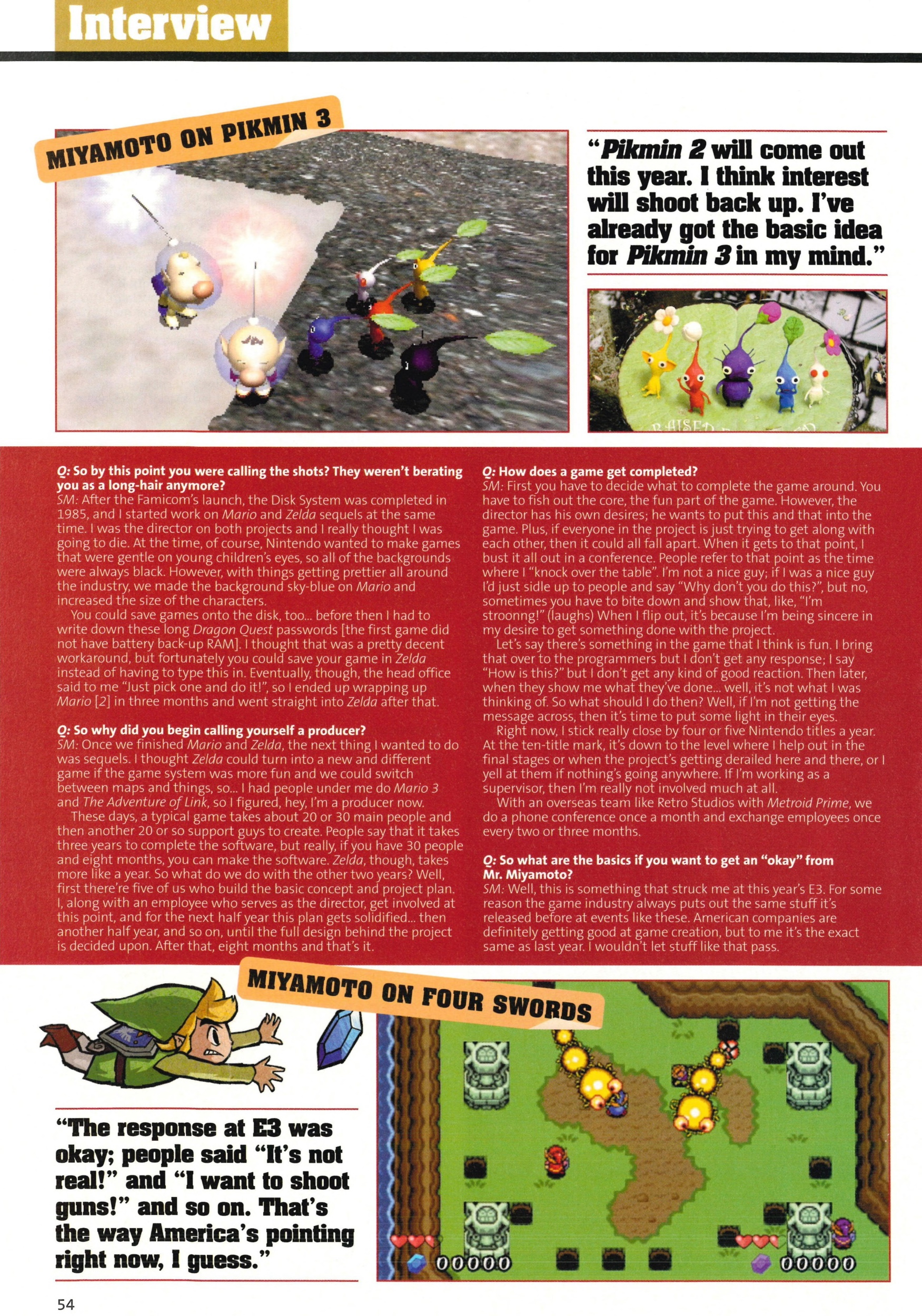

Translator: Kevin Gifford
Notes: An unknown person attended a lecture by Mr. Miyamoto at Tokyo University’s Komaba campus and wrote about it. According to Chris Kohler’s Power-Up: How Japanese Video Games Gave the World an Extra Life bibliography section the video-fenky version was translated from Japanese by Kevin Gifford. The gameplay footage mentioned is likely the same as was shown at E3.
Nintendo Official Magazine claims to have snuck a translator into this same lecture by Mr. Miyamoto, and then translated it. In the NOM version’s introduction “by the time I enterted the room” has been changed to “by the time we entered the room”, further giving the impression that the author is working for NOM. The video-fenky version does not mention the author being a translator, sneaking in, or working for NOM. NOM’s version is shorter and is slightly reworded in places.
Thank you to tabslockalt for providing the video-fenky source. Scans by Out of Print Archive.
Summary: If you visit a game development studio you won’t see much but desks, Choco-Egg figures, and model kits.
He is a board member. There is no strict definition director or project document. He made Donkey Kong to make use of extra arcade boards Nintendo had. At the time one person could do everything, so there was no “designer”. By the time of Super Mario Bros. he could do the design work and let apprentices do the rest, that was when he became a director. He thought he was going to die working on Mario and Zelda sequels in 1985.
He had people under him do Super Mario Bros. 3 and Zelda II: The Adventure of Link so he figured he was a producer. Nintendo actually use a section chief/department chief system, but people overseas don’t understand that. To sell himself he put “producer” on his business card, which eventually caused him to get yelled at.
Now a game can take 20-30 people and 20 support staff to make. You can make the software in eight months, 12 if it’s a Zelda game. The other two years are spent making a concept and project plan with five people. He doesn’t like when people tell him a game in progress is fun, he wants to hear something’s missing.
You have to fish out the game’s core, the fun part. Sometimes the people on the top and the people on the bottom blame each other and everything goes haywire. When that happens he knocks over the table. When he flips out it’s because he wants to get some work done. He works on four to five games a year. With 10 titles he helps out here and there, gets things on track. When he’s the supervisor he’s not very involved. With overseas developers there’s a monthly phone conference and employees are exchanged every few months.
Video game expos have shown the same things for 20 years. American games didn’t used to be put together very well, but they had variety. He gives the OK to games when someone is sincere, not what will necessarily sell. Games with new ideas.
Hiroshi Yamauchi told him to devote money to what others aren’t doing. Now that the economic bubble burst other companies are in trouble, but Nintendo isn’t. Mr. Yamauchi always said to take the money they make in entertainment and invest it back back in entertainment.
Project documents that propose taking a game but doing something different with it are no good. Some project documents are very pompous.
When he’s asked for an autograph he wants to draw a caricature of the person, but he worries about it looking weird, so he just draws Mario.
Games don’t sell well because of their director, but because they’re good. The PlayStation 2, GameCube, and Xbox aren’t very different in their capabilities. If this keeps up then the competition is just about graphics and sound, which costs money. Game sales are down in general.
One minute of an opening movie can cost 20-30 million yen. This means more has to be spent everywhere else, too. So you have to bring on more people, which makes it harder to shape the whole thing.
He thinks its best to work on stupid ideas, but you have to work on sellable games, too. There’s no difference between the PlayStation 2, GameCube, and Xbox, so they have to make a difference with the software. They also have to keep building on GameCube and Game Boy Advance connectivity.
To really test how fun a game is he’ll invite employees and their children, and watch their reactions. He won’t say anything, he just watches. He and Takashi Tezuka are on the same wavelength.
He wants to help game players be more creative. Cutscenes are passive, comfortable, and becoming a big part of games.
[Promotional video for The Legend of Zelda: Four Swords Adventures plays.]
Four Swords Adventures got just an okay response at E3. People wanted something real, where you can shoot a gun. That’s how America is now.
[Miyamoto plays Pac-Man Vs. with three students.]
They made a game you can start playing right away. They made the game in a month, but it probably cost 20-30 million yen.
They’ve been working on Stage Debut since the Famicom Disk System.
[A character that looks like the instructor is on screen.]
Games are for everyone, not just children. He just wants to make games that make high-schoolers happy.
He has the idea for Pikmin 3 already.
Kenichi Nishi made some changes to Giftpia to help it sell better, but he thinks it would have been better if it had been more bizarre.
IGN: The F-Zero Press Conference
Publication Date: July 8, 2003
Subject(s): F-Zero GX
Format: Presentation, Q & A
People: Takaya Imamura, Toshihiro Nagoshi, Shigeru Miyamoto
Archive Links: https://web.archive.org/web/20040103171900/http://cube.ign.com/articles/427/427647p1.html
https://web.archive.org/web/20030710030924/http://cube.ign.com/articles/427/427647p2.html
Summary: They’ve finished F-Zero GX and it will be for sale soon in Japan. Today he wants to show the connectivity between F-Zero GX and F-Zero AX.
They want their games to be available to a wide user base. They are looking into having players trade information, like with Animal Crossing.
They have fans among game developers, Mr. Nagoshi grew up playing Nintendo games. They focus forming relationships with producers that will show a lot of care to a franchise.
They’re happy to see Mr. Imamura’s characters come to life.
Electronic Gaming Monthly: Nintendo Changes
Publication Date: September, 2003
Subject(s): System sellers, new Tokyo team, Game Boy Advance and GameCube connectivity, Grand Theft Auto III, Super Mario 128
Format: Transcribed interview
People: Mark MacDonald, Shigeru Miyamoto
Scans:


Notes: The summary assumes that “100 Marios” refers to Super Mario 128. Scans by Retromags.
Summary: People used to buy game systems for one game, but that isn’t the case anymore. They want to have a broad lineup of games to reach a broad audience. They have been slowly hiring new people and training them.
Their new team in Tokyo is being built with a core of their Kyoto team. They don’t like buying developers, they prefer to support people who are able to make creative games.
They can trust some developers from large companies to make games from their franchises. Namco is making Star Fox: Assault, Toshihiro Nagoshi is making F-Zero GX, and Shinji Mikami and Yuji Naka want to work on Nintendo games.
He was surprised the PlayStation Portable was announced with a list of specs and nothing to show. Lots of companies have released handhelds, but the Game Boy continues to do well. He wonders if Sony is going to try something like their Game Boy Advance and GameCube connectivity.
He is looking at how that connectivity can change gameplay and future hardware. People say online gaming is the future, but a lot of other things could be. You can create new styles of games with connectivity.
Using discs with the GameCube opens up more pricing options.
They’ll have something Pokémon related to announce for the e-Reader soon.
There are moral issues with Grand Theft Auto III, but it gives the player a lot of freedom. Game developers have to be careful with violence. GTA III doesn’t have polished graphics or incredible cinematic scenes, but it has sold well because of its gameplay.
Link will not look realistic in The Legend of Zelda: Twilight Princess.
Pikmin 2 will have the best parts of the original.
n-Space is a talented team.
Mario & Luigi is a very Nintendo action-RPG.
Donkey Kong is a remake of the original and is easy to pick up and play.
Metroid Prime 2 will come out next year.
If Super Mario 128 isn’t shown at E3 next year he’ll feel like he hasn’t fulfilled his responsibilities.
Mario & Zelda Big Band Live (untranslated from Japanese)
Publication Date: September 14, 2003
Subject(s): Unknown
Format: Interview, performance
People: Benimaru Itoh, Koji Kondo, Kazumi Totaka, Takashi Tezuka, Shigeru Miyamoto
Video: https://www.youtube.com/watch?v=jvBlUbLt-Uk
https://archive.org/details/mario-zelda-big-band-live-dvd/BIG_BAND_LIVE.iso
Notes: Mario & Zelda Big Band Live was a concert held in Nihon Seinenkan Hall. A DVD of the performance was included with an issue of Nintendo Dream, which is where this footage came from. There are interview segments with Mr. Miyamoto scattered throughout. I am unable to identify everyone involved. Uploaded by YouTube user phillai.
Nintendo Official Magazine: Hands Up If You Hate RPGs
Publication Date: October, 2003
Subject(s): Geist, role-playing games, Earthbound, Mother 3, Zelda II: The Adventure of Link, Donkey Kong, Donkey Kong Jr., Star Fox Adventures
Format: Transcribed interview
People: Chris Kohler, Shigeru Miyamoto
Link: https://www.zeldadungeon.net/wiki/Interview:Official_Nintendo_Magazine_September_14th_2003
Scans:


Notes: This interview took place in October, 2002. More of this interview appears in Chris Kohler’s book Power-Up. Scans by Out of Print Archive.
Summary: They are working on the next Mario game, they want it to be different.
The question he was asked most often at E3 was where Super Mario 128 was.
They are deeply involved with Geist, but not as much as Silicon Knights and Retro Studios.
He has a reputation at Nintendo for being loud and hard on people, someone who changes his mind a lot.
They have made some music-centered games like Mario Paint. He asks the music people about making a music game.
He fundamentally dislikes role-playing games, even though many like it and some games are suited to it. In role-playing games you are bound, only becoming powerful late in the game, and that’s not fun. Anyone can be good at them. Not everyone is good at Mario games, but they can still play them.
They wanted Earthbound to sell 3 million copies in the United States, but it didn’t do well. The petition to release Mother 3 in the U.S. got 30,000 signatures, which made them think Earthbound fans are solid.
They always want to sell their games globally, Americans made Donkey Kong huge. Hamtaro is doing well in the U.S. and Europe. Even anime is popular outside of Japan.
Everyone at Nintendo wants to release Zelda II: The Adventure of Link on GameCube, but he doesn’t know.
Designers have to understand the hardware they are designing games for.
Gunpei Yokoi wanted to make a game involving bouncing off of a seesaw, but they couldn’t get it to work.
They started planning Donkey Kong Jr.’s levels during Donkey Kong’s development. Donkey Kong was too big to be the playable character, so they made a little one. They wanted to still include Donkey Kong, but since it couldn’t be son versus father they decided that Mario had captured Donkey Kong.
After the Popeye game fell through he kept thinking about Popeye, Bluto, and Olive Oyl. They’re friendly rivals more than enemies. He needed to come up with his own characters. A main character, a strong guy and a beautiful woman, except his would be more beautiful than Olive Oyl. Donkey Kong was the most fleshed out, and it’s good to name a game after its strongest character.
He likes Donkey Kong a lot since he was the first character he’d made. If Nintendo got into robots, he’d make a robot Donkey Kong. He’d wear it like a suit and do a part-time job in it.
Rare is very independent. He was 10% involved with Donkey Kong Country at the start, decreasing over time. Almost all of Star Fox Adventures was done by Rare. Their separation was due to financial differences, not creative ones.
They’re always trying to be #1 in developing and publishing. They challenge themselves to be innovative. The days of people putting gaming as their top form of entertainment are gone. They need to be bold to stop the market from shrinking.
GameSpot: Shigeru Miyamoto Q&A
Publication Date: November 12, 2003
Subject(s): The Legend of Zelda: The Wind Waker, Soulcalibur II, F-Zero GX, Animal Crossing
Format: Transcribed interview
People: Unnamed GameSpot interviewer, Eiji Aonuma, Shigeru Miyamoto
Link: https://www.gamespot.com/articles/shigeru-miyamoto-qanda/1100-2911878/
Archive Link: https://web.archive.org/web/20200507020345/https://www.gamespot.com/articles/shigeru-miyamoto-qanda/1100-2911878/
Notes: This interview took place at the 2003 DICE Summit, which was held February 27-28.
Summary: There were voices on all sides of him asking if The Legend of Zelda: The Wind Waker’s art style was the right thing to do, but he feels rescued. They were able to use the cel shading style because Link is always a child in this game.
The developers of Soulcalibur II are big fans of Link and have given a lot of thought about what attacks he uses and how he looks.
The Capcom Zelda team is practically part of Nintendo even though Capcom is more regimented than Nintendo. They sent working builds of Wind Waker to them.
F-Zero is an intense series focused on speed, and Toshihiro Nagoshi has been very good at conveying that.
Bringing Metal Gear Solid to the GameCube has been in the works for a few years.
The video game market has seen a decline in individual game sales. Nintendo does not think a multiplatform strategy is the best path and third parties are figuring this out. They are trying to increase the GameCube’s user base with Game Boy Advance connectivity. Nintendo hasn’t shown all the benefits of connectivity, but needs to take the lead. The industry needs to look beyond the current styles and past graphics. It is a big success when a game sells 600,000-800,000 copies in Japan.
Pikmin 2 fell behind because because people were working on The Wind Waker.
They’ve been experimenting with online Mario Kart, but it would be difficult to pull off.
He didn’t know if Animal Crossing would be a hit, but knew its suited to everyday life. His wife would complain while playing The Legend of Zelda: Majora’s Mask that you had to play for a long time to make any progress, but Animal Crossing is a game you can play for a long time or a short time.
| 1983-1996 | 1997-1998 | 1999-2000 | 2001-2003 | 2004-2007 | 2008-2009 |
| 2010-2011 | 2012-2013 | 2014-2015 | 2016-2017 | 2018-2023 | 2024-2027 |