
This is the 1999-2000 page of the Shigeru Miyamoto Archive.
| 1983-1996 | 1997-1998 | 1999-2000 | 2001-2003 | 2004-2007 | 2008-2009 |
| 2010-2011 | 2012-2013 | 2014-2015 | 2016-2017 | 2018-2023 | 2024-2027 |
| Lost, Suspected, Incomplete, Unscanned, Untranslated |
1999
The Daily Telegraph: The Unsung Hero of Video Games
Publication Date: 1999
Subject(s): His start at Nintendo, ideas, Nintendo’s childish reputation
Format: Transcribed interview
People: Daniel Pemberton, Shigeru Miyamoto
Archive Link: https://web.archive.org/web/20070713071015/http://www.danielpemberton.com/shigerumiyamoto.html
Notes: Daniel Pemberton is a professional musician and the source is from his personal website.
Summary: He was hired by Nintendo around the time Space Invaders was big and he designed art for arcade games.
They made games designed to keep people putting coins into the machine. With the console business they had to take a new approach.
It’s important that games are kind to the player. For example, the save function has to be handled carefully so that players don’t feel bad about making a mistake.
New ideas are very important to Nintendo. A short conversation could to something that changes your job for the next five years. That’s why he doesn’t have plans for the future.
Donkey Kong and Super Mario Bros. were not meant to be children’s games, but children ended up playing them the most. They now have to deal with children whose parents grew up playing the Nintendo Entertainment System. They have to ask themselves how to appeal to people who don’t like the family-friendly atmosphere they create.
Sony proved that others could sell 10 million units of hardware. He spent a lot of time making new games from old series with the Nintendo 64, but he hopes to ask younger developers to work on those as he makes new series for the GameCube.
He receives no royalties, just a salary.
The 64DREAM: We still have questions about Zelda!
Publication Date: January, 1999
Subject(s): The Legend of Zelda: Ocarina of Time, 64DD, the Triforce, future games
Format: Transcribed interview
People: Fukayomi Ozeki, Shigeru Miyamoto
Link: https://goodblood.games/ootmiyamotoqa64dream28
Archive Link: https://web.archive.org/web/20251027202042/https://goodblood.games/ootmiyamotoqa64dream28
Japanese Archive Link: https://archive.org/details/64dream-january-1999-ozidual/64Dream%201999%2001%20%28J%20OCR%29/
Scans:


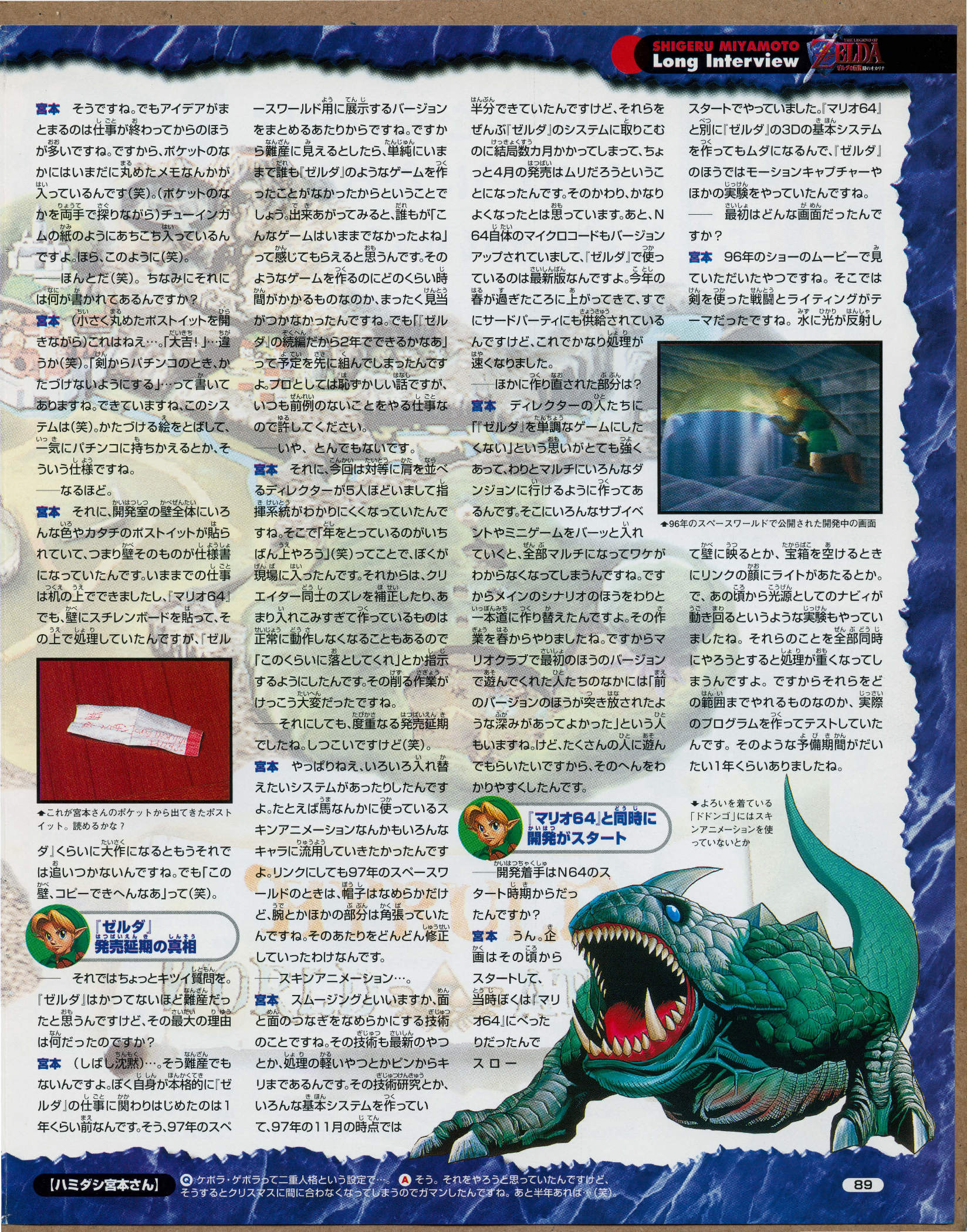
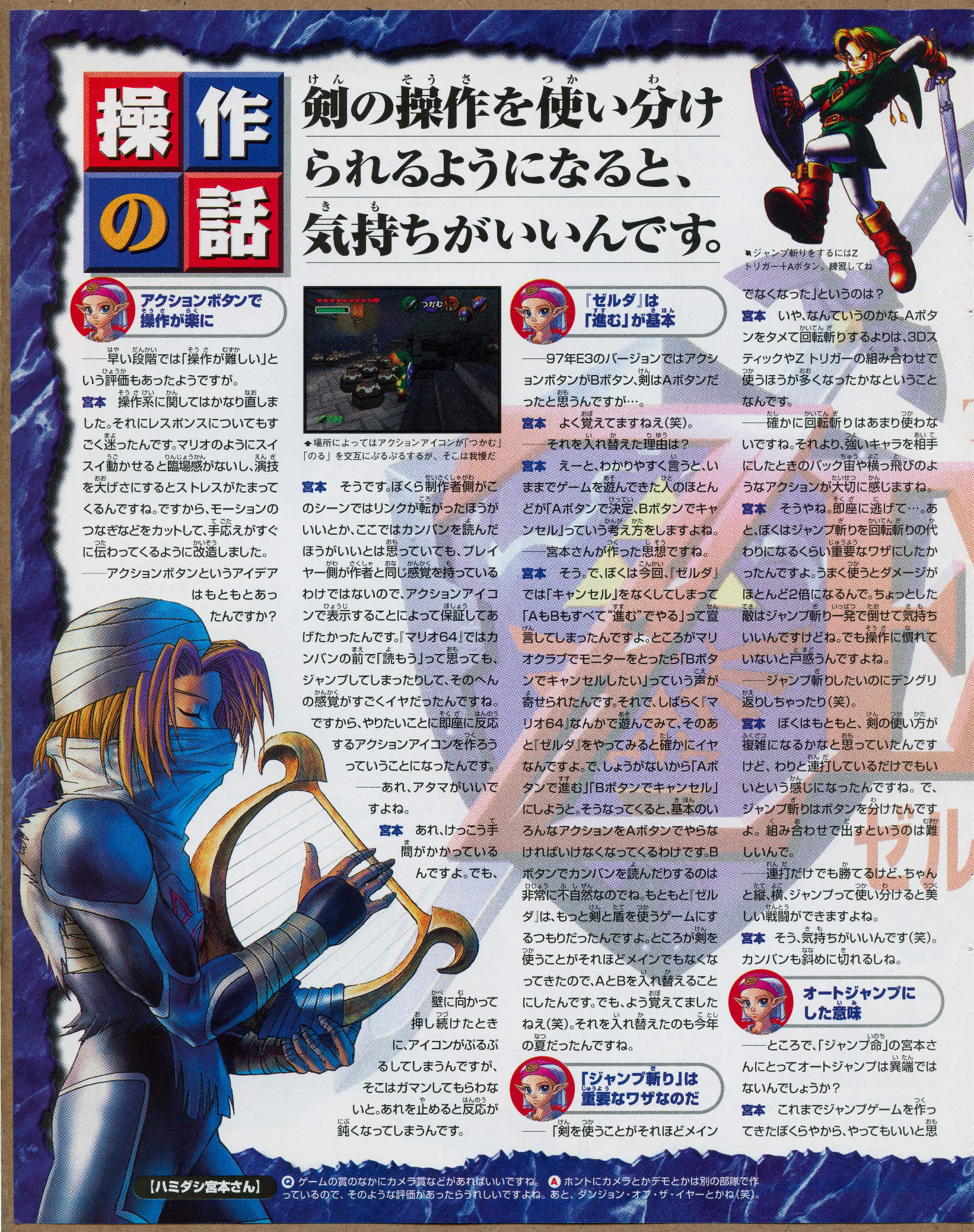
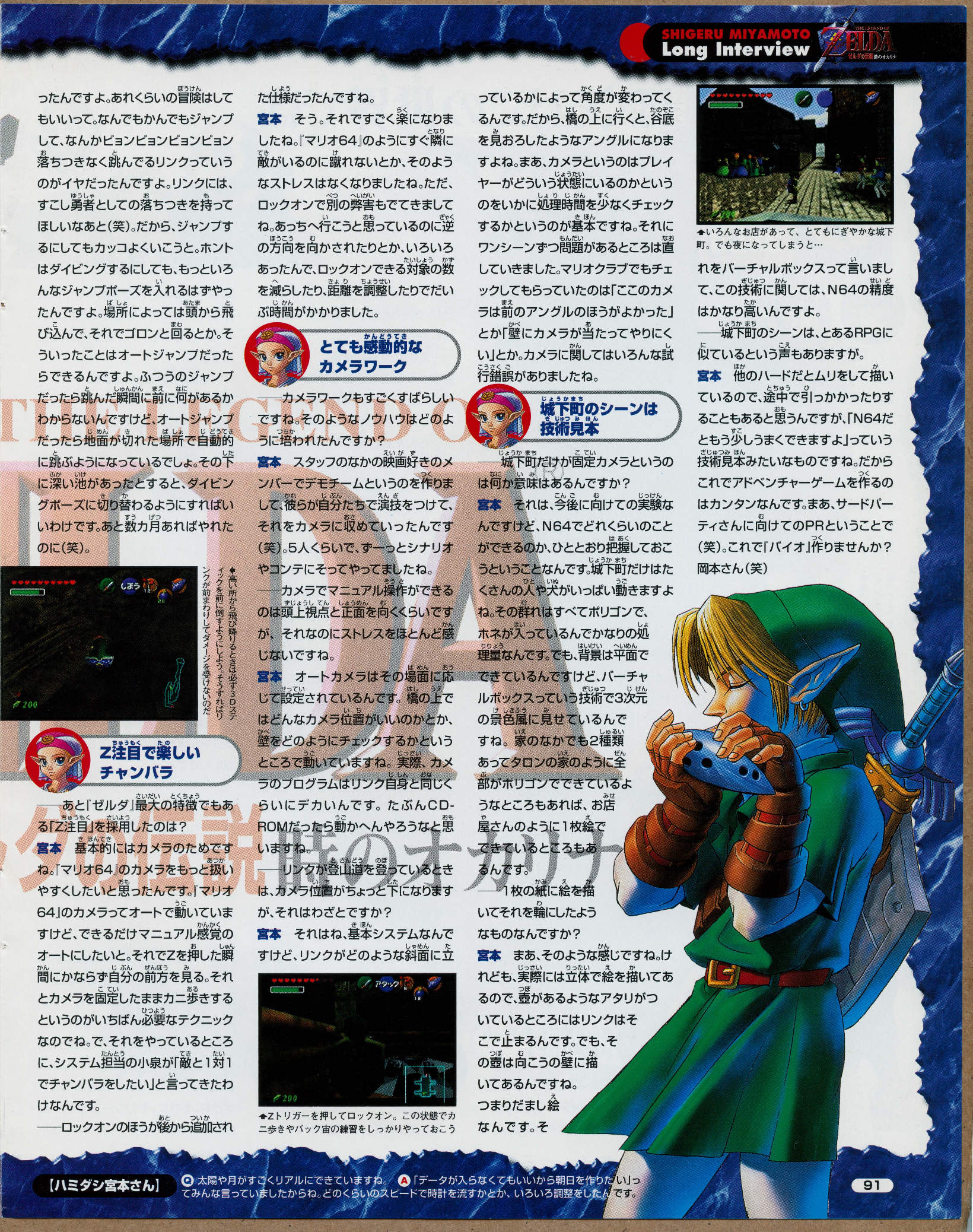

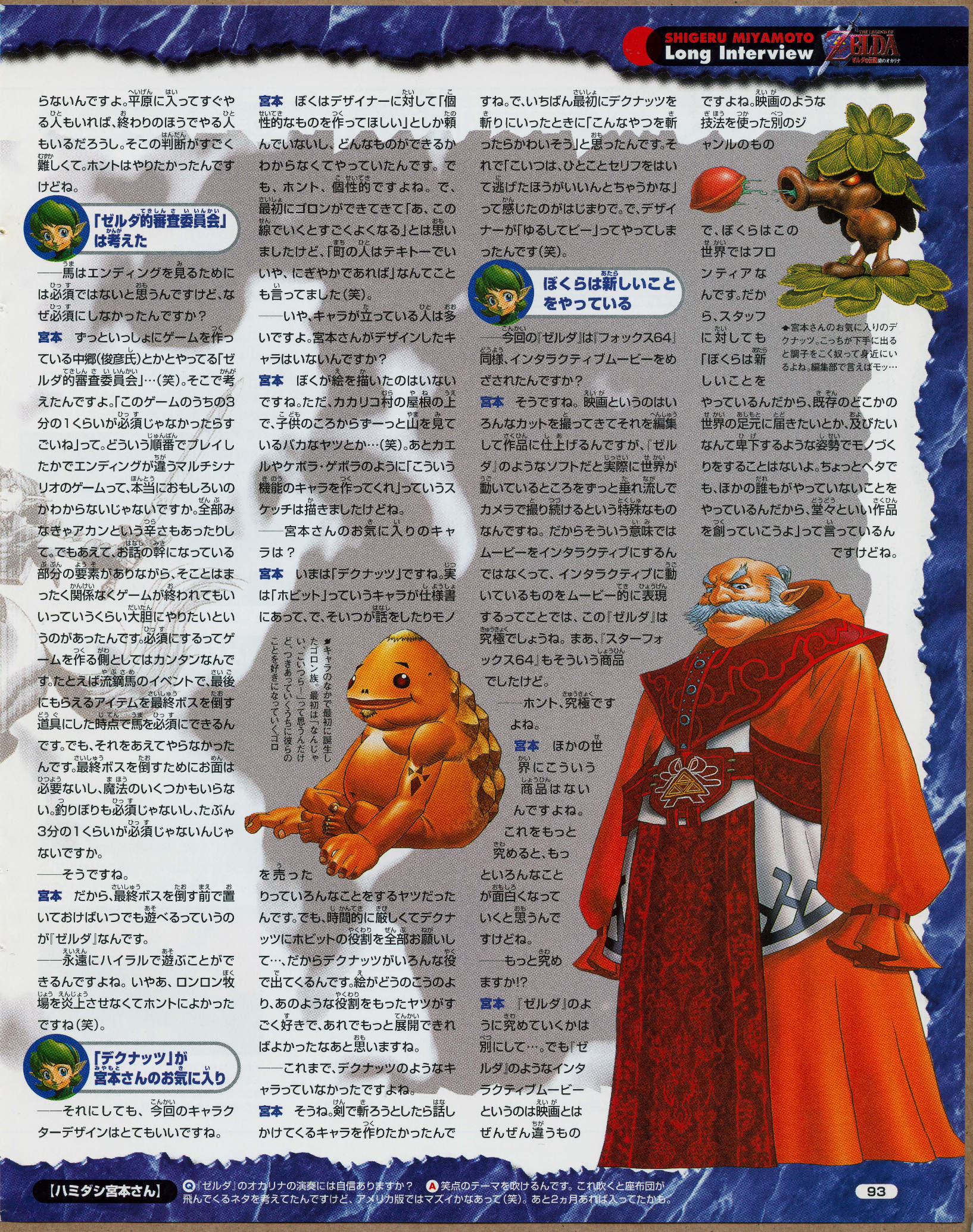


Translator: Roryj for Good Blood
Notes: Scans by ozidual.
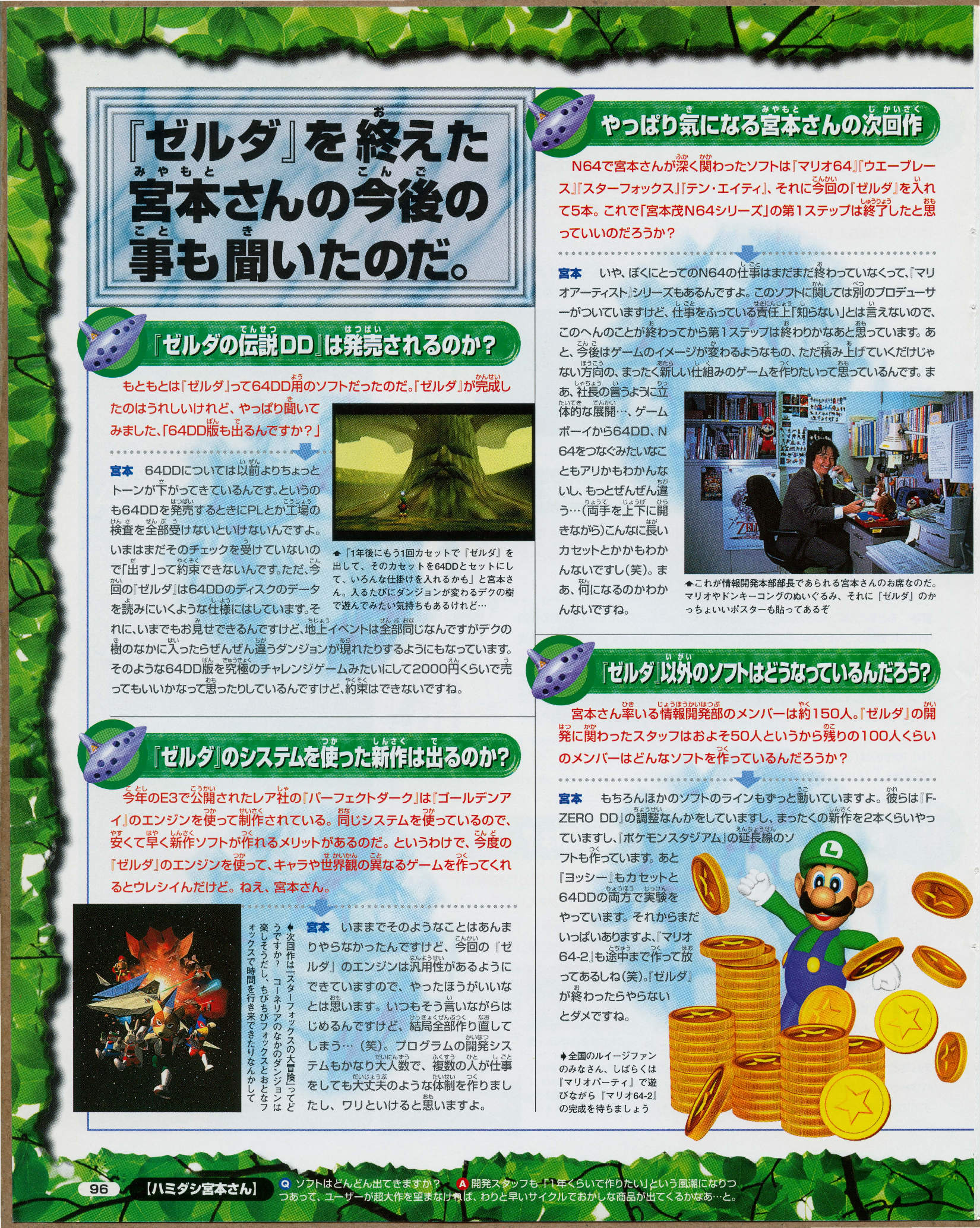
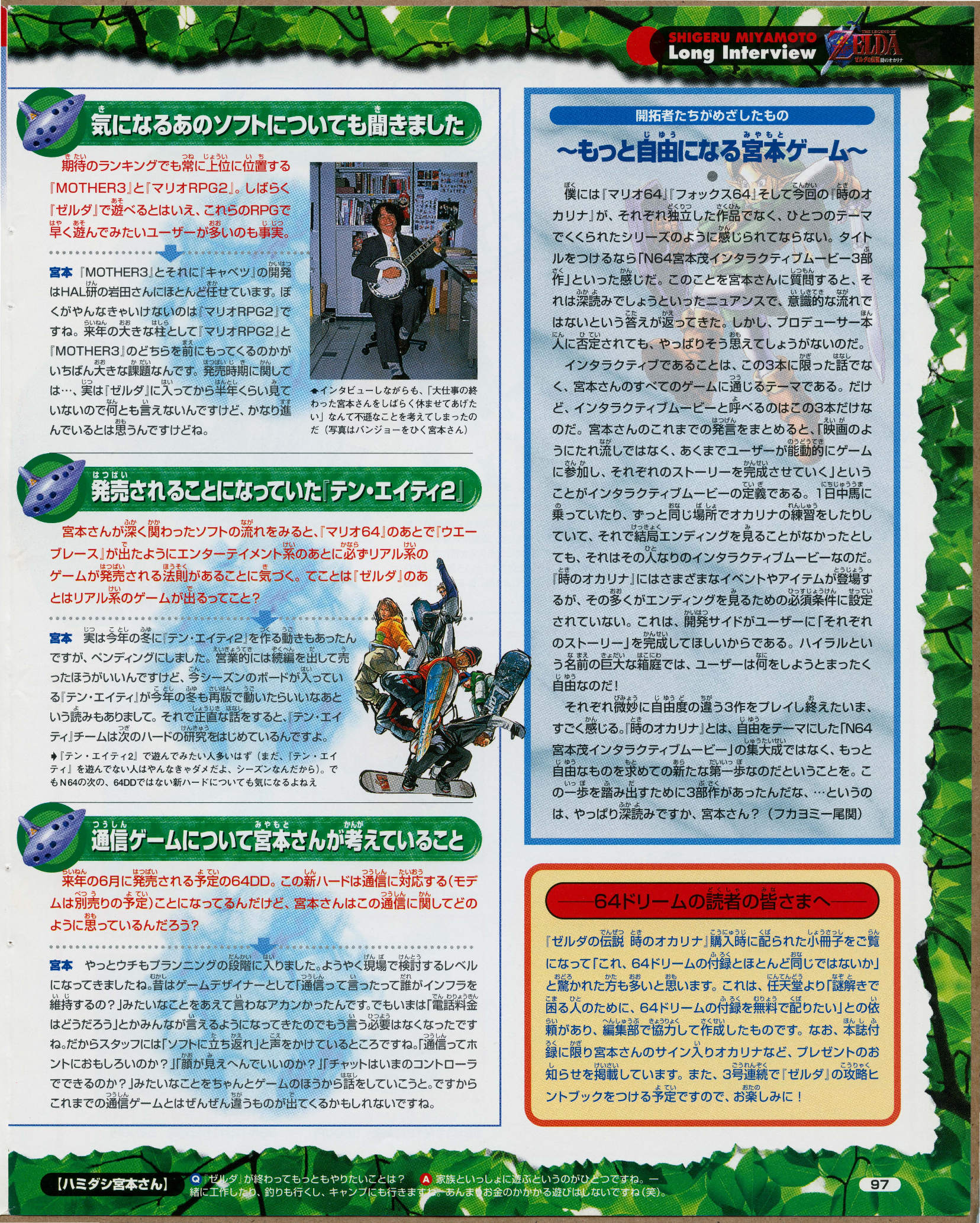
Summary: He’s changed Navi’s voice clips to be meaningless in English since the E3 preview.
Epona was not modeled after the horse in The Unfettered Shogun. He went along on a trip to see and ride horses.
He visited Germany and visited some castles after Super Mario 64 was finished. There was always a separate building where higher status people lived, and he wanted to create such a castle for The Legend of Zelda: Ocarina of Time.
We’re used to flat villages in video games, but it’s different in real life. He had terraced fields, a waterwheel, and a path to a well in mind.
They were told the release date of Ocarina of Time was being moved forward and they couldn’t make any more changes. He wanted to have a feature where after you beat the game there is a beep and then you are told how many in-game days have passed since leaving Kokiri Forest. It also would have said that Link’s adventure was over for now, to pressure him into making a sequel, but he wasn’t able to realize it.
When he was deciding the name of The Legend of Zelda he knew it would be The Legend of Something. He asked a songwriter who told him that F. Scott Fitzgerald’s wife was beautiful and named Zelda. Link’s name comes from connection, Impa is from impart, and Triforce means three powers.
The Triforce is not related to Fushimi Inari Taisha Shrine, it’s just a coincidence that they use the same symbol. Gunpei Yokoi’s family crest is the same. They thought a triangle power would be good when making The Legend of Zelda.
He’s about 90% satisfied with Ocarina of Time. He’s not interested in CD games. He does not want to be the president of Nintendo. Video games are not the kind of art that is considered academic.
There has been less interest in the 64DD lately, a Zelda game may not be released for it. It might be a more challenging version for 2,000 yen.
Ocarina of Time’s engine is versatile, it may be a good idea to make another game with it.
He’s still working on Mario Artist. He would like to make something that changes gaming’s image.
The rest of the members of his team that weren’t working on Ocarina of Time are working on an F-Zero game, an extension of Pokémon Stadium, and two other games. They are experimenting with Yoshi and there is some progress on Super Mario 64 2.
Mother 3 and Cabbage are mostly being worked on by Satoru Iwata and HAL Laboratory. It’s hard to decide whether to prioritize Mother 3 or Paper Mario. He hasn’t seen either for the last six months.
They were thinking of making 1080° Snowboarding 2 in the winter, but it was put on hold. That team is already researching Nintendo’s next hardware.
They are planning the 64DD’s online features. He’s telling people to go back to the basics.
Videogames.com: The Legend of Miyamoto
Publication Date: 1999 (on or before January 28, 1999)
Subject(s): Starting at Nintendo, Donkey Kong, computers versus game consoles
Format: Transcribed interview
People: Moira Muldoon, Shigeru Miyamoto
Archive Link: https://web.archive.org/web/19990128223751/http://videogames.com/features/universal/miyamoto/
Notes: There is a link to a sixth page, but if it ever existed it was never archived.
Summary: He wanted to make some unique toys or industrial designs when he joined Nintendo. Sometimes he was asked to make designs for video game characters.
He was given a programmer and full discretion about what to make, which ended up being Donkey Kong.
At first he thought that game design might be an interesting thing he just did with some of his time, but it’s been 20 years now.
They start with a game system and build that into a complete game.
They thought a game where a character had to climb and dodge obstacles would be fun.
His rival is the Rubik’s Cube.
Computers are designed to do many things, so there’s a lot you have to take care of when making a computer game. Game consoles are designed just to play games, and he always tries to use their full capacity. You can play a game within 10 seconds of starting a console.
There may be games just for adults in the future, but appealing to 18 year olds should reach a broad audience.
GameFan: Miyamoto Magic!
Publication Date: January, 1999
Subject(s): The Legend of Zelda: Ocarina of Time
Format: Transcribed interview
People: Video Cowboy, Shigeru Miyamoto
Scan:
Notes: Scan by RetroGameChampion.
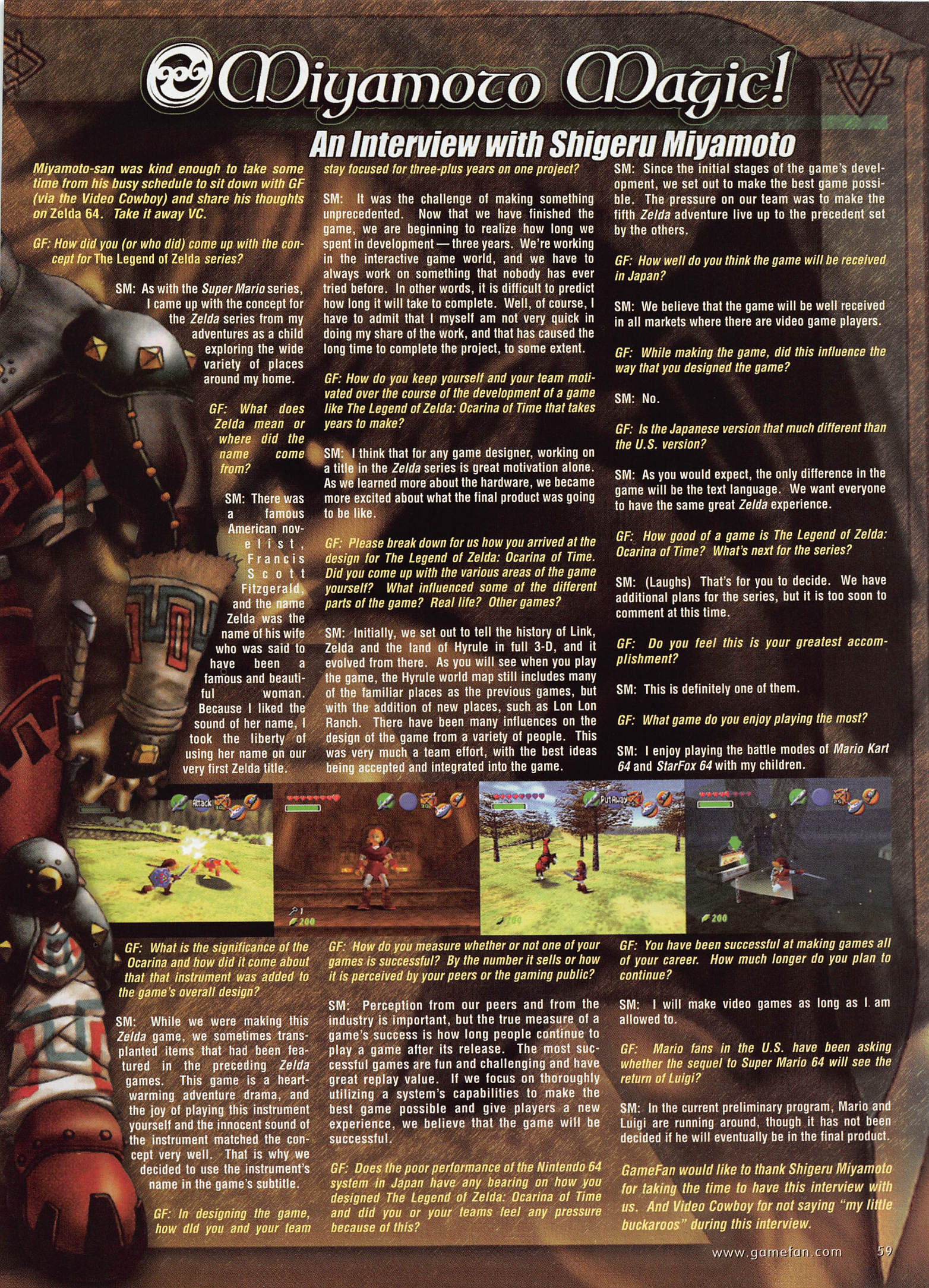
Summary: He came up with the concepts for Mario and The Legend of Zelda from his childhood explorations.
Zelda’s name comes from Francis Scott Fitzgeralds’s wife.
They used some ideas in The Legend of Zelda: Ocarina of Time from previous Zelda games. The joy of playing the innocent-sounding ocarina fit the game.
It was challenging to make something unprecedented over the course of three years. It’s his fault it took so long, to some extent. Working on a Zelda game is good motivation, but learning about the N64 was exciting too.
Their initial goal was to describe the history of Link, Zelda, and Hyrule in 3D. There are familiar places and new ones. It was a team effort, with the best ideas making it in.
The true measure of the success of a game is how long people play it after release.
He thinks Ocarina of Time will be well received everywhere.
The only difference between the Japanese and U.S. versions is the language.
He likes playing the battle modes of Mario Kart 64 and Star Fox 64 with his children.
He’ll make games as long as they allow him to.
Mario and Luigi can run around together in the Super Mario 64 2 prototype, but he’s not sure if that will be possible in the final release.
gM (untranslated from Japanese)
Publication Date: January, 1999
Subject(s): The Legend of Zelda: Ocarina of Time
Format: Transcribed interview
People: Unknown gM interviewer, Shigeru Miyamoto
Japanese Archive Link: https://archive.org/details/gM-1999-01/gM%201999%2001/page/6/mode/2up
Scans:
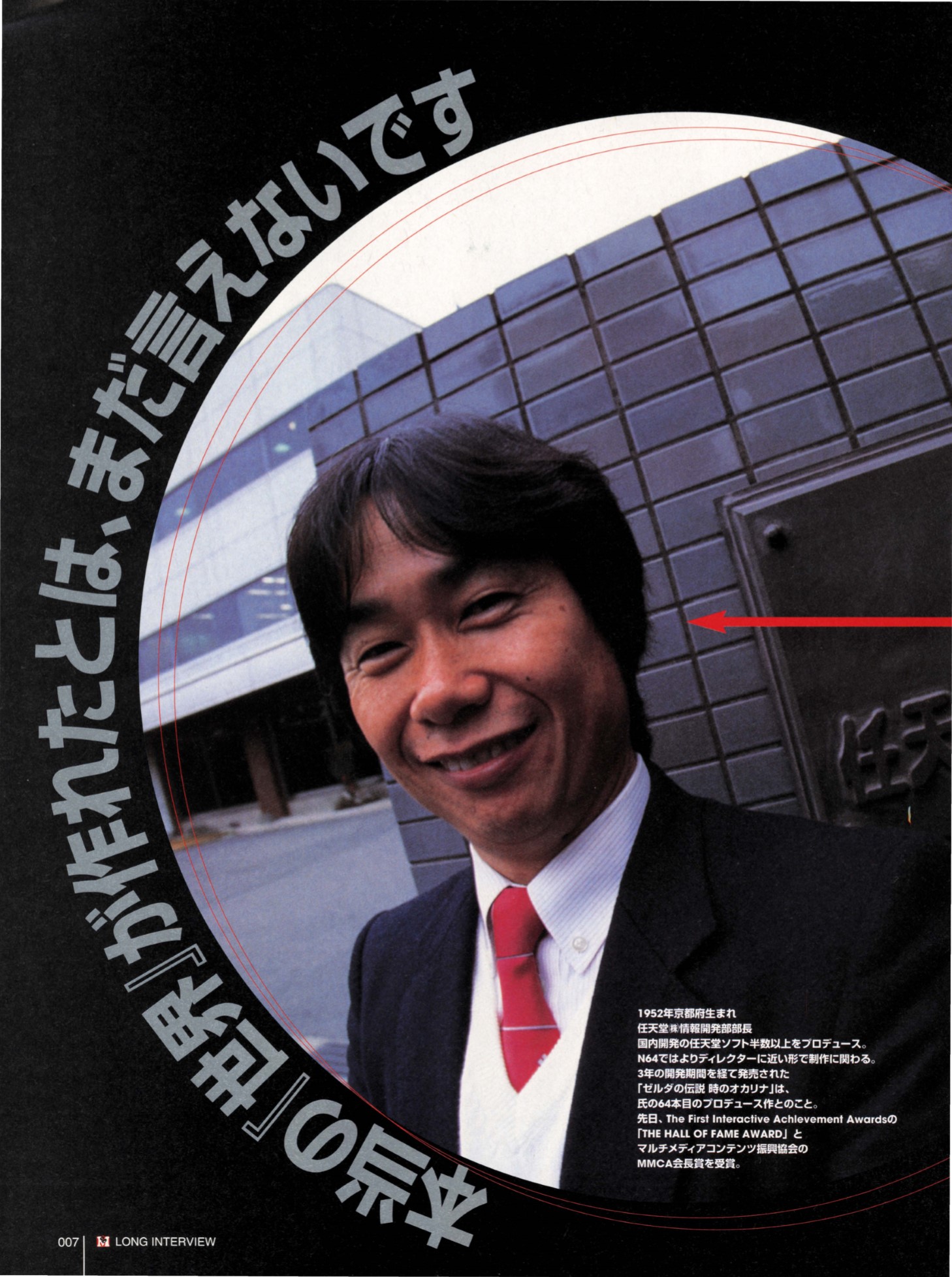


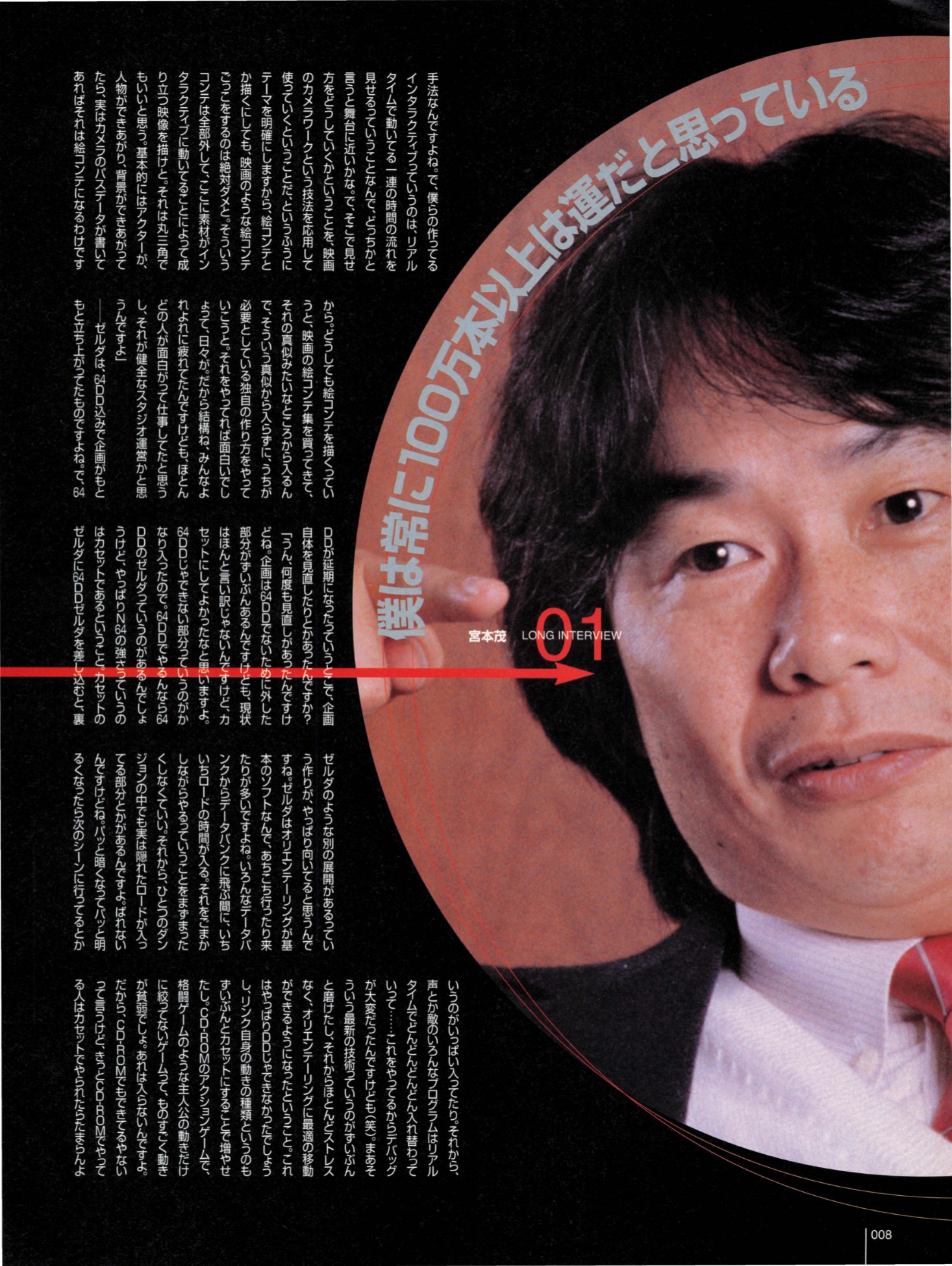
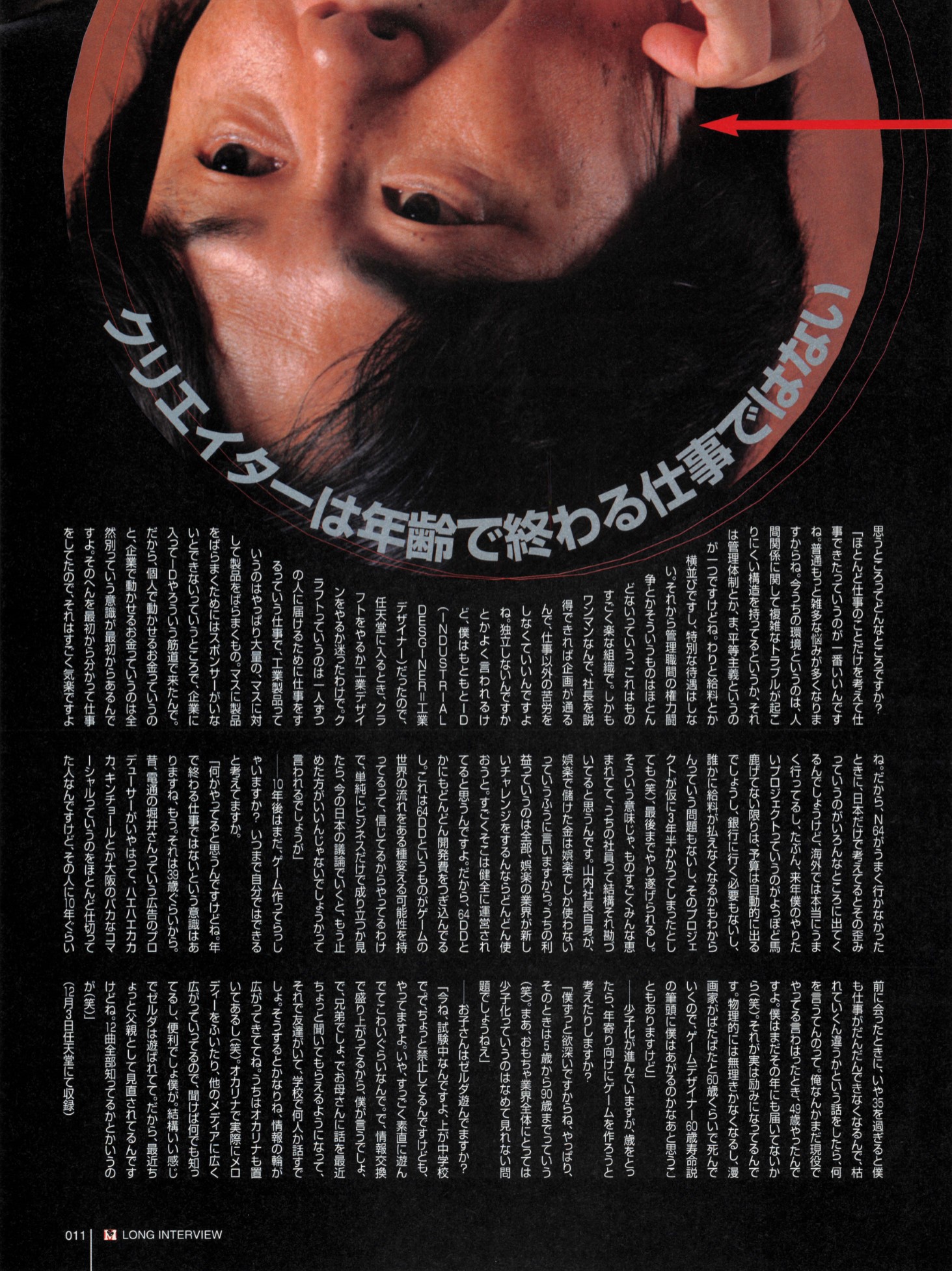
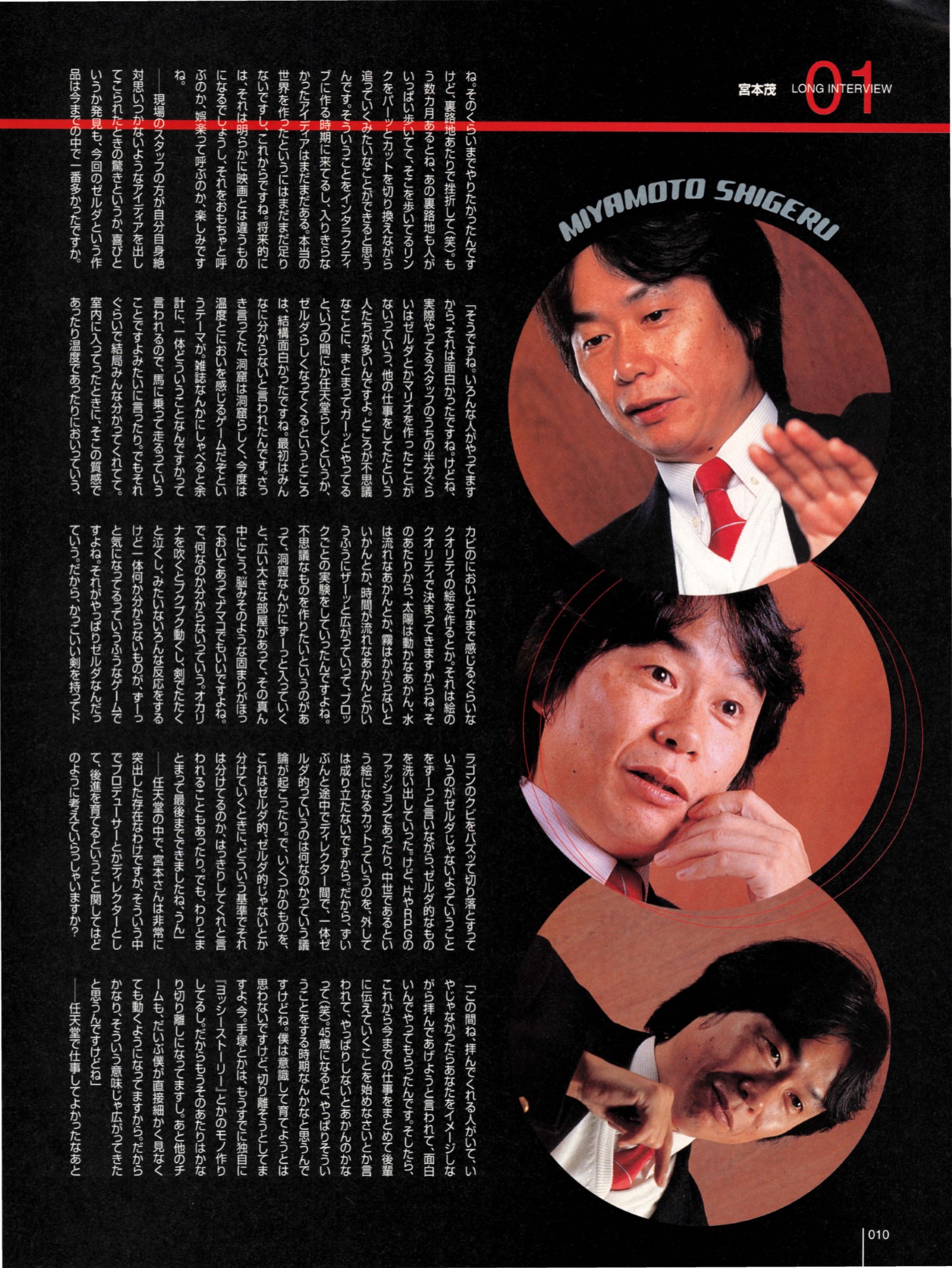
Notes: This was the first issue of gM. This interview took place December 3, 1998 if a machine translation is accurate. Scans by Detchibe.
1101.com: Miyamoto Talks Zelda Once More
Publication Date: January 3, 1999 (translated January 1, 2011)
Subject(s): The Legend of Zelda: Ocarina of Time, 1080º Snowboarding
Format: Essay
People: Shigeru Miyamoto
Link: https://glitterberri.com/miyamoto-talks-zelda-once-more/
Archive Link: https://web.archive.org/web/20230127003154/https://glitterberri.com/miyamoto-talks-zelda-once-more/
Japanese Link: https://www.1101.com/nintendo/nin1/nin1-21.htm
Japanese Archive Link: https://web.archive.org/web/20220708071101/https://www.1101.com/nintendo/nin1/nin1-21.htm
Translator: GlitterBerri
Notes: 1101.com is Shigesato Itoi’s website. This was the 21st of 21 Ocarina of Time articles on 1101 and it doesn’t appear to be an interview, just something Mr. Miyamoto wrote.
Summary: Hitting a rock with your sword made a thud sound, but he had it changed to a clang. It’s tough to double-check all of the details. He doesn’t have any particular emotional attachment to any place in the game, but he’d like you to notice the things that are incomparable to any other game. The base play time is 20-30 hours.
The second half of development was about sub-events and the ocarina. He told the designers to put in a terrible enemy for the final boss, that’s his involvement. No one can agree on what exactly makes something Zelda-esque. The people working together for the first time didn’t get any instructions from him.
He’d like to work on a game that isn’t part of a series. Few teams are completely carried over to another game. Usually about half are kept.
He’d like to recommend 1080º Snowboarding to everyone who bought a Nintendo 64 for The Legend of Zelda: Ocarina of Time. It didn’t sell well since it was released after the Nagano Winter Olympics. The boards are 1999 models from LAMAR.
TechTV
Publication Date: January 8, 1999
Subject(s): The Legend of Zelda: Ocarina of Time, Super Mario 64
Format: Interview
People: Lauren Fielder, Shigeru Miyamoto
Link: https://www.zeldadungeon.net/wiki/Interview:Tech_TV_January_8th_1999
Archive Link: https://web.archive.org/web/20130426180651/http://www.zeldadungeon.net/wiki/Interview:Tech_TV_January_8th_1999
Notes: This interview took place before the release of The Legend of Zelda: Ocarina of Time, which was in November, 1998. The video footage of this interview seems to be lost.
Summary: The game magazine people have enjoyed The Legend of Zelda: Ocarina of Time. Ocarina of Time has been the hardest game to develop, so he hopes it will be the best one too.
Super Mario 64 used about 60% of the Nintendo 64’s power, Ocarina of Time uses about 90%.
They are always trying to make something new and more interactive. Some people are used to beautiful pre-rendered graphics and Zelda games might not look good enough to them, so they encourage the development of further interactivity.
Super Mario 64 is a new type of game with new camera actions. Ocarina of Time has the same themes as other Zelda games, yet there are new elements. You don’t play as Link, you become Link.
He usually comes up with ideas while talking to programmers and creators.
The ideal number of people working on a game is 15. Ocarina of Time started with 25 and grew to 50, which is too much to take care of.
His favorite part of Ocarina of Time is riding on a horse and watching the sun set and rise. He also likes the events that aren’t necessary to beat the game, like fishing and playing the ocarina.
He is currently working on Mario Artist, Paper Mario, and Mother 3, and they are experimenting with connecting the Nintendo 64 and Game Boy.
He doesn’t know the future of games, there’s a new discovery every day. Graphics will get better but they should emphasize new ideas.
IGN: Sensei Speaks: Shigeru Miyamoto Interview
Publication Date: January 29, 1999
Subject(s): Super Mario 64, The Legend of Zelda: Ocarina of Time, 64DD, The Legend of Zelda: Ocarina of Time Master Quest, Super Smash Bros.
Format: Transcribed interview
People: Matt Casamassina, Peer Schneider, Shigeru Miyamoto
Link: https://www.ign.com/articles/1999/01/30/sensei-speaks
Archive Link: https://web.archive.org/web/20130820235938/https://www.ign.com/articles/1999/01/30/sensei-speaks
Translator: Minagawa-san for IGN.
Notes: The “Mr. Yawara” referred to is most likely someone mishearing “Iwata”, as in Satoru Iwata.
Summary: He was the principal director of Super Mario 64, with assistant directors. With The Legend of Zelda: Ocarina of Time he was the producer with many directors under him. Around 50 people were working on it by the end, he learned a lot from managing a team that size. They are still amateurs at making 3D games.
The biggest question was whether they could be called games, and whether players would like them. Many game developers are turning their games into movies. They don’t intend to make movies, but they are trying to make their games more cinematic, and to use technology from movies. Moving the camera and letting characters move in real time gives the feel of a movie. Other games use pre-rendered cutscenes.
He tries to have a theme for every game. He doesn’t play many games, but the idea for Star Fox came to him after playing PC games. Camera angles in games tend to be chosen by game creators, but Super Mario 64 is different.
Ocarina of Time was made with the 64DD in mind. He has ideas they didn’t have time to add. If they aren’t able to release 64DD version of Zelda they may have to release a special edition through a contest or something.
Resident Evil would have been better on the Nintendo 64, but that was an idea he wanted to do himself. PaRappa the Rapper comes close to his ideals, too.
He hopes Zelda is the high point of the N64. It can appeal to anyone from eight to 70 years old if they did it right.
In Ocarina of Time he wishes they could have fine tuned the synchronization between the music and sound and the actions more. He’s not totally happy with the 3D system.
There are many more Miyamotos, Ocarina of Time can be claimed by many of the people who made it, and they can make their own games. Newcomers were supported by old timers.
Game designers need to be creative and to be able to stand up against the marketing people at their company.
There has been a display on his desk of Mario and Luigi for a year now. The plan was for Super Mario 64 2 to be a 64DD game.
1999 will see the release of the Mario Artist series. Paper Mario and Mother 3 may release then as well.
Super Smash Bros. is being made by Mr. Yawara, who created Kirby, and his group. It should release in January. Hudson is also making Mario Party, a board game. Banjo-Kazooie had a better 3D system than Super Mario 64, there can be lots of enemies on screen at once.
The Ocarina of Time engine was almost made from scratch and it would be a shame to not use it again. There are about five modes for making 3D scenes, which are to show game designers the potential of the N64.
He hopes Ocarina of Time isn’t too influential since it took so long to make. Consumers are getting more critical, and making something on that scale takes a long time. Game creators should understand and appreciate smaller experiences.
He’s not sure anyone at Nintendo is being trained to make 2D games. He’s always telling himself he should make something new. He’s working on several projects, but it remains to be seen if they will be fun.
The Nintendo 64 Expansion Pak is necessary for the 64DD, so they will be making use of it. Games converted from the 64DD to cartridge will likely need it. They are also working on high resolution games that will need it.
If he had to be locked into one of his games it would be Zelda because Hyrule is relaxing. He’d choose a SCUBA diving game if they had one.
Shogakukan Link’s Awakening DX Strategy Guide
Publication Date: February, 1999 (translated March 1, 2011)
Subject(s): The Legend of Zelda: Link’s Awakening DX
Format: Q & A
People: Shigeru Miyamoto
Link: https://glitterberri.com/staff-questionnaire/
Archive Link: https://web.archive.org/web/20230128004312/https://glitterberri.com/staff-questionnaire/
Scan:
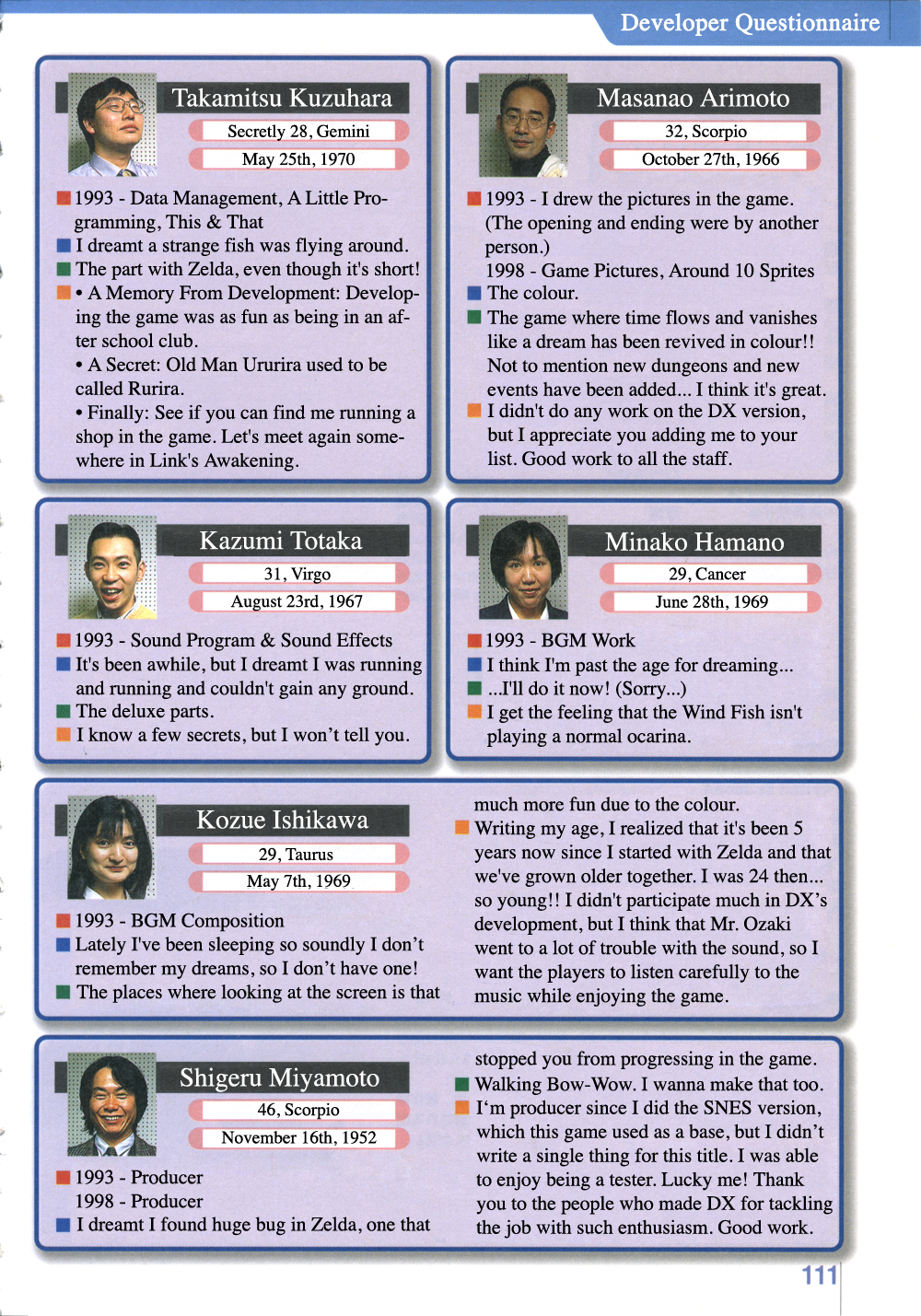
Translator: GlitterBerri
Notes: Scan by Lavacopter. The prompts were what they did on the game, a recent dream, what they liked about the DX version, and a message.
Summary: He was the producer, he had a dream he found a progression-blocking bug in the game, he likes walking Bow-Wow, and he didn’t write anything for this game but he tested it.
Gamers’ Republic: Interview With Mr. Miyamoto
Publication Date: February, 1999
Subject(s): The Legend of Zelda: Ocarina of Time, realism, movies and games, 64DD, impressive developers, future N64 games
Format: Transcribed interview
People: Gary Harrod, Yasuhiro Minagawa (translator), Shigeru Miyamoto
Scans:
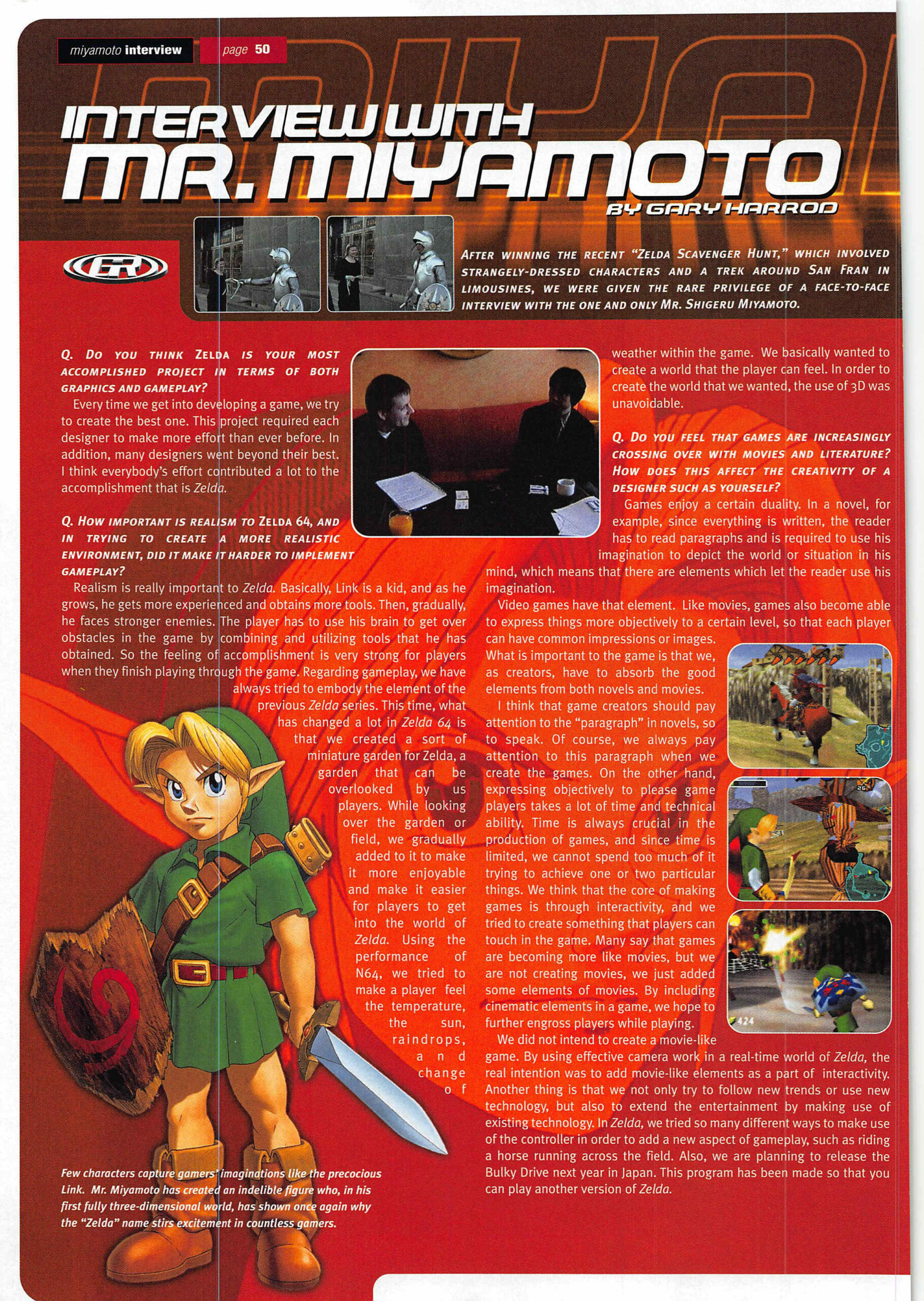
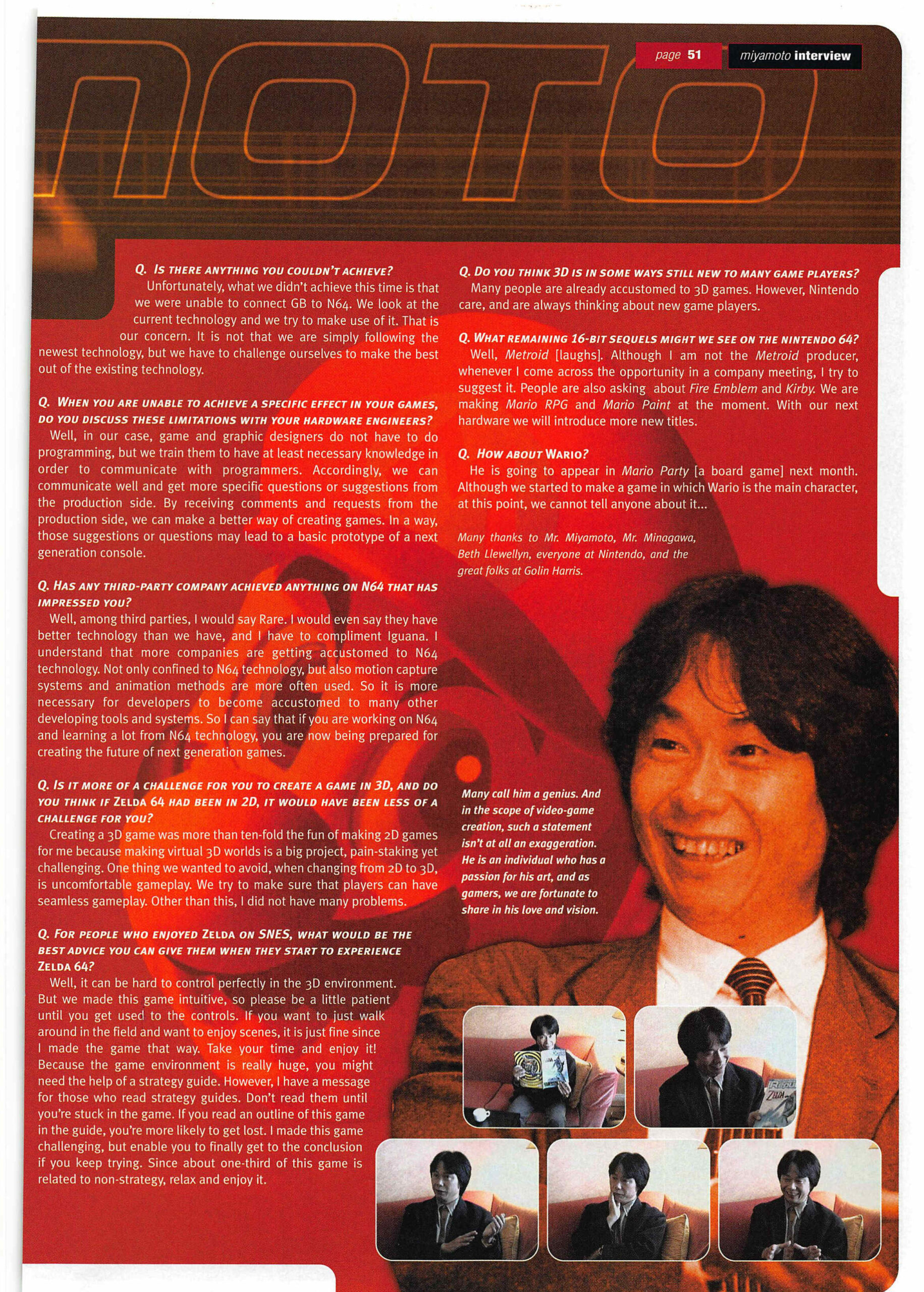
Notes: This interview took place in San Francisco. Scans by RetroCDN.
Summary: They try to make the best game every time. Every designer on The Legend of Zelda: Ocarina of Time made a greater effort than they ever had before, going beyond their best.
Realism is important for The Legend of Zelda series. They’ve created a miniature garden for Ocarina of Time. They’ve tried to enable the player to feel the temperature, sun, and raindrops. They had to use 3D to create this world.
You have to use your imagination when you read a book. Movies and games can express things objectively. Game makers have to use the best elements from books and movies, and to pay attention to the “paragraph”. Time is always limited when making games. Interactivity is the core of games. They aren’t making movies, they are just incorporating some elements from them, like effective camera work. They try not to follow trends, and to use existing technology. The 64DD will allow for a different version of Ocarina of Time to be played.
They weren’t able to connect the Game Boy and N64.
Nintendo’s game and graphics designers need to have enough programming knowledge to talk to their programmers.
He has been impressed with Rare, they may have better technology than Nintendo. Iguana, too.
Making 3D games is more than 10 times more fun than making 2D games. They had to make sure 3D games didn’t have uncomfortable gameplay.
Perfect control can be hard in 3D, so players should be patient until they get used to the controls in Ocarina of Time. It’s ok to walk around and enjoy the scenes. He advises not reading a strategy guide unless you get stuck. A third of the game is not related to strategy, enjoy it.
He tries to suggest a 3D Metroid at company meetings. They are working on Mario Paint and a Mario role-playing game for the N64. He knows people want Fire Emblem and Kirby.
Wario will be in Mario Party. They’ve started on a game where Wario is the main character but he can’t talk about it yet.
Next Generation: Minitalk: Shigeru Miyamoto
Publication Date: February, 1999
Subject(s): Super Mario 64, camera systems in 3D, The Legend of Zelda: Ocarina of Time
Format: Transcribed interview
People: Unnamed Next Generation interviewer, Shigeru Miyamoto
Scan:

Notes: Scan by Retromags.
Summary: People knew it was possible to make a game like Super Mario 64, but no one knew how to do it. When he makes a game he tries to make something unique. When playing computer games he realized that cameras were key to 3D games. Many used fixed angles because it was convenient for the developer, rather than the player. He wanted the camera to be free for Super Mario 64. In The Legend of Zelda: Ocarina of Time the focus is the world, so the camera angles show the environment.
Ocarina of Time was made with the 64DD in mind. He didn’t have time to implement all of his ideas. They may release a special edition cartridge instead of releasing it on the 64DD.
He’s not completely happy with some of the animations in Ocarina of Time. Many ideas that weren’t used will make their way into other games.
Other developers were an important part of Ocarina of Time, they will be able to be directors on future games.
He competes with himself more than with other developers. Being creative and being a marketer are different things, and it’s rare for someone to be able to do both. You have to push for creative independence. People could make better games if they were unhindered by the marketing department.
Super Mario 64 2 has remained a prototype on his desk. Luigi and Mario are together.
Gamejin: Nintendo Dojyo
Publication Date: February, 1999
Subject(s): The Legend of Zelda: Ocarina of Time, aiming reticules, Epona, puzzles, his interests, practical jokes, Super Mario 64 2
Format: Transcribed interview
People: Unknown Gamejin interviewer, Shigeru Miyamoto
Link: https://goodblood.games/ootmiyamotogamejin1998
Archive Link: https://web.archive.org/web/20250225235151/https://goodblood.games/ootmiyamotogamejin1998
Japanese Archive Link: https://archive.org/details/Gamejin-February-1998/Gamejin%20February%201998/
Scans:
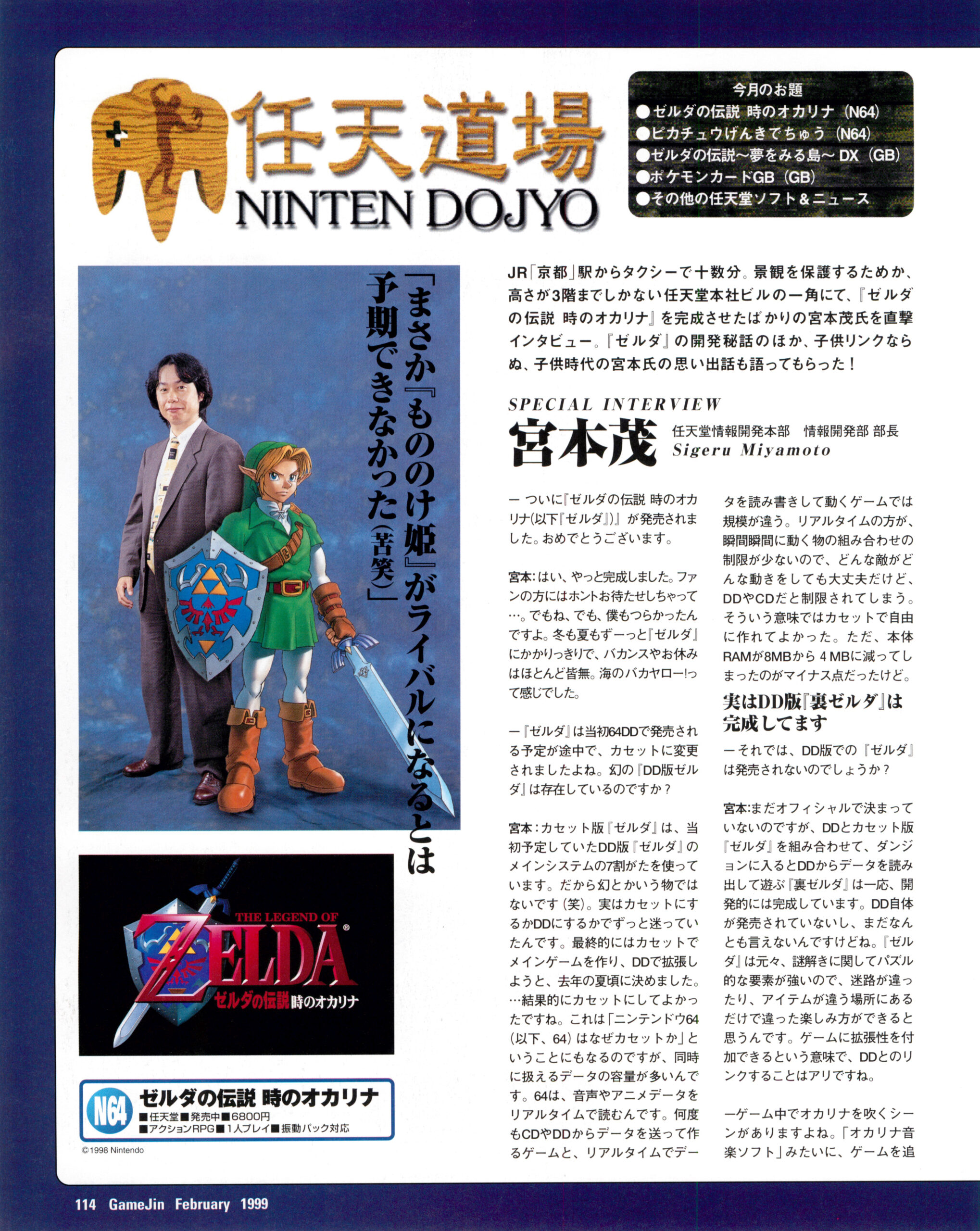
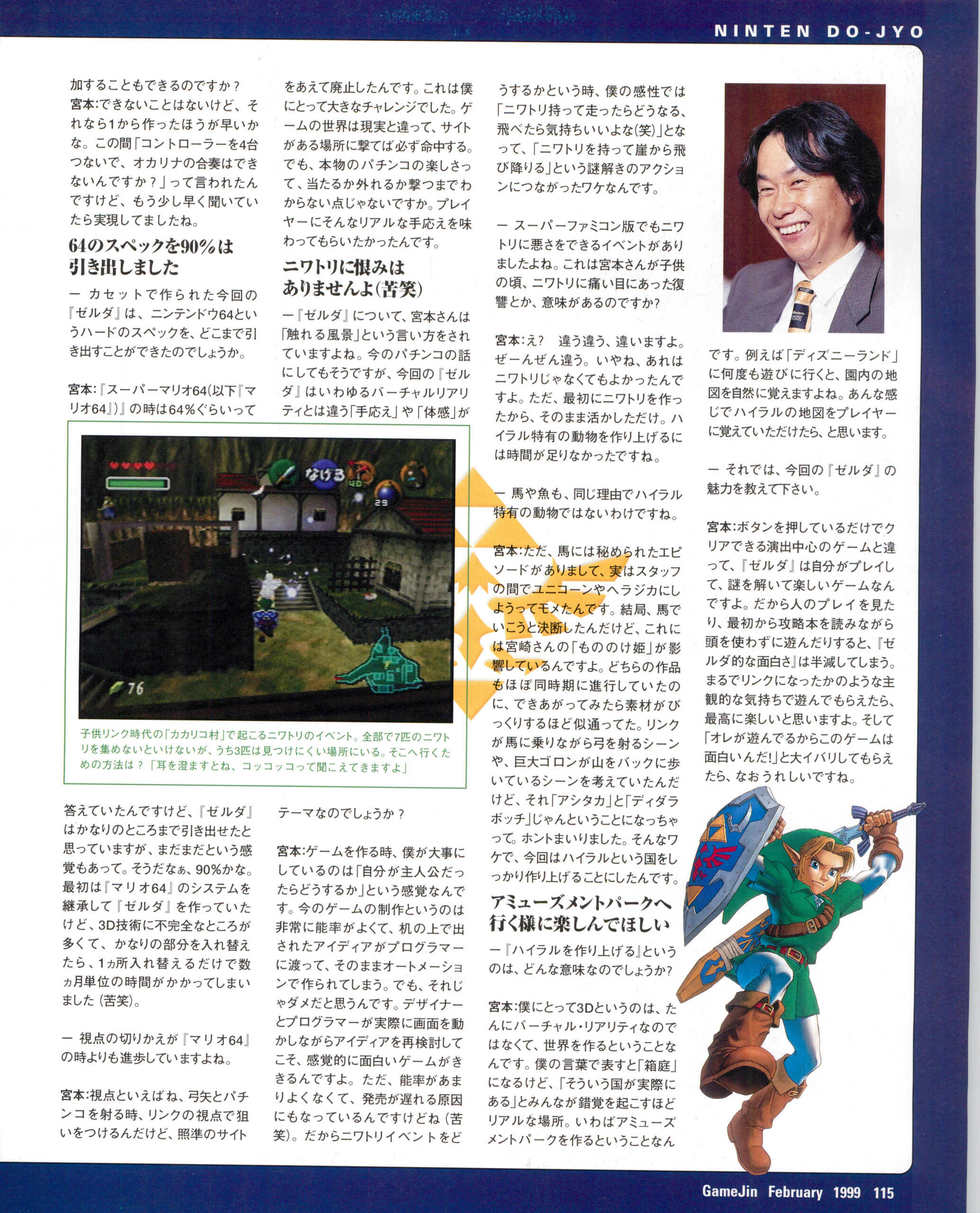
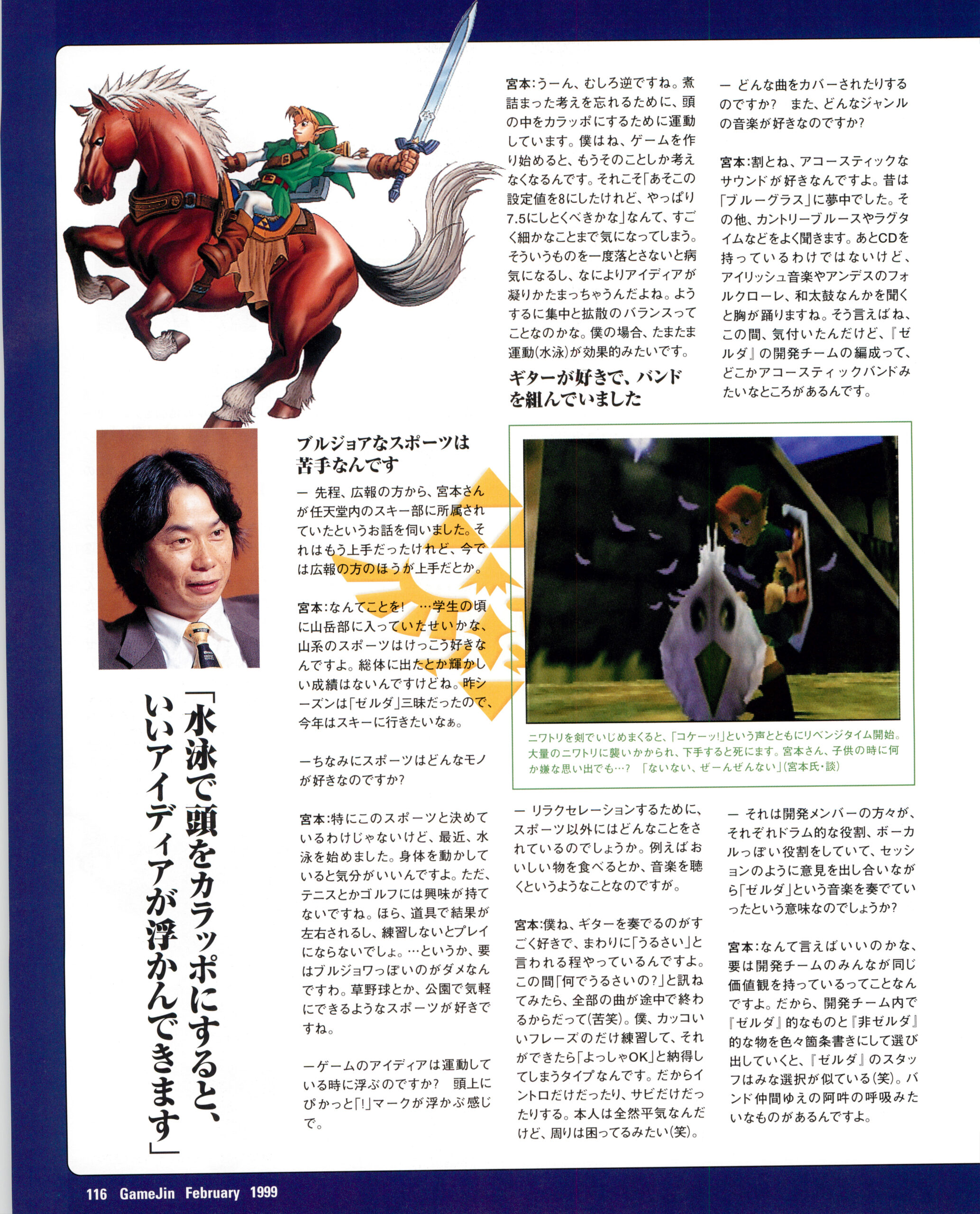
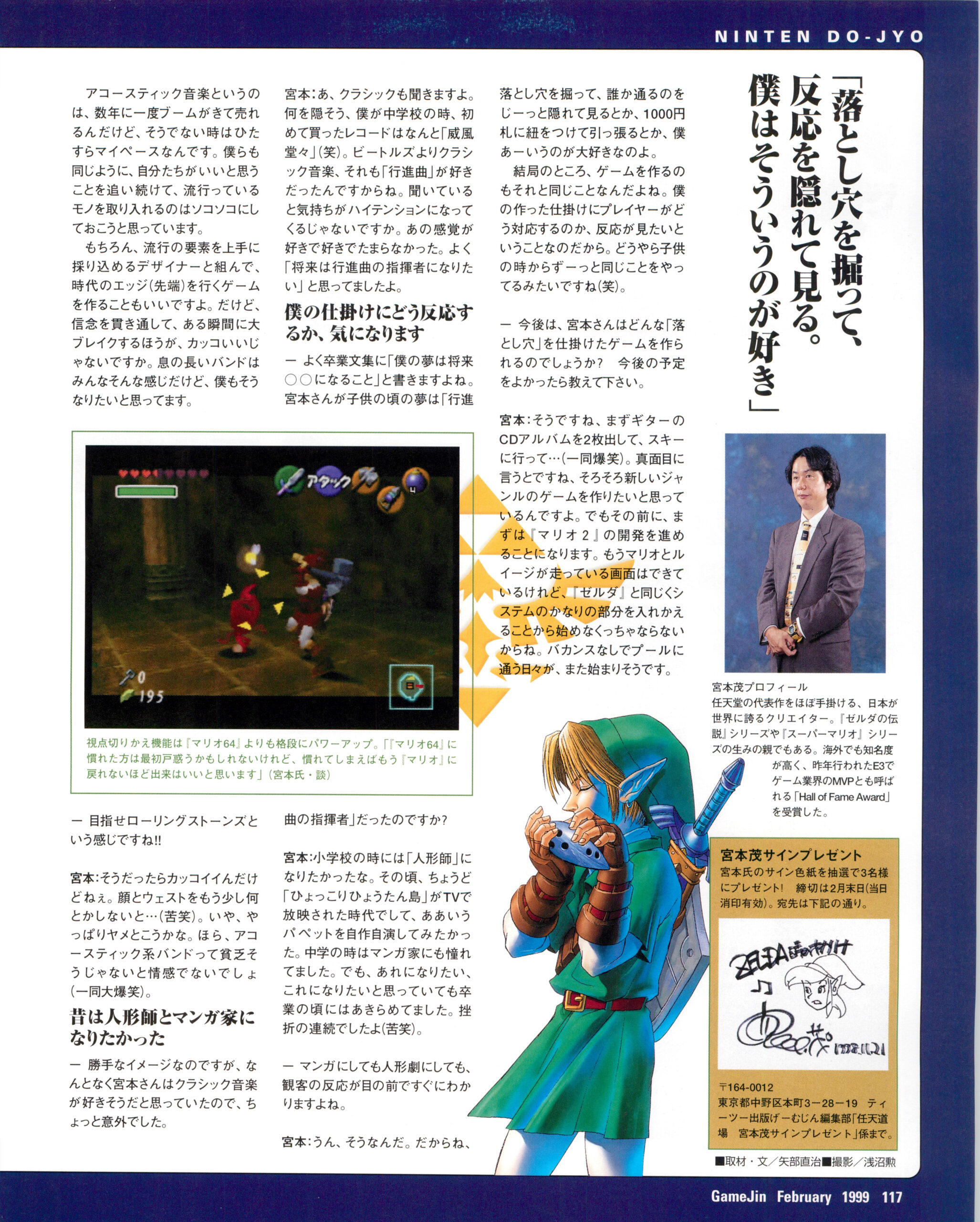
Translator: Rory for goodblood.games
Notes: Before this was translated it was difficult to tell if this was released in February 1998 or February 1999, but since the interview talks about The Legend of Zelda: Ocarina of Time as having been recently released the interview must have been conducted in late 1998 or early 1999 and the issue released in February 1999. Mr. Miyamoto refers to “Mario 2”, by context he is talking about Super Mario 64 2.
Scans by Detchibe.
Summary: Thanks to the fans who waited for The Legend of Zelda: Ocarina of Time to be released. He only thought about Zelda through the winter and summer.
They thought a lot about whether to release Ocarina of Time on cartridge or on the 64DD. The decided in the summer to use a cartridge and expand it with the 64DD. Reading data in real time from a cartridge has fewer restrictions. The 64DD version is completed.
They plan on combining the cartridge and 64DD versions so that you can enter a dungeon and then the disc is read, which gives you access to a new dungeon. The Legend of Zelda has roots in puzzle solving using items, which allows for a lot of fun ways to play. The 64DD can allow them to expand the puzzle solving possibilities.
They could possibly add the ability to make ocarina music, but it would probably be easier to make such a thing from scratch. He asked if four controllers could be used to create an ensemble.
Super Mario 64 used about 64% of the N64’s capabilities. Ocarina of Time used about 90%. They started with the same tools as Mario 64, but had to adjust a lot of things.
It was difficult for him to include the aiming reticle in first person. You know your shot will always land, but the fun of a real slingshot is not knowing if you’ll hit your target.
The idea of “what would I do as the main character?” is important to him when making a game. Ideas are given to programmers to implement, but that’s not good enough. Designers and programmers need to work together to make a game that is interesting from a sensory point of view. This is slower, but leads to things like falling slowly if you walk off a ledge while holding a cucco.
Some people wanted Epona to be a unicorn or a moose. Ocarina of Time was influenced by Princess Mononoke, which was in development at about the same time. There are some similarities, but they built Hyrule to differentiate it.
3D worlds are a kind of box garden, a place that feels real. If you visit Disneyland often you will memorize the layout of the park. They want players to memorize Hyrule in that way.
The Legend of Zelda is appealing because of its puzzle solving elements. Watching someone play or following a strategy guide reduces the Zelda-like fun.
He was in the mountaineering club as a student. He is excited to go skiing again now that he’s not so busy.
He enjoys swimming and he has no interest in golf or tennis. They are a bit bourgeois since the equipment and how much people have practiced affects the outcome.
He exercises to empty his mind, but he obsesses over details when he’s working on a game. He has to get the ideas out or he feels sick.
He plays the guitar often but he quits a song after the cool part.
He likes acoustic music, country blues, and R & B. He used to be really into bluegrass.
It’s easy to tell what ideas belong in a Zelda game. His team doesn’t just do what is popular. It’s cool to stick to what you believe in and make a big breakthrough.
He likes classical music, too. More than the Beatles. His first record was Pomp and Circumstance. He used to want to be a conductor.
He also wanted to make puppets like he saw on Hyokkori Hyotanjima. In high school he wanted to be a manga artist.
He loves practical jokes, it’s the same thing as making a game. He loves seeing how people react to his tricks.
He’d like to make a new genre of video game soon, but first he has to work on Super Mario 64 2. They have Mario and Luigi on screen together, but they have to replace a lot to get it working.
Game Developers Conference 1999 Keynote Speech
Publication Date: March 15, 1999
Subject(s): Game development, The Legend of Zelda: Ocarina of Time
Format: Presentation (spoken English, live translator)
People: Jennifer Pahlka, Jim Merrick, Bill Trinen (translator), Shigeru Miyamoto
Video:
Notes: Jennifer Pahlka, who I assume works for GDC, and Jim Merrick talk about Mr. Miyamoto before his speech. There is a short video going over some of his biggest games. IGN has a full transcript.
Summary: It would make him happy if what he talks about helps games be consistently fun to play. He would like to talk about three things today: the history of game design, the development of The Legend of Zelda: Ocarina of Time, and the future of game design.
Programmers and engineers used to design games, they even did the music and graphics. When, as an artist, he got involved in game design, he said he was one of the five best in the world because there were so few. With Donkey Kong we saw stories accompany games. Due to Dragon Quest and The Legend of Zelda, scenario writers started to lead game design. With arcade games the goal was to get people to spend their quarters, but paying a quarter for an inning of baseball, or getting to play less Mario Bros. because you did well started to become unacceptable to players. The Famicom allowed them to make games not for the arcade.
Though he is not an engineer, he designs games that consider the technology. People have told him that he should make movies, but he believes his strength is his pioneering spirit to make interactive games. He has been able to learn game design from scratch, slowly over time. Sometimes the idea for a hit game comes from a conversation with an ordinary person.
Sometimes he hits a wall with development, and sometimes developers have to release a game that isn’t ready. Sometimes it is because the developers don’t grasp the technology. When a game’s fun hinges on its technology, it can be difficult to judge how good it is until it is complete. Game developers are to blame when these games are not fun, but since there is no concrete definition of game designer, he can’t say for sure it is their fault. Painters and scenario writers can have an incomplete understand of the technology involved. Because he has been developing games since the dawn of the industry, he sees that game designers must envision a complete game system by understanding the technology involved. Games are entertainment, so he places great importance on the user’s reaction.
Things like how high Mario can jump are easily changed, but even a small change can greatly alter the feel of the game. At Nintendo, all designers undergo technical training. Good design requires management of the memory map and estimating the processing speed. Players and non-technical workers may make the mistake of thinking that the game behaves like the real world, but the laws of nature have to be put into the game. When developing Super Mario Bros., they used Excitebike sounds as placeholders, Mario would make an engine sound when jumping. Sometimes they misjudge how long part of a game will take to develop, especially veterans. Only about 1/3rd to 1/4th of the programs and sequences in a game may be unique to that game.
We can’t forget human ingenuity when it comes to game design. Recently a number of titles have led with their technology, rather than the personality of their developers. Game creation to him is like music or poetry. He places great importance on tempo and sound effects. Developers tend to boast about the technical aspects of their work, but it’s important that technology inspire from the background.
The Legend of Zelda: Ocarina of Time started with four or five teams experimenting. The scenario and planning team discussed the game’s position within the series. He was on the team responsible for Link’s actions and items. He also worked with the team experimenting with cameras. They worked with background virtual boxes and fixed-camera modes. Another team worked on the items Link touches and uses. There was a team working on motion capture. They continued to form new teams as needed. There was a sound team, a special effects team and a team working on the flow of time.
They have uncovered a number of ways of stimulating the player’s emotions. Cinematic sequences are one such method. There are over 90 minutes of these sequences in Ocarina of Time. The staff was for these was kept small, from three to seven people. There is a limit to how much work a team can do, including him. They decided not to spend their limited time making pre-rendered sequences, but to polish the game. He changed the scenario three months before release, but they were able to make changes quickly because of the lack of pre-rendereed sequences.
It’s not time to start work on the next generation of Zelda because the things that were praised about Ocarina of Time were in the game a year before it was completed, when he thought they game wasn’t fun to play. The reason it has received so much praise isn’t because of the N64, the unique camera, the auto-jump, the cinematic sequences, or the boss fights. Even with better hardware, he can’t guarantee the game will be fun. He wants to come up with new ideas without worrying about costs. More people are playing video games, but he worries they are all just repeating the same experiments. He did not feel the same freshness with Ocarina of Time that he had with Super Mario Bros. He wants to convey the charm of video games to the general public.
He’s working on a game called Talent Maker where you can create your own characters with the Game Boy Camera. They will be working on combining the Game Boy, Game Boy Camera, Rumble Pak, and others with the N64. They are working on Pokémon Channel, which will use voice recognition, and using the Game Boy as a controller for the N64. While working on Super Mario 64 they saw the huge popularity of Tamagotchi, and he thought they had lost. Let us create unique, fun software with new appeal. Let us take on new challenges so gaming does not become closed off, and let’s make some money.
Happy Puppy: Happy Puppy talks with a legend
Publication Date: March 19, 1999
Subject(s): The Legend of Zelda: Ocarina of Time, too much freedom, game design 20 years ago versus now, online gaming, hiring at Nintendo, envy, favorites
Format: Transcribed interview
People: Raymond M. Padilla, Shigeru Miyamoto
Archive Links: https://web.archive.org/web/20000608170207/http://www.happypuppy.com/features/interviews/miyamoto-in-1.html
Notes: This interview took place at the 1999 Game Developer’s Conference.
Summary: They’re looking into what comes after The Legend of Zelda: Ocarina of Time, he comes up with ideas while working on a game.
Too much freedom spoils the joy, and newcomers will be more hesitant to try.
Nintendo is interested in the internet, but they have to be careful. Games are fun when you can see someone else’s reaction, there will be less interest if there isn’t a chat system.
Thinking about game designers 20 years ago, there’s a Japanese saying that if you’re too big your wisdom can’t spread throughout your whole body. Games are so big now that you can’t concentrate on everything. It’s harder to focus on your original vision.
Game developers should focus more on interactivity than making games look ornate. Games made by different companies look very similar.
Ocarina of Time used about 90% of the N64’s power. It was interesting because it was 3D, but they don’t have to just make 3D games. They have to ask if they need 3D.
He’s always tried to make games that feel comfortable and fresh.
They don’t hire people who just play games at Nintendo. He tells children to make things with their own hands. Listening to criticism is an important part of being an artist.
He gets envious when he sees someone else make a game that he wanted to make, like SimCity.
Pac-Man is his favorite game, and Donkey Kong is special to him because it was his first game.
The 64Dream: Let’s talk about Zelda with Mr. Miyamoto again! (Reported on by DidYouKnowGaming, partially untranslated from Japanese)
Publication Date: April, 1999
Subject(s): The Legend of Zelda: Ocarina of Time
Format: Transcribed interview
People: Unknown The 64Dream interviewer, Shigeru Miyamoto
Video: https://www.youtube.com/watch?v=KxGHqoPAoUA&t=671s
Archive Link: https://archive.org/details/64dream-April-1999-ozidual/
Scans:
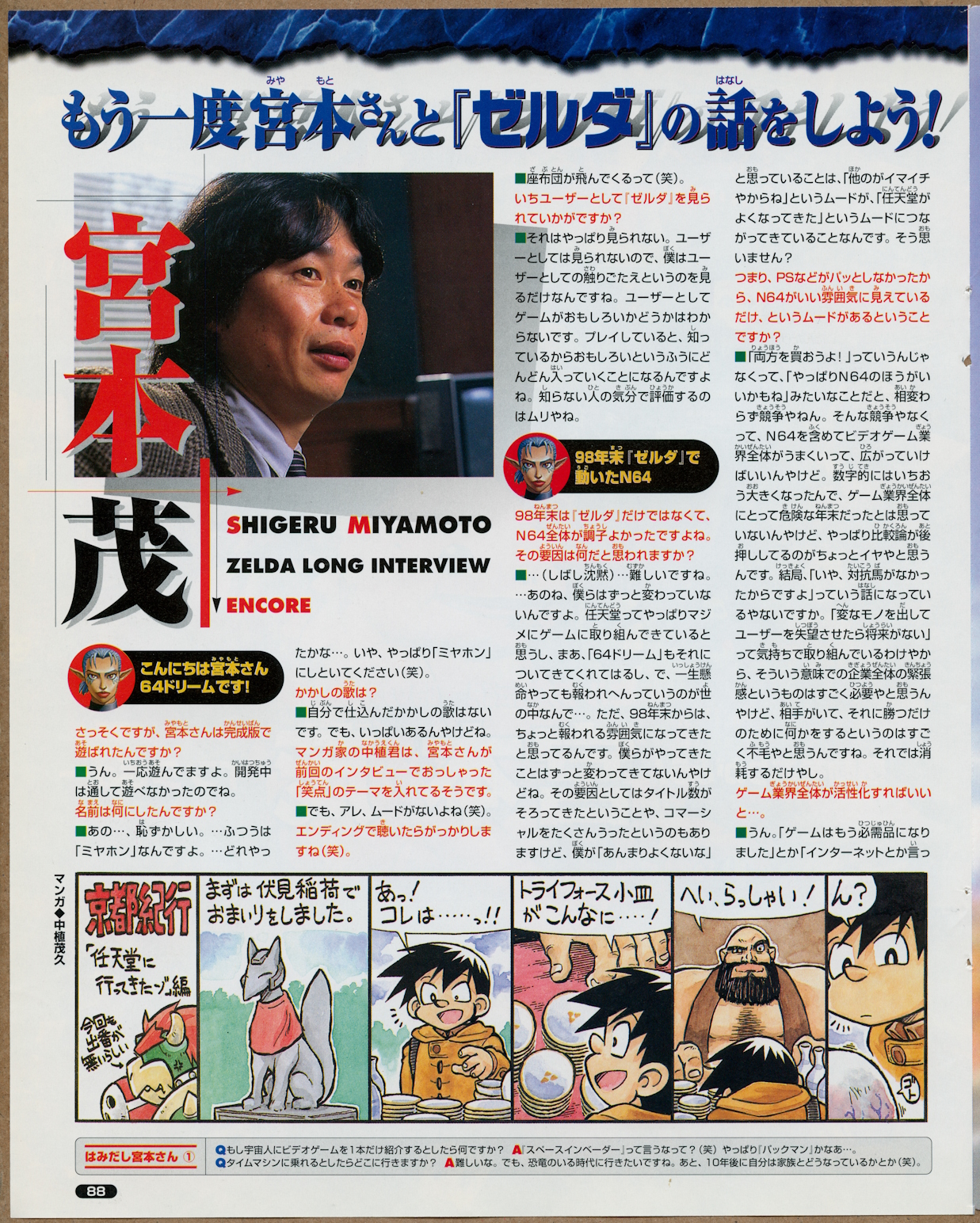
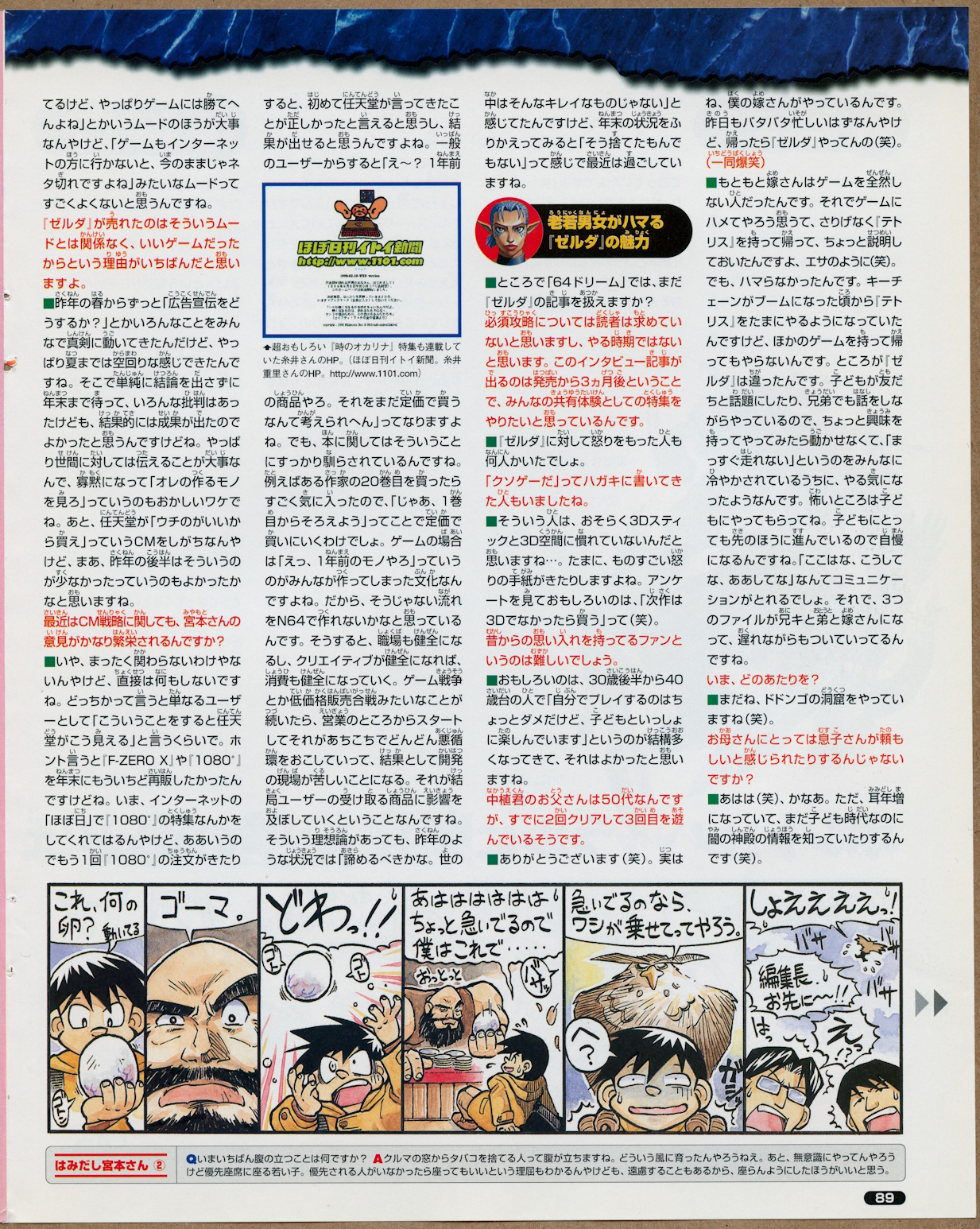
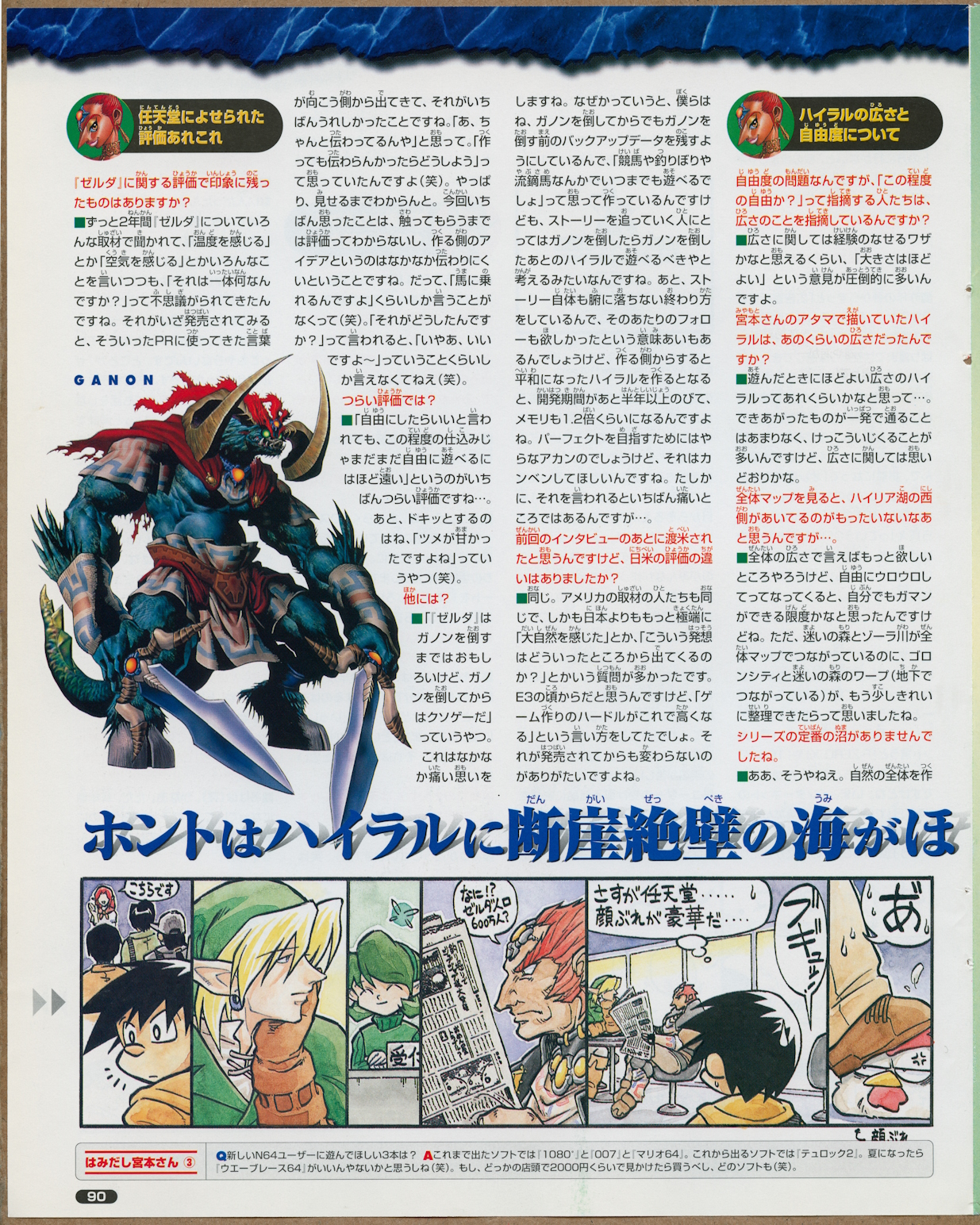
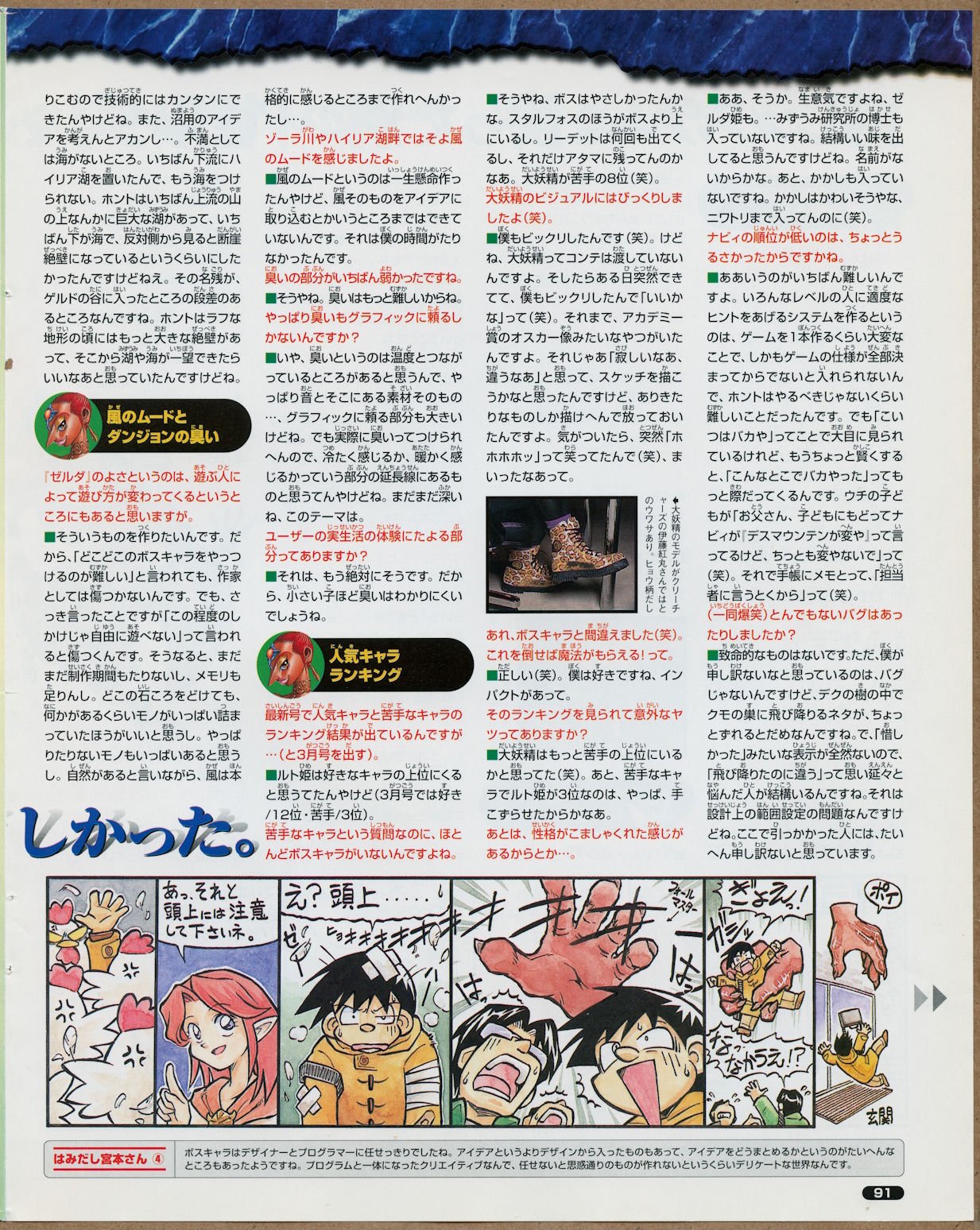
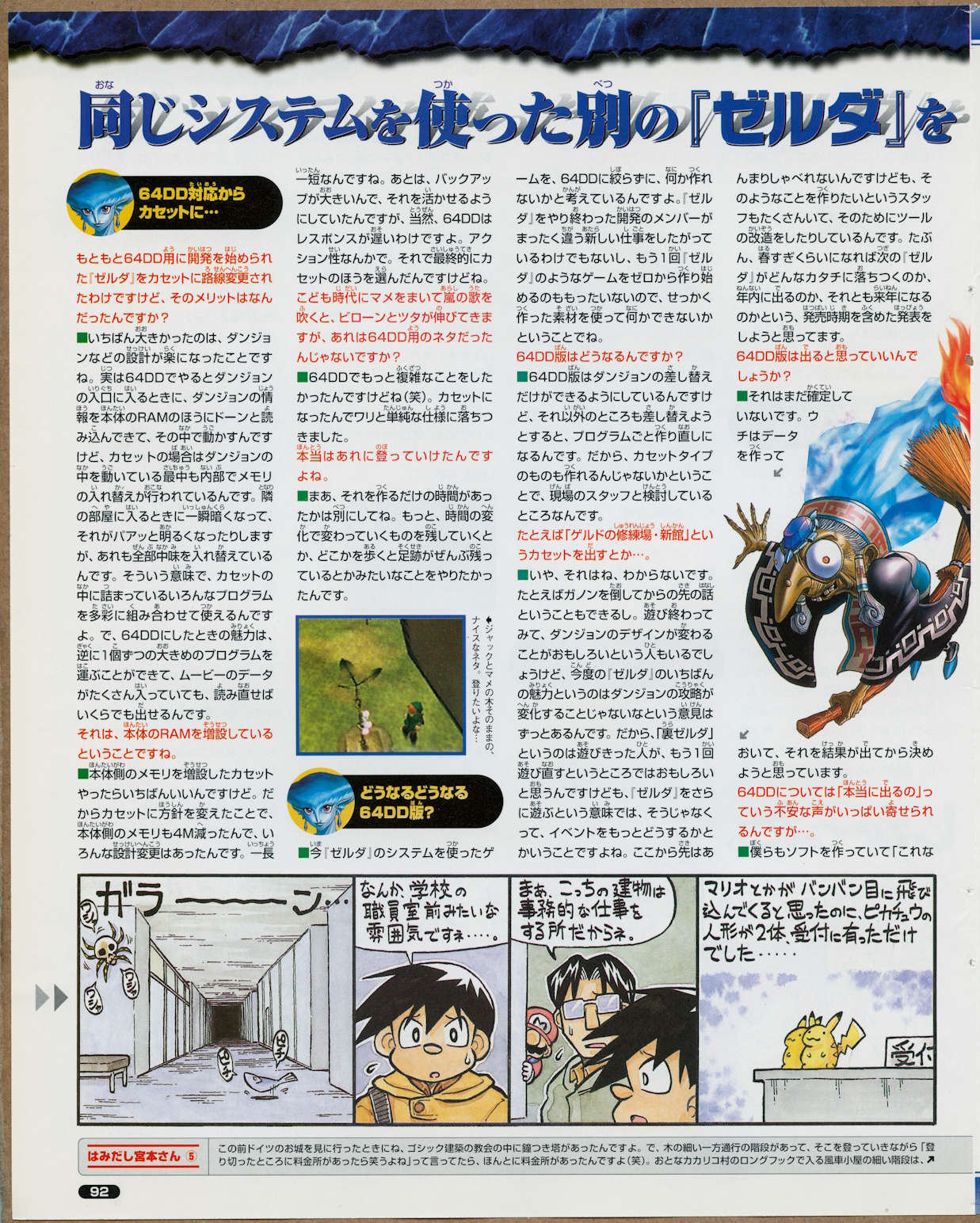
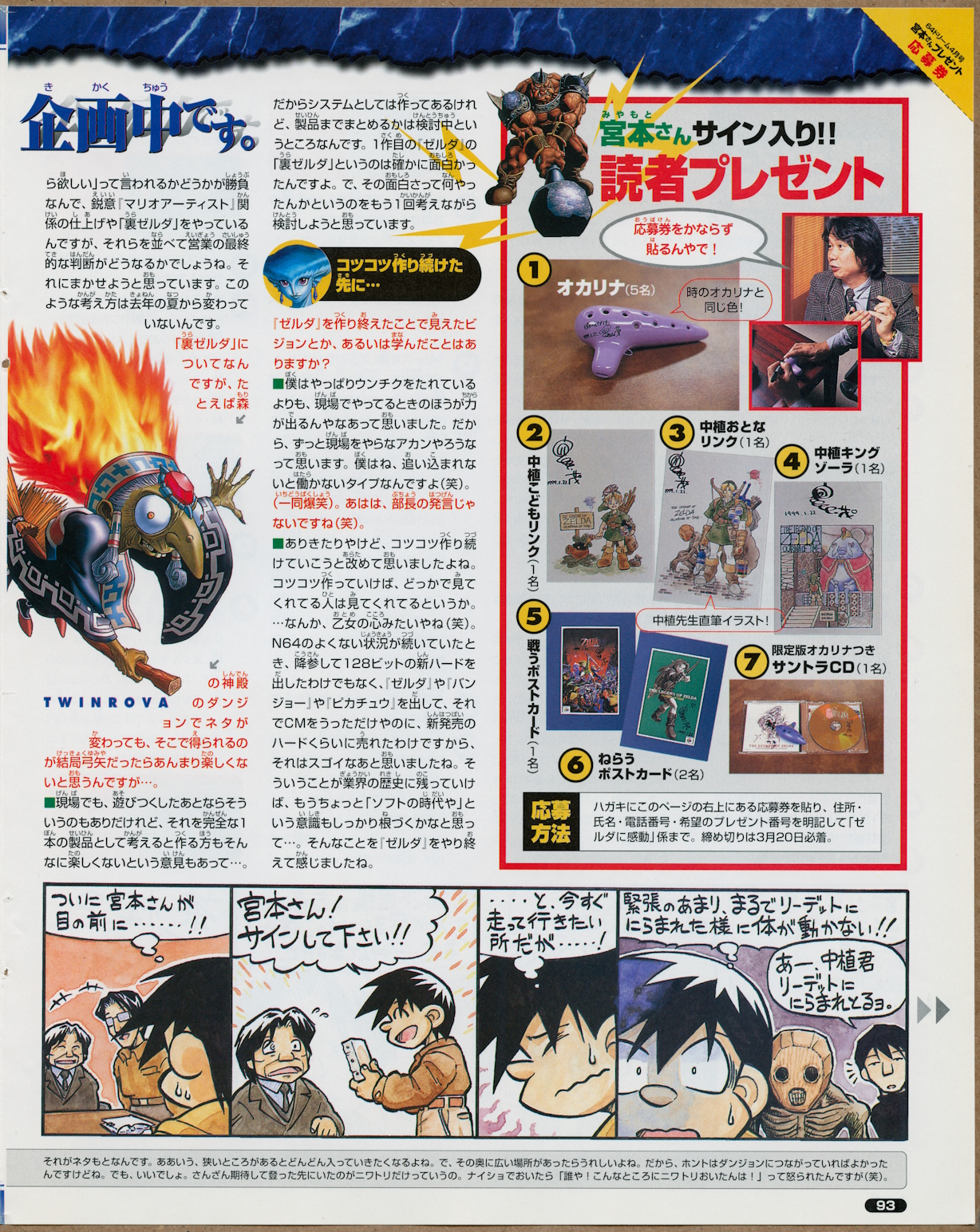
Notes: The title is a machine translation. Scans by ozidual.
DidYouKnowGaming has had this interview translated and included some of the translation in their video.
Summary: Hyrule Field was originally going to have a large lake on the northern mountain, and there was going to be a sea in the south. There were going to be more cliffs. To keep things simple they decided not to include a swamp.
They adjust things quite a bit when making a game, with The Legend of Zelda: Ocarina of Time they adjusted the scale.
They want Ocarina of Time to feel dense, but it still feels lacking in some ways. They never got the wind to figure into the gameplay.
The Great Fairy’s stand-in model looked like the Oscar Award.
People say that Navi is an idiot, but if she was smarter people would still complain. His son thought she was weird in Death Mountain.
The Legend of Zelda: Ocarina of Time Encyclopedia
Publication Date: April 1, 1999 (approximate)
Subject(s): The Legend of Zelda: Ocarina of Time
Format: Transcribed interview
People: Unnamed interviewer, Shigeru Miyamoto
Link: https://shmuplations.com/ocarinaoftime/
Archive Link: https://web.archive.org/web/20220126130937/https://shmuplations.com/ocarinaoftime/
Translator: shmuplations
Notes: I am using a machine translation of the title of this Japanese official guide.
Summary: In The Legend of Zelda: Ocarina of Time you will learn where the Triforce came from. The order of The Legend of Zelda games goes Ocarina of Time, The Legend of Zelda, The Legend of Zelda: A Link to The Past.
He’s not satisfied with some of the unanswered questions in the story, such as how did Ganon become that way, is Link from Ocarina of Time the father of the Link from the original game?, and was his mother Zelda?
You can think of Ganon as resurrecting for each game.
Their focus is to make an interesting game, he wanted Ocarina of Time to feel connected to the original game, but sometimes things don’t line up perfectly. The player’s aftertaste is more important than the continuity between games. He doesn’t want a huge break in canon, though.
He was worried the action portion of the game was too difficult, but he got postcards praising the difficulty, and his 5th grade daughter was able to reach each of the dungeon bosses with one continue. People haven’t liked easy games lately, they got a lot of feedback that Yoshi’s Story was too easy.
Navi giving you advice is the weakest part of Ocarina of Time. It’s difficult to make a system that gives advice tailored to the situation. They made Navi sound a bit stupid so that the repetition wouldn’t stick out so much. He wanted to remove the whole system. There’s no consistency to where people get stuck.
People don’t praise Dragon Quest’s designers for its balance, the tough difficulty in places makes it memorable.
Ocarina of Time took three years to make.
He was 70% involved with The Legend of Zelda, 50% for A Link to the Past, and 40% for Ocarina of Time. In the second year it felt like they’d never finish if he wasn’t there. He had to consolidate everyone’s work. He can’t exert control over everything with a team this large.
He told Toru Osawa to focus more on the characters and less on the story.
He focused on two things: the first 30-60 minutes of the game, through the Deku Tree Dungeon, and the aftertaste, giving it a Zelda vibe, making sure the traps and puzzles felt like a Zelda game. It’s not easy to describe the Zelda vibe, but it includes novelty and mystery.
It was heartbreaking removing things from previous Zelda games, but then if they had included them all it wouldn’t really be a new game. The team was mostly different from other Zelda games, and they wanted to add their own things, too. Chain Chomps were removed at the last minute, they were going to be in Gerudo’s Fortress.
At one point there were five or six magic spells, but he decided they would be better as items or songs. Magic is like taking the easy way out.
The first thing they did was make the ocarina a usable musical instrument. There were six songs initially, but that rose to 13.
Dungeons have to be remade several times, bringing the team to the verge of tears. They spent less time on dungeons this time, though. They decided it wasn’t fun to go through a linear labyrinth. The sense of dread and pressure is more important.
The sword combat didn’t come out how he’d hoped. He wanted something you could improve at steadily, but also wanted the action to be easier than Super Mario 64.
The biggest difference in expression between Mario and Zelda games now is that Zelda has more emphasis on lighting. The textures and colors are different, too.
He thought that adding jumping would make for too many gameplay elements.
Games that do something historically new create a new grammar or etiquette for basic movement and action. He created platformers and if someone is going to change jumping, it’s going to be him. They programmed what kind of jump Link would do at each location and encoded it in the terrain data. They’re building a new grammar of interactivity.
They know of the trend of role-playing games with lots of movies, but don’t plan on making games like that. They can’t make a hit game by appealing to that audience.
They don’t set out to make their series accessible to cosplayers. Their games need to be simple to explain, they depend on word of mouth.
He promises you’ll be able to ride the cow in the next game.
Games Business: Miyamoto Joins Battle/Q & A: Shigeru Miyamoto
Publication Date: April 1, 1999
Subject(s): PlayStation 2, N64, Artx, cartridges versus discs, his next game
Format: Transcribed interview
People: Unnamed Games Business interviewer, Shigeru Miyamoto
Link: https://archive.gamehistory.org/item/a3ac4ccd-db04-4286-a047-e79eab404195
Scans:
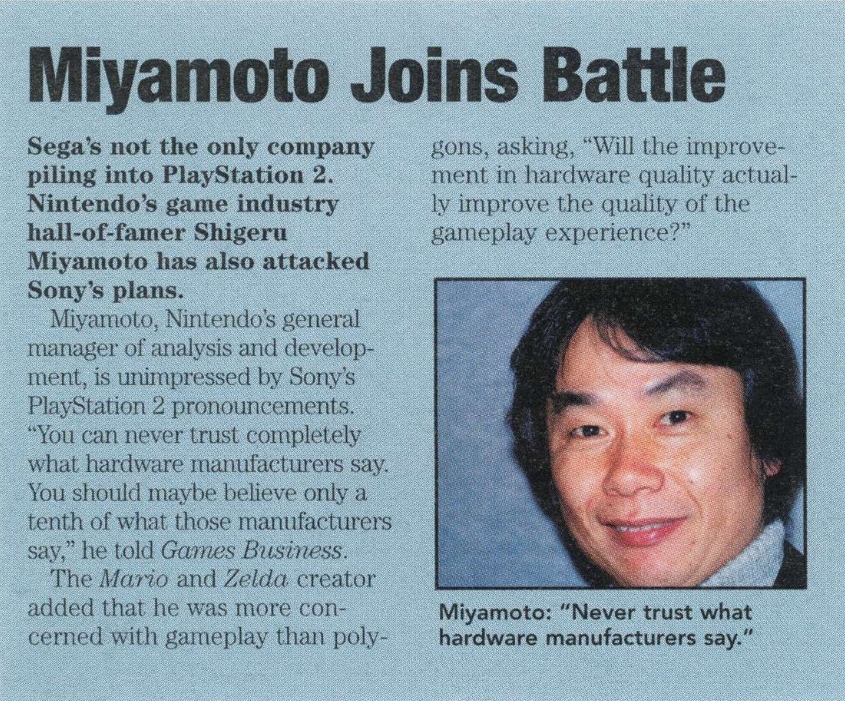
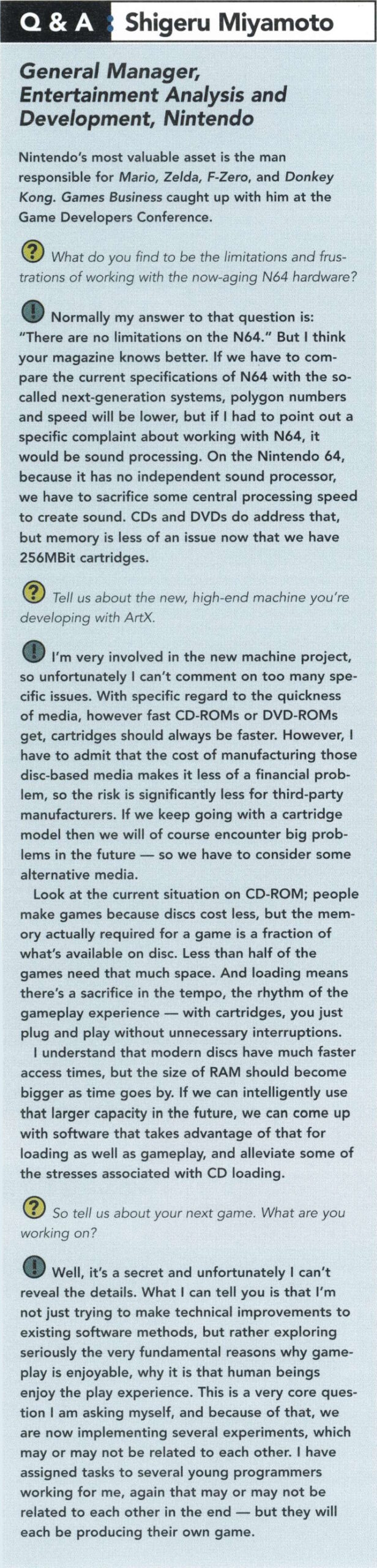
Notes: Artx was the company that made the GameCube’s graphics chip, and was bought by ATI. This interview took place at the Game Developer’s Conference, which ran March 8-12 in 1999. Scans by Video Game History Foundation.
Summary: Only believe a tenth of what hardware makers say. Will PlayStation 2’s hardware make the gameplay better?
They can display fewer polygons and will be slower than the competition. His biggest complaint about the N64 is its lack of an independant sound processor, they have to sacrifice central processing speed to make sound.
He’s working on the GameCube with ArtX, but can’t comment on much. Cartridges will always be faster than CDs or DVDs, but it’s cheaper to use discs and less risky for third parties. Many games use a fraction of a CD’s storage space. Loading times also mess with the rhythm of a game.
He can’t talk about the details of his next game, but he is exploring the fundamentals of what makes games enjoyable. He is conducting many experiments.
Time Digital
Publication Date: April 23, 1999
Subject(s): Mario Bros. and Donkey Kong inspiration, violence in games
Format: Transcribed interview
People: Unnamed Time Magazine interviewer, Shigeru Miyamoto
Link: https://www.zeldadungeon.net/wiki/Interview:Time_Digital_April_23rd_1999
Archive Link: https://web.archive.org/web/20200612012303/https://www.zeldadungeon.net/wiki/Interview:Time_Digital_April_23rd_1999
Summary: It would take a lifetime to perfect the look of the wind, water, and dust in Zelda.
In making Mario Bros. he wanted to make a game where enemies moved from the top to bottom and back. Turtles and crabs seemed like a good fit. He imagined a huge world under New York.
For Donkey Kong he wanted it to be difficult to move upward, so he chose a construction site and a ship’s gangway. It was also inspired by King Kong and Popeye.
He would like his games to encourage children to think of alternative ways to succeed rather than finding a single correct answer.
They try not to use violence as an easy means of expression, it’s easier to make someone cry than laugh.
If video games didn’t exist he might make educational toys.
The 64DREAM, May 1999 (untranslated from Japanese)
Publication Date: May, 1999
Subject(s): The Legend of Zelda: Ocarina of Time, Japan Media Arts Festival
Format: Transcribed interview
People: Unknown The 64Dream interviewer, Shigeru Miyamoto
Japanese Archive Link: https://archive.org/details/64dream-may-1999-ozidual/64Dream%201999%2005%20%28J%20OCR%29/
Scans:
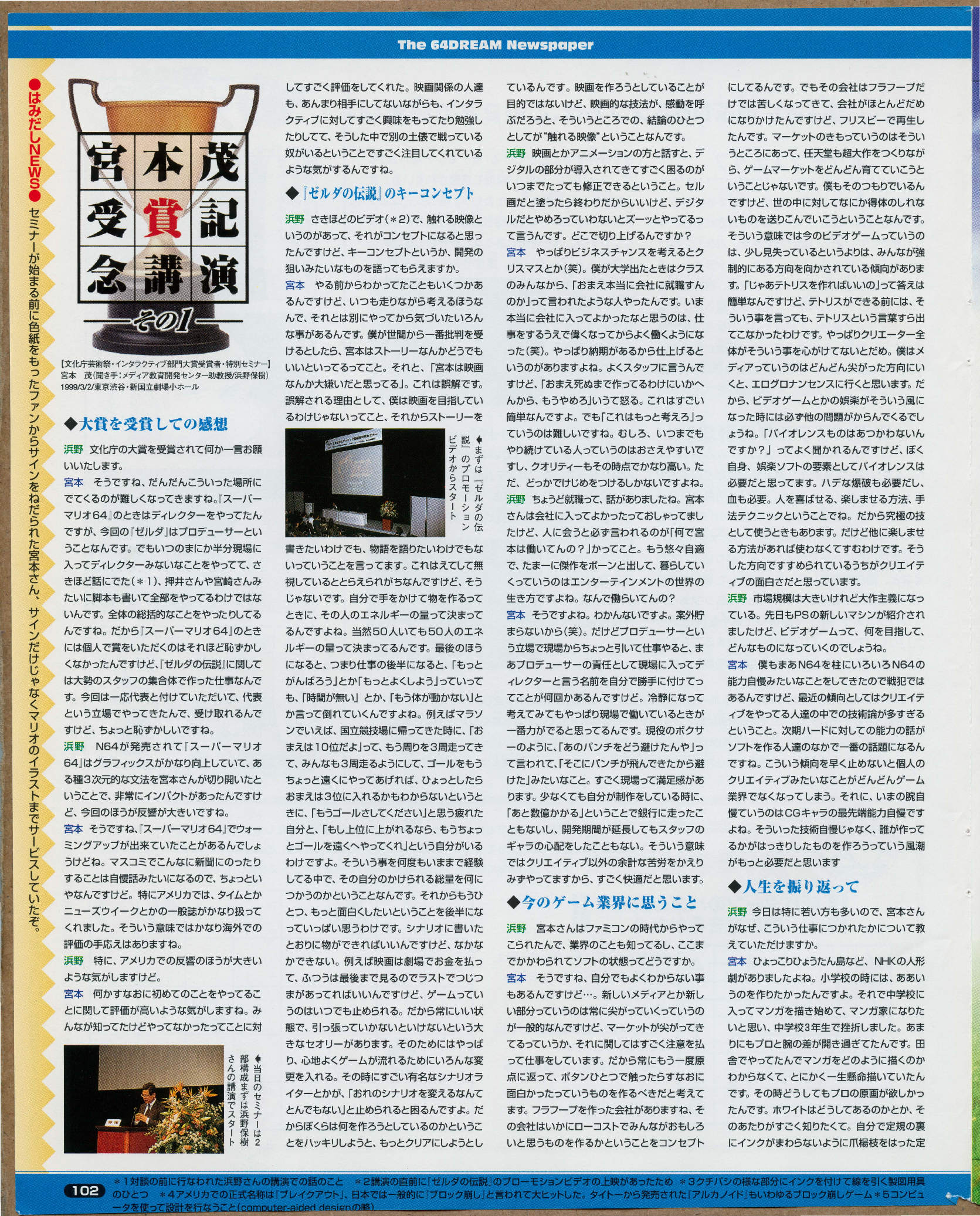
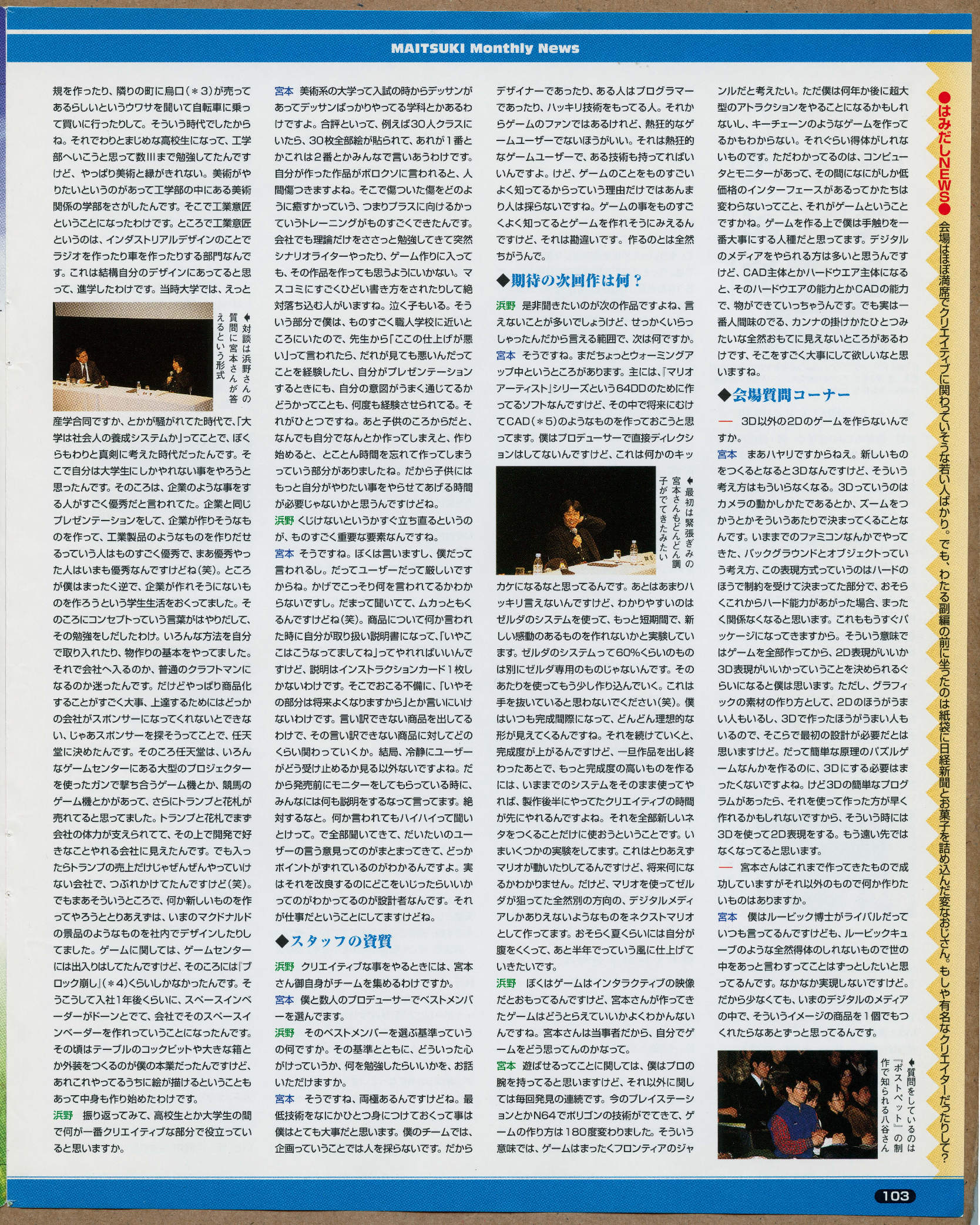
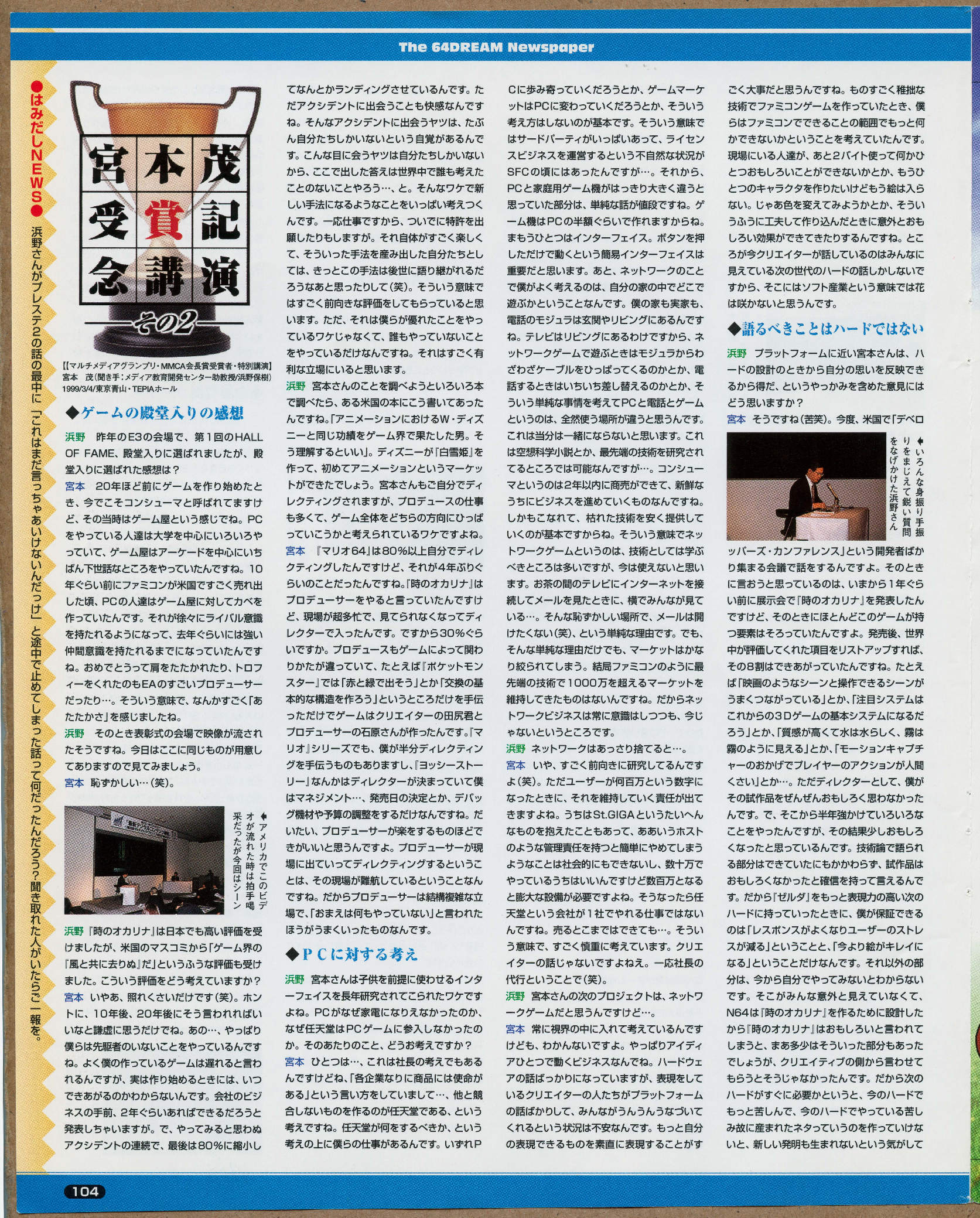

Notes: This interview is partially about The Legend of Zelda: Ocarina of Time winning Japan Media Arts Festival’s 1998 Digital Art (Interactive Art) Division Grand Prize. You can read more about the annual festival on Wikipedia. Scans by ozidual.
2nd Annual Interactive Achievement Awards
Publication Date: May 13, 1999
Subject(s): The Legend of Zelda: Ocarina of Time, 1080° Snowboarding
Format: Award ceremony (spoken English)
People: George Sanger, Chris Roberts, Zachery Ty Bryan, Nicholle Tom, David Perry, Jez San, Sid Meier, Peter Molyneux, Bruce Shelley, Takashi Tezuka, Shigeru Miyamoto
Video:
Notes: The Annual Interactive Achievement Awards would eventually become the D.I.C.E. Awards.
Mr. Miyamoto gives the acceptance speech for all six awards that The Legend of Zelda: Ocarina of Time wins: Outstanding Achievement in Interactive Design, Outstanding Achievement in Software Engineering, Console Role-Playing Game of the Year, Console Adventure Game of the Year, Console Game of the Year, and Game of the Year. Takashi Tezuka joins him on stage for the Game of the Year acceptance speech.
He also gives the acceptance speech for 1080° Snowboarding winning Console Sports Game of the Year.
Uploaded by The Video Game History Foundation as part of their 25-day Holiday Countdown Calendar.
Summary: [Outstanding Achievement in Interactive Design award speech.]
Thank you for playing the game.
[Outstanding Achievement in Software Engineering award speech.] [He bows.] [Console Sports Game of the Year award speech.]Thank you on behalf of Giles Goddard, who programmed the game.
[Console Role-Playing Game of the Year award speech.]
Thank you.
[Console Adventure Game of the Year award speech.]
He’s very lucky to work with talented people, thank you.
[Console Game of the Year award speech.]Thank you.
[Introducing the Hall of Fame Award.]
The Hall of Fame Award was made to honor those who make groundbreaking contributions, who pioneer influential games and have the most creativity. The 1999 recipient of the award is Sid Meier, who meets every criteria. Sid Meier made F-19, the first successful flight simulator, he made the first god game with Civilization, and he became a leader in real-time strategy games with Sid Meier’s Pirates!, Railroad Tycoon, and Sid Meier’s Alpha Centauri. These games have grown the audience for interactive entertainment.
[A video about Sid Meier plays.]
He and the Academy of Interactive Arts and Science are honored to give the 1999 Hall of Fame award to Sid Meier.
[Game of the Year award speech.]Takashi Tezuka has been working with him since Super Mario Bros. More than 50 people worked on The Legend of Zelda: Ocarina of Time, and he is honored to accept the award.
1101.com: Jack’s Beanstalk Plan Begins. (untranslated from Japanese)
Publication Date: May 13, 1999
Subject(s): Pokémon Snap
Format: Transcribed interview
People: Shigesato Itoi, Satoru Iwata, Shigeru Miyamoto
Japanese Link: https://www.1101.com/nintendo/nin5/nin5-1.htm
Japanese Archive Link: https://web.archive.org/web/20230904100500/https://www.1101.com/nintendo/nin5/nin5-1.htm
Notes: 1101.com is Shigesato Itoi’s website. The title is a machine translation. This is part 1 of a 6 part interview series.
1101.com: The Leader Never Appeared. (untranslated from Japanese)
Publication Date: May 25, 1999
Subject(s): Pokémon Snap
Format: Transcribed interview
People: Shigesato Itoi, Satoru Iwata, Shigeru Miyamoto
Japanese Link: https://www.1101.com/nintendo/nin5/nin5-2.htm
Japanese Archive Link: https://web.archive.org/web/20230407183941/https://www.1101.com/nintendo/nin5/nin5-2.htm
Notes: 1101.com is Shigesato Itoi’s website. The title is a machine translation. This is part 2 of a 6 part interview series.
Electronic Gaming Monthly: Miyamoto on Nintendo’s Future
Publication Date: June, 1999
Subject(s): 64DD, Nintendo 64 Transfer Pak, sequels
Format: Transcribed interview
People: Unnamed Electronic Gaming Monthly interviewer, Shigeru Miyamoto
Scan:

Notes: This interview took place at GDC 1999, on March 15. Scans by Retromags.
Summary: He’s been training younger game developers and being more of a supervisor. He’s also been asking himself what makes a game appealing.
They’ll have announcements about the next The Legend of Zelda game this Spring. They usually finish a game and then start making the next game in the series for the next system right away. It’s a new experience to keep working on The Legend of Zelda: Ocarina of Time.
The maker of Derby Stallion is working on a Game Boy version that will allow players to move their data to the Nintendo 64 version. Nintendo Entertainment Analysis & Development is working on using the Game Boy as a controller. All 151 Pokémon will be available in Pokémon Stadium 2.
He is working on Nintendo’s next console, but their policy is to support a system for at least five years, so the Nintendo 64 has several more years left.
He will make a Super Mario 64 sequel, and it will appear on the Nintendo 64.
1101.com: Can You Make A Game Out Of Just Taking Photos? (untranslated from Japanese)
Publication Date: June 1, 1999
Subject(s): Pokémon Snap
Format: Transcribed interview
People: Shigesato Itoi, Satoru Iwata, Shigeru Miyamoto
Japanese Link: https://www.1101.com/nintendo/nin5/nin5-3.htm
Japanese Archive Link: https://web.archive.org/web/20230406210422/https://www.1101.com/nintendo/nin5/nin5-3.htm
Notes: 1101.com is Shigesato Itoi’s website. The title is a machine translation. This is part 3 of a 6 part interview series.
1101.com: The Important Thing Was To Get Results. (untranslated from Japanese)
Publication Date: June 8, 1999
Subject(s): Pokémon Snap
Format: Transcribed interview
People: Shigesato Itoi, Satoru Iwata, Shigeru Miyamoto
Japanese Link: https://www.1101.com/nintendo/nin5/nin5-4.htm
Japanese Archive Link: https://web.archive.org/web/20240525192008/https://www.1101.com/nintendo/nin5/nin5-4.htm
Notes: 1101.com is Shigesato Itoi’s website. The title is a machine translation. This is part 4 of a 6 part interview series.
1101.com: Special Roundtable Discussion: What We Can Say Now. What Does It Mean To Create Something? Part 1 (untranslated from Japanese)
Publication Date: June 15, 1999
Subject(s): Pokémon Snap
Format: Transcribed interview
People: Shigesato Itoi, Satoru Iwata, Shigeru Miyamoto
Japanese Link: https://www.1101.com/nintendo/nin5/nin5-5.htm
Japanese Archive Link: https://web.archive.org/web/20230407022736/https://www.1101.com/nintendo/nin5/nin5-5.htm
Notes: 1101.com is Shigesato Itoi’s website. The title is a machine translation. This is part 5 of a 6 part interview series.
1101.com: Special Roundtable Discussion: What We Can Say Now. What Does It Mean To Create Something? Part 2 (untranslated from Japanese)
Publication Date: June 20, 1999
Subject(s): Pokémon Snap
Format: Transcribed interview
People: Shigesato Itoi, Satoru Iwata, Shigeru Miyamoto
Japanese Link: https://www.1101.com/nintendo/nin5/index.htm
Japanese Archive Link: https://web.archive.org/web/20000123030436/http://www.1101.com/nintendo/nin5/index.htm
Notes: 1101.com is Shigesato Itoi’s website. The title is a machine translation. This is part 6 of a 6 part interview series.
Famitsu (reported on by IGN)
Publication Date: August 23, 1999
Subject(s): The Legend of Zelda: Oracles of Seasons and Ages
Format: Transcribed interview
People: Reported on by unnamed IGN staff member, unnamed Famitsu interviewer, Shigeru Miyamoto
Link: https://www.ign.com/articles/1999/08/24/miyamoto-speaks-on-zelda-gbc
Archive Link: https://web.archive.org/web/20131012005144/http://www.ign.com/articles/1999/08/24/miyamoto-speaks-on-zelda-gbc
Summary: Yoshiki Okamoto of Capcom and Flagship wanted to make The Legend of Zelda games every four or five months. Instead Nintendo had Flagship do the scenarios for Game Boy Color Zelda games.
Mr. Okamoto asked if he could port The Legend of Zelda to Game Boy Color. It worked well so they decided to make three games that could be played in any order. He’d like to release the first one this year and release the sequels every three or four months.
IGN: Mr. Miyamoto Speaks
Publication Date: August 27, 1999
Subject(s): GameCube, the future, The Legend of Zelda: Ocarina of Time Master Quest
Format: Transcribed interview
People: Matt Casamassina, Peer Schneider, Yasuhiro Minagawa (translator), Shigeru Miyamoto
Link: https://www.ign.com/articles/1999/08/28/mr-miyamoto-speaks
Archive Link: https://web.archive.org/web/20140119200633/http://www.ign.com/articles/1999/08/28/mr-miyamoto-speaks
Notes: This interview took place at Space World 1999, which was held August 27-29.
Summary: He’s not sure if Paper Mario will be the last Mario game for the Nintendo 64.
There is an experimental game on the GameCube that could turn into a Mario game or a Zelda game.
A better looking Super Mario 64 or The Legend of Zelda: Ocarina of Time could not be called a GameCube Mario or Zelda. With the GameCube they can focus on their ideas rather than making special effects work.
Nintendo is always making what only they could make. They are trying to expand on the Nintendo 64 and Game Boy’s connection.
Most of his time is spent thinking about Nintendo and the gaming industry five years from now. He’s trying to avoid working on any game.
The Legend of Zelda: Ocarina of Time Master Quest is a parody of Ocarina of Time with new dungeons.
The 64DD and GameCube can coexist.
Giles Goddard was a contract employee and not currently working with them.
Japanese players say the N64 controller is too big, but Americans say it’s the right size.
He’d rather have something unique for the GameCube launch than a nicer looking Mario or Zelda game.
GameSpot: Miyamoto Talks Dolphin at Space World
Publication Date: August 27-29, 1999
Subject(s): Being a producer, GameCube development, online play, Pokémon
Format: Transcribed interview
People: Chris Johnson, Shigeru Miyamoto
Link: https://www.gamespot.com/articles/miyamoto-talks-dolphin-at-space-world-and14599/1100-2460819/
Notes: This article is incorrectly dated.
Summary: He is getting older. When he says he is a producer, his involvement is deeper. He is focusing on a GameCube game.
He’s not as involved with The Legend of Zelda: Majora’s Mask as usual.
When you’re the director you can touch each phase of the game. As a producer he asks the directors to reflect on their touches. You’ll be able to feel the Nintendo touch on future sequels, even if he’s not very involved with them.
They realized the Nintendo 64 wasn’t powerful enough for a game like Wave Race 64.
They had to pay close attention to games on the N64 to make sure they would run, but with the GameCube they can focus on details. There are so many 3D fighting games because there’s just two characters, they are easy to make. The GameCube can handle five or 10 characters.
He’d rather not be involved with any Disney branded games because they are a competitor.
Cartridges are still the best medium for games, DVDs have some inconveniences. However, using them will stabilize costs since they don’t have to consider what size each game is. It will be easier to implement artificial intelligence.
They can’t make entertainment without thinking of online, but they also have to consider the cost and who will use it. There isn’t a big market for it now. They also have to make parents feel secure, so online play won’t be a big concern with the GameCube.
The used movie technology in The Legend of Zelda: Ocarina of Time, but they didn’t make it like a movie. He’ll study movies, but not make games that are like movies.
When he started work on Pokémon he was told it would never appeal to Americans, so he assumed there would never be an English version. He realized he shouldn’t believe the conservative marketers. They said the characters look like Japanese animation, so they can’t be sold to Americans. Satoshi Tajiri is why Pokémon is popular. Mr. Tajiri made something he wanted to play, there was no business sense.
Nintendo Power Source: Talkin’ Zelda with Mr. Miyamoto Space World ’99
Publication Date: August 27-29, 1999
Subject(s): The Legend of Zelda: Ocarina of Time, The Legend of Zelda: Ocarina of Time Master Quest, The Legend of Zelda: Majora’s Mask, The Legend of Zelda: Oracles of Seasons and Ages
Format: Transcribed interview
People: Unnamed Nintendo Power Source interviewer, Shigeru Miyamoto
Archive Links: https://web.archive.org/web/19991127104439/http://www.nintendo.com/home/features/spaceworld/99/miyamoto.html
Notes: Nintendo Power Source was Nintendo’s old website. This interview took place at Space World 1999, which was held August 27-29.
Summary: They are working on two follow ups to The Legend of Zelda: Ocarina of Time. The Legend of Zelda: Ocarina of Time Master Quest uses the 64DD to change the dungeons, and The Legend of Zelda: Majora’s Mask is a whole new game.
He was 100% involved with the original The Legend of Zelda, about 60% with Ocarina of Time, 20% for Majora’s Mask, and 10% for The Legend of Zelda: Oracle of Seasons and Ages. If Majora’s Mask is fun there will be less time in between Zelda games. He’ll probably have less involvement in them, he trusts his teams.
As a producer he tells his teams what kind of game to make. He approves or disapproves of ideas, sets the direction, and recommends staff.
Master Quest will have some characters that were in Ocarina of Time. He wants players to feel a deeper connection to the Ocarina story. In many games you know you’re halfway through when you’ve done four dungeons if there are eight total. But interactive media shouldn’t be like that, like a book.
There are time limits in Majora’s Mask, if you fail to do something you can do it later. They are working on making it dense. They need the Expansion Pak to keep track of it all. There are three main masks that transform you. They’re aiming for just under 30 masks total.
Majora’s Mask will have a Running Man that is four times taller. Dogs won’t just follow you, their reaction will vary based on your mask.
Yoshiki Okamoto is working on The Legend of Zelda: Oracles of Seasons and Ages and he is young and energetic. He promised to use his best people. Letting someone else make a Nintendo game is a special case. Of the three games, one will be a conversion of The Legend of Zelda.
Dengeki Nintendo 64 (Mario Kart 64, untranslated from Japanese)
Publication Date: September, 1999
Subject(s): Mario Kart 64
Format: Transcribed interview
People: Unknown Dengeki Nintendo 64 interviewer, Shigeru Miyamoto
Scans:
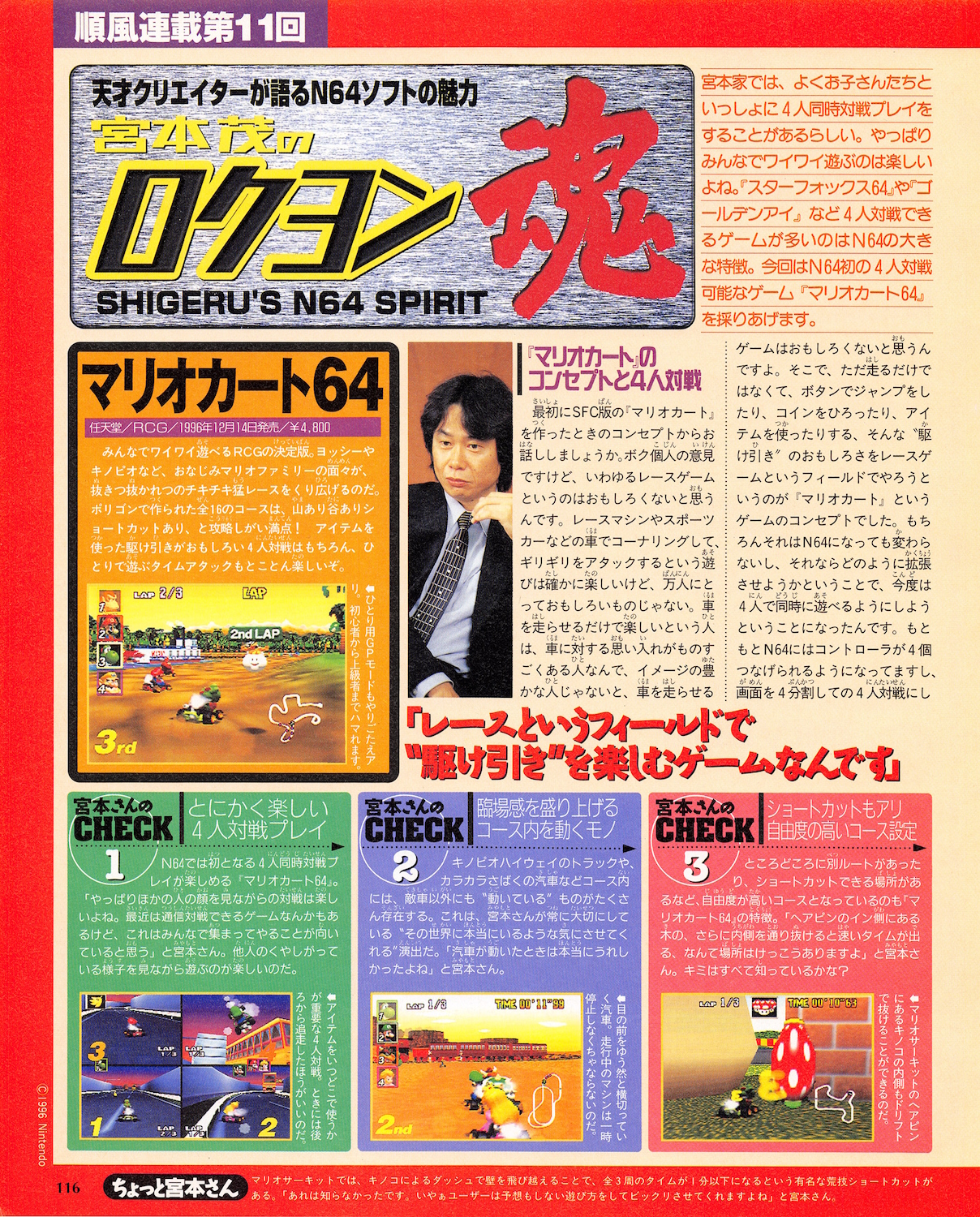
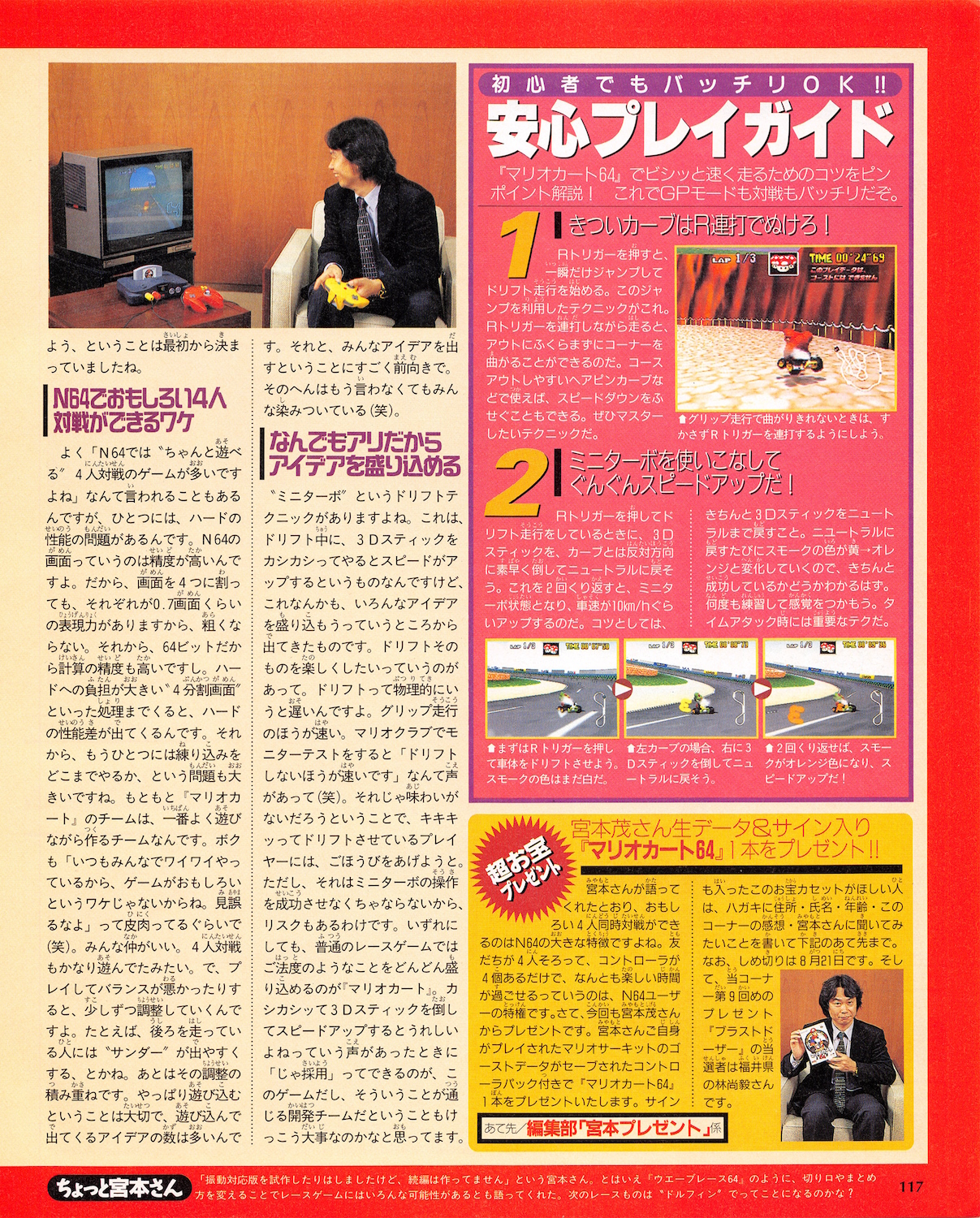
Notes: Scans by Retromags.
Games Business: Miyamoto Throws Some
Publication Date: September 15, 1999
Subject(s): Sony, Nintendo’s future, competition, using new technology
Format: Transcribed interview
People: Colin Campbell, Shigeru Miyamoto
Link: https://archive.gamehistory.org/item/99272d11-de6f-4cc2-bef9-dd0af2ccdb71
Scan:
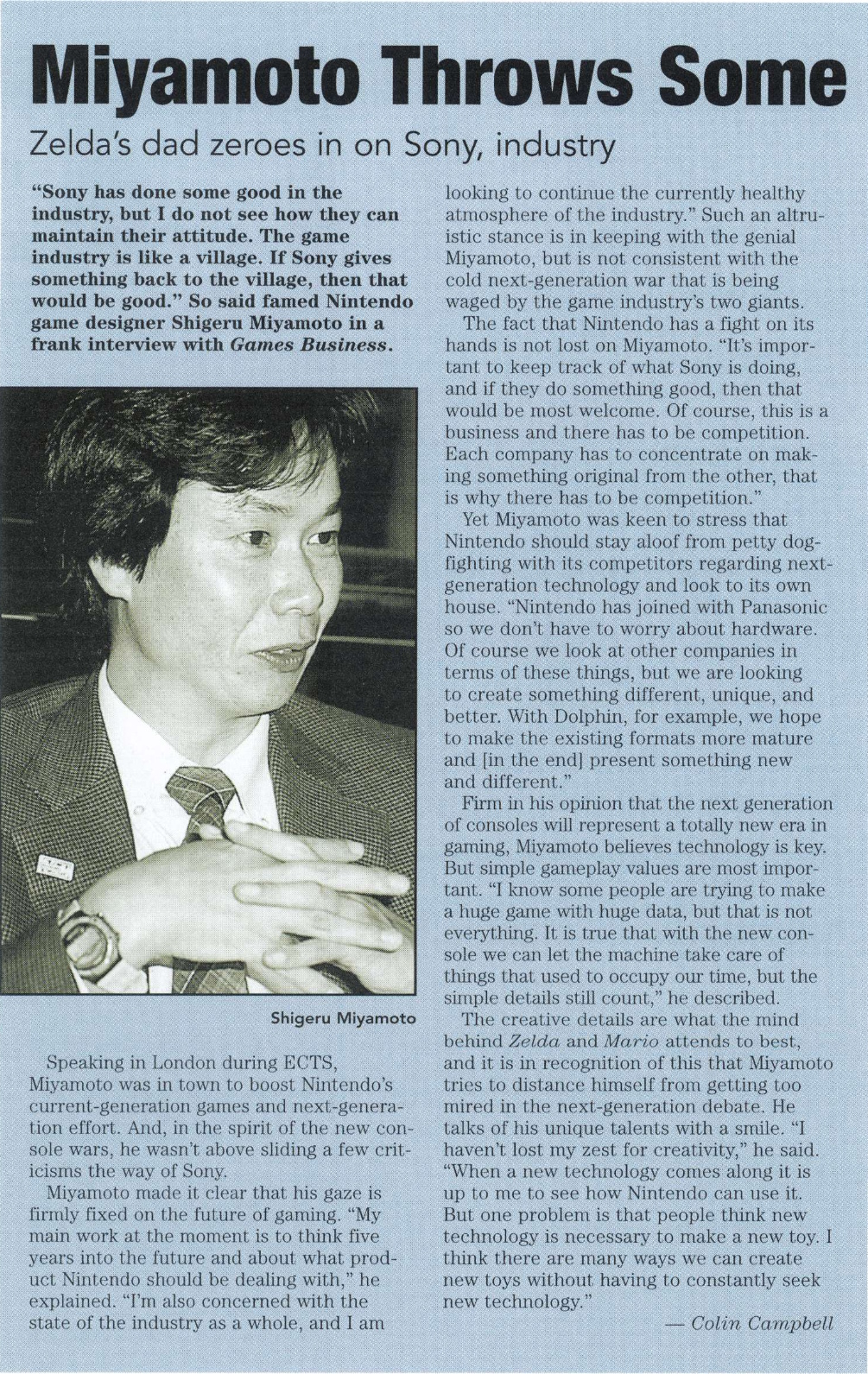
Notes: This interview took place at the European Computer Trade Show, which took place September 5-7. Scans by Video Game History Foundation.
Summary: Sony has done some good for the game industry, but it would also be good if they gave something back to the industry.
He is looking five years into the future and thinking about what Nintendo should be doing. He is also worried about the state of the video game industry.
They have to keep track of what Sony is doing. Everyone in the video game industry has to make something original.
Nintendo has joined with Panasonic for the GameCube and they want to make something unique and better.
The GameCube will handle things they used to have to spend time on, but simple details are still important.
It’s up to him to use his creativity for Nintendo when a new technology comes along. There are ways of making new toys without new technology.
The 64Dream (reported on by IGN)
Publication Date: Unknown (reported on September 22, 1999)
Subject(s): The Legend of Zelda: Majora’s Mask, Game Boy Camera, The Legend of Zelda: Ocarina of Time Master Quest
Format: Transcribed interview
People: Reported on by unnamed IGN staff, unknown The 64Dream interviewer, Shigeru Miyamoto
Link: https://www.ign.com/articles/1999/09/23/more-zelda-details-surface
Archive Link: https://web.archive.org/web/20150220231458/https://www.ign.com/articles/1999/09/23/more-zelda-details-surface
Notes: I looked through Mr. Miyamoto’s four interviews with The 64Dream from 1999 via machine translation and couldn’t find anywhere that he mentioned anything being 20% or 80% complete, nor any mention of the Game Boy Camera. I likely missed something, but if you can find which interview this article is about, please let me know.
Summary: The version of The Legend of Zelda: Majora’s Mask at Spaceworld was about 20% done. It will be about as long as The Legend of Zelda: Ocarina of Time. It won’t support the Game Boy Camera.
They may not release The Legend of Zelda: Ocarina of Time Master Quest. Majora’s Mask will not be for the 64DD.
GameSpot: Miyamoto Talks About the Future
Publication Date: September 20, 1999 (approximate, see notes)
Subject(s): A more mature Mario, Game Boy Advance, working with other companies, Seaman, Cabbage, working with Sega
Format: Transcribed interview
People: Sam Kennedy, James Mielke, Yasuhiro Minagawa (translator), Shigeru Miyamoto
Link: https://www.gamespot.com/articles/miyamoto-talks-about-the-future/1100-2450207/
Archive Link: https://web.archive.org/web/20240510053551/https://www.gamespot.com/articles/miyamoto-talks-about-the-future/1100-2450207/
Notes: This interview took place at the European Computer Trade Show, which the article describes as taking place “a couple weeks ago”. Around this time period ECTS always occurred in September, suggesting that the date on the article is incorrect. Earlier versions of the article say it was updated on April 27, 2000, rather than implying it was originally posted on that date, so this was most likely written after 1999’s ECTS.
Summary: He was surrounded by people while at the European Computer Trade Show, so he didn’t get to spend much time playing games. Game quality seems to have overall increased.
When he says Mario will be more mature in his next game, he means the background scenery and Mario’s facial expressions. They’re trying to make sure older players don’t feel ashamed to play it.
He never intended to make games that were just for children. Nintendo has fans who grew up playing Donkey Kong and Super Mario Bros., but they can’t just focus on appealing to children. There were many parents playing games with their children at Space World. Gaming magazines say Sony is for adults and Nintendo is for children. They should be aiming at the whole family, even if their games are child-oriented.
Donkey Kong could be the villain fighting Mario, or they could both be the bad guy. They don’t have to follow the old format. He doesn’t start with an idea like “what if Mario is against Donkey Kong?”. He thinks about new gameplay, then shapes that into a game.
The Game Boy Advance is not an advanced Game Boy. It will connect with cell phones and expand the form of entertainment. He wouldn’t mind making a Mario game for it, but he doesn’t want to make a deluxe version of Super Mario Bros. Deluxe. Super Mario 64 has a completely new system, he would want to make something like that.
He’s getting older and has to give the younger people more chances. Some of his coworkers are in their 40s and haven’t been able to make their own game yet. They have an alliance with Capcom to make three The Legend of Zelda games for Game Boy.
How they start to collaborate with other companies varies. HAL Laboratories is practically a part of Nintendo. Hudson wanted to make a Mario board game. Yoshiki Okamoto is a Zelda fan, so it was more of a collaboration with him than with Capcom. He thinks Konami will mostly make Nintendo games.
He’s been friends with Yutaka Saito for a long time. They had many conversations about whether Seaman should come to a Nintendo system and about the design of the game.
He’s been working on Cabbage for the 64DD, which is similar to Seaman, but it’s been delayed.
Sega’s president said that in order for Sakura Wars GB to be released it would need to connect to the Dreamcast, but that’s impossible. They’ve never considered working with Sega on a game, they are competitors.
He wants to make his own game, but he has to come up with a core idea. He’s working on something for the GameCube and thinking about what the industry will be like in five years. A lot of school children that play his games will be in high school by then.
The Electric Playground: Spyro 2 / Grand Theft Auto 2 with Dan Houser / Wizard World 1999
Publication Date: October, 1999 (E3 segments filmed June 19-21, 1997)
Subject(s): His family, Mario’s origins, The Legend of Zelda influences, people he respects
Format: Interview (live translator)
People: Victor Lucas, unnamed translator, Shigeru Miyamoto
Video: https://www.youtube.com/watch?v=U2Xv3FtbVmc
Notes: This is the fourth time footage from this interview appeared on The Electric Playground, I have not included one occurrence which had no unique footage.
Summary: He is 46. He has a 13 year-old boy and 11 year-old girl. They somewhat like video games, and they recently beat Zelda.
When he was designing Mario he had to work under restrictions.
The world of Zelda games has to do with his childhood. As for Link, everyone at some point wants to be strong. He may be too serious, and some people find it hard to work with him.
He still rides his bike to work, and swims. He only swims to work during typhoons.
When he joined Nintendo he thought he would be able to make whatever he liked.
He thinks Steven Spielberg is wonderful. George Lucas supports young talented people. He respects Gunpei Yokoi.
Monthly Coin Journal (untranslated from Japanese)
Publication Date: October, 1999
Subject(s): Space World, Nintendo, the gaming industry
Format: Transcribed interview
People: Unknown Monthly Coin Journal interviewer, Shigeru Miyamoto
Japanese Archive Link: https://archive.org/details/Coin-Journal-1999-10/Coin_Journal_1999_10/page/297/mode/1up
Scans:
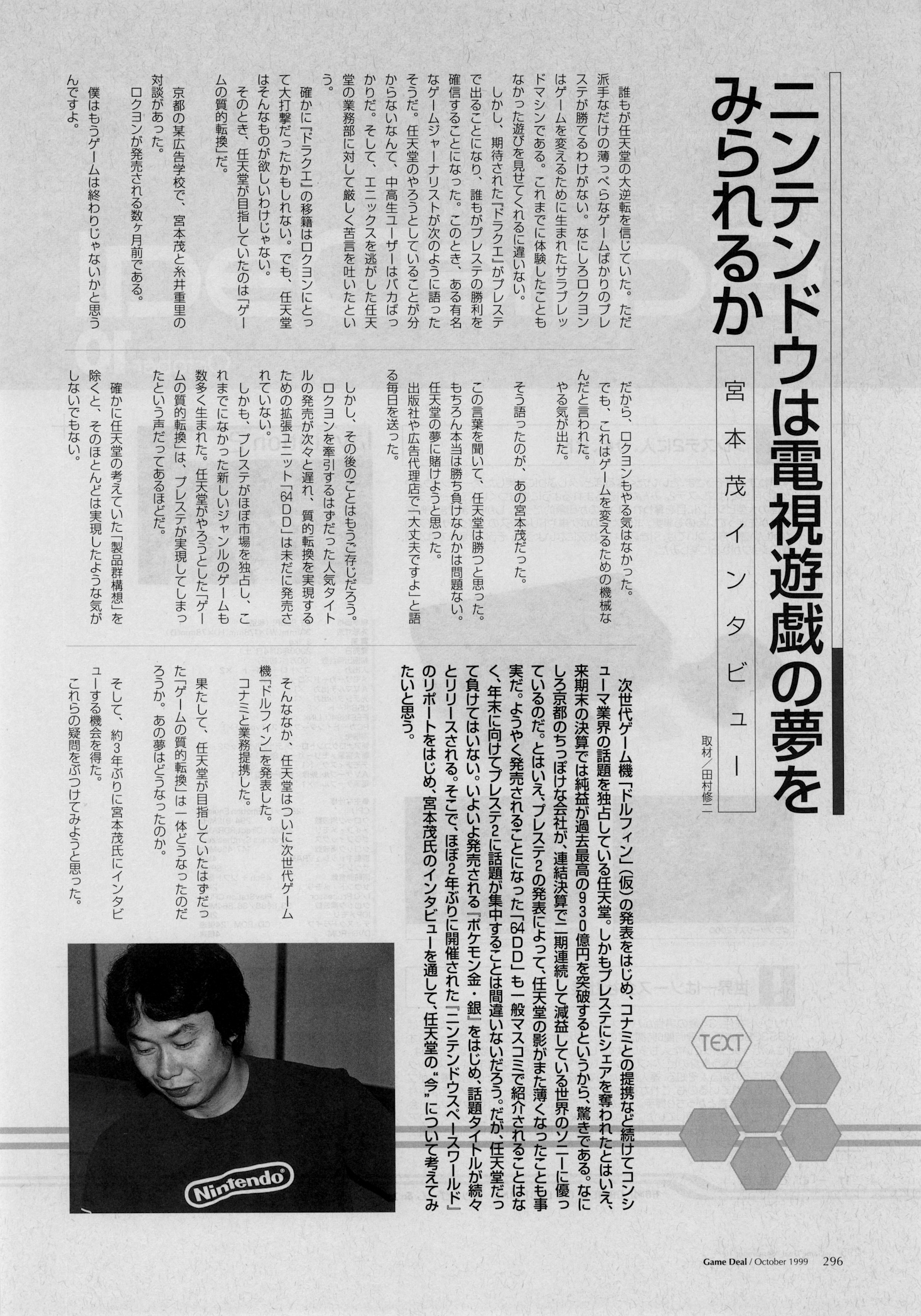
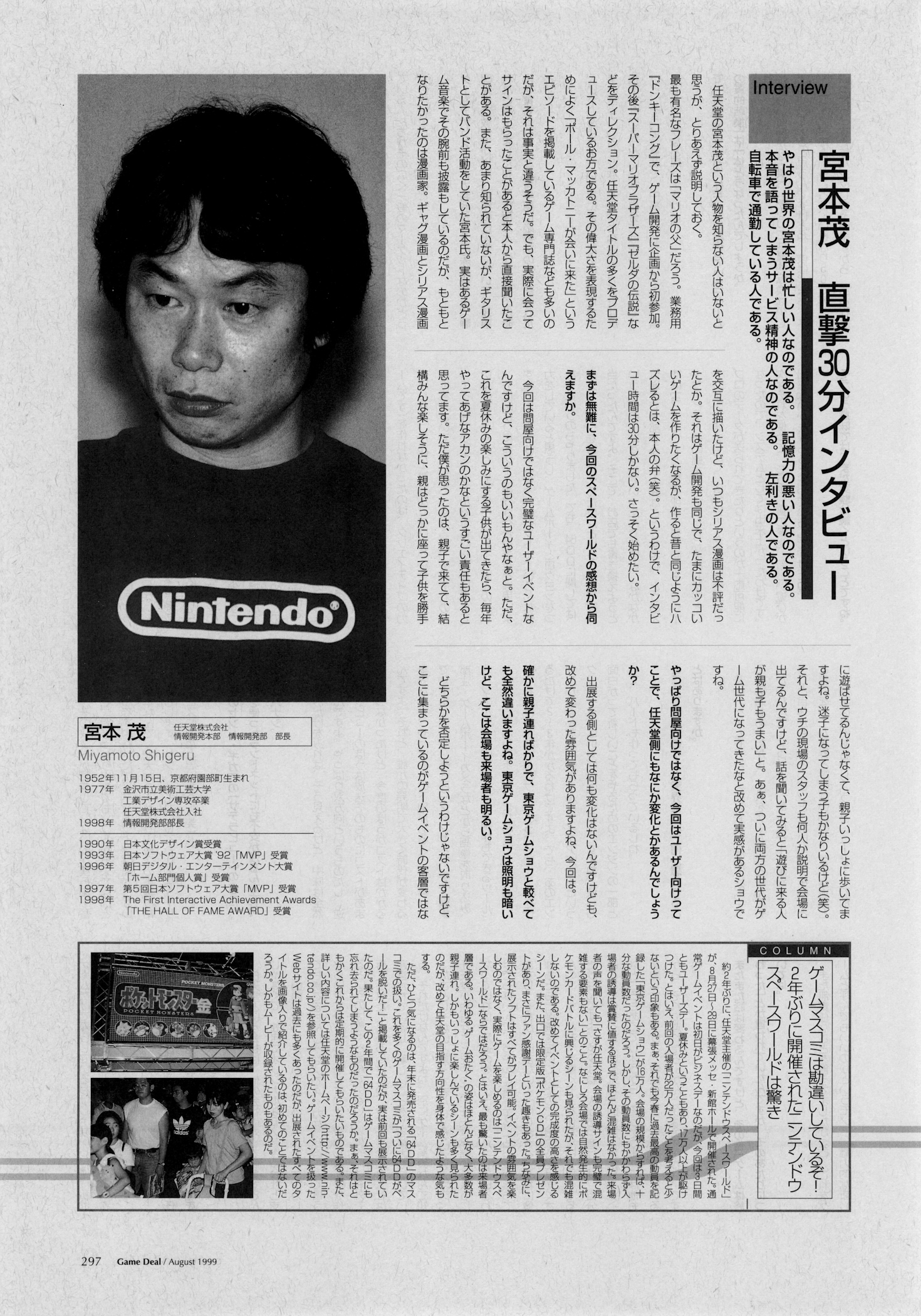
Notes: This interview took place during Space World and the interviewer had 30 minutes to talk to Mr. Miyamoto. Scans by Detchibe.
N-Zone: Exclusive Interview With Shigeru Miyamoto (untranslated from German)
Publication Date: October, 1999
Subject(s): The Legend of Zelda: Ocarina of Time, The Legend of Zelda: Majora’s Mask, 64DD
Format: Transcribed interview
People: Unknown N-Zone interviewer, Shigeru Miyamoto
Archive Link: https://archive.org/details/n-zone-archive-dvd/1999/NZ_1099
Scans:
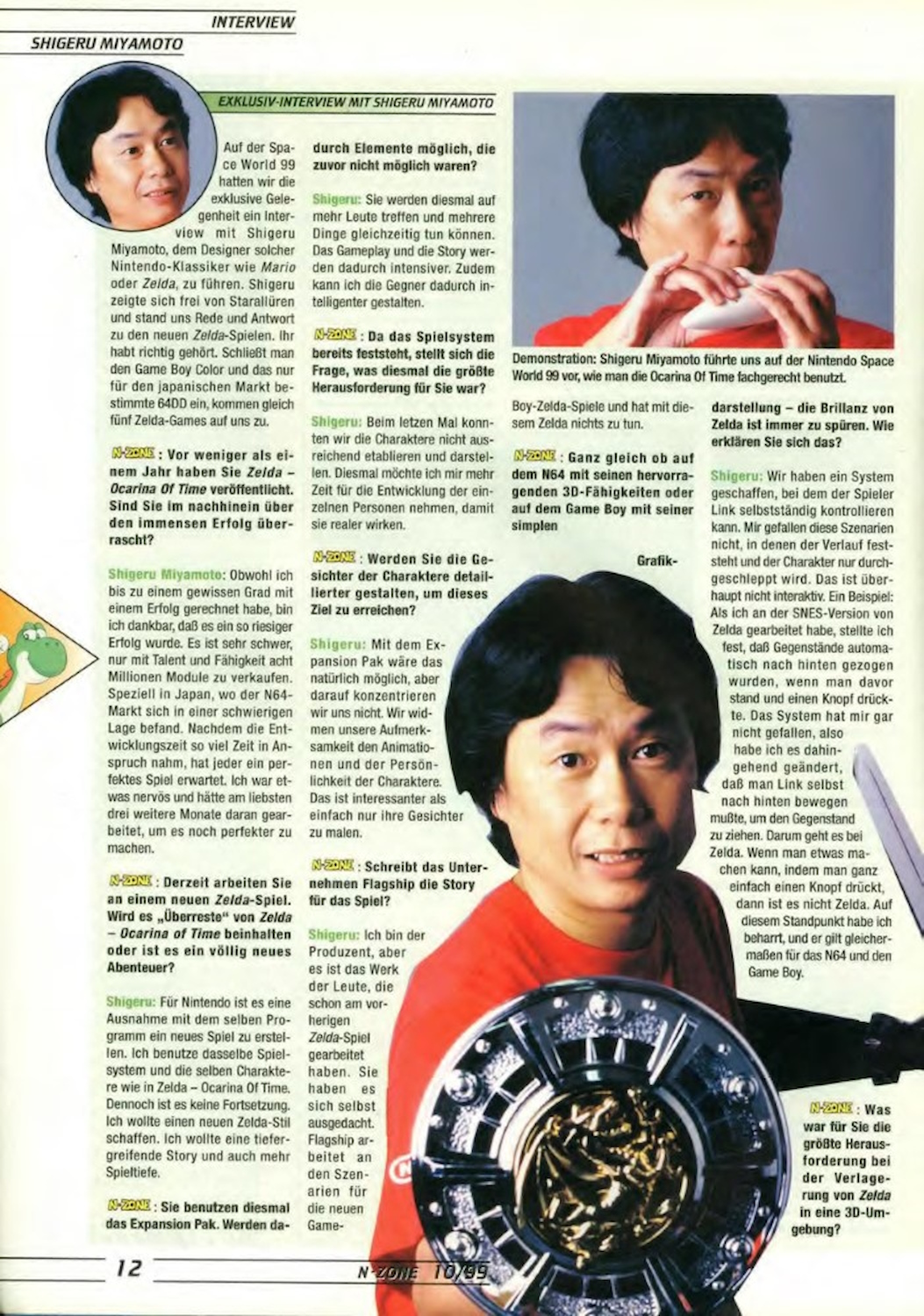
Notes: N-Zone is a Nintendo-focused German magazine. They released a DVD in 2022 with scans of all their past issues. The title is a machine translation. This interview took place at Space World 1999, which was held August 27-29.
1101.com: Shigeru Miyamoto Speaks: About his current thoughts and five years from now.
Publication Date: October 13, 1999 (translated January 20, 2014)
Subject(s): Being a director and manager, Seaman, Nintendo and its kiddie image, Nintendo 64, beating games, GameCube, Donkey Kong 64, Rare, Mother 3
Format: Transcribed Interview
People: Shigesato Itoi, Shigeru Miyamoto
Japanese Links: https://www.1101.com/nintendo/nin8/nin8_1.htm
https://www.1101.com/nintendo/nin8/nin8_2.htm
https://www.1101.com/nintendo/nin8/nin8_3.htm
https://www.1101.com/nintendo/nin8/nin8_4.htm
https://www.1101.com/nintendo/nin8/nin8_5.htm
https://www.1101.com/nintendo/nin8/nin8_6.htm
Japanese Archive Link: https://web.archive.org/web/20000226064549/https://www.1101.com/nintendo/nin8/nin8_1.htm
https://web.archive.org/web/20000121171500/http://www.1101.com/nintendo/nin8/nin8_2.htm
https://web.archive.org/web/20000121185022/http://www.1101.com/nintendo/nin8/nin8_3.htm
https://web.archive.org/web/20000121202738/http://www.1101.com/nintendo/nin8/nin8_4.htm
https://web.archive.org/web/20250929115258/https://www.1101.com/nintendo/nin8/nin8_5.htm
https://web.archive.org/web/20250929115258/https://www.1101.com/nintendo/nin8/nin8_6.htm
Translator: Danny Bivens for NintendoWorldReport
Notes: 1101.com is Shigesato Itoi’s website. Mr. Miyamoto was supposed to leave after 30 minutes.
Summary: Working as a project manager or director feels like stopping fires from starting, and you don’t get credit for it. When he speaks at seminars he tries to sound well-spoken and there is no warmth left. Nintendo’s CEO don’t like celebrating anniversaries. He changed his flight back from England from September 9th to September 10th because it’s unlucky. The Nintendo 64 isn’t doing well in Europe. Even without his name tag he was constantly asked for autographs. He met a lot of new people and everyone was nice.
People say that kids grow out of Nintendo, but they just leave for a while. He saw a kindergarten-aged girl playing Perfect Dark and that made him think. He got a letter from a parent whose child plays games all day and who wants to make games someday. The child is wrong, but there’s nothing a parent could say to dissuade him. He questions how much his games are really his. His children have friends over and play competitive multiplayer games, if they’ve having fun he can’t be upset. He feels like grinding for hours in a role-playing game to raise a stat is a waste of time. When someone says the story in a game is interesting he wants to ask why they don’t read a novel. Perhaps 30-50% of The Legend of Zelda: Ocarina of Time players stop at Dodongo’s Cavern, the Fire Temple or the Shadow Temple. He wants 80-90% of players to beat a game, even if it has to be very easy. Products aren’t cool just because they are electronic games anymore. He used to be so into Space Invaders but any kid today wouldn’t find it fun. You can’t just make games that appeal to people who will sit and get better at it.
He was the first person Yutaka Saito showed Seaman to and he gave advice. He wishes Nintendo could have published it. He doesn’t go to bars or drink. People say games fall into patterns, they are thrown into genres. They’ve gotten efficient at categorizing in that way and he wonders if they’ve hit their limits. He feels lucky to have a latent power drawn out of him by being a developer. He thinks some people with power aren’t noticed because there are so many people. He has been having younger employees do the creating. He’s a nagging older brother. He needs to make it clearer to people that he’s not making games with them, he’s introducing people.
Before he knew it Mario was following a pattern of becoming more aimed toward children as younger people joined Nintendo, as outside companies licensed him, and as marketing aimed him at small children. He made Mario when he was 27 and he was in no way embarrassing, he was an older uncle type. It makes sense for Yoshi, but he thinks Mario is different. Takashi Tezuka likes Mario doing the peace sign, but he wants to ban it. People say kids graduate from Nintendo in middle school, but it doesn’t seem like it used to be that way. When asked about the PlayStation 2 he has been saying Nintendo plays on a different field. They didn’t feel like they were in a console war during the Nintendo 64. He’s trying to imagine what the game industry will be like in five years. They are past the point where gaming is a fad. The PlayStation is creating more wonder, but its makers don’t realize that. Nintendo’s CEO is quick, even if he doesn’t play games.
The GameCube has a lot of power, they are still figuring out what it can do. He’d like Super Mario 128 to be an interesting toy that will make people buy GameCubes. He tries to make sure ports are done externally so that they don’t get hung up on porting Super Mario Bros. to every system. He had make sure they don’t spend much time making movies or cutscenes. The GameCube will be faster than the PlayStation 2. He wants the next Mario game to make people say they’ve never seen anything like it. They’ll make something new, and if Mario doesn’t fit they’ll switch him out. There aren’t players that won’t play a game because Mario isn’t in it.
Donkey Kong 64 is an old fashioned, standard game. It’s a 3D action game and he’s been questioning whether those are fun. They are a pain to make, they aren’t that much more fun, and they’re hard to play. Rare has perfected 3D action games, Donkey Kong 64 is beyond what Nintendo is capable of making. He bets it’s the best one on any hardware, including the Dreamcast. It won’t attract anyone new to gaming, though. Rare are independent and don’t always listen to outsiders. It’s more fun to limit the number of levels in a 3D game and include multi-layered gameplay and gimmicks. Mother 3 is about 80% done and feels fresh. It has graphics in a different class entirely.
Game Informer: An Interview with Shigeru Miyamoto
Publication Date: November, 1999
Subject(s): The Legend of Zelda: Majora’s Mask, 64DD, third party developers
Format: Transcribed interview
People: Unnamed Game Informer interviewer, Shigeru Miyamoto
Link: https://huguesjohnson.com/scans/random/
Archive Link: https://web.archive.org/web/20220602160504/https://huguesjohnson.com/scans/random/
Scan:

Notes: Scanned by Hugues Johnson. The Legend of Zelda: The Continuing Saga was an early name for Majora’s Mask.
Summary: They were planning on making something other than The Legend of Zelda: Majora’s Mask for the 64DD. Games that can make use of writeable data would be unique to the 64DD.
It is up to Nintendo of America if Mario Artist is available as a cartridge. They are working on a system that will allow 64DD games to be released on cartridges.
The people working on Cabbage have also been busy with other projects and they aren’t sure if it will be a cartridge, 64DD, or GameCube game. He has been trying to get Seaman to come to the Nintendo 64.
He has been involved in developing 10 games at once, but he is trying to keep it under five now. He wasn’t considering a Zelda game for the GameCube but is now due to so many requests. He has had many questions about Metroid for the Nintendo 64.
Left Field Productions are close to Japanese craftsmen. Konami are also knowledgeable and experienced.
Nintendo is making fewer first-party titles and doing more collaborations. The results will be apparent in five years.
Electronic Gaming Monthly: Shigeru Miyamoto: Swimming With Dolphin
Publication Date: November, 1999
Subject(s): The Legend of Zelda: Majora’s Mask, a director’s touch, Wave Race 64, the GameCube’s potential, cartridge versus DVD, online gaming
Format: Transcribed interview
People: Unnamed Electronic Gaming Monthly interviewer, Shigeru Miyamoto
Scans:

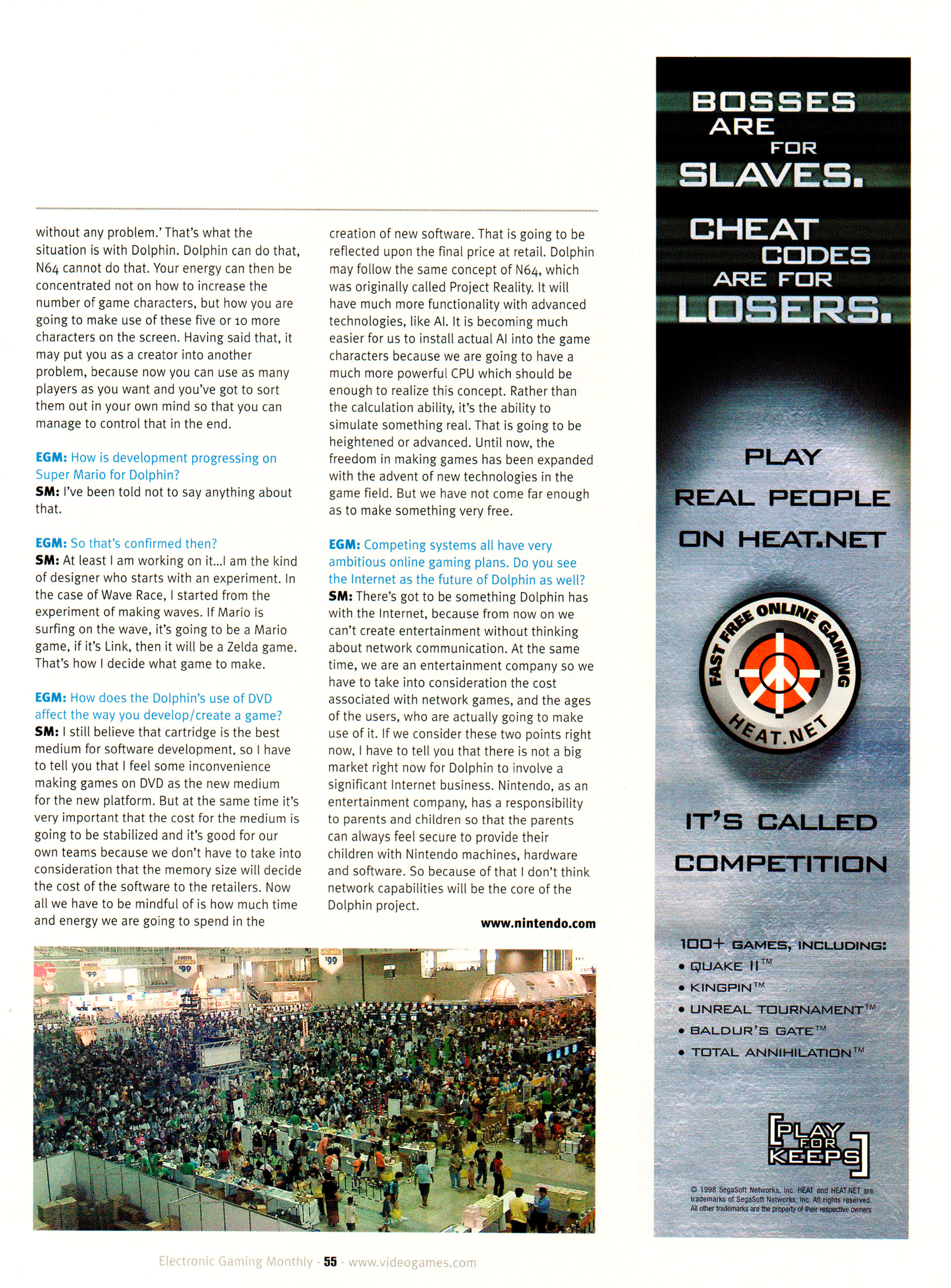
Notes: This interview took place at Space World 1999, which was held August 27-29. Scans by Retromags.
Summary: He’s not as involved with The Legend of Zelda: Majora’s Mask as he wants to be, he’s stopped himself from making specifications for it.
There will be more Nintendo games that he won’t be deeply involved with. The sequels that come out will make you feel the same way as when he worked on them. A director checks each part of the game to make sure it’s still their game. F-Zero and Yoshi games have the touch of other directors. He wants to oversee the process and make sure the directors reflect on their touch.
They realized while working on Wave Race 64 that the Nintendo 64 wasn’t powerful enough for detailed wave movement.
Though the Nintendo 64 was powerful for the time, they had to pay attention just to get games to run on it. They can focus on details with the GameCube, which allows them to try new things. They also had to get used to making 3D games.
Other game systems had lots of 3D fighting games because they were easy to make when there were only two characters. Super Smash Bros. could handle four characters, but they were simpler than a game with two characters. The GameCube could handle five to 10.
He starts games with experiments. If Mario is riding a wave, it’s a Mario game, that how he decides what game to make.
Cartridges are the best medium for games, using DVDs is inconvenient. However, it’s important to stabilize the price, so that bigger games don’t cost more to produce. The GameCube will have more advanced technology, like artificial intelligence. It’s easier to use AI because the CPU is stronger.
The GameCube has to have something online since they can’t think of entertainment without considering online communication. There is not currently a big market for online GameCube games. Nintendo also has a responsibility to make parents feel secure with allowing their children to play games.
GamePro: Miyamoto Speaks!
Publication Date: November, 1999
Subject(s): The Legend of Zelda: Majora’s Mask, 64DD, GameCube
Format: Transcribed interview
People: Unnamed GamePro interviewer, Shigeru Miyamoto
Scans:
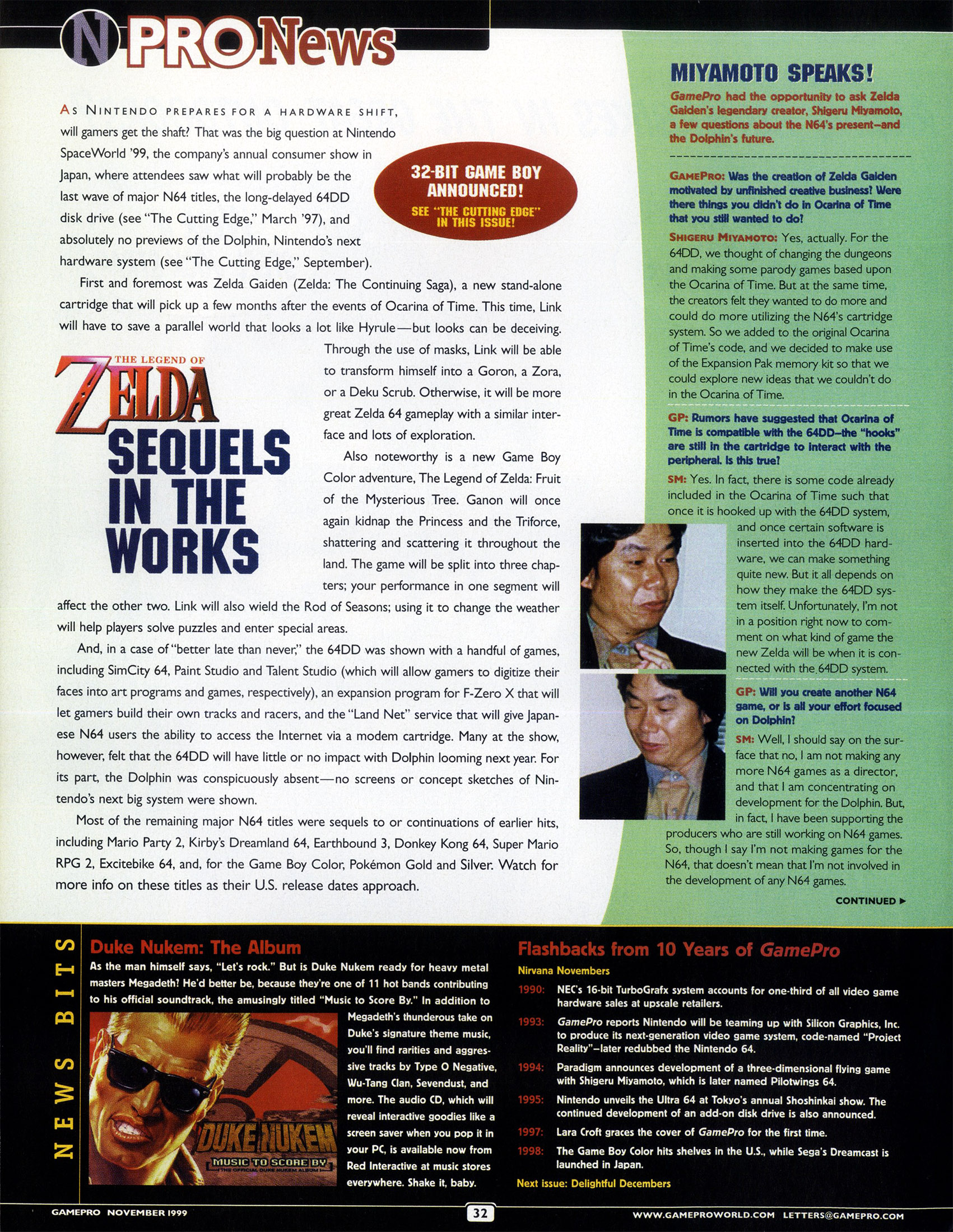

Notes: The Zelda Gaiden mentioned eventually became The Legend of Zelda: Majora’s Mask. Scans by Retromags.
Summary: They thought of making parody games based on The Legend of Zelda: Ocarina of Time, but also wanted to use the Expansion Pak to do more than they could before.
Ocarina of Time includes code that makes it ready for the 64DD.
He’s not the director of any Nintendo 64 games in development, but he is helping some producers with N64 games.
They worked with Silicon Graphics on the N64, but they had no experience with video games. They’ve learned a lot that will be useful for the GameCube.
DVDs will reduce the cost of making games. They won’t need to be as concerned about RAM.
Other than games he made, he enjoys Super Smash Bros., International SuperStar Soccer ’98, and Rare’s games.
Next Generation: Still Swimming with the Dolphin?
Publication Date: November, 1999
Subject(s): GameCube, ideas, the Nintendo 64 in Japan
Format: Transcribed interview
People: Unnamed Next Generation interviewer, Hiroshi Imanishi, Shigeru Miyamoto
Scans:
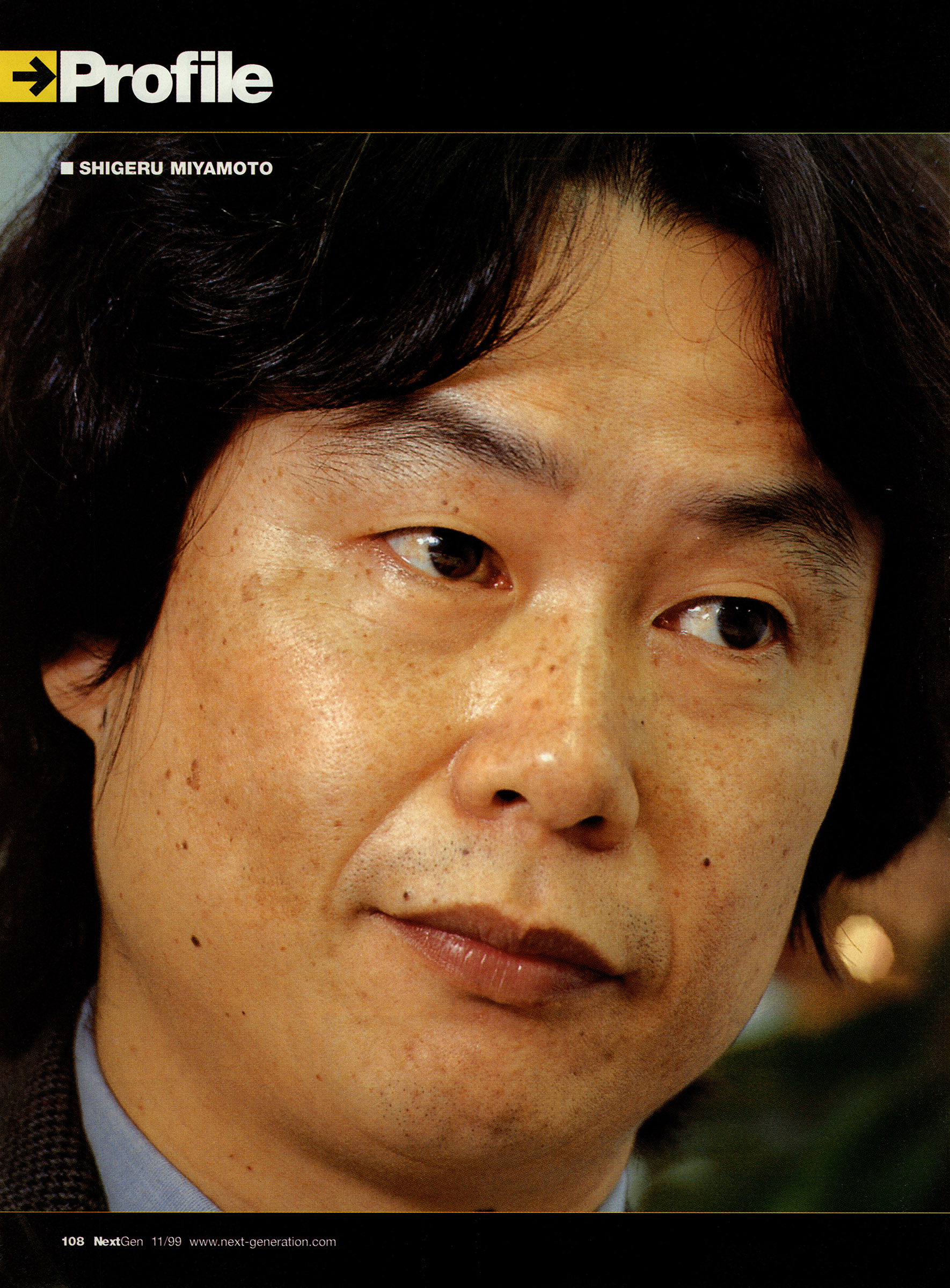
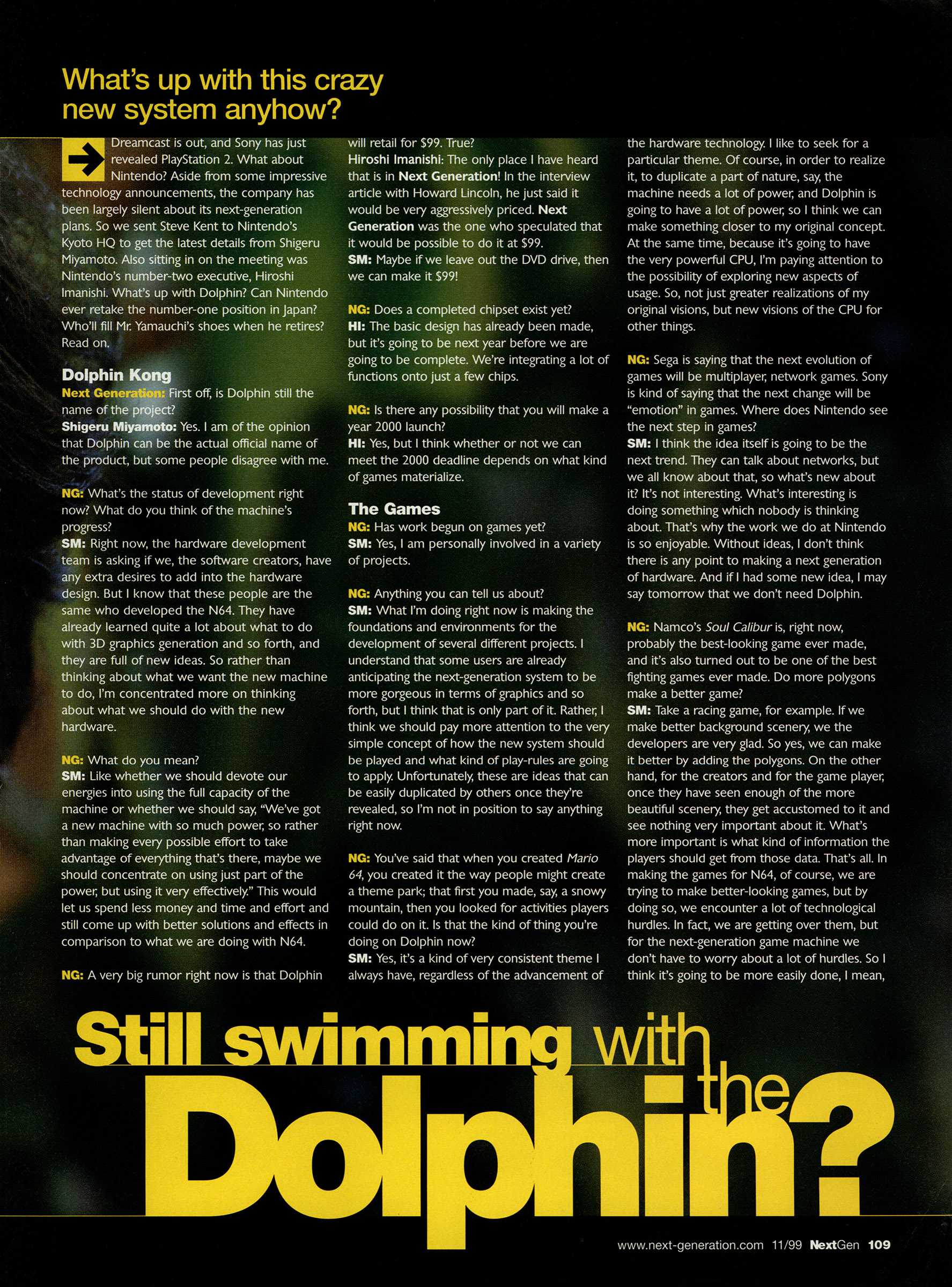
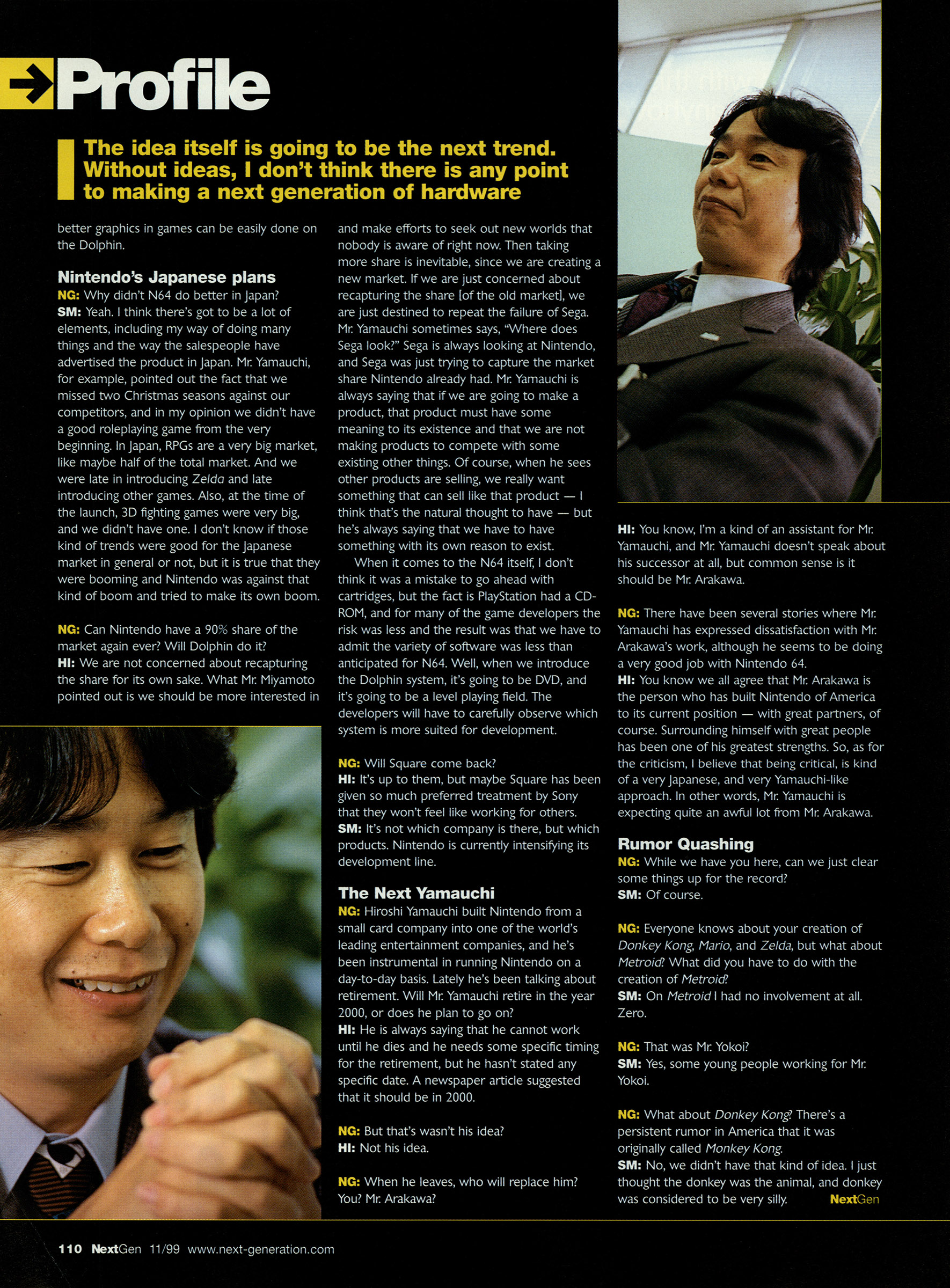
Notes: This interview took place at Nintendo’s Kyoto offices. Scans by Retromags.
Summary: He thinks Dolphin should be the name of their next system, but others disagree.
The hardware team is asking the software people if there’s anything they’d like to have added to the GameCube. Maybe it can be $99 if they leave out the DVD drive.
He’s laying the foundation of several games right now. Rather than focus on the improved graphics people should be paying attention to how the GameCube will be played.
He’s interested in doing what no one is thinking about. Everyone knows about online play so it’s not interesting. There’s no point to a new generation without ideas.
When you add more polygons to a racing game’s scenery the developers are happy, but the player becomes accustomed to it and it becomes unimportant. They don’t have to worry about technological hurdles as much with the GameCube.
The reasons the Nintendo 64 didn’t do well in Japan include his way of doing things and how it was advertised. They also didn’t have a role-playing game from the start, and they are as much as half the market in Japan. The Legend of Zelda: Ocarina of Time came late, and they didn’t have a 3D fighting game even though those were big. Nintendo tried to make its own boom.
He had no involvement with creating Metroid, that was young people working with Gunpei Yokoi.
Donkey Kong was never called Monkey Kong, he thought donkeys were considered silly.
Nintendo Official Magazine: The Legend of Zelda The Continuing Saga / A Genius Speaks
Publication Date: November, 1999
Subject(s): The Legend of Zelda: Majora’s Mask
Format: Transcribed interview
People: Unnamed Nintendo Official Magazine interviewer, Shigeru Miyamoto
Scans:
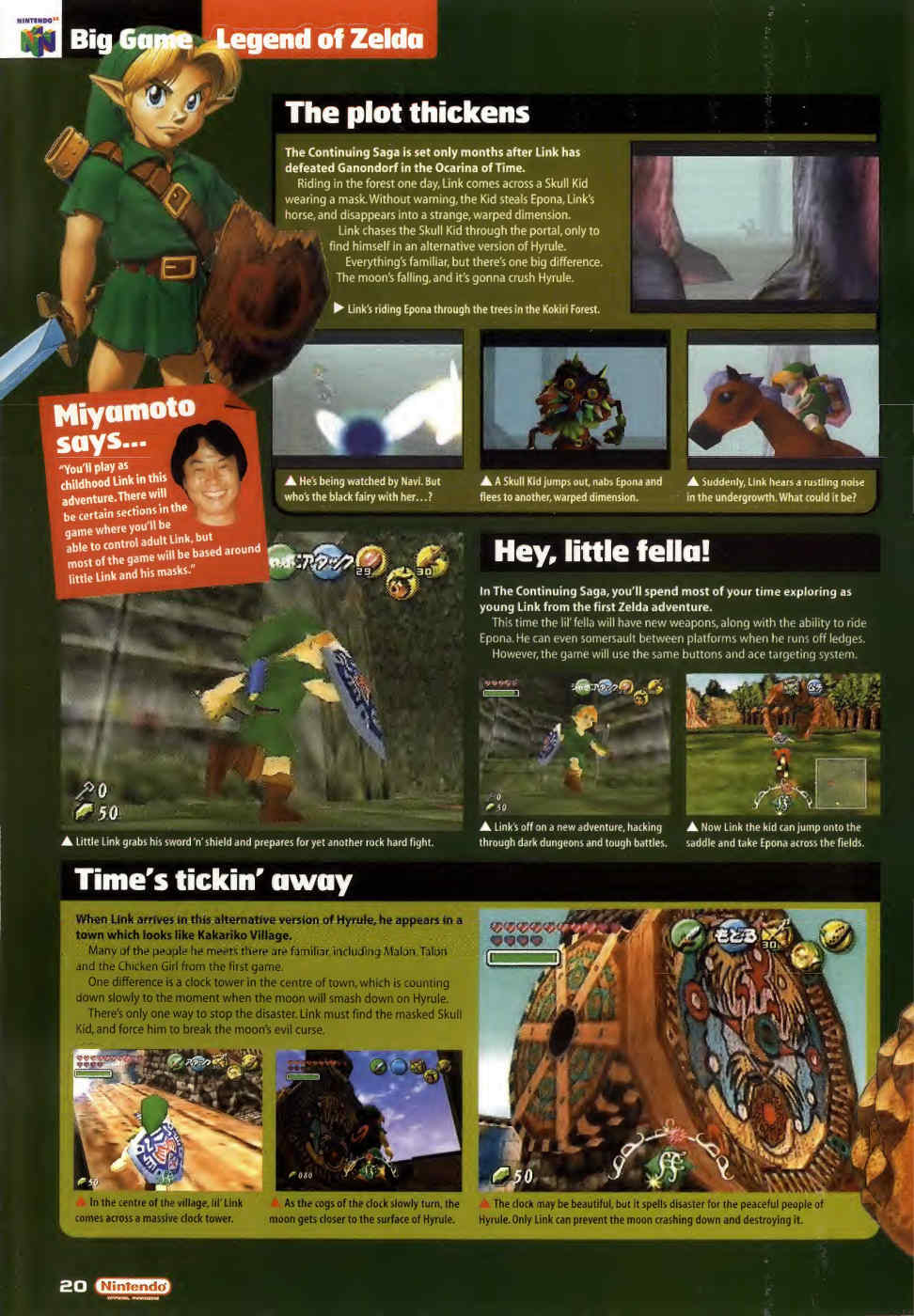
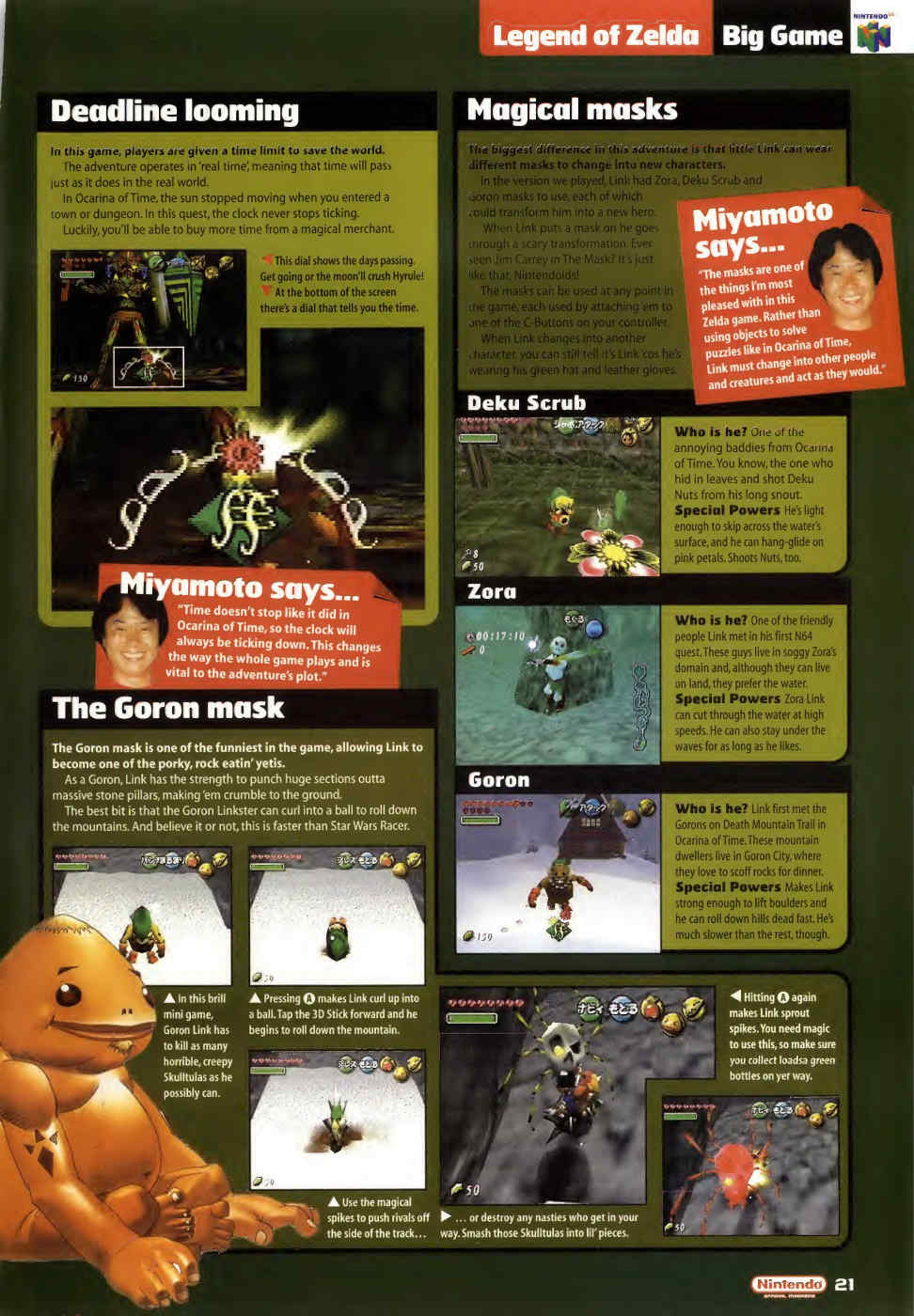

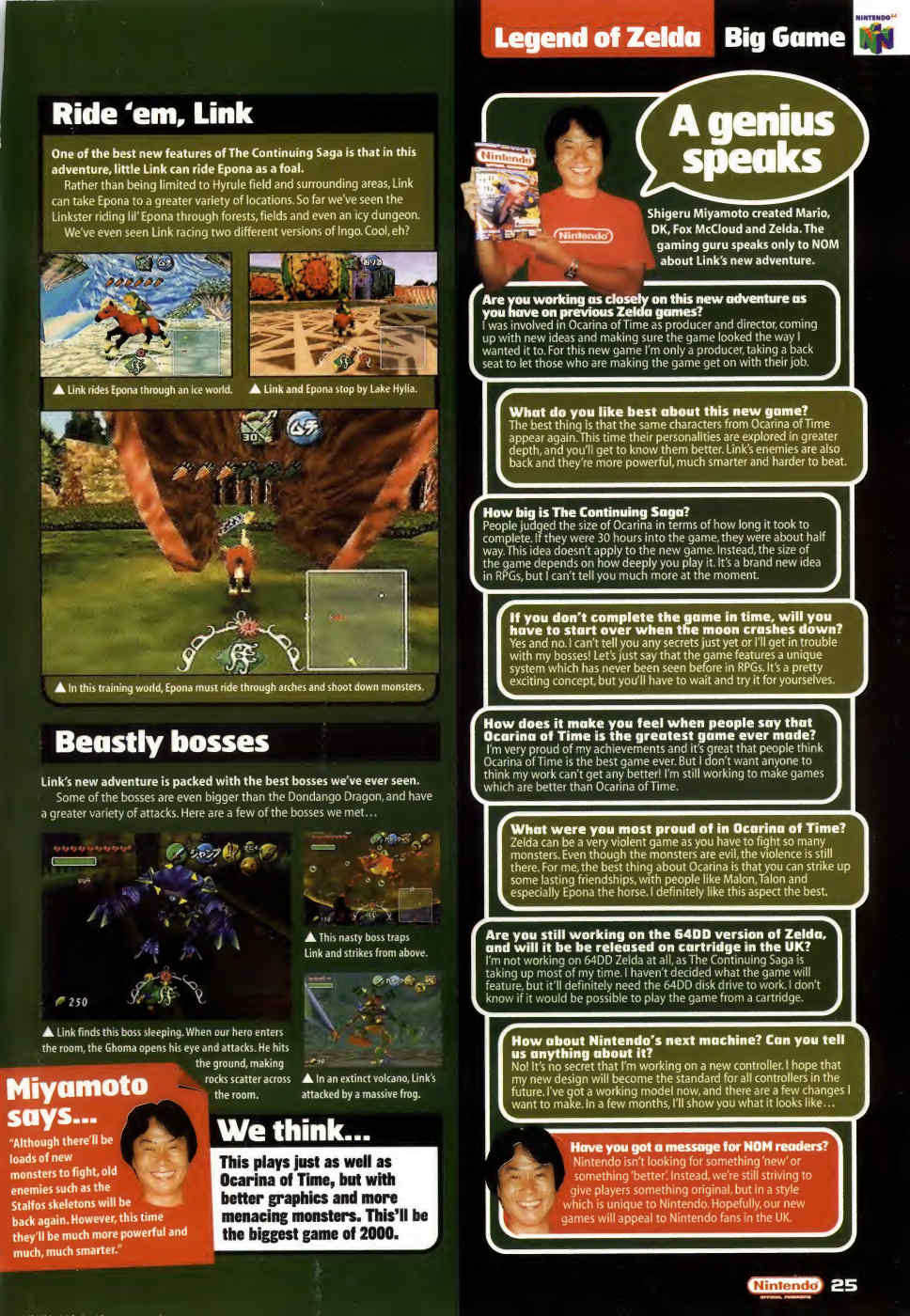
Notes: The Legend of Zelda: Majora’s Mask is referred to as “The Continuing Saga” throughout this feature. In Japan this game was known as “Zelda Gaiden” before release, so this is either an early English version of that name, or Nintendo Official Magazine is made up an approximate translation. Scans by Out of Print Archive.
Summary: In The Legend of Zelda: Majora’s Mask you’ll mostly play as child Link. There will be parts where you can play as adult Link.
He’s pleased with the masks, you use them rather than objects to solve puzzles.
The clock is always ticking down.
The Nintendo 64 Expansion Pak means the enemies are smarter.
Staflos skeletons are back, but they are stronger and smarter.
He is a producer on Majora’s Mask.
Characters from The Legend of Zelda: Ocarina of Time return and you’ll get to know more about them. The enemies are back, but stronger.
People 30 hours into Ocarina of Time were about halfway done. The size of Majora’s Mask depends on how you play it, a new idea to role-playing games.
It’s great that people think of Ocarina of Time as the best game of all time, but he’s trying to make even better games.
The Legend of Zelda can be a violent series, but his favorite aspect is making friends with characters.
He doesn’t know what the 64DD The Legend of Zelda game will feature.
He hopes the GameCube controller design he has been working on will become the standard in the future.
Nintendo isn’t trying to make something new or better, they are trying to make something original that is unique to Nintendo.
The 64Dream, November 1999 (Reported on by DidYouKnowGaming, partially untranslated from Japanese)
Publication Date: November, 1999
Subject(s): The Legend of Zelda: Ocarina of Time, The Legend of Zelda: Majora’s Mask
Format: Transcribed interview
People: Reported on by DidYouKnowGaming, Unknown The 64Dream interviewer, Shigeru Miyamoto
Video: https://www.youtube.com/watch?v=KVRMb6aFdqY&t=386s
Translator: Jacob Newcomb for DidYouKnowGaming
Summary: He gave brief notes to the team working on The Legend of Zelda: Majora’s Mask. If Majora’s Mask needed another year by November it would have been cancelled so as not to get in the way of the GameCube.
They started thinking of Majora’s Mask before The Legend of Zelda: Ocarina of Time was released.
They wanted Majora’s Mask to be more accessible, most Ocarina of Time players quit around the Fire Temple. His wife is still in the Shadow Temple.
The plot involves masks to make the characters feel more alive.
There will be an ending if time runs out.
Game Hihyou: What Is The Pleasure Principal Of Games?
Publication Date: November, 1999 (translated June 28, 2023)
Subject(s): Game design, jumping, arcade games, controller design, the Rubik’s Cube, timing
Format: Transcribed interview
People: Unknown Game Hihyou interviewer, Toshihiro Nagoshi, Shigeru Miyamoto
Link: https://shmuplations.com/miyamotoxnagoshi/
Archive Link: https://web.archive.org/web/20230628020438/https://shmuplations.com/miyamotoxnagoshi/
Scans:
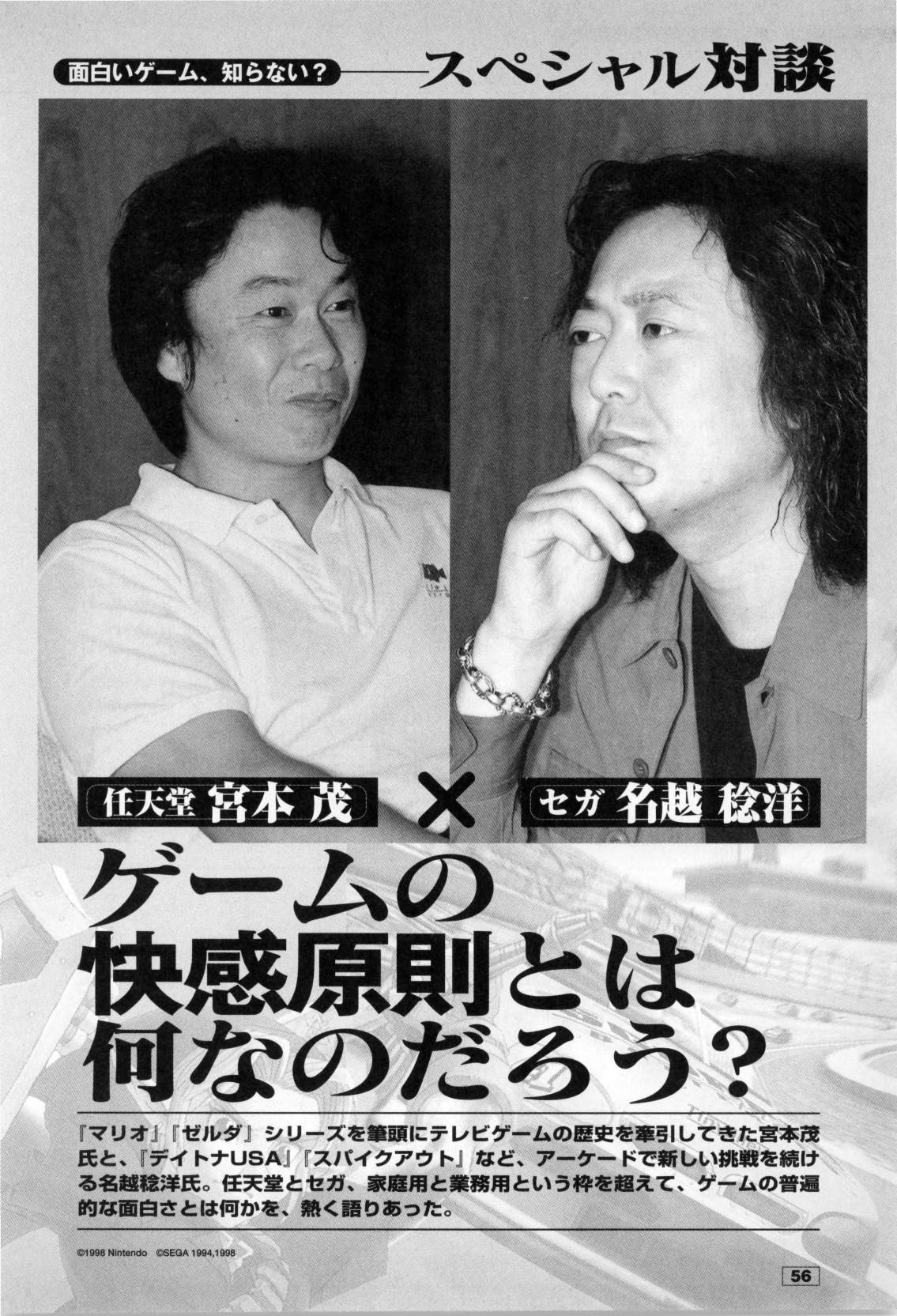
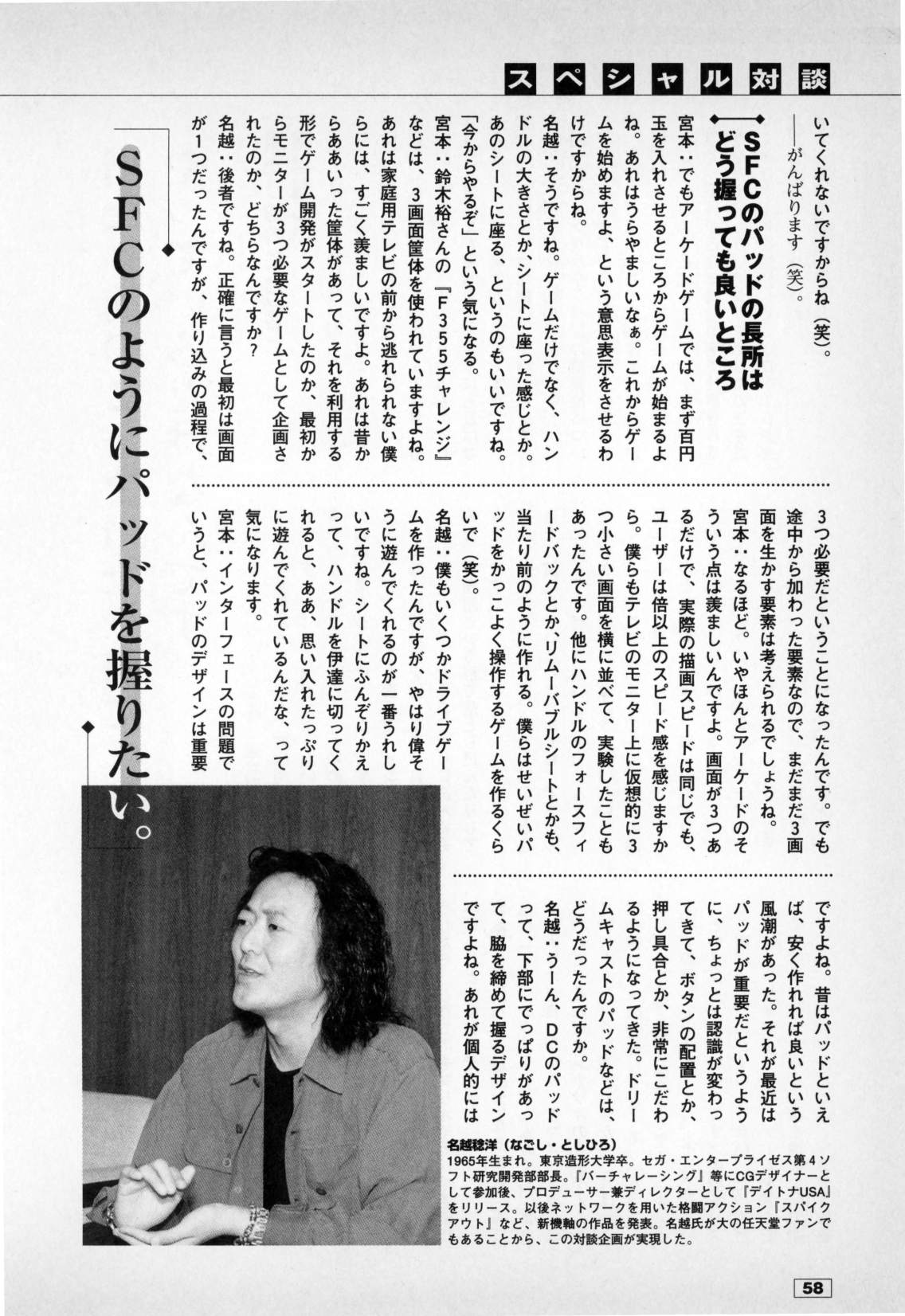

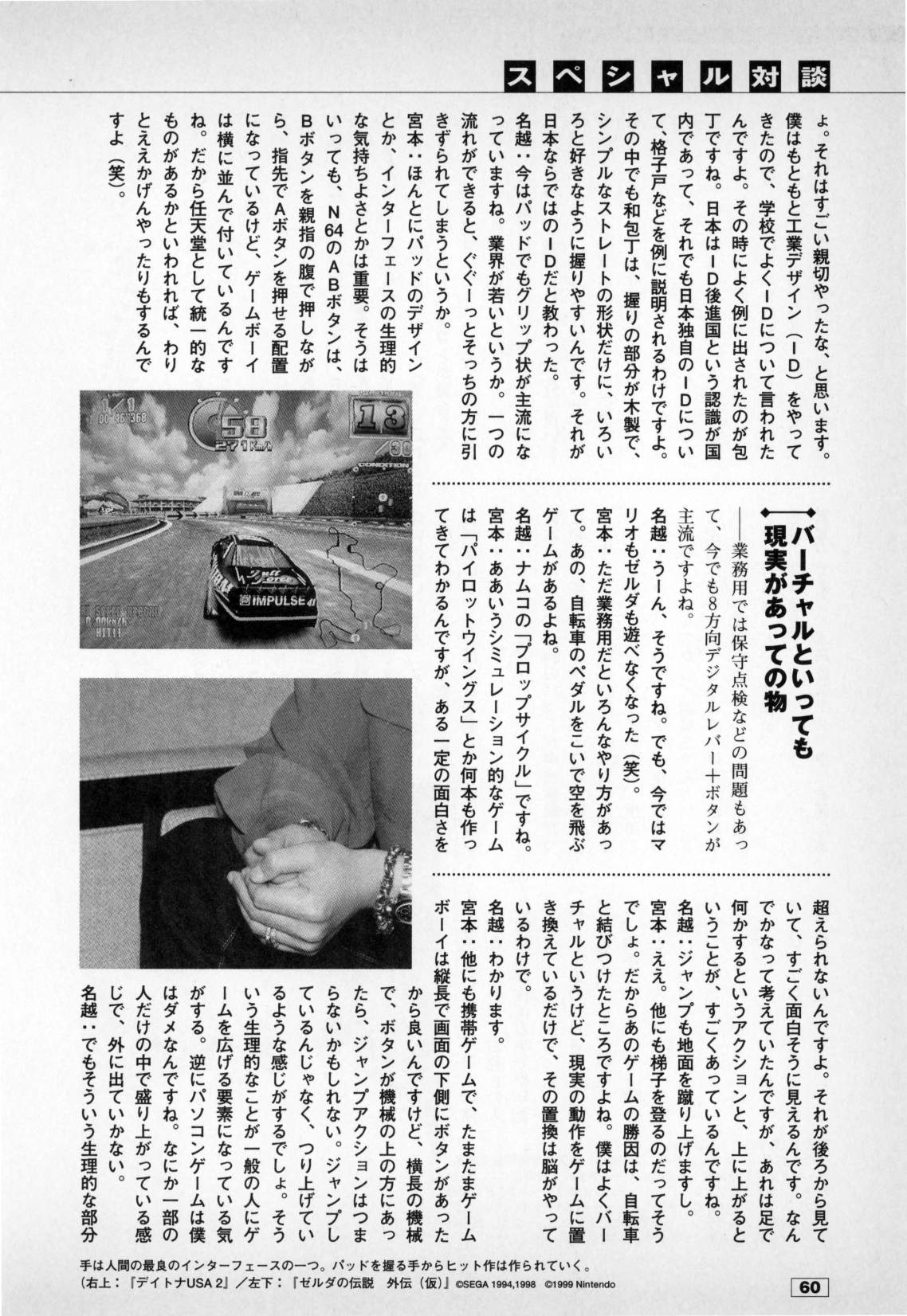
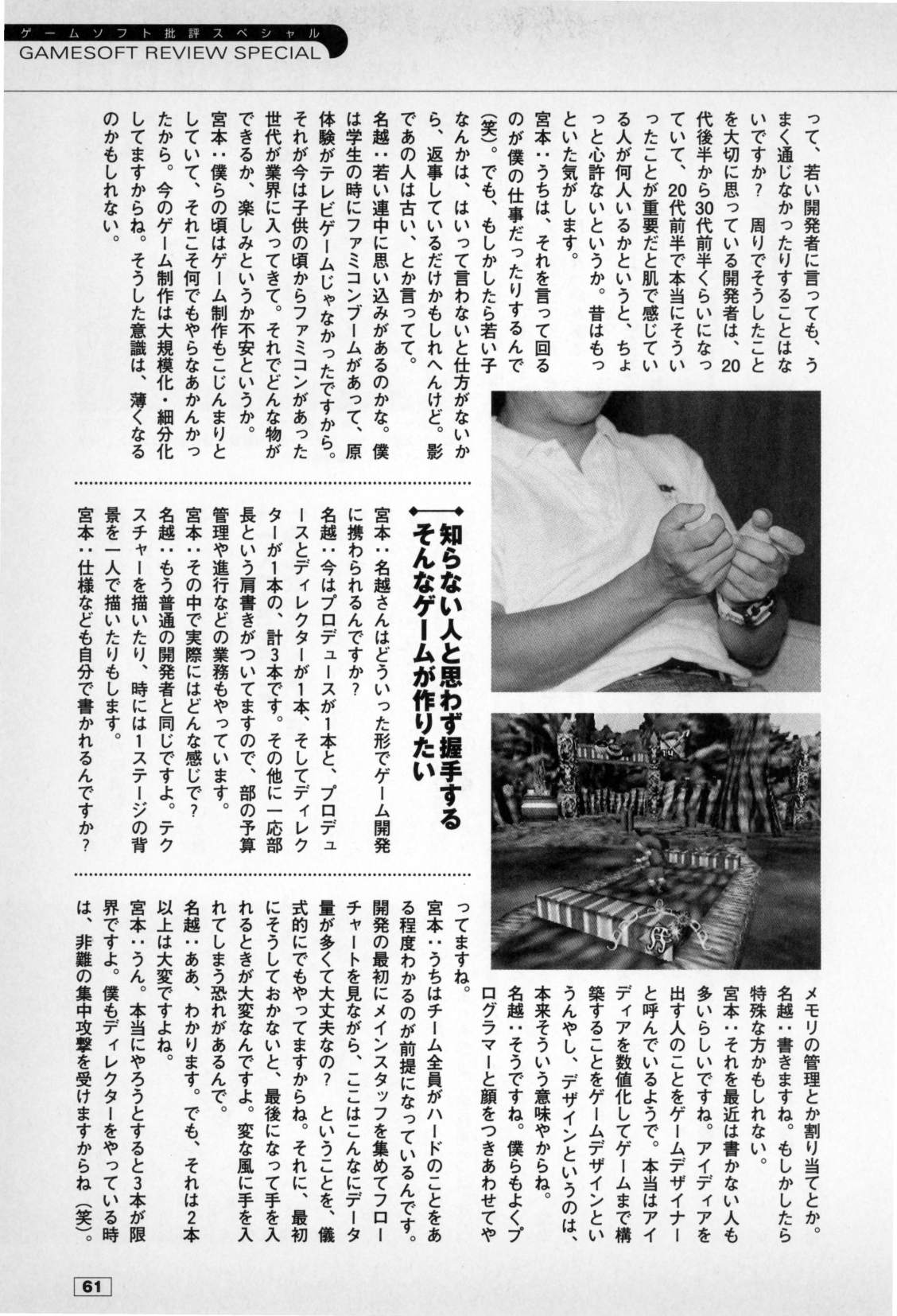
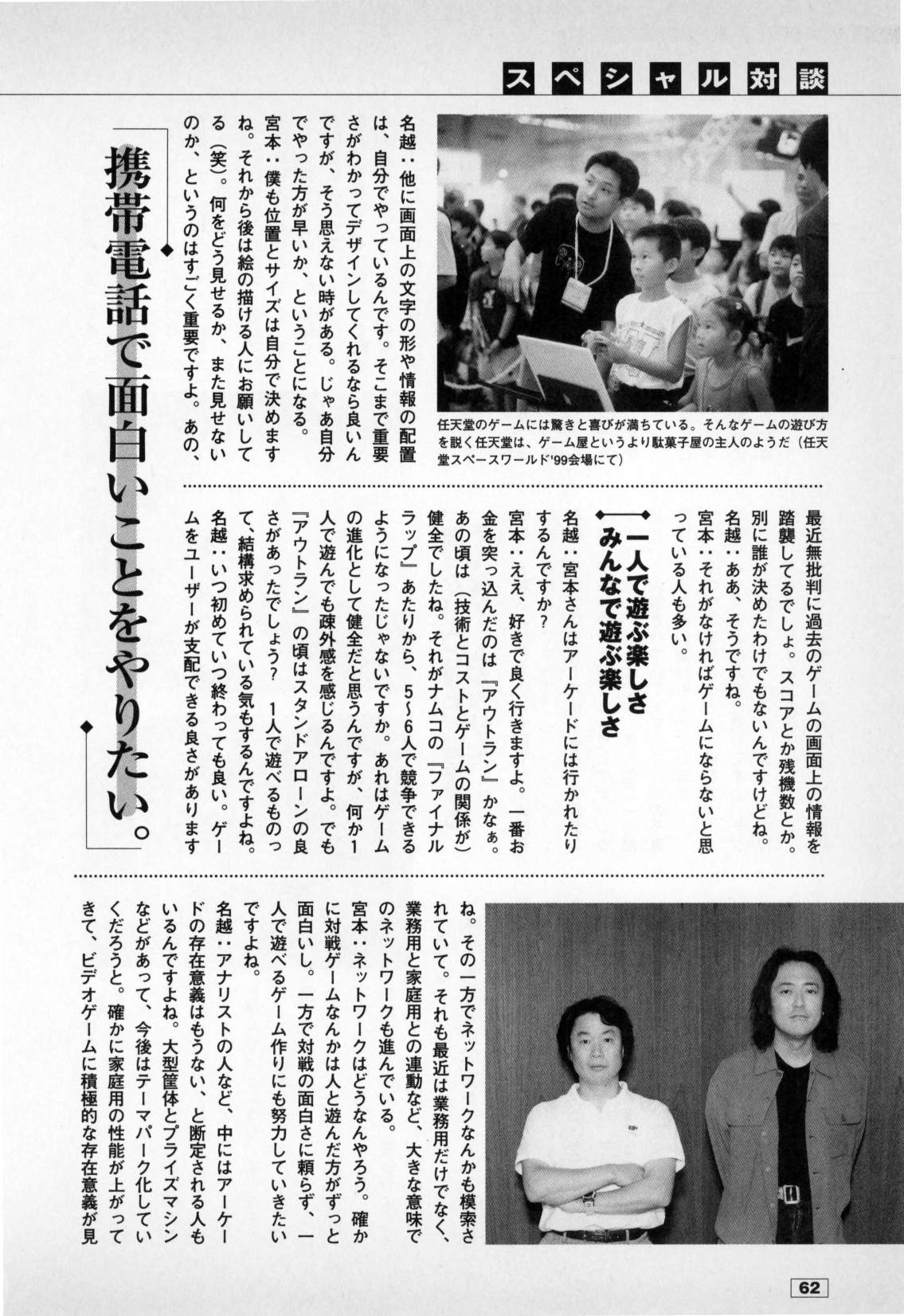


Translator: shmuplations
Notes: Game Hihyo (Game Criticism) was a Japanese magazine dedicated to being independent from publisher’s ad money and honestly covering game news. You can read more about it on Gaming Alexandria, who are responsible for the scans.
Summary: At Nintendo they do what seems obvious, but there are a lot of games that don’t get that kind of attention during development.
What does the word “jump” really mean? How is it handled in the game? Expressing everything that goes into a jump in numbers is game design.
The media talked a lot about how good Dragon Quest’s story was and since then people think that a good story makes a game great. He likes the rhythm and how it is paced.
Arcade games have the premise of trying to get someone to insert a coin, it’s a very clear declaration of intent.
They are jealous of F355 Challenge’s three monitor setup; they are chained to the console format. Having three screens increases the sense of speed, and arcade games can have force feedback, too. They can only make the controls feel cool on a console.
There used to be a tendency to make controllers as cheaply as possible, but now there’s a lot of focus on how they feel to use.
There were many Nintendo 64 controller prototypes. The future will have a merging of console and computer games that can connect to the Internet.
Fighting game developers used to tell them that their games required six buttons, which was a non-starter. He can’t call the N64 controller a success when people tell him that it feels like it was made for Super Mario 64.
He thought puzzle games would use the d-pad, and others could use both the d-pad and analog stick. It would be more user friendly to have the analog stick on the left in the future.
He thinks the analog stick should be on the right, since most people are right handed.
With the N64 controller the B button is placed so you can press it with the flat part of your thumb while still being able to press A with the tip. You can’t do that with the Game Boy since the buttons are horizontal.
Watching someone play Prop Cycle is always fun, there’s a timelessness to it when what you physically do matches what happens in the game.
When the buttons are above the screen in a handheld gaming system the jump button feels wrong, like you’re lifting the character. He doesn’t like computer games, they can’t reach a broad audience. It’s his job at Nintendo to tell the younger developers about the visceral feel of controls.
Since the gaming industry was new when he started he had a lot of freedom. Now there is a lot of specialization.
Many people call someone who comes up with ideas a game designer, but a game designer has to turn those ideas into numbers.
Everyone at Nintendo has to have a certain level of knowledge about their hardware. They look at flowcharts early in development and discuss whether there will be enough data for various sections. It’s easier than correcting things later. He worries about things changing at the last minute.
Three games is the most you can oversee at once.
He decides on fonts and the layout of the user interface. A lot of people are just copying interface elements like score and lives remaining from other games.
He stills likes to go to arcades, he’s probably spent more money on Outrun than any other game.
Some kinds of games are more fun with other people, but he doesn’t want to focus on multiplayer games.
They gave the Nintendo 64 four controller ports because it encourages socializing. When four kids are playing one will suggest going outside.
The last phase of game development has an appeal. When he’s a supervisor on a game he is hands-off on the controls, one person should be responsible for those.
He’s never believed that you have to make a totally unique game. Making ports is fun too. Seeing a game you worked on being enjoyed is more important than name recognition.
Nintendo is keeping a close eye on mobile and handheld gaming.
The Legend of Zelda Oracle games came about more because they had a relationship with Yoshiki Okamoto than Capcom. He’d like to create more bonds of trust with other companies.
Making a game is more like molding clay than carving. He likes to look at games about 90% complete and give them pointers.
Rubik’s Cube is his eternal rival. His notion of games started with the arcade.
His sense of timing in games is inspired by Yoshimoto Shinkigeki, rakugo, and manzai.
If you only focus on making games your family will fall apart.
Gamers’ Republic: Nintendo’s Shigeru Miyamoto
Publication Date: November, 1999
Subject(s): Dreamcast, online gaming, GameCube, cartridges versus disks, his hobbies, assigning characters to games, online gaming, widening the market
Format: Transcribed interview
People: Unnamed Gamers’ Republic interviewer, Shigeru Miyamoto
Scans:

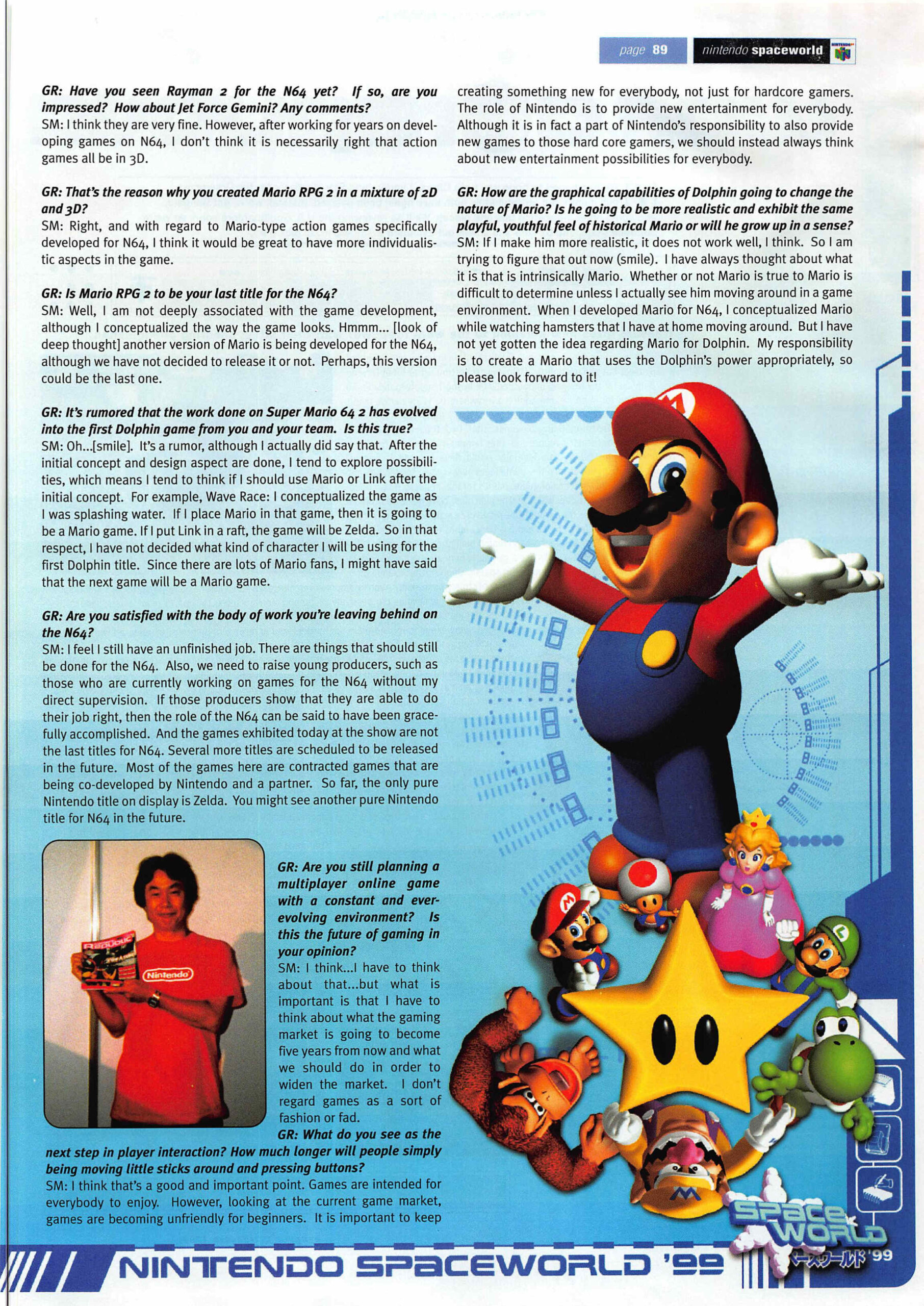
Notes: This interview took place at Space World, held August 27–29, 1999. Scans by RetroCDN.
Summary: He doesn’t think about other company’s game hardware. Some are better at one thing or another, but Nintendo tries to make hardware that is good for gameplay and is reasonably priced. Sega is making the Dreamcast to be symbiotic with personal computers.
The GameCube will be able to do what the Dreamcast does online. GameCube development is not influenced by the PlayStation 2 or Dreamcast. They decided to make the GameCube so they could develop games for a more powerful and more efficient system.
Cartridges are good for children since they won’t damage them. Many developers want them to keep using cartridges, but they cost more to make.
The GameCube will not be a multimedia device. They will make games, but it’s ok if other companies make multimedia peripherals.
Making games is like making movies, where he is the director.
He rests on weekends and spends time with his family. He has been gardening, he even has a sun tan. He sort of became a sponsor to a student who is studying gardening and they have been working on the garden. He also swims and plays the guitar.
The people who handle music at Nintendo may get annoyed at him for asking too many questions.
He wants to make games without worrying about how many polygons there are. Developers will be able to display as many as they want with the GameCube.
Not all action games have to be 3D.
He conceptualized how Paper Mario looks, but he’s not very involved with it. There is another Mario game for the N64 being worked on, but they don’t know if they will release it.
When a game’s concept and design have been decided on he thinks about whether they should use Mario or Link in the game. He conceptualized Wave Race as he was splashing water. If he put Link in such a game, it would be a The Legend of Zelda game. He hasn’t decided what character will be in the first GameCube game.
He hasn’t finished his job with the N64 yet. Younger producers need to make games without his supervision before he says his role with the N64 is done.
He’s still thinking about online games, but he has to concentrate on how the market will change in the next five years and how they can widen it.
Games are for everyone, but they have become unfriendly to newcomers. They have to make games for hardcore gamers and explore new possibilities.
Making Mario more realistic doesn’t work. He has to think about what is intrinsically Mario. He conceptualized Super Mario 64 by watching hamsters move around.
Incite: Gettin’ Shiggy with it..
Publication Date: December, 1999
Subject(s): The Legend of Zelda: Ocarina of Time, The Legend of Zelda: Majora’s Mask, The Legend of Zelda: Ocarina of Time Master Quest, The Legend of Zelda: Oracles of Seasons and Ages
Format: Transcribed interview
People: Unnamed Incite interviewer, Shigeru Miyamoto
Scans:


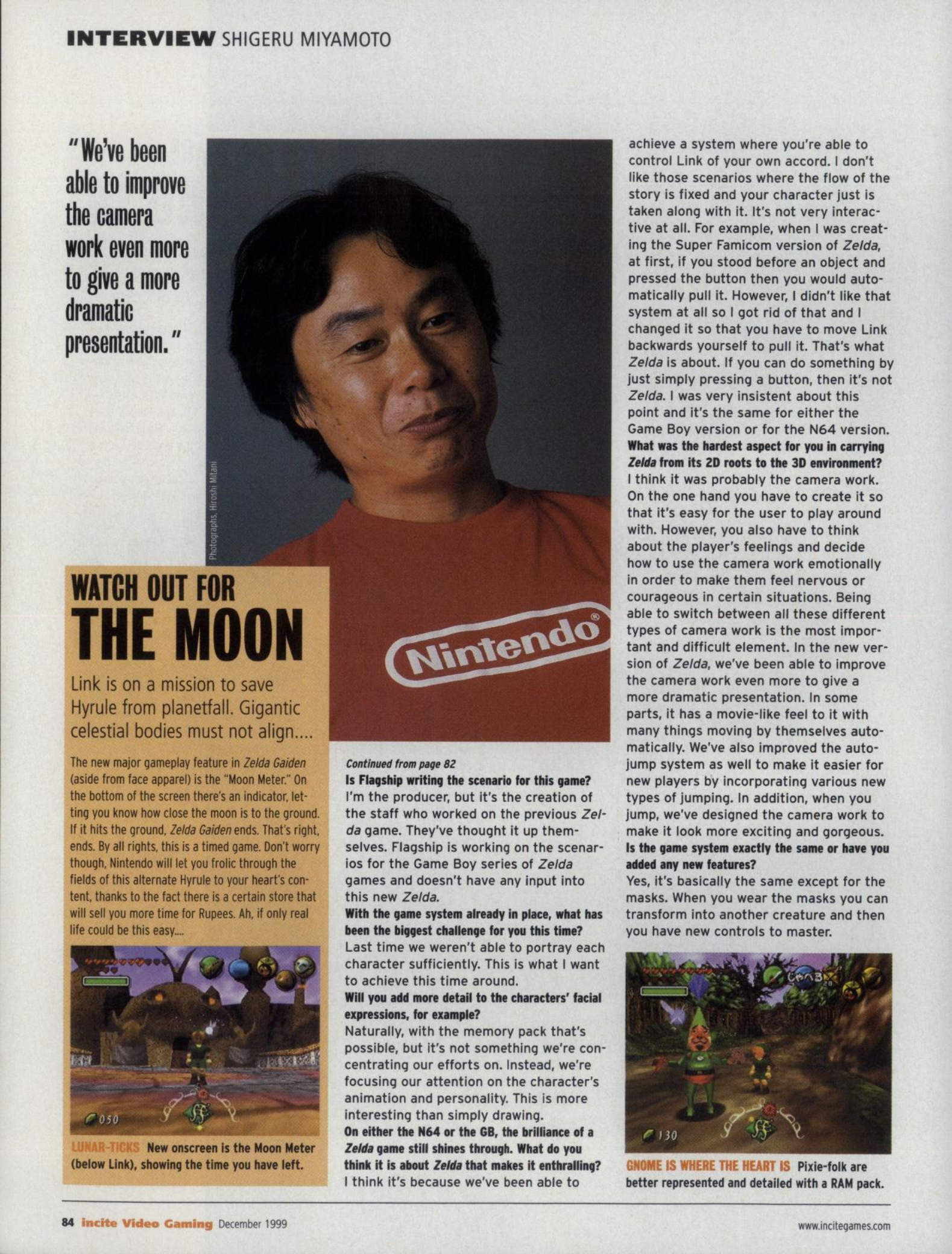
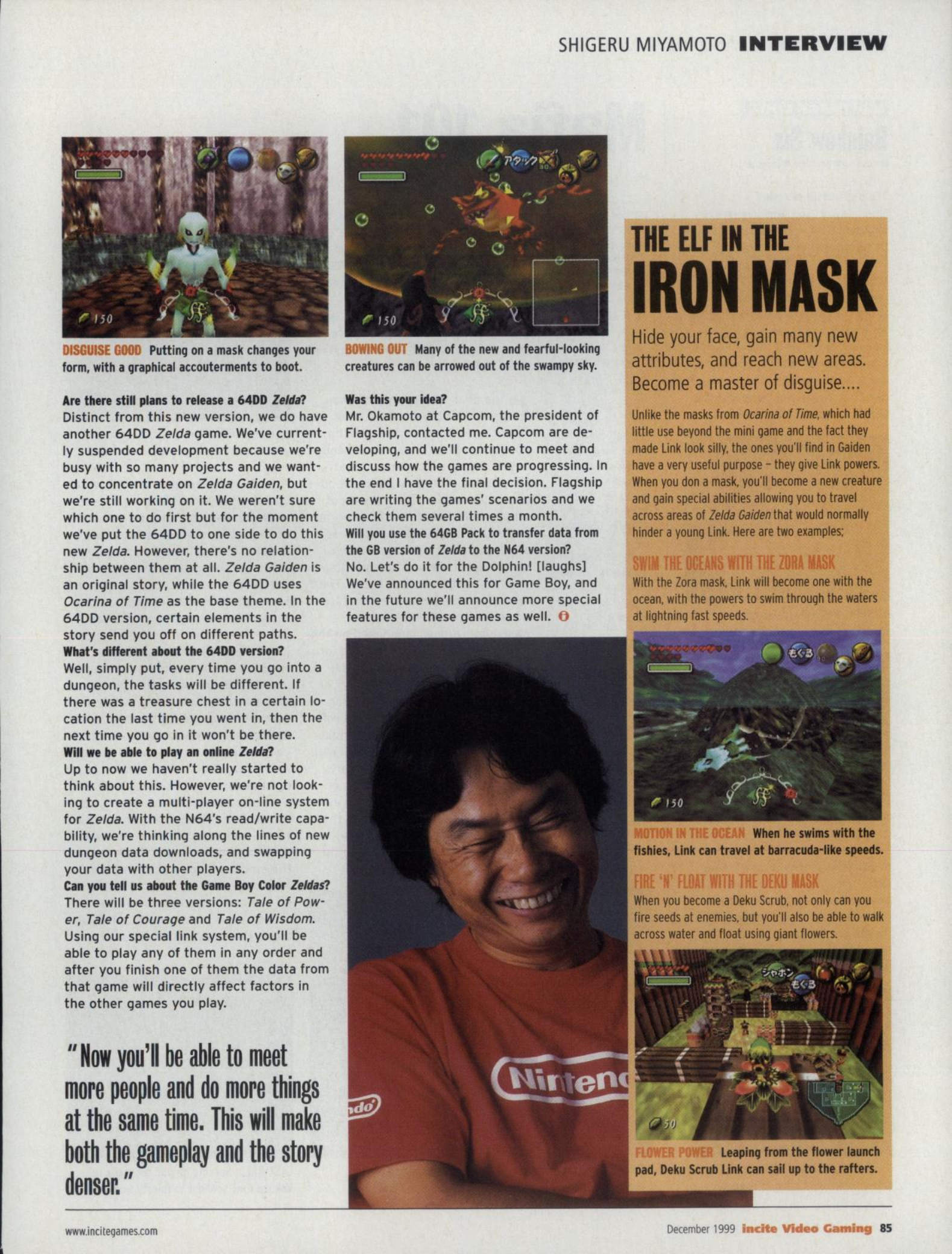
Notes: Scans by Computec Media USA. All four (or five if you consider the original plan of a Game Boy Color trilogy) upcoming The Legend of Zelda games that come up in this interview would release with different names.
Summary: He’s thankful that The Legend of Zelda: Ocarina of Time sold well. Selling eight million copies is difficult. Everyone expected it to be perfect and he wishes he had another three months.
Nintendo rarely reuses a game engine, but the next The Legend of Zelda game will. It won’t be a sequel, but it will have a deeper story and more layers. It will use the Nintendo 64 Expansion Pak to let players do more, make it denser, and make enemies smarter.
He’s the producer of The Legend of Zelda: Majora’s Mask and it’s being made by the same people who made Ocarina of Time. Flagship is working on Game Boy Zelda games.
He wants to portray each character sufficiently with Majora’s Mask.
The Legend of Zelda series is compelling because you can control Link. He doesn’t like games where the story is fixed and you’re just going along with it. He changed The Legend of Zelda: A Link to the Past so that instead of just pressing a button to pull an object, you had to move backwards yourself. That is what the Zelda series is about.
The camera was the hardest part of moving to 3D. It needs to be easy to play with, but also needs to be able to encourage certain emotions. Majora’s Mask’s camera is improved to be more dramatic and feel more like a movie. They’ve also improved jumping. The masks will allow you to transform into other creatures.
They are also working on a Zelda game for the 64DD, but development has been suspended for now. It will use Ocarina of Time as a base. The dungeons will be different.
They aren’t planning on an online Zelda game.
There will be three Game Boy Color Zelda games: Tale of Power, Tale of Courage, and Tale of Wisdom. With their link system you’ll be able to play them in any order and use your data to affect the others. Yoshiki Okamoto contacted him about the idea. Capcom are making the games, but he has the final say.
Arcade: Shigeru Miyamoto
Publication Date: December, 1999
Subject(s): Being recognized, England, London, IC, what Nintendo character he is
Format: Transcribed interview
People: Rich Pelley, Yasuhiro Minagawa (translator), Shigeru Miyamoto
Archive Link: https://archive.org/details/Arcade_13_1999-12/page/n35/mode/2up
Scans:
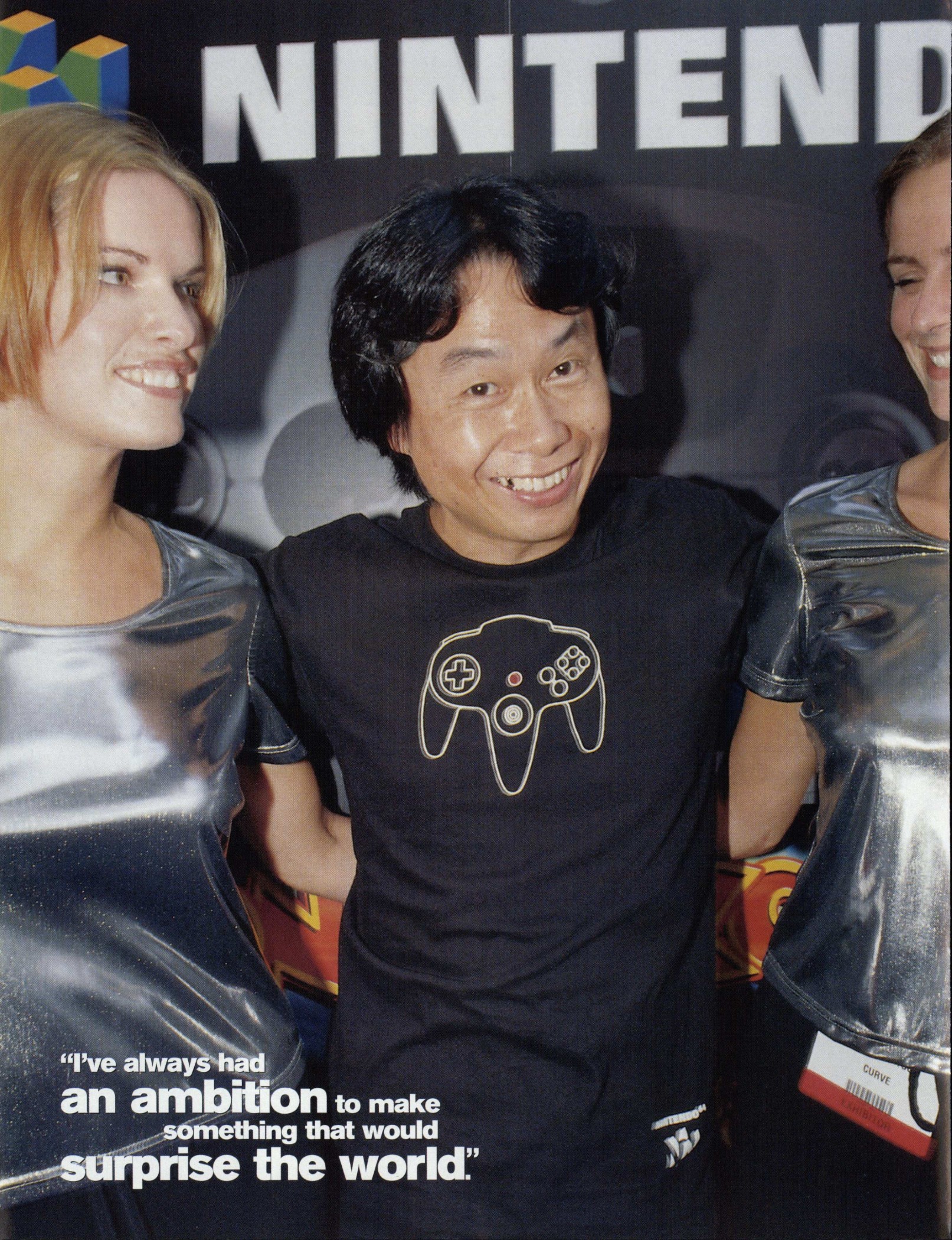
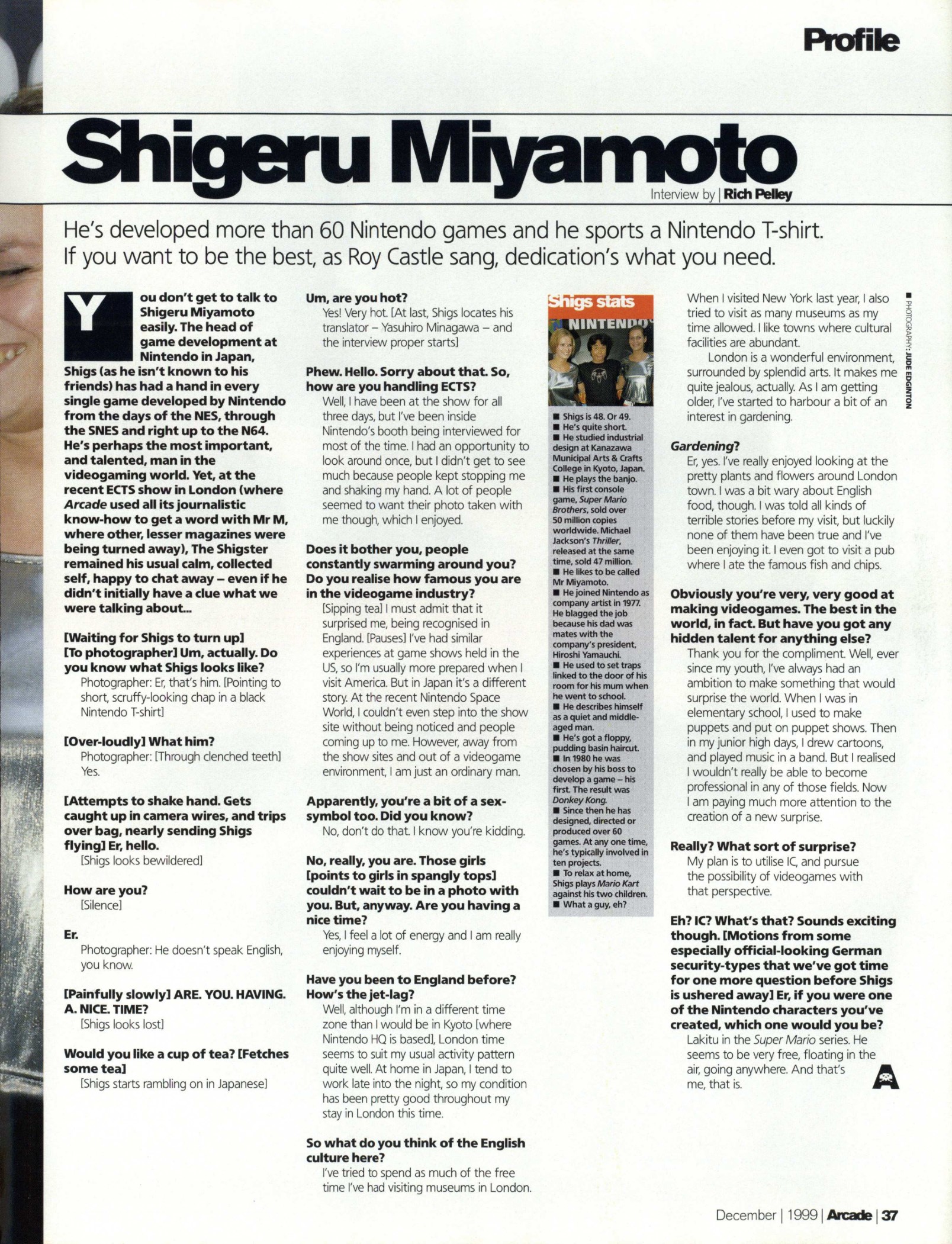
Notes: I found this interview after becoming aware of an unsourced quote by Mr. Miyamoto in a smallmariofindings post and managed to find it.
This interview took place at the European Computer Trade Show, which ran September 5-7 this year. Mr. Miyamoto says he has spent most of his three days there being interviewed but very few of these seem to have surfaced.
“IC” may refer to the Game Boy Color’s infrared communications.
Uploaded to Internet Archive and presumably scanned by Kerrazzy.
Summary: He is hot.
He’s been at the European Computer Trade Show for three days, mostly being interviewed in Nintendo’s booth. He wasn’t able to look around for long because people kept stopping him to shake his hand or to take their picture with him.
It surprised him to be recognized in England. It’s happened in the United States too. He can’t step onto the show floor at Space World without people coming up to him. He’s an ordinary man.
He knows he’s not a sex symbol.
Despite the time difference London suits his activity pattern. He works late in Japan.
He’s spent his free time visiting museums in London, like he did when he visited New York last year.
As he gets older he has become more interested in gardening, so he has been looking at the plants and flowers in London. He was worried about English food, but he’s been enjoying it. He ate fish and chips at a pub.
He’s had an ambition to surprise the world since he was young. He used to make puppets, draw cartoons, and play music in a band. He wants to create a new surprise, using IC.
If he was a Nintendo character he would be Lakitu, because he is free and floats in the air.
2000
GameSpot TV: Legend of Zelda Retrospective
Publication Date: 2000
Subject(s): The Legend of Zelda
Format: Interview (dubbed)
People: Adam Sessler, Kate Botello, unnamed interviewer, Shigeru Miyamoto
Video:
Notes: I couldn’t find more precise information on when this aired. It is unknown where the footage of Mr. Miyamoto talking about The Legend of Zelda came from, as it doesn’t seem to have been filmed for this documentary. Uploaded by YouTube user SuperKaizoku1138.
Summary: Mario and The Legend of Zelda are based on a miniature garden that you can explore.
They wanted it to be easy to move Link. They think of the game system first, and then about the characters.
Every player will have a different volume of game play with The Legend of Zelda: Majora’s Mask.
Amazon: In the Game: Nintendo’s Shigeru Miyamoto
Publication Date: 2000
Subject(s): Childhood experiences, Zelda’s name
Format: Transcribed interview
People: Todd Mowat, Porter Hall, Shigeru Miyamoto
Archive Link: https://web.archive.org/web/20010803200749/http://www.amazon.com/exec/obidos/tg/feature/-/117177/
Notes: No date is given, but there are references to this article as early as October 1, 2000. Later versions of this article do not credit Porter Hall.
Summary: He came up with the ideas for the Mario and The Legend of Zelda games from his childhood experiences exploring. There were caves and mountains. He made slingshots and puppets.
Zelda was the name of Francis Scott Fitzgerald’s wife. He used her name in the original The Legend of Zelda.
Game Design: Secrets of the Sages
Publication Date: 1999-2002 depending on edition. This entry is based on the second edition, which was published in 2000.
Subject(s): Game design, Mario’s popularity
Format: Transcribed interview
People: Marc Saltzman, Shigeru Miyamoto
Archive Link: https://archive.org/details/gamedesign00marc/ (you may be able to borrow this book for free)
Notes: This book mostly consists of quotes from dozens of game developers about their craft.
Summary: People who make games completely devote themselves to it, which allows them to make unique games. This devotion makes it impossible for them to know how someone will feel when they play it for the first time.
Their only goal is to make fun games. Mario is only popular because his games are fun. Players can relate to video game characters. Mario has a different meaning depending on the context of the game he is in. Some may not like his characters because they aren’t cool. He is sorry to those people.
Game creators are artists as well as engineers. New designers at Nintendo have to go through the technical lecture so they know what is possible and what isn’t. He tells his coworkers that they should be proud to be on the frontier of interactive entertainment.
He feels he should make games as entertainment rather than art. He makes his games so that they reflect his thoughts.
Nintendo Official Magazine: Ask Miyamoto!
Publication Date: January, 2000
Subject(s): The Legend of Zelda: Majora’s Mask, Mario’s appearance, the Triforce
Format: Transcribed interview
People: Unnamed Nintendo Official Magazine interviewer, Shigeru Miyamoto
Scan:

Notes: Scans by Out of Print Archive.
Summary: There will be more masks in The Legend of Zelda: Majora’s Mask than the Zora, Deku Scrub, and Goron masks. You’ll see familiar people from The Legend of Zelda: Ocarina of Time.
Mario will be more mature in his next game, but that doesn’t mean he’ll be rude. Mario will look more sophisticated in order to be more appealing to everyone.
He’s never been involved in development of a Metroid game.
Anyone with a good heart who collects the Triforce will rule the world. Ganon was trapped in a dark dimension because he was evil.
Electronic Gaming Monthly: Should you buy a Dreamcast or wait?
Publication Date: January, 2000
Subject(s): GameCube, online gaming
Format: Transcribed interview
People: Unnamed Electronic Gaming Monthly interviewer, Shigeru Miyamoto
Scans:


Notes: This was part of a feature comparing the Dreamcast, PlayStation 2, GameCube, and Xbox. Scans by Retromags.
Summary: It’s easier to experiment with the GameCube, they don’t have to worry about keeping the game running.
They can’t make entertainment without thinking about online gaming, but they have to consider the cost and who would use it. There’s not a big market for online GameCube games.
While making Wave Race 64 they realized the N64 wasn’t strong enough for it.
The GameCube will be more technologically advanced. It’s easier to program AI.
Super Power: Eri Maailmoissa (untranslated from Finnish)
Publication Date: January, 2000
Subject(s): GameCube, The Legend of Zelda: The Wind Waker
Format: Transcribed interview
People: Topi, Loviisa, Shigeru Miyamoto
Scans:


Notes: The title of this interview is “In Different Worlds” according to machine translation. The interview is also described as taking an hour. Scanned by PixelBoy for Retromags.
Nintendo Online Magazine: An exclusive interview with the man who created Donkey Kong, Shigeru Miyamoto
Publication Date: February, 2000
Subject(s): Donkey Kong
Format: Transcribed interview
People: Riko Kushida, Shigeru Miyamoto
Link: https://themushroomkingdom.net/interview_miyamoto_nom18_feb2000.shtml
Archive Link: https://web.archive.org/web/20121016100628/http://themushroomkingdom.net/interview_miyamoto_nom18_feb2000.shtml
Japanese Link: https://www.nintendo.co.jp/nom/0002/01/miyamoto.html
Japanese Archive Link: https://web.archive.org/web/20000713055648/http://www.nintendo.co.jp/nom/0002/01/miyamoto.html
Translator: Matt W. for The Mushroom Kingdom
Notes: Nintendo Online Magazine was a section of the official Japanese Nintendo website.
Summary: He created the Donkey Kong arcade game, which was his first game.
They were trying to make a Popeye game so they were going to include Brutus and Popeye. When plans changed Popeye became Mario and Brutus became Donkey Kong. Donkey Kong was to be Mario’s dumb pet gorilla who escaped.
He thought “Kong” referred to gorillas, so he wanted the name to end in Kong. He looked up the word “dumb” in an English dictionary and read that “donkey” could mean dumb. Americans told him that “donkey” does not mean dumb.
Donkey Kong Jr. has to save his father from Mario in Donkey Kong Jr. You can climb up faster using two vines, or go down faster using one.
He did the graphics for Punch-Out!! and put Donkey Kong in the crowd.
The Game Boy Donkey Kong is enjoyable. He has fond memories of the original Donkey Kong. Nintendo of America was skeptical of it at first but he’s been able to keep making games because it was a hit.
In 1994 the Rare president said they could make a Donkey Kong game since Nintendo was busy with their other series. He gave the OK after seeing the CG. Rare breathed new life into Donkey Kong, they really made a Nintendo-like game.
He wanted Rare to give Donkey Kong eyebrows for Donkey Kong Country, but since that was hard to show he settled for making the area around Donkey Kong’s eyes black. He decided to give Donkey Kong a necktie to make him look a bit more dumb.
Donkey Kong is cool, but has become a bit kiddie. He’d like Donkey Kong and Mario to be a bit cooler.
The 64 Dream (reported on by mother4ever.net, partially untranslated from Japanese)
Publication Date: February, 2000 (reported on June 30, 2021)
Subject(s): Cabbage, BAFTA Awards, 64DD
Format: Transcribed interview
People: Reported on by Echoes and 8lackSphinx, unknown The 64 Dream interviewer, Shigeru Miyamoto
Link: https://mother4ever.net/cabbage-itois-other-n64-project/
Archive Link: https://web.archive.org/web/20210701014208/https://mother4ever.net/cabbage-itois-other-n64-project/
Scans:

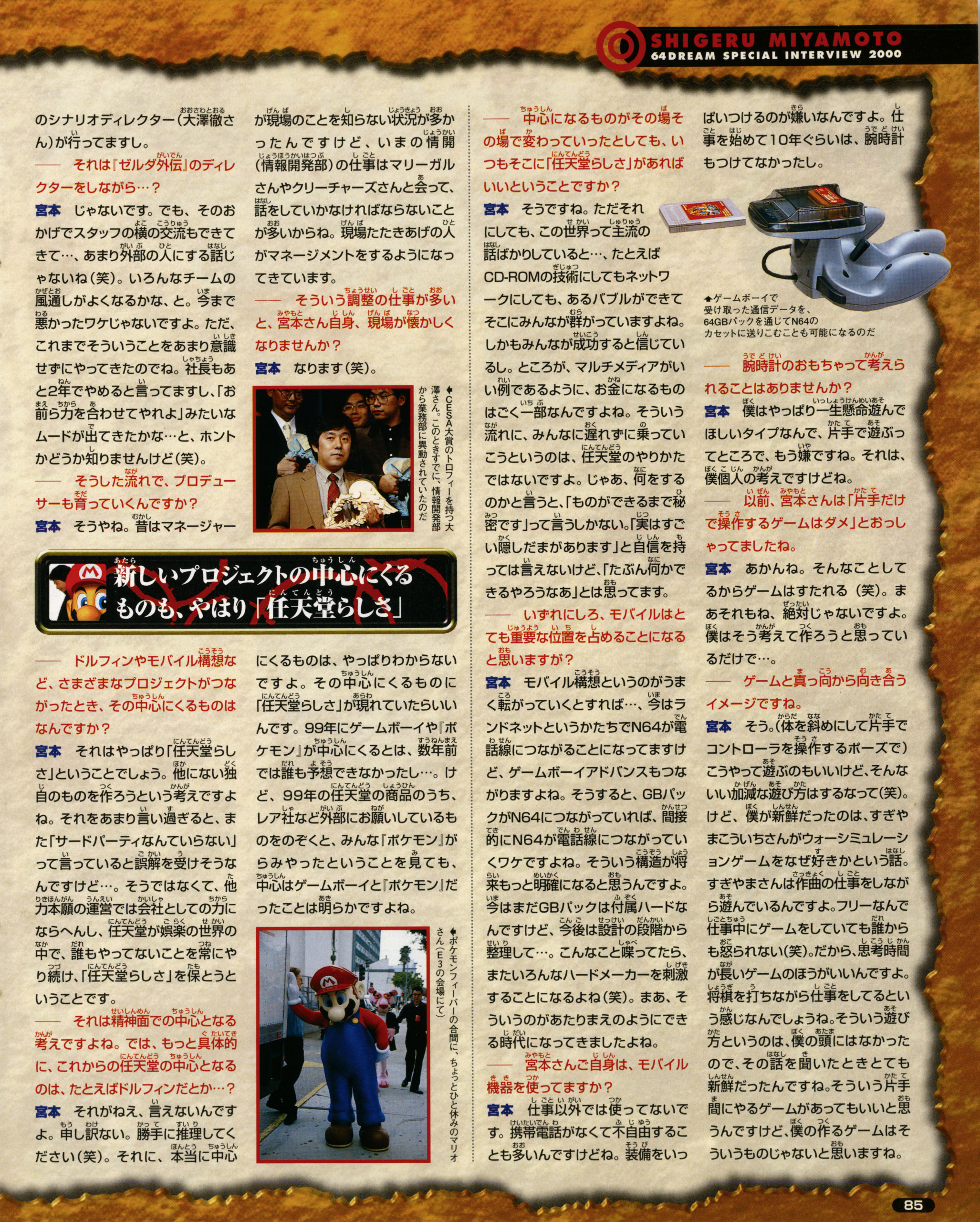


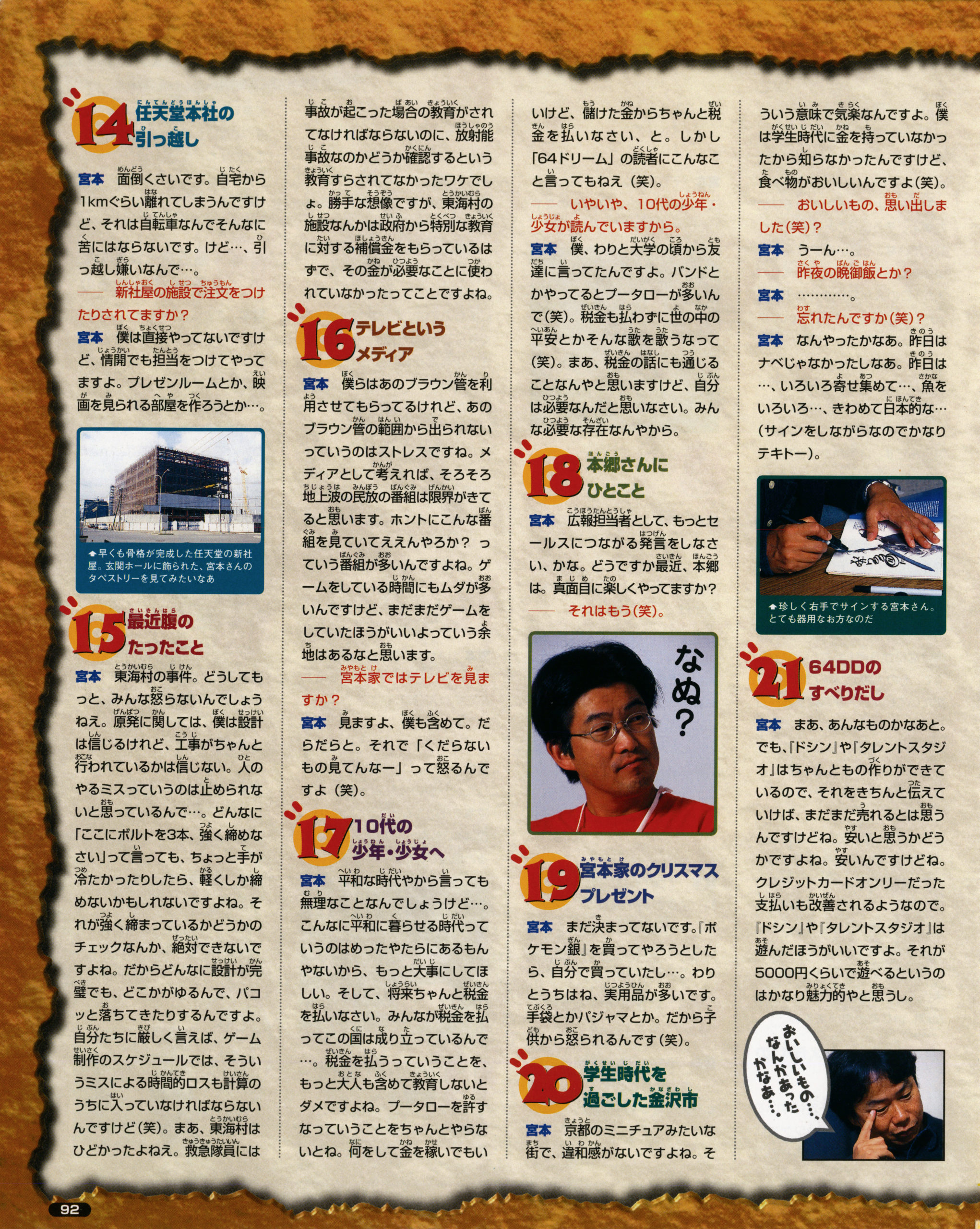
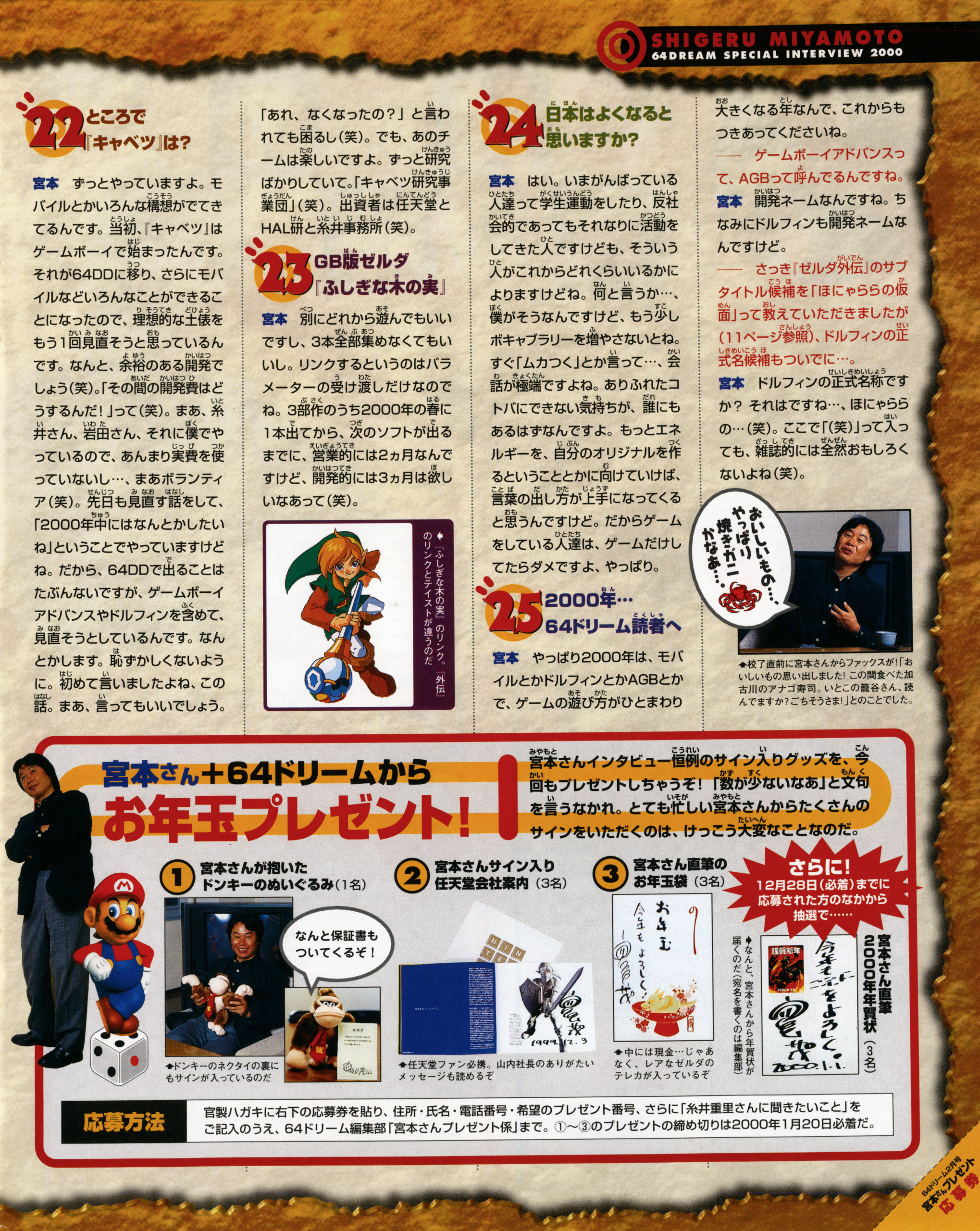
Notes: As far as I can tell only this small part of the interview about Cabbage has been translated. Scans by MyCom.
Summary: They are trying to work on Cabbage in 2000. It’s unlikely to be released for the 64DD, but the Game Boy Advance and GameCube are possibilities.
Nintendo Official Magazine: Ask Miyamoto!
Publication Date: February, 2000
Subject(s): GameCube, Pokémon, cartridges
Format: Transcribed interview
People: Unnamed Nintendo Official Magazine interviewer, Shigeru Miyamoto
Scan:

Notes: Scans by Out of Print Archive.
Summary: The GameCube will be a new frontier for Pokémon.
He’s been thinking of projects so strange that they might not even be called games.
He’s sad to move on from cartridges, they allowed for instant loading.
He’s working more on GameCube than Game Boy Advance.
He likes Psyduck the best because he looks like he’s in trouble.
N64 Magazine: Shigeru Miyamoto Your Questions Answered!
Publication Date: February, 2000
Subject(s): A new invention, GameCube, Mario Artist: Talent Studio, online gaming, PlayStation 2, DVDs, Metroid, Game Boy Advance
Format: Transcribed interview
People: Unnamed N64 Magazine interviewer, N64 Magazine readers, Shigeru Miyamoto
Scans:


Notes: Scans by Out of Print Archive.
Summary: People focus on what technology will do in the future, but what we actually need is a new invention. Nintendo is working on a new invention, but technology is only a part. They want to make something unique, and the GameCube has more possibilities than the Nintendo 64.
In Mario Artist: Talent Studio players can “be in the game”, but he’s not sure it counts as a game. You can import pictures from the Game Boy Camera.
He’s interested in online gaming and understands why others are too. If they talk about online gaming it will be because they have a new idea, not because everyone else is doing it. Simple entertainment is needed for online games. It would need to be easy to handle, but mass audiences aren’t ready for it yet. Networking costs are too expensive and if millions tried to play at once the servers would go down. They are doing some experiments, though. They sell the 64DD online in Japan. Their announced Game Boy to cell phone connection is also realtime online gaming.
He asked Nintendo of Europe why The Legend of Zelda: Majora’s Mask was taking so long to get to Europe. It will come out by the end of next year.
The PlayStation 2 will make it more difficult to make games because of the new tools and demand for more realistic graphics and sound. Nintendo doesn’t make realistic games. You can make realistic or non-realistic games with the GameCube.
They wanted to keep using cartridges, but DVDs lower the risk for third party developers. They couldn’t have made revolutionary games like Super Mario 64 or The Legend of Zelda: Ocarina of Time for the Nintendo 64 with CDs.
Nintendo does not intend to fight Sony, they will do what they can and should do.
Twenty years ago both adults and children played games, but Mario has become more cute over time. He wants Mario to appeal to everyone, for adults to not feel shame. Mario won’t make the V sign often in his next game.
The producer of Metroid is aware that there is a demand for a new Metroid game, but he has been busy making Game Boy games. His team is considering a Nintendo 64 or GameCube Metroid game.
They want to make new characters, which is why he is working on a systemic organization of Nintendo. They were busy making sequels, but have more resources now. They are working with Capcom on a The Legend of Zelda game for the Game Boy. They also started a new company with Konami to make Game Boy Advance games.
The Game Boy Advance will have a communication feature, but he can’t talk about it yet.
Nintendo Official Magazine: Ask Miyamoto!
Publication Date: March, 2000
Subject(s): GameCube, online gaming, voice recognition software, Game Boy games
Format: Transcribed interview
People: Unnamed Nintendo Official Magazine interviewer, Shigeru Miyamoto
Scan:

Notes: Scans by Out of Print Archive.
Summary: Connecting their games to the Internet would not be the best use of the GameCube’s capabilities. They are not in a position to reveal their Internet strategy right now. In April you will be able to connect the Game Boy Advance to a mobile phone in Japan.
When he met Jake Lloyd he thought that he fit his image of child Link.
They will make voice recognition hardware if developers want to make games that use it. Voice recognition will become indispensable for controlling games.
If he was stuck on a desert island he would bring development tools for Super Mario 64, The Legend of Zelda, and Mario Artist.
He takes a Game Boy with him everywhere. He loves playing Pokémon and Tetris.
Nintendo Official Magazine: Ask Miyamoto!
Publication Date: April, 2000
Subject(s): Favorite movie, making mature games, choosing characters
Format: Transcribed interview
People: Unnamed Nintendo Official Magazine interviewer, Shigeru Miyamoto
Scan:

Notes: Scans by Out of Print Archive.
Summary: Raiders of the Lost Ark is his favorite movie.
More Nintendo games will be aimed at a mature audience, but they will still be making games for the whole family.
He starts game development with an idea, then he plans an environment, and then he makes the characters. If existing characters fit the game, then they will come back.
Nintendo Official Magazine: Ask Miyamoto!
Publication Date: May, 2000
Subject(s): GameCube’s code name, Luigi’s star power, Jungle Emperor Leo, online and multiplayer games
Format: Transcribed interview
People: Unnamed Nintendo Official Magazine interviewer, Shigeru Miyamoto
Scan:

Notes: Scans by Out of Print Archive.
Summary: “Dolphin” is a code name, the system will have a different name when it is released. You’ll probably be able to play games for it at Space World 2000.
Luigi is doing well in their GameCube experiments.
He felt it was important for Takashi Tezuka to be the director on Jungle Emperor Leo. Since Mr. Tezuka gave priority to the movie, development on the game came to a halt.
He likes the parks and museums in Britain, and people are nice. He’d like to visit the European Computer Trade Show in September.
He hasn’t had time to play online games lately. Lots of people at Nintendo play fighting games, but he doesn’t like them. Mario Kart 64 is the multiplayer game of choice in his home.
Nintendo.com: Shigeru Miyamoto Interview
Publication Date: May 13, 2000
Subject(s): The Legend of Zelda: Majora’s Mask
Format: Transcribed interview
People: Unnamed Nintendo.com interviewer, Eiji Aonuma, Takashi Tezuka, Shigeru Miyamoto
Archive Link: https://web.archive.org/web/20010626151838/http://www.nintendo.com/games/gamepage/developerinfo.jsp?gameId=146
Notes: This interview took place at E3 2000.
Summary: He worked with Eiji Aonuma on the basics of the The Legend of Zelda: Majora’s Mask. It’s like they built a table together. Majora’s Mask is supposed to feel mysterious, not scary.
You can watch the characters on their daily routines. You’ll need to learn about them and get new masks to conquer the game.
They thought they could do more with The Legend of Zelda: Ocarina of Time’s engine. They accomplished what they set out to do with Star Fox 64, so there won’t be a sequel until the GameCube.
Rare has done a lot for the video game industry, even though their games are all 3D they play differently.
IGN: Shigeru Miyamoto Interview
Publication Date: May 13, 2000
Subject(s): Game Boy Color, Game Boy Advance, The Legend of Zelda: Oracle of Seasons and Ages
Format: Transcribed interview
People: Craig Harris, Yasuhiro Minagawa (translator), Shigeru Miyamoto
Archive Link: https://web.archive.org/web/20000619181836/https://pocket.ign.com/news/19355.html
Notes: There was a video of this interview, but it has been lost. This interview took place at E3 2000.
Summary: He wasn’t involved in the design of the Game Boy Color, but he has been involved with The Legend of Zelda: Link’s Awakening DX and Super Mario Bros. Deluxe.
He has been working with the Pokémon Gold and Silver team on making the games look more interesting, with color and without. He has also been deciding what kinds of games are appropriate for the Game Boy Advance.
Yoshiki Okamoto from Capcom is producing a trilogy of The Legend of Zelda games for the Game Boy Color. They running behind because of the link system, which allows one game to effect another. It uses passwords. They will release later in the year.
At first he wondered what was so good about a Game Boy in color, but then he said it was good for no reason. Then when he played the Game Boy Advance with better graphics he thought it was good for no reason. You can make games in C, so it will be easier.
Famitsu (HISTORY of ZELDA『ゼルダの伝説』の過去から未来へ) (untranslated from Japanese)
Publication Date: After May 13, 2000 and on or before July 11, 2000
Subject(s): The Legend of Zelda, E3, online games
Format: Transcribed interview
People: Yasuhiro Nagata, Shigeru Miyamoto
Japanese Links: https://www.famitsu.com/game/extra/special/2000/zelda/zelda01.html
https://www.famitsu.com/game/extra/special/2000/zelda/zelda02.html
https://www.famitsu.com/game/extra/special/2000/zelda/zelda03.html
https://www.famitsu.com/game/extra/special/2000/zelda/zelda04.html
Japanese Archive Links: https://web.archive.org/web/20230522025038/https://www.famitsu.com/game/extra/special/2000/zelda/zelda01.html
Notes: From what I can gather with machine translation Yasuhiro Nagata was interviewing Mr. Miyamoto on camera for the video documentary HISTORY of ZELDA『ゼルダの伝説』の過去から未来へ. He also asked him about some more casual things when the camera wasn’t rolling, and recorded the audio. He then got permission from Mr. Miyamoto to publish a transcribed version of that audio.
Nintendo Official Magazine: Ask Miyamoto!
Publication Date: June, 2000
Subject(s): Mario Artist: Talent Studio, piracy, favorite Rare games
Format: Transcribed interview
People: Unnamed Nintendo Official Magazine interviewer, Shigeru Miyamoto
Scan:

Notes: Scans by Out of Print Archive.
Summary: He can feel the future in Mario Artist: Talent Studio.
If a lot of people make requests there could be another Star Fox game.
They partnered with Panasonic on the GameCube because of their anti-piracy measures. It’s important for everyone to realize that piracy is bad.
He’s never made a game just for fun that was never released. He has tested many ideas, including odious creatures.
He loved Donkey Kong Country and Snake Rattle ‘n’ Roll. He’s looking forward to Perfect Dark.
The 64 Dream: NINTENDO DOUBLE HEADER INTERVIEW
Publication Date: June, 2000
Subject(s): The Legend of Zelda: Majora’s Mask, The Legend of Zelda: Ocarina of Time
Format: Transcribed interview
People: Unnamed The 64 Dream interviewer, Eiji Aonuma, Yoshiaki Koizumi, Shigeru Miyamoto
Link: https://goodblood.games/mmdoubleheader64dream45
Archive Link: https://web.archive.org/web/20240111225746/https://goodblood.games/mmdoubleheader64dream45
Japanese Archive Link: https://archive.org/details/64-dream-june-2000-06-600dpi-ozidual/64Dream%202000%2006%20%28J%20OCR%29/page/n83/mode/2up
Scans:


Translator: Frank for goodblood.games
Notes: A few answers do not label the speaker, at least some of these are likely Mr. Miyamoto. Scanned and uploaded to archive.org by ozidual.
Summary: He let Yoshiaki Koizumi loose this time.
He was more hands off with The Legend of Zelda: Majora’s Mask because he thought it would still turn out fine, but he was very involved with the initial framework. The only two people who were on The Legend of Zelda: Ocarina of Time team and left were him and Toru Osawa.
Ocarina of Time was a success, so they thought it would be nice to release another The Legend of Zelda game within a year. There was also a plan not to make another Super Mario or Zelda game until the next generation, but they thought they could use the 64DD’s increased capabilities. He thought Ocarina of Time could have used more time for polish. They began talking about what would become Majora’s Mask in December 1998, started development in January 1999, and started full development in February 1999. It would have been tough for his kids to wait three years for the next Zelda game, so it was nice to finish one in a year.
For Majora’s Mask he wanted to evolve the game system rather than add secrets. Sixty percent of game development is the name registration screen or the credits, and they were able to reuse that kind of thing from Ocarina of Time. They put more work into the characters this time.
They were focused on realism with Ocarina of Time, but they could do something different with Majora’s Mask. Final Fantasy was popular at the time of Ocarina of Time’s development, which might be why it was so stylized.
When they finished Majora’s Mask plot in March, 1999 he rejected it. They had eight dungeons, but after four people think “I’m only halfway through?”. Instead of doing more than Ocarina of Time they made a game that people can play as long as they want. This changed their goal to making a game that was interesting.
Majora’s Mask originally took place over a week, but they changed it to three days after three months of development. Ocarina of Time took 60 hours to beat, so people asked if Majora’s Mask would take 80 hours, then they asked if the GameCube Zelda would take 100. It seemed like they’d never be able to stop working, so as for how long Majora’s Mask takes to beat: it depends on the player.
Games are entertainment and they have to make sure players don’t get frustrated. Even when the developers play they think some parts are unfair. He wanted two more months to smooth those areas over, but that kind of thinking leads to questioning whether you should be able to stop time in dungeons, and then whether there should be dungeons at all. They worked hard to make it fun even when it felt arbitrary.
In Majora’s Mask traditional Zelda gameplay is about 60% of the experience, side quests are 20%, and the Bomber’s Notebook is 20%. Pushing blocks isn’t what makes Zelda games fun, it’s the question in their mind of what is going on in the world. Zelda games should become more fun the more you play them. His biggest regret with Ocarina of Time is not being able to fight the dungeon bosses again.
They are okay with magazines publishing guides for Majora’s Mask, the experience can’t be spoiled with them.
He wanted to make a game that took 80 hours to beat, but which you can lose in two. He wants everyone to get a game over, to feel like they weren’t being careful enough.
When play testing he sometimes had to redo boss fights, but you get used to it.
Three days in the game is 1.5 to 2 hours.
You can strategize how you approach the game since you can’t grind like in a role-playing game. Everyone’s memory of the game will be different.
IGN: Interview: Miyamoto and Aonuma
Publication Date: June 5, 2000
Subject(s): Daily routine, The Legend of Zelda: Majora’s Mask, Excitebike 64, The Legend of Zelda: Oracle of Seasons and Ages, Game Boy Advance
Format: Transcribed interview
People: Matt Casamassina, Peer Schneider, Eiji Aonuma, Shigeru Miyamoto
Link: https://www.ign.com/articles/2000/06/06/interview-miyamoto-and-aonuma
Archive Link: https://web.archive.org/web/20220428073729/https://www.ign.com/articles/2000/06/06/interview-miyamoto-and-aonuma
Notes: This interview took place at E3 2000.
Summary: He starts his days at work by saying he’s sorry he’s late. He checks his e-mails and looks through the cartridges on his desk.
They don’t make all of the game specifications to start with at Nintendo. One small change can cause everything else to be changed.
Sometimes they get frightening e-mails from fans.
Players won’t feel like they are playing with an old game engine with The Legend of Zelda: Majora’s Mask.
He was involved with Excitebike 64’s outline and final design. Since it was developed in the United States he gave advice but did not follow up.
He hopes they will launch a couple communication games for the Nintendo 64 this year.
Catroots was being made by Marigul, but now Nintendo has responsibility for it. It’s unique.
He was involved in making Pokémon Gold and Silver more colorful.
The Legend of Zelda games for the Game Boy Color are becoming late due to the link system, but they should release this year. There are similar events in both Oracle games, so if you do it in one game, you won’t have to do it in the other.
When they were developing the Game Boy Color it seemed pointless, but he realized it was good after playing it. He had a similar experience with the Game Boy Advance. It will be 32-bit and games can be made in C.
They will show games for the GameCube, Game Boy Advance, and the cell-phone application at Space World.
If he had an unlimited budget for a game he’d want to be able to float weightlessly. It would be a game machine you attach to your head that allows you to float in real life.
The thing he’s most worried about with GameCube is not being able to produce enough.
History of Zelda 「ゼルダの伝説」の過去から未来へ
Publication Date: June 22, 2000
Subject(s): The Legend of Zelda
Format: Interview
People: Yasuhiro Nagata, Shigeru Miyamoto
Video:
Notes: This documentary about the history of The Legend of Zelda series was released on VHS for 1500 yen in Japan and was made by Enterbrain and Nintendo. Also see the Famitsu interview conducted at the same time. Zelda no Video is an extended and updated documentary released in 2003 that has been translated, please see that entry for more details. Uploaded by YouTube user IGFTW Video Game Dump.
Nintendo Power: The Faces Behind the Masks/Zelda and Beyond
Publication Date: July, 2000
Subject(s): The Legend of Zelda: Majora’s Mask
Format: Transcribed interview
People: Unnamed Nintendo Power interviewer, Eiji Aonuma, Takashi Tezuka, Shigeru Miyamoto
Scans:


Notes: This interview took place “before the doors opened” at E3 2000. Scans by Retromags.
Summary: The Legend of Zelda: Majora’s Mask uses a similar technique as Toy Story 2. They focused on some minor characters from the original.
Their goal is to present something mysterious, not scary.
The game is based on a three day interval so that you can see the character’s daily routines. They do different things at different times of day and may reveal clues to the central mystery.
The game’s world is a small garden you must explore. It takes place in the course of three days so that you have to learn everything that happens to save the world.
He worked with Mr. Aonuma decide the basic principles of the game and left it to him to follow through on them.
The Legend of Zelda: Ocarina of Time was a great game but they thought they could do more with the engine. With Star Fox 64 they accomplished everything.
Rare has done a lot for the gaming industry and they are happy to work with them. They manage to make varied games even though they are all 3D.
They’re finishing up Mother 3 and Paper Mario. They’re working on a communication game for this summer.
Gamers’ Republic: Interview: Shigeru Miyamoto
Publication Date: July, 2000
Subject(s): The Legend of Zelda: Majora’s Mask, his role at Nintendo, Gamecube, online gaming
Format: Transcribed interview
People: Mike Hobbs, Shigeru Miyamoto
Scans:


Notes: This interview took place at E3 2000. Scans by Sega Retro.
Summary: The Legend of Zelda: Majora’s Mask is not a true sequel to The Legend of Zelda: Ocarina of Time, it’s a separate story. The other six directors had more control for Majora’s Mask, and they wanted to make their own world.
He has been letting others do more game design work, being more of a producer than a director. Sometimes he just works on something during the planning stage and the final tuning stage. If he wasn’t satisfied with Majora’s Mask, he would have stepped in.
This isn’t his future at Nintendo, though. They have lots of new young people and the people who are 40 years old are ready for more responsibility.
The Nintendo 64 was a next-generation system, being the first to realize a 3D environment. This allowed them to be the first to train programmers in making 3D games. The GameCube will be a massive upgrade that is more comfortable to make games for.
If everyone uses the same development tools then games end up being similar. There could have been more Nintendo 64 games if they had provided more tools with better variety. They are working with several companies to make development tools for the GameCube.
The GameCube will be released after the PlayStation 2, and have better performance, and the Xbox should have better performance than the GameCube. The key to success isn’t power, though, it’s coming up with unique ideas. They are focused on the beauty of game design.
Video games are no longer fun and completely fulfilling. There are other avenues for pleasure, and games can’t be fun enough for long.
He is interested in the portable nature of the Game Boy Advance, and connecting game worlds.
Online games are just another form of entertainment. Nintendo has to be cool and critical. Network systems are different around the world. They can make more money with other types of games. Some companies think that online gaming is the future, and is cool and hip. But that is an illusion. They won’t jump in blindly.
He is interested in online gaming’s effect on game design, but he can’t share his ideas. They have Randnet and the Game Boy Advance will connect to cell phones soon.
He’s more interested in families playing multiplayer than a Tekken kind of game where only professionals have good matches. He wants players of different skill levels to share an interest.
Nintendo staff’s favorite online game right now is Ultima Online. It’s possible to make online games that aren’t violent, but it seems like the easiest approach.
His garden is about 80% done, the trees are growing.
Game Informer: Visions of the Visionaries
Publication Date: July, 2000
Subject(s): Gaming stigma, the competition
Format: Transcribed interview
People: Unnamed Game Informer interviewer, Shigeru Miyamoto
Scan:

Notes: Game Informer interviewed video game visionaries while at E3 2000. Please note the left side of the page is Lorne Lanning speaking, not Mr. Miyamoto. Scan by Retromags.
Summary: Right now a member of a family may become addicted to the gameplay of a game. Other family members may be worried they will become a social outcast. Games should be enjoyed together by a family. Technology improving may bring us to a new era.
There won’t be room for Sega, Microsoft, and Sony. They are going to battle, but Nintendo is going to do something different.
Nintendo Official Magazine: Ask Miyamoto!
Publication Date: August, 2000
Subject(s): Space World 2000, becoming a game designer, gaming skills
Format: Transcribed interview
People: Unnamed Nintendo Official Magazine interviewer, Shigeru Miyamoto
Scan:

Notes: Scans by Out of Print Archive.
Summary: He can’t talk about Space World 2000.
The name “Marioke” sounds good for a karaoke game.
He entertained his family with puppets he made and manga he drew as a child. He wanted to be a manga artist or musician. He studied industrial design in college and joined Nintendo. When Nintendo started making games he became a game designer.
He used to be able to say he was the best middle-aged game player, but he can’t compete with kids anymore.
GameFan: GameFan Interviews Shigeru Miyamoto, creator of Mario, Zelda, F-Zero, and many other instant classics!
Publication Date: August, 2000
Subject(s): 2D versus 3D games, Pokémon’s longevity, 64DD, voice recognition, Microsoft making a console
Format: Transcribed interview
People: Unnamed GameFan interviewer, Shigeru Miyamoto
Scan:

Notes: This interview took place at E3 2000. Scan by RetroGameChampion.
Summary: 3D games aren’t replacing 2D ones, they are an expansion of the possibilities. There will still be 2D games.
People said Donkey Kong was an adult game that children could play. People think of Nintendo systems as something for children that adults can play, and he doesn’t like that stereotype. He appreciates a game like Conker’s Bad Fur Day. Mario won’t appear in such a game. He has grown concerned that Mario seems too childish.
They are trying to make sure that Pokémon remains popular. It became a surprise hit because they made the anime and movie so quickly. They are worried about the repercussions. They make Mario and The Legend of Zelda games appeal to everyone.
He’s one of the main people working on the 64DD, and he’s been pushing the idea. He hopes to make new formats of entertainment with it. They are going to release Mario Artist: Polygon Studio, which will have data exchange disks. You can interact with others via the host CPU.
Single player games will continue.
The GameCube controller will be suitable for a variety of methods.
He’s been involved with the development of Seaman from the start. He’s also been involved with Hey You, Pikachu!, so he is interested in voice recognition.
He didn’t play guitar for Super Mario World, but he did play the opening theme of Earthbound, which was then modified and improved.
Microsoft has a lot of physical strength, but they aren’t too worried about them entering the console space. He has to worry about Microsoft giving a lot of money to every developer. He’s concerned with Nintendo making something new.
If they make Pilotwings for the GameCube it will be great. But what they want to do is make something new that isn’t a sequel.
Electronic Gaming Monthly: Talking With Miyamoto
Publication Date: August, 2000
Subject(s): Mother 3, The Legend of Zelda: Oracle of Seasons and Ages
Format: Transcribed interview
People: Unnamed Electronic Gaming Monthly interviewer, Shigeru Miyamoto
Scan:

Notes: This interview likely took place at E3 2000. Scan by Retromags.
Summary: Mother 3 is still being developed.
The Legend of Zelda: Oracle of Seasons and Ages will be two games, not three. Since people could play the games in any order it got very difficult to have three.
Core Magazine (reported on by Nintendo World Report)
Publication Date: Unknown (reported on August 5, 2000)
Subject(s): Nintendo 64, GameCube
Format: Transcribed interview
People: Reported on by Mike Sklens, unknown Core Magazine interviewer, Shigeru Miyamoto
Link: https://www.nintendoworldreport.com/news/4897/miyamoto-talks-dolphin
Archive Link: https://web.archive.org/web/20220506203130/http://www.nintendoworldreport.com/news/4897/miyamoto-talks-dolphin
Notes: Despite pretty good archiving of Core Magazine’s website, I could not find this interview.
Summary: Developing for the Nintendo 64 was difficult because the software libraries were delayed. He thinks the PlayStation 2 is harder to develop for. The Nintendo 64 weeded out weak developers. The cost of developing games will skyrocket in the coming years.
1101.com: MOTHER 3 To Everyone Who Waited
Publication Date: August 22, 2000 (translated August 18, 2013)
Subject(s): Earthbound 64, Mother 3
Format: Transcribed interview
People: Shigesato Itoi, Satoru Iwata, Shigeru Miyamoto
Link: https://yomuka.wordpress.com/2013/08/18/earthbound-64-cancellation-interview-itoi-miyamoto-iwata/
Japanese Link: https://www.1101.com/nintendo/nin13/nin13_2.htm
Japanese Archive Link: https://web.archive.org/web/20220418193630/https://www.1101.com/nintendo/nin13/nin13_2.htm
Translator: Yomuka
Notes: 1101.com is Shigesato Itoi’s website.
Summary: Development was going well, but it had to be cancelled so it wouldn’t impact other projects. It was at least 60% complete. Nintendo has asked a lot of Iwata recently, he’s pushed himself as much as he could. There were two hardware shifts, he wasn’t able to be on-site, and Iwata was being pushed to his limit. Their supervisors wanted to cancel it since last year, but then felt it would be a waste.
They had to cancel Kimba the White Lion after two years of work.
Producers need to adapt products into something suitable for designers. When he makes things he starts with the tips, a randomized tree with no trunk. People raised on video games focus on perfecting the details, and nothing else. Mother 3 had this problem. They considered moving Mother 3 to GameCube. He showed an early version of Super Mario 64 to Yuji Horii, which caused him to make a mad dash for 3D. He heard that Mr. Itoi wanted Mother 3 to be reminiscent of a Hollywood movie. There were several parts that couldn’t work on the Nintendo 64. The reason for making the game was Earthbound’s (Mother 2) success, it was a commercial decision.
People assume he just has to put his name on a game for it to sell well, but everything he’s accomplished was because of his blood, sweat, and tears. They were accused of wagging their tails at celebrities because they worked with Mr. Itoi. He still doesn’t know if 3D is the way to go for Mother 3, or if a novelization or movie would be better.
He discussed making Mother 3 for the Game Boy Advance with Mr. Iwata, but a producer said it would take as much time as making for the Nintendo 64. Everyone feels like it would be a waste to start over. They struggled for so long because they wanted the game so badly.
Until the time they started on Mother 3 and Donkey Kong Country had come out the gap between games and movies was huge. There was a large gap between Final Fantasy VI and a movie.
His son asked him if Mother 3 was coming out because he wanted to buy something else if it wasn’t. He had played Earthbound (Mother 2) while in elementary school.
Tekken was difficult because it had over 20 characters and only needed five.
Nintendo Space World 2000 Stage Presentation (Partially untranslated from Japanese)
Publication Date: August 24, 2000
Subject(s): GameCube, Super Mario 128
Format: Presentation
People: Shigeru Miyamoto
Videos: https://www.youtube.com/watch?v=62O2vFfS_Ok&t=616s
https://www.youtube.com/watch?v=VBH50xxUKEk
Translator: Shinki Nishikori
Notes: The first video contains footage of Space World 2000 and a stage presentation. The second video contains part of the presentation with a translation in the subtitles. Uploaded by YouTube user Adam Doree.
Summary: This is the same Mario model as in Super Mario 64, made up of 700 polygons. They could only have about five enemies on screen at once in Mario 64. The background has about as many polygons as two Marios. There are over 30 Marios now. Now 128. Here’s 128 boxes, they have animation and collision.
When the processing meter reaches the right side of the screen is how long it took to draw one frame in Mario 64. There are 100 times more objects than in Mario 64, on a screen with four times the pixels, and it’s using one-third of the maximum processing power.
Let’s make terrain more intense. Mario is rolling around. Here it is with cel-shading. The processing meter barely changes when they make Mario transparent or add blur. All of the Marios have slightly different coloring. Mario is Italian so he prefers pizza.
IGN: Miyamoto Roundtable
Publication Date: August 28, 2000
Subject(s): GameCube, Luigi’s Mansion, WaveBird Wireless Controller, Mother 3, PlayStation 2, role-playing games
Format: Q & A
People: Takashi Tezuka, Minoru Minagawa (translator), Shigeru Miyamoto
Link: https://www.ign.com/articles/2000/08/29/miyamoto-roundtable
Archive Link: https://web.archive.org/web/20020221063125/http://ign64.ign.com/articles/084/084134p1.html
Notes: This Q & A took place August 25, 2000.
Summary: There is a loading time problem with using disks now instead of cartridges, but they are working on it. They should have enough RAM to get rid of it.
There are only two memory card slots on the GameCube for cost reasons.
The GameCube is the ultimate game machine from the viewpoint of people making sounds, collision detection, and animation effects, making it the most well-balanced.
People are working on game compilations for the GameCube. He wants to make more than a Mario to introduce the GameCube.
Going from the Nintendo 64 to the GameCube is like going from the Nintendo Entertainment System to the Super Nintendo Entertainment System. It’s more mature technology.
The video they showed of Luigi’s Mansion was to show off the GameCube to game developers. They are worried about trade secrets being leaked so he can’t talk more about it.
There is a Zelda game for the 64DD that is finished.
The GameCube is not a multimedia machine, but it can connect to the Internet.
The WaveBird Wireless Controller does not use Bluetooth, it uses something similar.
He is sorry about the cancellation of Mother 3, but things might have been different if there were 500,000 Americans that wanted to play it. They spent hundreds of millions of yen working on it and would like to make use of what they’ve made.
About 70% of Nintendo is working on GameCube games, and the rest are working on Nintendo 64 and Game Boy.
He’s not interested in making games with full motion videos, but those who want to will be able to with the GameCube.
Animal Crossing is a communication game according to Takashi Tezuka. There’s no difficulty or hurting each other, it encourages communication between child and parent.
He spent more time on the GameCube controller than any other, and this is the fourth or fifth version. They want everyone to be able to use it.
The GameCube has a handle because they want the whole family to enjoy it, it’s not audio/visual equipment that doesn’t get moved.
Mario will look less childish in his next game. When he said Mario would be more mature he didn’t mean it would be like Conker’s Bad Fur Day.
He doesn’t feel the PlayStation 2 is a threat because the software they make for the GameCube will be requisite for everyone.
Takashi Tezuka is the second most important game maker at Nintendo. He has lots of good designers so he doesn’t have to worry about game creation. Since being appointed to a role as director of Nintendo he has to do more paperwork. His creative position has not changed, but he can do it more efficiently now.
He’s heard that the PlayStation 2 is harder to develop for than the Nintendo 64.
The Nintendo 64 wasn’t missing role-playing games, it just didn’t have this and that one. The GameCube will be easy to develop for. They need to increase the player base enough that developers can make money.
With the GameCube you can achieve your wildest dreams without worrying about performance. Designers can put their personality in games.
Nintendo Official Magazine: Ask Miyamoto
Publication Date: September, 2000
Subject(s): Star Fox 64 sequel, making a game with Rare, Pokémon team, adult oriented games, favorite Nintendo 64 games
Format: Transcribed interview
People: Unnamed Nintendo Official Magazine interviewer, readers of Nintendo Official Magazine, Shigeru Miyamoto
Scan:

Notes: Scans by Out of Print Archive.
Summary: Star Fox 64 is one of his favorites, sometimes he wears a shirt with the logo for interviews. He’d like to make a sequel some day.
He’d rather Nintendo and Rare made their own games instead of making one together.
His Pokémon team is Venusaur, Psyduck, Arcanine, Alakazam, Marowak, and Zapdos.
Nintendo is looking to make games aimed at adults, as Rare has done with Conker’s Bad Fur Day. They want to find new ways to surprise players. Nintendo games shouldn’t just be for kids, but it’s also important that children don’t play the wrong kinds of games.
His favorite Nintendo 64 games would probably be Super Mario 64, Wave Race 64, and The Legend of Zelda: Ocarina of Time. As for games he wasn’t part of, Perfect Dark and Konami’s soccer and baseball games.
Game Freak: The Creative Group Rewriting the Rules in the World of Play (reported on by DidYouKnowGaming, partially untranslated from Japanese)
Publication Date: September 1, 2000 (approximate)
Subject(s): Pokémon
Format: Transcribed interview
People: Reported on by DidYouKnowGaming, Akihito Tomisawa, Shigeru Miyamoto
Video:
Notes: This book contains a lot of people talking about what someone else said, without direct quotes. DidYouKnowGaming had a portion of this book translated and this video contains a portion of the translation.
Summary: He didn’t care what genre Pokémon ended up being when they were starting work on it. Satoshi Tajiri thought it needed to be a role-playing game, but he was worried they wouldn’t know when to stop if it was. It wasn’t up to him since he was the producer. He’s still not sure it was the right decision.
GamesRadar (Edge Magazine interview)
Publication Date: September 3, 2000
Subject(s): GameCube, multi-purpose game systems, online games, movie-type games
Format: Transcribed interview
People: Unnamed Edge interviewer, Shigeru Miyamoto
Link: https://www.zeldadungeon.net/wiki/Interview:Games_Radar_September_3rd_2000
Archive Link: https://web.archive.org/web/20140814040244/http://www.zeldadungeon.net/wiki/Interview:Games_Radar_September_3rd_2000
Notes: This seems to be a version of an interview with Edge magazine that was posted on GamesRadar, though both versions have some unique questions and answers. GamesRadar is still around and has archives going back this far, but they do not include this interview. This interview took place at Space World 2000, which ran August 24-26, 2000.
Summary: The GameCube will have a lot of RAM, so you won’t see much difference in loading times compared to the Nintendo 64. PlayStation players are generous when it comes to loading times.
He takes a rational approach with his ideas. He thinks about what he’d like to play, has a lot of conversations, and usually comes to a conclusion about the “play” he wants to have.
The GameCube will be easier to develop for because it will be easier to have a standardized set of development tools. The 1T SRAM is the world’s best graphics chip.
They don’t have the intention of fighting a console war. They will make fresh and exciting games, and go their own way. The GameCube will be for the whole family. People who grew up playing Super Mario Bros. may have children playing games. That’s how video games should be: for the whole family.
The Nintendo motto is that they have to do what only they can do. Multi-purpose game machines often can’t do anything. He doesn’t like hardware manufacturers leaving software developers to lead the market. They have been experimenting with mobile phone technologies with the Game Boy. They are trying to launch with a game that uses the modem. They are going to expand entertainment by linking the GameCube and Game Boy Advance.
They are working on GameCube games featuring Mario, Yoshi, and Link, but he doesn’t want their developers to solely focus on established series. Games like Animal Crossing, which is a “family communication” game, they hope to bring to GameCube.
For GameCube it’s important they start with ideas, then characters, so they can see what’s working. They keep in mind what was important and fun for them as children.
Some say movie-type games can be fun, but he disagrees. They can learn a lot from the movie industry, but integration should not be the goal. They make interactive entertainment. Hiroshi Yamauchi has different ideas. You can make a lot of money from a simple idea. When people say they are going to make a movie-type game, it’s like they’re saying they’re going to spend a lot of money on graphics and sound. Time and money should be spent making magic.
Other than Nintendo, he is very impressed with Rare. Otherwise there are not many unique games.
It will be easier to develop for the GameCube than the Nintendo 64 and its cartridges.
He’s bad at the banjo, but practices the guitar.
As a member of the board of directors he has a bigger responsibility to see the big picture. He is supervising 30 titles but only deeply involved in two or three. He hopes he can sell the Mario 128 demo free of charge.
He preferred having smaller development teams, but also gets stressed working on one game at a time. He’s been seeing a lot of games lately and can’t enjoy himself. Connecting the GameCube and Game Boy Advance is really fun.
Bits
Publication Date: September 3, 2000
Subject(s): The future, parents and children
Format: Transcribed interview
People: Aleks Krotoski, Yasuhiro Minagawa (translator), Shigeru Miyamoto
Archive Link: https://web.archive.org/web/20110901094336/http://www.miyamotoshrine.com/theman/interviews/090300.shtml
Video:
Notes: Bits was a television show that aired on Channel 4. The short portion of the interview shown in the video does not quite match up to the interview on Miyamoto Shrine, and the show doesn’t really seem to do long form interviews either, so the full interview must have appeared on the Bits website. The previous episode of Bits shows some more footage of the interview, but it is talked over.
Summary: [From the Miyamoto Shrine.]
He can’t predict the future, and that’s what makes it interesting.
It’s easier to simulate the 3D world with the GameCube. Creators can now freely make their dreams come true.
Parents used to complain about their children playing video games, but now many parents grew up playing games themselves. Now they can play alongside their children, so video games are becoming more for families.
GameCube discs are small enough for a child to hold, and the system can easily be brought from a child’s room to the parent’s room.
He feels lucky that Mario became so famous. The game was interesting, and the character followed. He wishes to make a second or third Mario.
[From the video.]
The Nintendo 64 was limited, it was difficult just to make the 3D engine. The GameCube can do 3D as easily as 2D.
MSNBC: ’Zelda’ creator talks GameCube
Publication Date: September 3, 2000
Subject(s): GameCube, the competition, graphics
Format: Transcribed interview
People: Steve Kent, Shigeru Miyamoto
Link: https://www.zdnet.com/article/zelda-creator-talks-gamecube-5000110669/
Archive Link: https://web.archive.org/web/20220118015952/https://www.zdnet.com/article/zelda-creator-talks-gamecube-5000110669/
Notes: The footage of “Zelda” here refers to the more realistic style before The Wind Waker’s cel shaded look was decided upon.
Summary: The GameCube is easier to develop games for than the Nintendo 64 in many ways. Other developers saw Super Mario 64 and thought anyone could make a game like that, but they couldn’t.
Mario 128 is an experiment, it may not turn into a game.
He is working on a Luigi game with the code name Luigi’s Mansion. That will probably not be the final name.
The footage of Zelda, Luigi’s Mansion, and Metroid Prime is not playable because if it was then competitors could figure out their secrets.
The GameCube turned out better than they had hoped.
Tekken Tag Tournament looks good, but the PlayStation 2 games he has seen don’t do anything new. He started with arcade games, which had to look appealing to people walking by. Next generation games have gotten that part down, but there’s something missing. People are focusing too much on graphics and not enough on creativity.
Gamers’ Republic: Shigeru Miyamoto: The First GC Interview
Publication Date: October, 2000
Subject(s): GameCube, development kits, game prices
Format: Transcribed interview
People: Unnamed Gamers’ Republic interviewer, Yasuhiro Minagawa, Shigeru Miyamoto
Scans:


Notes: This interview took place at Space World 2000, which ran August 24-26, 2000. Scans by Sega Retro.
Summary: They considered who would be using the GameCube as they designed it. It will be used for more than five years, and parents are from the Super Mario generation now, so he wants the whole family to use the GameCube.
He can’t tell how the GameCube’s capabilities will be used to make new games.
Both game players and developers are getting bored with today’s games. They are excited about the GameCube. Someone said GameCube development will be delayed if they keep working on the Space World demo.
They are worried about copy protection, so they are using an original format for GameCube games since everyone will have a DVD-R soon. They decided not to enclose the disc in a case so they will be compatible with a potential DVD playing version of the GameCube that Panasonic may make.
He’s still worried about loading times with optical media, but he found a way to reduce them. They decided to use optical media because they can load as much RAM as they need.
Other companies talk about how many polygons their machines can handle, but then whisper that it is half as many if they have textures, and that lighting effects halve that number. There are many things that can bottleneck a game system. The GameCube’s operations are separated, the internal architecture is balanced.
Their development tools are inexpensive but even they don’t have them yet. They will be the cheapest Nintendo has ever made. You can also use any CG CAD program.
Nintendo would like to have five games ready for the GameCube launch.
He’d like games with a high value to be sold more. He’d be happy if his games cost as much as an AIBO – $2,300. Parents may not want to buy a $30 game for their children, but might buy a $100 game they can play together. His favorite family game is Samba de Amigo.
Edge: Shigeru Miyamoto
Publication Date: November, 2000
Subject(s): GameCube, multi-purpose game systems, games he plays, online games, movie-type games
Format: Transcribed interview
People: Unnamed Edge interviewer, Shigeru Miyamoto
Scans:


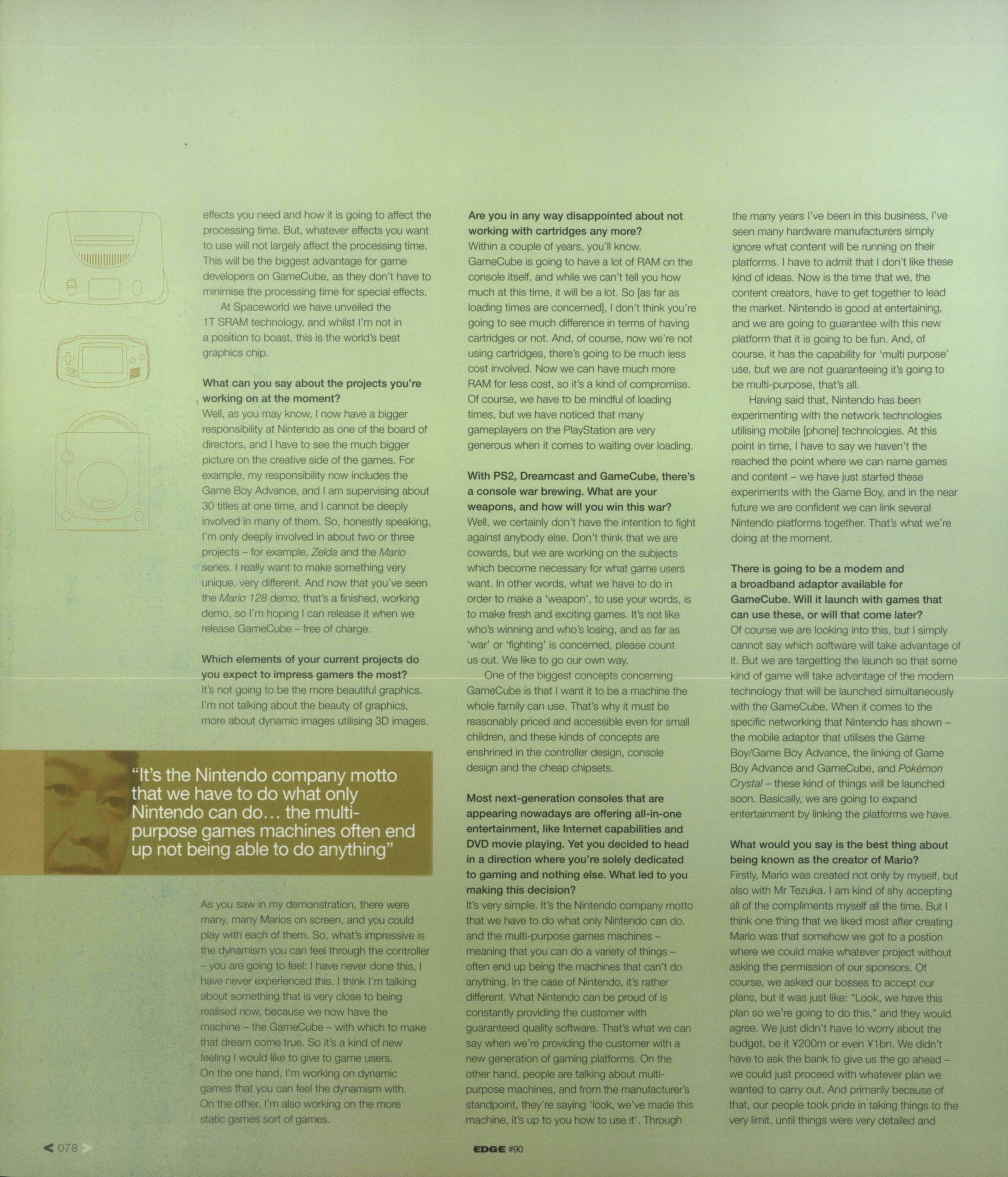

Notes: This interview is mostly identical to the GamesRadar interview, but the questions and answers are in a different order and there are a few that are unique to one or the other. This is likely because Edge magazine has never really had an official website, but has partnered with other websites that run their content. This interview took place at Space World 2000, which ran August 24-26, 2000. Uploaded to archive.org by mattandi.
Summary: Western Gun was the first game he ever played, and he thinks the first game he owned was TV Game 15.
He dislikes PCs and doesn’t have one.
He prefers working with small teams, but also gets stressed out if he’s only working on one game. It’s been fun working on Game Boy Advance and GameCube connectivity.
His ideas come from asking what he’d like to play. He starts with an experiment and has conversations.
The game he’s played the most is Pac-Man.
The last game he played was Samba de Amigo with his children. His wife says it is worth ¥10,000, while she usually limits the cost of toys to ¥2,000-¥3,000. He likes the idea of a father playing games with his children after work more than the idea of a father playing online games and not looking at his children.
When he was younger he would play games three or four hours a week, now he helps his kids sometimes when they get stuck.
He likes playing racing and rhythm arcade games, but not Dance Dance Revolution because he’s shy.
He wishes he could have worked on Virtua Fighter. They had a similar idea, but couldn’t get it to work with their hardware.
The GameCube will have a standard set of development tools, to make it cheaper to make games. The programming language will be simpler. The 1T SRAM is the best graphics chip in the world.
He has a big responsibility, being on the board of directors, and he is overseeing about 30 games. There are two or three games he is more deeply involved with. The Super Mario 128 demo is finished and he hopes to release it for free with the GameCube. The dynamism is impressive, you can feel it through the controller. The GameCube can make that dream come true.
The GameCube has a lot of RAM so the load times won’t be noticeably slower than they were with cartridges. It will also be cheaper using discs. PlayStation players are patient with loading times.
They don’t intend on fighting a console war, they want to make fresh, unique games. The GameCube is for families.
Nintendo wants to do what no one else can do. Multi-purpose game consoles can’t do anything. They guarantee quality games, while other companies say “it’s up to you how you use it”. Those companies ignore the games that are released on their platforms. The GameCube can be multi-purpose, but they’re not promising that it will be. Soon they will be able to link Nintendo systems together.
They hope to have a launch game that can make use of the modem.
Mario was made with Takashi Tezuka. He likes that they are able to make games without having to ask permission, they don’t have to worry about the budget. Their only trouble are in making something new.
He doesn’t think the movie-type game will become interesting. They should absorb some ideas from movies to improve games. Video games are not transforming into any other medium. You can make a lot of money in the video game world with a simple idea, so making a movie-type game is just spending a lot on graphics and sound.
There’s no specific game developer he respects. He admires a portion of Dragon Quest, Final Fantasy, and Seaman.
He’s bad at the banjo. Usually his friends play it while he plays guitar.
Next Generation: Nintendo’s not-so-secret-weapon: Shigeru Miyamoto
Publication Date: November, 2000
Subject(s): GameCube, designing hardware, anniversaries
Format: Transcribed interview
People: Unnamed Next Generation interviewer, Shigeru Miyamoto
Scans:


Notes: Scans by RetroMags.
Summary: Not much has changed now that he is a board member at Nintendo. He goes to more meetings, but he also helped set up the Space World show floor.
The GameCube will be able to connect to the Game Boy Advance, and to a mobile system further in the future.
He likes to work until midnight and then sleep in.
He didn’t work on The Legend of Zelda: Majora’s Mask, but they trained people with the responsibility of each segment.
They shouldn’t have the demographic version of Link or Luigi. The characters of Super Mario 64 were familiar, but the gameplay was new. They come up with new game systems first, and then decide what character to use.
He’d like to focus on making something brand new. He wants to make a GameCube game that delivers a sense of touch, something you can feel in your hand and in your brain. Something people have never experienced, like Mario fried rice.
Hiroshi Yamauchi says that consoles can’t play the core role in the future, that Nintendo can’t rely on legacies.
Just because hard drives exist doesn’t mean they will make a game that requires one.
Nintendo declares what they are going to do, and shows what their hardware can do. Other companies don’t take responsibility for their hardware. Third parties know they will make money with Nintendo’s hardware because Nintendo is going to make money. How can hardware makers say multimedia is the future without showing a business model? Online businesses say they have the infrastructure, but never guarantee the business model.
In developing the GameCube they started by reflecting on the Nintendo 64. It will take less time to develop games. Nintendo will be the first to link a console with mobile systems.
The GameCube is the best in the world at texturing.
When he graduated everyone thought he couldn’t work anywhere, and that he’d leave Nintendo. He was able to work in multiple ways right when he started. Even in the early days Hiroshi Yamauchi told them they had to be different from everyone else.
He forgot that Mario’s 20th anniversary is next year. Nintendo doesn’t do much for anniversaries, they didn’t even celebrate their 100th. With how fast it is to develop for the GameCube they may be able to make a 20th anniversary version of Mario.
GamesMaster: Shigeru Miyamoto Speaks
Publication Date: November, 2000
Subject(s): GameCube, Luigi’s Mansion, PlayStation 2
Format: Transcribed interview
People: Unnamed GamesMaster interviewer, Shigeru Miyamoto
Scan:

Notes: This interview took place at Space World 2000, which ran August 24-26, 2000.
Summary: The GameCube is not the best ever at graphics, but it is the most well-balanced for game developers, which is why they say it is the ultimate game machine.
There is an issue with loading times now that they are using discs, but they are trying to mitigate it. They have sufficient RAM.
The GameCube is a greater revolution from the Nintendo 64 than the Nintendo 64 was from the Super Nintendo Entertainment System. You’ll have an experience like Super Mario 64 on the GameCube.
Luigi’s Mansion will have familiar faces. The public relations team said he couldn’t show any more.
Anyone can use the GameCube controller. He started working on it three years ago.
The GameCube has a handle to convey that it’s for the whole family and isn’t an immobile piece of audio/visual equipment.
Mario will look less childish, he’s not going to be like Conker’s Bad Fur Day.
He doesn’t feel threatened by the PlayStation 2. Their games will be requisite for everyone.
They don’t intend to fight anyone in a console war. You can count Nintendo out of it, they like to go their own way.
CG8
Publication Date: November 12, 2000
Subject(s): The Legend of Zelda: Majora’s Mask
Format: Transcribed interview
People: Kris, Eiji Aonuma, Mitsuhiro Takano, Shigeru Miyamoto
Link: https://www.zeldadungeon.net/wiki/Interview:GG8_November_12th_2000
Archive Link: https://web.archive.org/web/20130426155643/http://www.zeldadungeon.net/wiki/Interview:GG8_November_12th_2000
Notes: I could not find any information on CG8.
Summary: He was involved in planning The Legend of Zelda: Majora’s Mask and finishing it up. They decided on the three day system in the first planning session. He also adjusted the three character roles.
The challenge of keeping the game fun while repeating the same three days was handled by Eiji Aonuma. Other Zelda games have this kind of repetition within the terrain, rather than in time. They wanted players to become very familiar with everything that happens in those three days.
On behalf of Mitsuhiro Takano they understood that the repetition was a hardship, they felt it when making the game too. They were tempted to make the game easy, but giving the player too much freedom would not be realistic. By creating many different events they made sure it didn’t become boring. Letting the player try different things makes it enjoyable.
It’s difficult for designers to balance the new players and the people who are experienced with your games. He generally keeps the people that haven’t played the previous entries in mind, but they kept the people who had played The Legend of Zelda: Ocarina of Time in mind instead for Majora’s Mask.
In Ocarina of Time Link could be a dog, a child, or ride a horse, which all provided different kinds of enjoyment. They expanded on that with the masks in Majora’s Mask. You can become a different person and perform different actions.
Isaac Asimov and Sir Arthur Conan Doyle inspired him growing up, as well as Thunderbirds.
Nintendo Official Magazine: Ask Miyamoto!
Publication Date: December, 2000
Subject(s): Pokémon Snap sequel, Cabbage, being included in Perfect Dark
Format: Transcribed interview
People: Unnamed Nintendo Official Magazine interviewer, Shigeru Miyamoto
Scan:

Notes: The June, 2000 Ask Miyamoto! section had a similar question about being sad that the 64DD would not be leaving Japan. Scans by Out of Print Archive.
Summary: If they make a sequel to Pokémon Snap they’d like to add more Pokémon.
Cabbage was cancelled because the developers were busy. Hopefully they will be able to resume development in the future.
He’s still interested in the unused ideas they had for the 64DD.
It’s an honor that a guard uses his face in Perfect Dark. Please don’t chase him.
Game Maestro vol 1
Publication Date: December 15, 2000
Subject(s): Joining Nintendo, Donkey Kong, Mario Bros., Super Mario Bros., The Legend of Zelda
Format: Transcribed interview
People: Hidekuni Shida, Naoko Yoshida, Shigeru Miyamoto
Link: https://shmuplations.com/miyamoto2000/
Archive Links: https://web.archive.org/web/20241229174639/https://shmuplations.com/miyamoto2000/
https://archive.org/details/book_game-maestro_vol1/page/97/mode/2up
Gallery of Shigeru Miyamoto’s portion: https://spritecell.com/shigeru-miyamoto-game-maestro/
Translator: shmuplations
Notes: Game Maestro was a series of books that each interviewed several people who worked on video games. The first volume has an interview with Mr. Miyamoto. The gallery contains the whole section, which consists of an interview as well as other background information.
Scans are by History of Hyrule and thanks to Max Nichols of Hyrule Interviews.
Summary: He joined Nintendo in 1977. He did some work on the design and coloring of the TV Game 15, Color TV – Racing 112, and Color TV – Block Kuzushi. He made remixed pixel art of the sprites from Space Invaders. He worked on Sheriff and Space Firebird while proposing several different games, which were rejected.
He wanted to work on planning but was mostly made to work on design.
Donkey Kong was originally going to be an athletic game rather than a jump game. There were going to be seesaws. It was going to feature Popeye trying to rescue Olive Oyl from Bluto.
They started with the slopes for barrels to roll on, which led to using ladders to avoid them. He thought it would make sense to be able to jump over the barrels too. It was difficult to decide if the one button on the arcade machine should be used to jump over barrels or to swing a hammer to destroy them. They went with a jump because it meant you could also jump onto the seesaws.
If two teams were to make a game based off of the same planning documents they could end up making completely different games. This is why he likes using the term “game author”.
Some of his favorite manga authors were Osamu Tezuka, Fujio Akatsuka, Akaki Yamane, George Akiyama, and Mitsuteru Yokoyama. He wanted to be a manga artist but realized he couldn’t compete. He went to engineering classes but didn’t find it interesting and wanted to keep drawing, so he studied industrial design. He thought playground equipment might be fun to design. He hoped to work for Gakken no Furoku, but they were all wearing neckties when he visited.
His father talked to Hiroshi Yamauchi and got him an interview at Nintendo. It seemed like they were making a lot of money so he thought they’d let him do what he wanted. At the interview he showed off what he’d designed as a student, like a clothes hanger with animal faces. After he joined he found out that Nintendo had patented his hanger.
Gunpei Yokoi thought that video game graphics would be more important in the future and looked for Nintendo employees who could draw. Several people submitted a plan for a game and Gunpei Yokoi chose his.
Donkey Kong was not well received by the sales staff. Mr. Yamauchi said he’d done a good job, though.
During his early days at Nintendo the programmers and hardware people did game development, and their art was bad. He learned how computer graphics worked and started doing pixel art. He made graph paper with the same 4:3 ratio as a TV. He made the barrels by drawing a circle on this graph paper.
He wanted to make a game like Joust, and that’s how he started working on Mario Bros. with Gunpei Yokoi.
They needed an enemy that was weak to being hit from below and he came up with turtles. Hirokazu Tanaka suggested they pop out of their shells. He wanted players to be able to jump on them too, but there were programming issues.
They had crabs, flies, and turtles as enemies, and an underground tunnel fit them all. There were big tunnels under New York City. They still needed a way to get enemies from the bottom of the screen to the top when he saw a plastic pipe in a wall in Kyoto.
It made him happy to see some very muscular men playing Mario Bros. together once.
The Nintendo Entertainment System opened new possibilities, but Super Mario Bros. was still like an arcade game. The Legend of Zelda broke the arcade mold.
Super Mario Bros. took eight months to make and was finished in August, and they did it while making The Legend of Zelda, which was finished in January.
At first they just wanted to make Mario Bros. with bigger sprites, but he started thinking about a world that could accommodate both big Mario and small Mario. He thought for a long time about what would allow Mario to change sizes before coming up with a mushroom.
Some of the tricks people found in Super Mario Bros. were things they intentionally left in, and some they weren’t aware of. They thought it would be cool for kids to exchange information. He didn’t expect strategy guides to take off. It was a big deal when BEEP wrote about Super Mario Bros.
Coin blocks that you could hit over and over were originally a bug. Since they work side by side with programmers at Nintendo they can say “that bug seems cool, keep it”. They didn’t foresee the negative world.
He can’t program, but he knows how games are made, which makes communication easy. He has to reach his goals without giving too much to the programmers.
The Legend of Zelda doesn’t have experience points because he doesn’t know a lot about role-playing games. He didn’t want The Legend of Zelda compared to Hydlide. Experience shouldn’t be a number.
| 1983-1996 | 1997-1998 | 1999-2000 | 2001-2003 | 2004-2007 | 2008-2009 |
| 2010-2011 | 2012-2013 | 2014-2015 | 2016-2017 | 2018-2023 | 2024-2027 |