
This is the 1983-1996 page of the Shigeru Miyamoto Archive.
| 1983-1996 | 1997-1998 | 1999-2000 | 2001-2003 | 2004-2007 | 2008-2009 |
| 2010-2011 | 2012-2013 | 2014-2015 | 2016-2017 | 2018-2023 | 2024-2027 |
1983
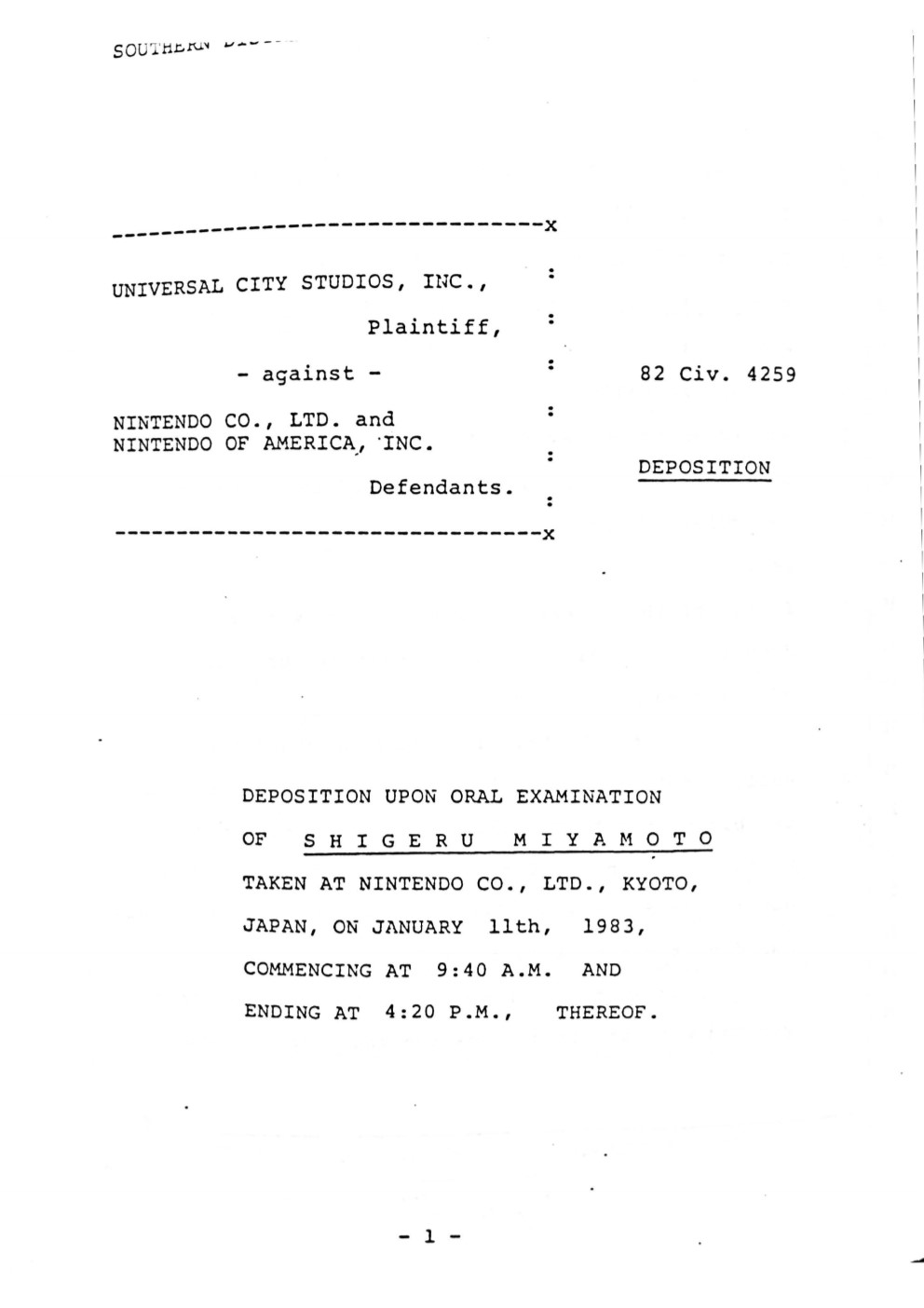
Universal City Studios, Inc. v. Nintendo, Co., Ltd.
Publication Date: January 11, 1983
Subject(s): Donkey Kong’s creation, Donkey Kong’s name, the meaning of “Kong”
Format: Deposition, design documents
People: Douglas C. Fairhurst, John Kirby, Shigeru Miyamoto
Archive Link: https://archive.org/details/universal-v-nintendo-court-documents
Scans:
Collapse/Expand
Deposition

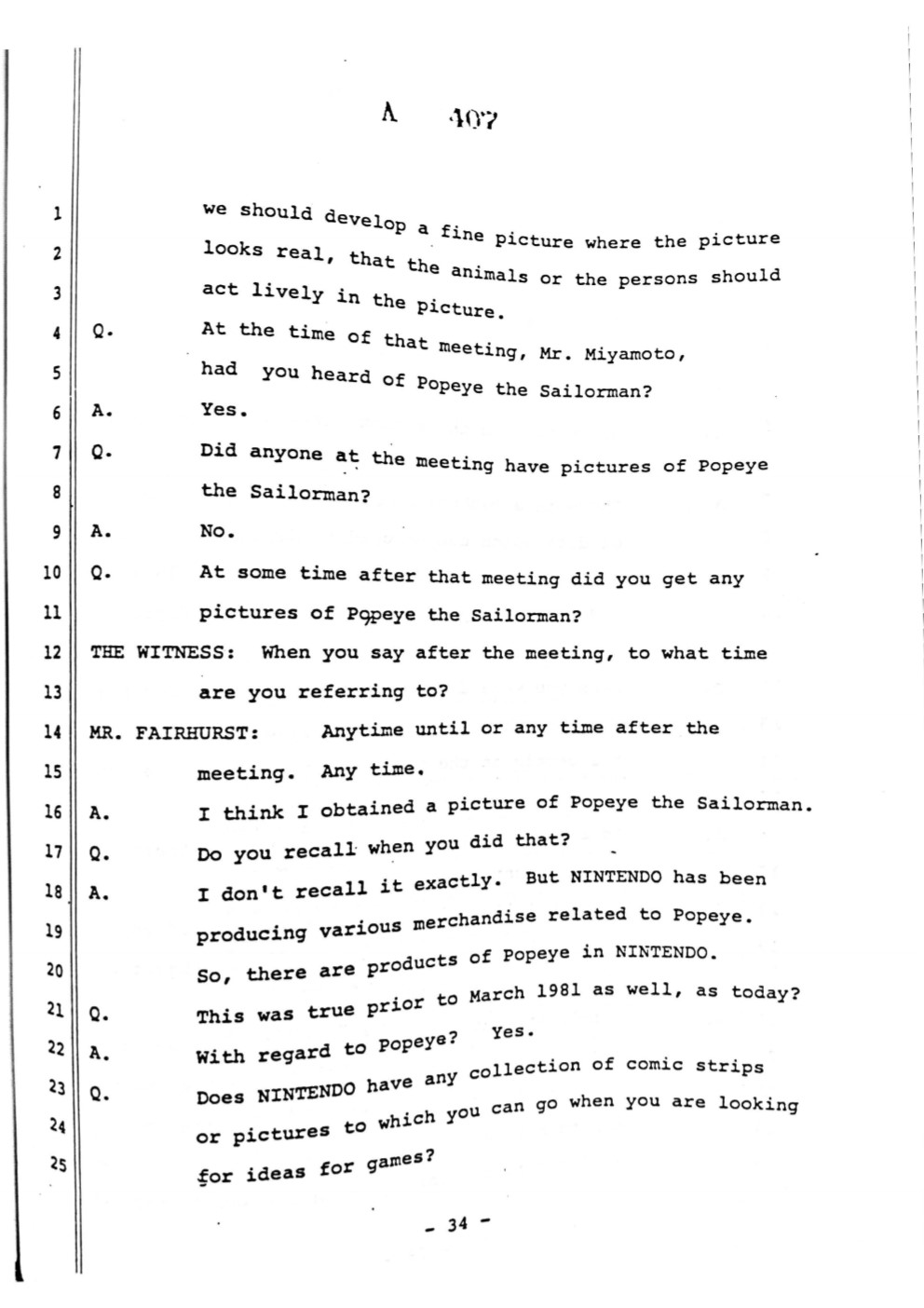

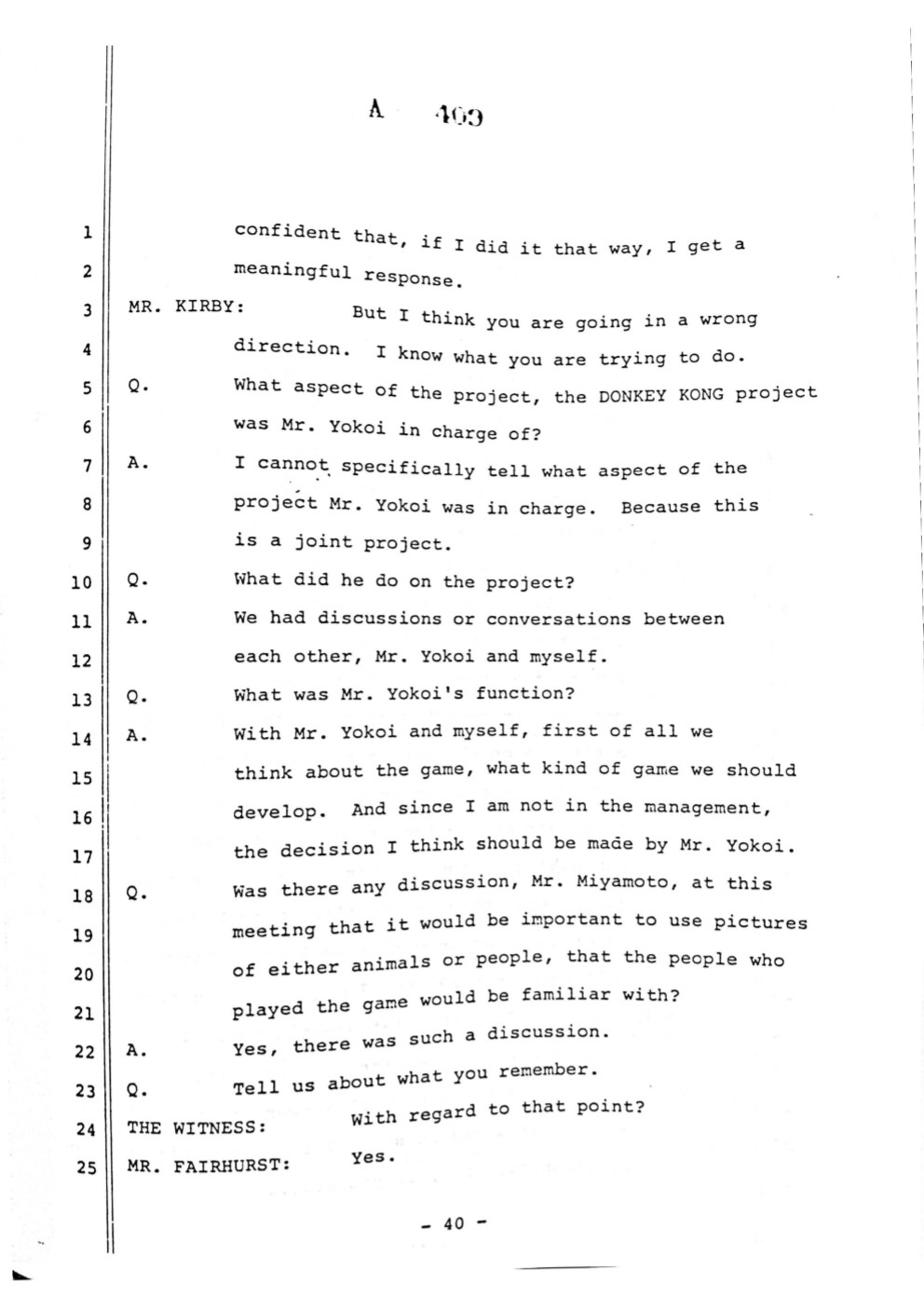
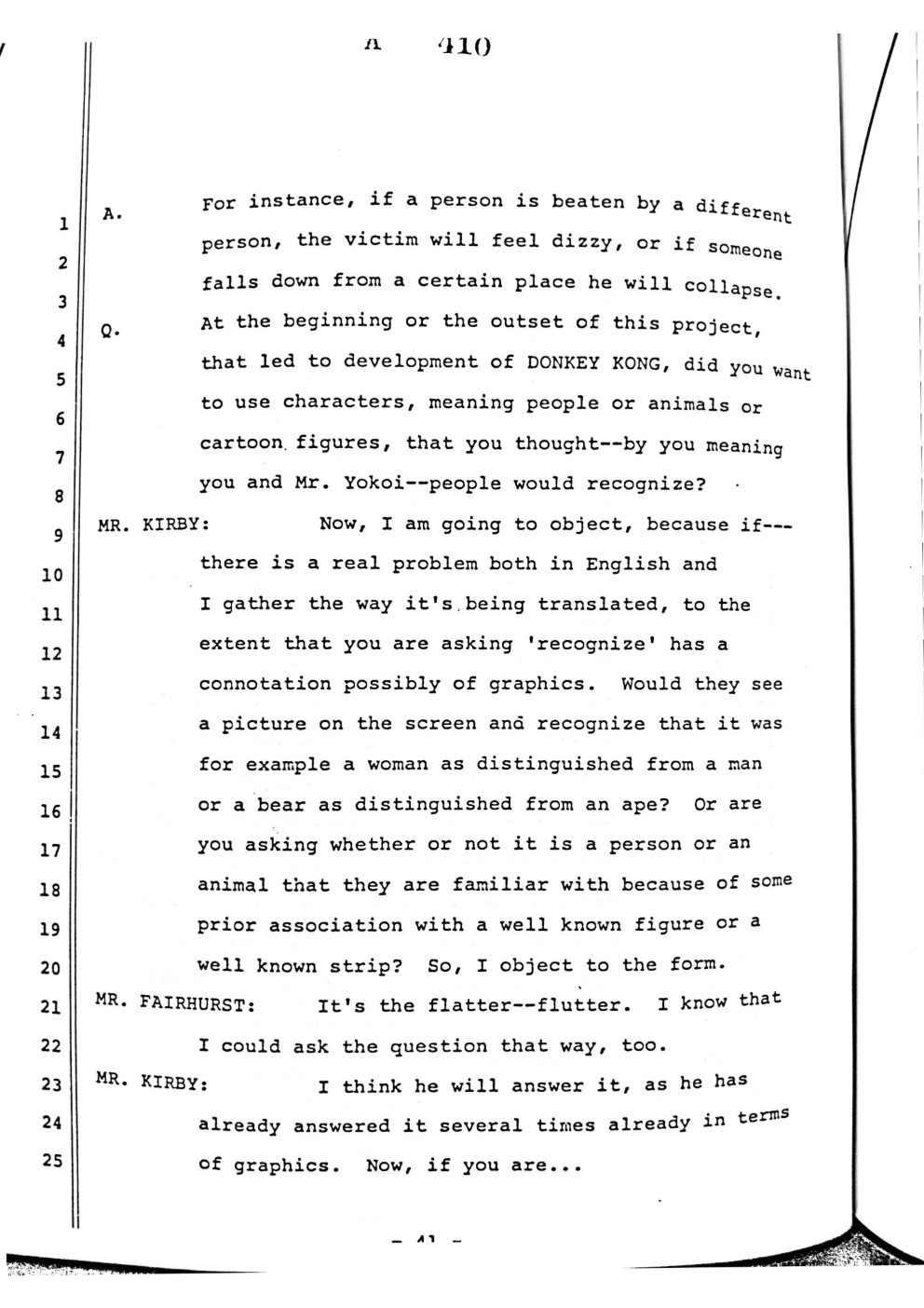
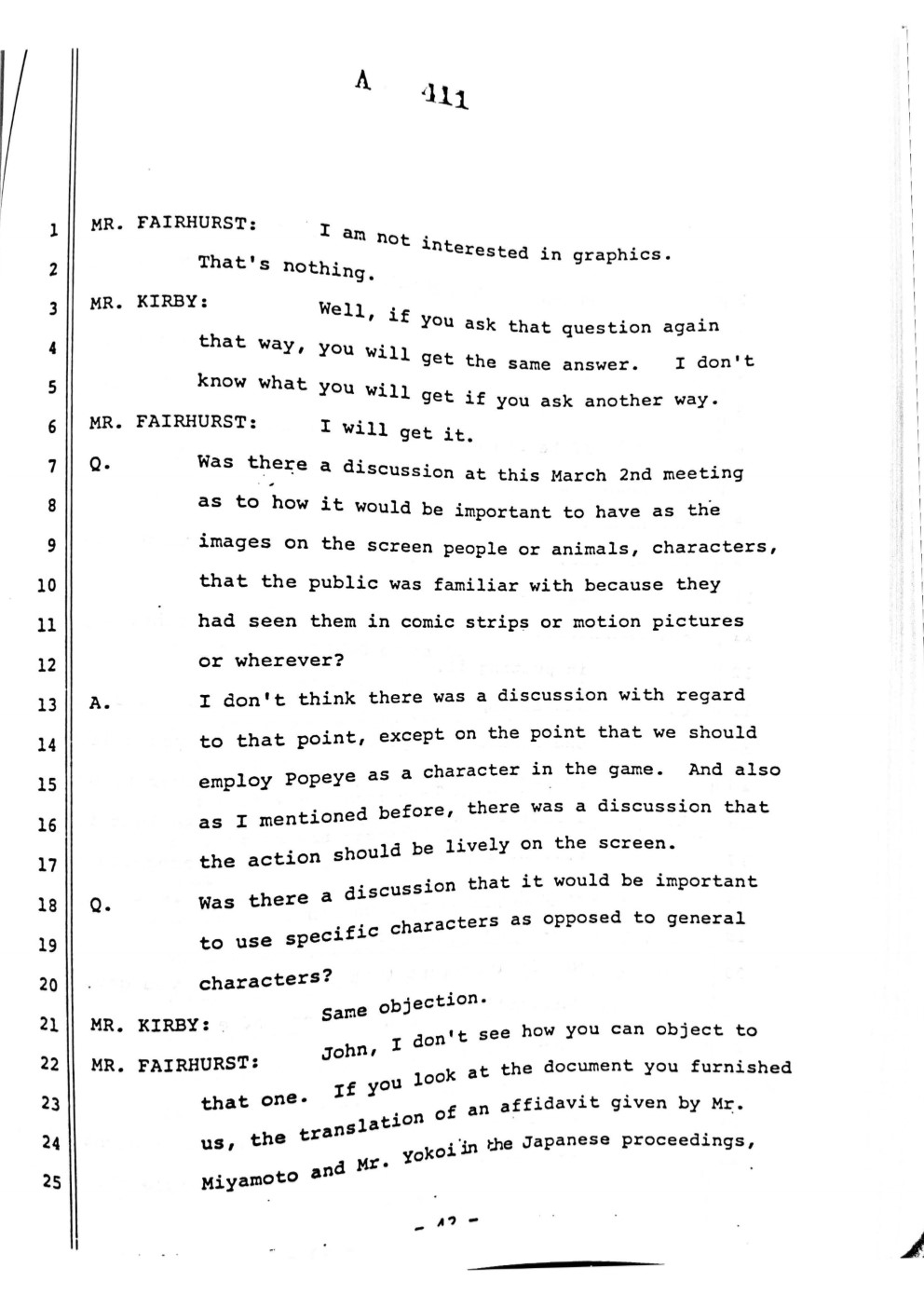
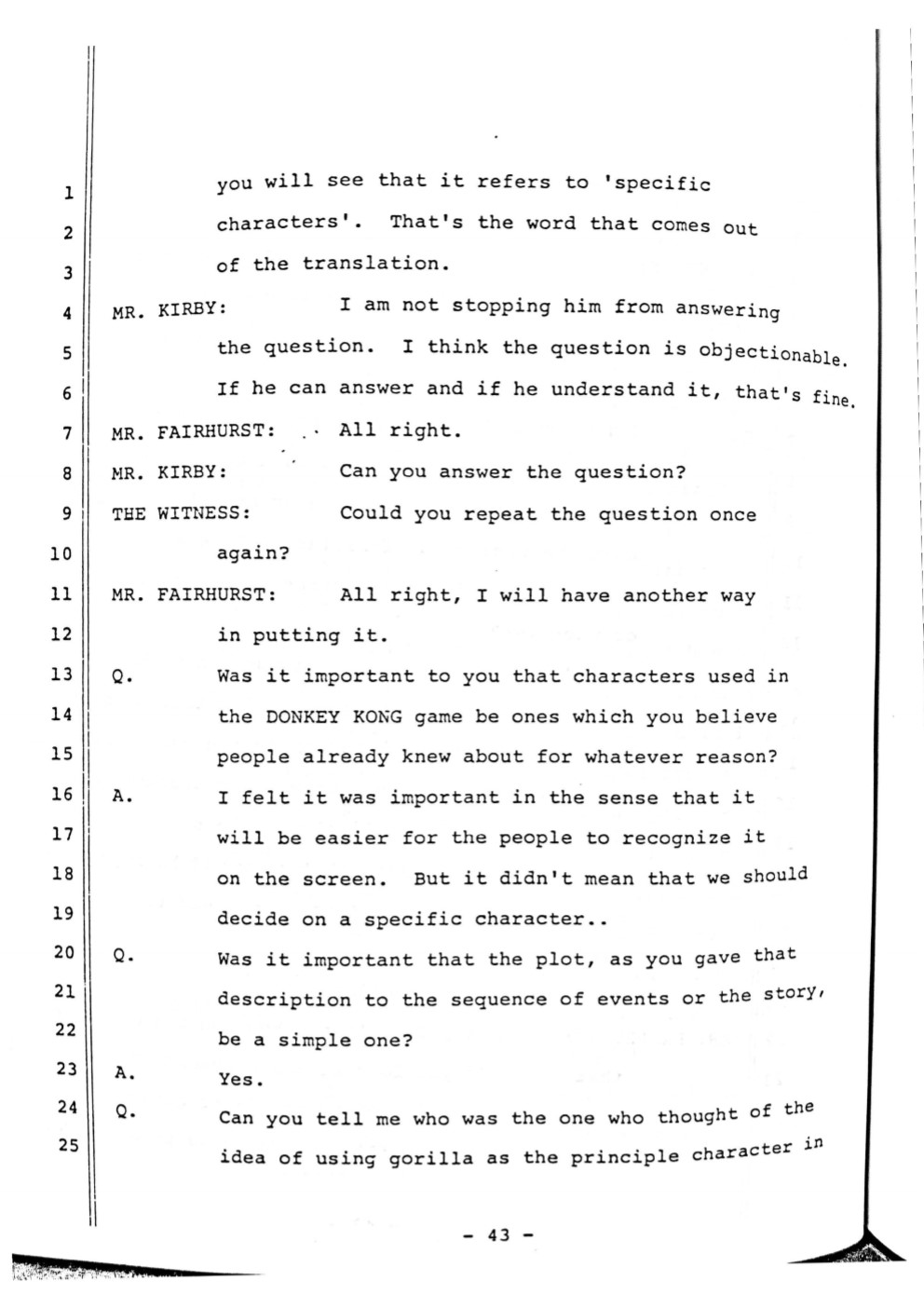













Summaries of Deposition
1984-03-16 Universal Brief (84-7095)
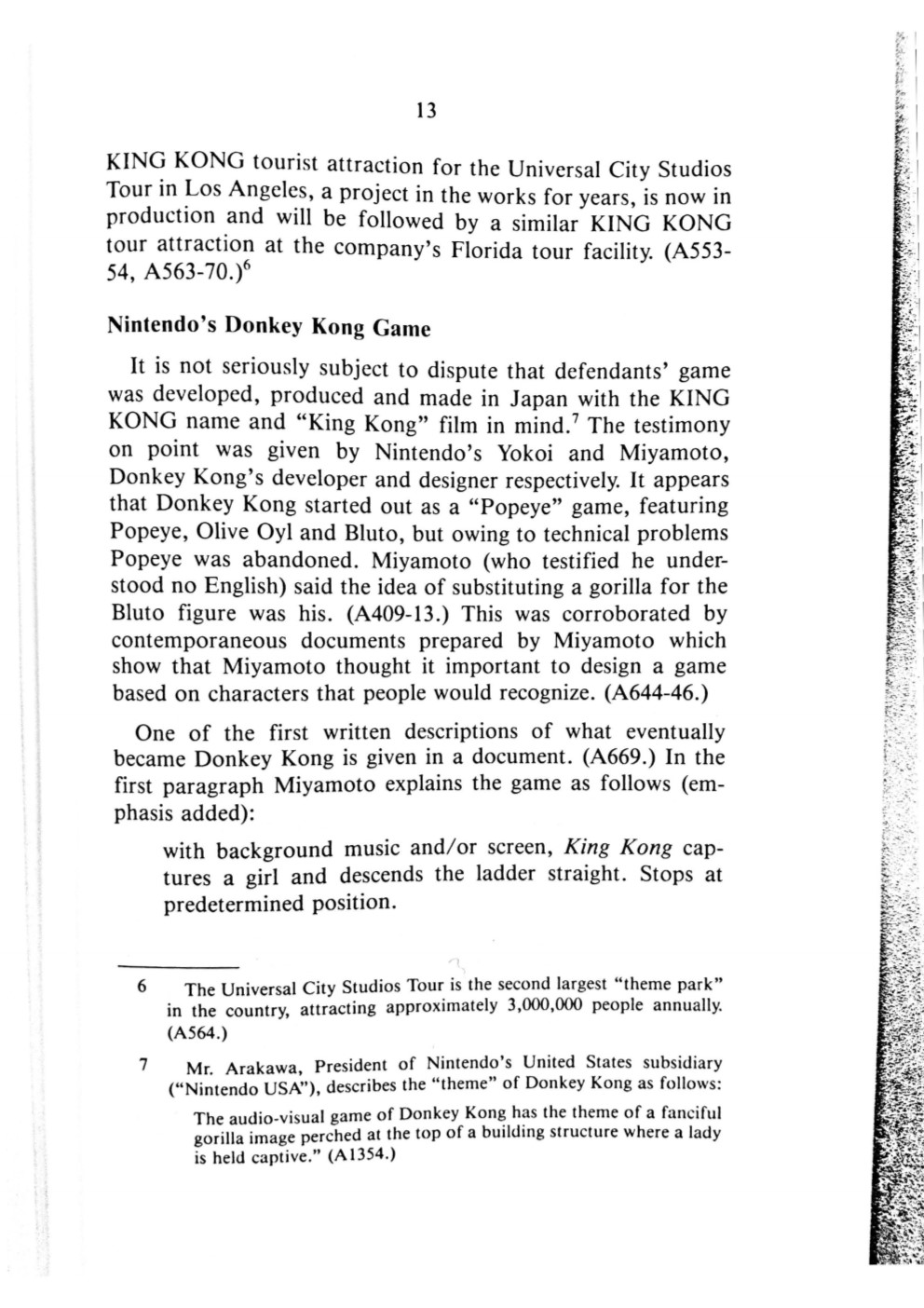
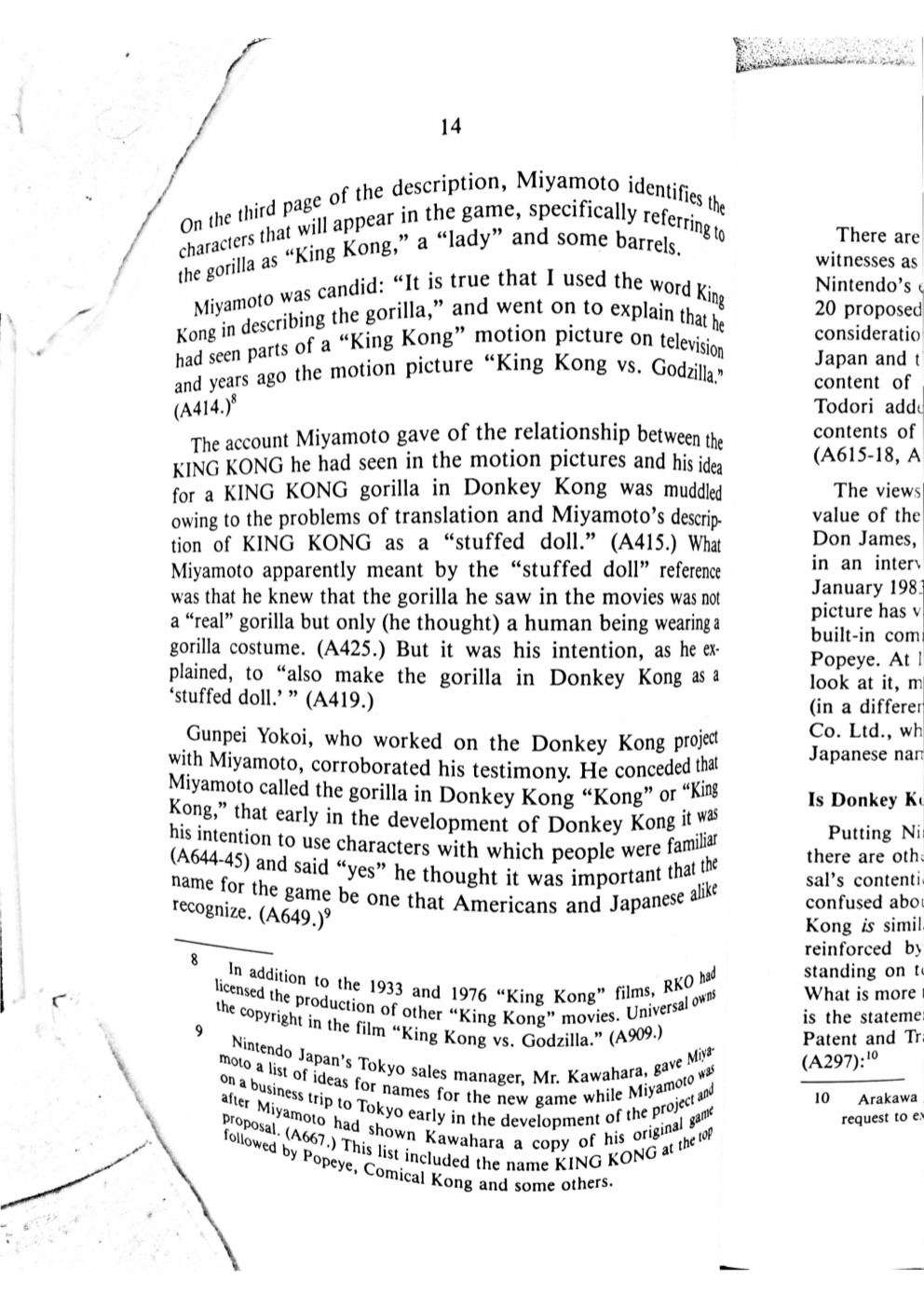
1984-04-09 Nintendo Brief (84-7095)
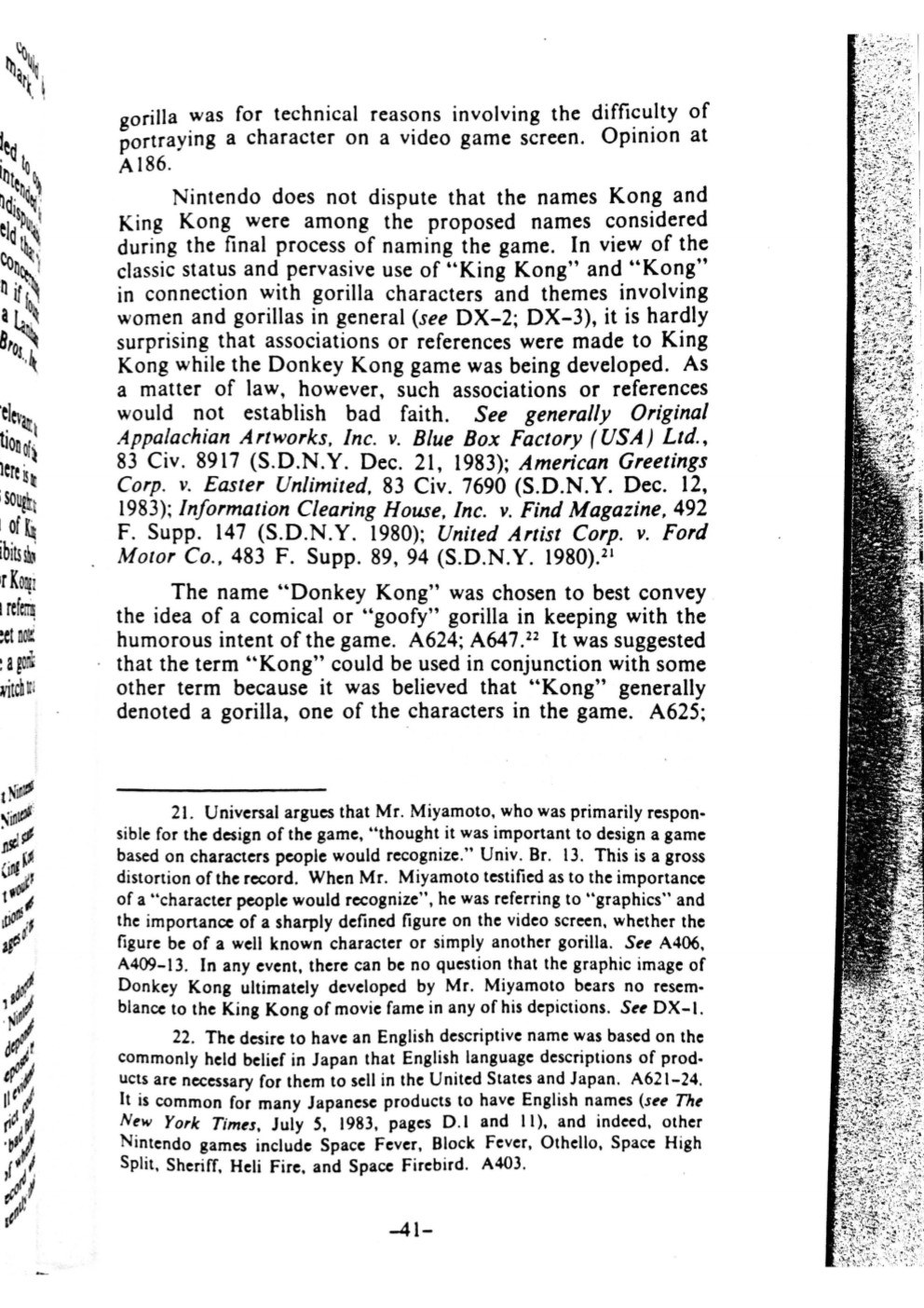
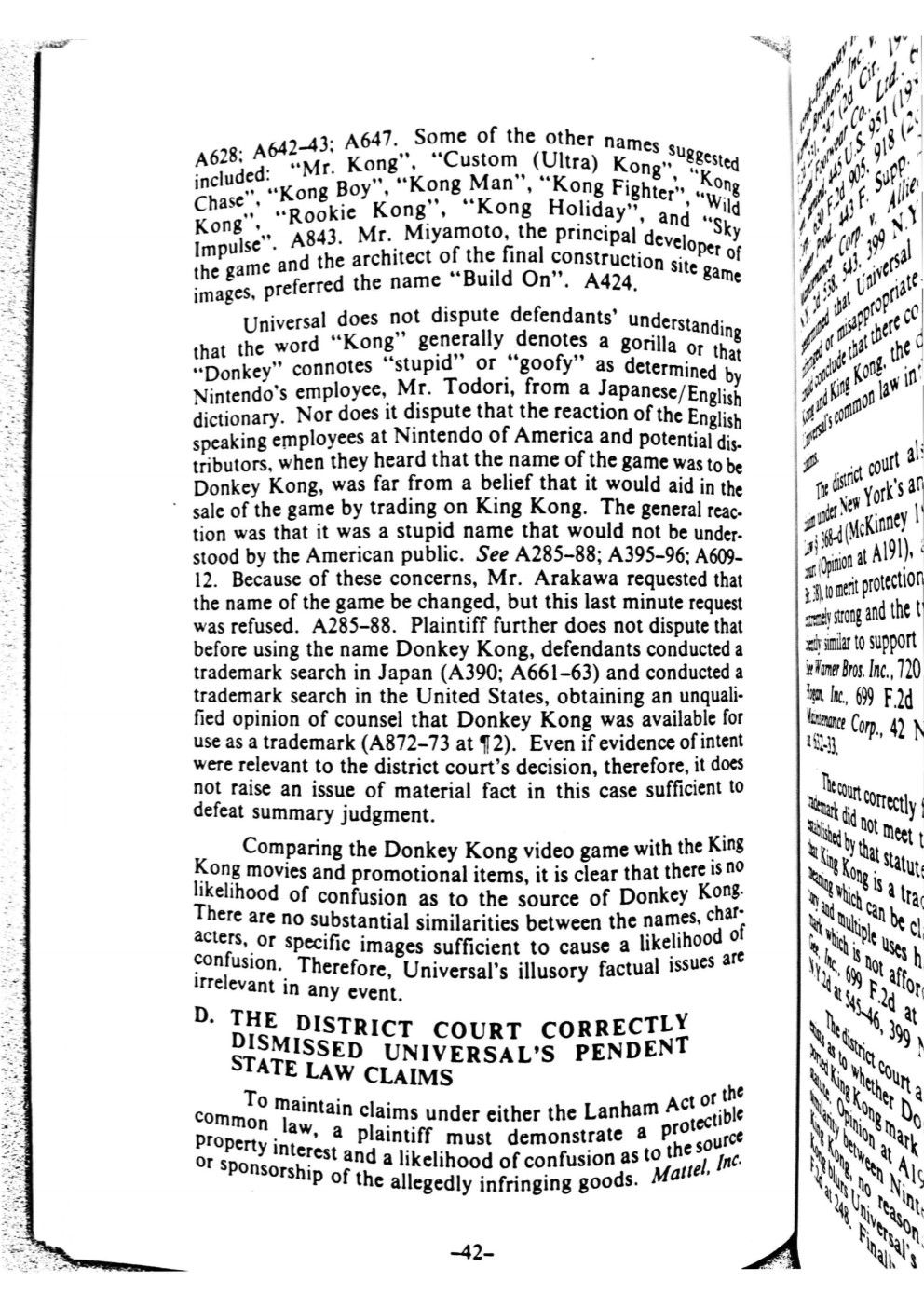
1983-07-08 Universal Reply to Motion for Summary Judgement (82-4259)
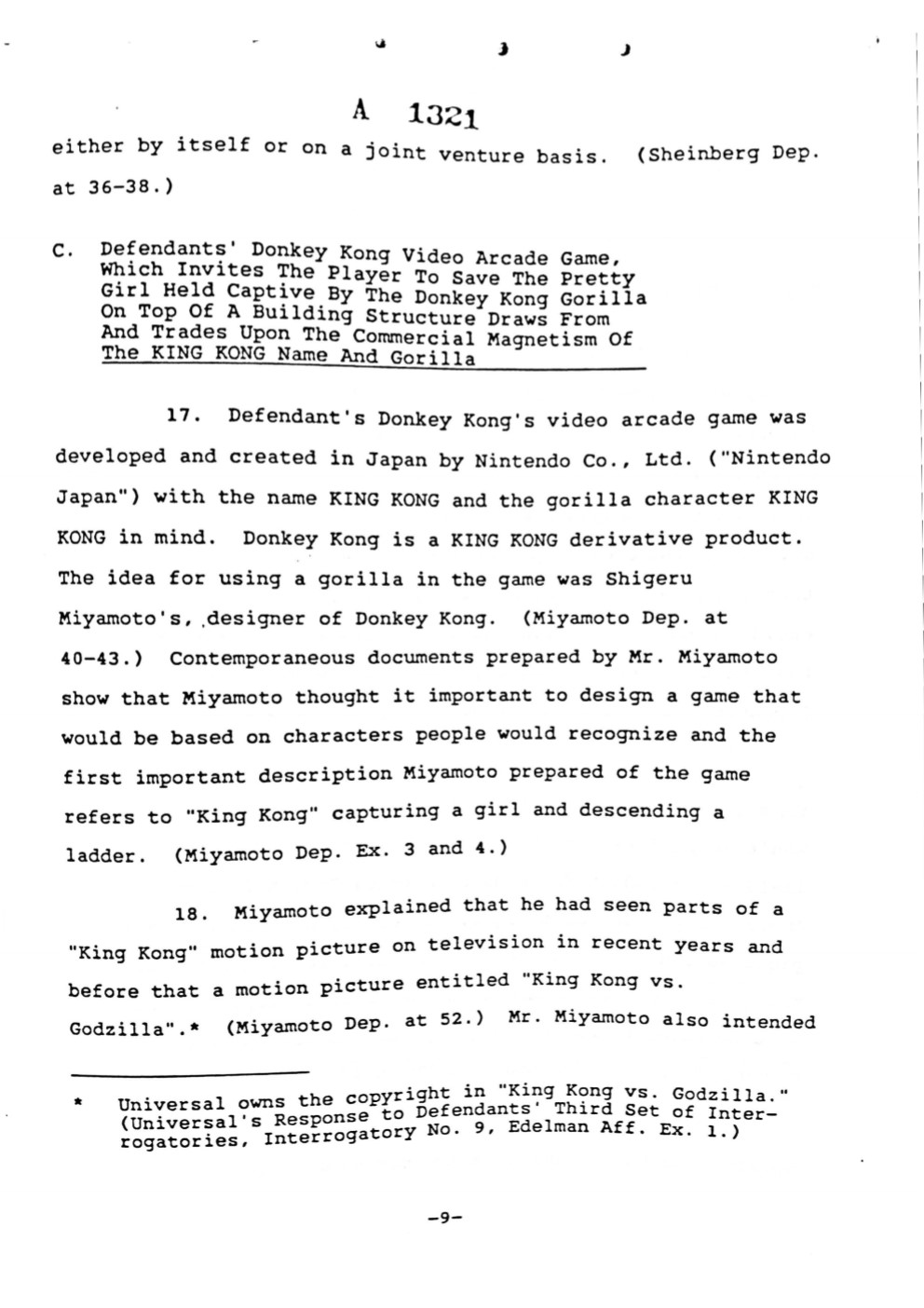
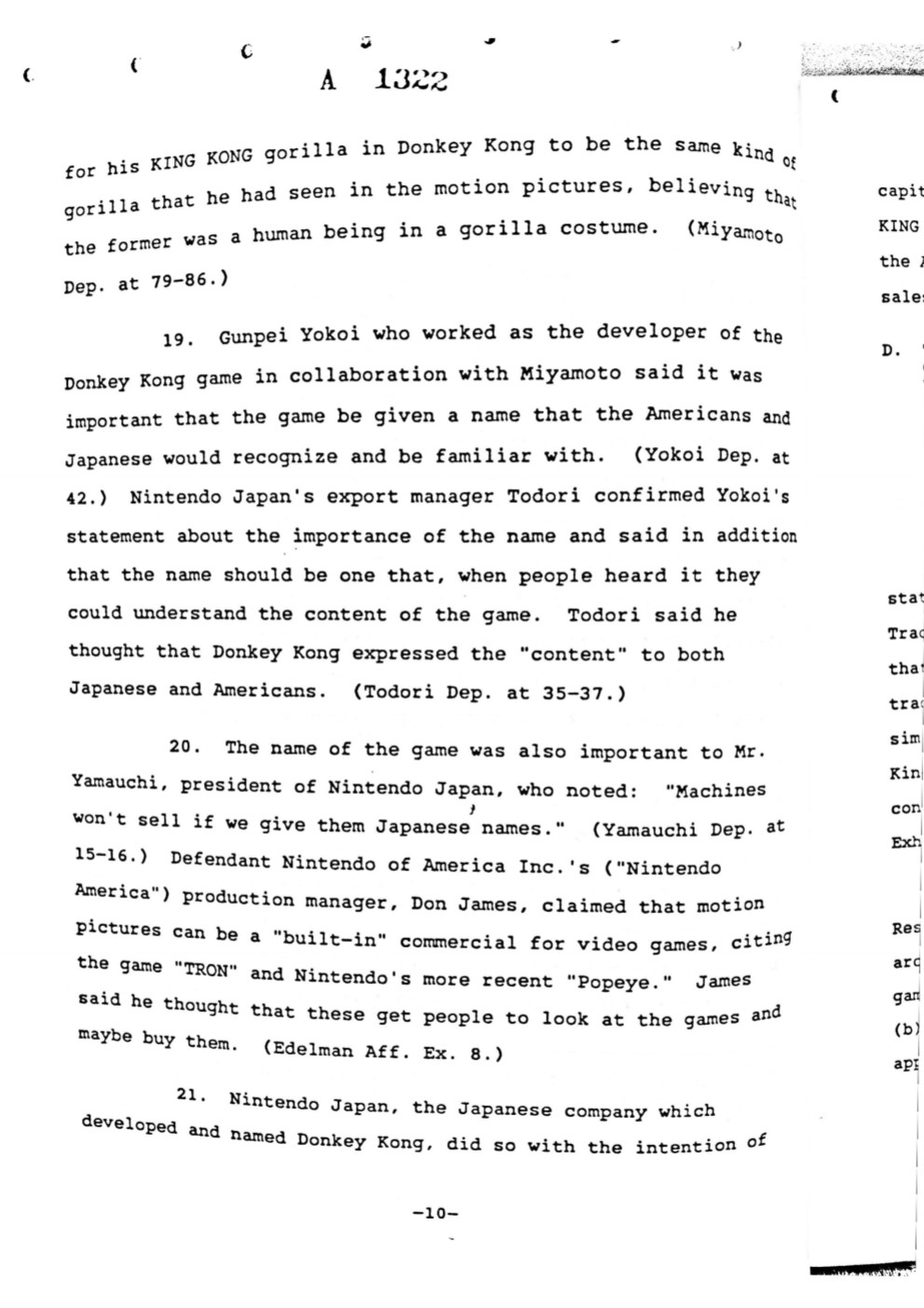
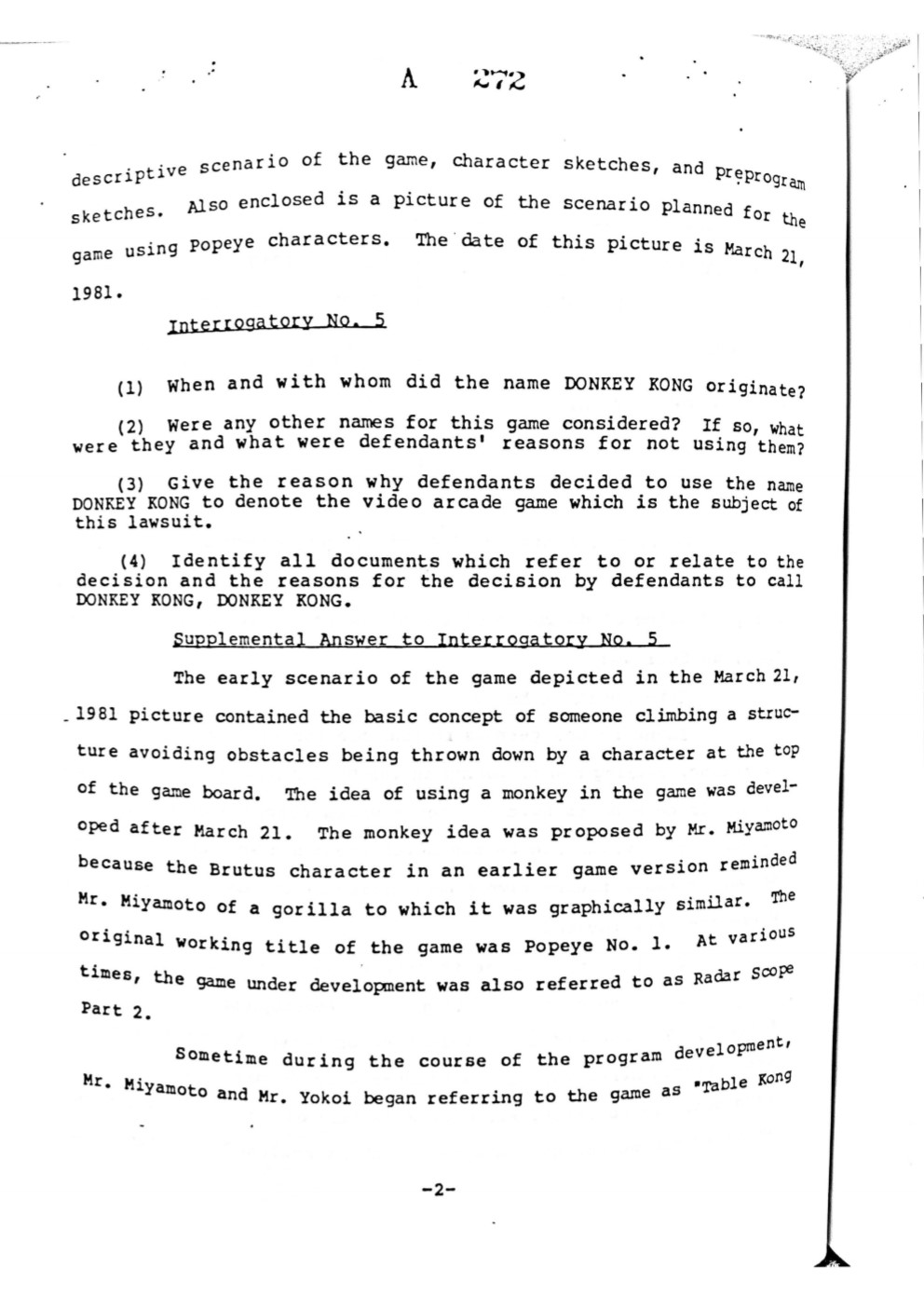
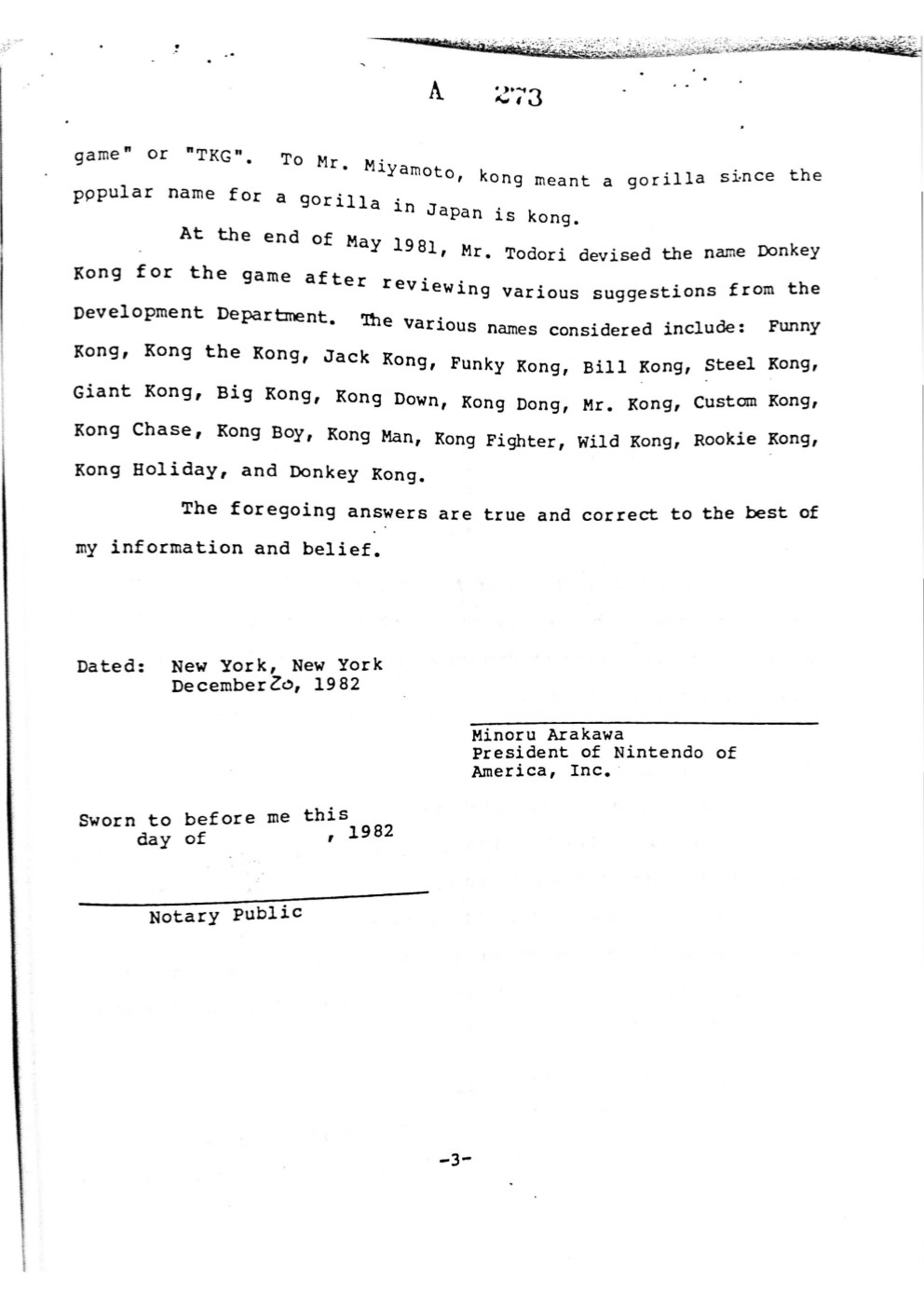
Nintendo Interrogatory Response (82-4259)
Design Documents
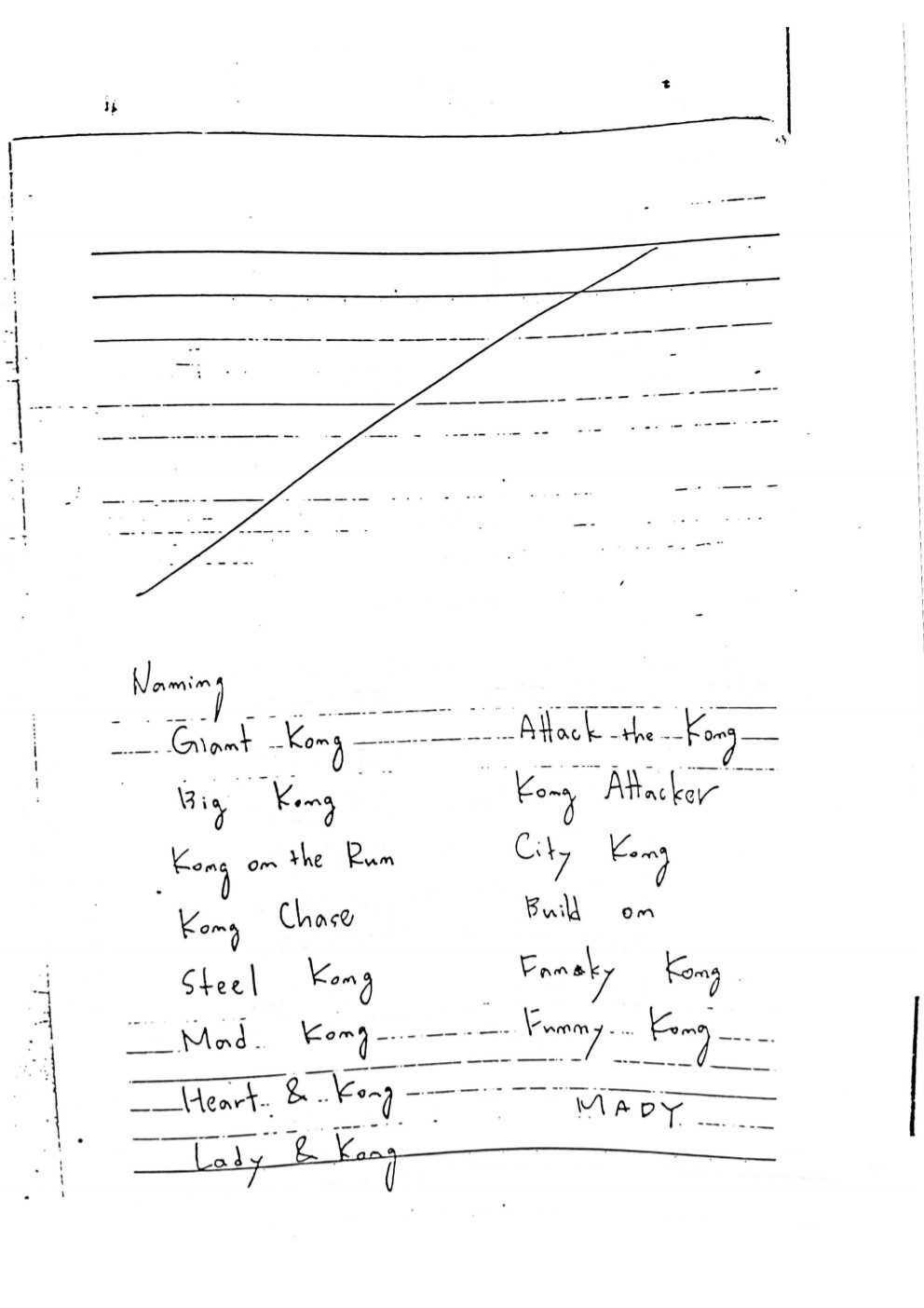
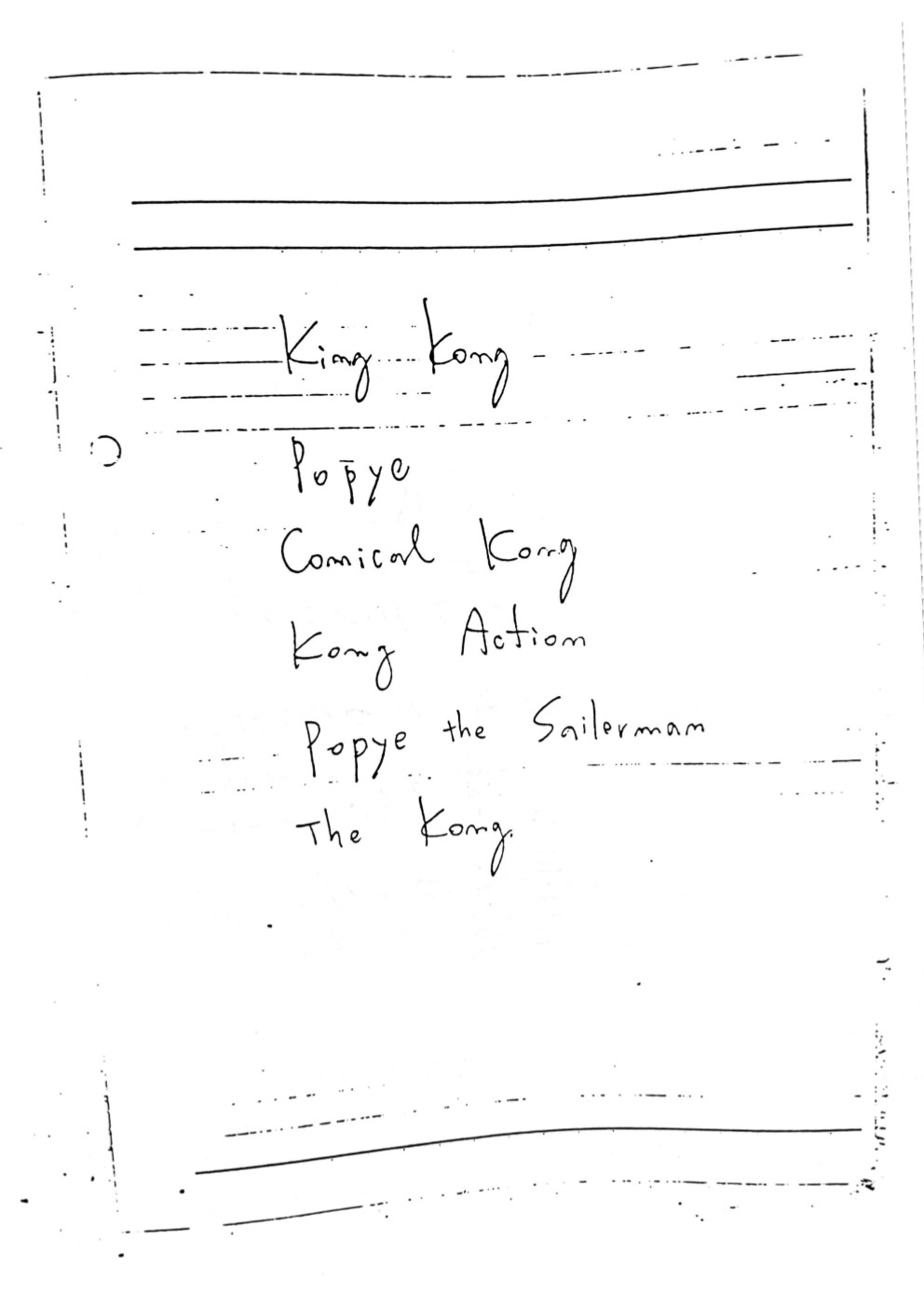
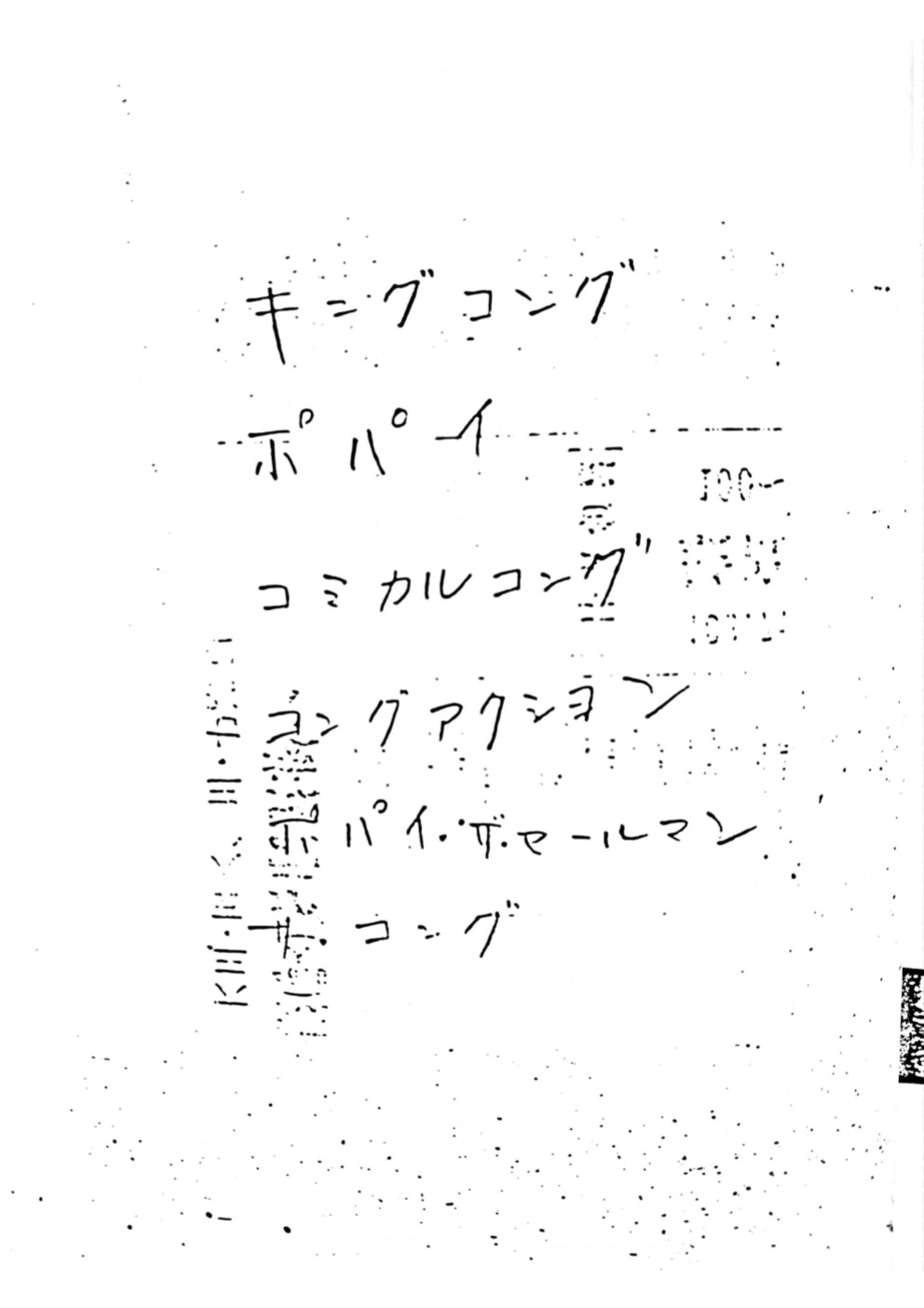
1981 Miyamoto Name Ideas (Exhibit M-5)

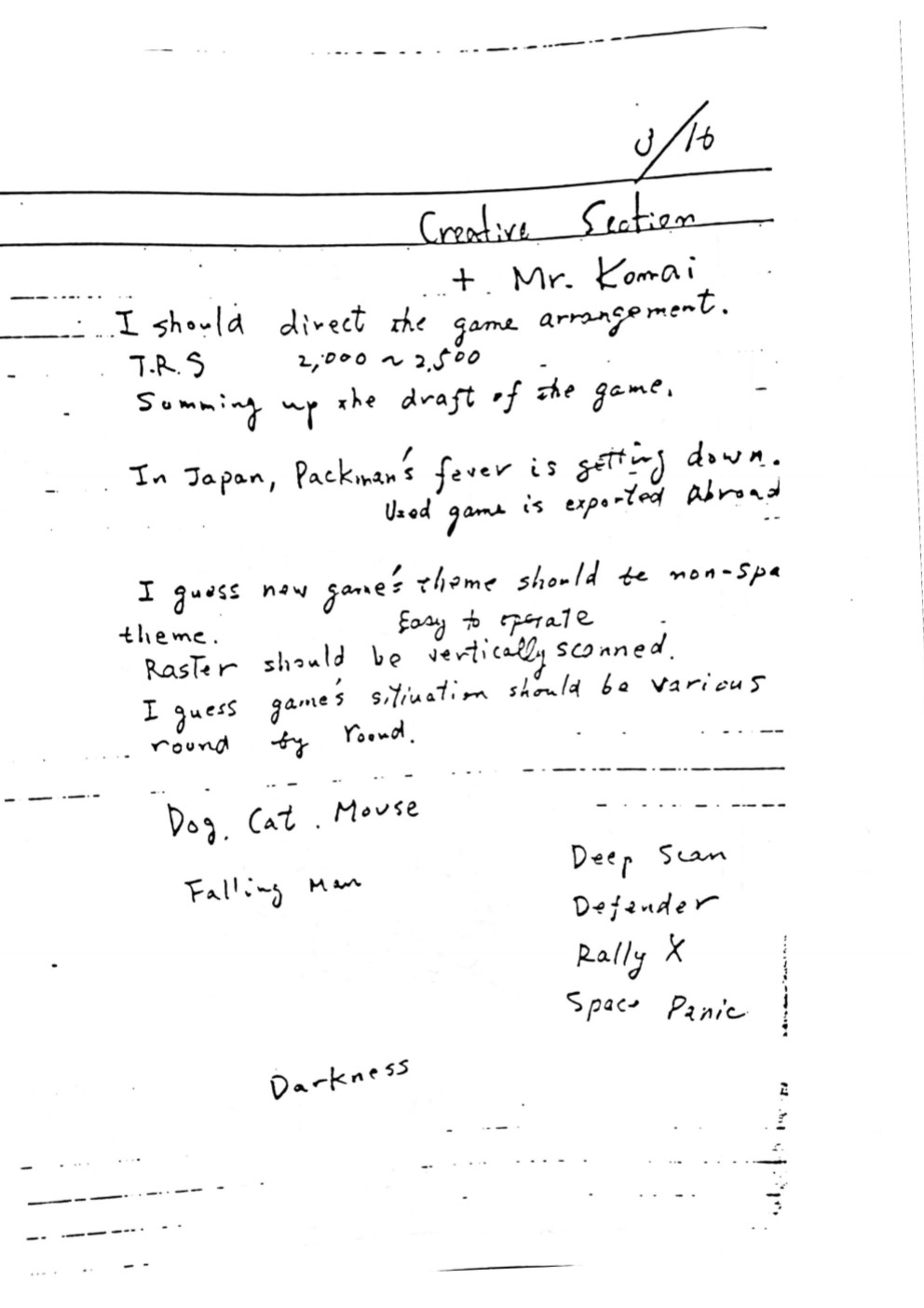
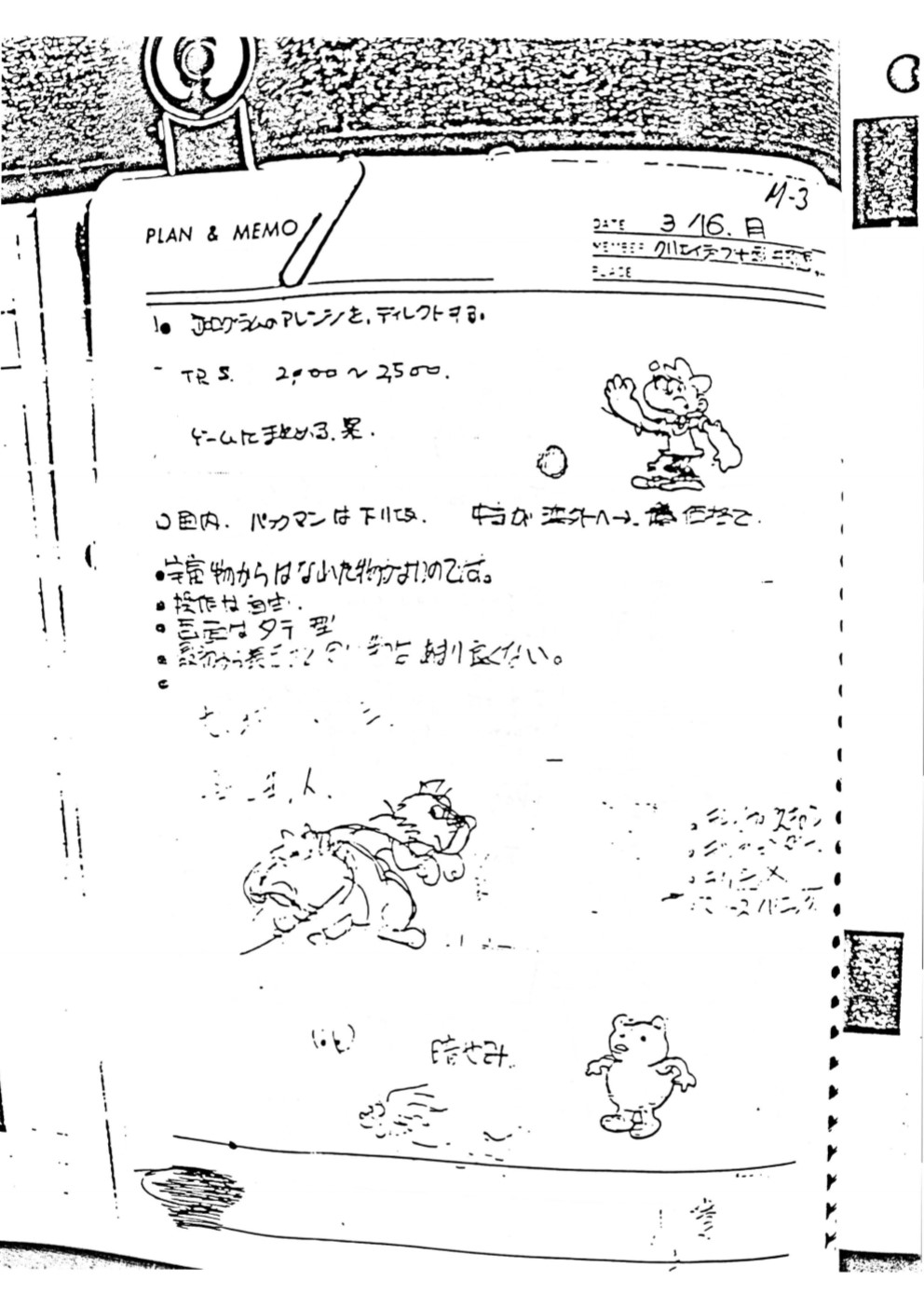
1981-03-16 Miyamoto Notes (Exhibit M-3)
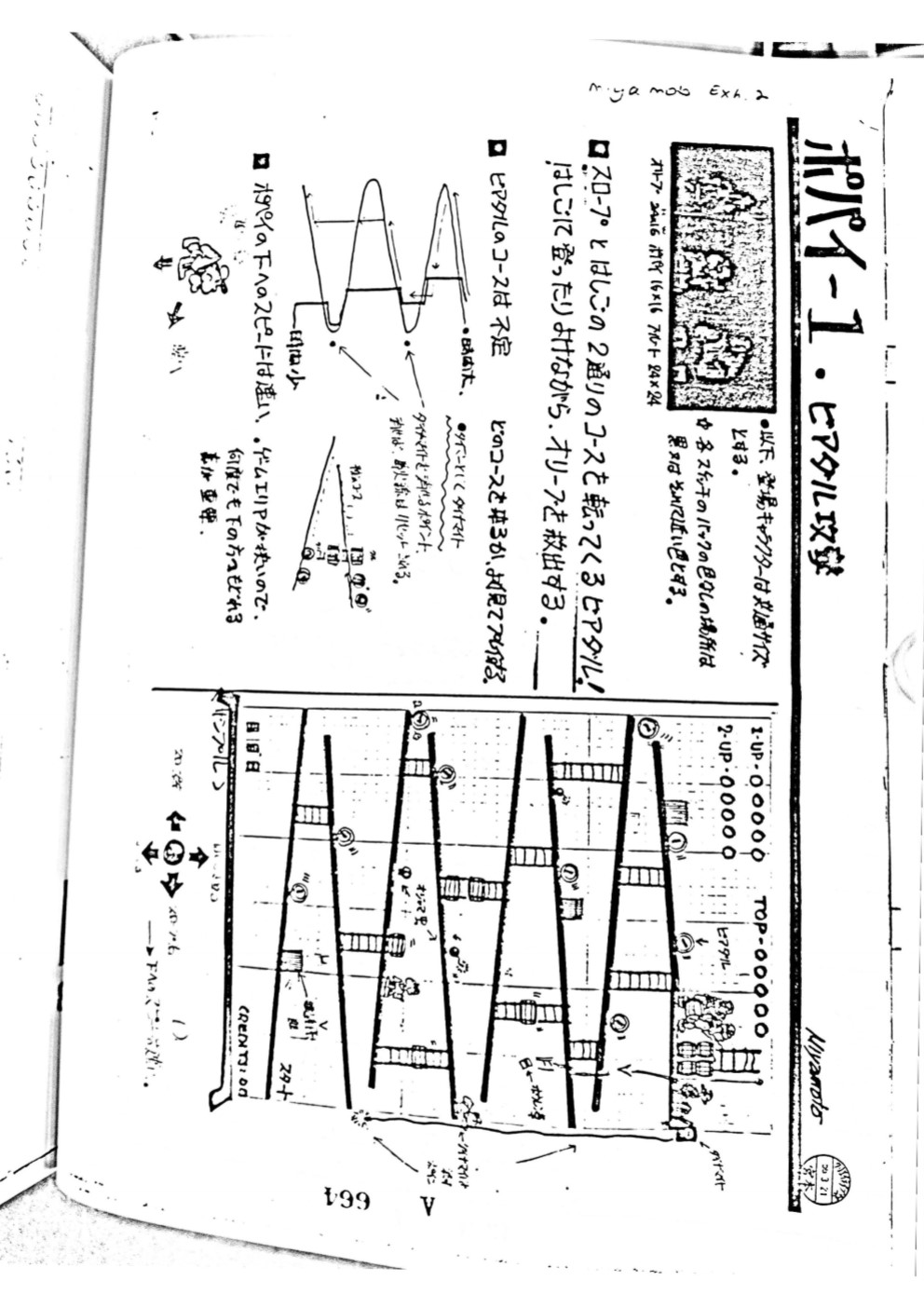
1981-03-21 Popeye Design Doc (Exhibit M-2)_1
1981-03-30 Miyamoto DK Design Notes (Exhibit M-4)
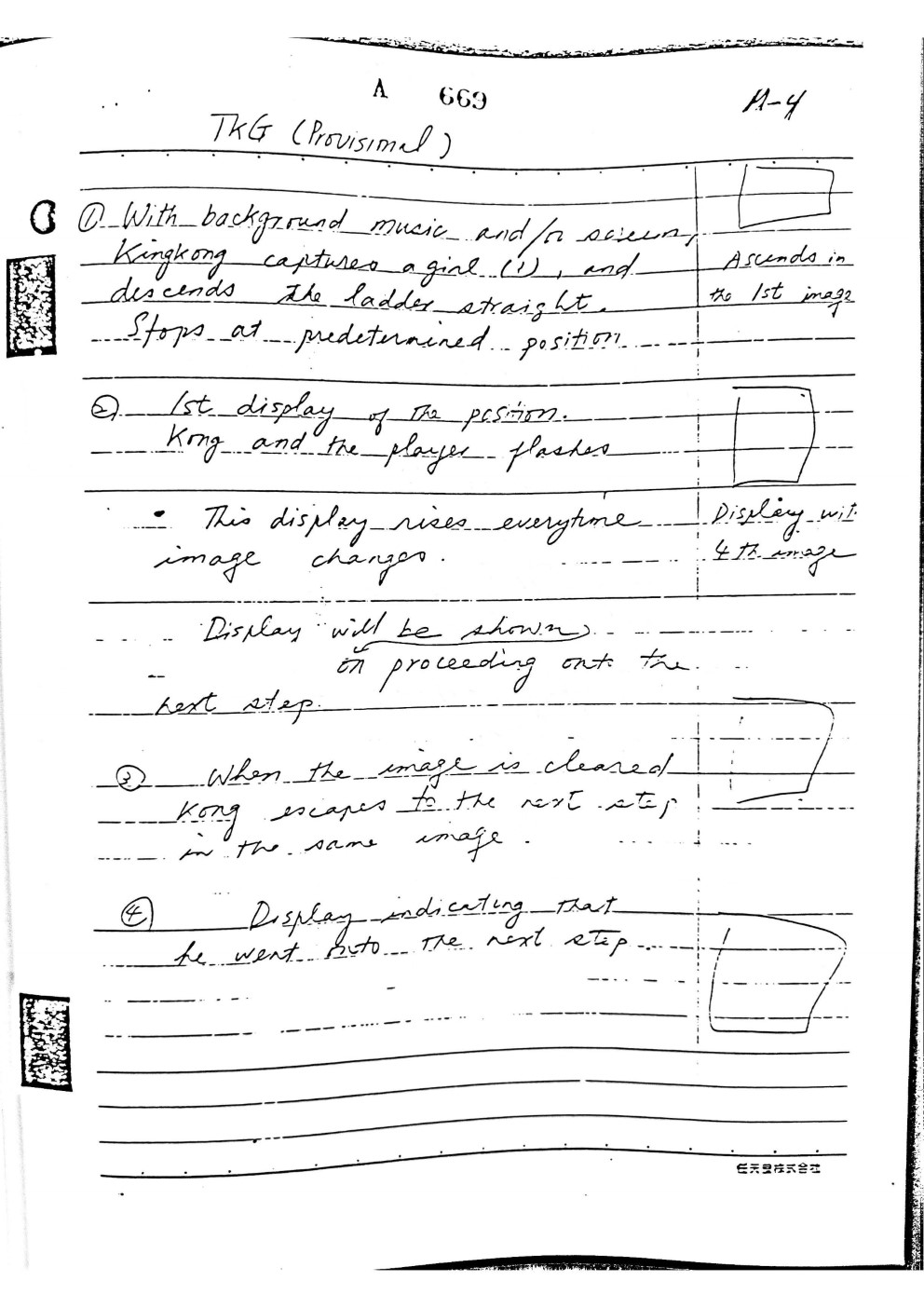


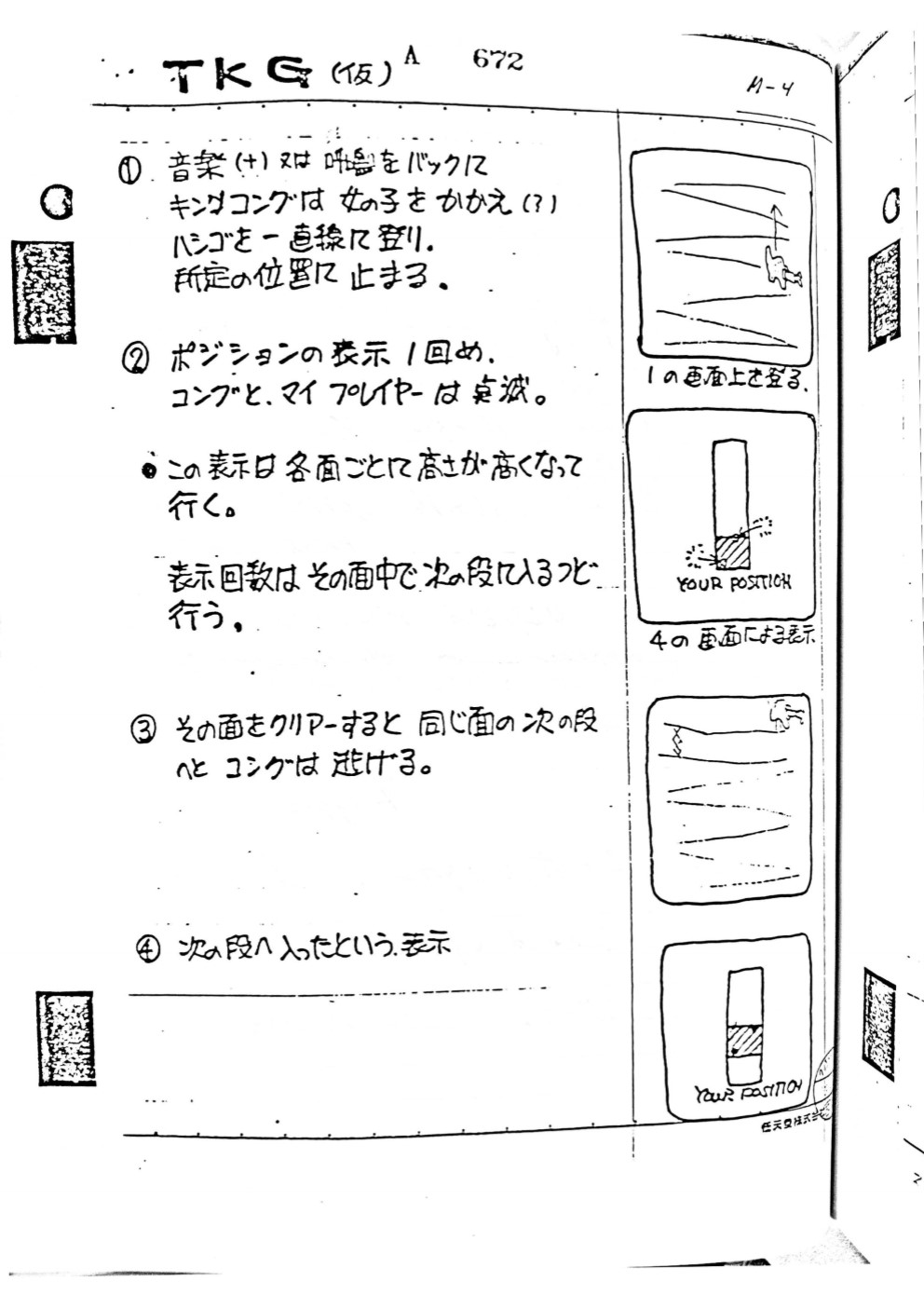
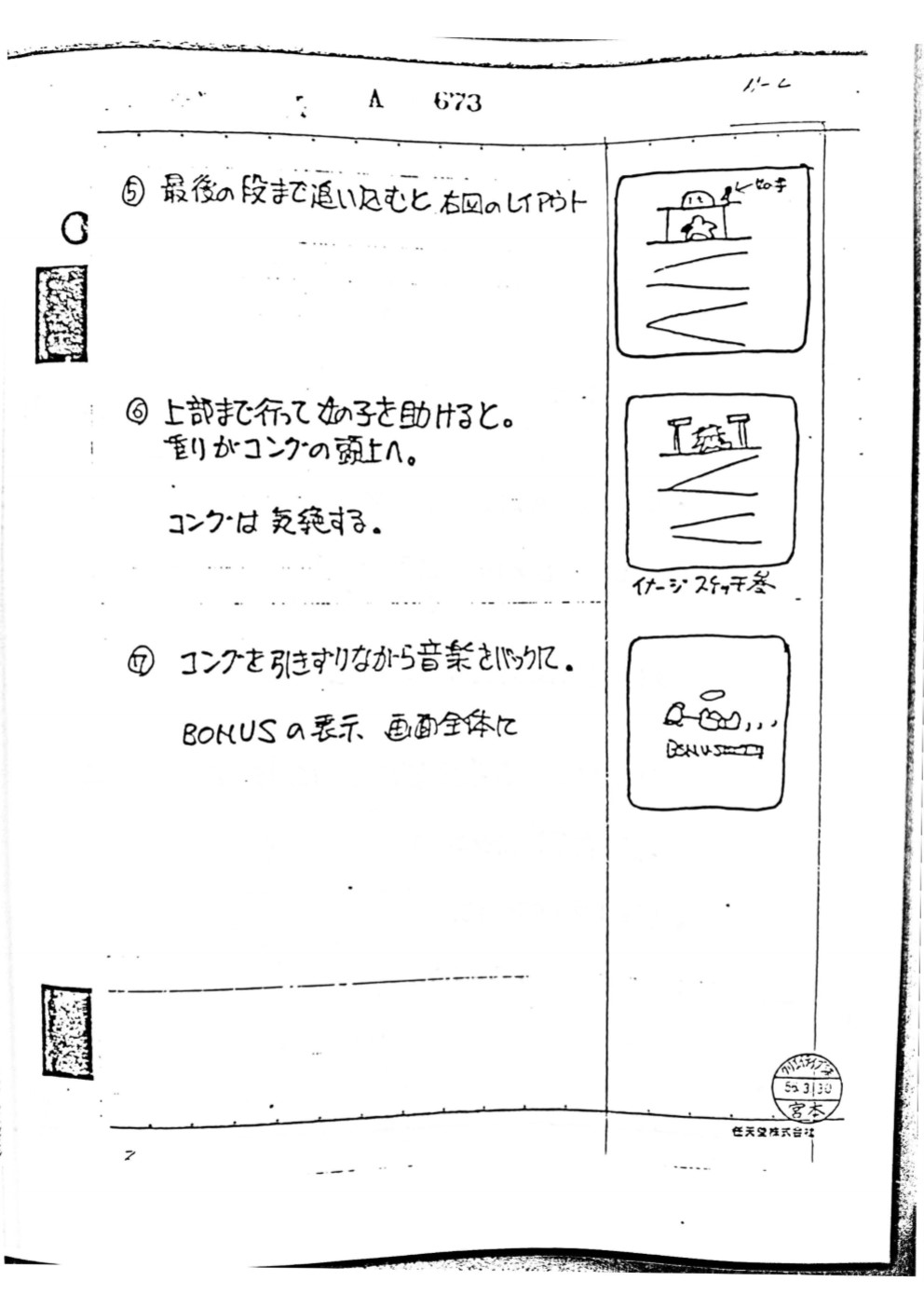
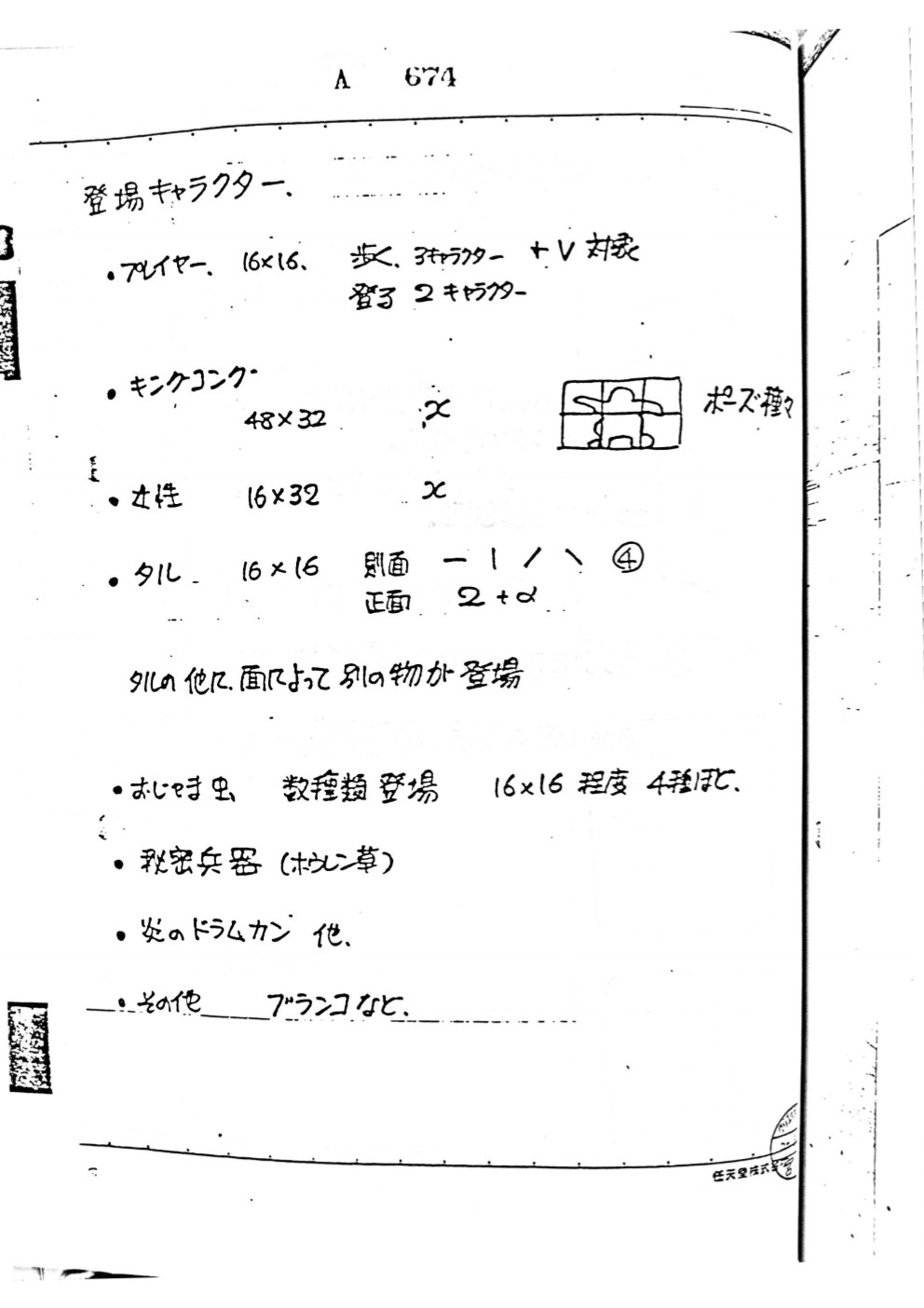
Notes: Universal City Studios, Inc. v. Nintendo, Co., Ltd. was a lawsuit over Nintendo’s use of Donkey Kong, which Universal asserted violated their ownership of King Kong. Mr. Miyamoto gave a deposition about his role in the creation of Donkey Kong for the case and some design documents that he had made were submitted as evidence. Mr. Miyamoto had only been working at Nintendo for six years during this trial.
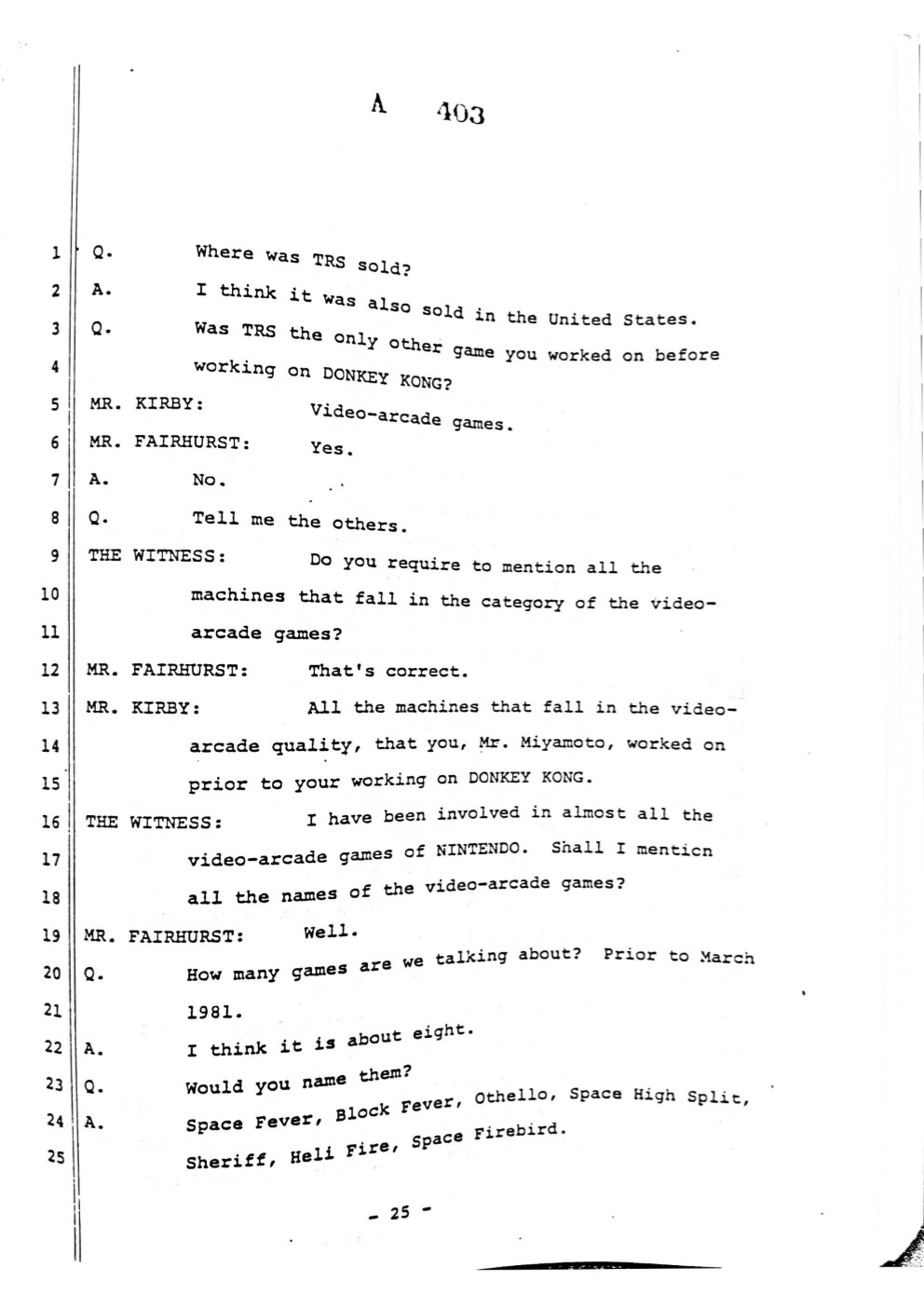
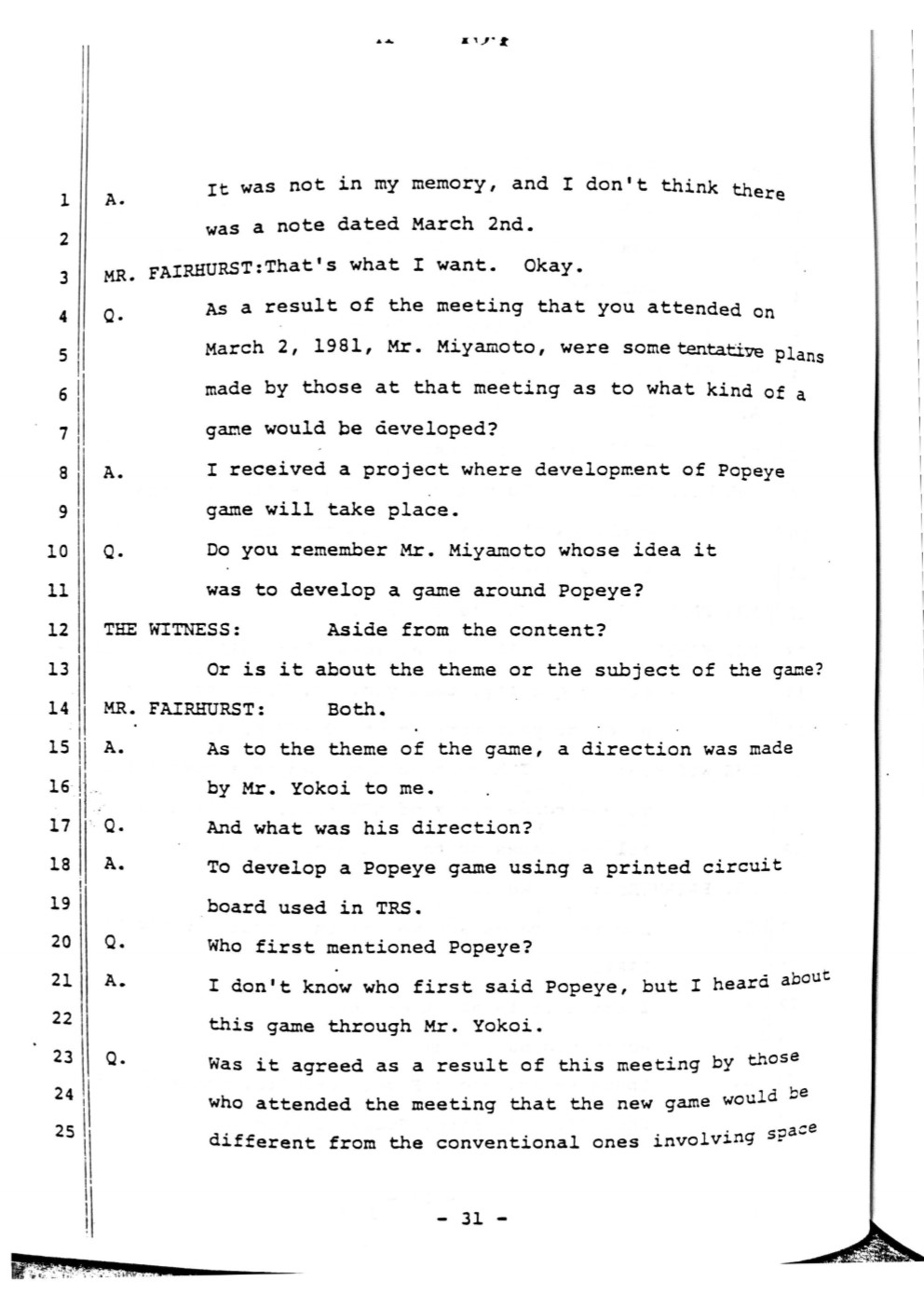
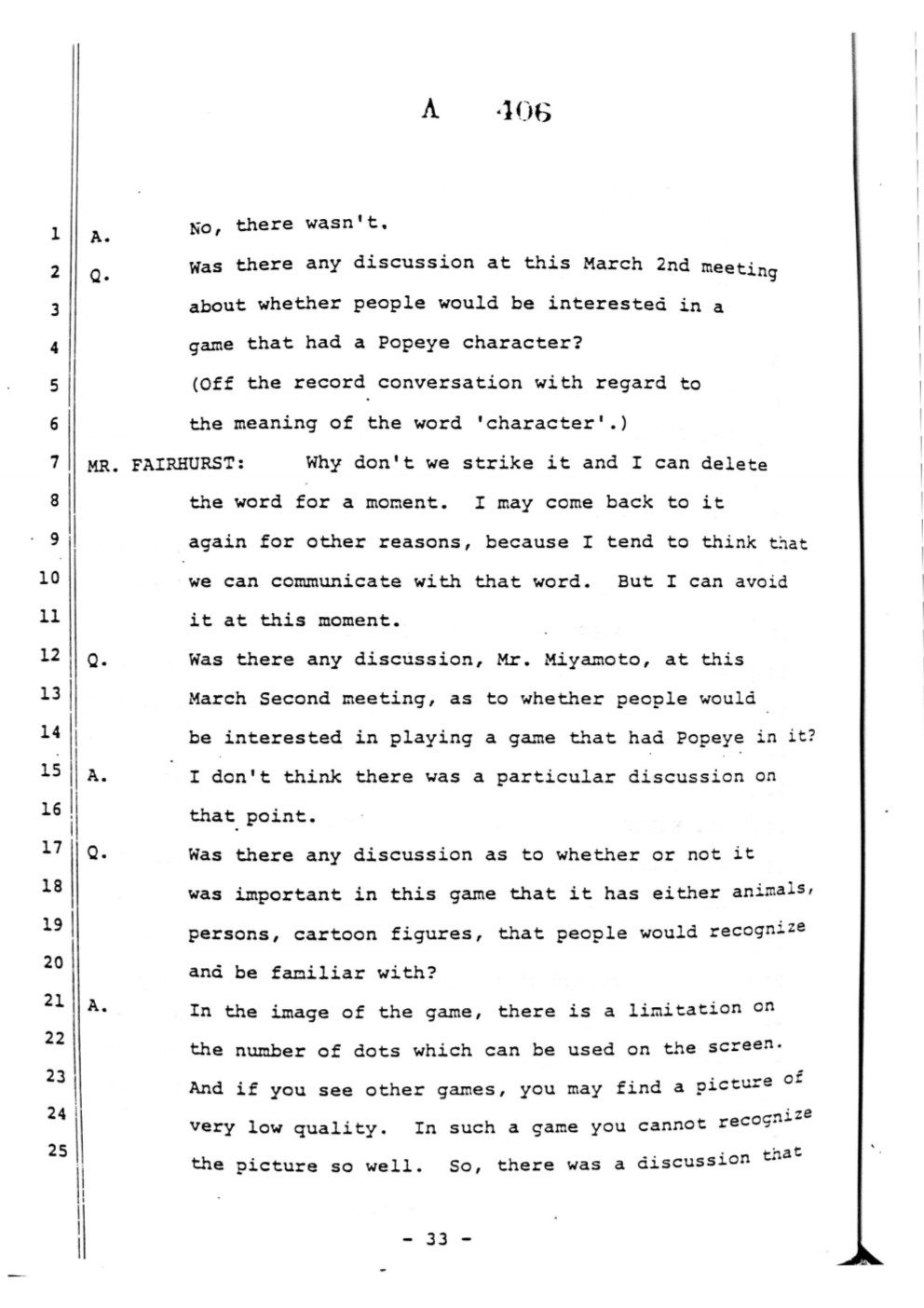
The deposition took place from 9:40 a.m. to 4:20 p.m. at Nintendo headquarters in Kyoto, and the transcript here is not complete. The transcript ends on page 86, but only pages 1, 25, 31, 32, 33, 34, 38, 40, 41, 42, 43, 44, 52, 53, 54, 69, 70, 79, 81, 82, 83, 84, 85, and 86 have been preserved.
I have included some documents that summarize Mr. Miyamoto’s words, for the purpose of including small bits of information not seen in the preserved deposition.
These documents were scanned by Norman Caruso (Gaming Historian) at the National Archives in Kansas City, Missouri.
Summary: Before Donkey Kong he worked on Space Fever, Block Fever, Othello, Space High Split, Sheriff, Heli Fire, and Space Firebird.
He was put onto a Popeye game project by Gunpei Yokoi. He was told to use the circuit board from TRS. In that meeting it was agreed that the game would have good graphics. There was no discussion of using a gorilla character. In some games you cannot recognize what is being depicted by pixel art, but they talked about making the game look real and where the characters are lively.
He had heard of Popeye, but there were no pictures of Popeye at the meeting. He doesn’t remember when, but he was given a picture of Popeye at some point. Nintendo had been making Popeye merchandise.
They decided not to use Popeye because of technical restraints. They couldn’t depict Popeye accurately in a 16×16 pixel area. At a meeting he said it was important that successive images be related to each other, for the plot.
He doesn’t know exactly what responsibilities Gunpei Yokoi had, it was a joint project. There were discussions with him. Gunpei Yokoi was the manager so he deferred to him.
They decided that if someone was defeated they would appear dizzy.
He felt it would be easier to recognize characters that were familiar to people, and it was important to the plot. He thinks he discussed with Gunpei Yokoi the idea of using a gorilla. He said that he could draw a gorilla the same size as Bruto.
He used “King Kong” to describe the gorilla. He had seen King Kong vs. Godzilla. He understood King Kong to be a giant gorilla which is a stuffed doll. He doesn’t think he knew the exact difference between King Kong and a gorilla.
Mr. Kawahara said what he had been working on was not a new game. He has not discussed King Kong with Mr. Kawahara since then.
He referred to the gorilla character as Kong, King Kong, monkey, and gorilla.
He tried to make the gorilla character close to a human, like a human wearing stuffed doll. A stupid and goofy gorilla, like Bruto.
He drew art featuring a woman and barrels around the middle towards the end of the project.
He heard the name would be Donkey Kong from his boss. He slightly remembers the name Funky Kong being considered. He doesn’t know why Donkey Kong was chosen. He had the image of a big, goofy gorilla in his mind.
He understands “donkey” to refer to an animal and to a person who is slow or stupid.
He discussed the U.S. version with someone in July 1981. There are differences between the U.S. and Japanese versions of Donkey Kong. The U.S. version is harder and shorter.
No one said that Donkey Kong reminds them of King Kong, nor of a stuffed gorilla.
It was not important to him that the character be named Kong. He came up with a few names, but any would be fine with him. Some names did not include the word Kong or gorilla. His favorite was Build-On.
Stuffed doll refers to the person inside the gorilla costume, the actor.
1986
Famimaga (interview with Masanobu Endo)
Publication Date: February, 1986 (translated February 27, 2023)
Subject(s): Mario’s origins, game design
Format: Transcribed interview
People: Masanobu Endo, Shigeru Miyamoto
Link: https://shmuplations.com/miyamotoxendo/
Archive Links: https://web.archive.org/web/20230227180839/https://shmuplations.com/miyamotoxendo/
Scans:
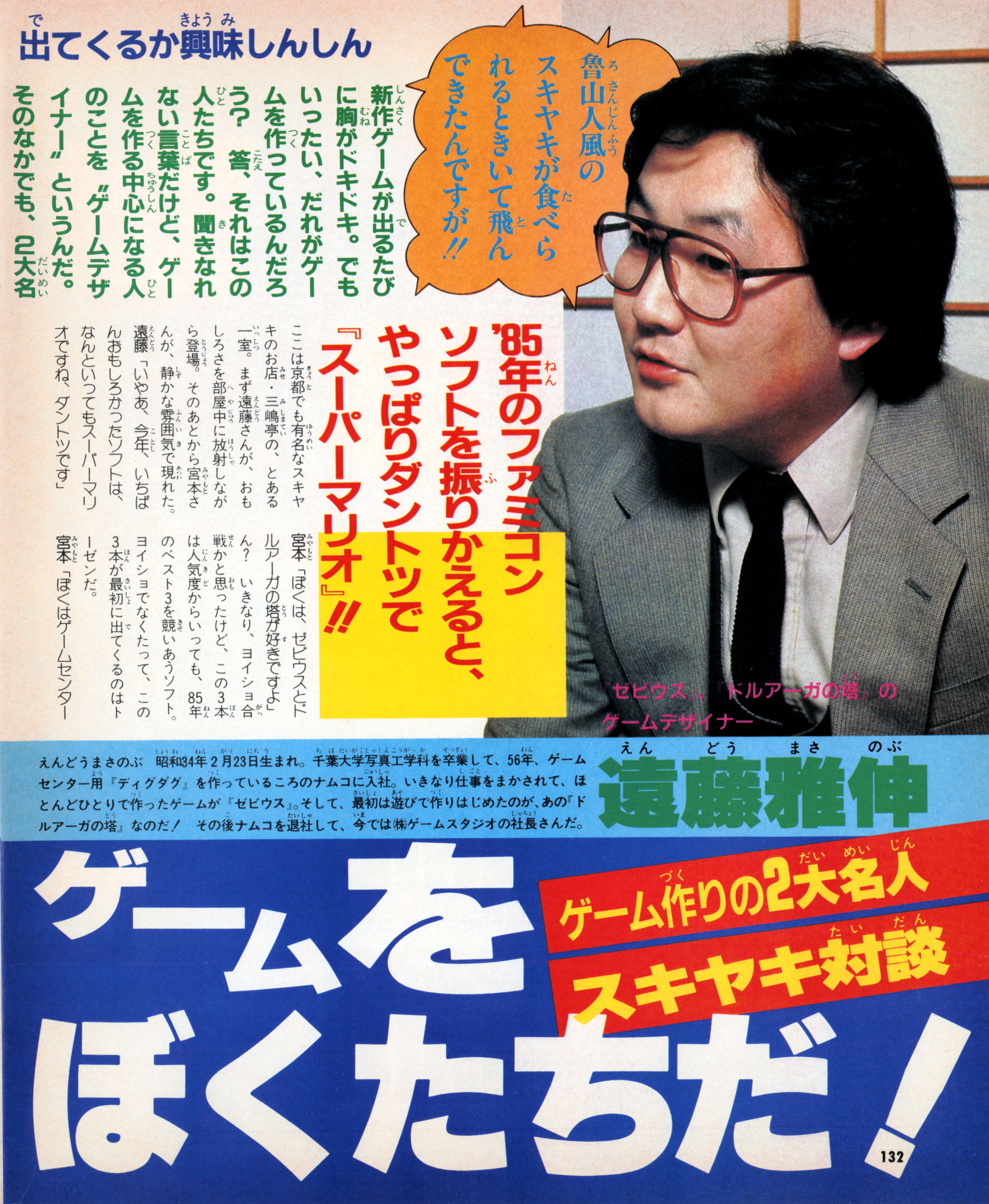
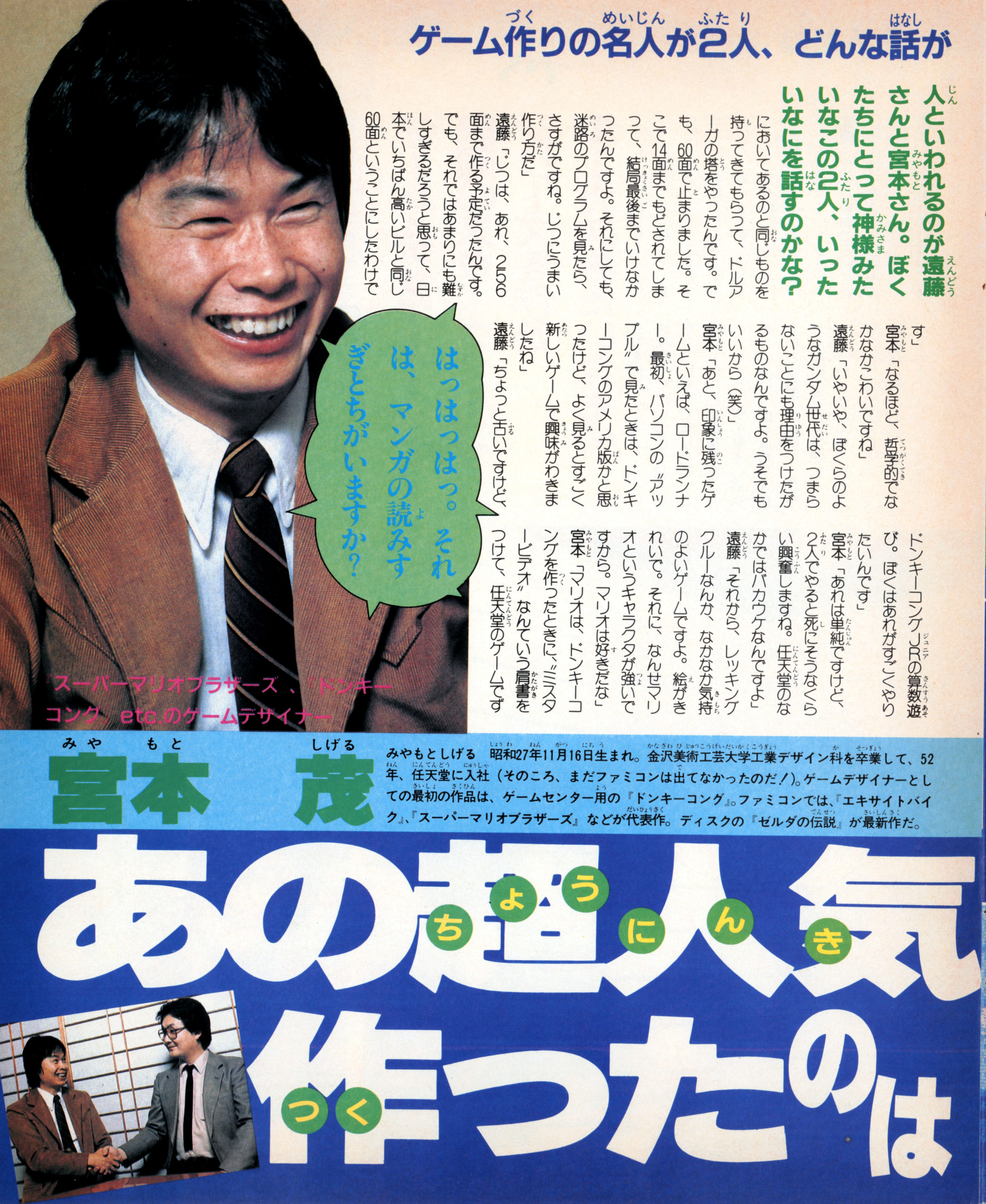
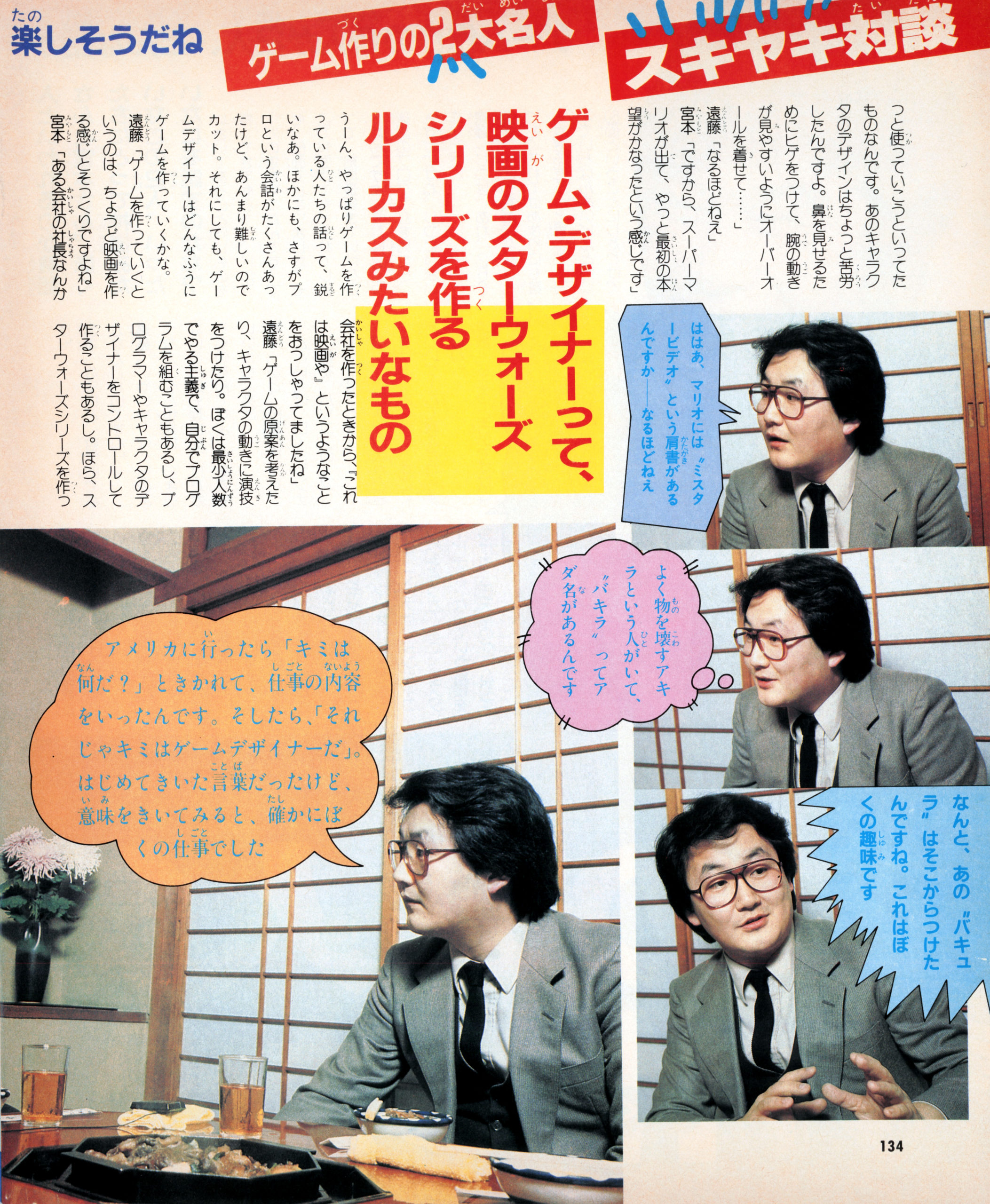
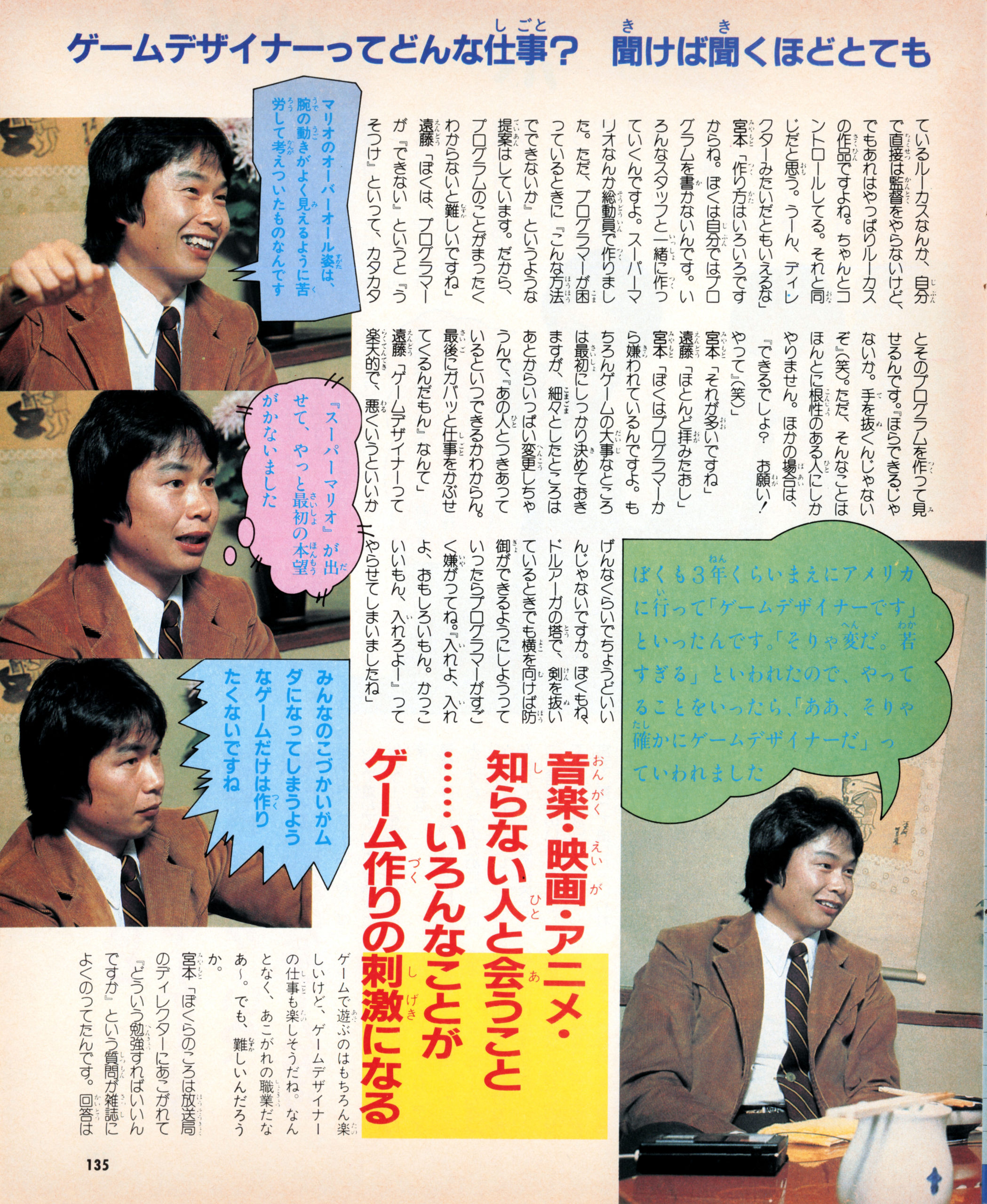
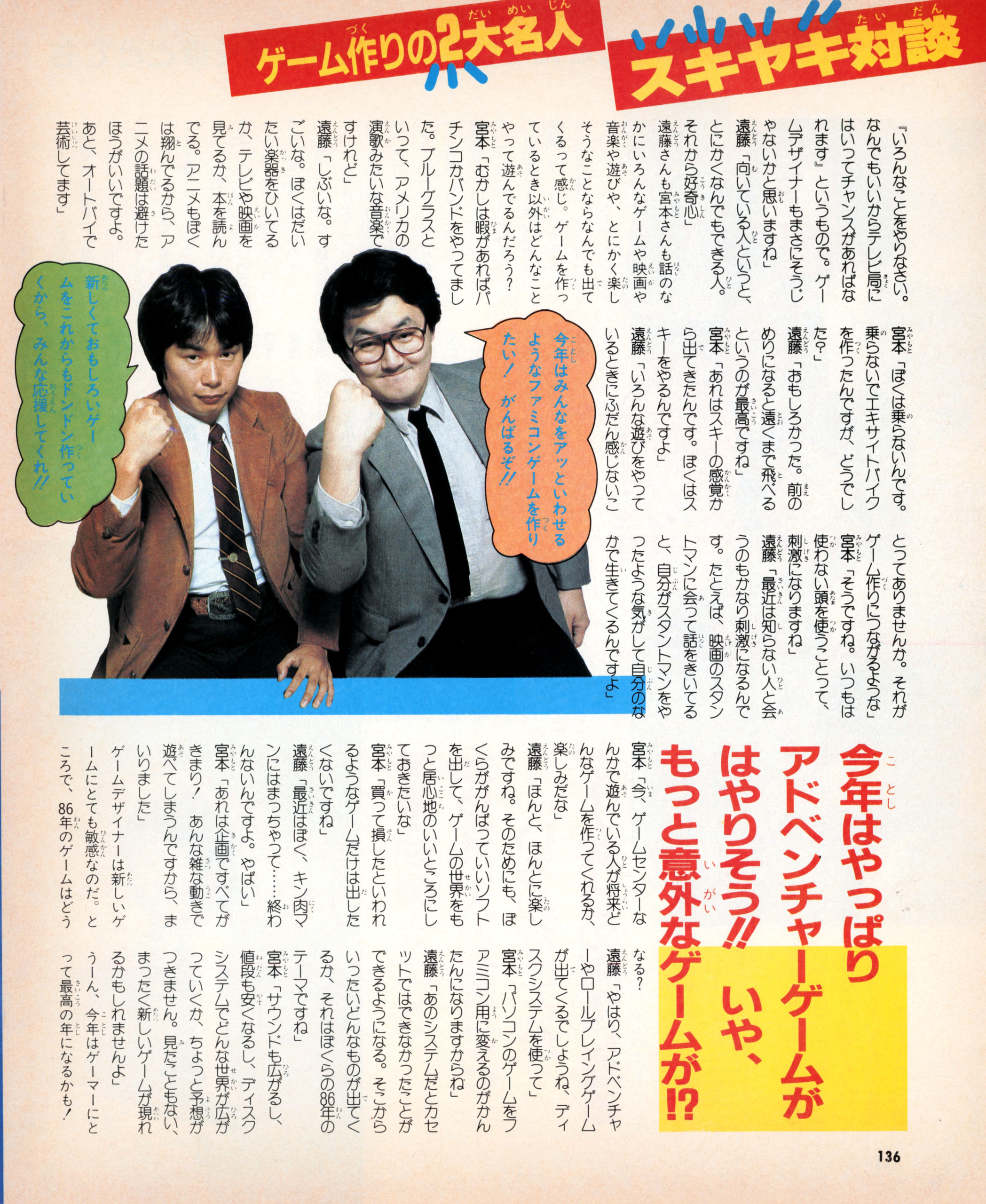
Translator: shmuplations
Notes: Scans by Hubz.
Summary: He’s a big fan of Xevious and Tower of Druaga, but he got stuck on floor 60.
Lode Runner is a fresh, novel game.
Donkey Kong Jr. Math is a good time with two people, Nintendo employees play it.
He originally called Mario “Mister Video”. He struggled with the design, Mario got a mustache to show the nose better, and overalls for his running animation. His wish was for Mario to keep being used in Nintendo games.
A president of a game company keeps saying that games are movies.
He’s not a programmer but he offered suggestions when the programmer of Super Mario Bros. got stuck. It’s a bit of a problem if a game designer doesn’t understand programming at all. He’s disliked by the programmers since he makes small changes during development. People say that you’ll have a mountain of work if you work for him.
TV directors would say that you should try a variety of things, just join a studio if you want to be a director. It applies to being a game designer, too.
When he had more time he’d play pachinko or bluegrass music.
He’d never ridden a motorcycle when he made Excitebike.
He’s looking forward to seeing what kind of games the next generation makes.
The Famicom Disk System will have better audio and it will be cheaper. We may see whole new types of games.
Famimaga: World 9 Is Caused By Interference
Publication Date: April, 1986
Subject(s): Super Mario Bros.
Format: Summarized interview
People: Unknown Famimaga interviewer, Shigeru Miyamoto
Scans:
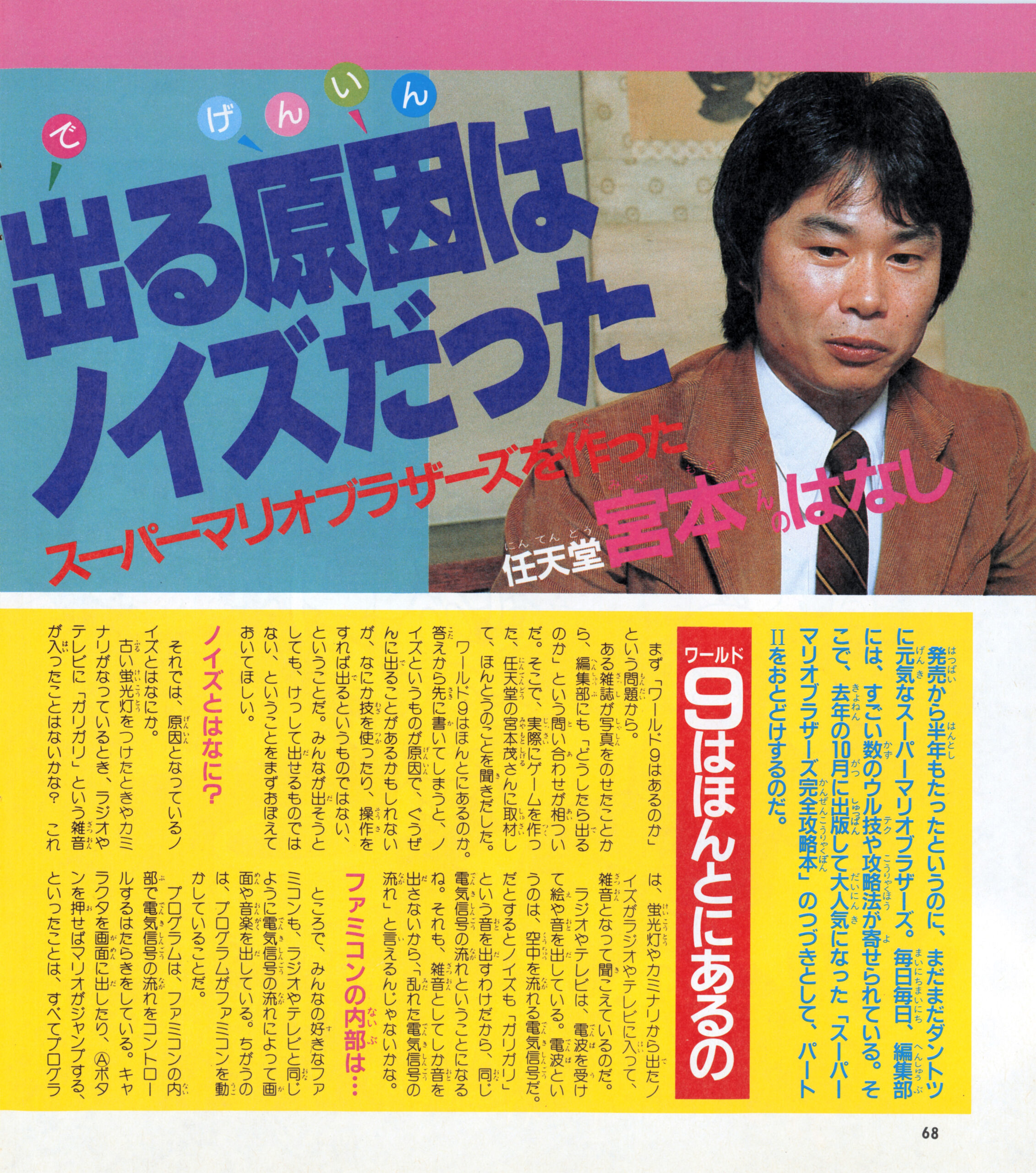

Translator: Cerealandchoccymilk for Hyrule Interviews
Notes: Famimaga interviewed Shigeru Miyamoto about a “World 9” in Super Mario Bros., but doesn’t provide direct quotes, instead summarizing his answers. Scanned by Hubz for Gaming Alexandria.
Summary: World 9 in Super Mario Bros. can appear sometimes due to interference. This interference can be caused by lightning or electronic devices. When a Famicom experiences interference things like World 9 can happen. He doesn’t recommend looking for World 9, since interference can damage your Famicom.
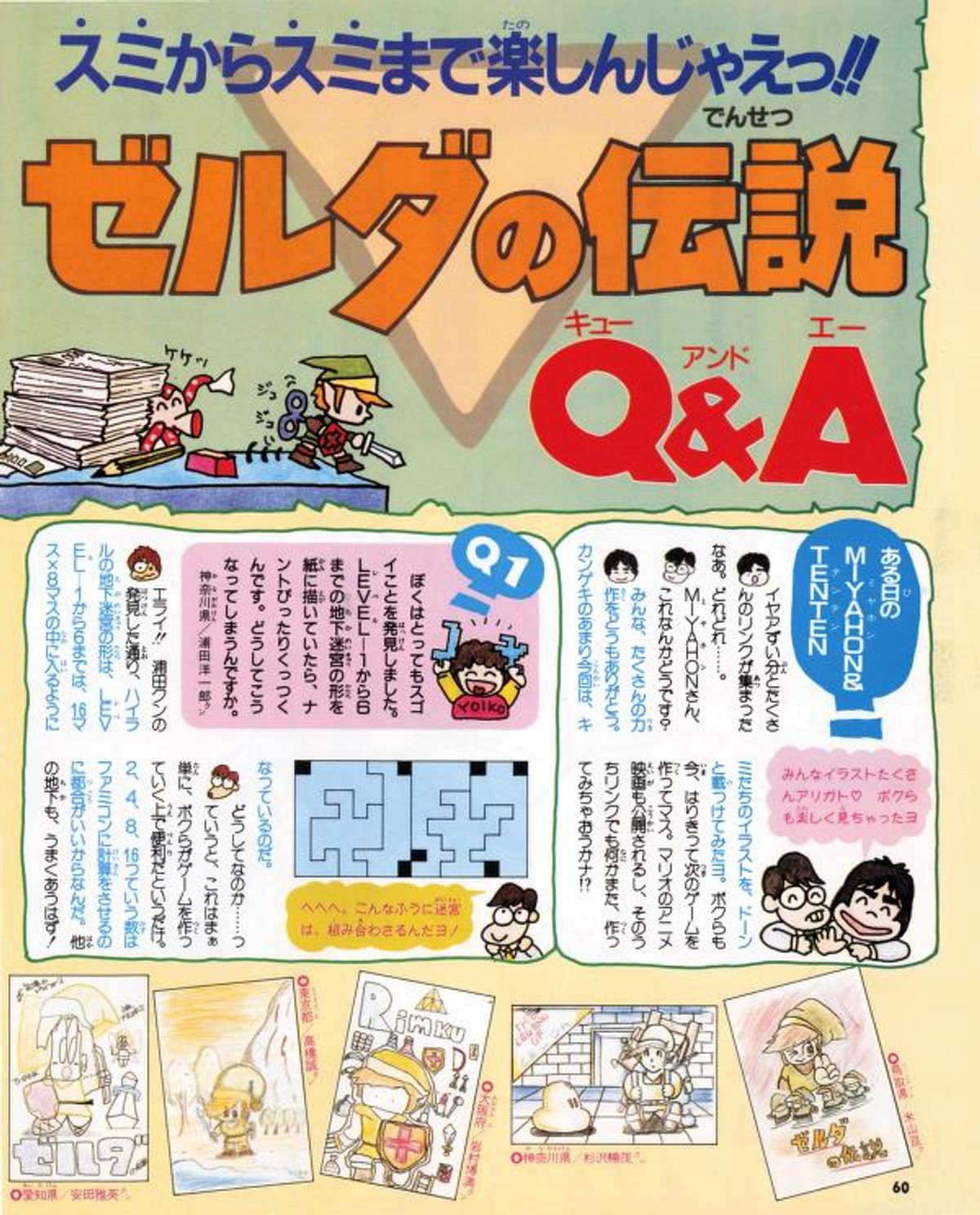
Famimaga May Q & A (untranslated from Japanese)
Publication Date: May 2, 1986
Subject(s): The Legend of Zelda
Format: Q & A
People: Unknown questioners, Takashi Tezuka, Shigeru Miyamoto
Scans:

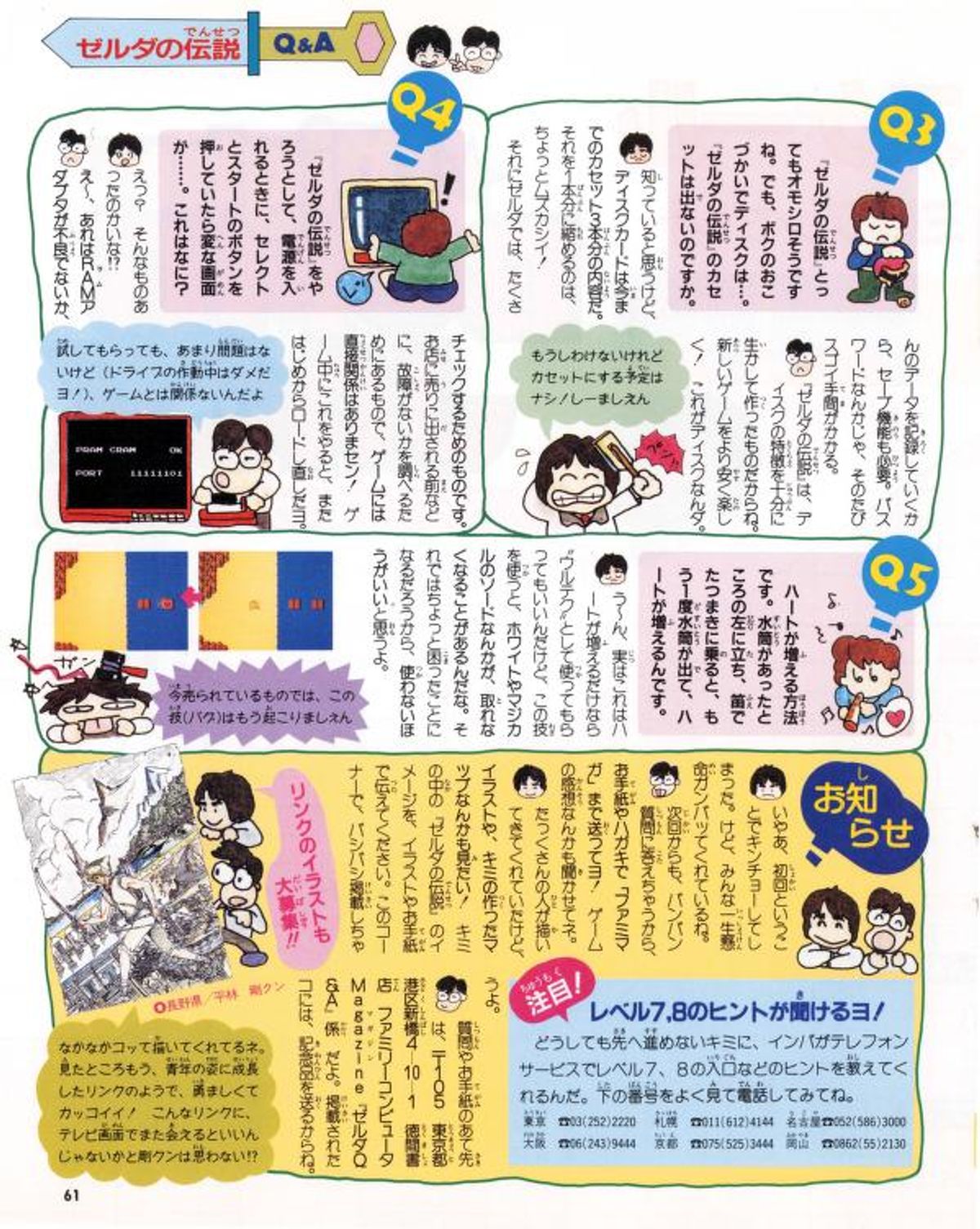
Notes: Via Hyrule Interviews. Scans by Hubz for Gaming Alexandria.
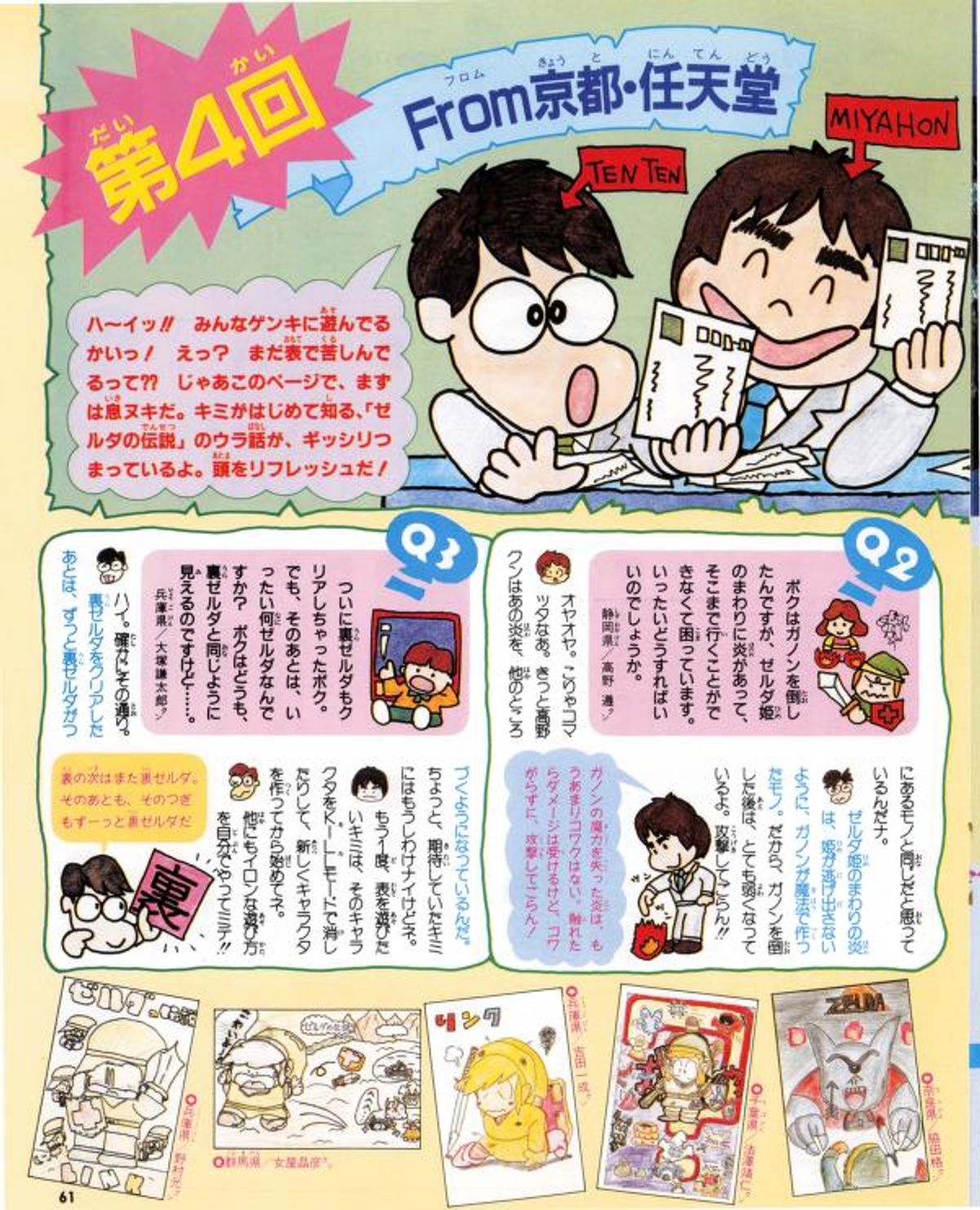
Famimaga May Q & A (untranslated from Japanese)
Publication Date: May 16, 1986
Subject(s): The Legend of Zelda
Format: Q & A
People: Unknown questioners, Takashi Tezuka, Shigeru Miyamoto
Scans:


Notes: Via Hyrule Interviews. Scans by Hubz for Gaming Alexandria.
Famimaga June Q & A (untranslated from Japanese)
Publication Date: June 6, 1986
Subject(s): The Legend of Zelda
Format: Q & A
People: Unknown questioners, Takashi Tezuka, Shigeru Miyamoto
Scans:


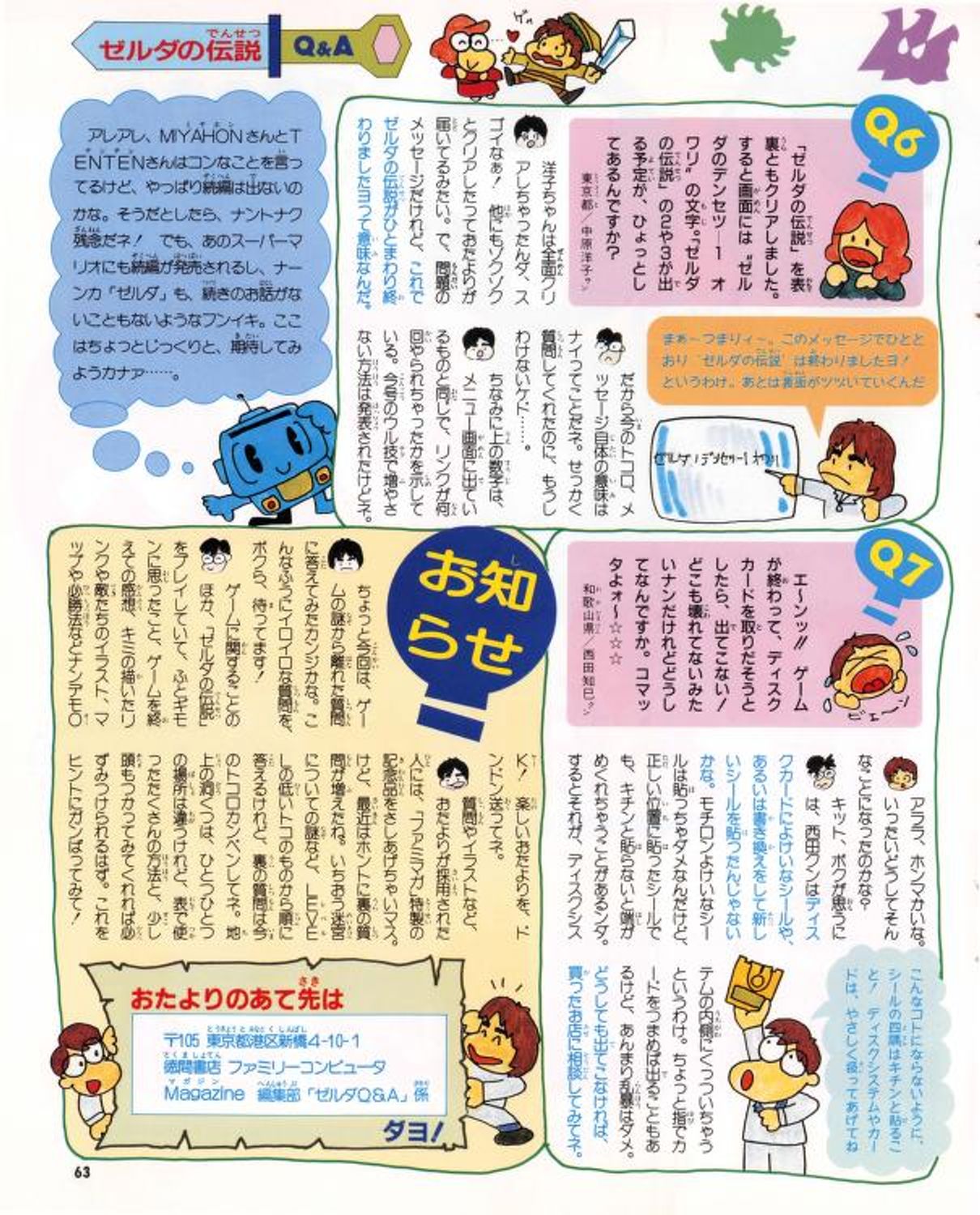
Notes: Via Hyrule Interviews. Scans by Hubz for Gaming Alexandria.
Famimaga June Q & A (untranslated from Japanese)
Publication Date: June 20, 1986
Subject(s): The Legend of Zelda
Format: Q & A
People: Unknown questioners, Takashi Tezuka, Shigeru Miyamoto
Scans:
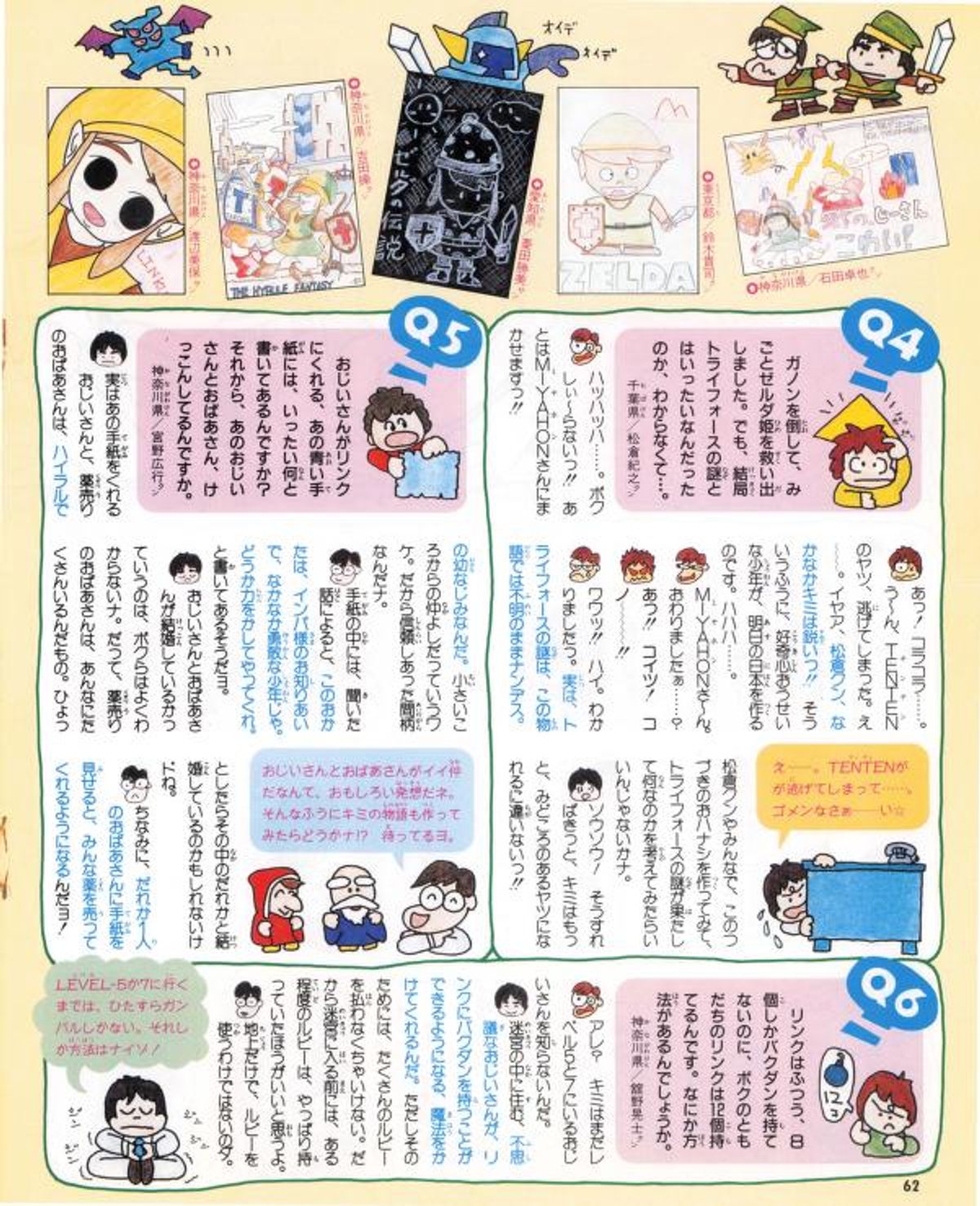

Notes: Via Hyrule Interviews. Scans by Hubz for Gaming Alexandria.
Famimaga September Q & A (untranslated from Japanese)
Publication Date: September 5, 1986
Subject(s): The Legend of Zelda
Format: Q & A
People: Unknown questioners, Takashi Tezuka, Shigeru Miyamoto
Scans:


Notes: Thank you to makgameadv. Scans by Hubz.
The Leader Post: Electronic game hero is the rage in Japan
Publication Date: September 2, 1986
Subject(s): Mario’s name, Luigi’s name
Format: Transcribed interview
People: Unnamed Reuters interviewer, Shigeru Miyamoto
Scans:

Link: https://news.google.com/newspapers?id=LYlWAAAAIBAJ&sjid=VkENAAAAIBAJ&pg=3477,183775&hl=en
Notes: This article is by news agency Reuters, and the interview is described as being via telephone. This is currently the earliest known interview with Mr. Miyamoto that was originally presented in English. In all other interviews Mr. Miyamoto describes Mario as being named after Mario Segale.
Summary: Mario’s appearance came to him from the fantasy and romance stories he enjoys. Mario needed bold features.
Mario was named after an Italian caretaker at a small New York hotel that Nintendo employees stayed at.
They needed similar characters to compete, and “Ruiji” is Japanese for “similar”. Luigi is a Chaplinesque hero.
1988
Terebi Game Denshi Yuugi Taizen
Publication Date: May 30, 1988
Subject(s): Becoming a game designer, making games, Super Mario Bros., The Legend of Zelda
Format: Transcribed interview
People: Tsunekazu Ishihara (presumably), Shigeru Miyamoto
Link: https://shmuplations.com/miyamoto1989/
Archive Links: https://web.archive.org/web/20170330031840/http://shmuplations.com/miyamoto1989/
https://archive.org/details/tv-games/tv-games/page/n11/mode/2up
Scans:


Translator: shmuplations
Notes: Terebi Game Denshi Yuugi Taizen (Video Games – Television Games Encyclopedia according to machine translation) is a book about video game history. The author on the Internet Archive’s page is given as “Video Game Museum Project”, and it is also described as “planned” by Tsunekazu Ishihara.
Scans by Collector Yuna.
Summary: He’s somewhere in between an artist and an engineer. He aspires to be an entertainer.
He wanted to make toys, but the popularity of Space Invaders made Nintendo focus more on games.
Making a game can take from six months to over a year. It depends on how complete the design is to start with and how much content the game has. Adding pre-development it can take one to two years to make a game.
Their games take six to 12 people to make. Super Mario Bros. took eight people.
He won’t comment on other media he likes so as to not give away their future games. He likes being athletic and wants to quit smoking.
Mario has a mustache and overalls to make him seem more alive and individual. Mario and Luigi’s names were added by Nintendo of America.
They wanted Super Mario Bros. to use the best aspects of Donkey Kong and to be a final celebration of cartridge games.
He wanted The Legend of Zelda to give you the sense of exploring a city for the first time. He wanted the player to identify with the character and get lost and immersed. He feels responsible for the rise in mean-spirited games.
He blushes at hearing he’s being called a genius. He’s a normal person.
He wants to make games that are like toys and can be explored freely.
Video games are just a job in one sense, but he’s also a player.
1989
Unknown (interview with Yuji Horii)
Publication Date: 1989
Subject(s): Dragon Quest IV, The Legend of Zelda: A Link to the Past, game development, silent protagonists
Format: Transcribed interview
People: Yuji Horii, Shigeru Miyamoto
Links: https://glitterberri.com/miyamoto-horii-discussion/
https://www.siliconera.com/origins-of-the-legend-of-zelda-a-link-to-the-past-and-dragon-quest-iv/
Archive Links: https://web.archive.org/web/20230210012154/https://glitterberri.com/miyamoto-horii-discussion/
Translator: GlitterBerri
Notes: I first found this discussion on Siliconera, but later found it was GlitterBerri’s work. I have included both sources. It’s possible this discussion is actually from Yuji Horii’s book Rainbow-Colored Dip Switches: Famicom Industry Quest, which has its own entry. The first part is Mr. Miyamoto asking questions about Dragon Quest IV, there’s not much to summarize on his end, but check out the links if you’re interested in its development.
Summary: He’s working on four Super Nintendo Entertainment System games, from simple to huge.
The Legend of Zelda: A Link to the Past is going to return to the style of the original. He’s been saying the third The Legend of Zelda game will include the protagonist, who is an elf and fighter, a magic user, and a girl. The fairy in Zelda II: The Adventure of Link was designed for the third Zelda game. The girl would be a fairy that could do reconnaissance.
He’s not picky about the stories in his games, action games just have stories to make them a bit more interesting.
He’d like to wait until Dragon Quest comes out to release the next Zelda.
They started A Link to the Past as an action game. Role-playing games have a set structure and anyone can make the overworld. Some players prefer a good story, others prefer new features.
Game structures are being improved by combining genres.
Because of deadlines he has to release games even if he finds out they contain something similar to another game. Ghosts ‘n Goblins released in arcades while they were making Super Mario Bros., and you don’t die in one hit in that game either. But it would have broken the game to remove it at that point.
He tells people what to do and the programmers tell him if it’s possible or not. They start development with three or four people and add 20 more when get into trouble. People wouldn’t have anything to do if they added them too early.
They try to reduce the dungeon difficulty when they’re done. They make the second stage first and first stage last.
Some scenes make you feel like you’re doing everything, and others pull you against your will. He dislikes taking control away. He doesn’t like how Mario enters the castle on his own after you slide down the flagpole. Zelda II didn’t have good cutscenes.
There’s a difference between solving something by yourself and lucking upon the answer.
There’s been talk of a Famicom network. But there’s still the problem of players seeing a huge phone bill. They’ll do something interesting when everyone can access networks easily.
He wants to make a game where you raise a child. The child would have to be taught to speak and they’d get smarter over time. Then Puppy Love came out in America. He also wants to make a game for fathers.
The Stars of Famicom Games
Publication Date: 1989
Subject(s): Making puppets, biggest worry
Format: Transcribed interview
People: Mitsuteru Shimaguchi, Eiichi Murata, Shigeru Miyamoto
Link: https://www.chrismcovell.com/secret/weekly/Stars_of_the_Family_Computer.html
Archive Links: https://web.archive.org/web/20231209192538/https://www.chrismcovell.com/secret/weekly/Stars_of_the_Family_Computer.html
https://archive.org/details/The-Stars-of-Famicom-Games
Scans:

Translator: Chris M. Covell
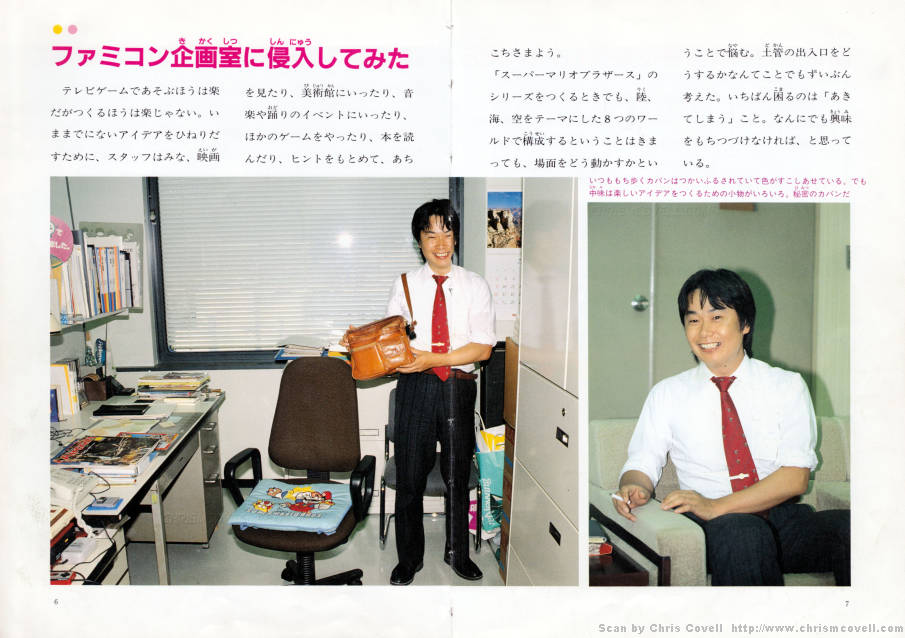
Notes: Chris M. Covell scanned and translated this children’s picture book, which contains a tour of Nintendo’s offices and interviews with Shigeru Miyamoto, Takashi Tezuka, Koji Kondo, Toshihiko Nakago, and Hideki Konno. The book was released in late 1989, but a calendar on the wall implies the authors toured Nintendo in July.
The Video Game Library gives the name of this book as “Protagonists of Famicom Games: Production and Distribution of Game Software”.
Summary: As a child he wanted to make puppets like the ones he saw on Chirolin Village and the Walnut Tree. Now he makes games for children around the world.
His biggest worry is keeping players from being bored.
Micom BASIC Magazine (Super Mario Bros. 3)
Publication Date: February, 1989
Subject(s): Nintendo’s popularity, Super Mario Bros. 3
Format: Transcribed interview
People: Akira Yamashita, Shigeru Miyamoto
Link: https://www.tumblr.com/thearkhound/188457878823/shigeru-miyamoto-interview-from-micom-basic
Scans:
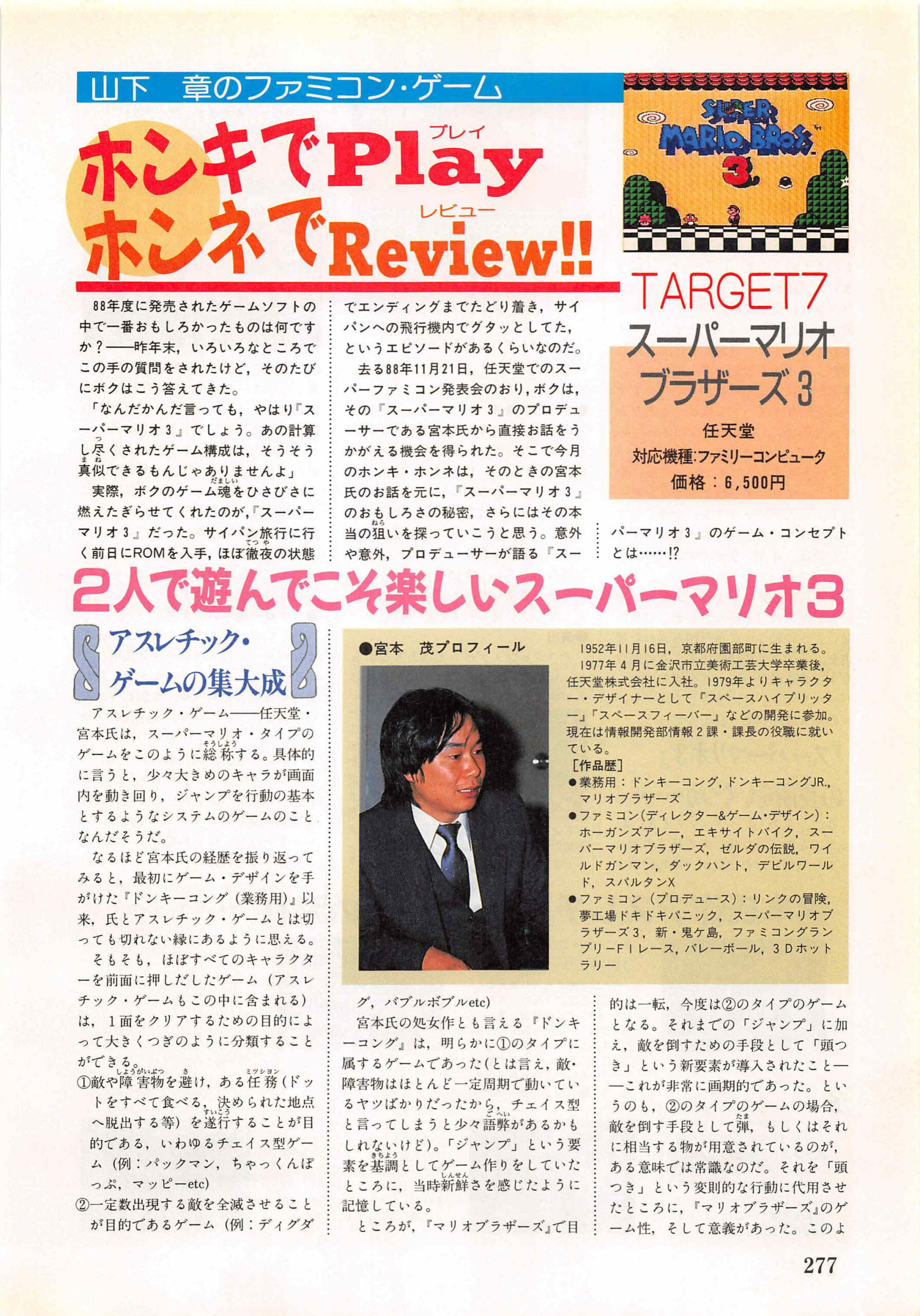
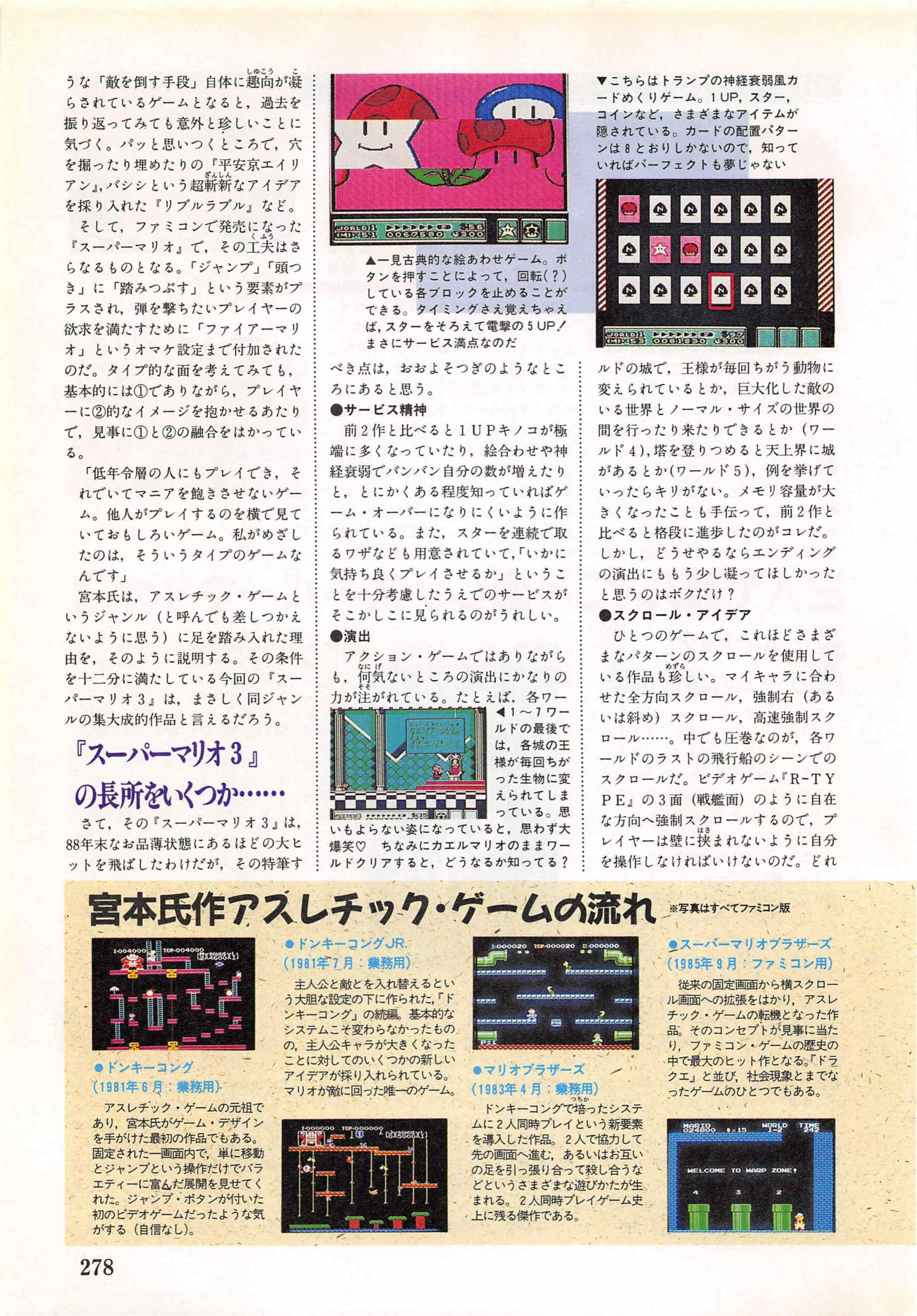
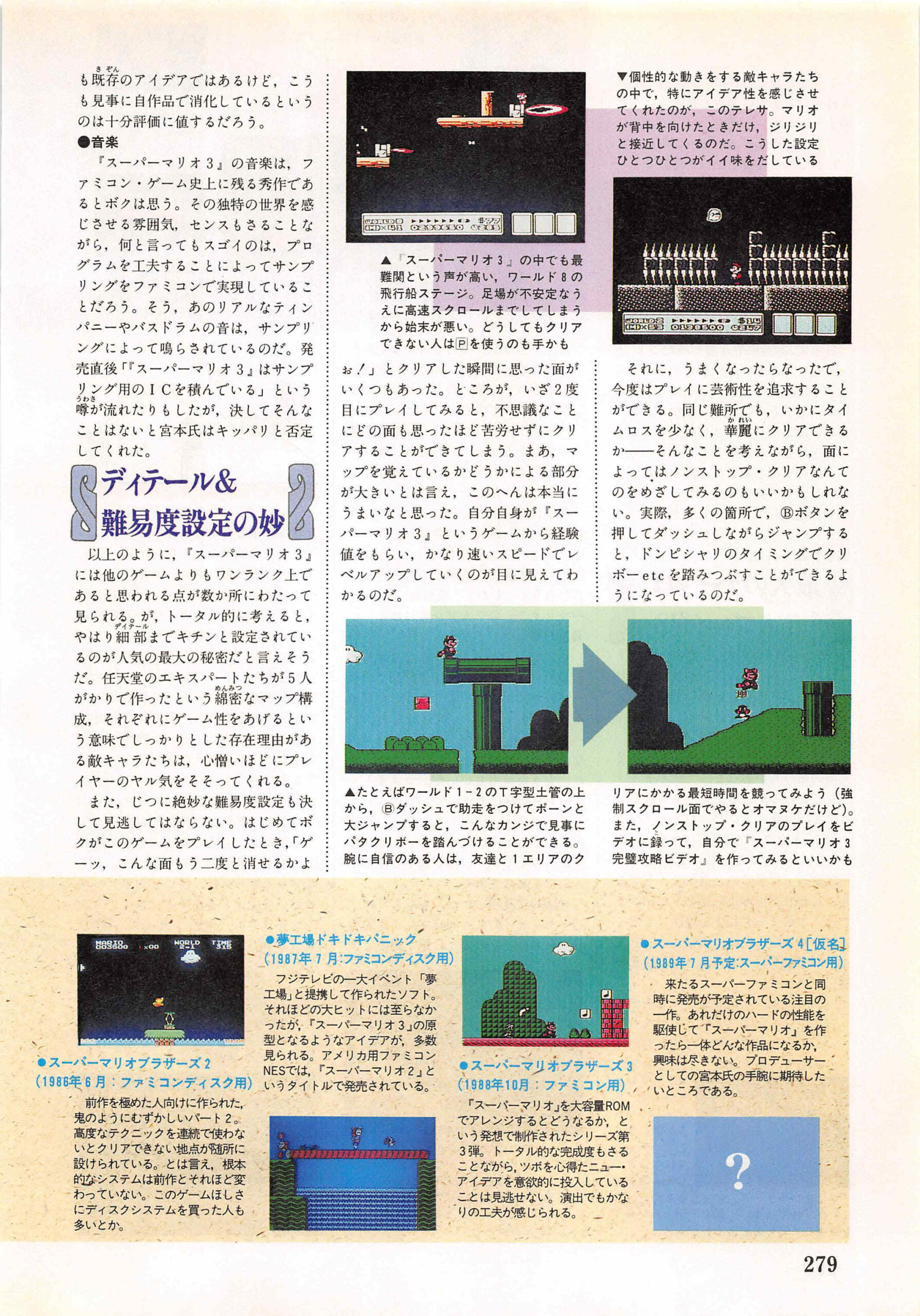
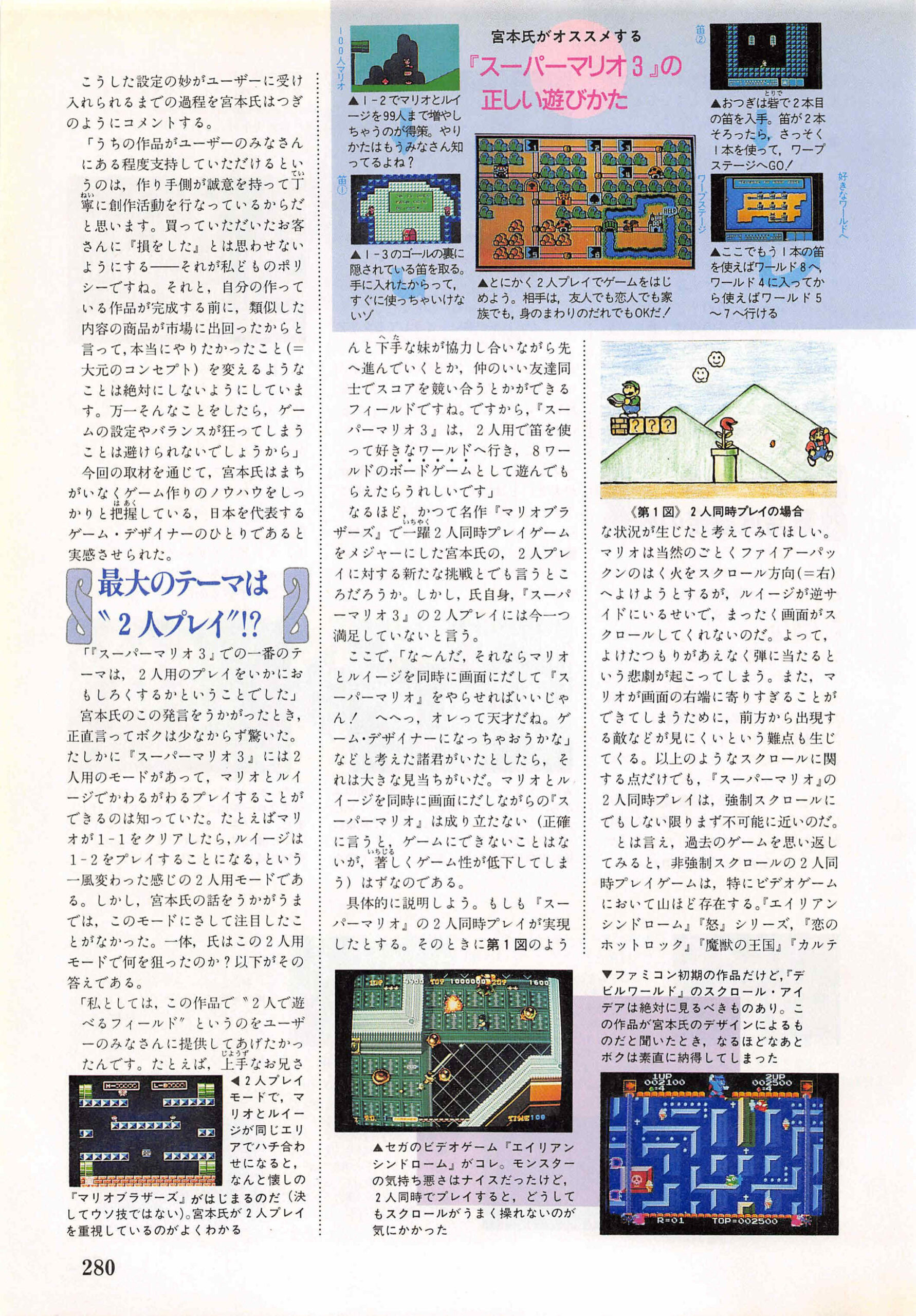

Translator: thearkhound
Notes: This interview is part of a review of Super Mario Bros. 3. Scans by Sega Retro.
Summary: He thinks players support their games because they are made with sincerity. Their policy is to not make the player feel lost. They stick with their original intent, even if another game comes out that is similar to what they’re working on.
Super Mario Bros. 3’s theme is making a fun two player game. You can help your unskilled sister, or friends can compete for the high score. Play it like a board game and use the whistles to access whichever world you want.
He wants to continue to lead game direction, but he also hopes to someday plan a gameplay system.
He wishes there was a field that allowed people to get involved in game development, his dream is to create a point of contact for people who don’t make games.
Please look forward to Mother.
Famimaga (1988 Game Awards, untranslated from Japanese)
Publication Date: February 12, 1989
Subject(s): Famimaga Game Awards, Super Mario Bros. 3
Format: Essay
People: Yuji Horii, Koichi Sugiyama, Koichi Nakamura, Yukinobu Chida, Koji Kondo, Kenji Terada, Hironobu Sakaguchi, Nobuo Uematsu, Shigeru Miyamoto
Japanese Archive Link: https://archive.org/details/famimagafebruary1989/page/n107/mode/2up
Scans:
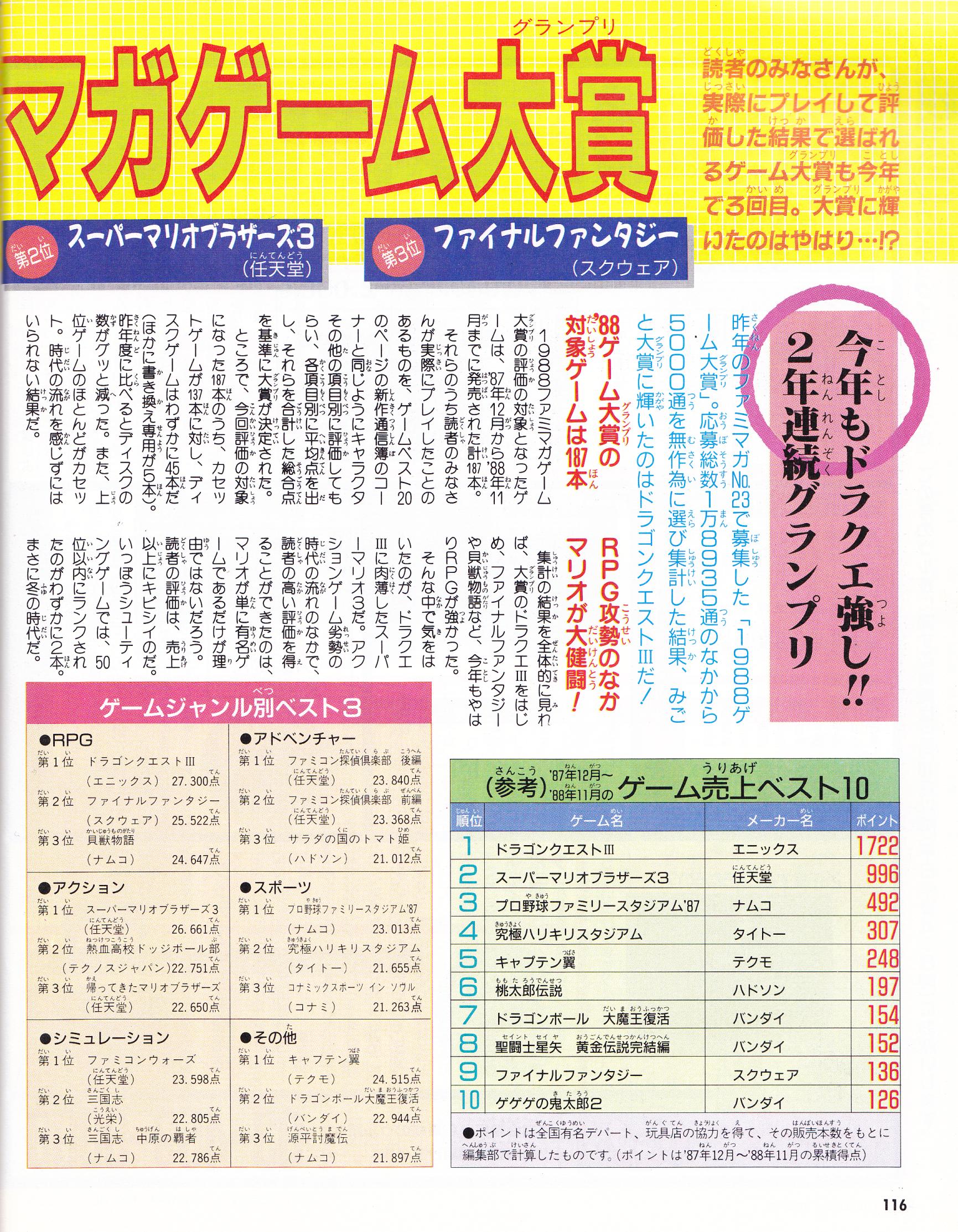
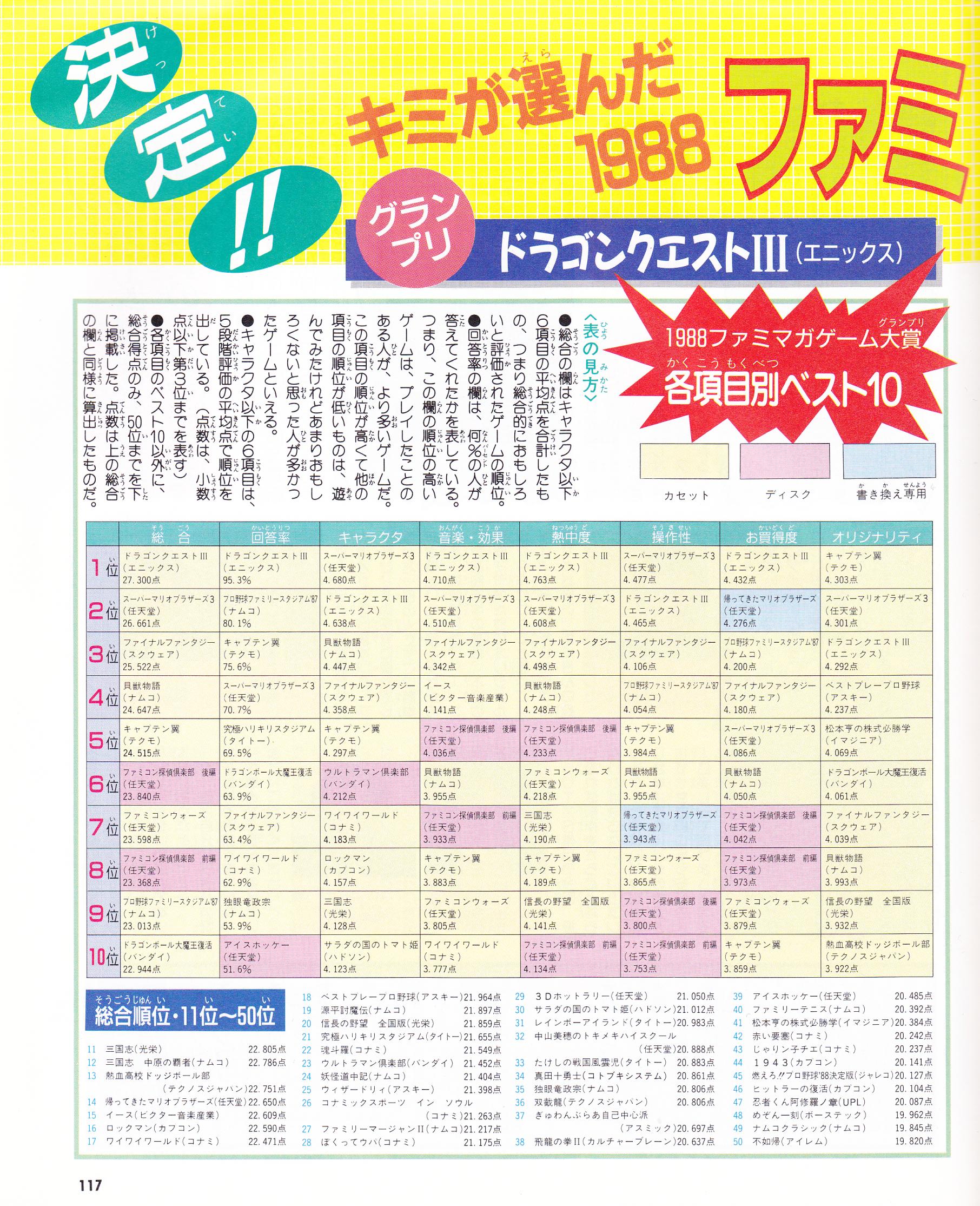


Notes: Famimaga seems to have had a yearly game award section, with people who worked on the winning games writing something. Thank you to makgameadv for information on this article. Uploaded to Internet Archive by Ethereal Dragonz, who does not take credit for the scan and does not know who scanned it.
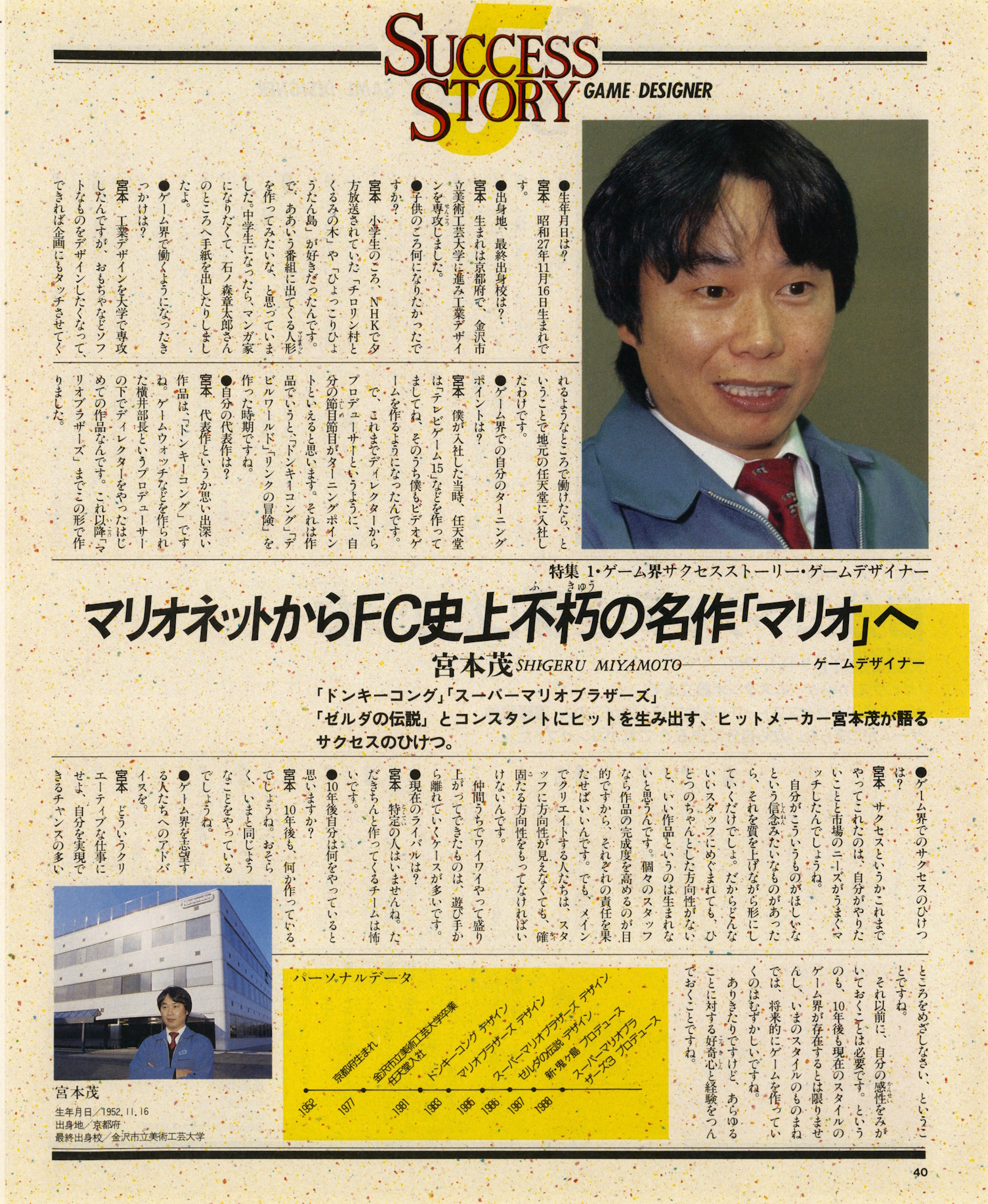
Beep: Success Story Game Designer
Publication Date: March, 1989
Subject(s): Childhood dream jobs, joining Nintendo, advice to game designers
Format: Transcribed interview
People: Unknown Beep interviewer, Shigeru Miyamoto
Link: https://shmuplations.com/success1989/
Archive Links: https://web.archive.org/web/20191202001047/http://shmuplations.com/success1989/
Scan:
Translator: shmuplations
Notes: Mr. Miyamoto was one of 12 developers interviewed as part of a “Success Story” feature. The title is a machine translation. Scan by ozidual.
Summary: He graduated from Kanazawa College with a degree in industrial design.
As a child he watched Chirorin Village and the Walnut Tree and Accidental Gourd Island. He wanted to make marionettes like they had in the shows. He wanted to be a manga artist in middle school.
He wanted to make toys so he applied to Nintendo. They were making the Color TV-Game 15 when he joined and he was assigned to work on video games. Donkey Kong, Devil World, and Zelda II: The Adventure of Link were all important periods of his career.
His most memorable game was Donkey Kong, where he worked under Gunpei Yokoi.
He’s found success by making games that he wants to make that also line up with what the market needs. No matter how good your team is, you won’t make a good game if you don’t have a clear direction. The lead creator has to keep sight of that vision.
He’ll probably still be making things in 10 years.
People in creative fields should find a job that realizes their potential. It’s important to refine your sensibilities, you can’t just mimic what exists. Follow your curiosity and have many different experiences.
Gamer Handbook
Publication Date: November 1, 1989
Subject(s): The future of games, the video game industry, realism versus responsiveness, HyperCard, hidden secrets
Format: Transcribed interview
People: Itou Seikou, Shigesato Itoi, Shigeru Miyamoto
Link: https://shmuplations.com/itoimiyamoto/
Archive Link: https://web.archive.org/web/20260302233629/https://shmuplations.com/itoimiyamoto/
Japanese Archive Link: https://archive.org/details/Gamer-Handbook-Nesco/Gamer%20Handbook/mode/2up
Scans:
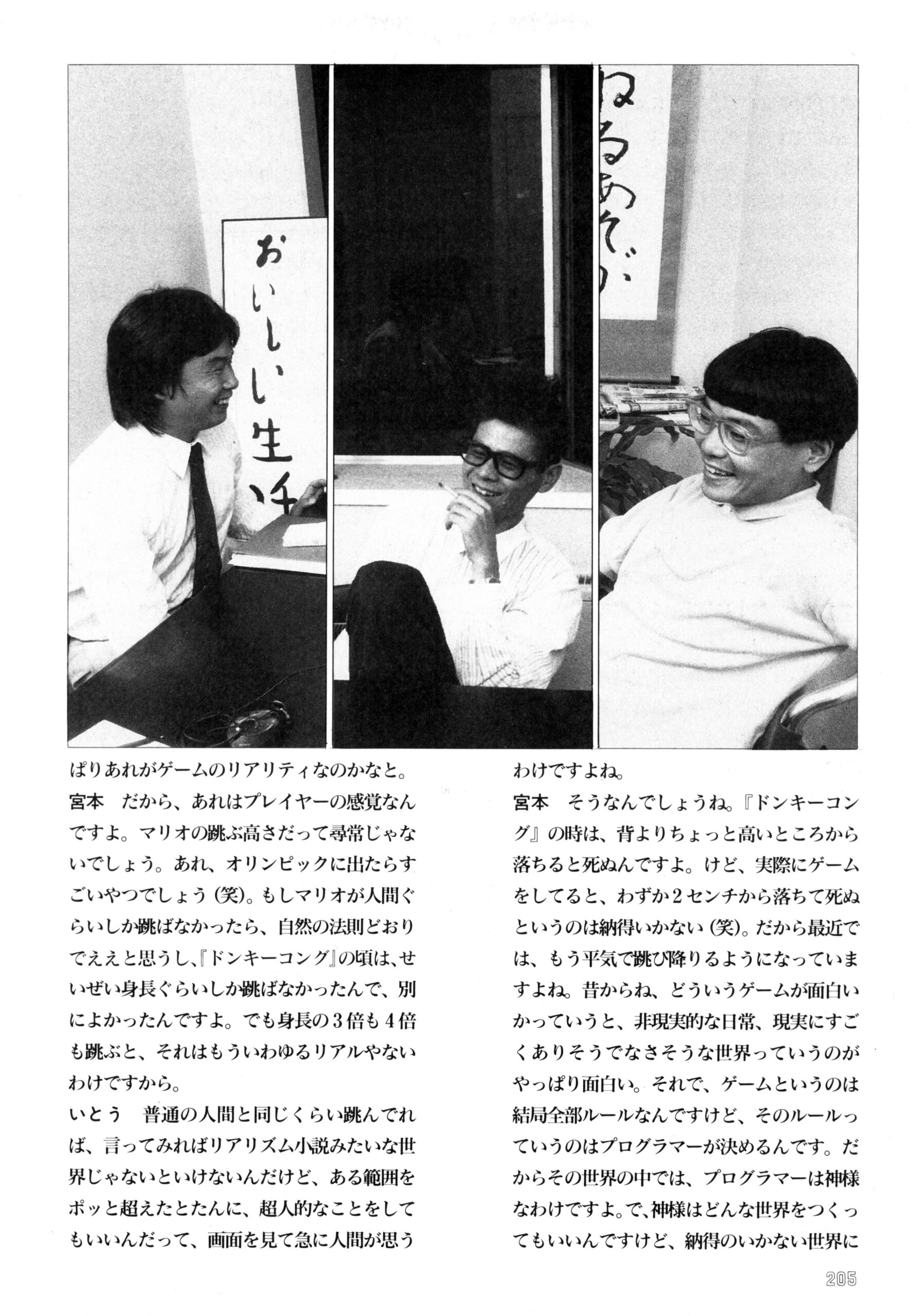
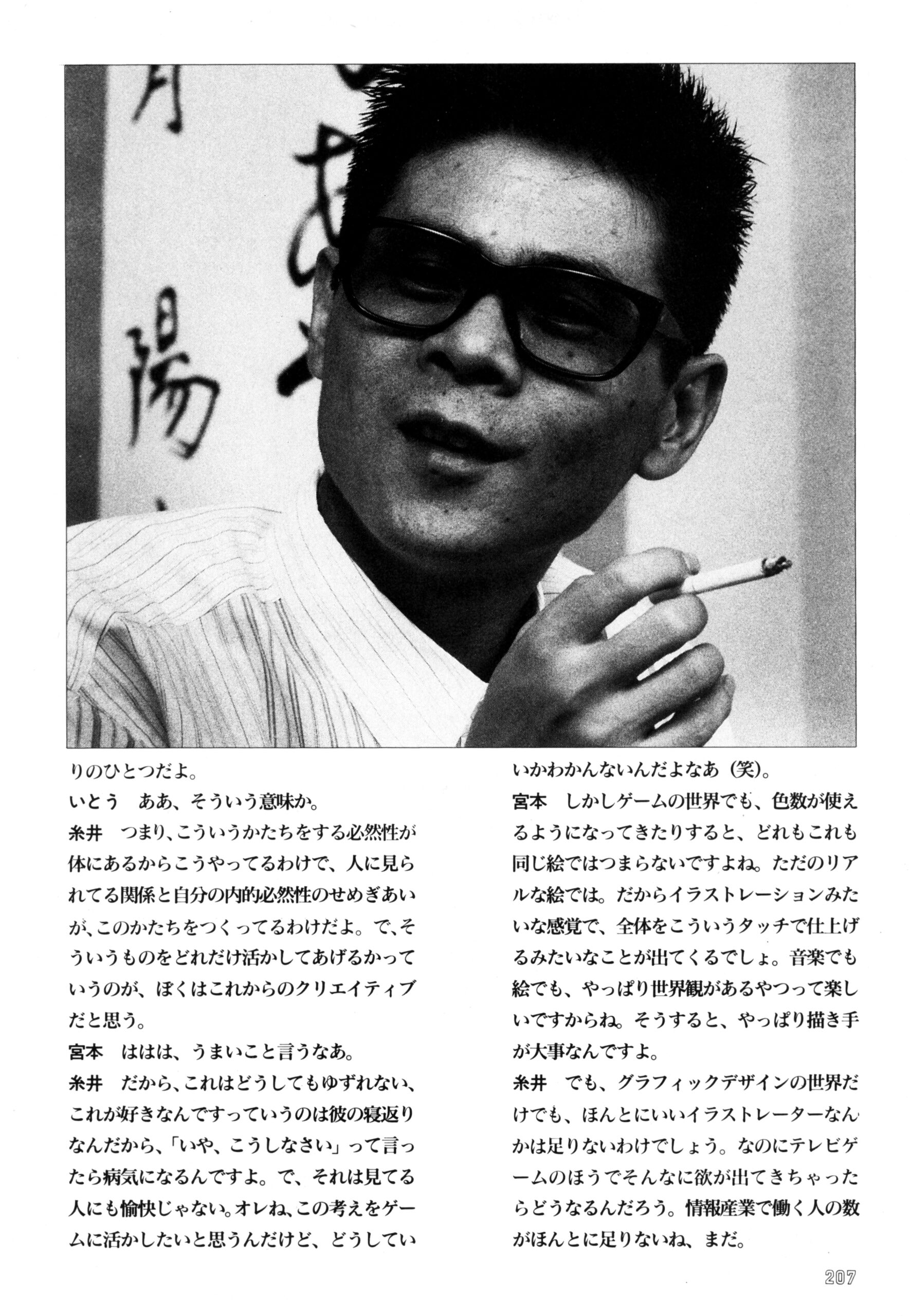
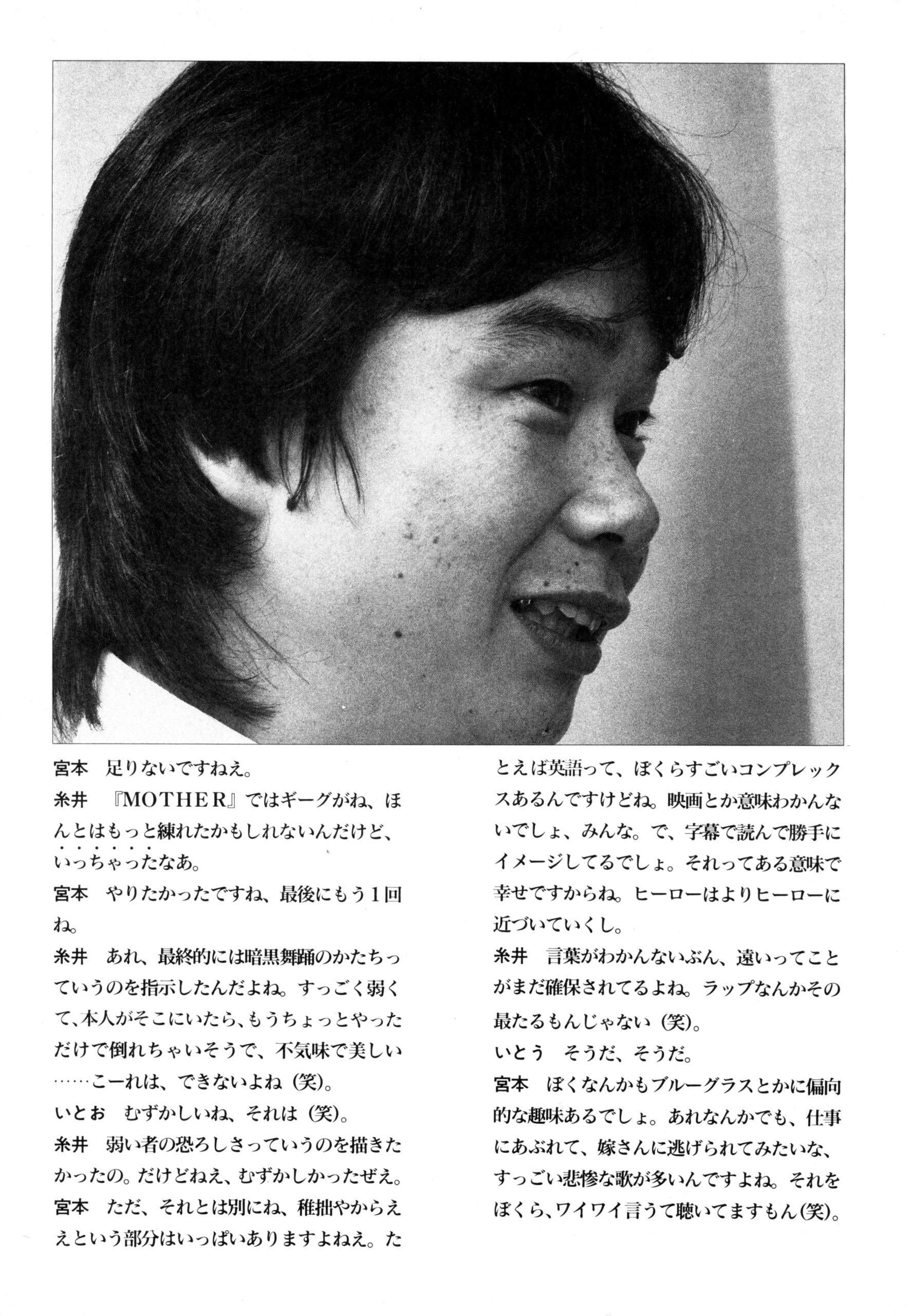
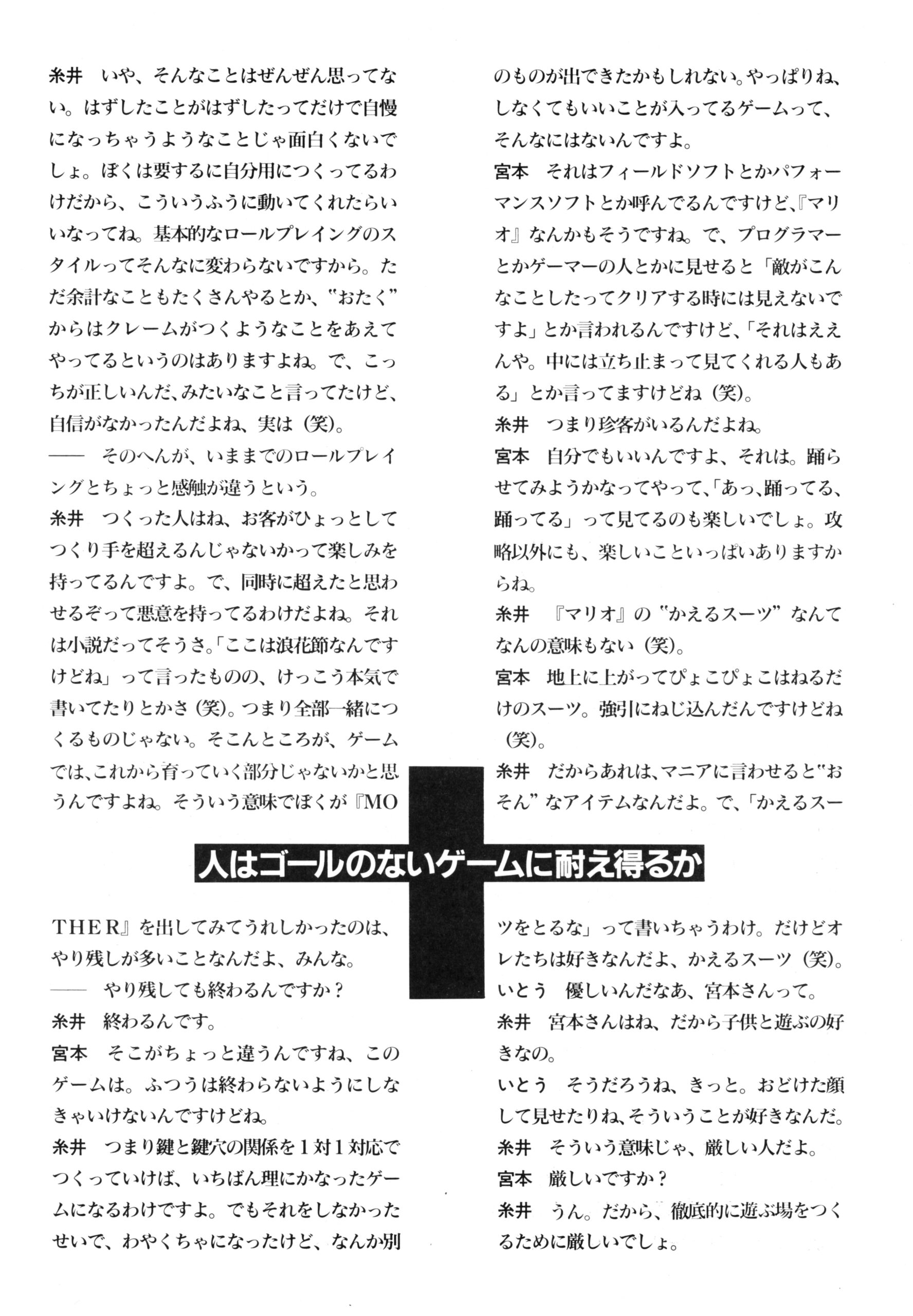
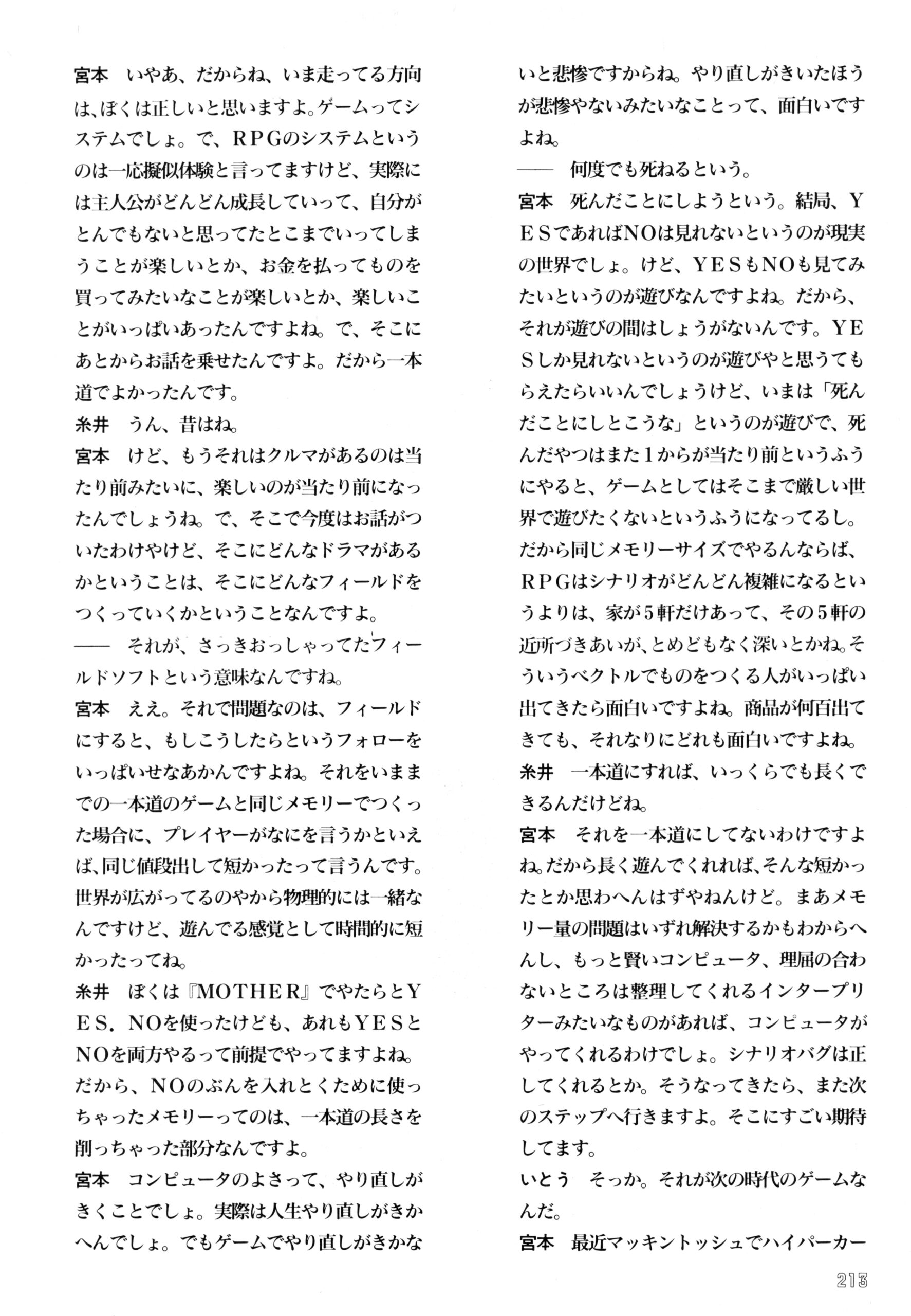
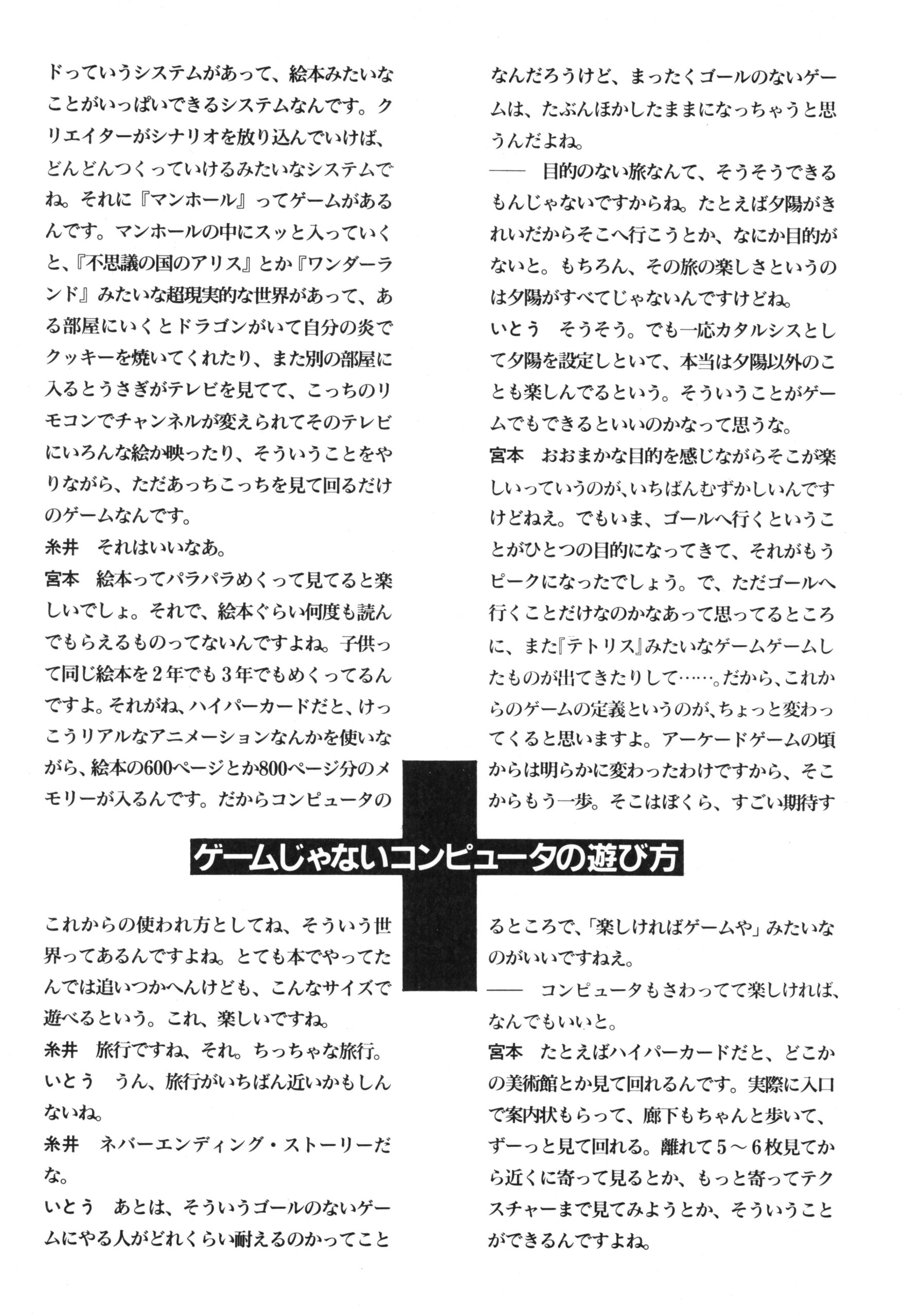
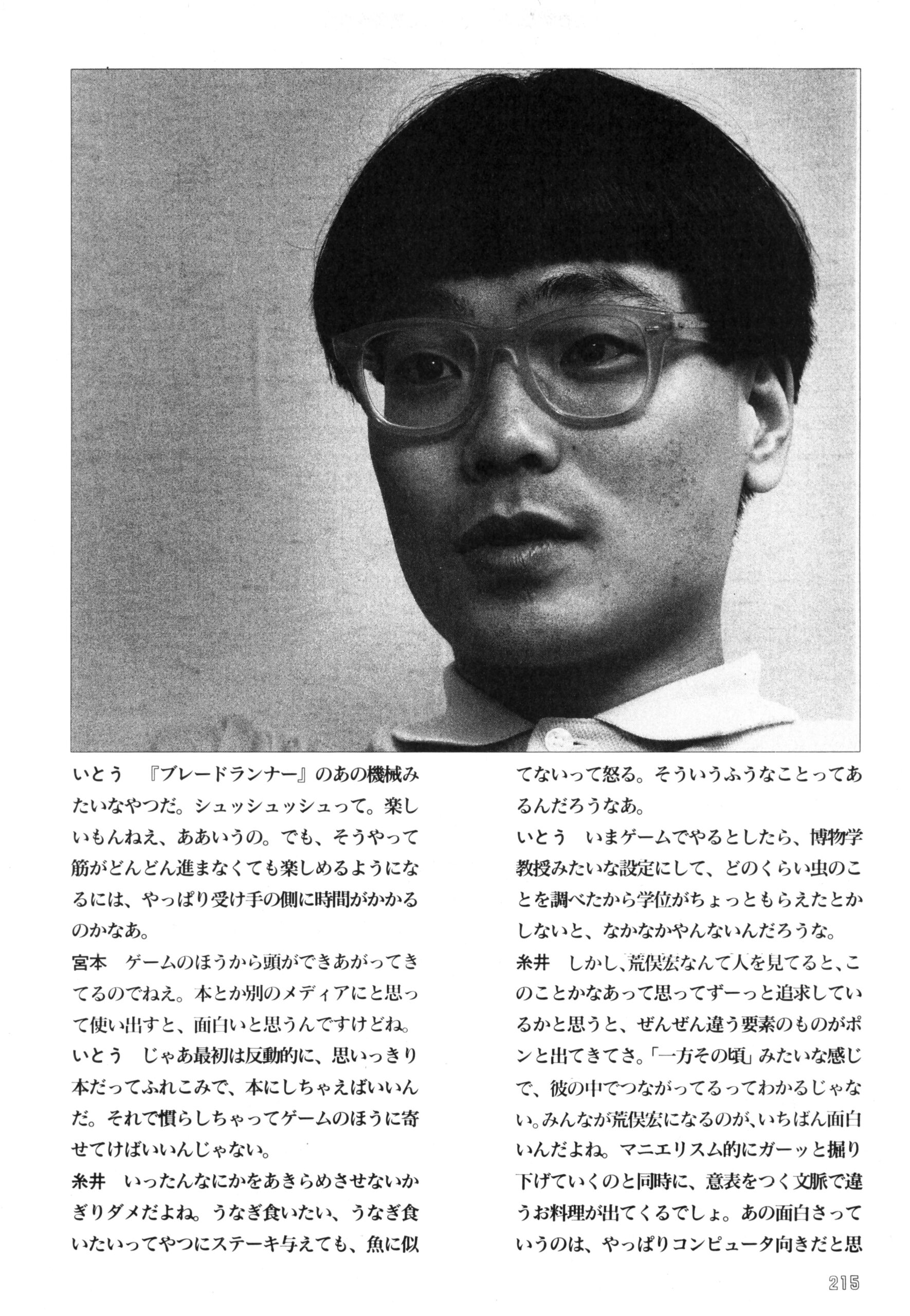
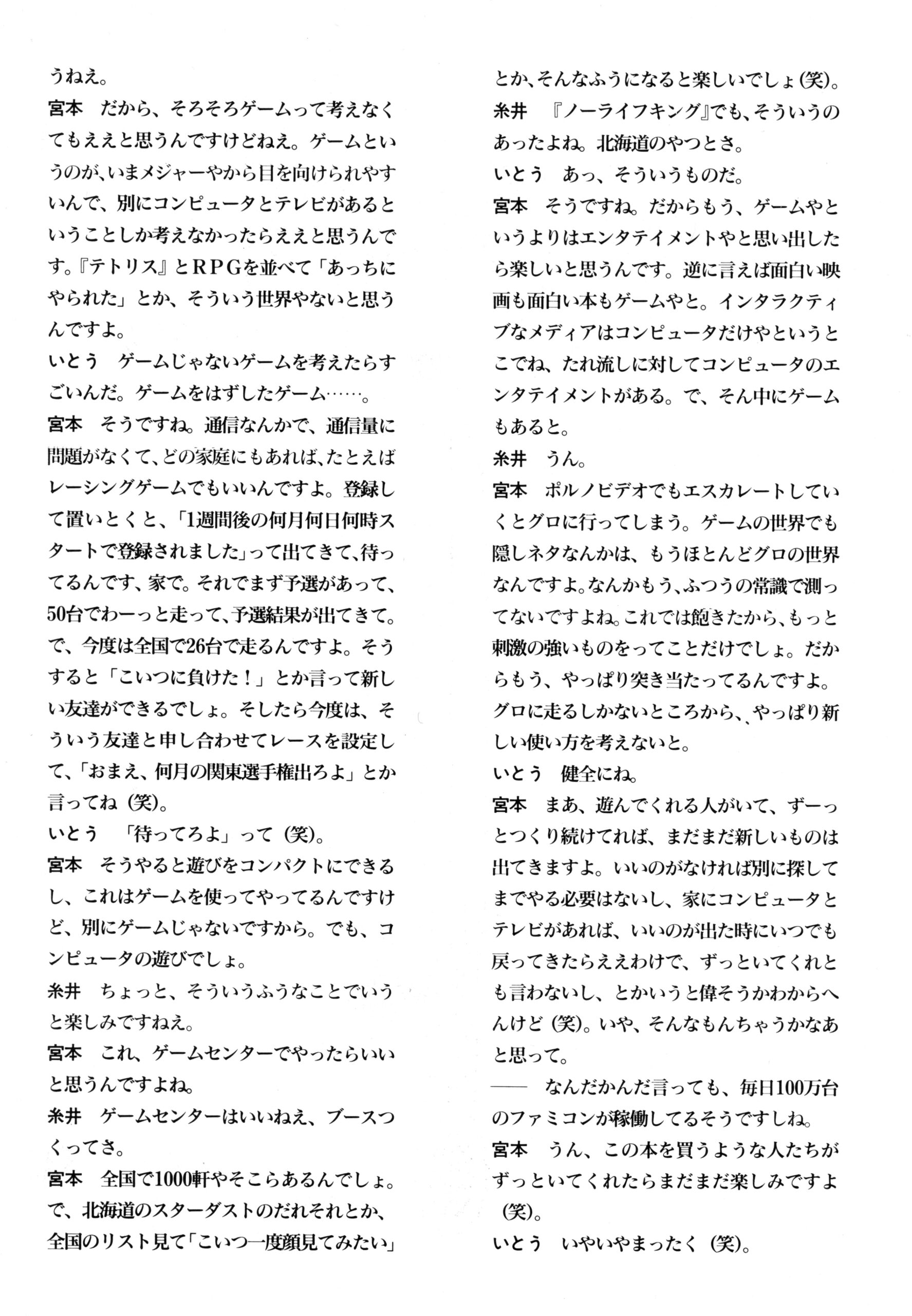
Translator: shmuplations
Notes: Gamer Handbook features profiles of several Japanese game developers, essays, this discussion, and a dictionary of gaming terms. Scans by Detchibe.
Summary: The director tells the programmer what they want, and they turn that into numbers.
Everyone knows how something like a weasel should move. It’s more important that the game is fun. In animation you draw what you want people to see, but with games you can’t just make a character speed up for a moment. If a character has a smooth walking animation it might conflict with the player’s desire to run or chase something. Some games have prioritized smooth animations over responsiveness, they have been failures as games. Many karate games have smooth, fluid motion, but then something like drawing your sword has to be slow. The player’s intent should be reflected by their button inputs.
Mario’s ability to change direction in mid-air is ridiculous. In Donkey Kong Mario couldn’t jump as high so not being able to change direction wasn’t as big of a deal. When Mario can jump several times his own height being realistic isn’t a concern anymore. It’s fun for video game worlds to seem like they could exist. Game programmers are the god of the worlds they make. If that world isn’t convincing no one will want to visit it. Charlie Chaplin and Tom and Jerry have been inspirations to video game developers.
He agrees with Shigesato Itoi, stereo sound is more important than realism, people aren’t looking for perfection.
As games are able to use more colors it will be boring if everyone goes for a realistic style. Art with a distinct worldview is more fun.
Being a bit crude can be beneficial, Japanese people can’t fully understand movies in English, so they have to imagine to a degree. The hero becomes more heroic in their minds. Many bluegrass songs are about tragic things, but he just laughs and sings along.
It’s condescending to say that gamers forget they’re playing a game just because they get immersed in it.
The video games that sell well have been driven by fashion. People look at what’s hyped, that’s fashion to him. He doesn’t know where the industry is going. Large scale role-playing games that take a lot of time are popular. He likes games that can be beaten quickly. People think long games sell, but then something like Tetris comes along.
Combining shooters with RPGs comes from the idea that if you put two things together you’ll get something even better out of it. It works sometimes, but he wouldn’t want to always do that.
There’s lots of unexplored ideas in gaming. What if you did something in a game and then a month later it had changed into something new? People in apartments can’t have pets. If a game could capture that feeling of having a pet it could become a craze.
Games still have the arcade style, which is a rigid framework and feels like a dead end. Everyone makes action games based on Earth. What if gravity was different? You can stumble on something unexpected and fun thinking like this. People in America are doing things like this. When input methods change new possibilities open up. When you focus on best sellers it may seem like there’s a wall, but there’s more possibilities than ever.
Not having to do everything before you beat the game is what sets Mother apart.
If he wants to add a funny animation at the end of a level the programmers and hardcore gamers might protest, saying no one will ever see it. But there will always be some people who will. There is more to enjoy in games than just beating them. The Frog Suit is awkward on land, he had force that into the game.
The fun in RPGs is seeing your character get stronger than you could have imagined, or saving up money. Those things are taken for granted now and added more complex stories. If you have an open game you have to accommodate every possible player action, and then the game has to be shorter, which leads to people feeling short-changed.
The essence of play is wanting to see what happens if you choose “yes” and if you choose “no”. If you have to start over every time you die it would be too harsh.
They’ll have less memory limitations in the future. He’s looking forward to when you can have a built-in interpreter organize things.
There’s something called HyperCard for Macintosh computers. You can make things that are like picture books. One HyperCard game is The Manhole, where you can wander around and see things. There’s nothing people read as often as a picture book. HyperCard can use 600-800 pages, that’s how computers can be used in the future.
It’s difficult to make players feel a sense of purpose while making the journey fun. He thinks they’ve reached the peak of “reach the goal” design. Tetris shook things up. They’ve moved on from the arcade era.
Players have a certain mindset with video games, if they can frame games more as books people would find them interesting.
You could do something amazing with an online racing game. You could register for a race next week and then wait for it to start. You’d make new friends with the people you raced against and coordinate races with them. That wouldn’t be a “game”, it would be a new way to use a computer. Things become more interesting when you start see games as entertainment. A book or a movie can be a “game” too, but they are passive.
Pornography becomes grotesque when it escalates. Hidden secrets in games have almost reached that level of grotesqueness. People are just looking for stronger stimulation.
As long as people are playing and they’re making games new will things will emerge. If there’s nothing good being released you don’t have to play anything.
1990
Rainbow Colored Dip Switches: Famicom Industry Quest
Publication Date: 1990
Subject(s): Super Famicom shortages, F-Zero, controller buttons, The Legend of Zelda: A Link to the Past, Dragon Quest
Format: Transcribed interview
People: Unnamed interviewer, Yuji Horii, Shigeru Miyamoto
Link: https://shmuplations.com/miyamotohorii/
Archive Link: https://web.archive.org/web/20180703075218/http://shmuplations.com/miyamotohorii
Translator: shmuplations
Notes: This book is a collection of essays by Yuji Horii, and also includes some discussions with other video game developers. You can read slightly more about it at The Video Game Library. Yuji Horii and Mr. Miyamoto also spoke in 1989, it’s possible that both conversations are from this book.
Summary: It’s so hard to get a Super Famicom due to production shortages that they held a lottery at Nintendo so an employee could get one. Even the RF cables are in short supply. They didn’t include an AV cable to keep costs down, but they made sure to include two controllers so as not to change what kinds of games developers make.
F-Zero isn’t an F1 game due to the director’s tastes, and so they wouldn’t have to animate tires. They would have needed to show all four tires during drifting, and that wasn’t feasible. Super Mario Bros. was made so people playing games for the first time could have fun. Mario games keep getting more complicated and he’s worried Super Mario World is too hard, so he wanted to make sure F-Zero was friendly to beginners. Shigesato Itoi made it to Bowser on his own, so anyone can.
In America they made it so that in Super Mario Bros. 3 if you get hit as raccoon Mario you become big Mario instead of little Mario. In Super Mario World they tinkered a lot with the dropping item system. They removed some controls and moves.
There’s a lot of buttons on the Super Nintendo Entertainment System’s controller compared to the previous console. They put A and B together, then wanted another easy to remember group and used X and Y. There were other suggestions like 12, 3, 6, and 9 o’clock.
The theme of The Legend of Zelda: A Link to the Past is real-time action-adventure game. The Zelda series has never used the term role-playing game to describe itself, though is does use some elements, like how your power progresses. This is to help poor players. He wanted your stats in Zelda II: The Adventure of Link to go up to 16, to make it easier.
They can’t fudge some things with the Super Nintendo that they could before. He wants A Link to the Past to be so gorgeous that players will just want to run around.
He has played all four Dragon Quest games. Dragon Quest IV is a great game. The dialogue in Dragon Quest III and IV made the characters feel alive.
He was obsessed with Tetris for a while. Some of their developers are obsessed with Dr. Mario.
The large amount of RAM the Super Nintendo has is the biggest allure to developers. Sprite scaling and rotation are possible.
Games aren’t just for your eyes and hands, they should involve the ears and your whole body.
Unknown (Nintendo Kyoto offices interview, untranslated from Japanese)
Publication Date: 1990
Subject(s): Super Mario Bros. 3
Format: Interview
People: Unknown interviewer, Shigeru Miyamoto
Video:
Notes: The subtitles contain machine translated English. Contains footage from inside Nintendo’s offices. Uploaded by YouTube user Sir Mix-A-Lot Rare Music.
Nintendo Power: The Making of Super Mario Bros. 3
Publication Date: January, 1990
Subject(s): Super Mario Bros. 3
Format: Transcribed interview
People: Unnamed Nintendo Power interviewer, Shigeru Miyamoto
Scans:

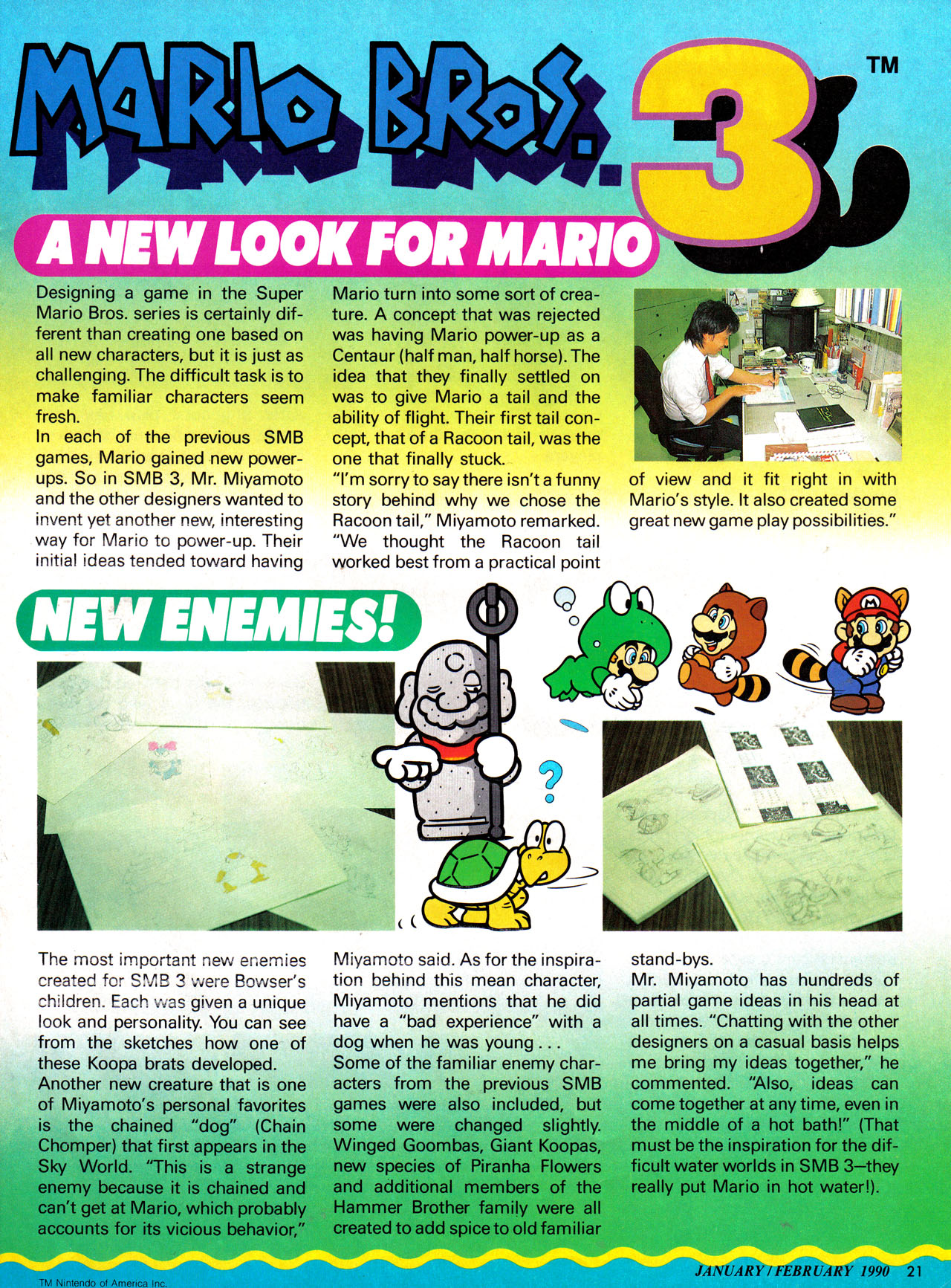


Notes: The profile on Mr. Miyamoto claims he is known as “Dr. Miyamoto” to his fans. Scans by Retromags.
Summary: There’s no funny story behind Raccoon Mario, it worked well and fit in.
Talking with other designers helps him with ideas, which can even come during a hot bath.
They wanted Super Mario Bros. 3 to be a game everyone can enjoy, no matter their skill level.
They are proud of the magical wonderland and dastardly enemies they made.
He’s not famous but people write to him and ask for photos. Coming up with your own ideas is key to making games. Keeping up with popular culture will help you come up with ideas. Assembly language is essential for programmers.
The Money Programme: NINTENDO and the JAPANESE SOFTWARE boom
Publication Date: March 25, 1990
Subject(s): Working at Nintendo
Format: Interview (dubbed)
People: Unnamed The Money Programme interviewer, Shigeru Miyamoto
Video:
Notes: Footage of Nintendo offices starts at 3:03 and the narrator says cameras have never been allowed in before. There is a lot more talk about Nintendo and the Japanese gaming industry that is not part of Mr. Miyamoto’s interview. Uploaded by YouTube user BBC Archive.
Summary: They’re not paid glamorously, but Nintendo pays for and encourages them to go to museums and to see movies to get inspired. Everyone is happy to work there, especially with the prestige.
Family Computer Magazine (Super Mario World interview, untranslated from Japanese)
Publication Date: October 5, 1990
Subject(s): Super Mario World
Format: Transcribed interview
People: Unknown Family Computer Magazine interviewer, Shigeru Miyamoto
Scans:


Notes: Scans by RevengeOfTheHubz.
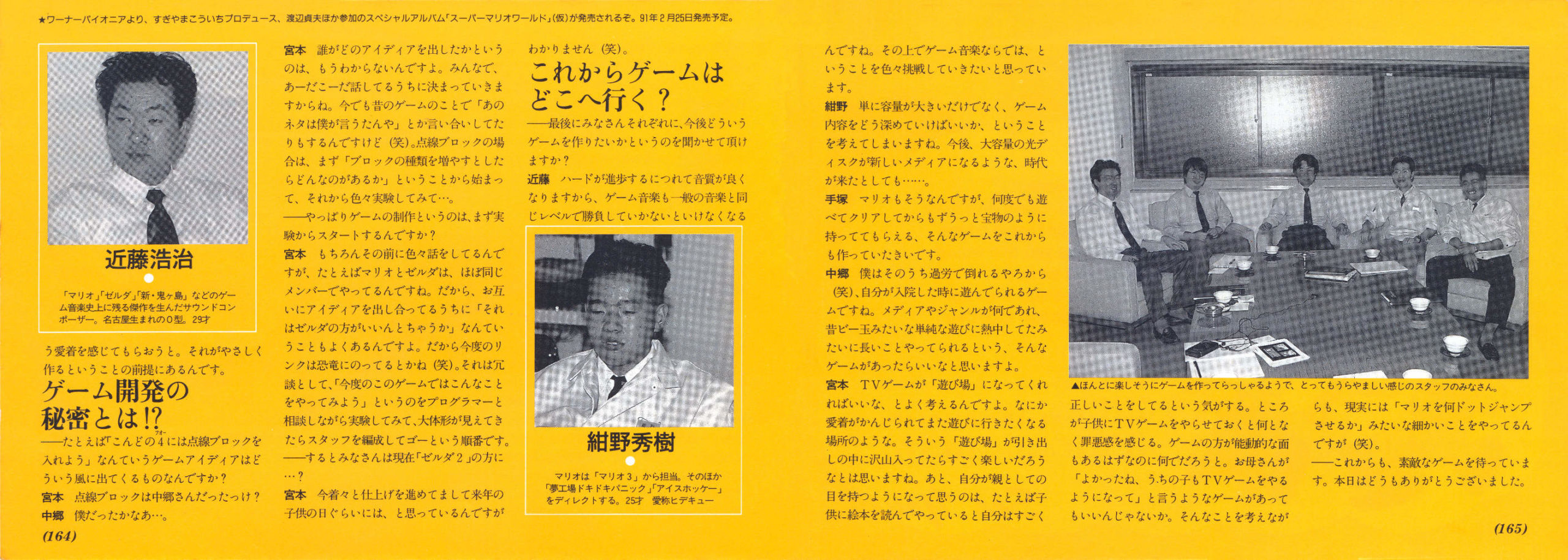
Nintendo Official Guidebook: Super Mario World
Publication Date: November 21, 1990 (approximate)
Subject(s): Super Mario World
Format: Transcribed interview
People: Takashi Tezuka, Toshihiko Nakago, Hideko Konno, Koji Kondo, Shigeru Miyamoto
Link: https://shmuplations.com/supermarioworld/
Archive Link: https://web.archive.org/web/20151218010330/http://shmuplations.com/supermarioworld
Japanese Archive Link: https://archive.org/details/smw-nintendo-official-guide-book/SMWAPEvol1/mode/2up
Scans:
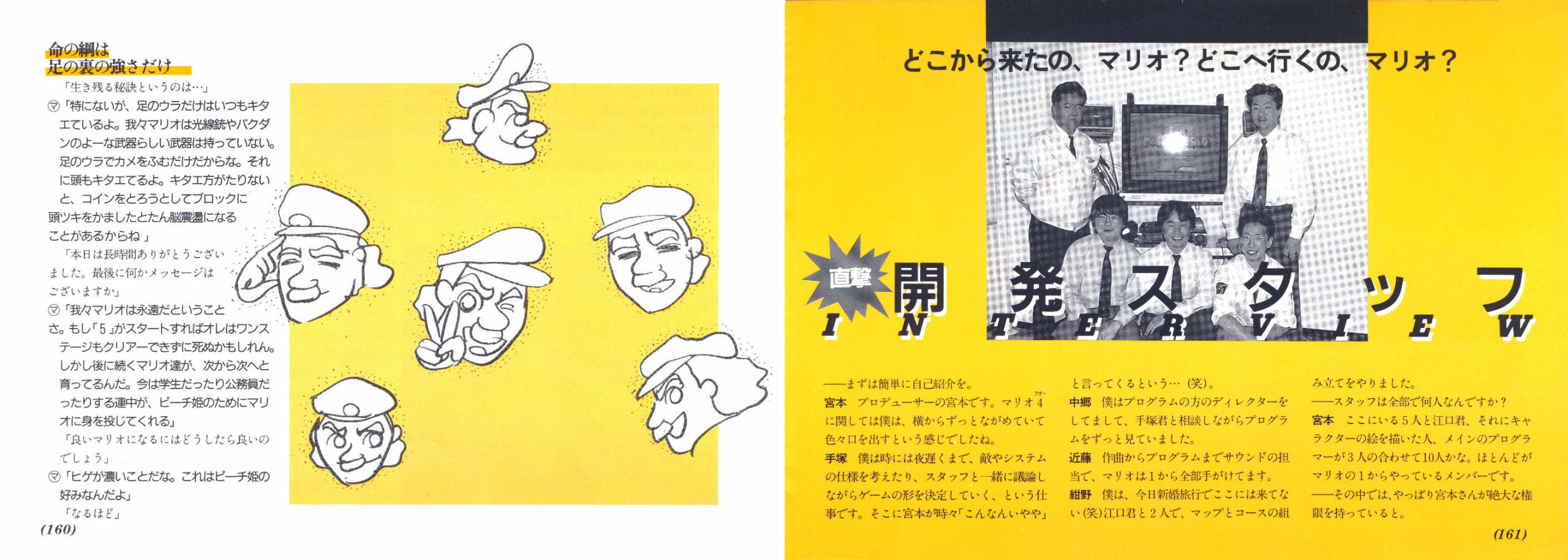
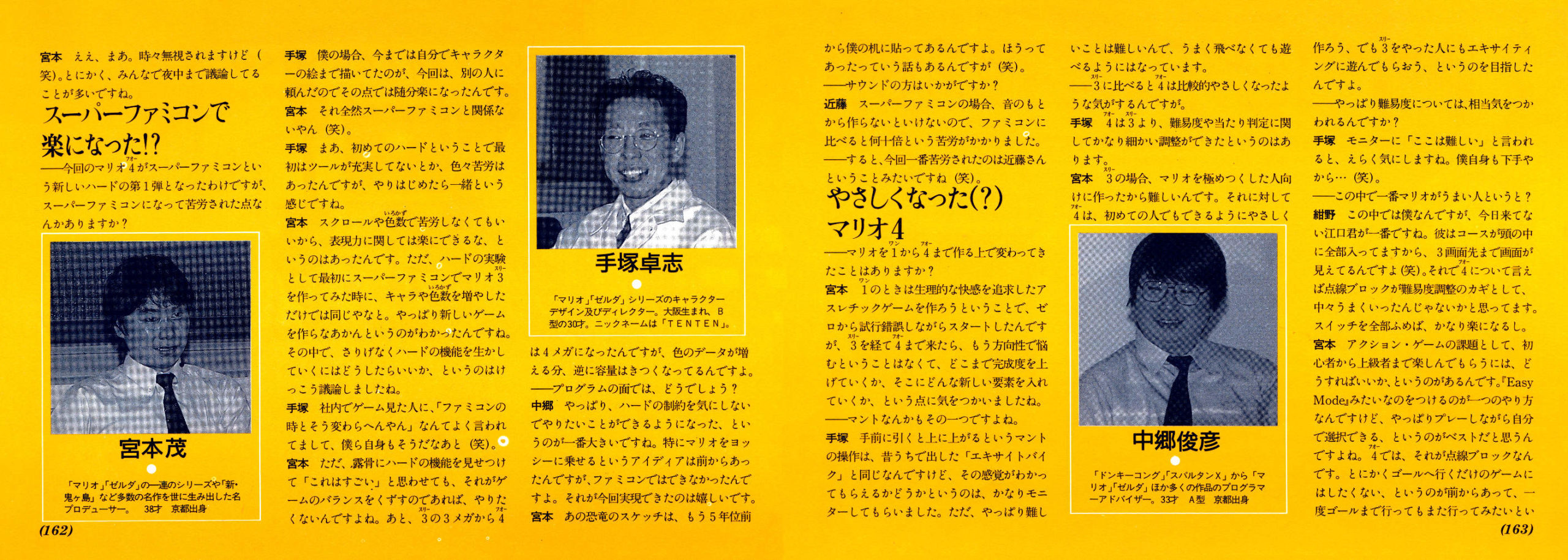
Translator: shmuplations
Notes: Scans by Mittermeyer.
Summary: He was the producer, watching everyone and interjecting his ideas.
About 10 people made Super Mario World, most of which worked on Super Mario Bros.
Without the scrolling and color restrictions it was easier to depict things. Before they started on Super Mario World they ported Super Mario Bros. 3, and it was the same game. This made him realize they had to make something new. The memory limitations were stricter than Mario 3 because the colors took more memory.
He had the Yoshi concept art on his desk for five years.
With the last two Super Mario games they have been able to focus on polish and adding fun things rather than getting the movement to feel right.
Super Mario 3 targeted experienced players, while Super Mario World is friendly to beginners.
It’s difficult to make an action game that players of all skill levels can play. The best method is letting the player adjust the difficulty themselves while playing, like with the dotted-line blocks in Super Mario World.
The Mario and Zelda teams are very similar and they bounce ideas off each other.
He thinks The Legend of Zelda: A Link to the Past will be done by May 5.
He wants console games to be something children feel affection for. It’s awesome that kids have worlds they can visit within their game libraries. Parents think reading a book is good and proper for their children, but feel guilty if they play a video game. He’d like to make a game that makes a mother happy that their child is old enough to play games.
The Seattle Times: Move To Level Two Ho A Hurdle, Dodge A Fireball On The Way To Finding The Spirit Of Americas Favorite Toy
Publication Date: December 16, 1990
Subject(s): Children playing too many video games, money
Format: Transcribed interview
People: O. Casey Corr, Shigeru Miyamoto
Link: https://archive.seattletimes.com/archive/?date=19901216&slug=1109845
Archive Link: https://web.archive.org/web/20200920153649/https://archive.seattletimes.com/archive/?date=19901216&slug=1109845
Notes: This interview doesn’t contain many direct quotes so it’s difficult to tell what was said by Mr. Miyamoto.
Summary: Pull the plug if your kids are playing video games too much. People talking about video games being bad for kids reminds him how they talked about rock and roll.
He makes a modest amount of money, but good facilities and coworkers are more important. But more money is better.
He tries to find a commonality in his and the player’s feelings.
Donkey Kong took four to six months to make, while Super Mario Bros. 3 took 18 and cost around $800,000.
1991
Super Time (Vadim Gerasimov interview, untranslated from Japanese)
Publication Date: 1991
Subject(s): Tetris
Format: Interview
People: Vadim Gerasimov, Gunpei Yokoi, Hiroshi Imanishi, Shigeru Miyamoto
Japanese Link: https://x.com/whats_this_VGM/status/1876463780860686473
Japanese Archive Link: https://archive.is/pMxgY
Notes: Vadim Gerasimov developed the IBM PC version of Tetris and was featured on Super Time visiting Nintendo. Posted by whats_this_VGM, who also provided more information. Thank you to VGDensetsu for additional context.
Mario Mania: The Man Behind Mario
Publication Date: August, 1991
Subject(s): Mario’s design, Mario’s future, Super Mario World
Format: Transcribed interview
People: Shigeru Miyamoto
Archive Link: https://archive.org/details/Nintendo_Players_Guide_Mario_Mania_1991/page/n23/mode/2up
Scan:
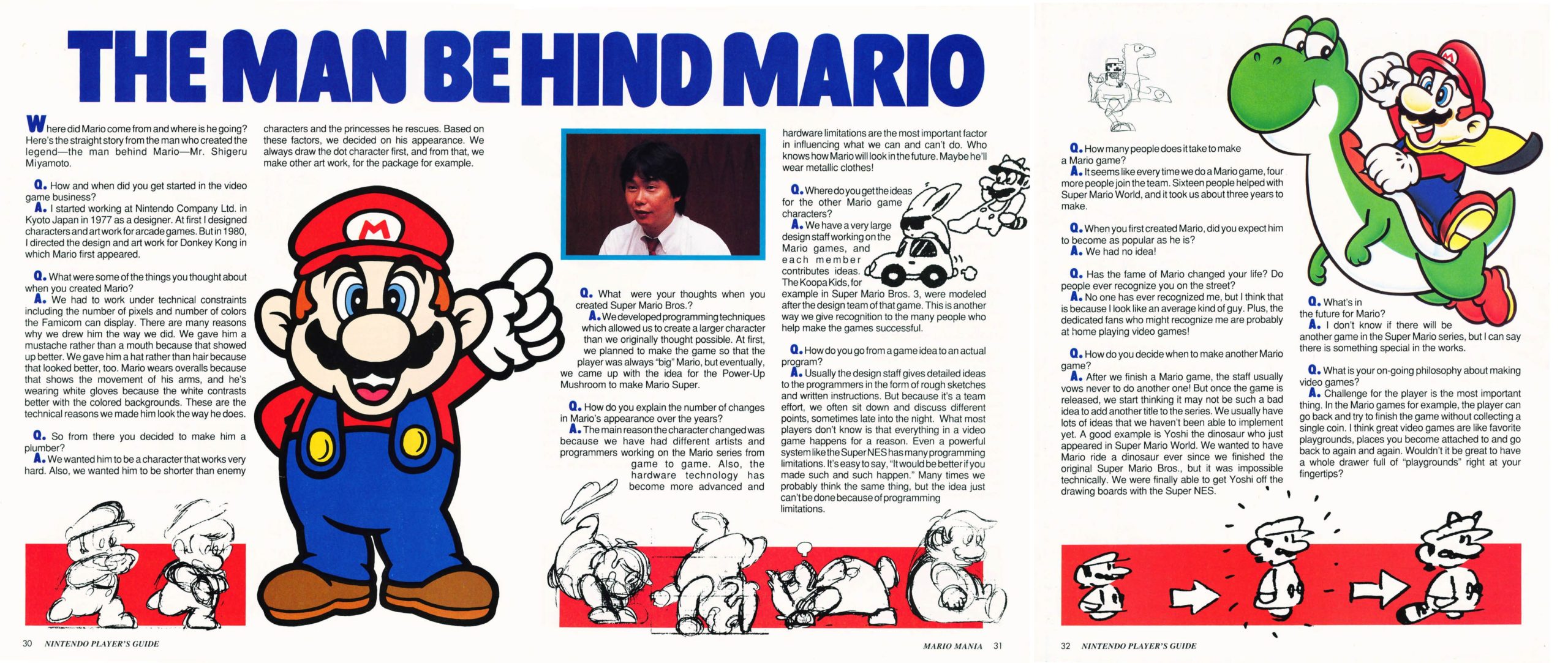
Notes: Mario Mania was a player’s guide for Super Mario World published by Nintendo Power. Scanned, or least added to Internet Archive by Sketch the Cow.
Summary: He started with Nintendo in 1977 as a designer.
Mario has a mustache and a hat because they showed up better, overalls to show his arm movement, and white gloves to contrast with backgrounds. He wanted Mario to be a character that works hard and is shorter than the princesses. Mario’s appearance changes because different artists work on him and the technology improves, maybe one day he’ll have metallic clothes.
The Koopa Kids were modeled after the designers of Super Mario Bros. 3.
Sixteen people worked on Super Mario World and it took about three years.
He has never been recognized in the street.
They wanted Mario to ride a dinosaur in Super Mario Bros., but couldn’t make it work.
He isn’t sure there will be another game in the Mario series.
Challenge is the most important thing, like trying to beat the game without collecting a coin.
Perfect Fan Book, Marukatsu Super Famicom Magazine Appendix (untranslated from Japanese)
Publication Date: December 20, 1991
Subject(s): The Legend of Zelda: A Link to the Past, The Legend of Zelda timeline
Format: Essay
People: Shigeru Miyamoto
Japanese Archive Link: https://archive.org/details/zelda_guide_lttp_pfb/page/34/mode/2up
Scans:
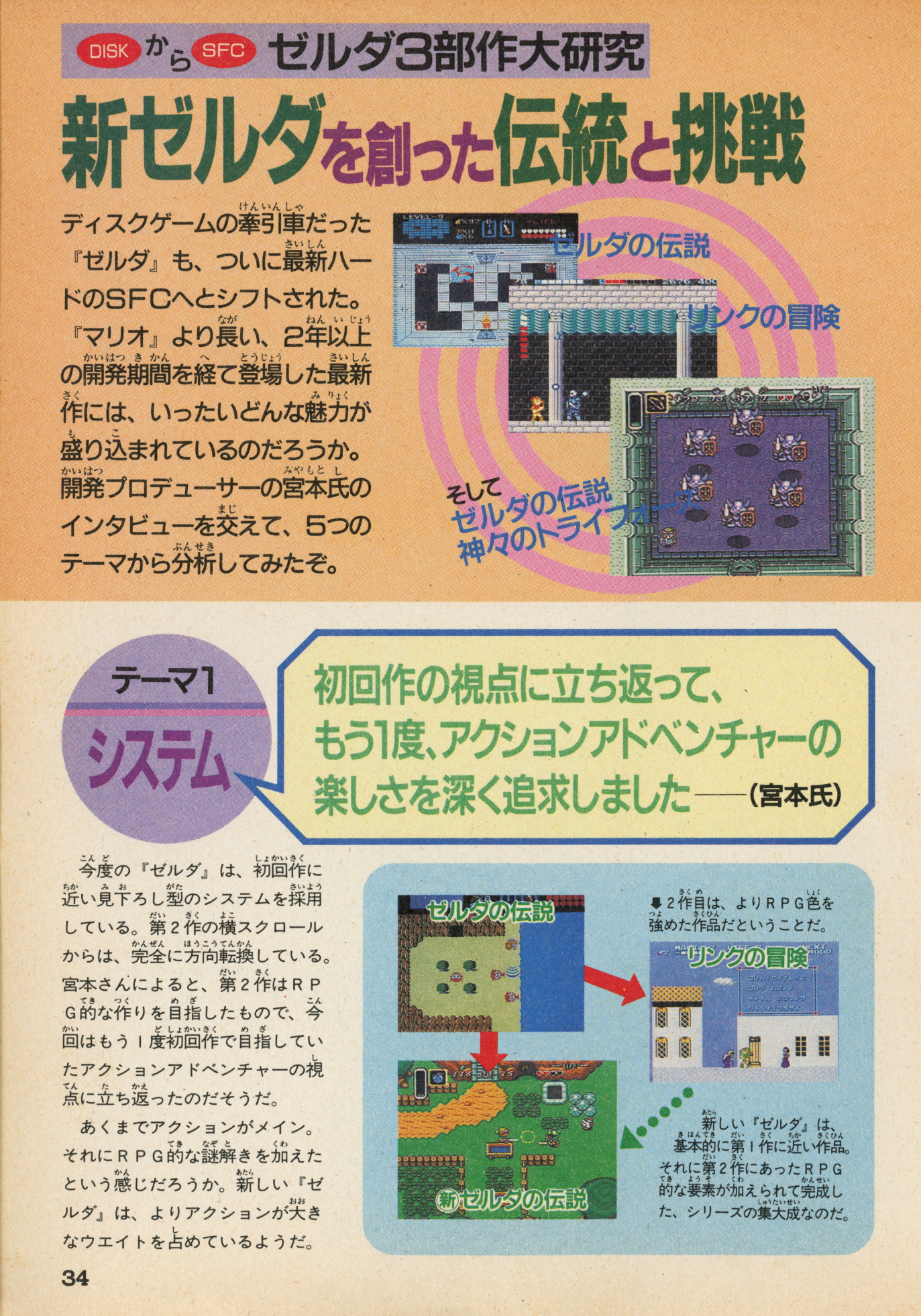

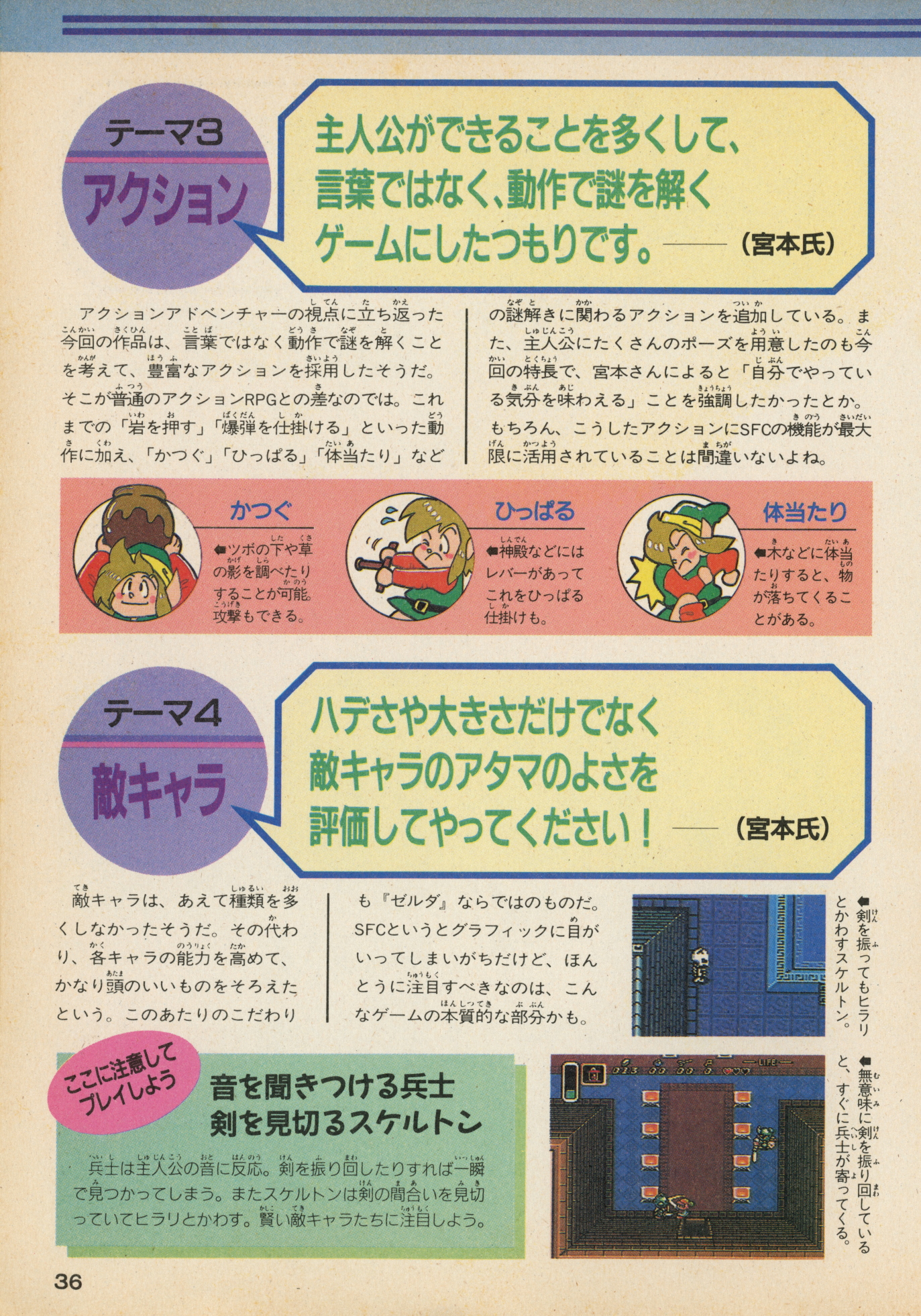

Notes: This is from an additional booklet that was bundled with an issue of Marukatsu Super Famicom magazine. More information can be found on History of Hyrule’s Bluesky post, which also credits makgameadv. Scanned and uploaded to Archive.org by historyofhyrule.
1992
Famitsu/Electric Brain: ZELDA THE MAN BEHIND THE GAME!, Super play: Shigeru Miyamoto: The Man Behind Zelda
Publication Date: January 1992 (Famitsu), Early 1992 (Electric Brain), December, 1992 (Super Play)
Subject(s): The Legend of Zelda, Zelda II: The Adventure of Link, The Legend of Zelda: A Link to the Past
Format: Transcribed interview
People: Unnamed Famitsu interviewer, Shigeru Miyamoto
Links: https://shmuplations.com/zeldalttp/
https://glitterberri.com/development-interview/
Archive Links: https://web.archive.org/web/20170215133412/http://shmuplations.com/zeldalttp/
https://web.archive.org/web/20230201214317/https://glitterberri.com/development-interview/
Scans:


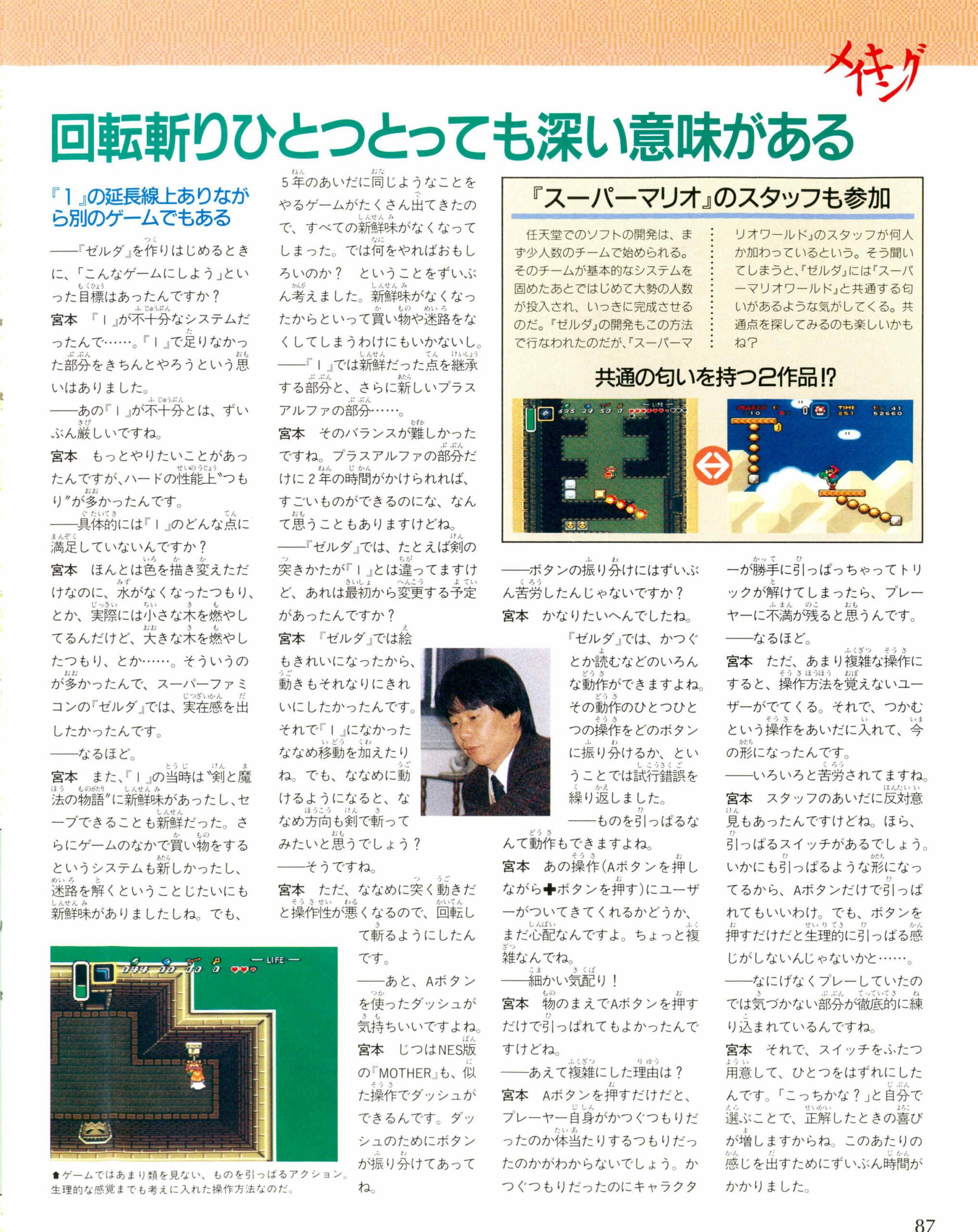
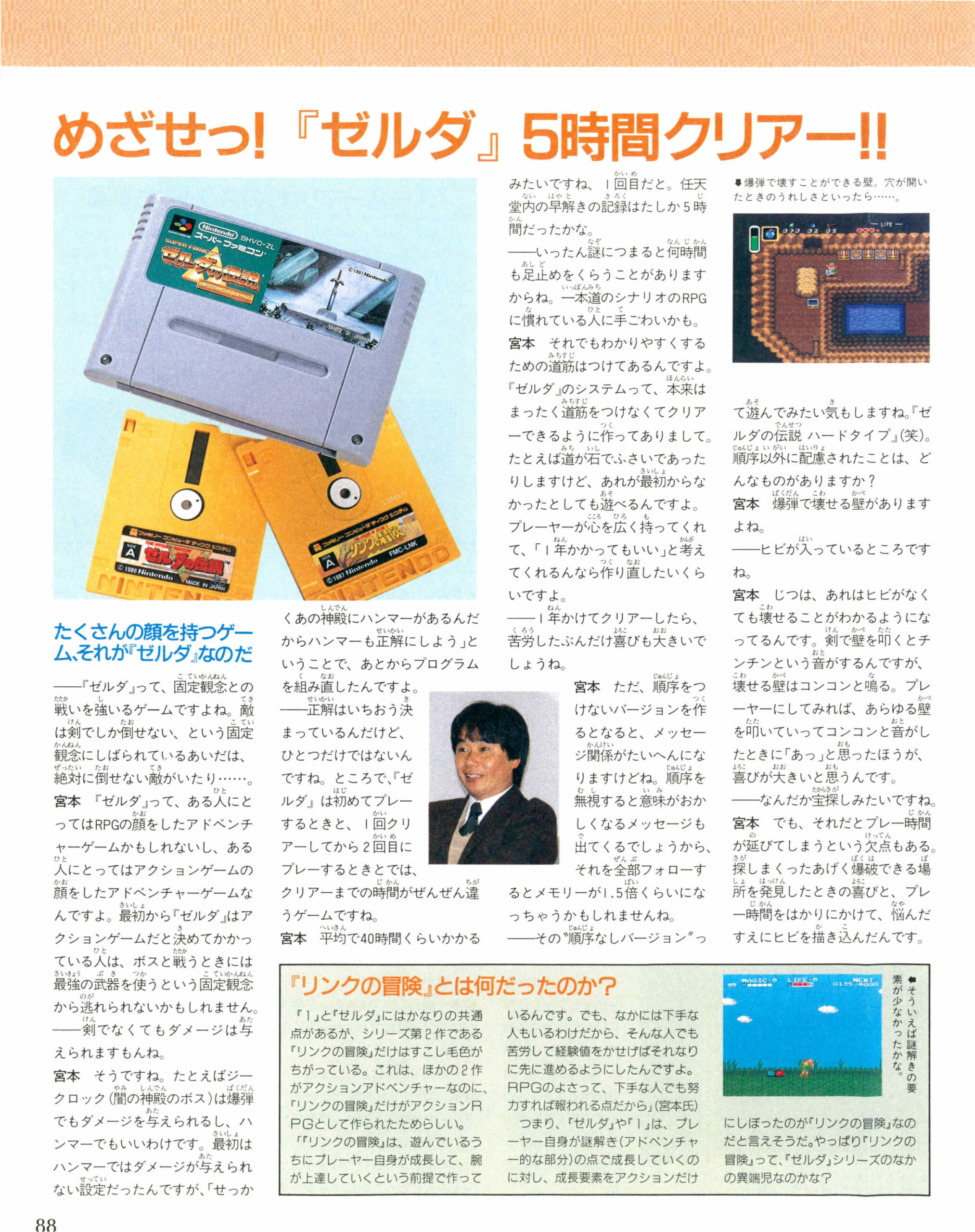

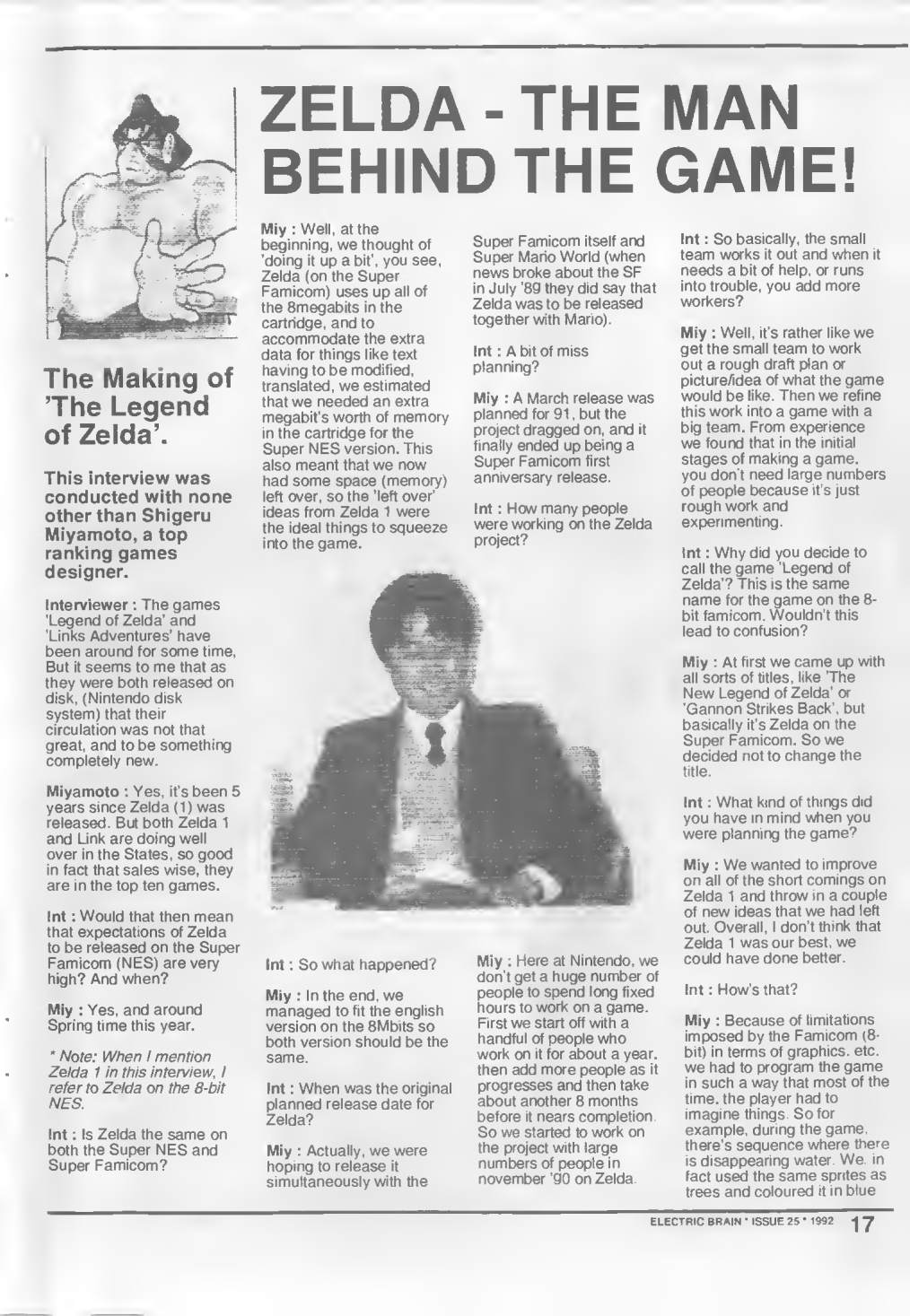

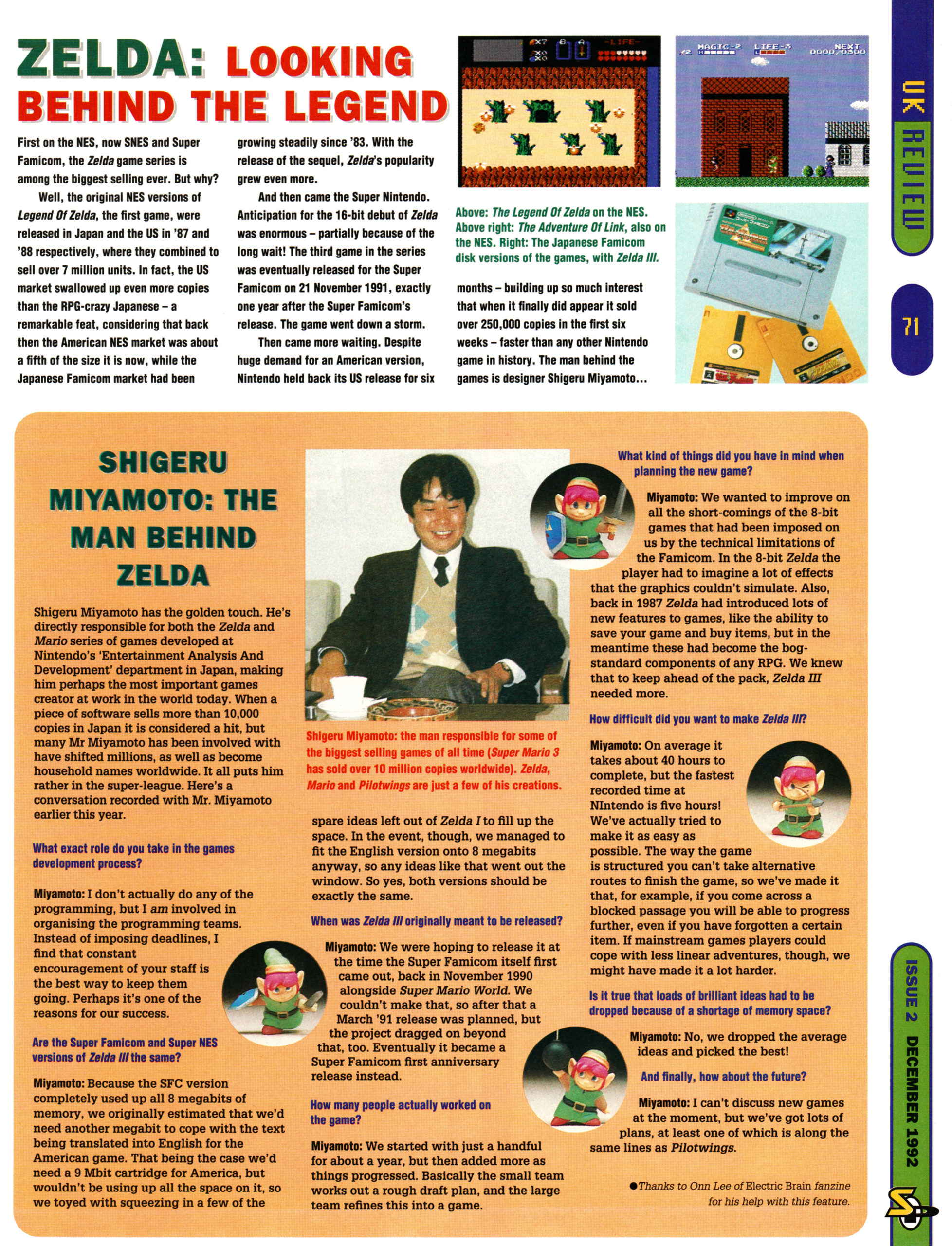
Translator: GlitterBerri and shmuplations
Notes: I learned of the Electric Brain version of this interview from a Nintendo Life article, but the original source had been deleted. However, I found a proper scan of the issue here, by gingerbeardman.
I found out later (after I had written the summary) via shmuplations that this was originally a Famitsu interview, which Electric Brain makes no mention of. Shmuplations credits much of the translation to GlitterBerri, who had access to an incomplete version of the interview. I have improved the summary based on the additional translations. This also seems to be a different January Famitsu interview than the next entry.
In December Super Play ran a portion of this interview in their second issue. They don’t explicitly claim that they conducted the interview, but do thank Onn Lee of Electric Brain.
Summary: The Legend of Zelda: A Link to the Past comes out this Spring, but it hasn’t been announced yet.
The Japanese version of The Legend of Zelda: A Link to the Past uses all 8 megabits of cartridge space, but the English localization was going to take an extra megabit. Eventually they managed to fit it all in. They wanted to release A Link to the Past as a launch title, but it ended up taking a year longer.
At Nintendo a handful of people will work on a game for about a year, and they add more people as time goes on. The small team does silly experiments and figures out the hardware limits. People asked him what he’d do when his body gives out, but he always got eight hours of sleep. Sleep is important for everyone, but it’s also bad for someone to leave at 5 PM.
They decided to keep the The Legend of Zelda part of the title, but considered some other names like Ganon’s Revenge.
They wanted to fix the issues the original The Legend of Zelda had and do what they were unable to do.
The original was based on swords and magic, you could save and load, you could buy items, and there were complex mazes. These were novel ideas at the time, but now they are standard.
For some people Zelda are adventure games disguised as role-playing games, for others they are adventure games disguised as action games. The latter group may feel they have to use the strongest weapon on the boss.
A Link to the Past takes around 40 hours to beat, but the record at Nintendo is around five hours. It was originally more open-ended, he wanted players to get lost and take a year to beat the game.
If you hear a hollow sound when you hit a wall with your sword you can bomb it.
They scrapped mechanics where you could set fire in the field and it would spread, and digging a ditch with the shovel. They’ll never run out of ideas, genres can still be created.
Ideas are limitless, a game designer has to figure out how to make them work.
A game is more than the time you spend playing it, it’s also when you’re away from it and thinking about it.
Famitsu: SNES CD ROM Flash Interview With Shigeru Miyamoto
Publication Date: January, 1992 (translated January 24, 2017)
Subject(s): Super NES CD-ROM
Format: Transcribed interview
People: Unknown Famitsu interviewer, Shigeru Miyamoto
Link: https://glitterberri.com/flash-interview/
Archive Link: https://web.archive.org/web/20230127062501/https://glitterberri.com/flash-interview/
Scans:
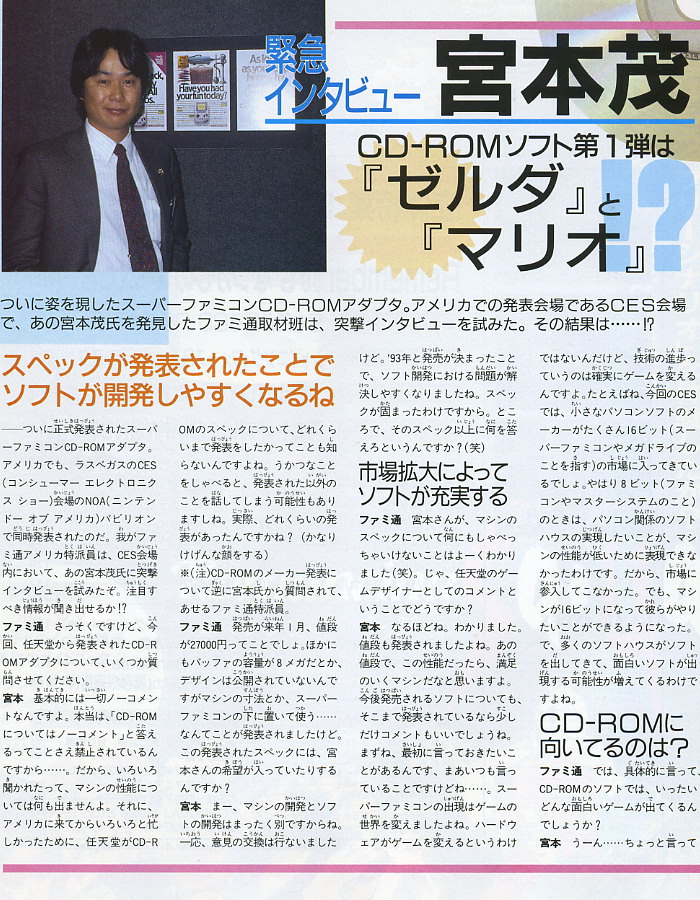
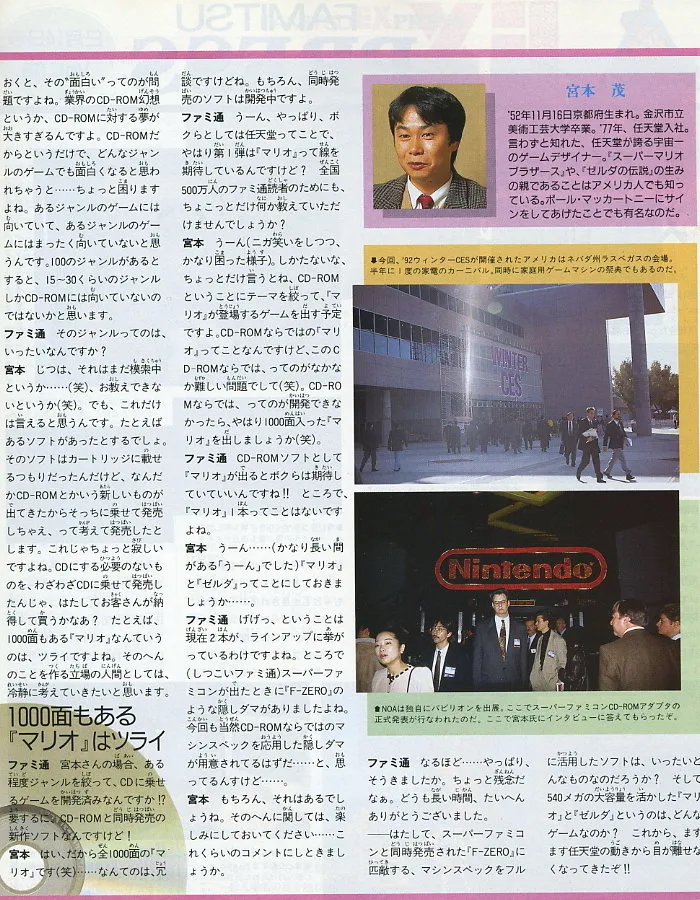
Translator: GlitterBerri
Notes: The scans are originally from Game Jouhou & Blog. This interview took place at Winter CES 1992 which took place January 9-13.
Summary: He has been told to say “no comment” to anything concerning the CD-ROM. He doesn’t know what has been announced.
The Super Nintendo Entertainment System changed the world of gaming. There are a lot of small PC developers at CES because 16 bit consoles allow them to do what they want to do.
The industry has illusions about the CD-ROM. Not every genre will suit it, only 15-30 out of 100. It would make him sad if developers changed their cartridge game into a CD-ROM game. A Mario game with 1000 levels would be cruel. They have plans for a Mario CD-ROM game that could only be done on CD-ROM.
Rolling Stone: Mario’s Big Brother
Publication Date: January 9, 1992
Subject(s): Creativity, limitations
Format: Transcribed interview
People: David Sheff, Shigeru Miyamoto
Links: https://www.rollingstone.com/culture/culture-news/marios-big-brother-sigeru-miyamoto-198593/
https://www.rollingstone.com/culture/culture-news/marios-big-brother-sigeru-miyamoto-198593/2/
Archive Links: https://web.archive.org/web/20230601025825/https://www.rollingstone.com/culture/culture-news/marios-big-brother-sigeru-miyamoto-198593/
Scans:

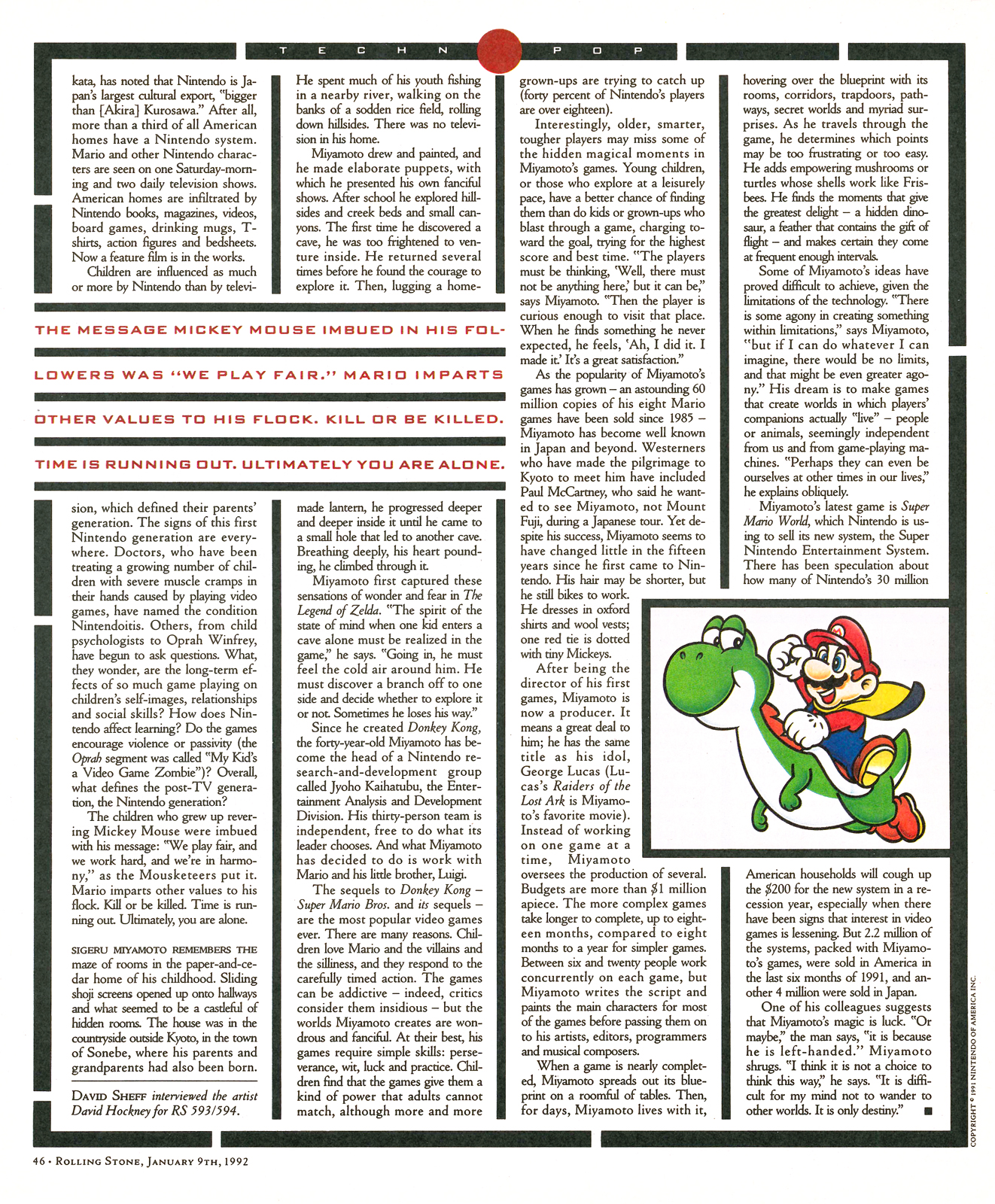
Notes: Scans are by Vault1541. There are only a few direct quotes in this article.
Summary: If you’re on a crowded street and you see something that shouldn’t be there you’ll either shake your head or accept it. If it’s a doorway to another place and you go inside, you might find the unexpected.
The Legend of Zelda should capture the state of mind of a child entering a cave alone.
Players may go past secrets, thinking there is nothing there, but it is very satisfying when they do find it.
There’s an agony to making things that fit within limitations, but having no limits would be a greater agony.
It’s hard for him not to think of other worlds.
Shogakukan A Link to the Past Strategy Guide (Part 1)
Publication Date: January 10, 1992 (translated May 28, 2011)
Subject(s): The Legend of Zelda: A Link to the Past
Format: Transcribed interview
People: Shigeru Miyamoto
Link: https://glitterberri.com/the-men-who-made-zelda/
Archive Link: https://web.archive.org/web/20230127182453/https://glitterberri.com/the-men-who-made-zelda/
Translator: GlitterBerri
Notes: This was part of an official guide that was only released in Japan. The original Japanese follows the English translation in the link.
Summary: He was the producer and arranged everything in The Legend of Zelda: A Link to the Past. The theme is the player feeling like they are doing everything themselves. There was a year of planning, a year of experimentation, and a year of production. Some things seemed impossible at first, but seemed more possible as other things came together. There were some walking animations and poses that were useless to the player. He pays no mind to what is going well, only what isn’t.
When soldiers can’t see Link they’ll still come running if they hear something. Other stupider enemies just come at Link without heeding obstacles. There was an argument about smarter enemies being weaker than dumber ones.
When players brag about their tunic it means they’re attached to their character, and that is why he wanted the player to choose their character’s name. The game got so full of puzzles that he wasn’t sure it was an adventure anymore.
There were originally going to be three worlds, but players would have gotten confused.
Deciding on the difficulty of the puzzles was difficult since some people can find hints and some can’t. People can take a minute or hours to solve a puzzle.
There are lots of details to discover by accident. People will be happy if they come back a year later and discover something new. But if there’s too many then players will forget what they’re doing.
They considered using the NES Zapper for The Legend of Zelda, but many people didn’t own one.
There wasn’t a market for fantasy games with swords and magic when The Legend of Zelda came out, so it had that appeal. Now they are forced to keep using swords and magic in the series. There’s no challenge in swords and magic. A constant stream of sidequests isn’t good. He wanted quests where you had to think, not just deliver medicine to a girl. There were actions like Eat and Dance early on.
He left Koji Kondo to do the music, but he’d tell Kondo if he didn’t like the final result. Near the end they ran out of memory for music.
Family Computer Magazine (discussion with Hayao Miyazaki)
Publication Date: June, 1992
Subject(s): Porco Rosso, movies, video games, The 7th Guest
Format: Transcribed interview
People: Hayao Miayzaki, Shigeru Miyamoto
Video:
Translator: RyiSnow
Notes: RyiSnow translated this interview and made a video where he reads each person’s responses and shows the original Japanese text on screen.
Summary: He enjoyed seeing Porco Rosso, thought it’s difficult to explain why. It’s hard to convey speed in video games the way the dogfight scenes do.
Their games start from random conversation, they don’t make a script first. They used to stay at the office until 2 a.m.
Not many in their industry can bring development to a close properly, which makes him worry.
When he doesn’t know where to go his co-workers think for him. When they’re done with a game they ask if he had everything planned, but he doesn’t know. He does what seems fun and follows his instincts. Chaos is fun, it adds charm.
Video games are tools but they aren’t the same as movies even though they share TVs, scripts, and pictures. People will watch a boring movie, but get bored of a video game quickly.
They may be able to make movie-like games with CDs. They could make a 30 hour game that’s an interactive movie.
Players want to walk the right path, but they also want challenge. Sometimes he feels like things go too smoothly in movies. A game that was in between a game and a movie could be interesting.
The developers of The 7th Guest scanned an entire house to render it in 3D. They are thinking about what to do in such a virtual environment. It took them about two years to make graphics.
Letting players feel an object and its temperature can be truly immersive. Appealing to the five senses with visuals and audio.
You can move the camera above a chandelier in The 7th Guest and look down on the characters, it’s inspiring.
Super Mario Kart Japanese Official Strategy Guide
Publication Date: August 27, 1992 (approximate)
Subject(s): Super Mario Kart
Format: Transcribed interview
People: Hideki Konno, Tadashi Sugiyama, Masato Kimura, Hajime Yajina, Shigeru Miyamoto
Link: https://shmuplations.com/supermariokart/
Archive Link: https://web.archive.org/web/20160629145913/http://shmuplations.com/supermariokart/
Translator: shmuplations
Notes: I was unable to find the name of this guide that never left Japan.
Summary: He was the producer of Super Mario Kart. He more observed than participated in the development.
Early experiments started in Fall of 1990 and main development started April 1991.
They went to Nemu no Sato for a day of go-karting.
Super Mario Kart was originally a lighthearted car racing game, which evolved naturally to go-karts.
They wanted there to be more to the racing than cornering. No one was allowed to play 2-player mode during development because then it becomes about the competition. If 1-player was fun, so would 2-player.
They had to add time trial mode since it’s a racing game, but they left it for last. They about battle mode the most. It helped reinforce the idea that this isn’t a racing game, it’s a game where you drive a go-kart with your friends.
It was very difficult to get the feel of the go-karts right, they couldn’t imitate a real car. He gave some advice that didn’t make sense. It wouldn’t be fun if you couldn’t drift, but they also couldn’t just slide around too much.
Super Mario Kart is intense because you don’t know what’s going to happen.
Game design isn’t work you do with your head, it’s real labor. It probably seems cool to middle and high school students, but it’s hard work.
Nintendo Life: The Real Wizard: A Nintendo World Champions Tale Jeff Hansen
Publication Date: October 8, 1992
Subject(s): Video game development
Format: Transcribed interview
People: Jeff Hansen, Seisuke Yamauchi (translator), Koji Kondo, Shigeru Miyamoto
Link: https://www.nintendolife.com/news/2018/12/feature_the_real_wizard_a_nintendo_world_champions_tale
Video:
Notes: Jeff Hansen was one of the winners of the 1990 Nintendo Challenge Championship. He was invited to challenge Japan’s champion on Super Mario Club. Afterwards he got to visit Nintendo offices. Nintendo Life made this video about Hansen’s experiences using his footage. The exact date can be seen on the trophy at 30:44.
Summary: He draws the people and comes up with the idea, and then they take it to a programmer and they take it to a music person.
La folie des jeux vidéo (Untranslated from French)
Publication Date: October 9, 1992
Subject(s): Unknown
Format: Interview (dubbed)
People: Unknown interviewer, Shigeru Miyamoto
Video:
Notes: There are segments with Mr. Miyamoto talking starting at 9:06 and 14:41. Includes footage of Mr. Miyamoto playing Super Mario World.
The Super Famicom: We Interviewed The Men Who Created RPGs!
Publication Date: November 27, 1992
Subject(s): Role-playing games, The Legend of Zelda: A Link to the Past, Dragon Quest, Final Fantasy
Format: Transcribed interview
People: Unknown The Super Famicom interviewer, Shigeru Miyamoto
Link: https://shmuplations.com/futureofrpgs/
Archive Link: https://web.archive.org/web/20210127115802/http://shmuplations.com/futureofrpgs/
Japanese Archive Link: https://archive.org/details/thesuperfamicom1992no.22hq/TheSuperFamicom%201992%20No.22%20HQ/mode/2up
Scans:
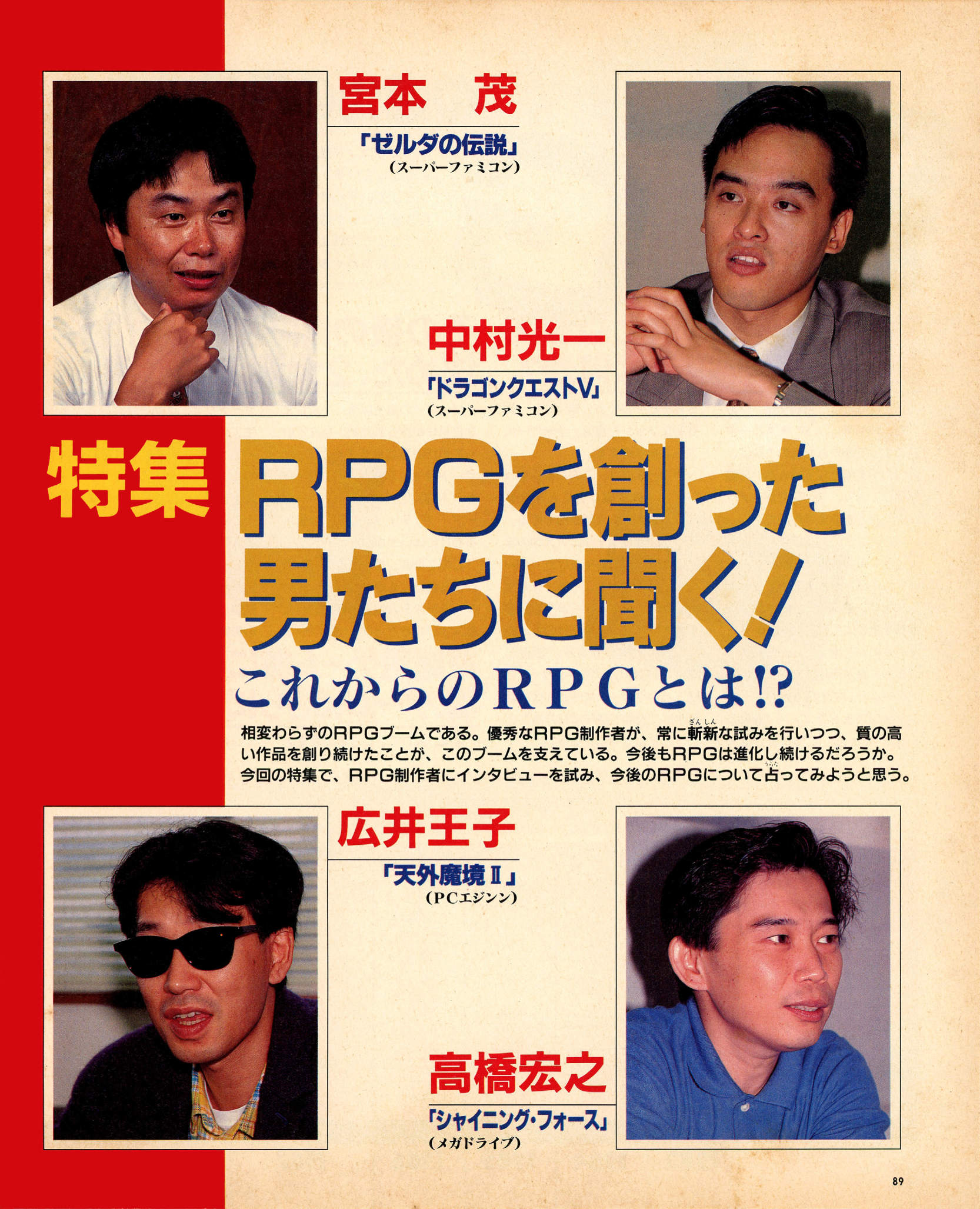
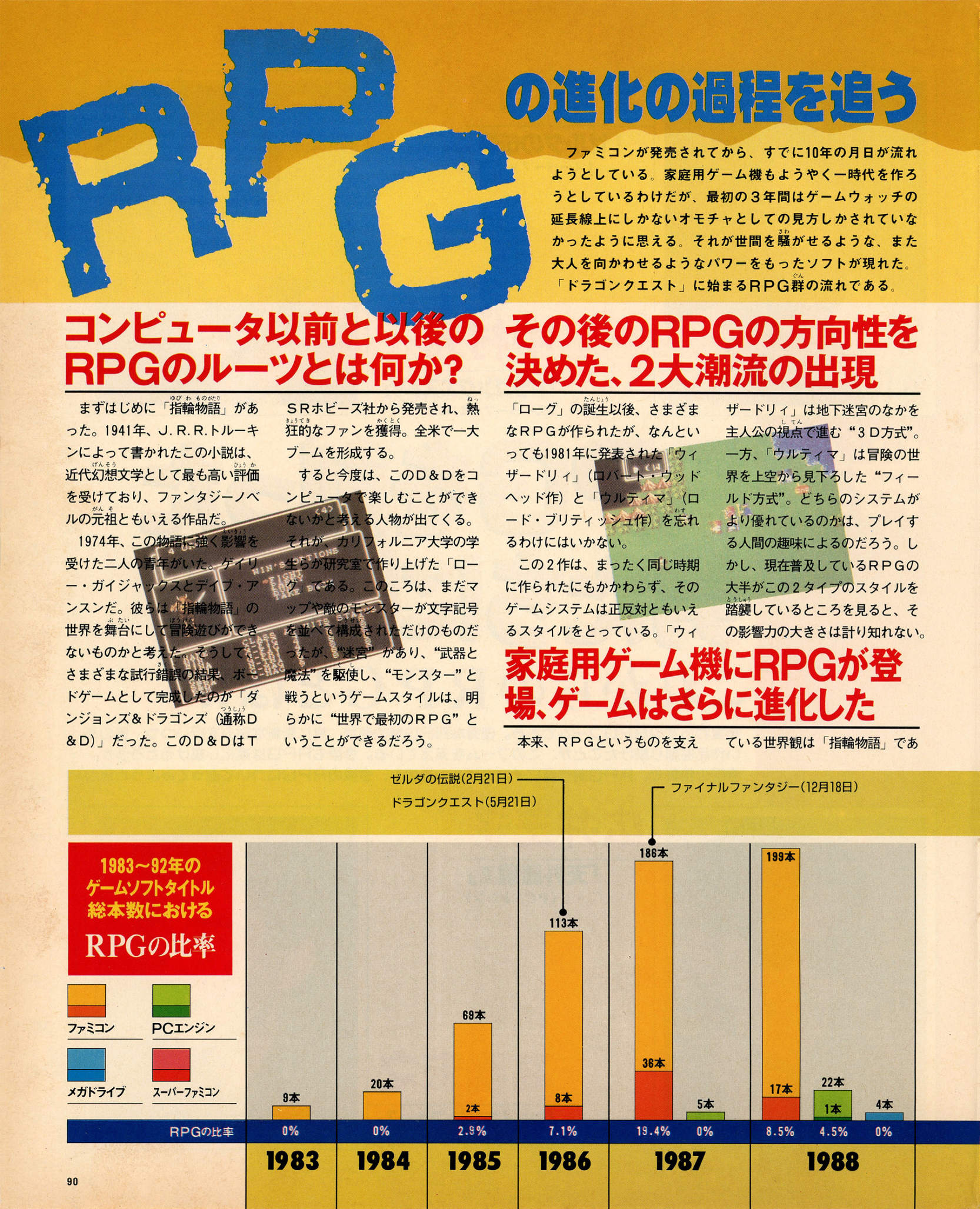
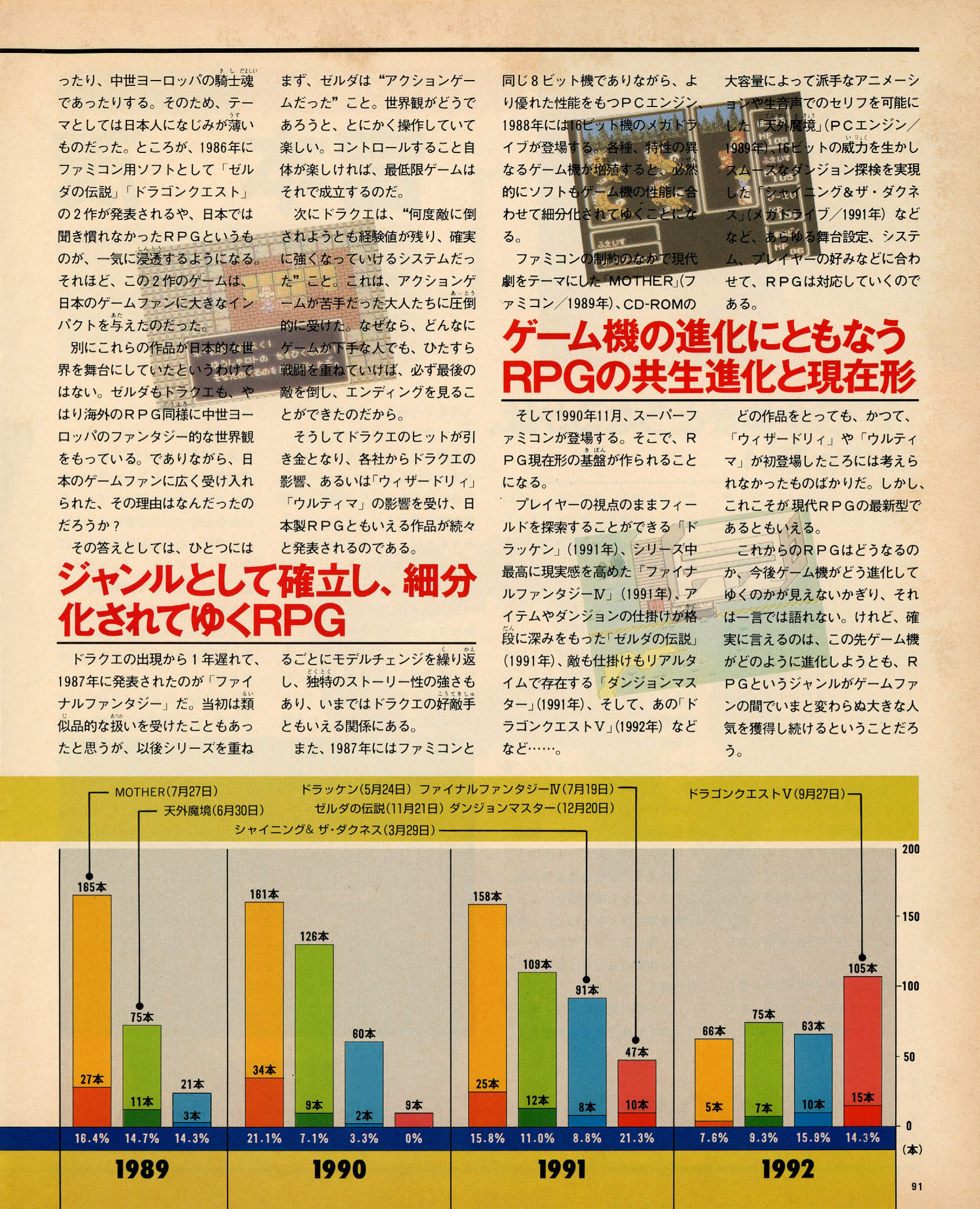
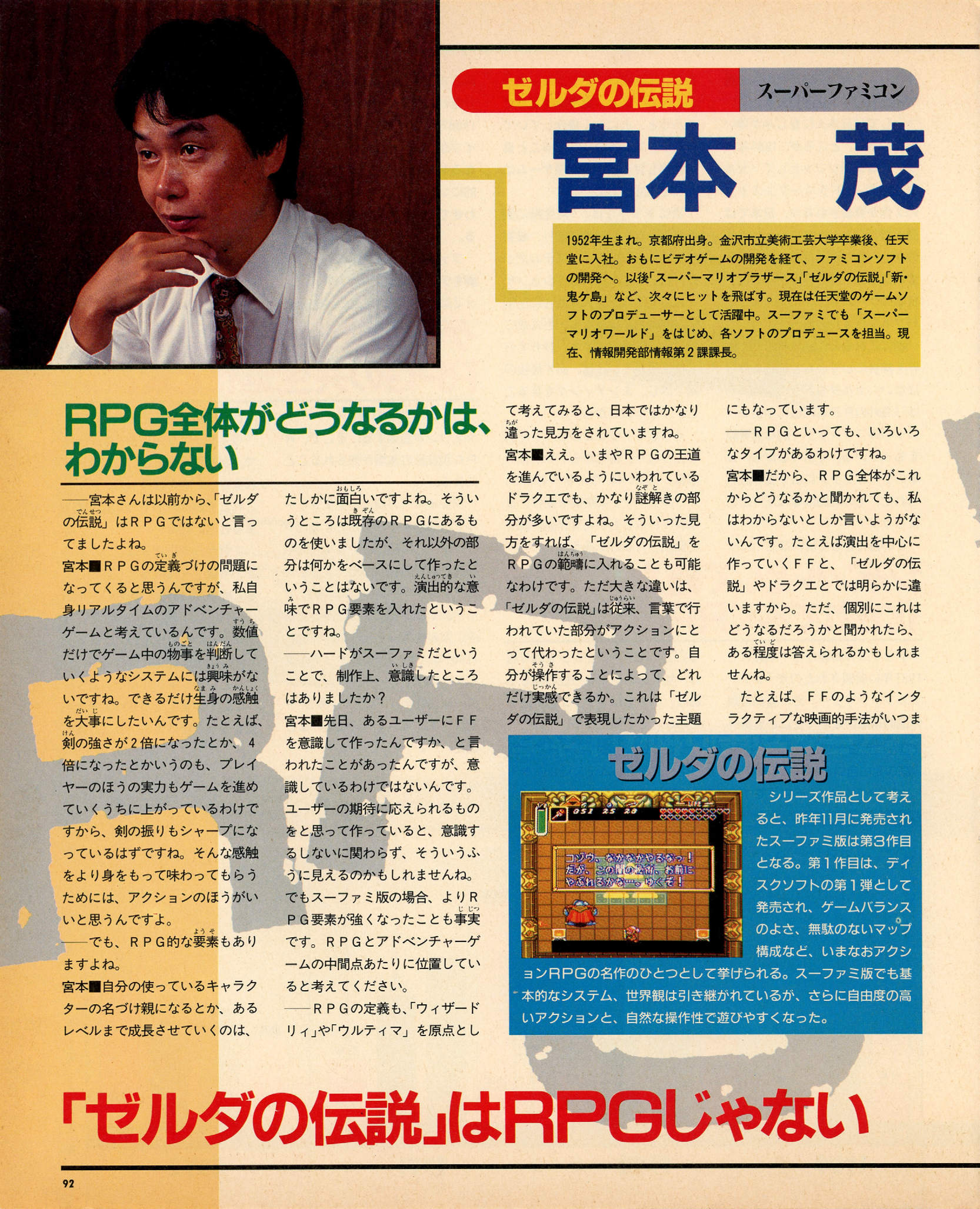
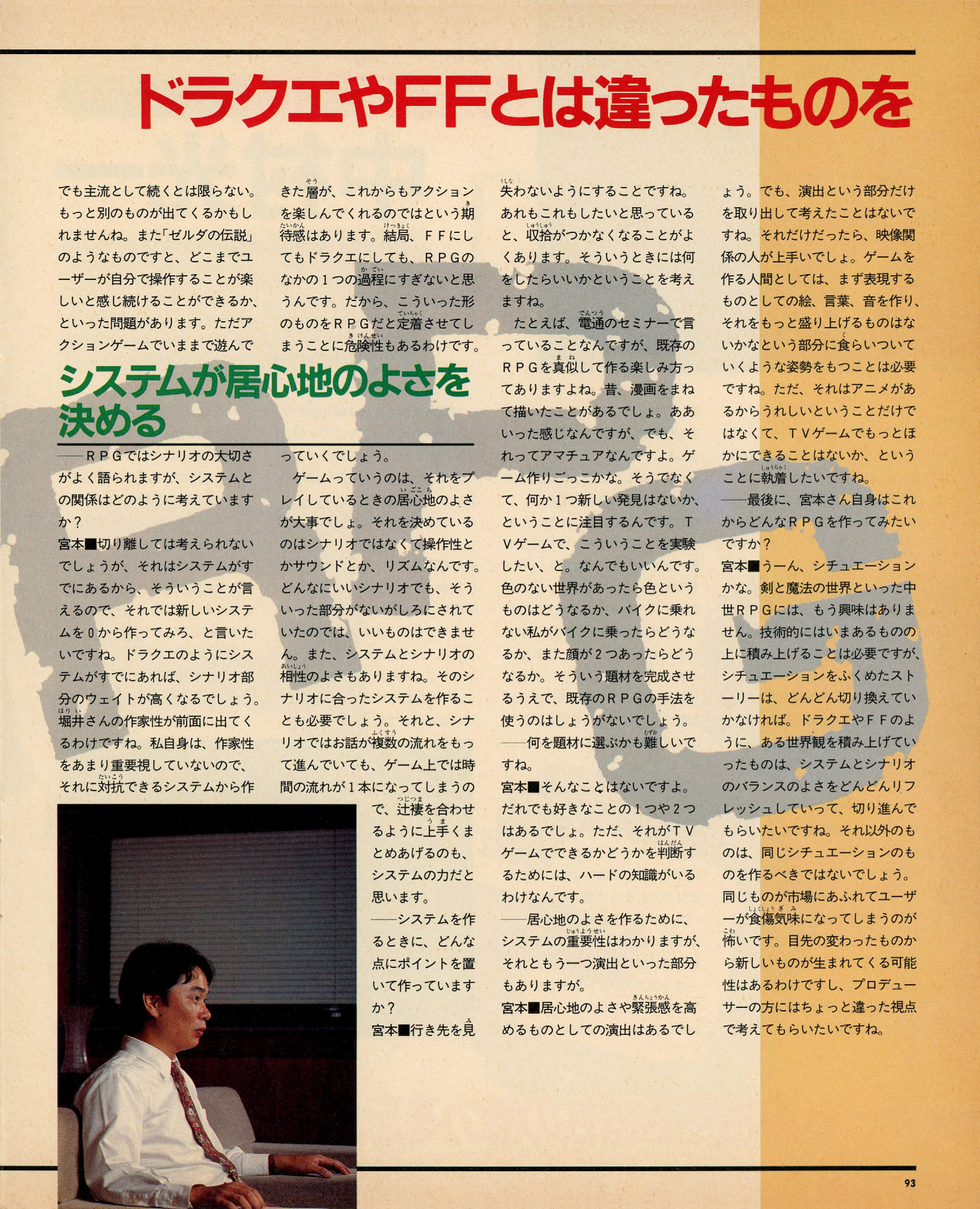
Translator: shmuplations
Notes: The title is a machine translation. The Super Famicom was a magazine that eventually became Super64. Four game designers were separately interviewed about role-playing games for this feature. I’ve included scans of what seems to be the start of the article and Mr. Miyamoto’s interview. Scans by SnesLegacy.
Summary: He thinks of Zelda as a real-time adventure, not a role-playing game. He’s not interested in things being decided by stats. Action games are better at showing your progress in skill.
They drew on some role-playing tropes for The Legend of Zelda, but they didn’t base it on anything.
The Legend of Zelda: A Link to the Past was not influenced by Final Fantasy, but he sees how it could look that way. It had more role-playing elements than previous Zelda games.
Dragon Quest is said to embody the traditional role-playing game, but it has lots of puzzles. What’s done with dialog in Dragon Quest is done with player action in The Legend of Zelda, that’s the main theme.
Final Fantasy emphasizes presentation, which is different from Dragon Quest and The Legend of Zelda. Final Fantasy’s cinematic approach may not continue. There’s no single process with games, which makes it hard to define what a role-playing game is.
Since Dragon Quest has its gameplay set there’s more weight put on the story. He doesn’t put much emphasis on story, he starts with the gameplay and tries to make something that can handle a good story. Video games need to feel good to play no matter how good the story is. It’s also important that the story and gameplay match.
When designing a gameplay system he makes sure they don’t add too much and get out of control. Imitating role-playing games is like tracing your favorite manga. They like to focus on finding a new idea.
They don’t think about aesthetic in isolation, it should elevate and excite. It shouldn’t be an anime veneer either, video games can do more.
He might like to make a role-playing game with an interesting setting, but he has no interest in sword and sorcery worlds. Role-playing games shouldn’t keep using the same settings or the market will be flooded.
1993
Unknown (Star Fox essay)
Publication Date: 1993
Subject(s): Star Fox, STGs, Super FX chip
Format: Essay
People: Shigeru Miyamoto
Link: https://shmuplations.com/starfox/
Archive Link: https://web.archive.org/web/20141012022010/http://shmuplations.com/starfox/
Translator: shmuplations
Notes: I couldn’t locate the origin of this essay. STG, the Japanese term for shoot ’em up or shmup, is used throughout this essay and I will be using it.
Summary: If you had to put Star Fox into a genre it would be a STG. But all other STGs have the same formula where you shoot things on a 2D plane and memorize patterns. He doesn’t want Star Fox to be thought of like that.
They didn’t feel bound by genre convention when making Star Fox, just like they never called The Legend of Zelda a role-playing game.
There have been good 3D STGs, but they aren’t really 3D. There’s no feeling of controlling something in 3D. He’s wanted to make a 3D STG for a while, especially one where you can fly in any direction.
Star Fox’s graphics look better in person than in a screenshot. They didn’t want to add too much that would interfere with the feeling that you’re flying through space.
Star Fox is hard at first, unlike most STGs that are easy at the start. It’s easy once you understand the mechanics.
They didn’t want to add characters, but the backstory included flying with other pilots. He wanted the setting to be like Star Wars, but a puppet show setting like Thunderbirds. Not realistic or deep. They added the other pilots because it’s fun to fly with them.
The Fushimi Inari-Taisha Shrine is near his office, which is associated with foxes. There’s a place in the game where you fly through arches and the path splits, that’s from the Senbon Torii path at Fushimi Inari-Taisha.
The Super FX chip can render graphics on screen itself. The Super Nintendo Entertainment System isn’t good at rendering polygons. The Super FX chip can do other things, too, it’s similar to the Amiga.
There’s value in more realistic sounds, but it’s different for visuals. Highly detailed doesn’t mean realistic. A writer uses words to make images in the reader’s mind, and games use abstract representations of things.
Video games have come of age and shouldn’t mimic movies or novels. Graphics and stories aren’t what it’s about, it’s about exploring virtual spaces.
Star Fox: Mission File Printout
Publication Date: February 21, 1993 (approximate)
Subject(s): Star Fox
Format: Essay
People: Shigeru Miyamoto
Link: https://glitterberri.com/message-from-god/
Archive Link: https://web.archive.org/web/20230222182516/https://glitterberri.com/message-from-god/
Translator: GlitterBerri
Notes: Star Fox: Mission File Printout was an official guide for Star Fox. It looks like the developers were given a few questions and wrote their answers.
Summary: He was a workplace supervisor, sometimes relieving people of work, sometimes giving them more.
It took two years to make the Super FX chip, while Star Fox took one year. It was the first time they’d worked with English developers and communication was difficult at first.
Star Fox’s perspective is between that of a movie and a play. It’s less detached than a movie because you can move the camera.
Kirby’s Adventure Nintendo Official Guidebook
Publication Date: April, 1993 (approximate)
Subject(s): Kirby’s Adventure
Format: Transcribed interview
People: Masahiro Sakurai, Hiroaki Suga, Takao Shimizu, Takashi Saitou, Satoru Iwata, Shigeru Miyamoto
Link: https://shmuplations.com/kirbysadventure/
Archive Link: https://web.archive.org/web/20151208153309/http://shmuplations.com/kirbysadventure
Translator: shmuplations
Notes: A machine translation of the name of the guide is Kirby of the Stars – Story of the Fountain of Dreams Nintendo Official Guidebook.
Summary: The first time he saw a color illustration of Kirby he thought pink looked good. A character like Kirby would usually be yellow, like Pac-Man.
They wanted Kirby’s name to sound like an American idol. Nintendo of America had an important lawyer named Kirby.
Beautiful sightseeing spots have mountains, rivers, or something that calls to your heart. It’s the same for games. He’d like to see more game maps drawn by people with an artist’s sensibility.
Equinox: Serious Fun
Publication Date: May 10, 1993
Subject(s): Mario’s origins, Star Fox’s origins
Format: Interview (dubbed)
People: Shigeru Miyamoto
Video:
Notes: Contains footage of early Mario planning drawings on graph paper. Uploaded by YouTube user mcbpete.
Summary: He wanted to make a fantasy world rooted in real life. Mario can jump like a real person, but higher. Their job is to help people recall their childhood memories.
Since Mario originally had to fit within 16 pixels they were limited in what they could do. His hair was three pixels, not enough for his hair to move when he jumped, so they gave him a hat. His arms needed to be a different color from his body so it would be clear when he was running, which is why he wears overalls.
There’s a nearby shrine dedicated to a fox god that can fly, which gave him the idea of a fox that flew through arches. The polygon rendering used in Star Fox makes you feel like you’re the fox. It might look boring until you play it.
People: Master of the Games
Publication Date: June 14, 1993
Subject(s): Super Mario Bros. (movie), inspiration, his video gaming ability, surpassing Mario
Format: Transcribed interview
People: Tom Gliatto, Kimberly Aylward, Shigeru Miyamoto
Link: https://people.com/archive/master-of-the-games-vol-39-no-23/
Archive Link: https://web.archive.org/web/20240710200304/https://people.com/archive/master-of-the-games-vol-39-no-23/
Scans:

Notes: This interview originally appeared in People magazine. The picture is from the magazine and was found in this article by the photographer where he writes about the photoshoot.
Summary: His favorite movie is Raiders of the Lost Ark.
He didn’t understand everything in the movie Super Mario Bros. because it was in English.
He doesn’t need any special compensation, just the ability to create.
The underground areas of Super Mario Bros. were influenced by caves he explored as a child. The darkness was scary, which became part of the joy.
Mario is an average guy.
His children can play video games no more than two hours a day unless it is raining outside.
He’s only average at video games compared to kids, but he’s better than most adults.
Several times a month he thinks to himself that he must make something better than Mario.
A Current Affair: Nintendo / Beam Software
Publication Date: July, 1993 (approximate)
Subject(s): Wages, his mind
Format: Interview (spoken English, dubbed)
People: Unknown interviewer, Shigeru Miyamoto
Video:
Notes: This is from the Australian TV show A Current Affair, not the American one. This contains footage of Mr. Miyamoto riding his bike to work and was filmed at Nintendo’s Kyoto headquarters. Uploaded by YouTube user ArbitraryUploader.
Summary: He did not get a raise after the release of Donkey Kong and Super Mario Bros.
He has a child’s mind.
Shogakukan Link’s Awakening Strategy Guide
Publication Date: August 1, 1993 (translated May 4, 2011)
Subject(s): The Legend of Zelda: Link’s Awakening
Format: Essay
People: Shigeru Miyamoto
Link: https://glitterberri.com/staff-list-interview/
Archive Link: https://web.archive.org/web/20230127212436/https://glitterberri.com/staff-list-interview/
Translator: GlitterBerri
Notes: Members of the development team of The Legend of Zelda: Link’s Awakening were each presented with 13 questions, though many did not answer all of them.
Summary: He produced the game and was a tester for the latter half. His hobby is making games. He’s past the age for nicknames and players should check out the mellow places.
Super Play: Miyamoto Speaks
Publication Date: September, 1993
Subject(s): Super Mario All-Stars, Super Mario Bros. (movie), Stunt Race FX, Super FX Chip, Star Fox
Format: Transcribed interview
People: Unnamed Super Play interviewer, Shigeru Miyamoto
Scan:

Notes: Super Play printed an interview with Mr. Miyamoto without giving credit to the source the previous year. The intro to this interview only describes it as “happening recently”, so it make have been taken from somewhere else too, but if so I haven’t come across it.
The word zenmai refers to a spring or specifically a spiral torsion spring in Japanese.
Scan by Out of Print Archive.
Summary: They wanted Super Mario All-Stars to look and feel like the original games, with some small changes. The improved graphics are the most noticeable change. They added backgrounds to Super Mario Bros. They couldn’t decide on the Japanese name, whether it would be Super Mario All-Stars or Mario Zenmai. The project name was Super Mario Zenmai.
When movies adapt a cartoon character they can ruin someone’s image of the original. In Super Mario Bros. the movie the director didn’t distort Mario’s image. He’s glad it’s rated PG.
He’s working on Stunt Race FX right now, which is far from complete. They showed it at the Consumer Electronics Show in the summer, and they rarely show a game as unfinished as it was. They want to release it before Christmas in Japan. It’s different from Star Fox, they want it to be enjoyable for everyone. Many thought Star Fox was too hard. Only when more people have experienced the Super FX Chip can they make games like Star Fox. There are two or three more Super FX Chip games being worked on.
Software is Nintendo’s thing, they have to keep the releases coming and keep having breakthroughs in quality and originality. They should explore new concepts and types of media, like the CD-ROM.
Famitsu (Retrospective interview, untranslated from Japanese)
Publication Date: December 31, 1993
Subject(s): His career at Nintendo
Format: Transcribed interview
People: Unknown Famitsu interviewer, Shigeru Miyamoto
Japanese Archive Link: https://archive.org/details/famitsu-0263/page/24/mode/2up
Scans:


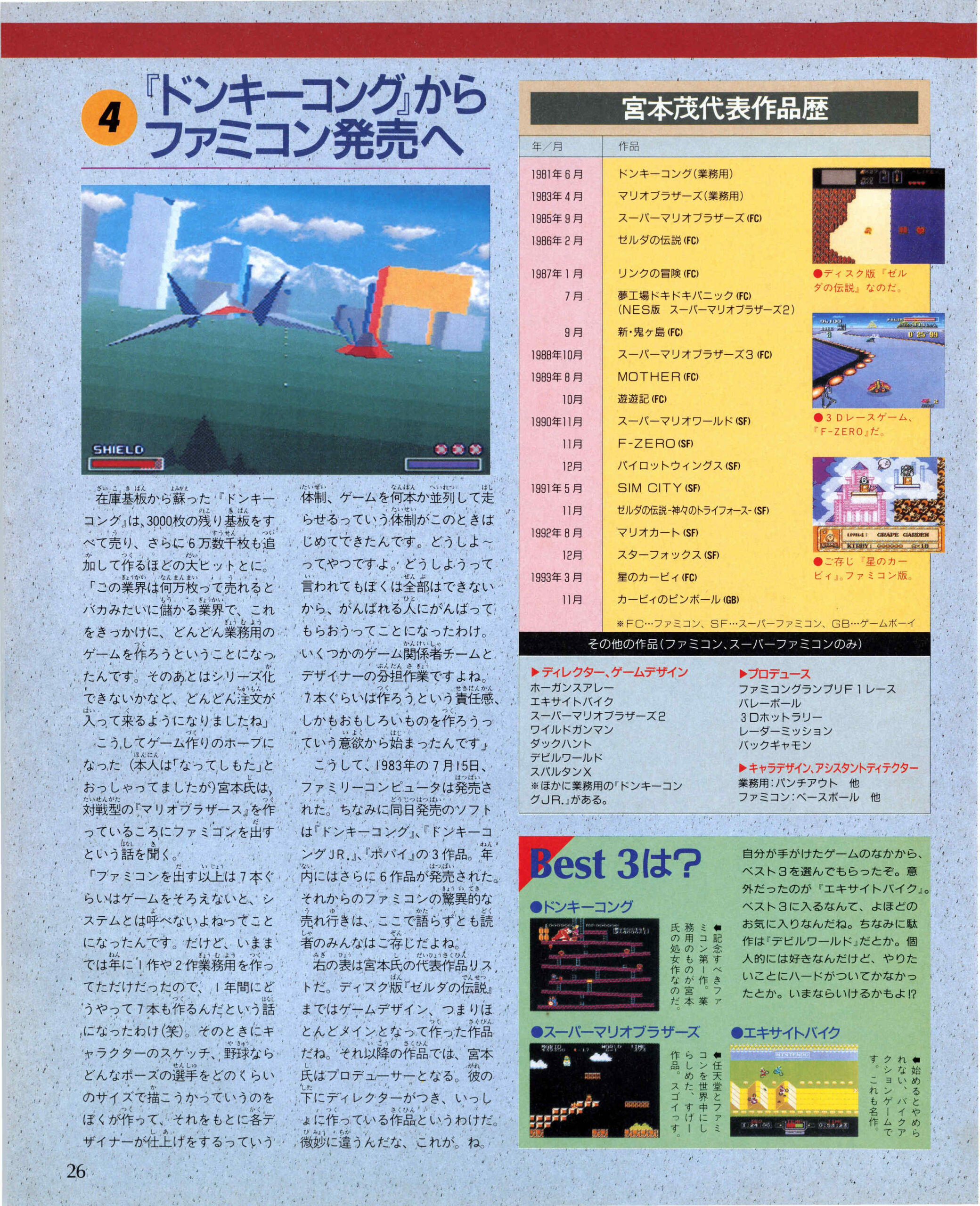
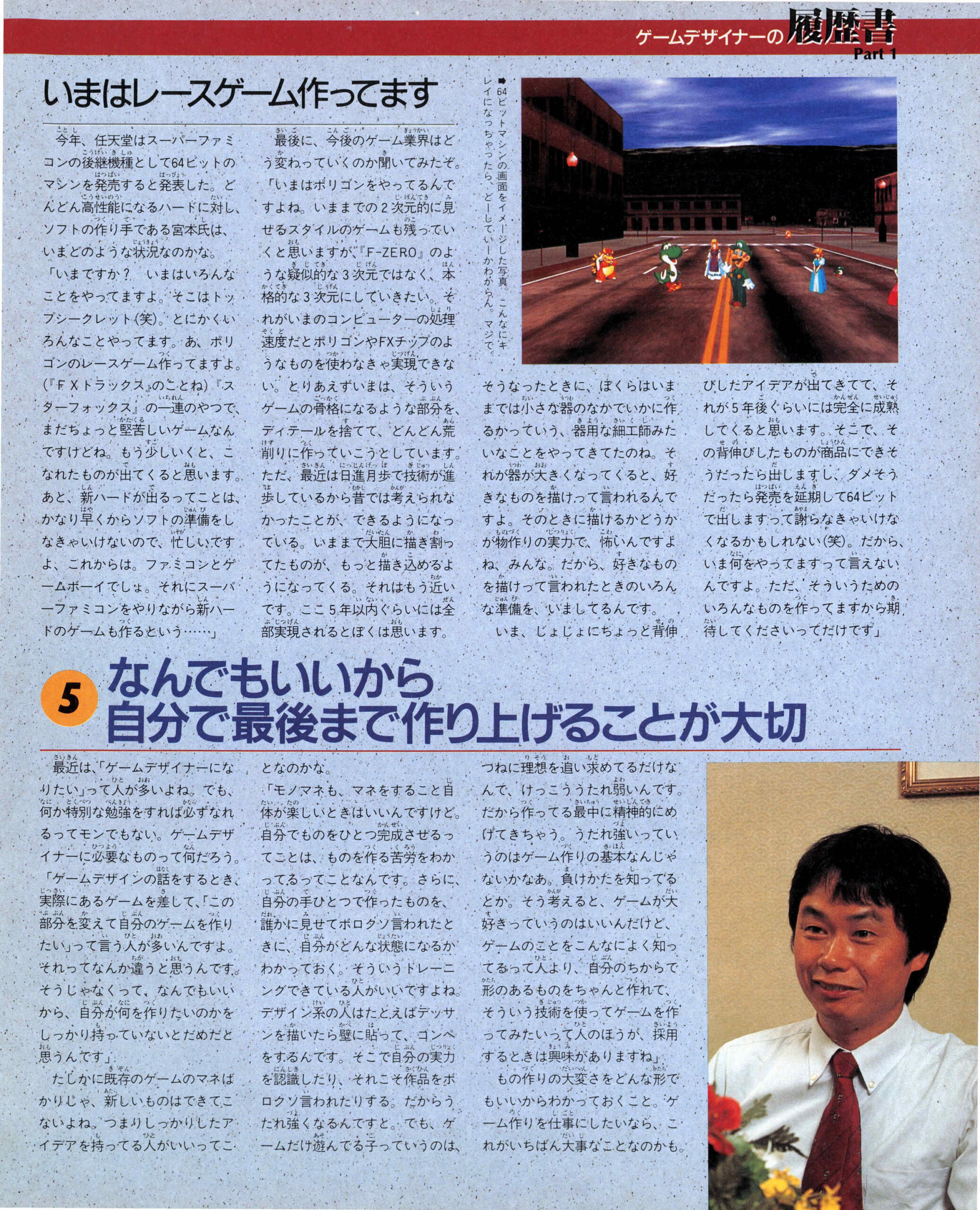
Notes: In the second picture you can see an illustration of the elephant hangar that Mr. Miyamoto brought to his interview at Nintendo, as told in All Your Base Are Belong to Us: How Fifty Years of Videogames Conquered Pop Culture. Scans are by Bultro.
1994
Otaku
Publication Date: 1994
Subject(s): Mario’s design, the competition, budgets
Format: Interview
People: Unknown interviewer, Shigeru Miyamoto
Video:
Translator: Game Escape
Notes: This is a segment of a French documentary that was later dubbed in German. The subtitles are in English. I couldn’t find a more precise release date than 1994. Nintendo Soup seems to have also translated this.
Summary: He is 40 years old.
He wanted to make an Italian character with a mustache. They wanted Mario to stand out so he exaggerated the mouth, nose, and eyes.
Comparing Mario and Mickey Mouse is just an idea the media had. Mickey is 50, Mario will have to be that old before we can compare them.
The real competition is between the developer and the customer.
When kids are not playing video games they are imagining them, using their sense of fantasy. This is useful as an adult.
Super Mario Bros. 3 sold 12 million in the United States and Canada, 3 million in Japan. One third of families has a game.
He is concerned about becoming less creative. Nintendo’s budgets are unlimited. Working independently would be risky. He’s not sure if he is a creator or a manager.
Introduction to Game Design
Publication Date: 1994
Subject(s): Being a game designer and director, game design, F-Zero, working with others
Format: Essay
People: Shigeru Miyamoto
Link: https://shmuplations.com/1994gamedevs/
Archive Link: https://web.archive.org/web/20220118225849/https://shmuplations.com/1994gamedevs/
Translator: shmuplations
Notes: Introduction to Game Design is a Japanese book that features essays written by several people involved in the game industry. “Game system” seems to be an equivalent term for a game engine.
Summary: Making Mario didn’t feel like making a computer game, it felt like making a toy.
There’s little point in making a game that doesn’t change the gameplay system, a Mario game that just changes the levels wouldn’t be very good.
At Nintendo they start with a team of three or four working on a game and add people until they reach 20 or so. Making the new game system is 60% of the work.
They needed a new racing game for the Super Nintendo Entertainment System. Early versions of F-Zero had a horizontal view., but that didn’t allow for bank curves, which wouldn’t be interesting. Adding tires would double the memory so they changed the cars to hovercrafts.
A game has two or three minutes seize the player’s heart.
They don’t add graphics until they’ve polished the core gameplay. If they can’t make the core good they throw it away. Those kinds of failures are important.
They get lots of letters from children with their game ideas, which are usually similar to Mario or Dragon Quest games with a different story. Stories are not the heart of a game, but they only come after the game system. Aspiring designers don’t need to use their imaginations on coming up with stories, they should start from the fundamentals.
Movie directors can’t refilm footage they don’t like, but games can be changed up to the very end. Since changing a small part of a game can change it drastically you can’t rest until it’s over. Don’t give up until the end.
Game directors need to know enough about programming to convince the programmers, otherwise they may evade your suggestions. When you ask a programmer why something isn’t possible, they may ask why you’d want to do that. This can reveal a new way to solve the problem.
You have to have thick skin in game design, you will be sharing your work with people. Ask yourself if you truly enjoy creating things.
Game Strategy Guide: SFC Kirby Bowl (untranslated from Japanese)
Publication Date: 1994
Subject(s): Kirby’s Dream Course
Format: Essay
People: Kensuke Tanabe, Takashi Saito, Satoru Iwata, Shigeru Miyamoto
Link: https://twitter.com/ObscureKirby/status/1657844258211069956
Archive Link: https://web.archive.org/web/20230602233859/https://twitter.com/ObscureKirby/status/1657844258211069956
Scan:

Notes: The title is a machine translation. This is from a guide for Kirby’s Dream Course.
Game Over: How Nintendo Conquered The World
Publication Date: March 29, 1994
Subject(s): Donkey Kong, Mario
Format: Transcribed interview
People: David Sheff, Shigeru Miyamoto
Notes: There is a lot of historical and biographical information about Mr. Miyamoto in this book, much of which probably came from interviews, but I will only be summarizing some of what is directly quoted.
Summary: Donkey Kong was meant to be not repulsive and to be the pet of a laid-back guy.
Noses say a lot about a character.
Mario had a hat partially because he’s not good at making hairstyles.
Mario makes adults feel primal, like a child. Adults are children with ethics.
While living in an apartment there was a building with a manhole cover mounted on it. He would wonder why it was there and where it led.
Some people say that video games are bad for you, but they said the same thing about rock ‘n’ roll.
Total: Shigeru Miyamoto/Game Players Shigeru Miyamoto Bares All
Publication Date: April, 1994/May, 1994
Subject(s): Mario, Super Mario Bros., The Legend of Zelda, Sonic the Hedgehog, graphics versus game play
Format: Transcribed interview
People: Frank O’Connor, Gunpei Yokoi, Shigeru Miyamoto
Scans:
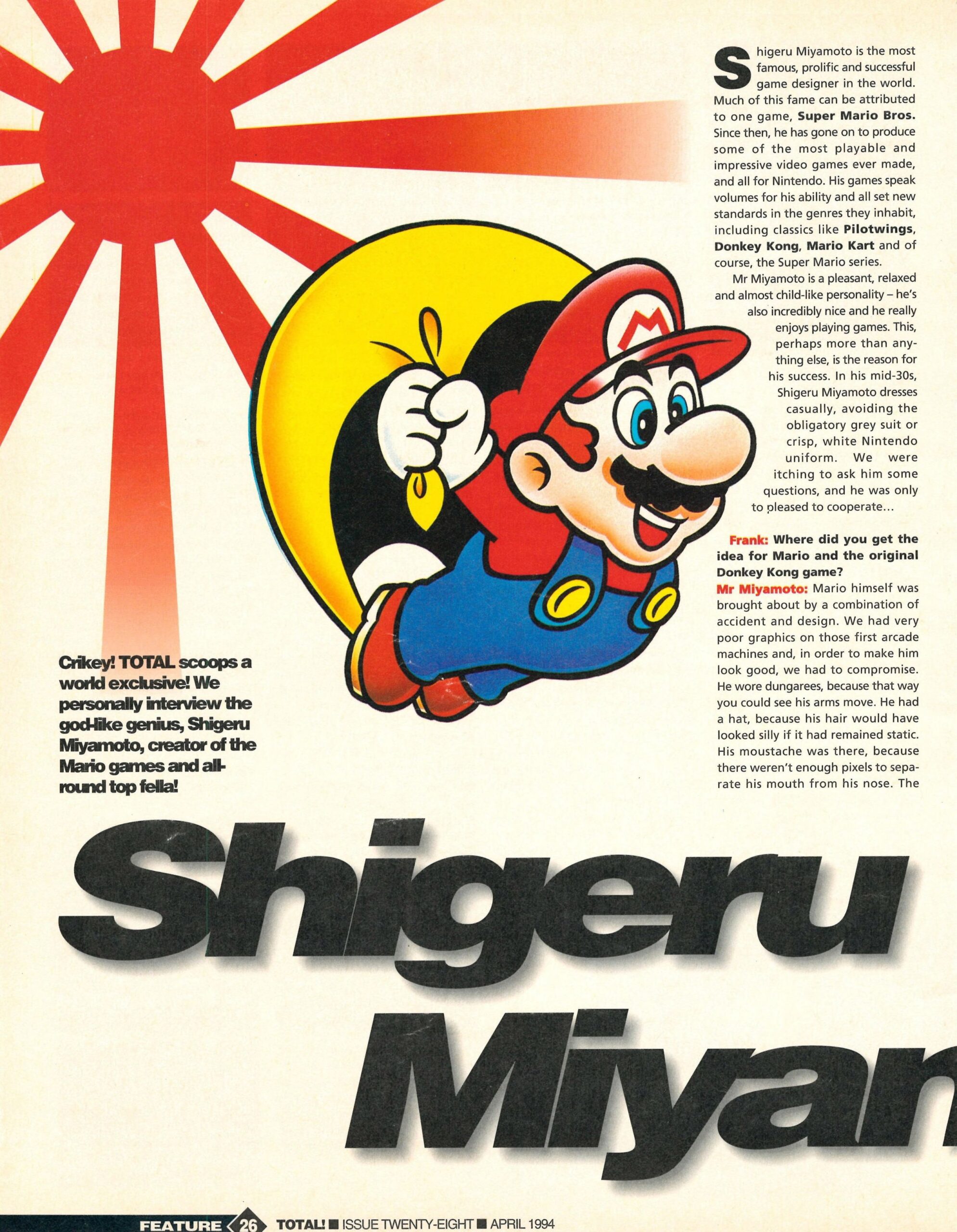
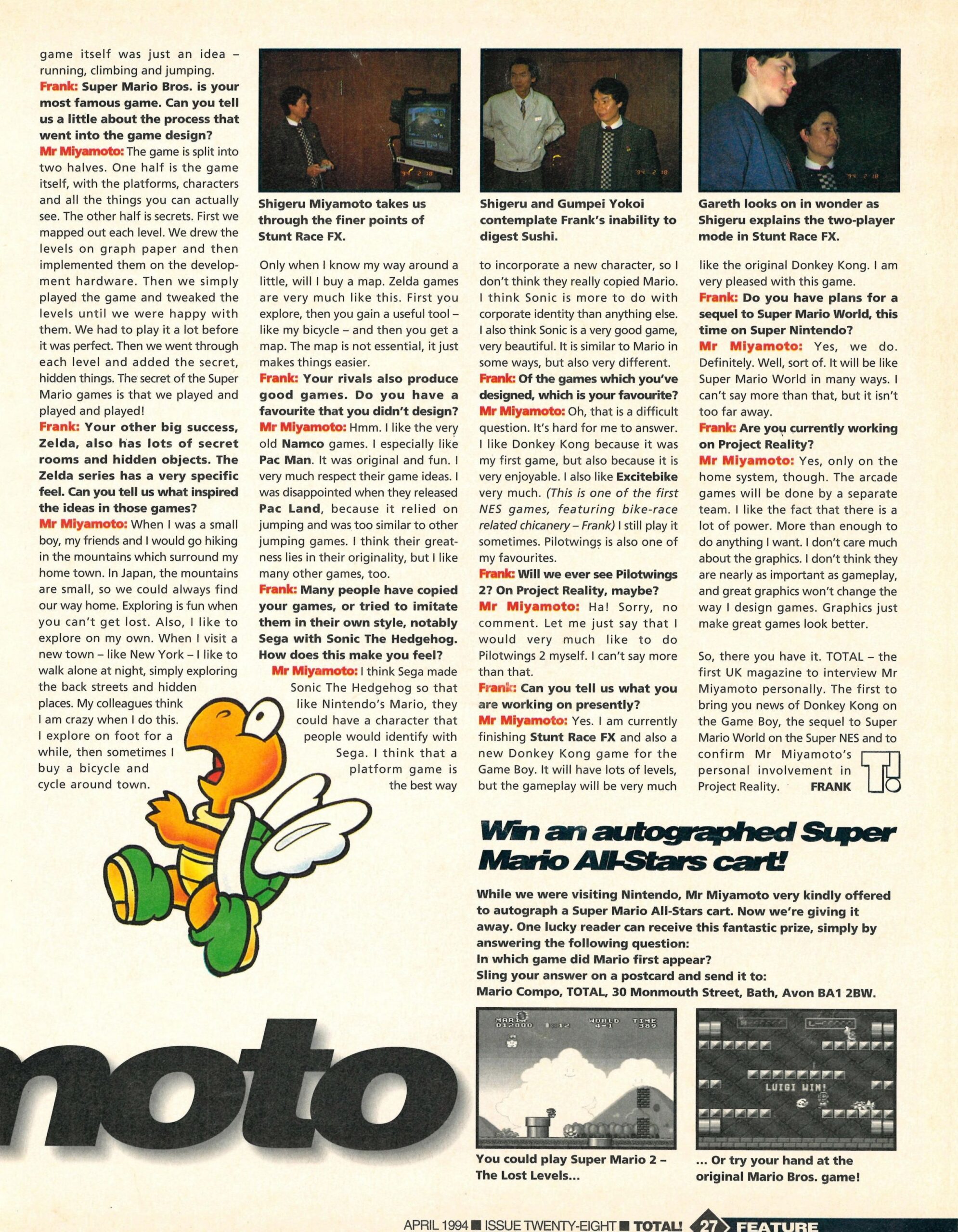


Notes: Gareth Bailey won a competition and got to visit Konami and Nintendo headquarters, and can be seen in some of the photos. Total claims to be the first British magazine to visit Nintendo and visited the actual game development area. Game Players ran the same interview a month later. Scans by RetroCDN and Retromags.
Summary: Mario’s design was the result of accident and design. He wears dungarees so you can see his arms move, a hat because it would look bad if his hair didn’t move, and he has a mustache because there wasn’t room to separate his mouth and nose.
Super Mario Bros. has two halves, one half is the game itself, and the other is the secrets. They drew the levels out with graph paper and implemented that on development hardware. From there they played the game and tweaked things as necessary. Then they add the secrets. They have to play the levels a lot to get them perfect.
He hiked through the mountains as a boy. It’s fun to explore when you can’t get lost, he likes to walk around New York at night on his own. Sometimes he buys a bike to ride around town. Only after he explores for a bit will he buy a map. The Legend of Zelda games are like this.
He likes old Namco games, like Pac-Man. Pac-Land was disappointing since it was similar to other jumping games. Pac-Man’s greatness comes from its originality.
He thinks Sega made Sonic the Hedgehog so they’d have a character people can relate to. Platform games are the best way to use a new character, so they didn’t copy Mario too much. Sonic the Hedgehog is a very good and very beautiful game, similar to Mario games in some ways and different in others.
He likes Donkey Kong since it was his first game. He likes Excitebike and still plays it. Pilotwings is a favorite.
He’d like to do a Pilotwings 2, but no comment on making one.
He’s finishing up Stunt Race FX and a Donkey Kong game for Game Boy which will play like the original.
There will be another Mario game for the Super Nintendo Entertainment System, sort of. It could be announced before Christmas.
He’s working on N64 games, but no arcade games. It’s powerful enough to do anything he can think of. Graphics aren’t as important as game play. Graphics will make the games he makes look better, but won’t change his design.
Legend of Zelda: Sound and Drama
Publication Date: June 22, 1994
Subject(s): The Legend of Zelda, The Legend of Zelda: A Link to the Past
Format: Transcribed interview
People: Unnamed interviewer, Shigeru Miyamoto
Link: https://shmuplations.com/zelda/
Archive Link: https://web.archive.org/web/20140223014926/http://shmuplations.com/zelda/
Translator: shmuplations
Notes: Legend of Zelda: Sound and Drama contains the soundtrack to The Legend of Zelda and The Legend of Zelda: A Link to the Past as well as an audio drama. This interview is from the liner notes.
Summary: The Legend of Zelda was made as a launch title for the Famicom Disk System. They were working on Super Mario Bros. at the same time for part of development.
They had lots of ideas for how to utilize the Disk System such as naming your character, better music, and saving your progress.
They were concerned about players figuring out what to do and solving the puzzles. They used some Super Mario Bros. programmers for the final stretch.
Zelda games are about a boy who grows into a hero. He wanted to make a game where you could explore the world. In adventure and role-playing games you advance the story with dialog, but they wanted players to experience moving the character with the controller.
He likes the Darknut soldiers, because of the name and his behavior, which was elaborate for the time. In A Link to the Past they’ll walk around until Link enters their line of sight. If Link makes a sound they’ll investigate. They had to make sure there weren’t too many on screen on once so the game wouldn’t slow down.
Nintendo Magazine System: Shigeru Miyamoto
Publication Date: July, 1994
Subject(s): Inspirations, his characters, Punch-Out!!, violence in games, The Legend of Zelda, Link, Zelda, The Legend of Zelda: A Link to the Past
Format: Transcribed interview
People: Unnamed Nintendo Magazine System interviewer, Shigeru Miyamoto
Pictures:

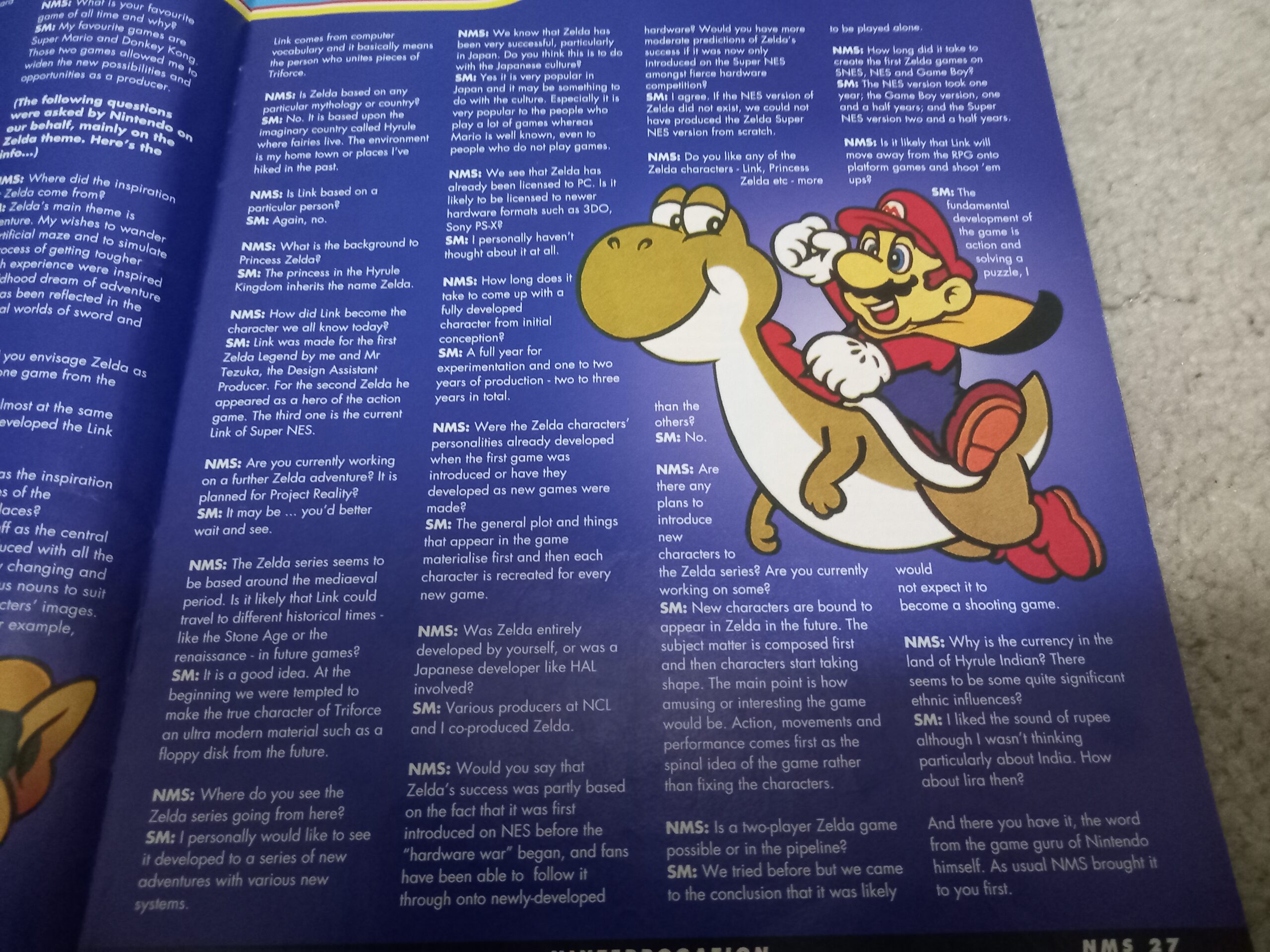
Notes: This is from the Australian Nintendo Magazine System. Online scans of this issue omit this interview but reddit user blake3683 took pictures of their copy of the magazine and sent them to me for the archive.
Summary: He was a student at Kanazawa Art and Craft University before he was hired at Nintendo. He has wanted to design toys, be a cartoonist, or be a musician.
Western Gun and Invader inspired him to make a ball game and animations.
Mario, Link, and Kirby were made due to a willingness to improve and to make games until they are satisfied.
The project he enjoyed the most was transferring SimCity to the SNES. The Legend of Zelda was the most challenging game he’s made. Super Mario Bros. was the most rewarding.
He is attached to his characters, he gets nervous when others work with them. He’s happy when they are drawn well.
He co-produced Punch-Out!! for the arcade.
It’s OK if violent scenes are important to a game scenario, but violence and killing shouldn’t be the only thing you do in the game.
He doesn’t have any personal video game projects, but he does like to play softball, swim, and ski. He likes to play the piano and guitar. There is no end to making video games so he has no plan to make the ultimate game. He’ll go with the trends in game production.
His favorite video games are Donkey Kong and Super Mario Bros., which widened his opportunities.
The theme of The Legend of Zelda series is adventure. He wants to explore a maze and get tougher with experience.
The name Link comes from computer vocabulary, it means the person who unites the Triforce. Link is not based a on specific person.
The princess of Hyrule inherits the name Zelda.
He and Takashi Tezuka designed Link.
At first they were tempted to make the Triforce something like a floppy disk from the future.
The Legend of Zelda series is popular in Japan, and popular among people who play a lot of video games. Mario is well known to people who don’t play games.
He hasn’t thought about licensing The Legend of Zelda games to the 3DO or PlayStation.
Making a new character requires a year of experimentation and one or two years of production.
He co-produced The Legend of Zelda with other Nintendo producers.
They wouldn’t have been able to make The Legend of Zelda: A Link to the Past without The Legend of Zelda.
Action, movement, and performance comes before making new characters.
They tried making a two-player The Legend of Zelda, but came to the conclusion it was more likely to be played alone.
The Legend of Zelda took one year to make, The Legend of Zelda: Link’s Awakening took a year and a half, and The Legend of Zelda: A Link to the Past took two years.
The Legend of Zelda series is fundamentally action and puzzle-solving focused, he doesn’t think it will become a shooting game.
He liked the sound of “rupee”, he wasn’t thinking of India.
Donkey Kong 1994 Wonder Life Special APE Inc. Official Nintendo Guide
Publication Date: August 20, 1994
Subject(s): Donkey Kong (1994)
Format: Transcribed interview
People: Unnamed interviewer, Takao Shimizu, Masayuki Kameyama, Yoshiaki Hoshino, Masayuki Hirashima, Hideo Kon, Takaya Imamura, Kenta Usui, Shigeru Miyamoto
Link: https://shmuplations.com/dk1994/
Archive Link: https://web.archive.org/web/20240301030349/https://shmuplations.com/dk1994/
Scans:

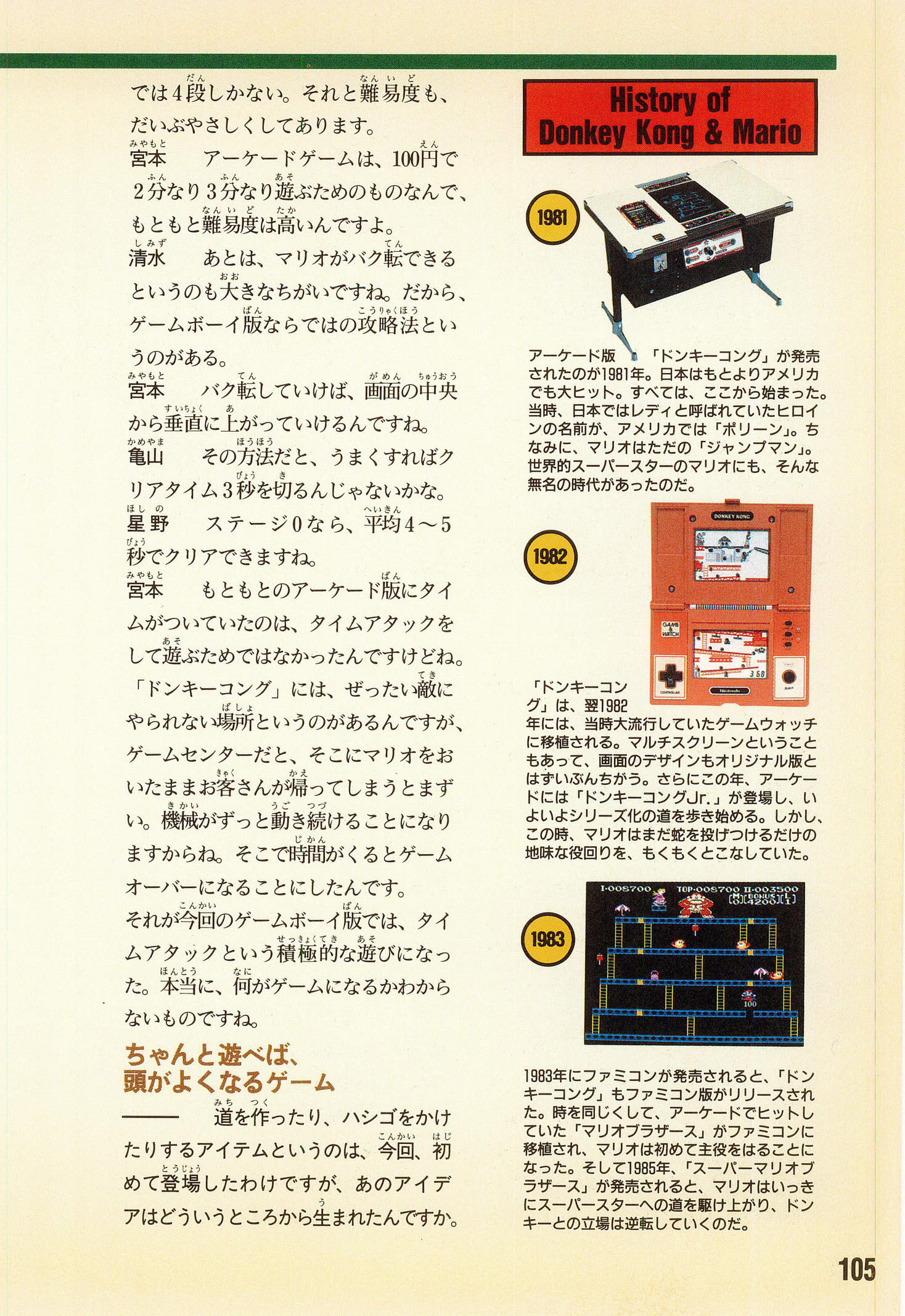


Translator: shmuplations
Notes: The scans were uploaded to the Internet Archive by Comfort Food Video Games. I don’t know what magazine the screenshot is from, but you can see the cut squirrel boss on TCRF.
Summary: There was talk about making a Donkey Kong game to celebrate the 10th anniversary of the first game, but all that happened was Donkey Kong Jr. being in Mario Kart. Now on the 13th anniversary they have this game.
Donkey Kong (1994) is a re-envisioning of the original.
The original Donkey Kong arcade game has a timer because there are safe spots where Mario can’t be damaged by enemies. Time attacks are a part of this new game.
The placeable ladders and platforms were from a stage building mode that was cut because it was too difficult for children to understand.
It’s difficult to keep track of fast moving objects on a Game Boy so they made Donkey Kong (1994) more of a puzzle game with levels that are about one and a half screens. This requires the levels to be dense, so it’s more fun to have puzzle elements.
Donkey Kong (1994) requires more precise movements than other Super Mario games. He wants people to memorize the levels. It will probably improve your memory and make you smarter.
Donkey Kong was originally Mario’s pet who kidnapped Pauline to anger Mario. They aren’t enemies, which is why the original arcade game isn’t about killing Donkey Kong.
The Mushroom Kingdom is perhaps just outside of Donkey Kong’s homeland. Maybe Mario met Peach there while he was still with Pauline.
Action games have two elements: completing the goal, and all the things you can do in pursuit of that goal. It’s important that it’s fun to move. They added as many different moves for Mario as possible. They decided not to unlock moves over time because it would be unfair to deny them to people who aren’t able to get very far.
They wanted to expand on how Mario would be set on fire in Mario Bros. when he touched a flame, so they added lots of reactions like that to this game.
A squirrel boss that flew around was cut.
They’d prefer players keep the default palette when playing with the Super Game Boy. They’ll reflect on why they’re so touchy if people change them.
Please try to beat the game without looking at the strategy guide and don’t just try to mash buttons.
1995
Unknown (Yoshi’s Island interview)
Publication Date: 1995
Subject(s): Super Mario World 2: Yoshi’s Island
Format: Transcribed interview
People: Unnamed interviewer, Shigeru Miyamoto
Link: https://shmuplations.com/yoshi/
Archive Link: https://web.archive.org/web/20160412210320/http://shmuplations.com/yoshi
Translator: shmuplations
Notes: It’s possible this interview appeared in an official guide for the game, but I could find no information about its origin.
Summary: There was room for Yoshi to grow as a character after Super Mario World.
If they had a Yoshi control scheme and a Mario control scheme it would be confusing.
Since a game where you controlled Mario would sell more they added the Super Baby Mario power-up. It originally turned Baby Mario into regular adult Mario.
They made the story together as a team. They always focus on the gameplay first, then the story at Nintendo.
The first two years of development were spent doing experiments and it’s taken about five years total. The idea that really caught on was not dying when you get hit.
They wanted to include everything they could since it was going to be the last Mario game for the Super Nintendo Entertainment System. It’s designed for the levels to be replayed several times.
It pained him a bit to make a game where you aim to get 100%, but people seemed to be having fun during playtesting.
He was stressed during the development of Super Mario Bros. but he realized it would be a hit after he saw people anxiously waiting their turn to play.
Super Mario Bros. 2 started with someone making a difficult Super Mario Bros. level for fun, but they liked it enough to make a whole game like that.
Super Mario Bros. 3 is the real sequel to Super Mario Bros.
They wanted Super Mario World to feel upgraded and more impressive. He was happy with the graphics and the three directional scrolling.
With the next Mario game he wants to abandon some old but established ideas, like running into an enemy killing you.
He wants players to have as much freedom as possible.
He’s interested in the Rubik’s Cube. It’s deep and has endless variation. It’s something that grabs people’s attention. He’s not completely confident he can make innovative, timely, and relevant video games. He joined Nintendo to make something people would talk about and remember.
Next Generation: Why are Shigeru Miyamoto’s games so damn good?
Publication Date: February, 1995
Subject(s): Mario’s design and origins, exploration, secrets, Sonic the Hedgehog, Earthworm Jim, Pac-Man, appealing to a wide audience, Nintendo 64
Format: Transcribed interview
People: Unnamed Next Generation interviewer, Shigeru Miyamoto
Scans:
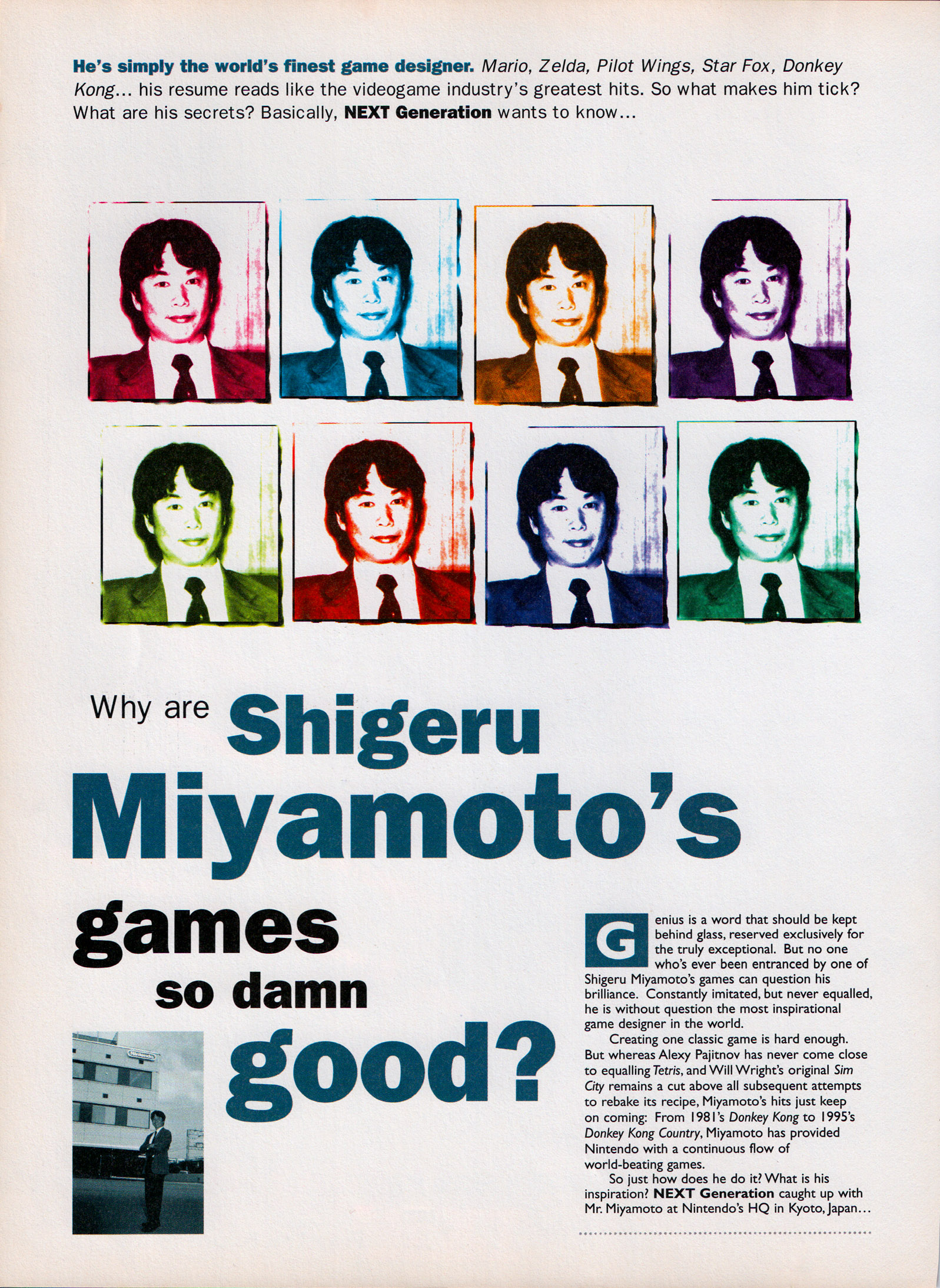
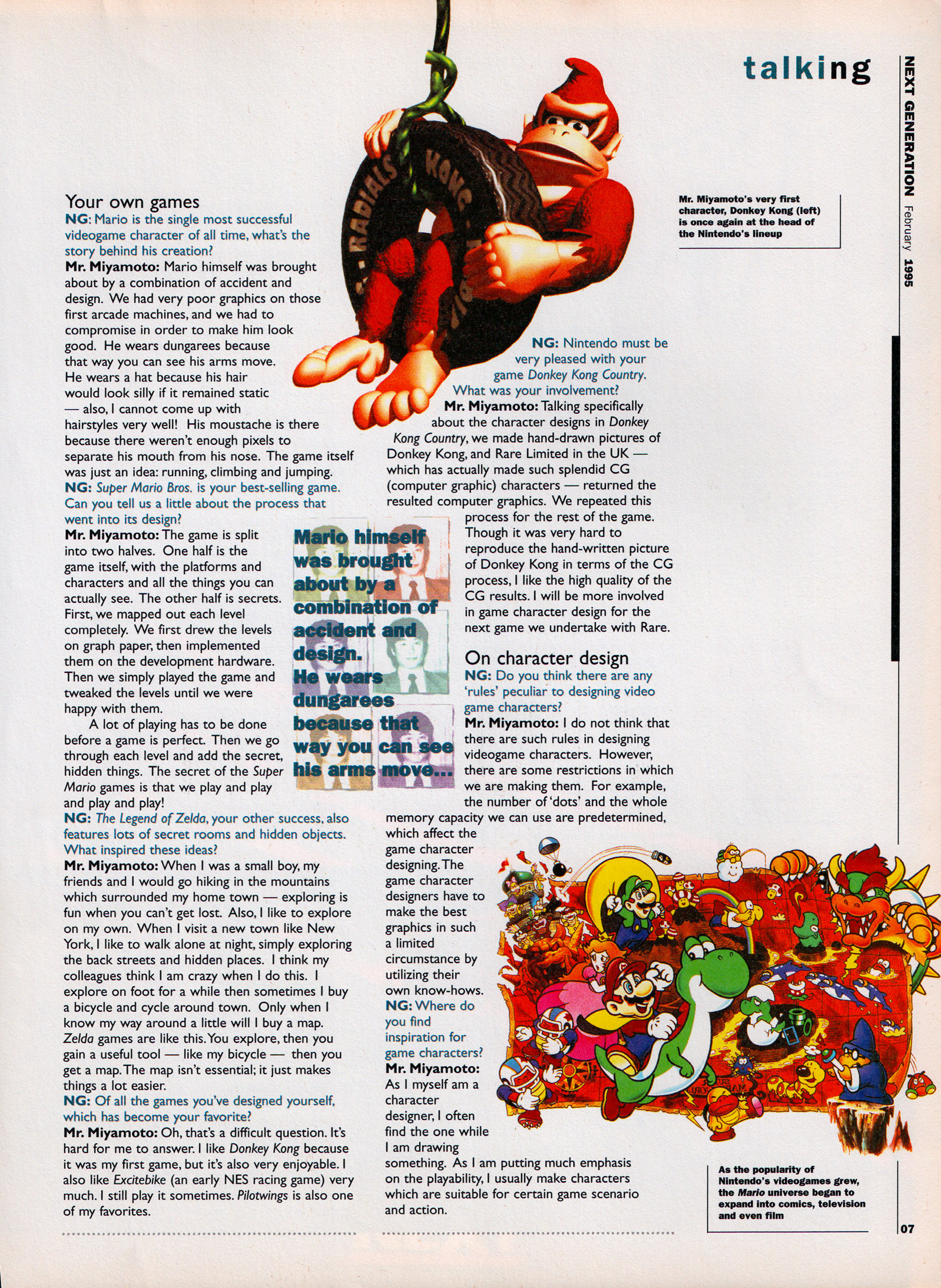
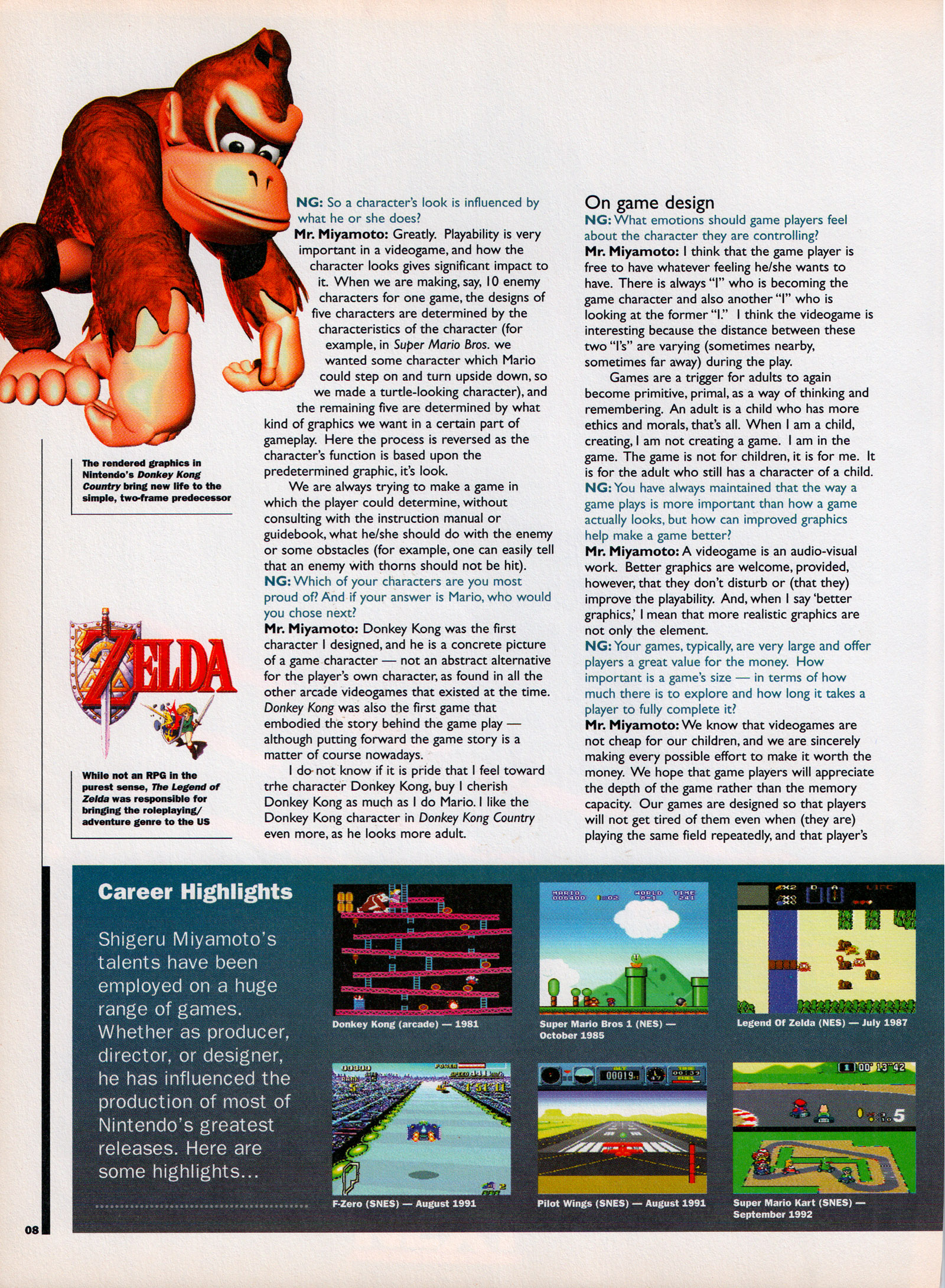
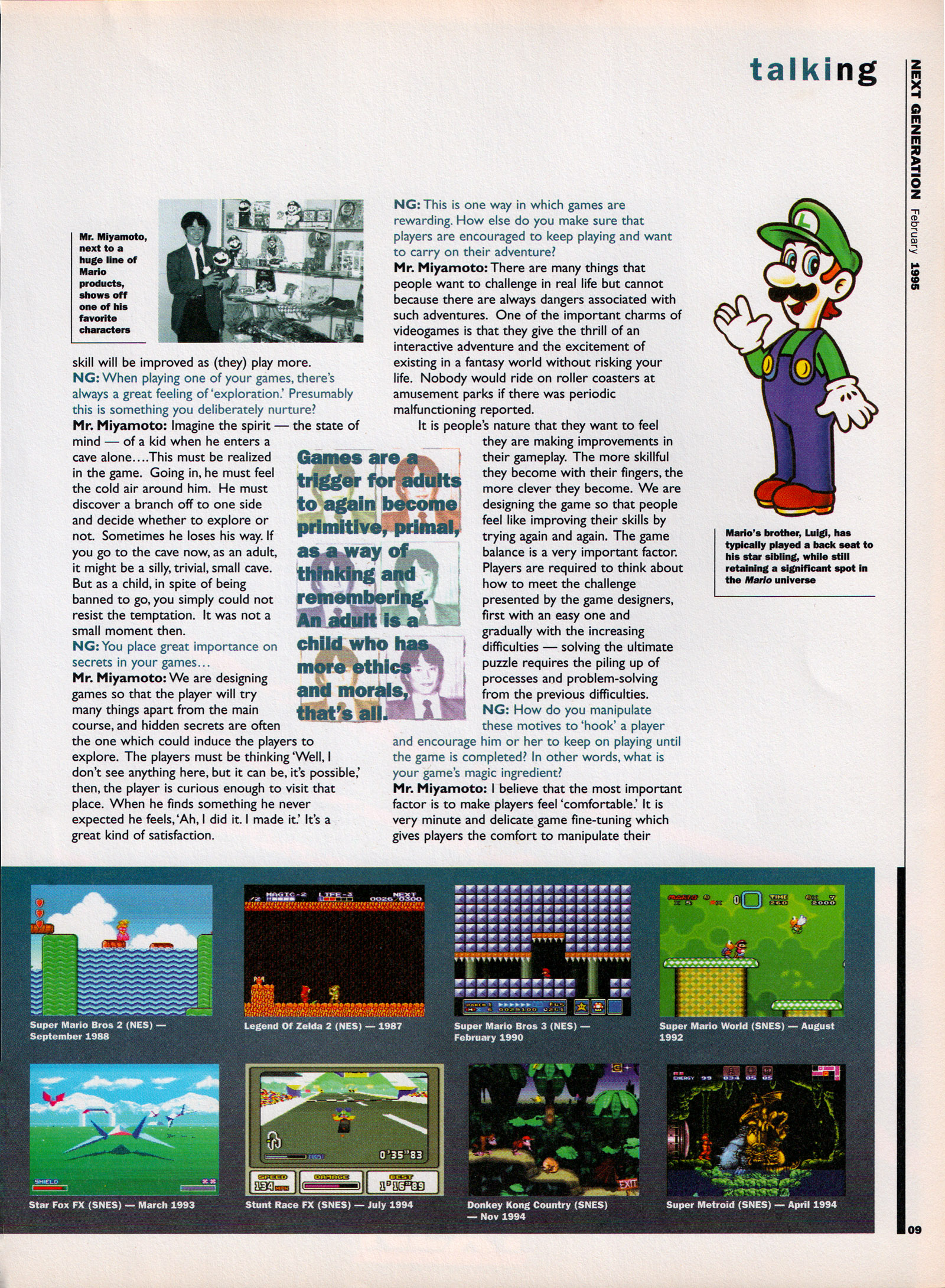
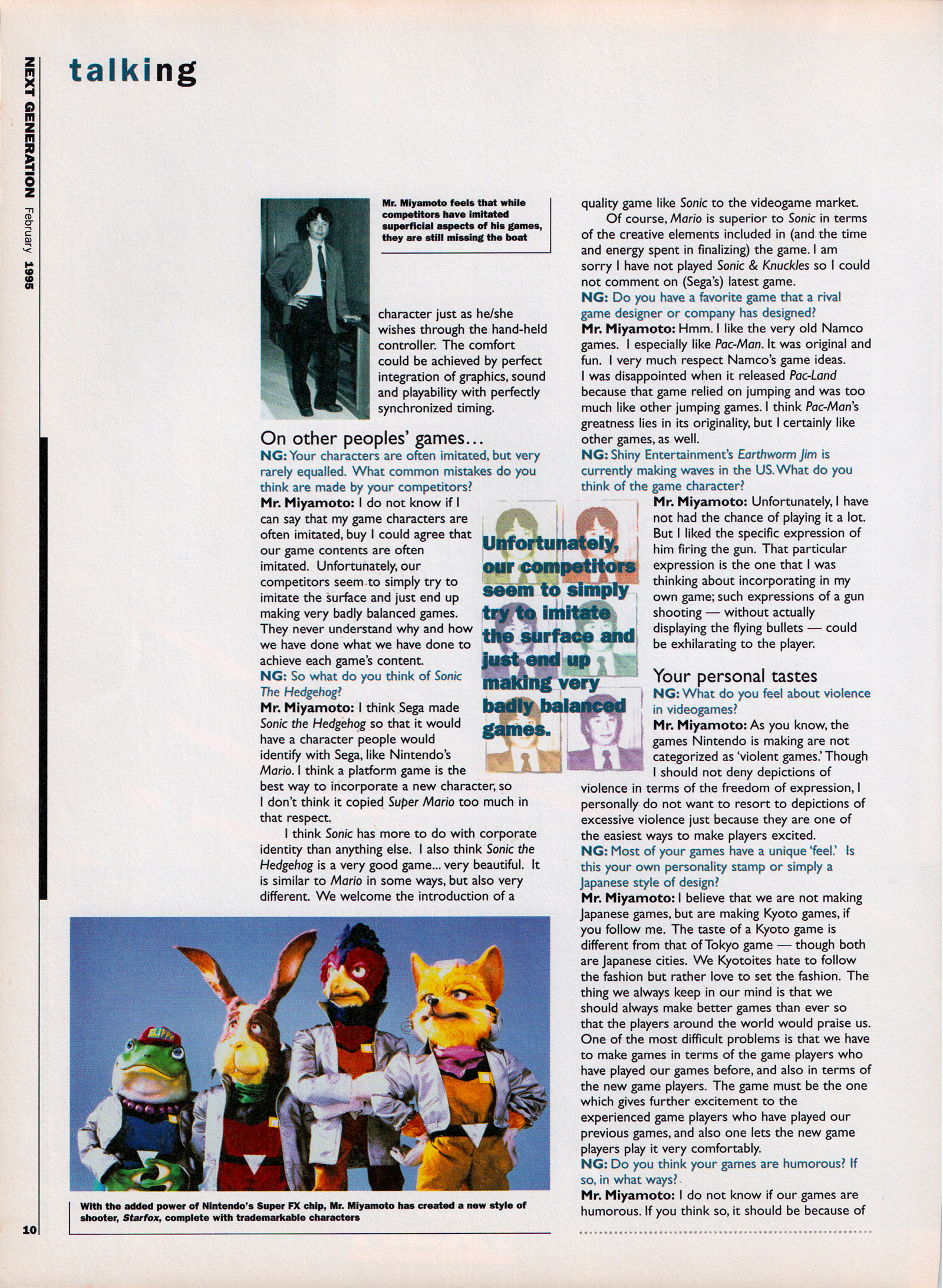
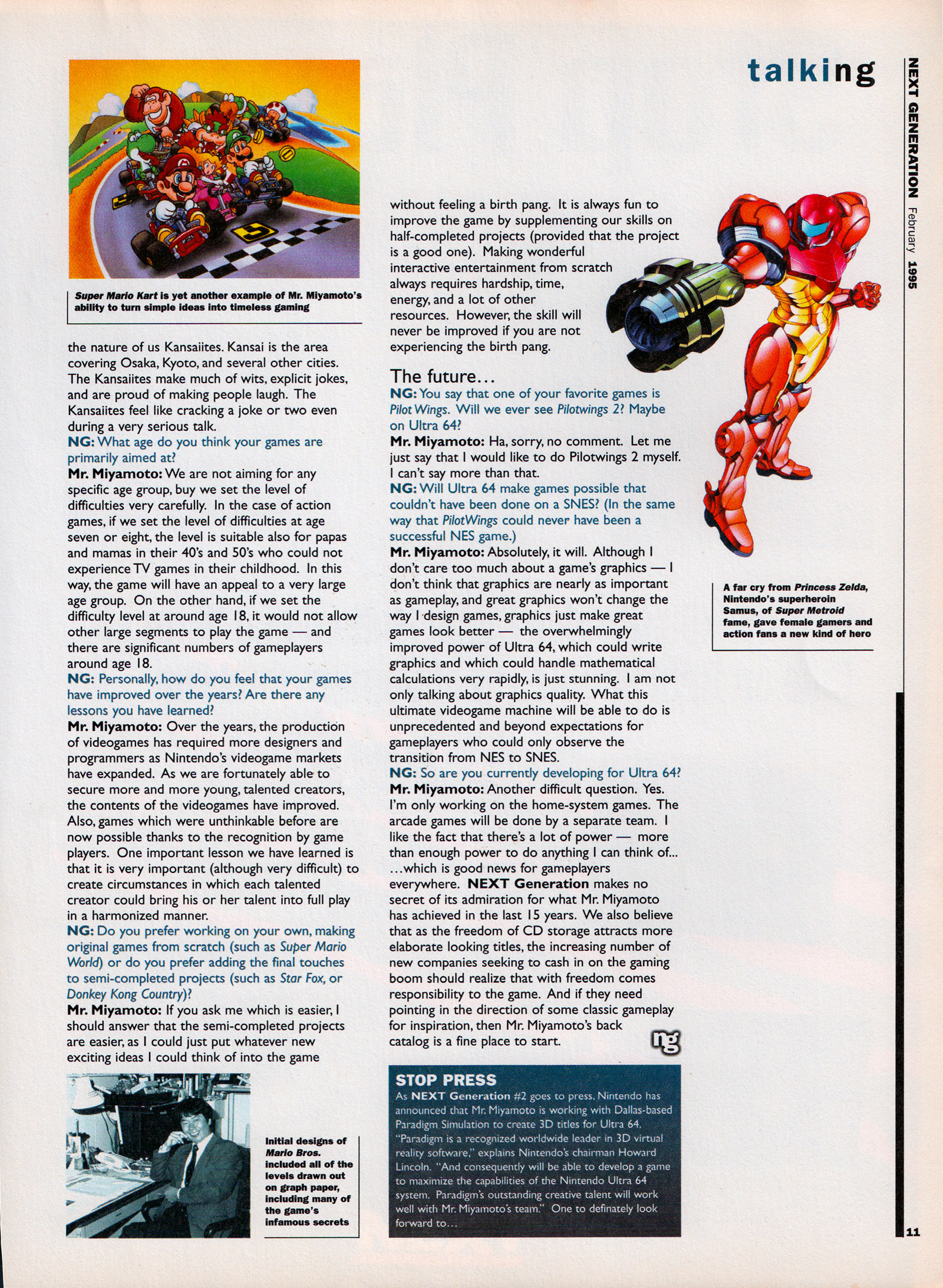
Notes: Scans by Retromags.
Summary: Mario wears dungarees so that you can see his arms move, and a hat because it would look silly if his hair didn’t move. He has a mustache because there wasn’t room to separate mouth and nose.
Super Mario Bros. has two halves: the game with the platforms, and the secrets. They drew the levels out on graph paper. They playtested them a lot. Then they added the secrets.
He explored the nearby mountains with his friends as a boy. He likes to walk alone in New York City and explore. When he knows his way around a bit he will buy a map. This is like The Legend of Zelda games, you explore and then get a useful tool.
It’s hard to say what his favorite game is. Donkey Kong was his first game and it is enjoyable. He also likes Excitebike and Pilotwings.
They drew pictures of the Donkey Kong Country characters and Rare made them in computer graphics.
When making characters the pixels and memory available are predetermined. He makes characters that will work in the kind of game they are for. If they make 10 enemies for a game, five will be designed around the player character’s abilities. The other five are based on the graphics for that part of the game. They try to make enemies that can be figured out without the instruction manual.
Donkey Kong was his first character, and is a concrete character. He cherishes Donkey Kong as much as Mario. Donkey Kong looks more adult in Donkey Kong Country.
There is an “I” that is the game character, and another “I” looking at the former “I”. The distance between them varies when playing a game. Games allow adults to become primitive, they are children with more morals.
Better graphics are fine as long as they do not disturb the playability of a game.
They know video games aren’t cheap, so they try to make them worth the money.
A game must capture the feeling a child has when entering a cave alone.
They try to include things in a game off the main course. It’s satisfying when a player finds something unexpected.
One of the charms of video games is doing things that you can’t do in real life, and not risking your life. People want to feel like they are improving. Balance is very important.
Players should feel comfortable, moving their character just as they wish.
He doesn’t know that his characters are imitated, but Nintendo’s games often are. Those people only copy the surface.
Sega made Sonic so they’d have a mascot. Platformers are a good way to use a new a character. Sonic the Hedgehog is a beautiful and good game that is similar to Mario games in some ways.
He likes Pac-Man, but Pac-Land was too much like other jumping games.
He likes how Earthworm Jim fires a gun, it doesn’t show the bullets. He was thinking of including something like that in one of his games.
He shouldn’t deny people’s right of expression, but he doesn’t want to use depictions of violence to get players excited.
They are making Kyoto games, not Japanese games. People in Kyoto love to set the fashion. One of their biggest difficulties is making games both for people who have played their games before and people who are new to games.
They don’t aim for a specific age group. If the difficulty of a game is set for eight year olds, it can also be played by parents in their 40s and 50s. If the difficulty is set for an 18 year old, not as many people would be able to play the game.
Working on games that are semi-completed is easier since he can just add his ideas in without a birth pang.
He would like to make a Pilotwings 2.
Graphics aren’t as important as gameplay. The Nintendo 64 will be stunning and unprecedented.
Electronic Games: The Top Bananas
Publication Date: May, 1995
Subject(s): Donkey Kong Country
Format: Transcribed interview
People: Steve Kent, Tim Stamper, Shigeru Miyamoto
Scans:
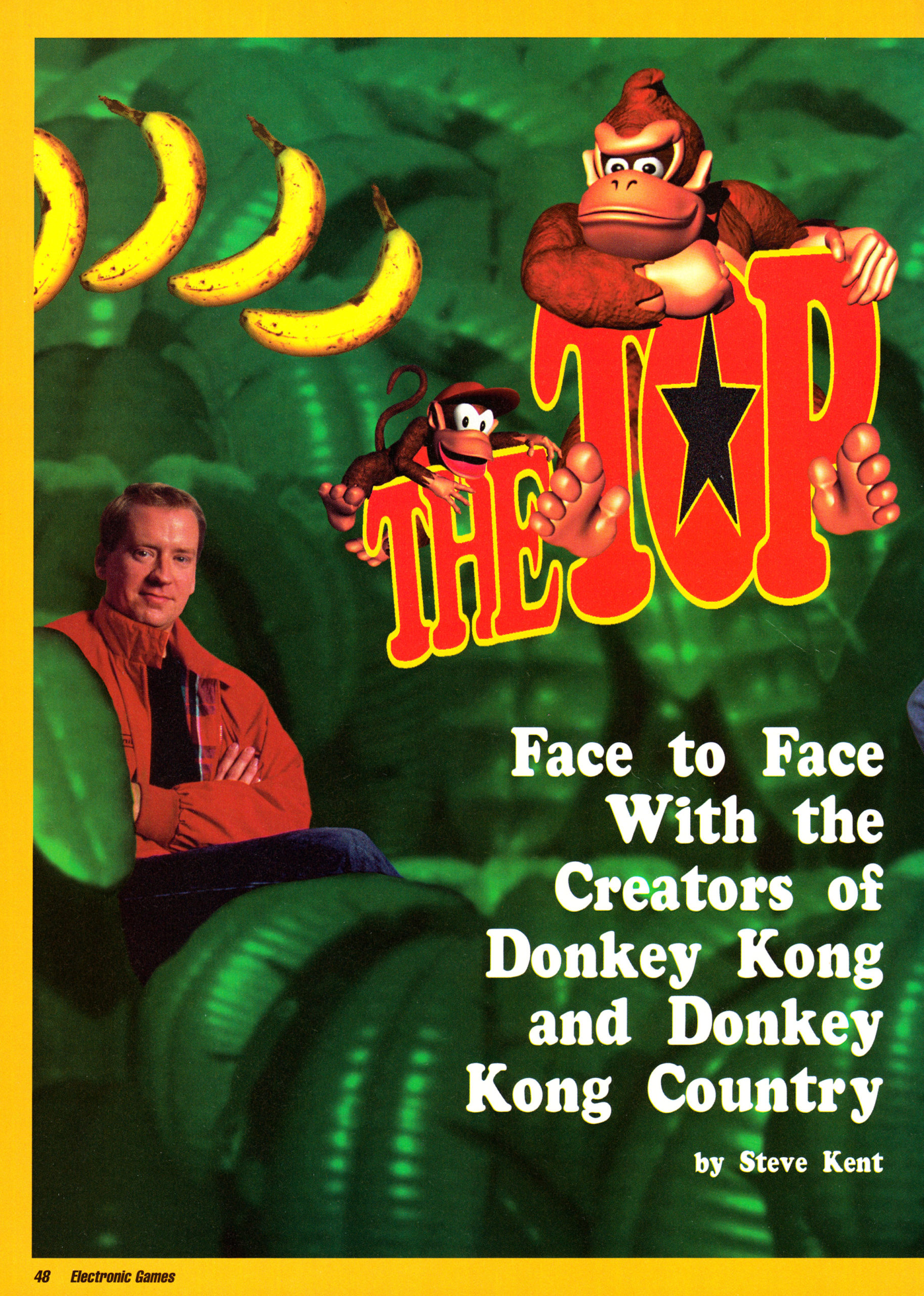
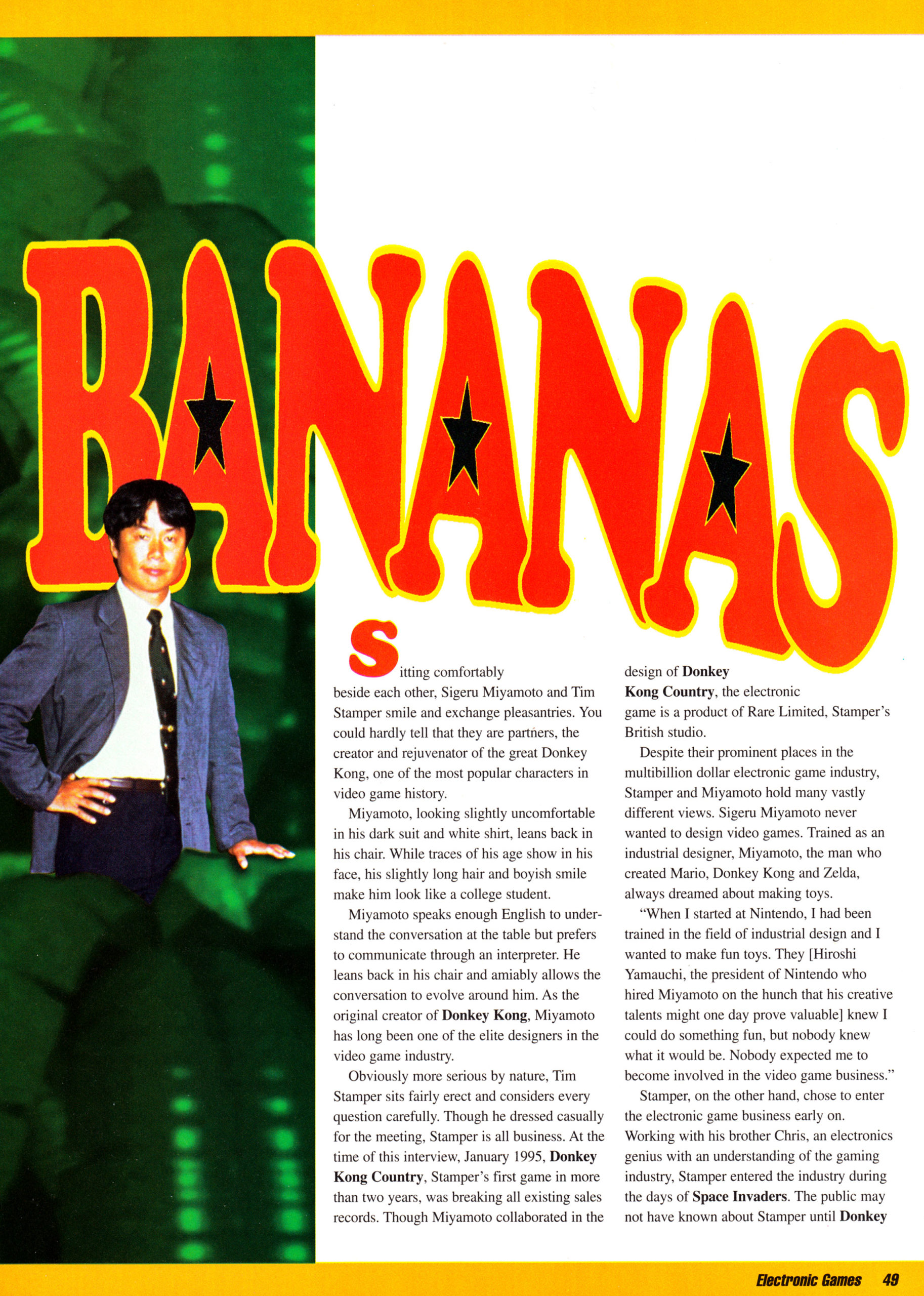

Notes: This interview was supposedly the origin of Mr. Miyamoto’s quote “Donkey Kong Country proves gamers will put up with mediocre gameplay if the art is good” for many years. Steve Kent, who conducted this interview, says in his 2001 book The Ultimate History of Video Games that Mr. Miyamoto “was a bit hard” on Tim Stamper and said the quote during the interview, but this is not reflected in this version published by Electronic Games.
Scans by RetroCDN.
Summary: When he started at Nintendo he wanted to make toys. Hiroshi Yamauchi knew he could do something fun, but no one expected it to be video games.
He was happy that Donkey Kong turned out so well.
Some of the games he played with friends when he was young had a winner chosen by another friend. That friend could change the rules as they wanted, but a computer will not change the rules. People forget about the human element of video games. Games are not made fun while thinking about business, his biggest barrier is when salespeople make decisions about which games are made.
He likes short games. His favorite is Pac-Man, though he wishes he had come up with SimCity.
Gaming has gone from the world of programmers to the world of designers.
Possibilities have opened up with better technology, they will be 3D in the future. TV screens are the wrong size and shape for video games.
If there was no game industry he would work in the toy or theme park industry. He would not make video games as a hobby for his friends.
Satellaview Tsūshin
Publication Date: May, 1995
Subject(s): Satellaview
Format: Transcribed interview
People: Reported on by Jack Yarwood, Unknown Satellaview Tsūshin interviewer, Shigeru Miyamoto
Scans:

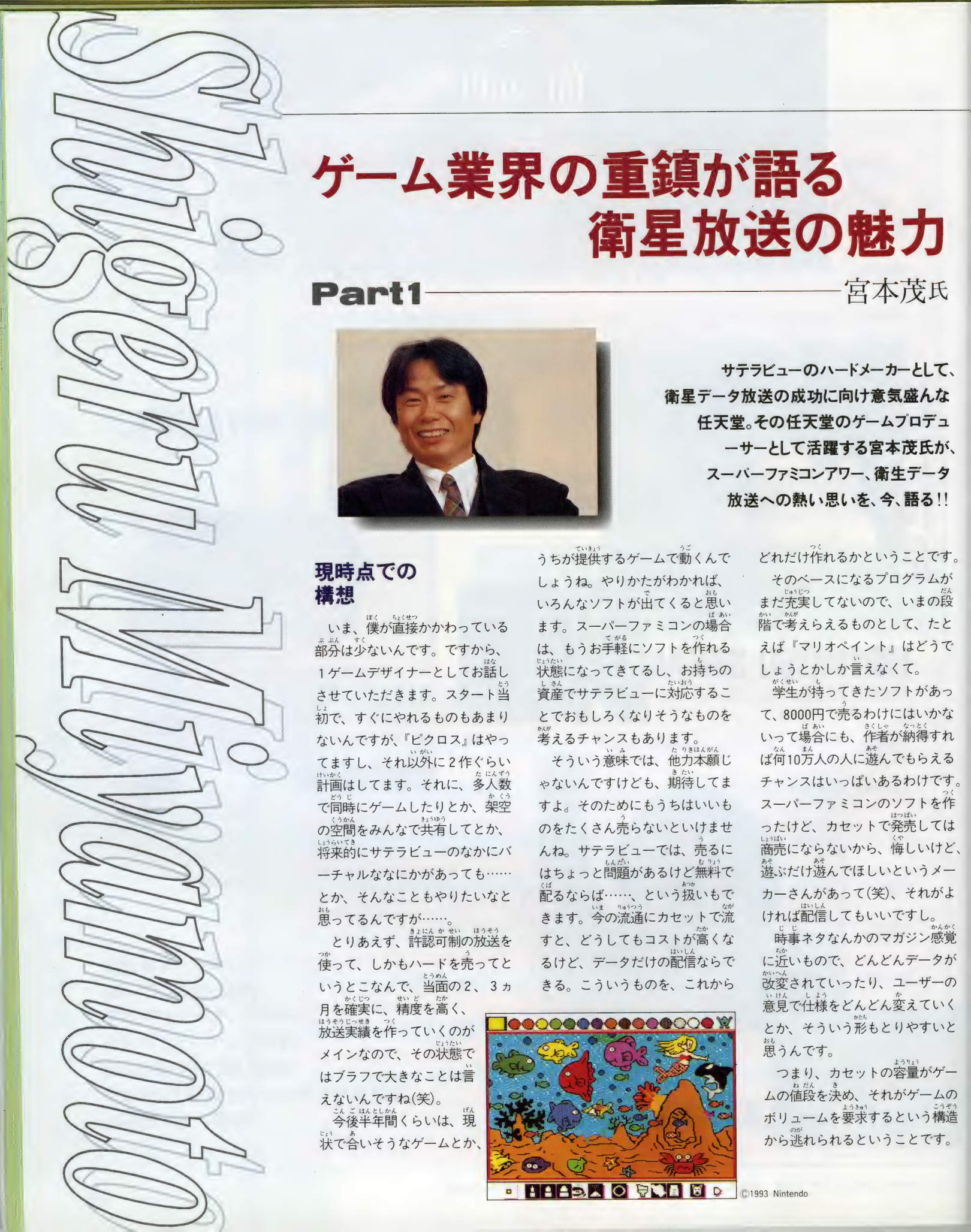
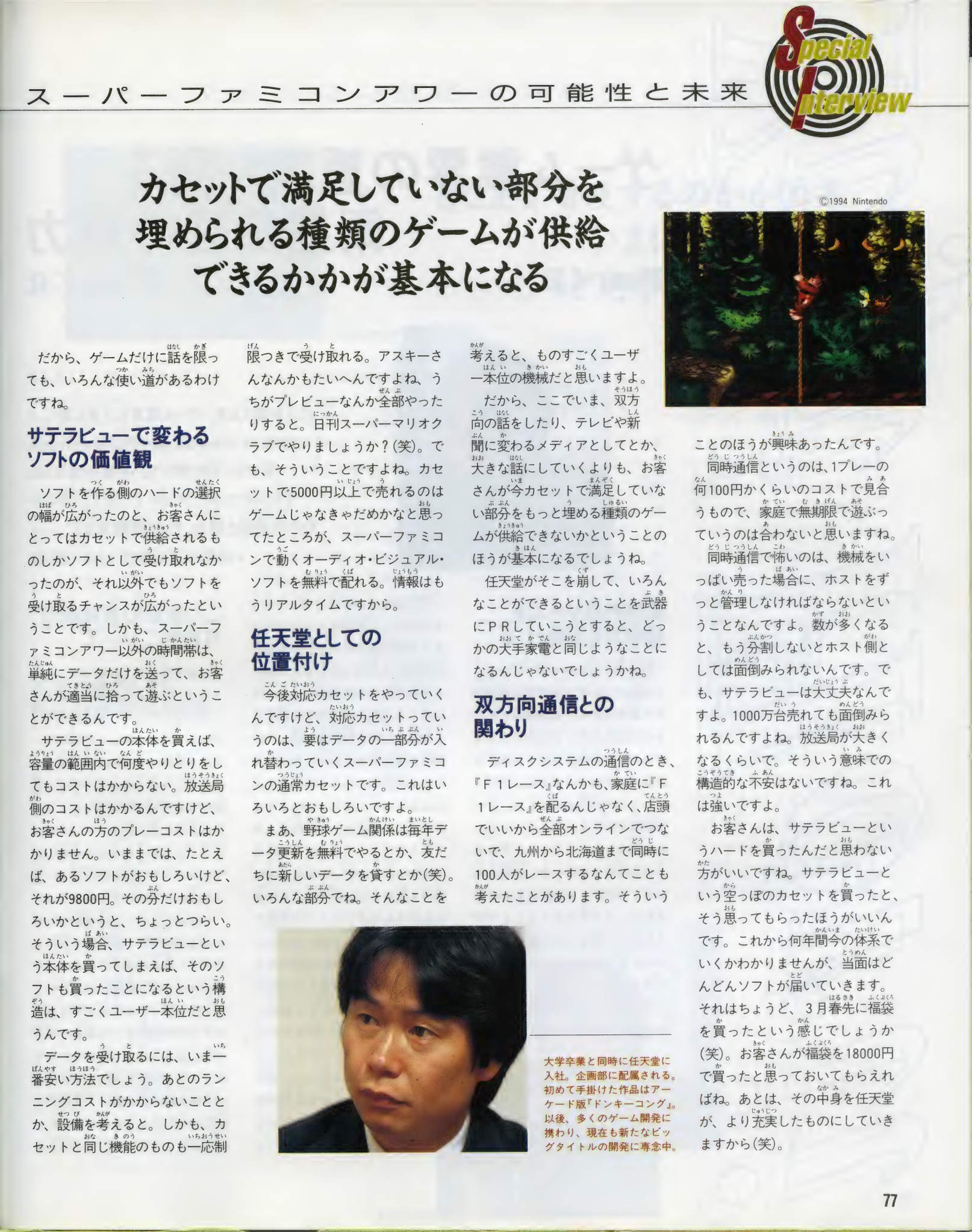
Translator: Stephen Meyerink for Time Extension
Notes: Famicom Tsūshin was a magazine about the Satellaview. Scans uploaded by koiuni6.
Summary: He hopes people think of Satellaview as an empty cartridge. He doesn’t know how long it will continue in this form, but it will receive more software for the time being.
Customers can rewrite their cartridge as many times as they want for free. It might be hard to say if a game is 9,800 yen worth of fun, but when you buy a Satellaview you also buy the software.
He’s not very involved in designing the Satellaview hardware. In the future they might have multiplayer games where people can share a space. They want to ensure they have reliable broadcasts.
The next six months of the Satellaview will probably mostly be games by Nintendo, there will be great variety. They can distribute games for free that they couldn’t sell as cartridges with the Satellaview. If someone brings them a game they could distribute it to 100,000 people. Some people made unprofitable cartridge games just because they wanted people to play them.
Developers could make changes based on player feedback. Cartridge size usually determines price, but the Satellaview doesn’t have that limitation. Players don’t have to pay anything when they change what data they have. It’s like paying for the software up front.
He assumes they couldn’t sell non-game cartridges for over 5000 yen, but they could distribute it with the Satellaview. They’re going to release cartridges where some of the data can be rewritten, so you can do things like update sports rosters. They’d like to use it to fill in gaps.
At the time of Famicom Grand Prix: F1 Race he thought about connecting things online and letting 100 people race at the same time. The issue with online play is maintaining a hosting service, but the Satellaview could do it on any scale. He wants people to think of Satellaview as an empty cartridge. More software will come over time, making it more and more satisfying.
Super Play: Shigeru Miyamoto The Super Play Interview, Edge: An Audience With…Shigeru Miyamoto, Consoles+: Nintendo Myamoto et Jeux Vidéo (untranslated from French)
Publication Date: June, 1995
Subject(s): Producers, English and American developers, Nintendo 64, CDs, Sega, Sonic
Format: Transcribed interview
People: Unnamed Super Play, Edge, Consoles+ interviewer, Shigeru Miyamoto
Scans:
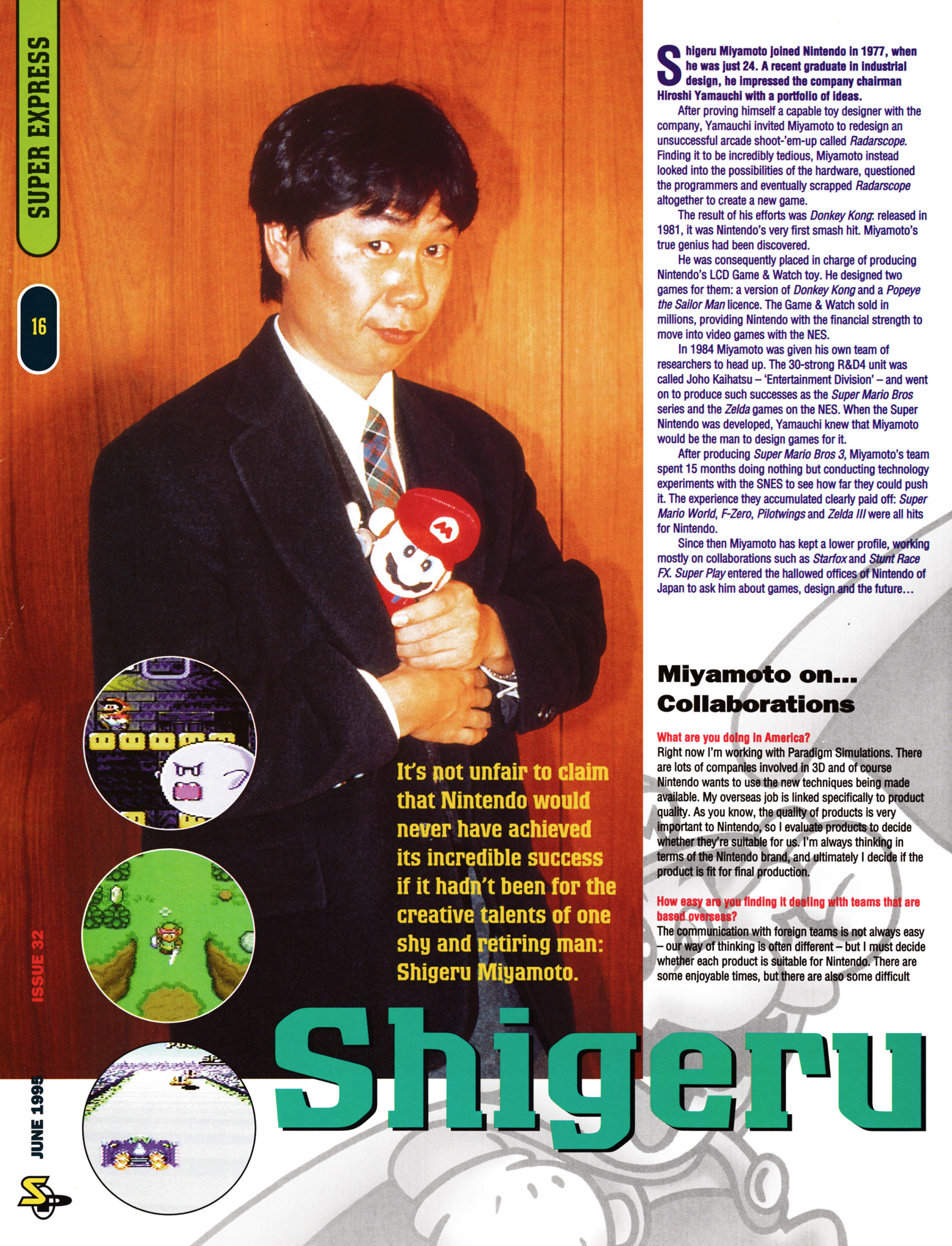
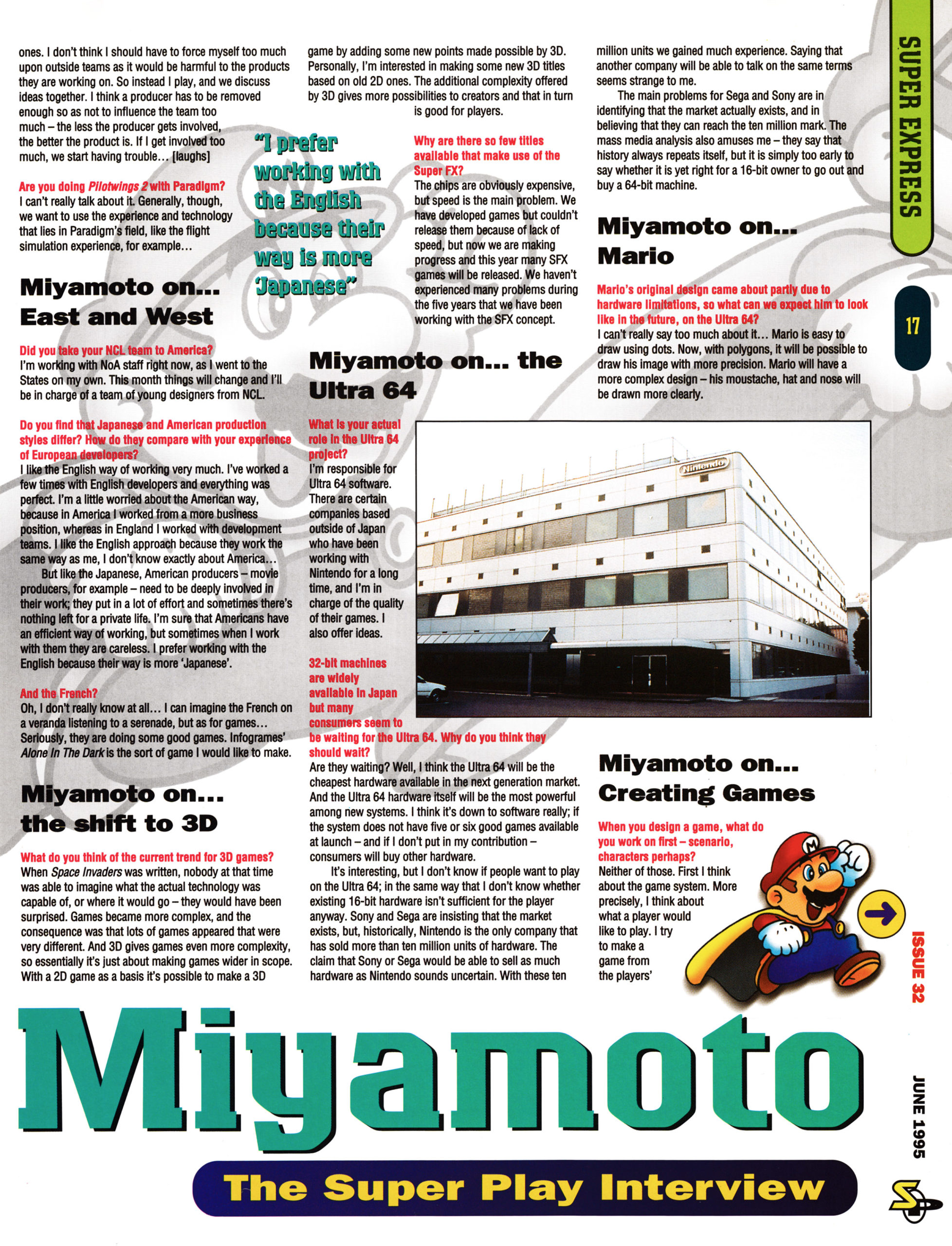

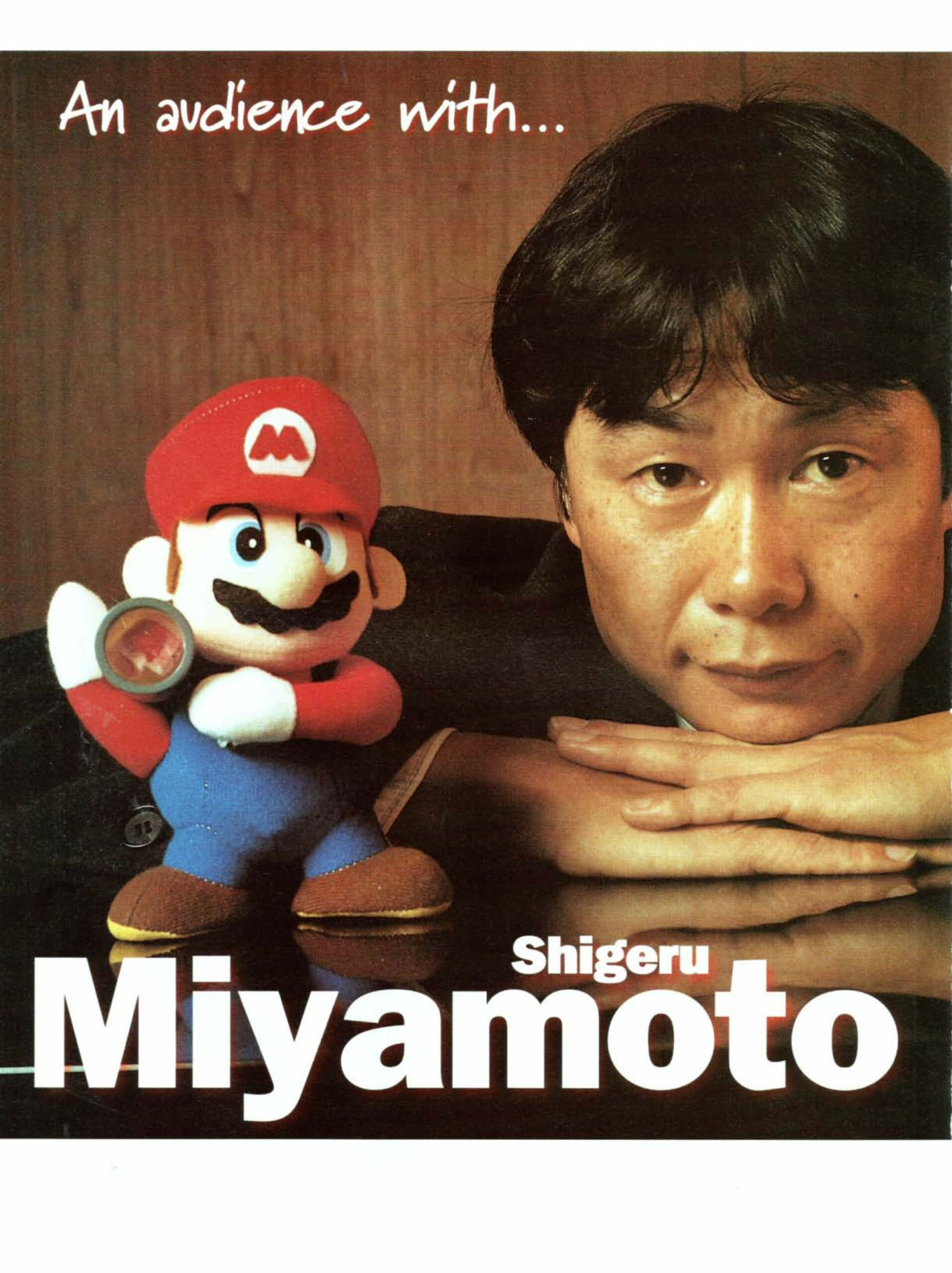
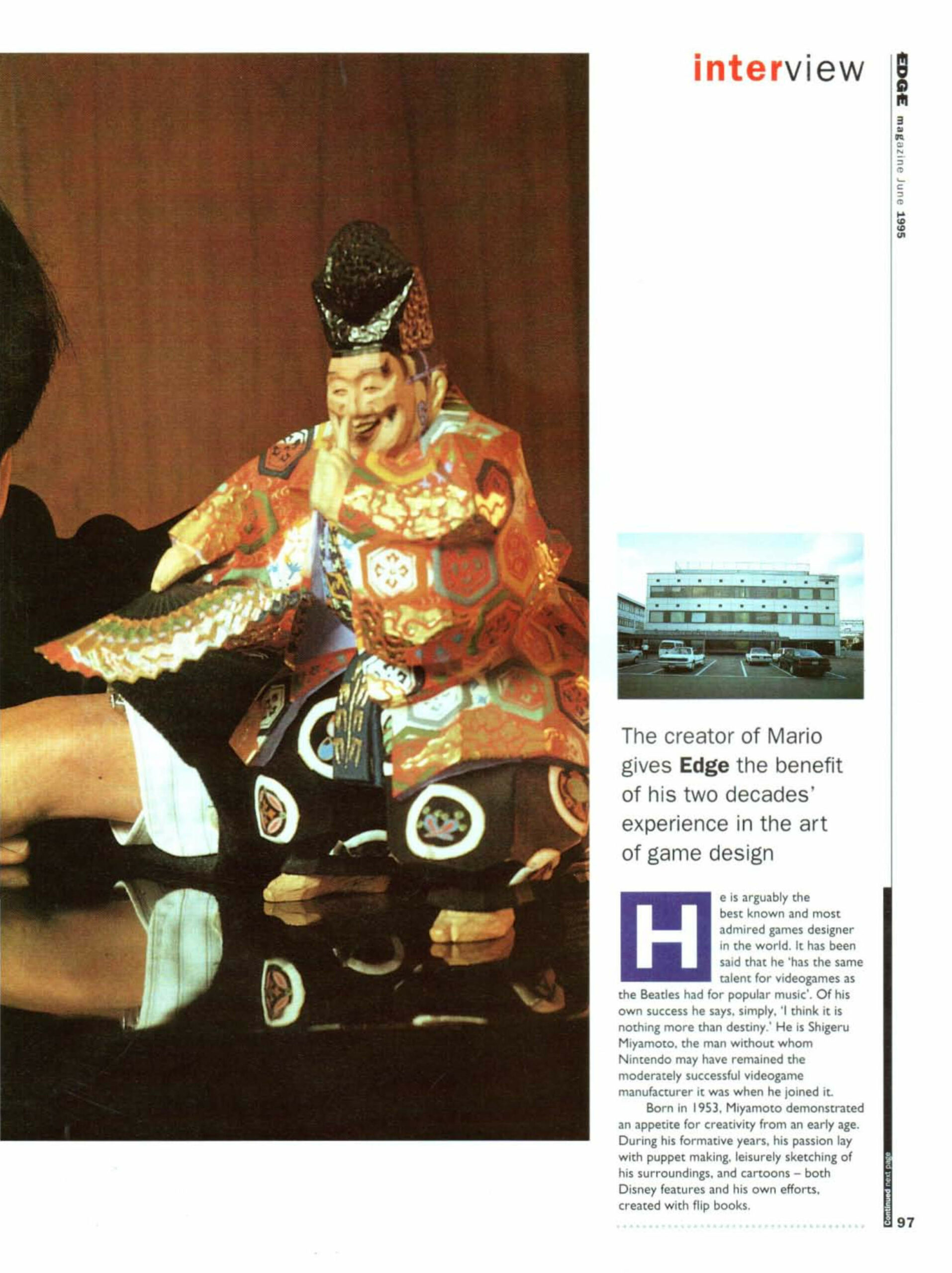
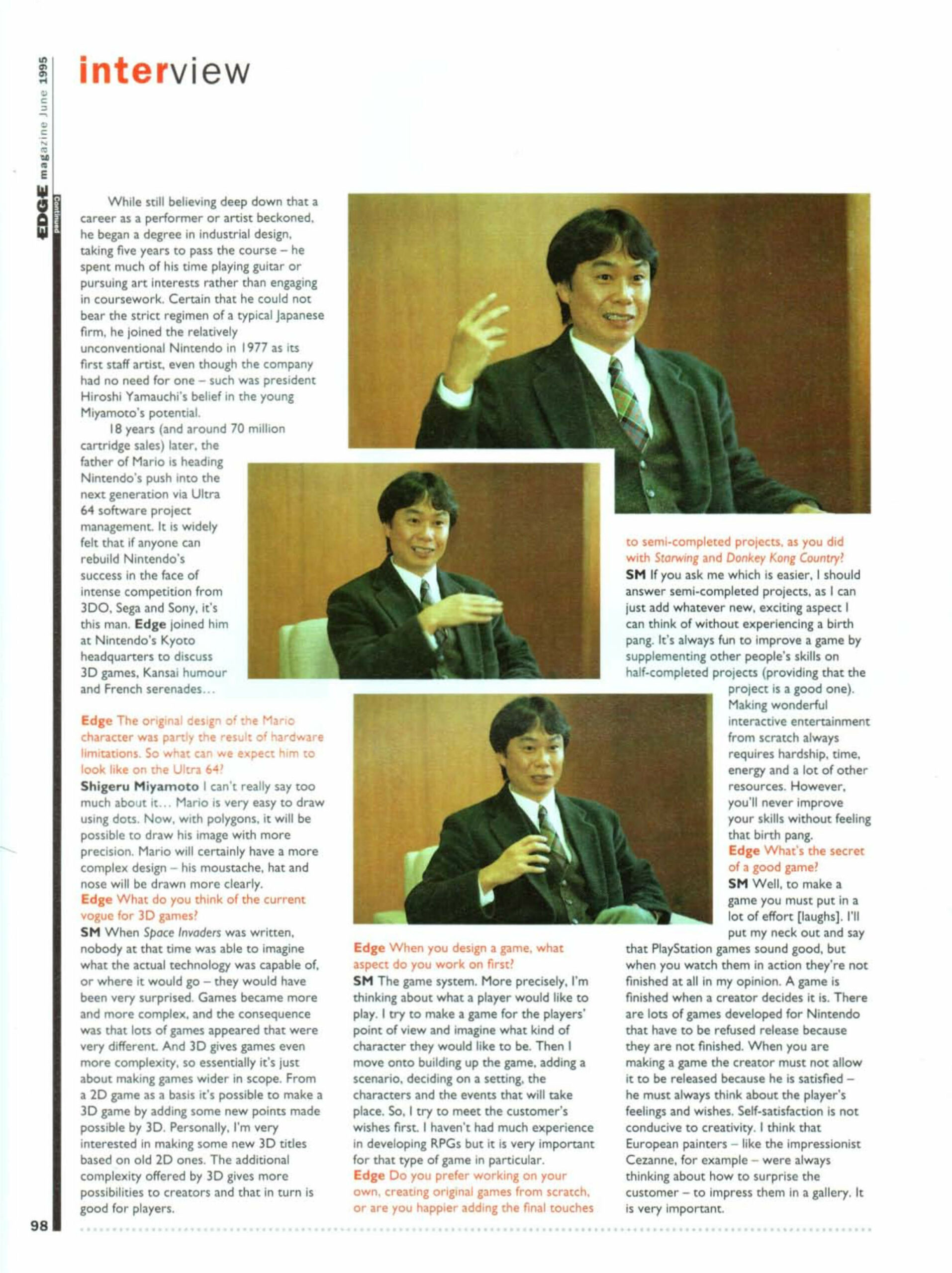
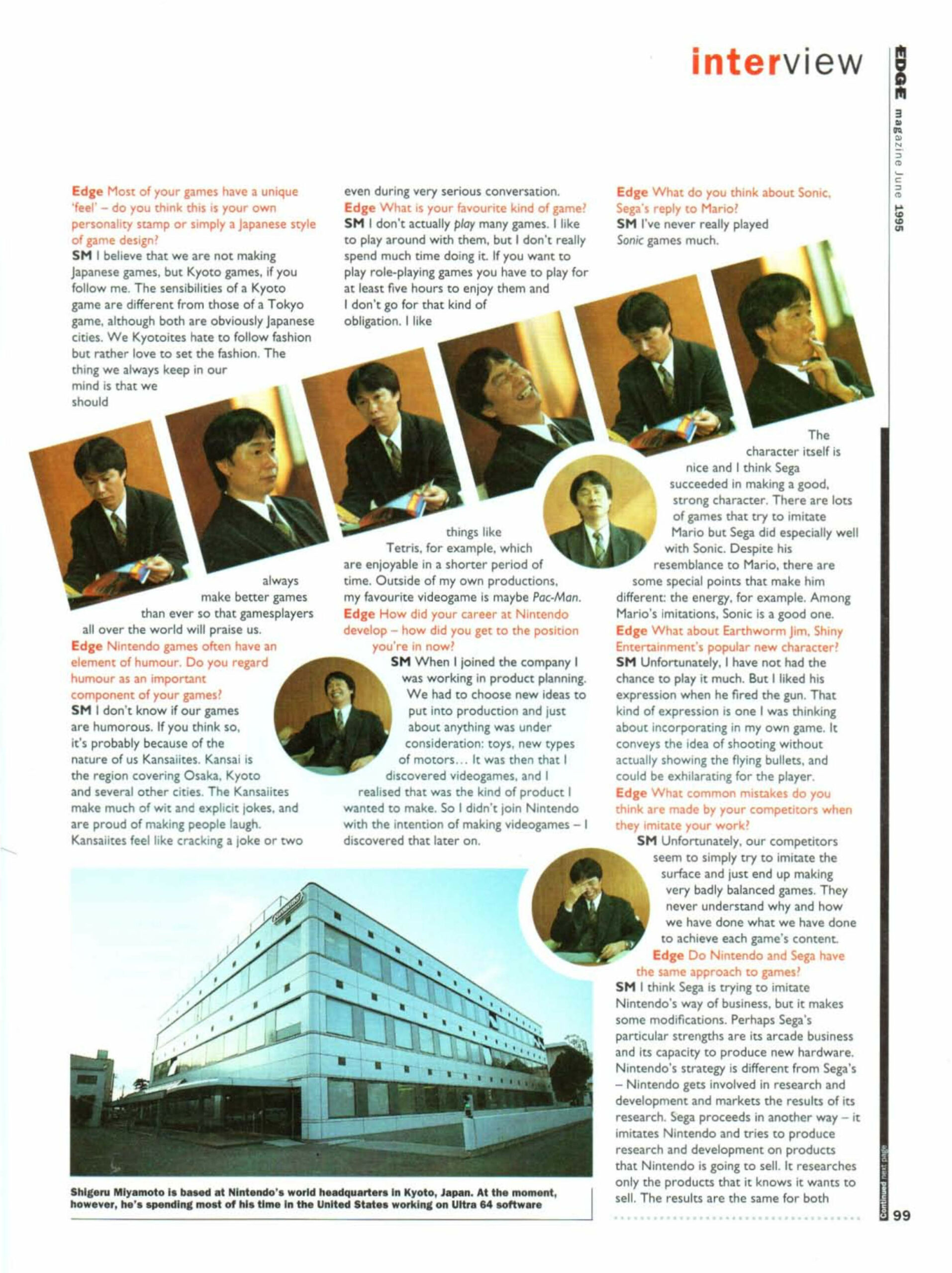
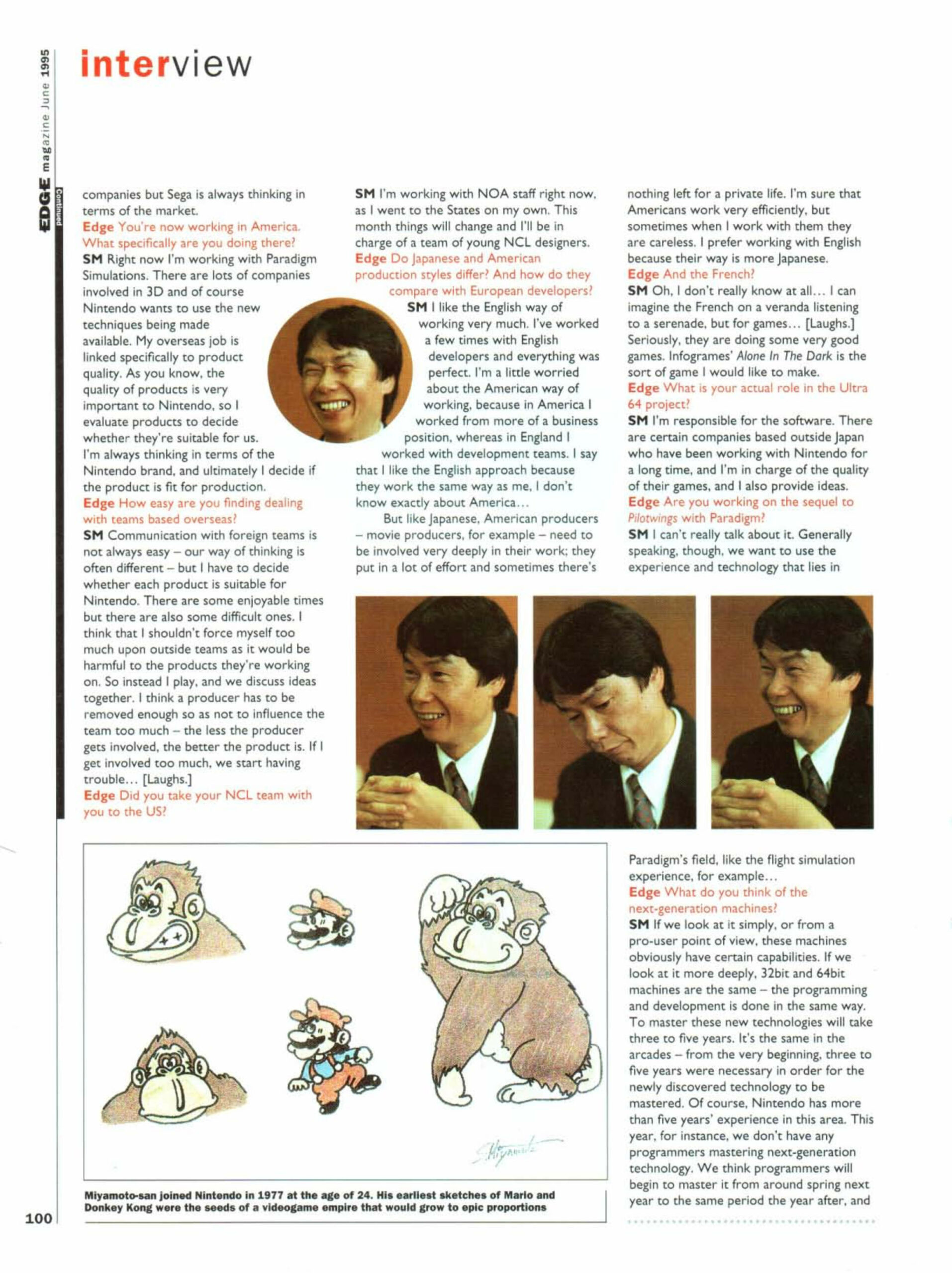
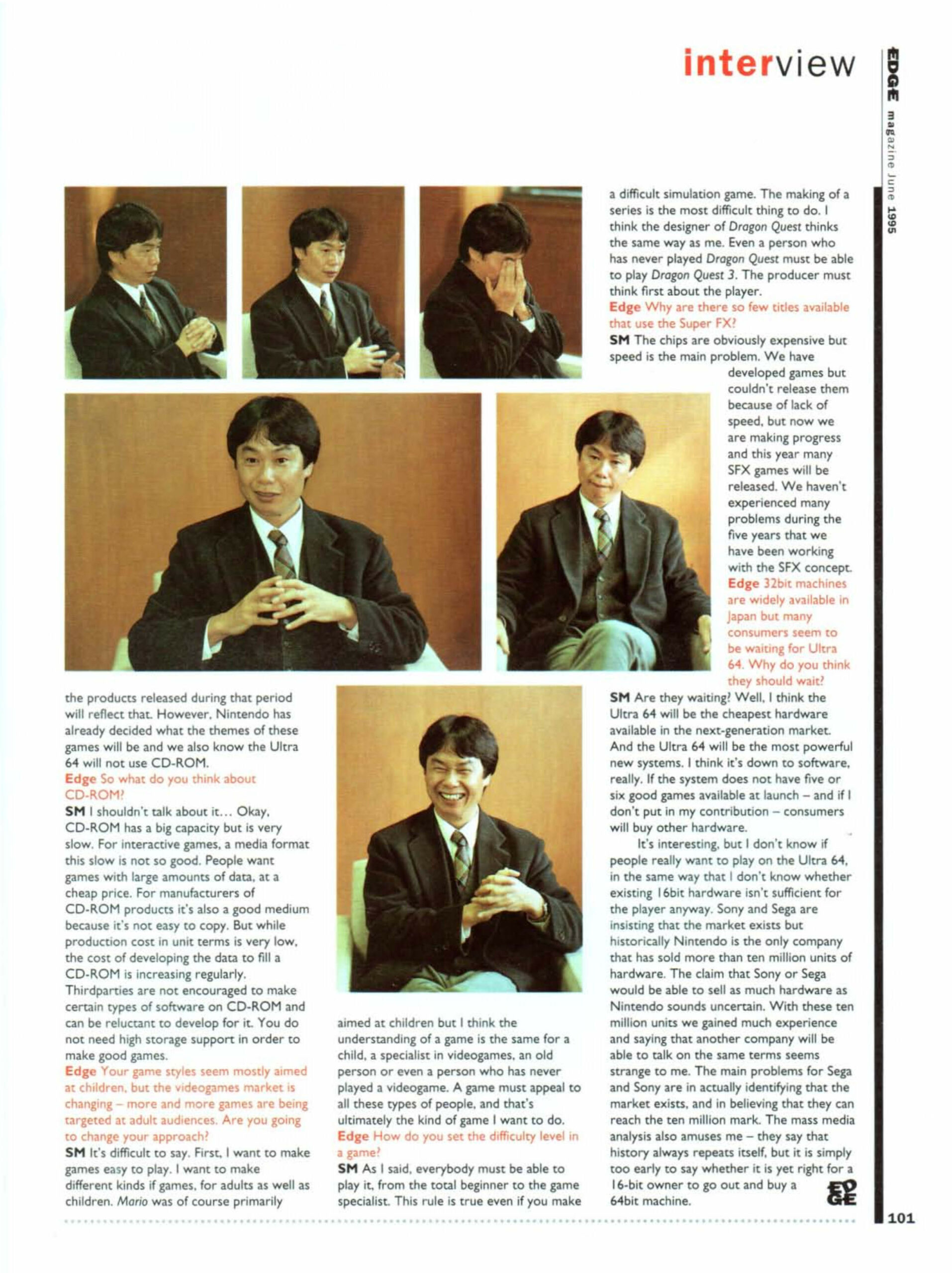
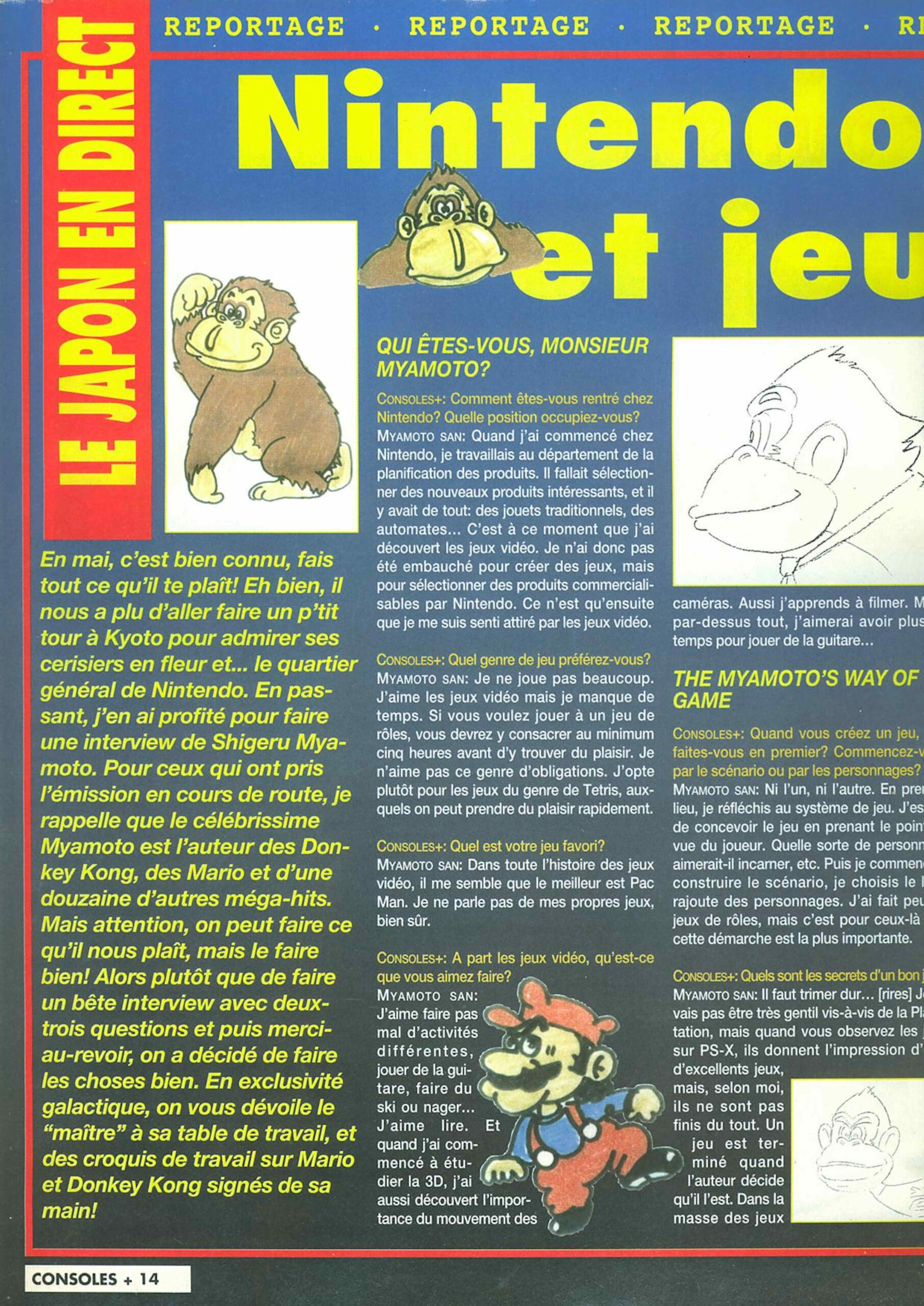
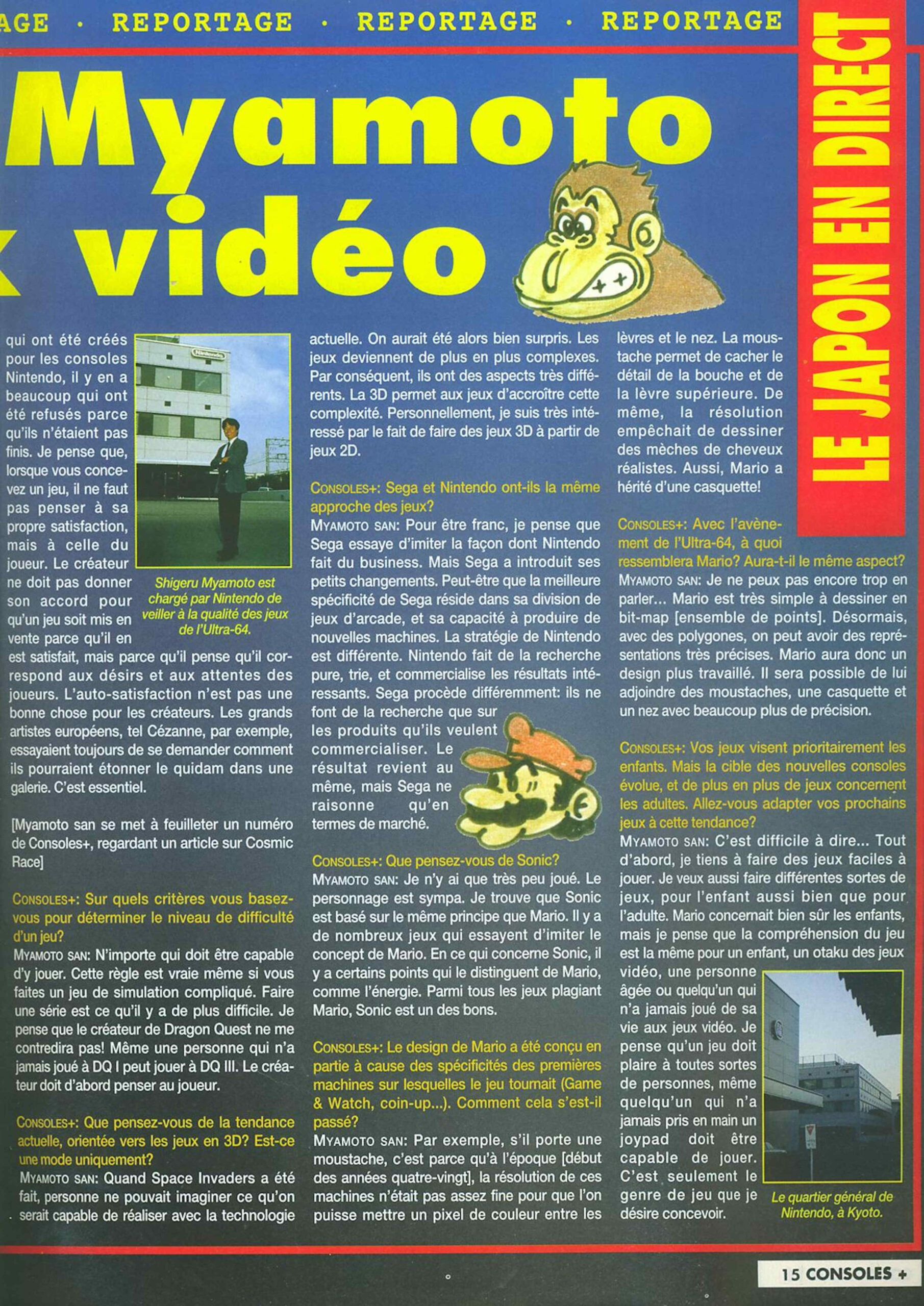
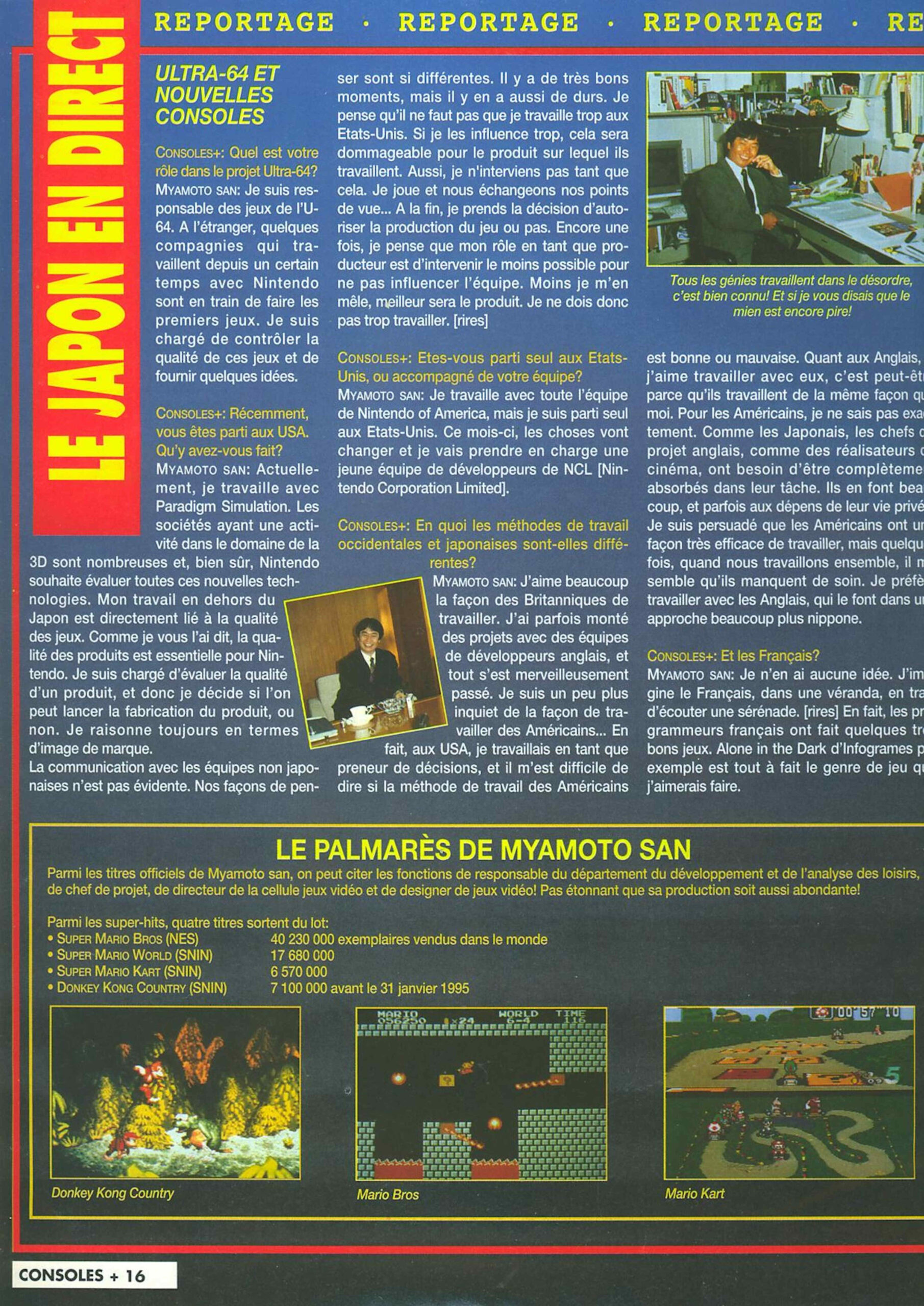
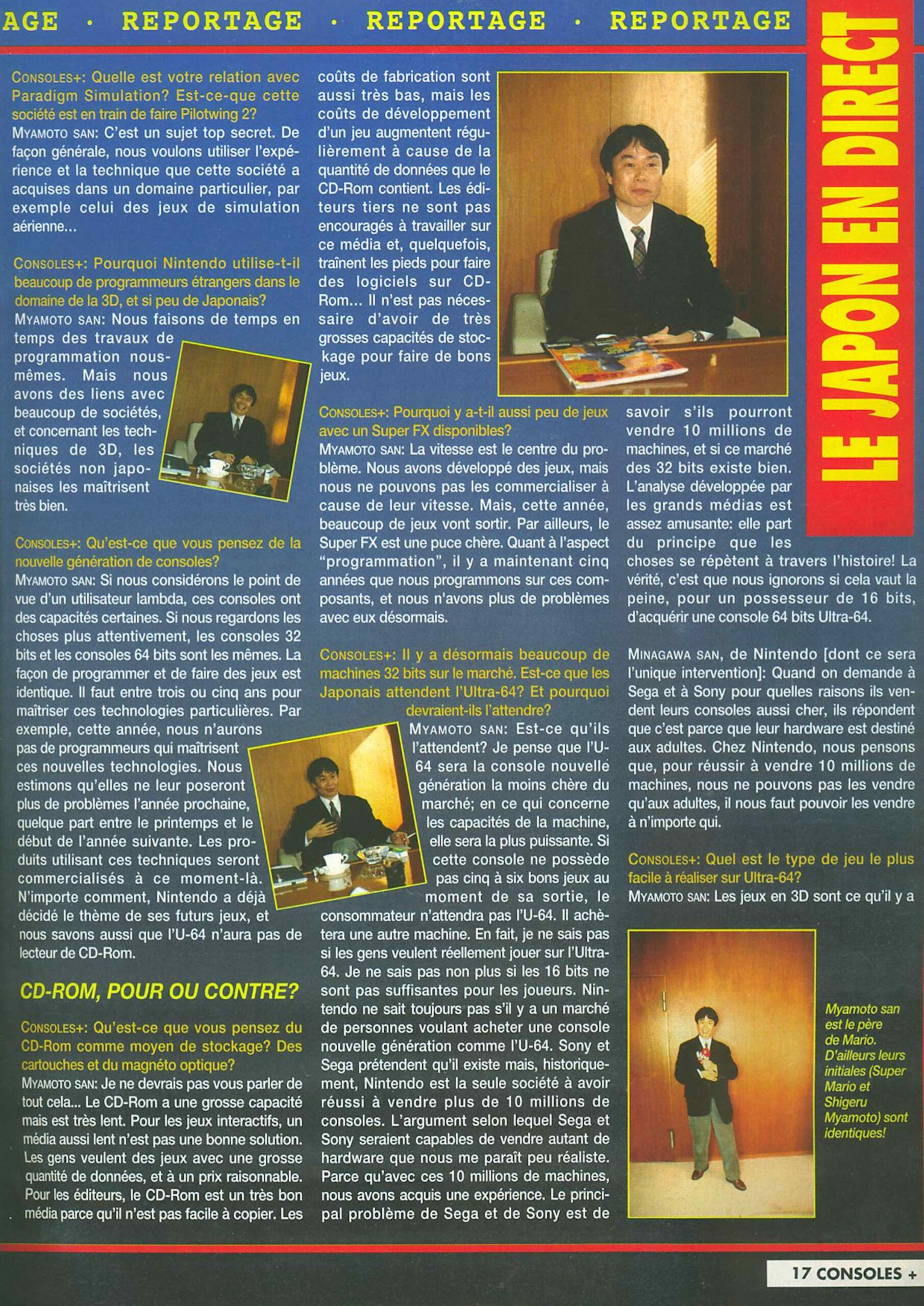
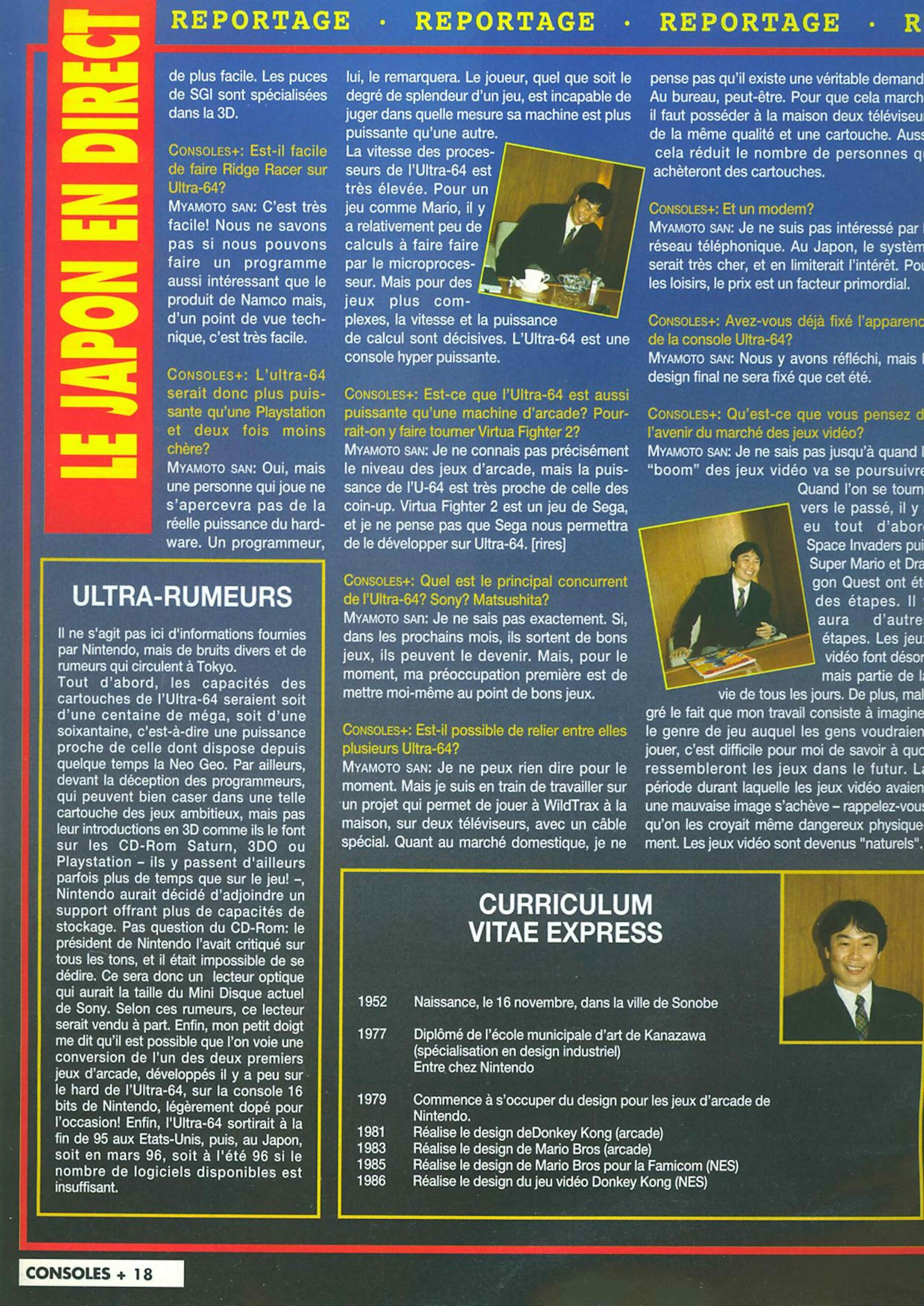
Notes: Super Play, Edge, and Consoles+ all at least somewhat claim this interview as their own. They all have pictures of Mr. Miyamoto in a wood paneled room at Nintendo headquarters in Kyoto. This was likely a single press event with several reporters attending.
When Mr. Miyamoto says he hasn’t had much experience with role-playing games an editor’s note in Super Play says “this, from the man who created Zelda!”.
Super Play scans by Out of Print Archive. Edge scans by mattandi. Consoles+ scans by RetroCDN.
Summary: He’s working with Paradigm Simulations in the United States. He evaluates game quality overseas. It can be difficult, their way of thinking is sometimes different. A producer shouldn’t influence the team too much.
He likes how they make games in England, it’s similar to his style. He is a bit more worried about America. Sometimes American producers work so hard they have no time for a private life, and sometimes American workers are careless.
He would like to make a game like Infogrammes’ Alone in the Dark.
Games have become more complex over time, and 3D games even more so.
Super FX chips are expensive. They couldn’t release some games because they were slow, but many Super FX games will be released soon.
He’s working on Nintendo 64 games and maintaining the quality of overseas games.
The N64 will be the cheapest and most powerful. If it doesn’t have five or six good games at launch consumers won’t buy it. He is unsure that 16-bit consoles aren’t enough. Sony and Sega say there’s a market for next generation systems, but only Nintendo has sold 10 million units of hardware. It sounds strange for another company to talk on the same terms. The media says history repeats itself, but it’s uncertain that people will buy a 64-bit machine.
They can make Mario with more precision using polygons.
When designing a game he first thinks about what the player would like to play, what kind of character they want to play as. Then he builds the scenario, setting, characters, and events. He hasn’t made many role-playing games.
It’s easier to help with a partially completed game, he can just add his ideas. Working from scratch is a hardship, but you your skills won’t improve unless you do.
PlayStation games look good but are unfinished. Many games developed at Nintendo are unreleased because they’re unfinished. The player must be satisfied, not the creator. The impressionist Cezanne always wanted to surprise the customer.
They make Kyoto games, not Japanese ones. They like to set the fashion in Kyoto, they aren’t like Tokyo.
He wants his games to be easy to play, and for adults and children. Mario was aimed at children. A beginner and a game specialist must be able to play a game. The maker of Dragon Quest agrees.
He doesn’t play many games, he just plays around in them for a bit. You have to play a role-playing game for five hours to have fun. His favorite game that he didn’t make is probably Pac-Man.
He didn’t join Nintendo with the intention of making video games.
It will take three to five years to master the next generation game systems. The N64 will not use CDs, which have a lot of capacity but are slow. CDs are good for manufacturers because they are cheap to make, but making the data that goes into them is becoming more expensive.
He hasn’t played much of Sonic, but Sega did well in imitating Mario games. His energy makes him different. Sega imitates Nintendo’s way of doing business. It strength is its arcade business making new hardware. Nintendo does research and development, but Sega only researches games it already wants to sell.
Club Nintendo: el control de las celebridades (untranslated from Spanish)
Publication Date: July, 1995
Subject(s): Super Mario 64, The Legend of Zelda: Ocarina of Time
Format: Transcribed interview
People: Unnamed Club Nintendo interviewer, Shigeru Miyamoto
Scans:
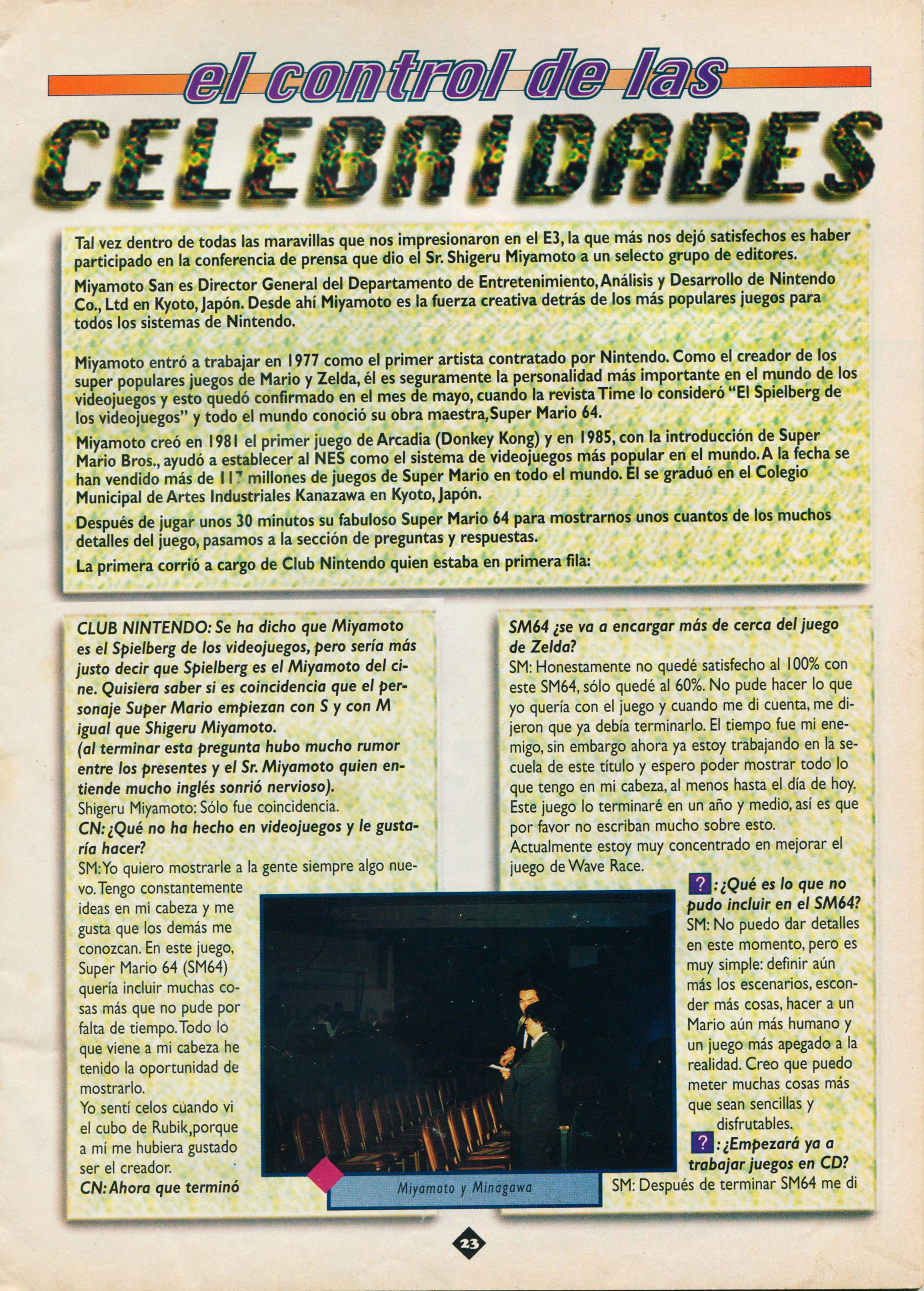

Notes: There were many Club Nintendo magazines from various countries, this is from the Chilean version. A machine translation of the title is “control of celebrities”. I was made aware of this interview from this smallmariofindings post, which linked to this tweet by mariozisun. The magazine was uploaded to the Internet Archive and presumably scanned by Retro_Archiver.
V Jump Festival ’95
Publication Date: September 13, 1995 (translated March 3, 2010)
Subject(s): Super Mario RPG
Format: Transcribed interview
People: Unknown interviewer, Chihiro Fujioka, Shigeru Miyamoto
Link: https://glitterberri.com/v-jump-presentation-part-2/
Archive Link: https://web.archive.org/web/20230128205448/https://glitterberri.com/v-jump-presentation-part-2/
Video: https://www.youtube.com/watch?v=E2rVWOhDZRU
Translator: GlitterBerri
Notes: The subtitles in the video use GlitterBerri’s translation. This was a prototype version of Super Mario RPG.
Summary: There were bugs with the art in flat areas. If you turned in circles you’d see glitches. The second one will be on a different platform, they’re doing their best to make sure this is the last 16-bit Mario game.
Super Mario Magazine (untranslated from Japanese)
Publication Date: September 22, 1995
Subject(s): Super Mario RPG, Super Mario 64
Format: Transcribed interview
People: Unknown Super Mario Magazine interviewer, Shigeru Miyamoto
Scans:
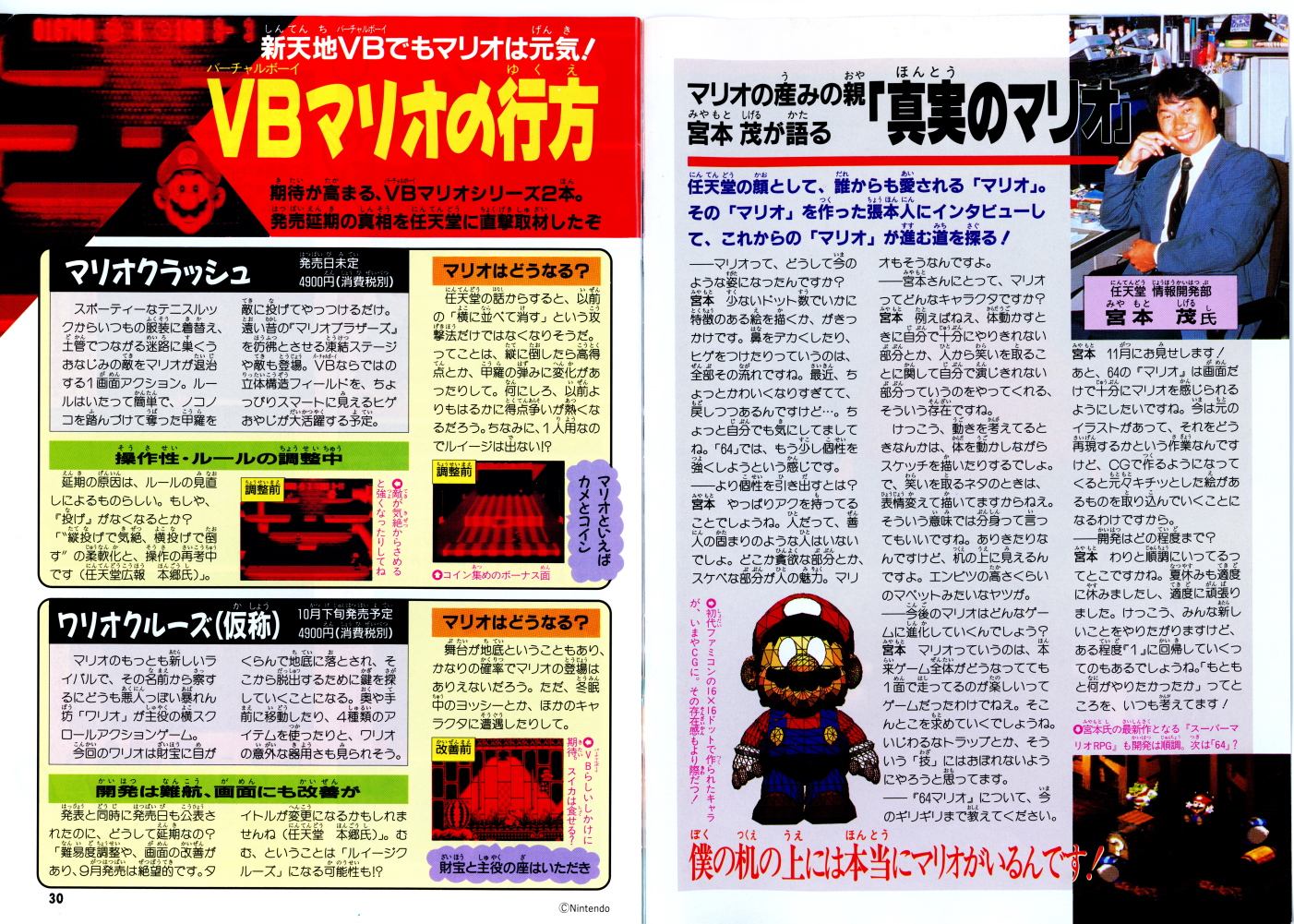
Notes: Super Mario Magazine was a short one-off special publication made by Japanese magazine Famimaga. Uploaded by MrTalida to Archive.org. Thank you to Stefanie Kischak for informing me about this interview.

Nintendo Power: The Spielberg and Lucas of the Video Game Industry
Publication Date: October, 1995
Subject(s): Super Mario World 2: Yoshi’s Island
Format: Transcribed interview
People: Unnamed Nintendo Power interviewer, Takashi Tezuka, Shigeru Miyamoto
Scan:

Notes: Scans by Retromags.
Summary: The Super FX Chip allows for enemies to be any shape, to scale, and to rotate.
He loves the Baseball Boys.
Game on!
Publication Date: October, 1995
Subject(s): Super Mario RPG
Format: Essay
People: Shigeru Miyamoto
Link: https://shmuplations.com/supermariorpg/
Archive Link: https://web.archive.org/web/20180610214400/http://shmuplations.com/supermariorpg/
Translator: shmuplations
Notes: Game On! was a Japanese video game magazine.
Summary: Before Super Mario RPG started development he talked with some people at Nintendo about making a Mario role-playing game. Later they were talking with Square and they wanted to make a game with worldwide appeal. After many discussions they decided to make a game that featured their respective strengths. They’ve made a game with Mario’s action gameplay and a turn-based role-playing game system where no blood is shed.
MAXIMUM The Video Game Magazine: The Return of the Awesome MARIO KART!
Publication Date: October, 1995
Subject(s): Mario Kart 64
Format: Transcribed interview
People: Unnamed MAXIMUM The Video Game Magazine interviewer, Shigeru Miyamoto
Scan:

Notes: This impromptu interview took place at Space World 1995 which occurred November 22–24. Scans by Sega Retro.
Summary: Mario Kart 64 is about 95% done and will be a launch title for the Nintendo 64 on April 21st. The 3D thumb controller is so good that there is no need for a steering wheel accessory.
Mario Kart 64 will not use any kind of link-up, their policy is one TV and one game for multiplayer. They could have added 8 person multiplayer, but everyone’s screen would be too small.
They would have had Mario Kart 64 playable at Space World, but their booths are too small to show off multiplayer.
Super Mario Stadium
Publication Date: November 22-24, 1995
Subject(s): Nintendo 64, Super Mario 64
Format: Interview, Q & A
People: Unnamed hosts, Kouji Watanabe, Shigeru Miyamoto
Video:
Translator: Meiji Ishin
Notes: The subtitles have the English translation. Super Mario Stadium was Nintendo’s TV show which aired on Thursdays. This interview took place at Space World 1995. The video contains beta footage of Super Mario 64. Uploaded by YouTube user Meiji Ishin.
Summary: The Nintendo 64 has a 64-bit CPU. The selling point are the fast computations, which allow for advanced AI. They made sure it felt different to the touch.
They’d always dreamed of making 3D animations and controlling characters like puppets.
Because it’s a free environment they have to draw what’s behind a tree too.
You can move the analog stick on the controller 360 degrees. The slot on the controller is for a Memory Pak that you can store data in and you can take it to a friend’s house.
The games will cost the same as Super Nintendo Entertainment System games, even though though they have more memory. They will cost 9,800 yen.
Game Catalog(?) (untranslated from Japanese)
Publication Date: December 2, 1995
Subject(s): N64
Format: Interview
People: Kukun Kun(?), Unknown Nintendo employee(?), Shigeru Miyamoto
Video: https://www.youtube.com/watch?v=CW0TpUdUrXY&t=569s
Notes: I don’t have much information on what this program is, but a machine translation of the description says it ran on TV Asahi and was a “game show supervised by Famitsu”. This interview took place at Space World 1995, which ran November 22–24.
1996
Nintendo Daijiten (untranslated from Japanese)
Publication Date: 1996
Subject(s): Game development
Format: Transcribed interview
People: Unknown interviewer, Shigeru Miyamoto
Gallery of Shigeru Miyamoto’s interview: https://spritecell.com/shigeru-miyamoto-nintendo-daijiten/
Archive Links: https://archive.org/details/nintendo-dictionary-vol-1
https://archive.org/details/nintendo-dictionary-vol-1-disc-two
https://archive.org/details/daijitenswf_202012
Notes: Nintendo Daijiten (Nintendo dictionary) is a CD-ROM made by Nintendo and several other companies. It uses Adobe Flash and contains information about Nintendo games and several interviews. I see conflicting claims of this being released in 1996, 1998, and 1999, while the back of the CD case has a copyright notice of 1997.
The first and second links (uploaded by Media-Monster) contain image files of the Nintendo Daijiten CDs, the third link (uploaded by craftersshaft) emulates disc 2 within a browser. Mr. Miyamoto is “GUEST4”.
Unknown (Super Mario 64 interview with Kōji Watanabe, untranslated from Japanese)
Publication Date: 1996
Subject(s): Super Mario 64
Format: Interview/Promotional video
People: Kōji Watanabe, Shigeru Miyamoto
Video: https://www.youtube.com/watch?v=mjRJAmtuaP8
Video Archive Link: https://archive.org/details/youtube-mjRJAmtuaP8
Notes: Uploaded to YouTube by kanpei hagama. This seems to be a promotional video for Super Mario 64, featuring beta footage. CharlyCNintendo has pointed out some differences on X and Time Extension has written an article about this video.
Nintendo Power: The Game Guys
Publication Date: January, 1996
Subject(s): Super Mario 64, Nintendo 64, The Legend of Zelda: Ocarina of Time
Format: Transcribed interview
People: Unnamed Nintendo Power interviewer, Takashi Tezuka, Shigeru Miyamoto
Scans:


Notes: This interview took place at Space World 1995, which occurred November 22–24. Scans by Retromags.
Summary: He first had the idea for a 3D Mario when working on Star Fox, five years ago. The Super Mario 64 at Space World is about 50% done and 20% mapped out. It will be released by April with plenty of time to spare.
Ideas for Super Mario 64 come from real life. During development Takashi Tezuka had the idea to put his wife in the game. She’s normally quiet, but exploded once because she was angry Mr. Tezuka spent so much time at work. There is a character that shrinks when Mario looks at it, but grows when he looks away.
They can show the entire game world in detail and convey emotions thanks to the Nintendo 64.
He’ll be working on The Legend of Zelda: Ocarina of Time with Mr. Tezuka after Mario 64 is done. The 64DD allows them to create software tools. You might be able to change backgrounds or back up games. The N64 will be better than PCs, they had plug and play long before the PC market did.
Mario Kart 64 looks good but doesn’t play much better than Super Mario Kart yet.
Bravo TV: Nintendo 64
Publication Date: January 28, 1996
Subject(s): Nintendo 64
Format: Interview (spoken English)
People: Unknown Bravo TV interviewer, Shigeru Miyamoto
Video:
Notes: This footage was shot November 22–24, 1995 at Space World.
Summary: The Nintendo 64 will change the image of games. Games will change as players play them.
Next Generation: Shigeru Miyamoto the Master of the Game, Super Play: Super Mario 64
Publication Date: February, 1996
Subject(s): Nintendo 64, Super Mario 64, Super FX chip, controllers and ports
Format: Transcribed interview
People: Unnamed Next Generation interviewer, unnamed Super Play interviewer, Shigeru Miyamoto
Scans:
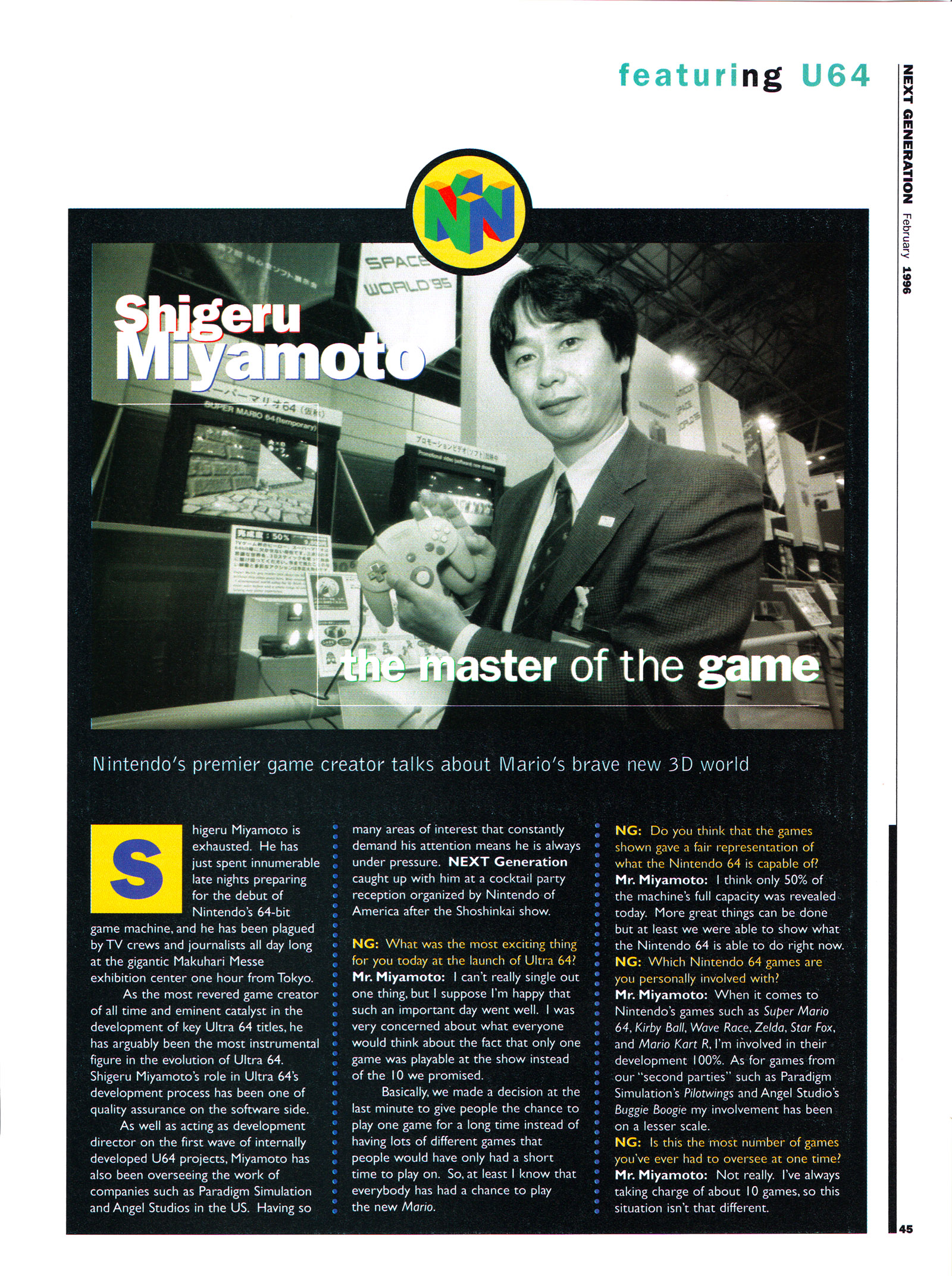
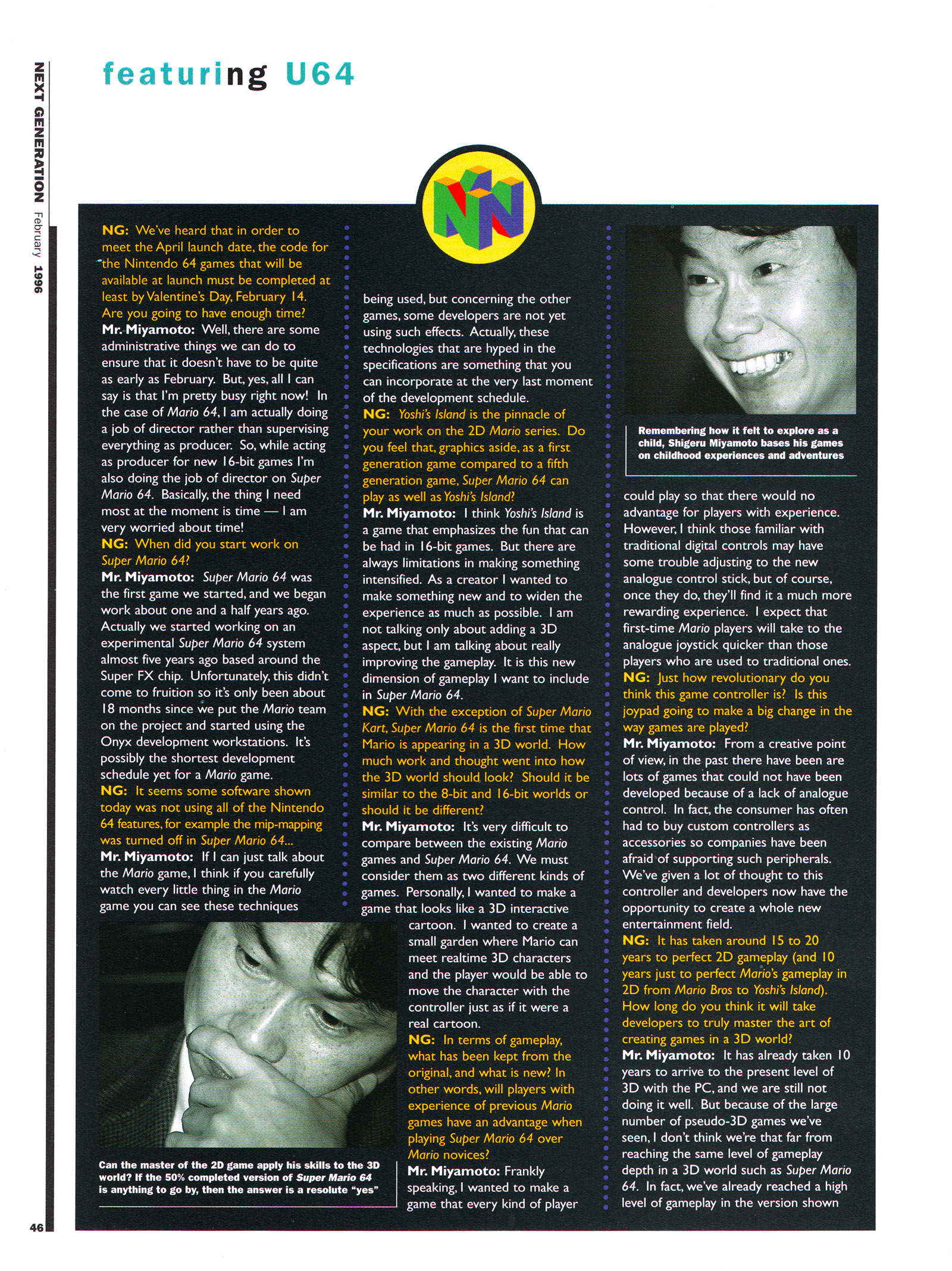

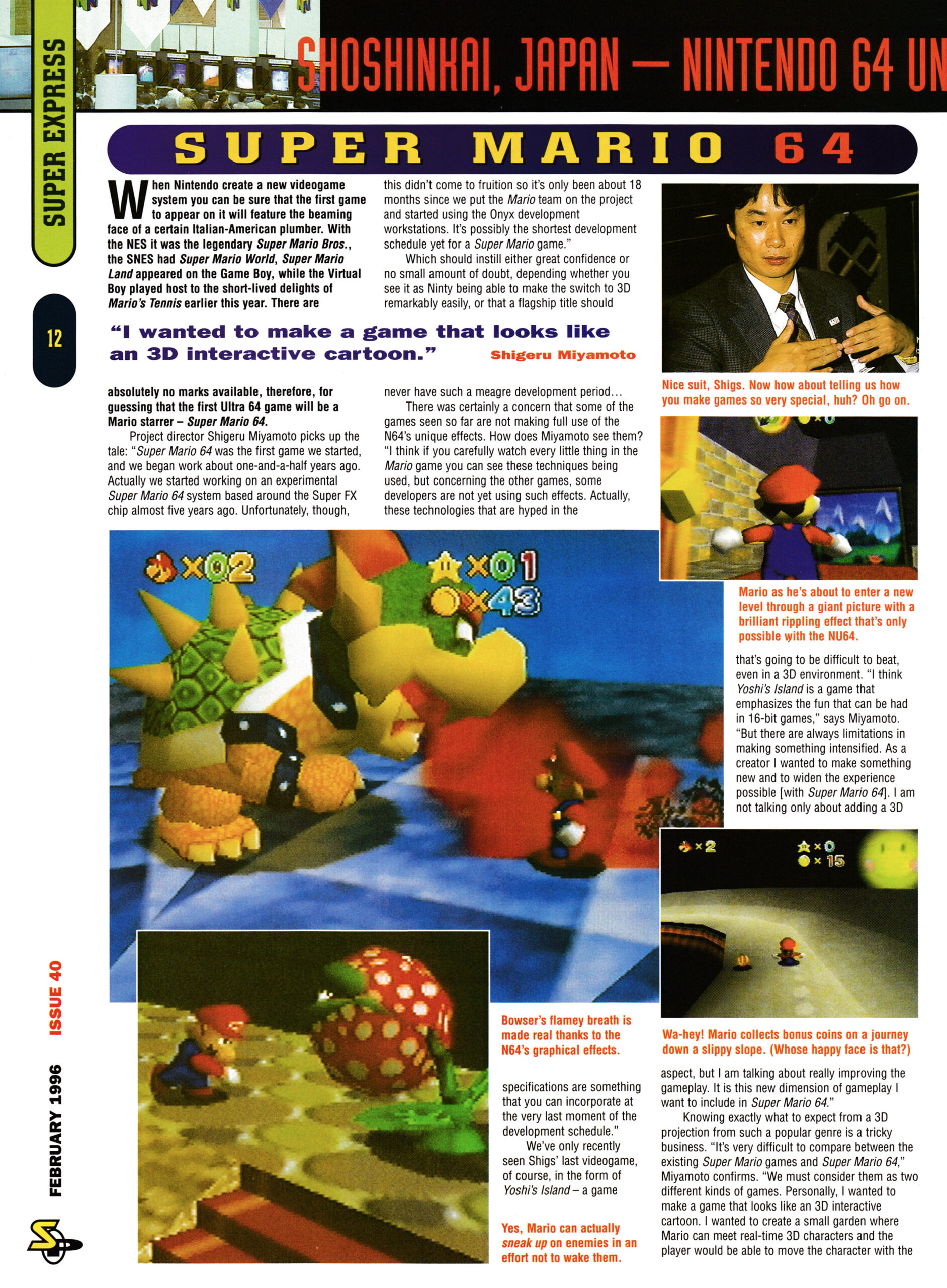

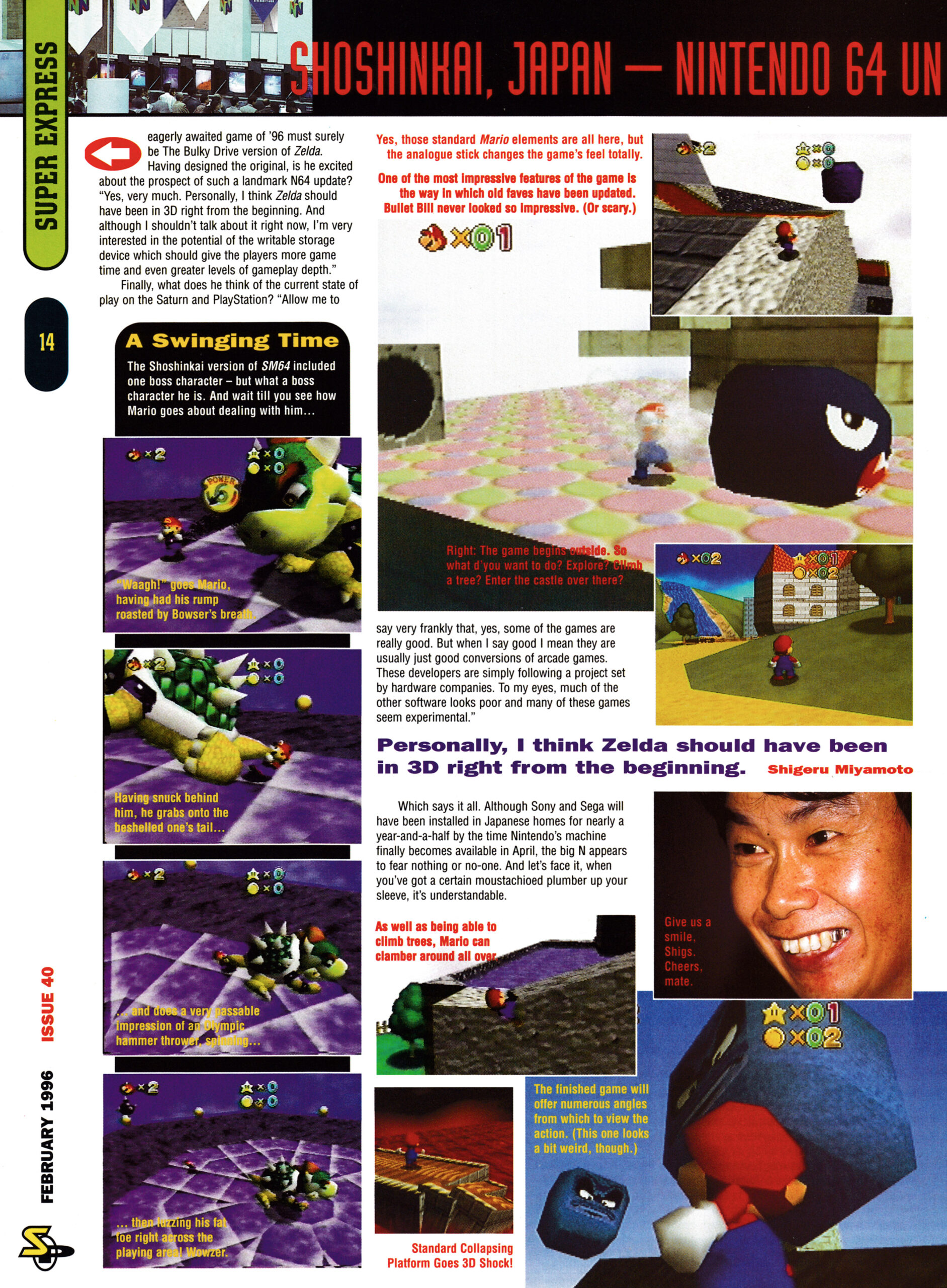
Notes: This interview took place at a cocktail party organized by Nintendo of America after Space World 1996. Scans by Retromags and Out Of Print Archive.
Summary: He’s happy that Space World went well even though they said 10 games would be playable but only Super Mario 64 was.
About 50% of the Nintendo 64’s power has been revealed.
He’s completely involved in Super Mario 64, Kirby’s Block Ball, Wave Race 64, The Legend of Zelda: Ocarina of Time, Star Fox 64, and Mario Kart 64. He is less involved with Pilotwings 64 and Buggy Boogie. He’s always in charge of around 10 games.
He is currently directing Super Mario 64 rather than producing. He needs more time. They started on Mario 64 one and a half years ago, though they worked on an experimental game almost five years ago with the Super FX chip. This has probably been the shortest development time for a Mario game.
With Mario 64 he wants to widen the experience and improve the gameplay compared to Super Mario World 2: Yoshi’s Island. Mario 64 is almost a different kind of game than past Mario games. He wanted to make an interactive cartoon. He wants experienced game players to not have an advantage. It may be difficult to adjust to the analog stick, but it’s worth it.
The Legend of Zelda should have always been in 3D. He’s interested in what writeable storage can do to lengthen games and provide deeper gameplay.
Saturn and PlayStation have some good games, but they are mostly arcade conversions. Other games seem poor and experimental.
They’d like to work on online play, and the expansion port of the Nintendo 64 was made for that possibility, but he’d rather talk about it when they’ve sold 3 million units.
They have four controller ports on the Nintendo 64 because it’s the first time they have a system that can handle four screens.
He stopped smoking because he has to work with Americans, but he’s been eating lots of sweets.
Time: THE SPIELBERG OF VIDEO GAMES
Publication Date: May 20, 1996
Subject(s): Graphical power, online play
Format: Transcribed interview
People: David S. Jackson, Shigeru Miyamoto
Link: https://content.time.com/time/subscriber/article/0,33009,984568,00.html
Archive Link: https://web.archive.org/web/20151005163616/http://content.time.com/time/subscriber/article/0,33009,984568,00.html
Summary: They’ve had trouble making games look as real as possible, but those problems have been solved with the Nintendo 64. The Internet has to be more popular before they use it for games. His kids can only play games for two hours a day after they finish their homework.
Next Generation: An interview with Shigeru Miyamoto
Publication Date: August, 1996
Subject(s): Super Mario 64, Nintendo 64
Format: Q & A
People: Unnamed Next Generation interviewer and other members of the press, Shigeru Miyamoto
Scan:
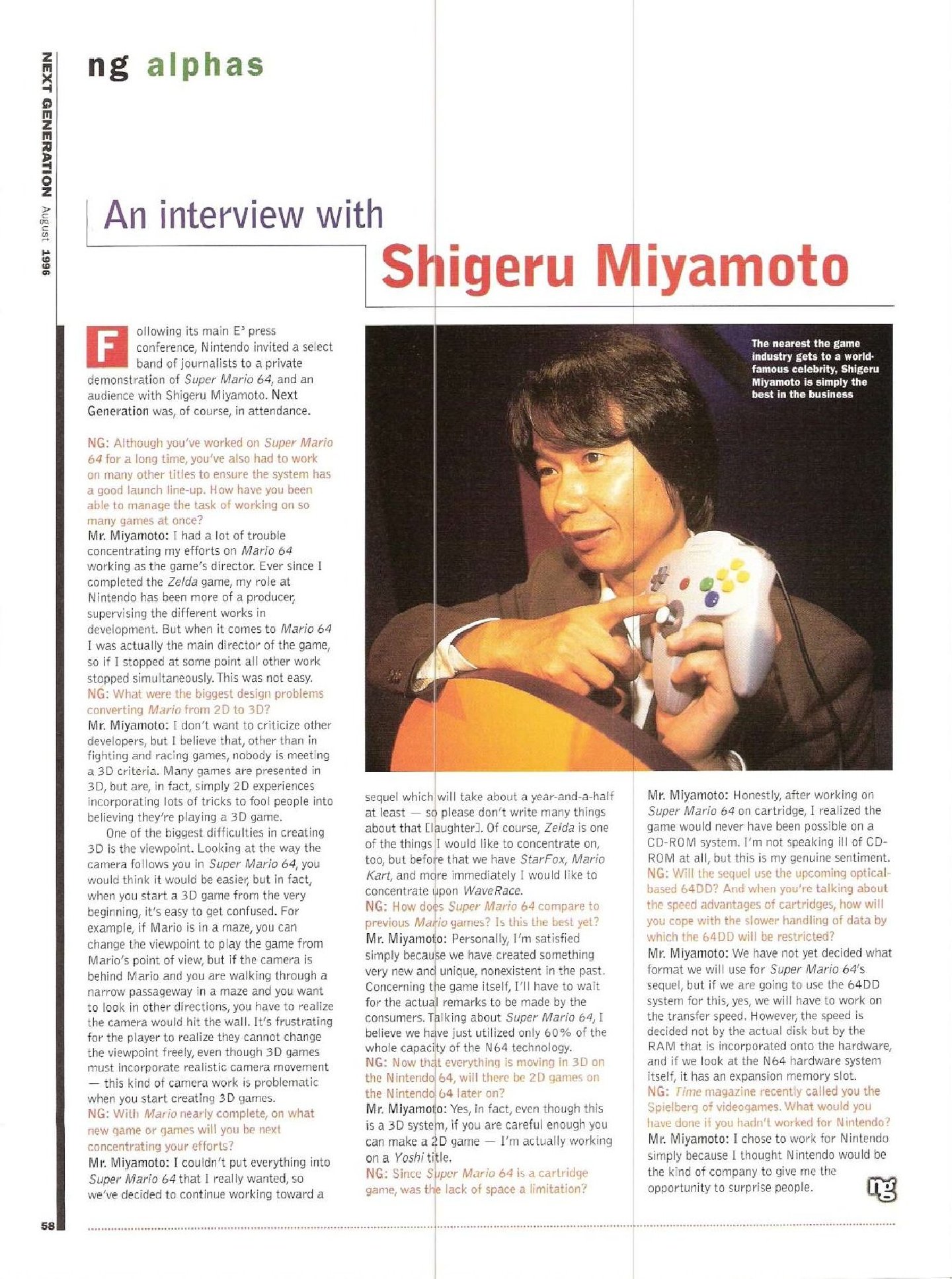
Notes: This group interview took place at E3 1996. Scans by Retromags.
Summary: He had trouble concentrating on Super Mario 64 since he’s become more of a producer at Nintendo, overseeing many games. If he stopped work on Mario 64 for a bit, then no one else would work on it.
Only fighting and racing games are meeting 3D criteria. Many games are 2D, but using tricks to seem 3D. It’s easy to get confused when playing a 3D game due to the camera. It’s frustrating when you can’t move the camera because a wall is in the way.
He couldn’t put everything he wanted into Super Mario 64, so there will be a sequel that will take at least a year and a half.
Super Mario 64 used about 60% of the Nintendo 64’s capabilities.
There will be 2D N64 games. He is working on a Yoshi game.
Super Mario 64 would have been impossible on a CD-ROM.
They don’t know yet if the Mario 64 sequel will be a 64DD game.
He decided to work for Nintendo so he’d have the chance to surprise people.
Nintendo Power: Miyamoto Speaks
Publication Date: August, 1996 (appeared in English October, 1996)
Subject(s): Super Mario 64, The Legend of Zelda: Ocarina of Time, Wave Race 64, Star Fox 64, Mario Kart 64
Format: Transcribed interview
People: Unnamed Famimaga 64 interviewer, Shigeru Miyamoto
Scans:


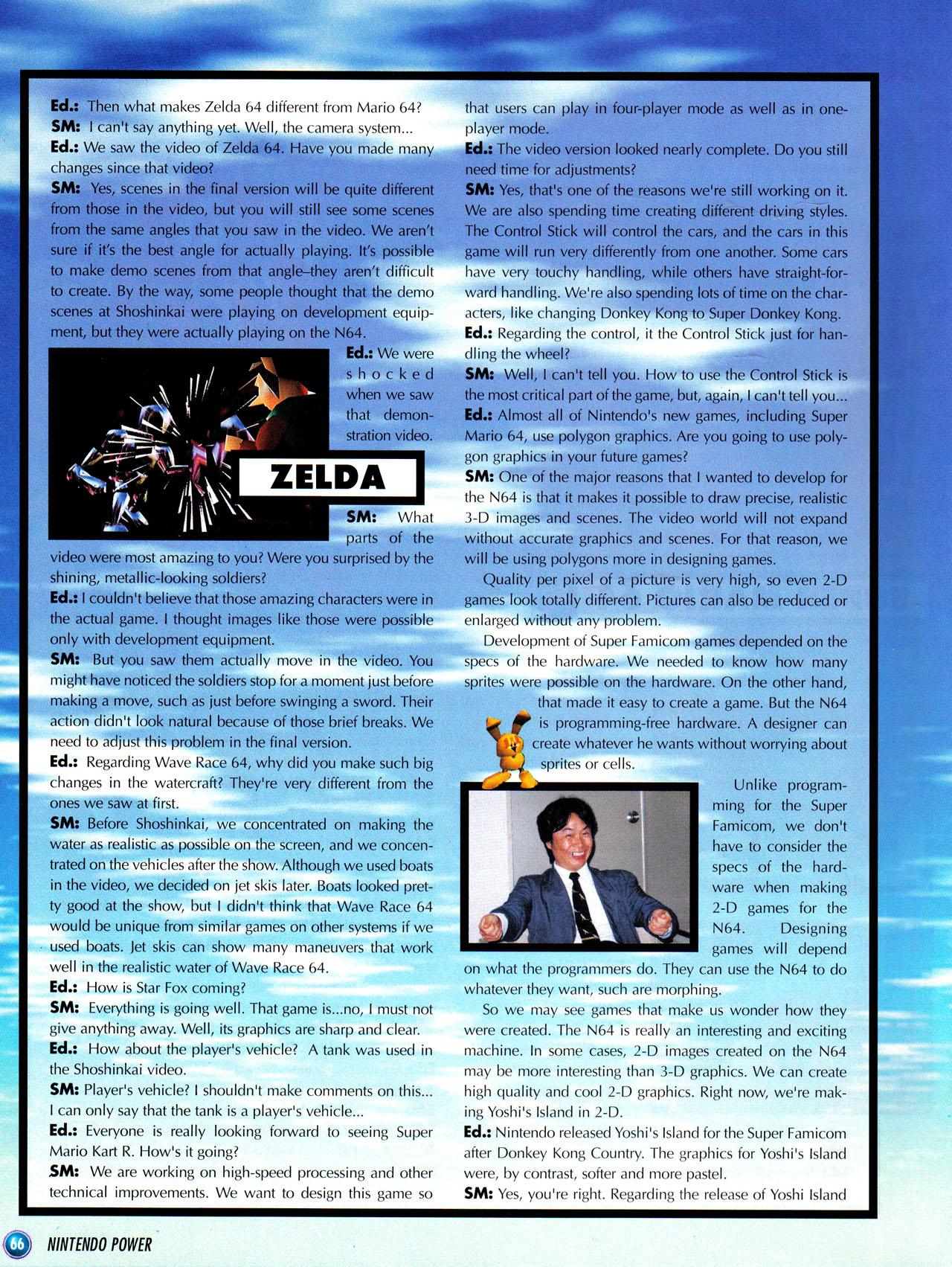
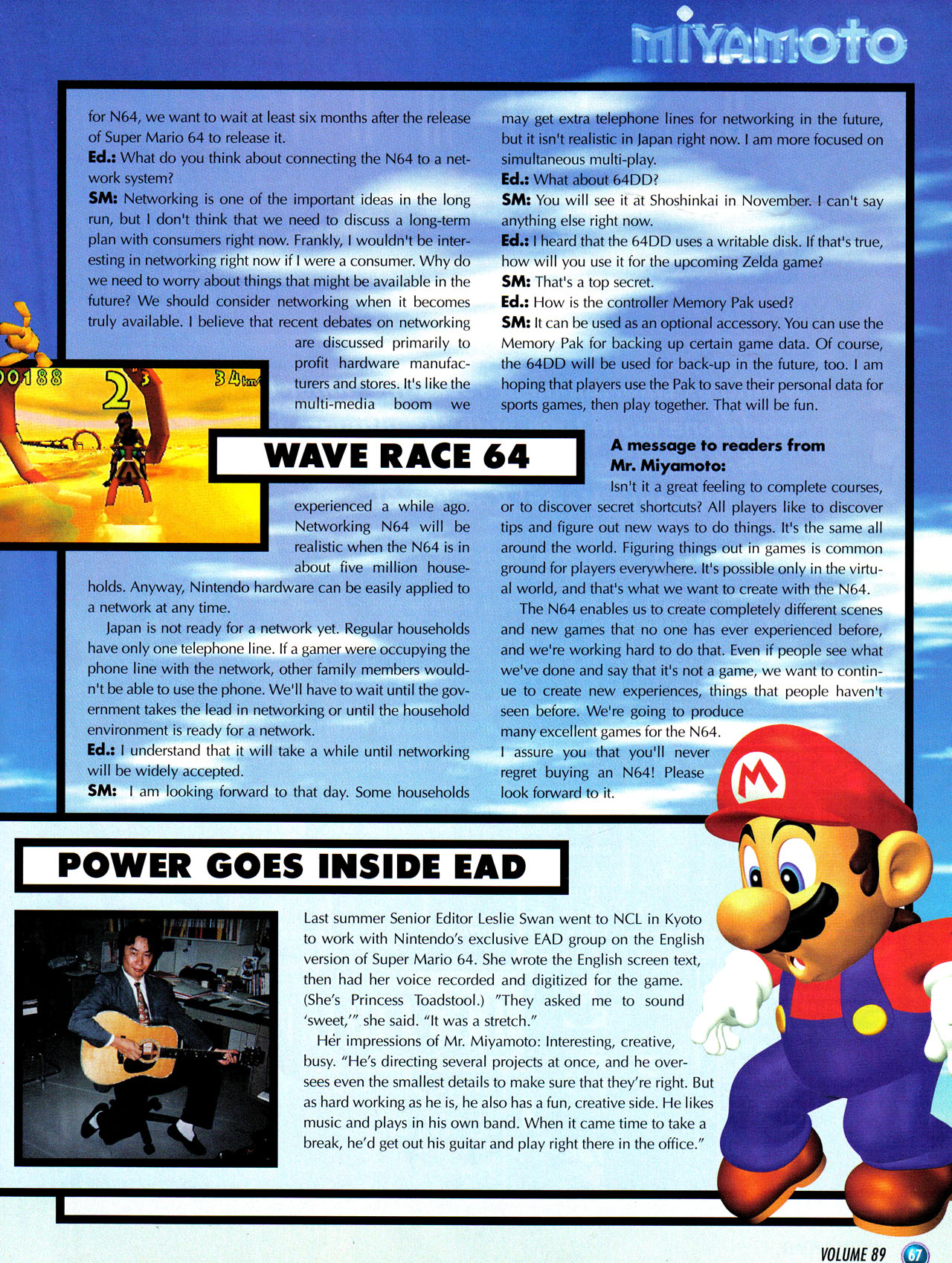
Notes: This interview was with Japanese gaming magazine Famimaga 64 and Nintendo Power later ran a translated version. Scans by Retromags.
Summary: He wrote the specifications for Super Mario 64 before Space World last year. He had wanted to use polygons since before the Super Nintendo Entertainment System. He tested them with Star Fox and Stunt Race FX. They made and tested samples for six months and then developed the game for a year.
They spent a year on the characters and camera angles. Mario and MIPS were used for testing.
He comes up with the concepts, like Mario’s moves, first. He started on creating the world after Space World in November 1995.
The leg sweep would be used to knock down bamboo poles and defeat Goombas.
Basically only A and B are used for control.
The Nintendo 64 might be the only console that can make a correct 3D view, so you can’t see Mario from behind a wall. It would be confusing if the camera shifted every time Mario moved.
The characters speak more in the English version, such as Mario saying “here we go!”
He used some ideas from The Legend of Zelda: Ocarina of Time in Mario 64, just like the Super Nintendo versions of Mario and Zelda.
The soldiers in the Ocarina of Time demo at Space World stop before they swing their sword, they need to fix that.
They focused on making the water look realistic in Wave Race 64 first. They originally used boats, but changed it to jet skis, which are more unique which can show more maneuvers.
They are working on more driving styles in Mario Kart 64, each car will run very differently. They are changing Donkey Kong to Super Donkey Kong.
They will be using polygons more in future games. They had a sprite limit on the Super Nintendo Entertainment System, but the N64 is programming-free, you can make whatever you want. They can make high quality 2D images, like with Yoshi’s Story.
Networking is important long term. If he was a consumer he wouldn’t be interested in it right now. Networking will be realistic when 5 million N64s have been sold. Japan is not ready for it, houses only have one phone line.
The Memory Pak can backup save data, and the 64DD will be able to too.
Super Mario 64 Official Guides
Publication Date: August 10, 1996 (approximate)
Subject(s): Super Mario 64, jumping in 3D, animation, enemies, initial prototype, movement and physics
Format: Transcribed interview
People: First interview: Unnamed interviewer, Shigeru Miyamoto. Second interview: Unnamed interviewer, Takashi Tezuka, Yoshiaki Koizumi, Hajime Yajima, Yasunari Nishida, Shigeru Miyamoto
Link: https://shmuplations.com/mario64/
Archive Link: https://web.archive.org/web/20160922162125/http://shmuplations.com/mario64/
Translator: shmuplations
Notes: This shmuplations article contains two interviews from different sources, I have included both in this entry because I am not exactly sure which guides they are from or which is which. Shmuplations links to this resource which cites, according to machine translation, “Nintendo Official Guidebook Super Mario64”, published by Shogakukan and “Super Mario 64 Mario the Technique”, published by Takarajimasha.
Summary: [First interview.]
Since Donkey Kong he’s thought that a game needs to be exciting for the people watching, too.They tried that for Super Mario 64.
A theme of his has been to let the player make their own vision. He wants players to make up their own solutions and play styles.
They returned to an older style with Super Mario 64. Jumping is difficult in 3D. They can’t measure the exact pixels Mario can jump anymore, like they could in 2D. Late in development they made it so that your jumps would make it if you were “close enough”.
They tried animating with motion capture but ended up doing it by hand. The area around his hips is a joint and all of Mario’s movements are based on that origin.
The Mario face in the opening was from a Mario Paint 3D prototype. He thinks it’s the first time the skin animation technique has been used in a game.
He’s always said he doesn’t want to make movies, but it seems like all the game developers now aspire to. Do they have a superiority complex?
Mario is an Italian-American from Brooklyn. The voice actor also did Mario’s voice five or six years ago at an event. There are more voice samples in the American version.
There are less than 40 enemy types, rather than the usual 80. Many are neither friend nor foe. They wanted the player to feel like it was a mysterious place.
They had a Yoshi event, but scrapped it. To not waste the model they put him in at the end. Luigi was in the game until February, but they had to cut him due to memory issues.
[Second interview.]
Super Mario 64 started simple: a room with Lego-like blocks. They knew they were halfway done when they got the controls to feel smooth. Things had to start vague since they were still designing the Nintendo 64 and didn’t know what it would be capable of. They started by developing on a powerful computer, no one thought they’d be able to get it running on a $250 console. The N64 prototype handled it almost perfectly, though. The staff felt they’d been lied to when they saw the planning sheet, it was going to be a massive game.
Moving Mario and Luigi around that small room and moving the camera was the fundamental basis. They wanted moving to be fun.
Yasunari Nishida and Yoshiaki Koizumi handled the animation. They were told to make as many movements as possible. They created movements for every button combination, which left a few useless ones.
At an expo in November they heard that the controls felt slippery, but they dug in. This is the kind of response you get when you’re trying to change the culture. They made Super Mario 64 to change the culture of gaming.
There’s a lot of physics calculations, all the jumps have different calculations. They had to learn physics all over again.
Half their time was spent on the basic systems, the levels and enemies were done at the end.
There was some concept art and sketches, but they didn’t make models. They started with a general shape but changed it as they added things. He had doubts about some of the ideas, like the Koopa the Quick race. It was originally a rabbit. He wanted to add a rabbit throwing animation.
They had children, including his son, playtest Super Mario 64, which is unusual for them. Watching his son try to climb an unclimbable hill in Bob-omb Battlefield over and over made him wonder if his son had any brains.
Their big gamble was that it would be fun just to wander around. They made it for the people that would hang around outside the castle at the start of the game.
They used 60% of the N64’s capabilities. Maybe 40%.
Mario and the Legend of Zelda have the same basic gameplay. One is focused on action, one on puzzles. They share ideas.
Space World 1996 Super Mario 64 Demonstration (untranslated from Japanese)
Publication Date: November 22-24, 1996
Subject(s): Super Mario 64
Format: Presentation
People: Unknown Nintendo presenters, Shigeru Miyamoto
Video: https://www.youtube.com/watch?v=1ZXA2pzrLlo
Official Mario Kart 64 Guidebook
Publication Date: December 14, 1996 (approximate)
Subject(s): Mario Kart 64
Format: Essay
People: Shigeru Miyamoto
Link: https://shmuplations.com/mariokart64/
Archive Link: https://web.archive.org/web/20181101232356/http://shmuplations.com/mariokart64/
Translator: shmuplations
Notes: Several people who worked on Mario Kart 64 wrote their answer to the question “what has changed from Super Mario Kart to Mario Kart 64?” for the official Japanese guide.
Summary: Mario Kart is meant for a wide audience of all skill levels. Even though people say that games are evolving, keeping some things the same makes it easier for the average person.
They mostly changed how the game worked under the hood, such as four player gameplay. It was difficult to balance the four player battle mode, but it’s amazing. The programmers thought it would be impossible.
They couldn’t have done it without cartridges and the way they preload data. CDs can store a lot of data, but they are limited in how much the can preload. They repeat the same mistakes as the Famicom Disk System.
When they have 128 or 256Mbit cartridges they’ll be able to add better steering animations and more combat abilities.
Famimaga 64 (Mario Kart 64, untranslated from Japanese)
Publication Date: December 27, 1996
Subject(s): Mario Kart 64
Format: Transcribed interview
People: Unknown Famimaga interviewer, Shigeru Miyamoto
Japanese Archive Link: https://archive.org/details/famimaga-64-issue-13-december-27th-1996
Scan:
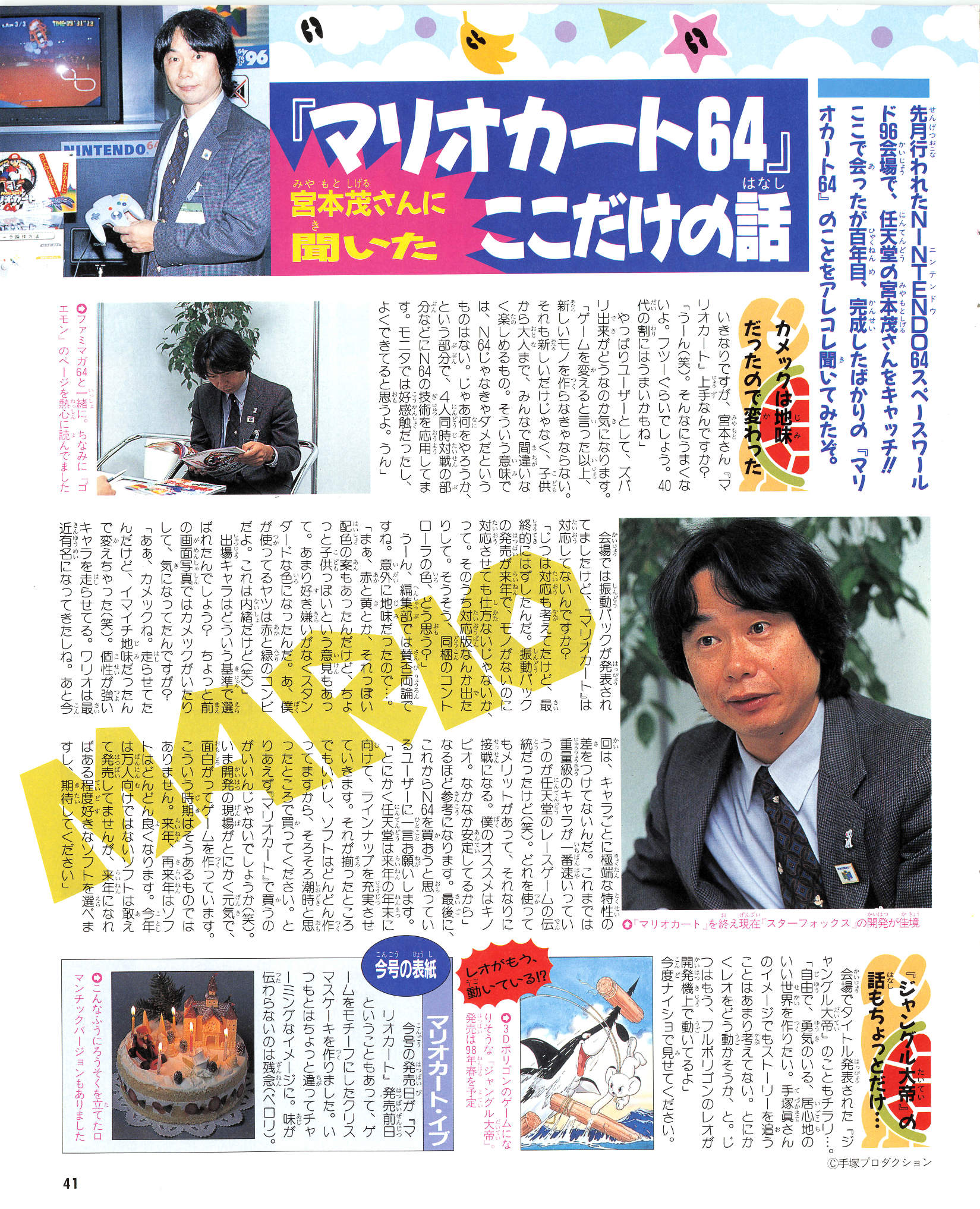
Notes: Scans are by RevengeOfTheHubz for Gaming Alexandria. DidYouKnowGaming translates a small part of this interview in a video.
| 1983-1996 | 1997-1998 | 1999-2000 | 2001-2003 | 2004-2007 | 2008-2009 |
| 2010-2011 | 2012-2013 | 2014-2015 | 2016-2017 | 2018-2023 | 2024-2027 |