
It Was 1995
1995 was a busy year in gaming. Over a dozen platforms were competing for player’s attention in an ever-expanding market that included home consoles and their add-ons, handhelds, arcades, and personal computers. It was a transitional year where 3D games began to take over, some hardware makers would falter and never recover, and a new one would have a spectacular debut. Disc-based games were becoming more common and developers had to figure out how to make use of unprecedented amounts of storage space.
In early 1995 the Super Nintendo was the best-selling console, but the Sega Genesis was still doing well, no thanks to its 32X add-on. The Game Gear wasn’t faring nearly as well against the Game Boy. The Atari Jaguar and 3DO had made an early jump to the next generation but lack of consumer interest led to some uncertainty whether the Sega Saturn and Sony PlayStation would suffer the same fate when they were released outside of Japan. The Virtual Boy confused everyone while they waited for the N64, which was pushed to 1996.
Less than 10% of Americans had Internet access. The primary sources of information about all of these competing systems were video game magazines. There was a strong game magazine industry by 1995, with dozens of competing publications vying for attention with loud, colorful covers on newsstands. Magazines could afford to specialize in what they covered and who their target audience was. The letter sections of these magazines served as the forums of the time and magazine editors were still figuring out an ever-shifting industry.
This study looks at what was happening in video games in 1995, primarily through the North American magazines that covered them. It’s going to take a look the big events and the systems that were available. The history, editorials, and covers of 10 magazines, as well as how they handled their reviews. There’s a lot of statistics relating to those reviews and a lot of statistics about advertisements that appeared in these magazines. We’re going to look at one particularly noteworthy ad campaign in detail, look at some other interesting ads, and finally there’s some miscellaneous items of interest.
Why 1995 And More About This Study
The first spark of an idea for this project came to me when I saw Ahoy’s “2000.” video, which looked at the year 2000 in video games. It was an interesting year in the history of games, but I wished there were more deep dives into other years of gaming. Doing one myself gave me an excuse to read more gaming magazines.
This project is about the North American console market and the magazines that covered them. The UK certainly had a thriving gaming magazine industry, and there were a lot of computer games being released, but I wanted to stay focused on something more specific. To decide what year to examine I started by finding the year that had the most active magazines. 1995 won out with a total of 42. Ultimately, we’re looking at 10 rather than 42 magazines here. That’s what’s left after leaving magazines that were PC-focused, spin-off publications, didn’t have reviews, were not monthly, not aimed at consumers, started or ended partway through 1995, or had incomplete scans for this period. I made an exception for Sega Visions, which only had four issues in 1995 before ceasing publication because it was the official Sega magazine and I didn’t want to include Nintendo’s and not Sega’s. The final 10 magazines are thus DieHard GameFan, Electronic Games, Fusion, Electronic Gaming Monthly, Game Informer, Game Players, GamePro, Next Generation, Nintendo Power, Sega Visions, and VideoGames: The Ultimate Gaming Magazine.
The scans for all of these magazines were mostly done by the people of Retromags. The February issue of VideoGames: The Ultimate Gaming Magazine was accessed via the Video Game History Foundation’s Digital Archive and was originally scanned by Johnathan Young. The DieHard GameFan issues were found on Internet Archive years ago and may be by Scott P or Sketch the Cow.
1995 works well as a year to study in a few ways. The PlayStation, Saturn, and Virtual Boy all launched in 1995. System launches make for exciting reporting and allow us to see which early games were reviewed and which weren’t. There weren’t many gaming websites at the time, so we can focus on the magazines, which are thankfully well preserved. Games were just starting to get real release dates, though it would still be a few more years before you could expect all of them to have one.
This study will refer to U.S. release dates, U.S. dollars, and U.S. sales unless otherwise noted.
What Was Happening In Gaming In 1995
A Brief Timeline And Gaming 1995
January 6-9: The Winter version of the Consumer Electronics Show is held in Las Vegas. This was the last CES where video games had a major presence.

May 11-13: The first E3 was held at the Los Angeles Convention Center. It was an immediate success, drawing over 40,000 people. Tom Kalinske announced that the Sega Saturn was now on sale for $399, while PlayStation’s Steve Race came on stage and simply said “Two ninety-nine”. Nintendo was the last holdout in favor of CES, but did attend.
May 11: The Sega Saturn goes on sale in North America at select retailers in small quantities.
August 14: The Virtual Boy goes on sale in North America.
September 9: The Sony PlayStation goes on sale in North America.
ESRB ratings had started being added to game boxes in late 1994 and Sega’s Videogame Rating Council was a thing of the past. The topic of violence in video games was receding for the time being.
Online play and distribution on consoles was its nascent stages as XBAND and Sega Channel launched in late 1994.
Many magazines covered what was going on in Japan, where so many popular games came from. Imports were an attractive option to play games that may never come to North America, or which were just taking too long.
Although there were a few platforms able to play games using CDs, they were niche. Most consumers would be used to cartridges until they got a PlayStation, Saturn, or a computer with a CD-ROM drive.
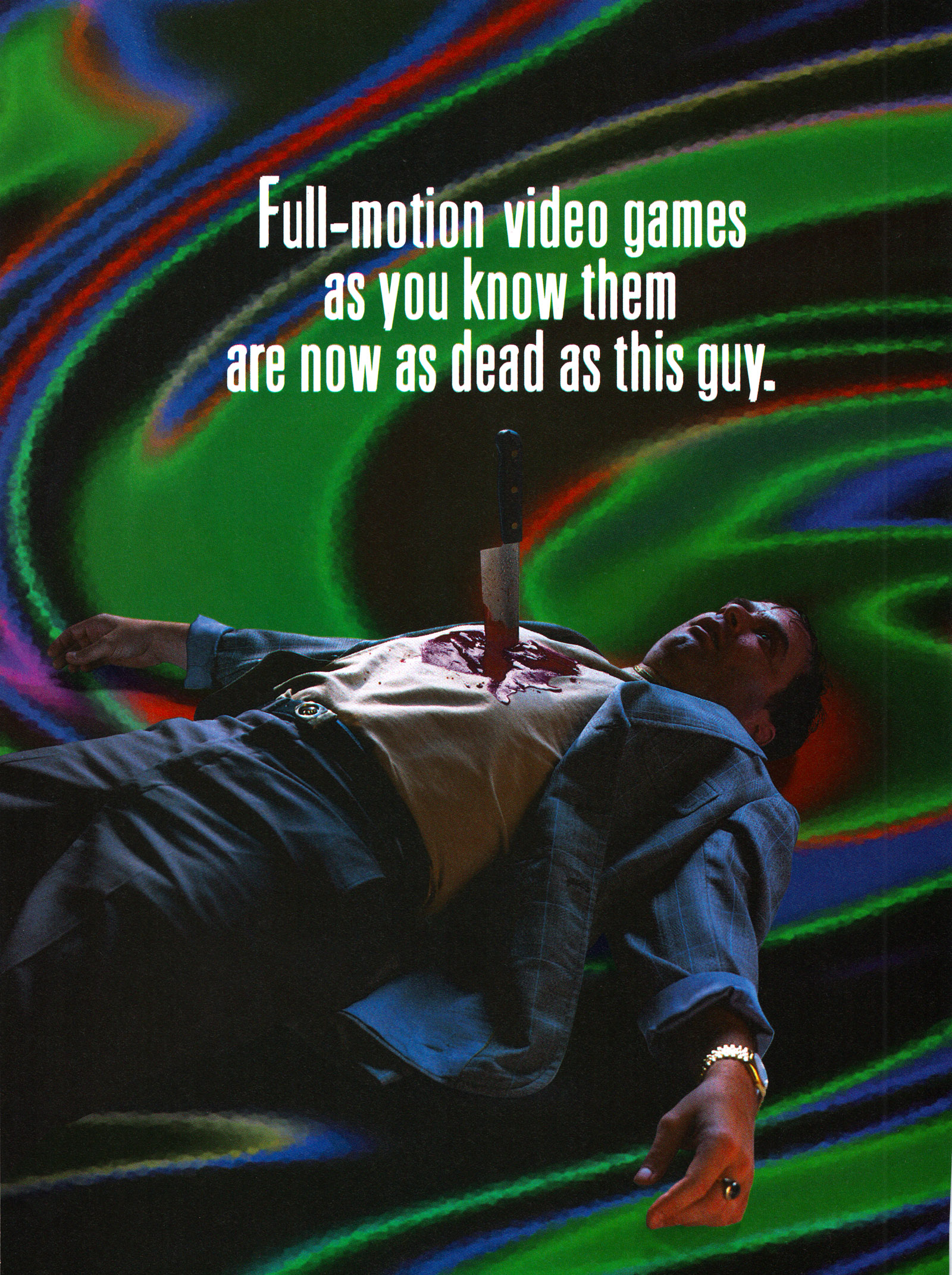
Fighting games were huge, driving people to arcades and eagerly awaiting the home versions. This was spurned on by the success of Street Fighter and Mortal Kombat, and there were new fighting games coming out all the time. There were also lots of sports titles, this was before any one developer was being sold exclusive access to team and player likenesses. Several popular RPGs and platformers released this year. Some FMV games were still being made, but were often the butt of jokes.
GameFAQs, Games Domain, and OGR launched in 1995, but there were very few video game news and reviews websites. Nintendo and Sega had their own websites, and perhaps other hardware makers. The magazines we’re covering all had e-mail addresses that you could contact them at, but only a few had a website. Electronic Gaming Monthly’s nuke.com was shared with Computer Gaming World but disappeared pretty quickly after their publisher Sendai was acquired by Ziff-Davis. Game Players launched a website in late 1995. GamePro may have had an AOL channel in 1995, but it is lost. GeoCities was still new and there were lots of fan sites about video games, mostly in the TimesSquare section. People were talking about games on Usenet. AOL and CompuServe had their own forums and communities about video games.
Looking At Each Game System
Sales numbers are worldwide in this section. Most of these companies report their financials from March to March, and even that doesn’t always include console sales numbers, so all of these sales in 1995 are estimates based on what data is available. This is meant to give an approximate idea of the relative popularity of each system in 1995.
3DO manufacturers had dropped the price of the system significantly to try to compete by 1995. This year was full of talk (and some cautious optimism) about the upcoming M2 add-on, later said to be a new console. It was never released and the 3DO stopped production in 1996. The 3DO likely sold around half a million units this year, as consumers were largely waiting for the PlayStation and Saturn. Some notable games in 1995 include Wing Commander III: Heart of the Tiger, Immercenary, and Captain Quazar.
Although Atari Corporation published the last two games for the Lynx in 1995 (Super Asteroids & Missile Command and Battlezone 2000) I didn’t see a single review or advertisement for them. The Jaguar was doing much worse than the 3DO, even after a price drop it sold around 25,000 units in 1995 and had 100,000 unsold units at the end of the year. The Atari Jaguar CD launched in September, but didn’t move the needle, and the Jaguar was also discontinued in 1996. There wasn’t much of note released in 1995 other than Rayman and Pitfall: The Mayan Adventure.
The Neo Geo AES was made as a way to play Neo Geo MVS arcade games on a home console and it was consequently very expensive. A little over a dozen games were released in North America in 1995, many of them fighting games. The Neo Geo CD was released in Japan in 1994 and was delayed in North America to early 1996. This was another console, not an add-on, which allowed Neo Geo MVS games to be put onto discs that were much cheaper than the AES’s cartridges. With few games and a small install base, some magazines ignored it completely. There is no reliable data for the number of Neo Geo AESs sold, perhaps 100,000 this year. Notable games in 1995 include Pulstar, The King of Fighters ’95, and World Heroes Perfect.
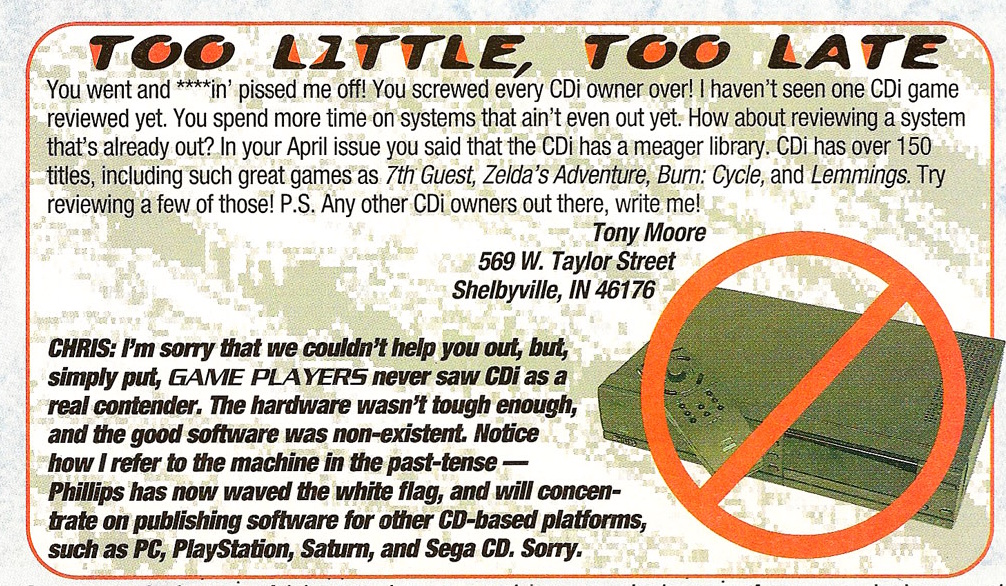
The CD-i was always an awkward piece of hardware that was part video game system and part multimedia software player. Without even the novelty of the Mario or Zelda games in 1995 magazines largely ignored the system, despite dozens of releases. Information on sales is very sparse, but it’s unlikely to have sold 200,000 units during 1995. Some notable releases include Mad Dog II: The Lost Gold and Chaos Control.
The 16-bit consoles were still selling well this year despite the imminent next generation of 3D consoles. Nintendo had to rely on the Super Nintendo a bit longer as the N64 was delayed. The SNES managed to sell several million units in 1995 and was the best-selling system of the year. Some notable games include EarthBound, Super Mario World 2: Yoshi’s Island, Donkey Kong Country 2: Diddy’s Kong Quest, and Chrono Trigger.

The Game Boy had the least power among the systems we’re looking at but it was still the most successful handheld around and likely sold a couple million in 1995. This was the year of the Play It Loud campaign and the release of Game Boys in a variety of colors. The Game Boy was also extending its life with the Super Game Boy, which had been released in 1994. This was a device you plugged into a SNES that allowed you to play Game Boy games on a TV. Some games had extra features that were only available with the Super Game Boy. Some notable games this year were Donkey Kong Land and Kirby’s Dream Land 2.
The Virtual Boy had an uphill battle with its red and black display and being released between the more exciting Saturn and PlayStation. Gaming press was skeptical, but 8 of our 10 magazines still reviewed games for it. Nintendo was cagey about sales and returns were high in Japan, but most of its approximate 770,000 sales were likely in 1995. It was discontinued in Japan in late 1995 and the following year in North America without ever launching in Europe. Of the 14 games released in America, 12 were in 1995 and the highlights are probably Jack Bros. and Virtual Boy Wario Land.
Game Gear released more games this year than you might expect, though none garnered much attention. Although graphically superior to the Game Boy it never came close in sales. Numbers are hard to come by but the Game Gear sold roughly half a million in 1995. Some notable games from this year are Legend of Illusion Starring Mickey Mouse, Ristar and Mega Man.
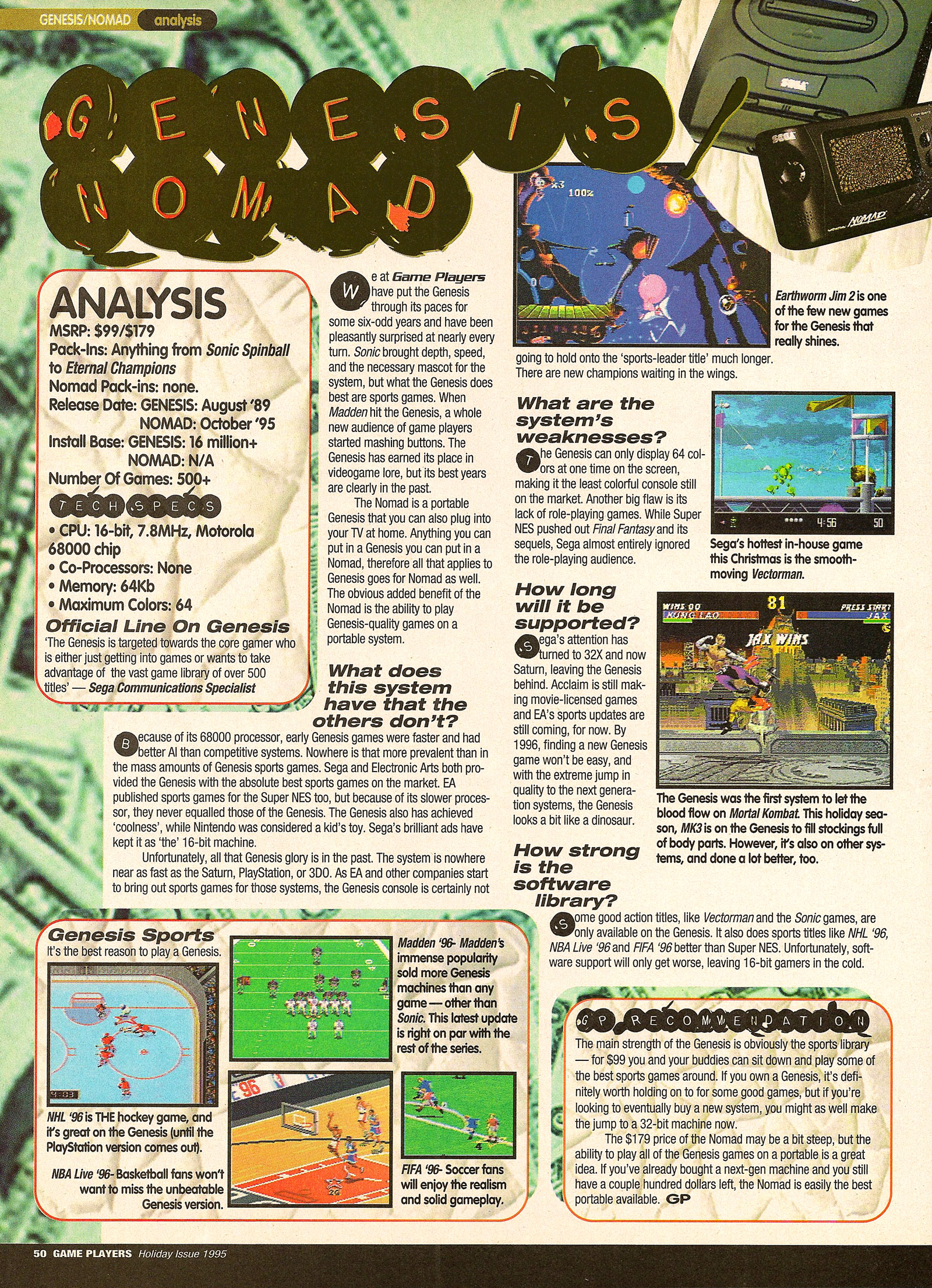
The Sega Genesis was the oldest game system we’ll be looking at but it was still doing well and competing with the SNES. The Genesis sold around 2 million this year, despite very low sales in Japan. Tom Kalinske said that they could have sold another 300,000 if they’d manufactured them. Some notable games include NBA Live ‘96, Vectorman, and Earthworm Jim 2.
The Sega CD add-on for the Genesis was made to take advantage of burgeoning CD technology. Although it launched three years after the Genesis it was also discontinued first and this was the final year any games were released for the system. While a few million total Sega CDs were sold, most were likely before 1995. Lunar: Eternal Blue, Mickey Mania, and SoulStar are some notable games from this year.
The 32X was another add-on for the Genesis, launched in late 1994. Games could use cartridges or discs, which required a Sega CD to also be connected to the Genesis. It was rushed out in order to keep up Genesis sales and make up for the flagging Sega CD, but consumers chose to wait for the Saturn instead. Most of its small library came out in 1995, with the last few released in early 1996. Sales numbers aren’t very clear but it sold about 300-500k in 1995 and was discontinued shortly after. Some notable games this year were Doom, Virtua Fighter, and World Series Baseball Starring Deion Sanders.
The Sega Pico was yet another Sega system that was active during 1995. This console was aimed at young children and had edutainment software. Although it was barely mentioned by gaming magazines it would have greater lifetime sales than either the Sega CD or 32X.
Sega also released the North America-exclusive Sega Nomad in October. This was a portable device that could play Genesis cartridges.
The Sega Saturn had a good start when it launched in Japan in late 1994. It was announced in March that it would go on sale in North America on September 2nd, so it was quite a surprise when two months later live on stage at E3 it was announced that 30,000 units were for sale at a small number of select retailers. Some of the retailers who weren’t chosen were quite angry about this, KB Toys for example refused to ever sell the Saturn. The price of $399 was dropped to $299 by October. There’s no sales numbers for 1995 specifically, but more than a million were sold this year thanks to strong demand and ample supply in Japan. Some notable releases include Virtua Fighter, Bug!, and Daytona USA.
The PlayStation and Saturn had launched close together in Japan in late 1994. There was a strong lineup of games for the PlayStation during its launch window thanks to its low royalties for developers, the purchase of Psygnosis, and strong development support. Although the PlayStation was initially being outsold by the Saturn in Japan it rallied and proved to be very popular once it saw a wider release, outselling the Saturn by several times in some markets and ultimately clearing at least 3 million in 1995, only behind the SNES. Some of the notable releases were Wipeout, Battle Arena Toshinden, Tekken, Twisted Metal, and Ridge Racer.
Gaming Magazine History And Editorials
This section includes some history of each magazine and what it was like reading it in 1995. I have also included summaries of each editorial to hopefully give further insight into each magazine’s focus and how it tried to cater to its audience.
DieHard GameFan

DieHard GameFan began as a Californian game store founded by Dave Halverson. The store advertised its mail-order service in at least Electronic Gaming Monthly during the early 90s. After producing some catalogs showing off the games they had to sell GameFan expanded into a magazine, with some store employees writing under pseudonyms and using cartoon avatars. The magazine had a strong focus on Japanese games and imports. It struggled to remain financially solvent for most of its existence until it shut down in 2000.
The editorials were written by Dave Halverson. Many of these are about the game industry’s transition to the next generation of consoles or GameFan itself. Dave grinds a few axes and I often find his points to be difficult to parse, but he’s clearly proud of the magazine he created and talks it up often.
If you’ve heard of the incident where some placeholder text that used a racial slur was left in the magazine, it was in a review of College Football ’96 in the September 1995 issue, which prompted an apology in the October issue. GameFan did indeed stay below 40% ads, as will be covered in detail later. Delaying the N64 did not ultimately allow it to launch with more than three games in North America, it launched with two.
- The game industry has changed a lot in the last decade. There are few RPGs or innovative games. Developers are scrambling to makegames based on licensed properties.
- The industry is transitioning from 16-bit to 32-bit. Developers used to be able to get good sales just by making good games, but now they are trying to reach everyone and spending a lot on advertising. Games will swing towards the hardcore crowd again. Hard core gaming is better than interactive multimedia.
- With discs, games can go from being finished to being pressed in two weeks, but it takes 90 days for a cartridge. This had led to more games being made for PC that can then be ported to the upcoming PlayStation and Saturn. GameFan doesn’t cover PC because the market will remain small until games are plug and play. You need a $3,000 PC to play the best games.
- The Nintendo 64 has such powerful hardware that CD-ROM technology can’t handle it, but developers don’t
A hard to read news page from April. There is a lot of questionable graphic design in GameFan. love cartridges. Sega and Nintendo will keep making 16-bit games for at least two years. Nintendo will require a team of gamers to approve every game for the N64. There will be few games, but they will all be high quality.
- To stay below 40% advertisements and to keep quality high, GameFan is raising its prices. American developers are catching up with Japanese developers, except when it comes to RPGs.
- The three big hardware manufacturers will be at E3, and video games are poised to became a mass market item. Video games are a good value compared to Laserdisc or S-VHS.
- 16-bit games fell off a cliff and the industry has been rough. 32-bit will usher in a new age and new genres and it’s exciting. It’s good to delay the N64 so it doesn’t only launch with three games, an April launch with 12 games is smart. More adults will likely start playing games.
- Chrono Trigger, Killer Instinct, Yoshi’s Island and Comix Zone rival games for the 32-bit consoles. Hopefully the next generation lasts for at least five years.
- GameFan has added three new reviewers. There is a new section detailing regional differences of games. There is a new top 10 games section.
- GameFan apologizes to Electronic Arts for malicious text in their September issue about College Football USA ‘96. The text does not reflect GameFan and they respect Japanese developers. GameFan apologizes to Namco.
- GameFan has a focus on Japanese imports because Japanese games represent more genres and are of a higher quality. There is a wide variety of merchandise associated with games in Japan. Western publishers avoid RPGs. Sega of America has no RPGs for the Saturn.
- GameFan has been running for three years. Arcade games are finally available on home consoles. There are an overwhelming number of good PlayStation games. It is the best system launch in gaming history.

Electronic Games/Fusion
Electronic Games was a 1992 revival of an earlier magazine called Electronic Games. Starting with the August 1995 issue Electronic Games became Fusion and branched out more into music, movies, computer software, and had an even greater focus on tech news. Although these two were clearly targeting an adult audience they often had

an irreverent 90s sense of humor. Although Electronic Games had a very plain, clean style with big chunks of unbroken text Fusion was often a chaotic mess. Fusion had some big plans to release a CD and launch a website, which never came to fruition.
Electronic Games’ editorials are by Arnie Katz, while Fusion’s are signed “The Management”, which is probably still Arnie. With Electronic Games/Fusion’s focus on more than games the topics of these editorials can be far-ranging and it feels like the magazine is constantly going through an identity crisis. These might be the longest editorials here, taking up most of a page.
These editorials talk about the end of the 16-bit generation, technology, politics and the internet. They try to convince you how mature and professional the magazine is.
- Piracy is stealing. Pirates have harassed him for writing this. The industry’s take is that piracy is stealing, hurts consumers, hurts the developers, and makes it harder for publishers to make money. Gaming is becoming a mass market hobby. Lower prices of games could discourage pirates and would increase sales.
- 16-bit game system sales are slowing and won’t rebound. Doom 2 sold 400,000 in a month, but that’s the only floppy disk hit. Some companies will go bankrupt. CD-ROM games and 32-bit consoles will take over. Soon there will be able to pay to download games and there are virtual reality arcades.
- They are dedicated to making Electronic Games the best magazine for gamers. They are professional. They won’t review a game until it’s time. No one is allowed to own stock in a gaming company.
- The analogy of the Internet being an “information superhighway” is imperfect. Soon the old Internet will be a memory. It was harder to use the Internet before, so there were fewer sightseers.

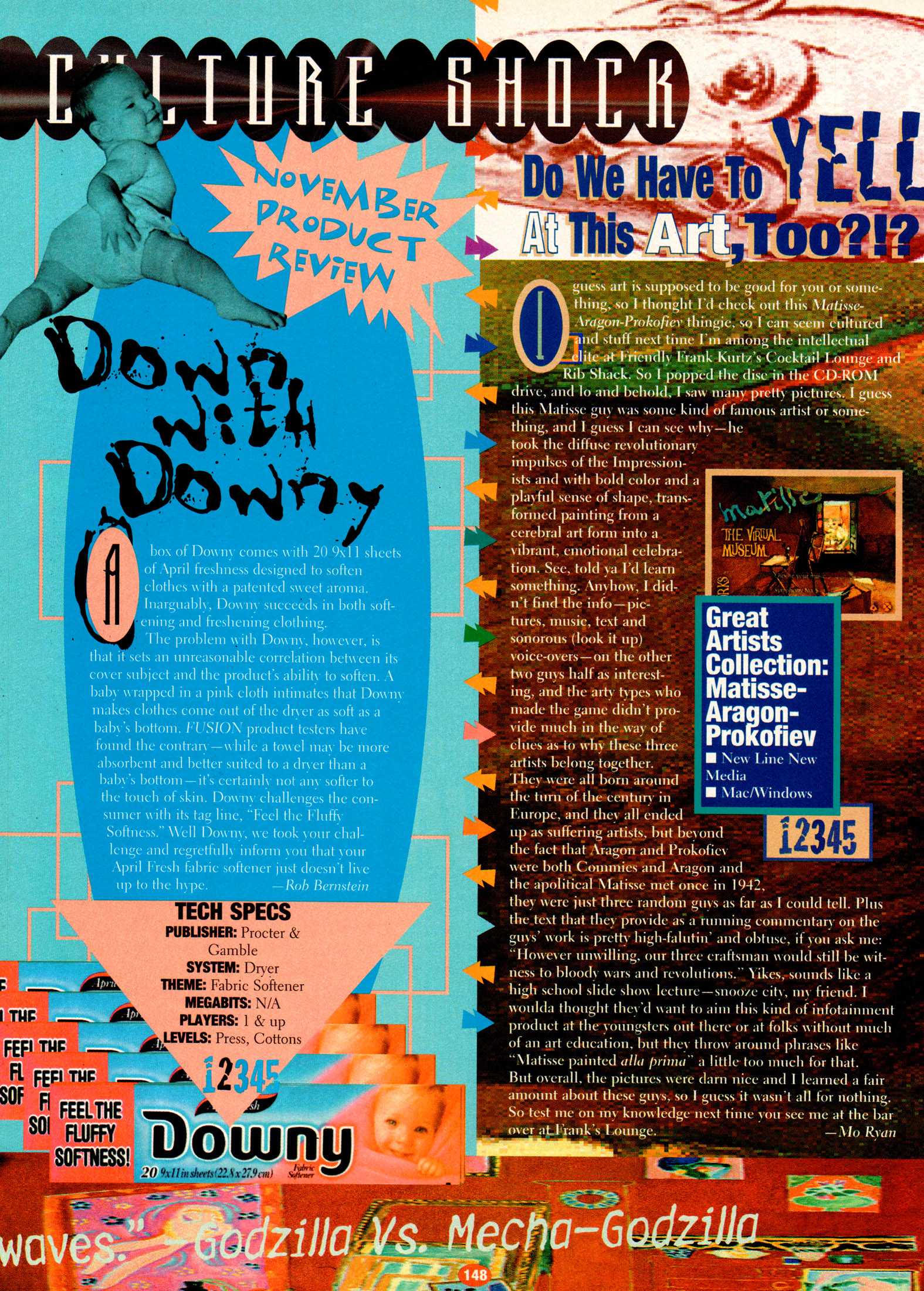
Fusion’s review of Downy fabric softener, November. - E3 was full of hype. Analysts say that only three systems can survive. CD-i has a wide appeal and its success or failure doesn’t depend on gamers. There’s no clear winner in terms of hardware performance. The first wave of games from the next generation will be similar to 16-bit games.
- People want to censor us, people who think they know best. The proponents of the Communications Decency Act of 1995 want to run our lives. This bill must be defeated.
- This is the last issue of Electronic Games, a magazine adults could read without shame. Electronic Games wasn’t an accurate title. Their successor will be Fusion, a title that captures the fusion of electronic and print journalism.
- Fusion is about more than games, it’s about all electronic entertainment. You’ll be able to experience it as a magazine, a CD-ROM, or a website. They want to keep you informed and entertained.
- Microsoft may not understand how important Windows 95 is. It will reshape how we entertain ourselves, it creates many opportunities for game developers.
- [Partially presented in mad-libs format] Readers have responded. People use saucy language in person regardless of concern about what you should be able to say on the Internet.
- Hollywood’s set builders are worried about computer generated imagery replacing their jobs. Others see it as a tool.
- Why pay $60 for an online multiplayer game? Losing feels bad, you have to play at someone else’s pace, and Internet access is expensive. It’s like asking why buy music CDs when you can listen to the radio.
Electronic Gaming Monthly
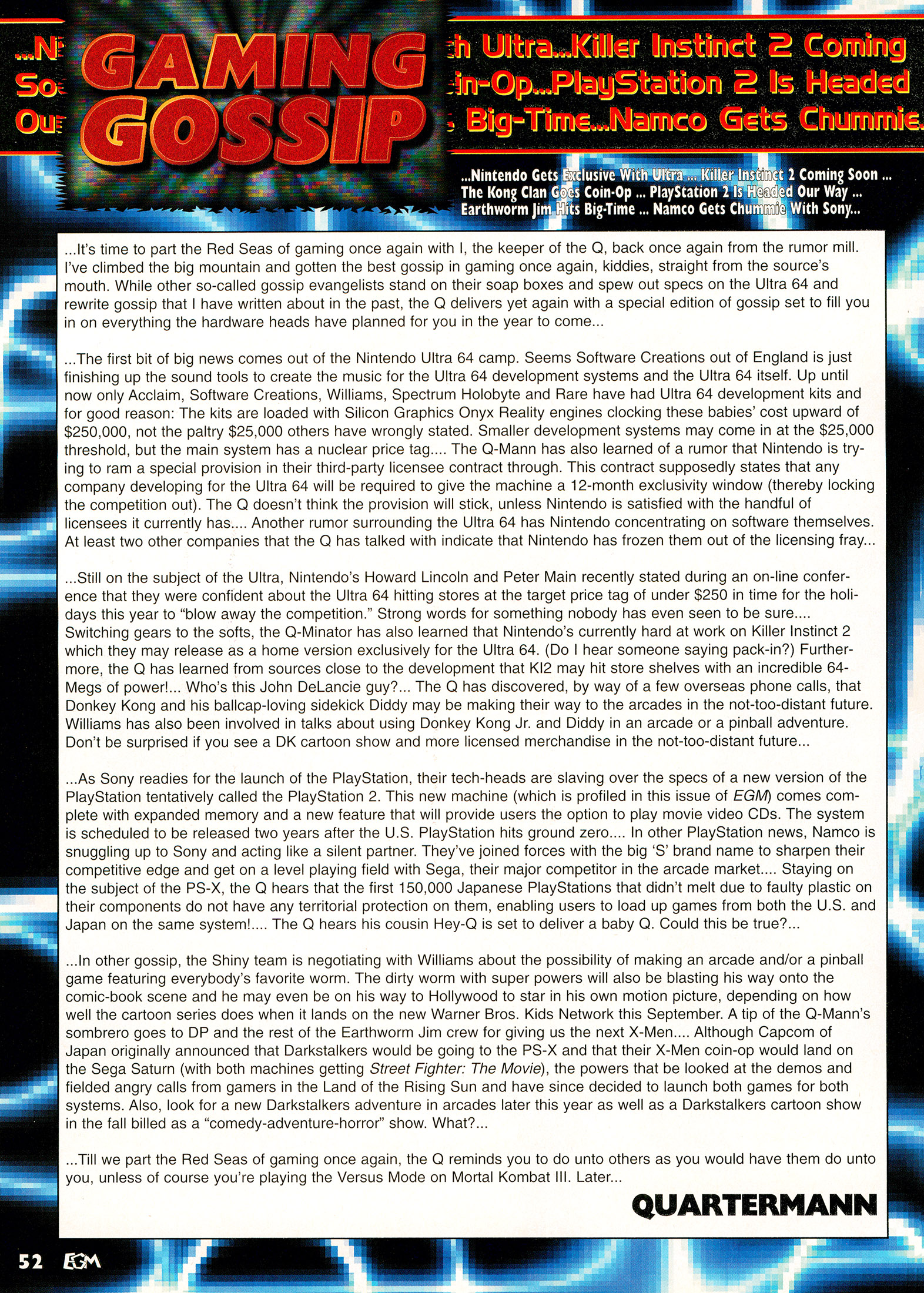
Electronic Gaming Monthly took after the Japanese Famitsu magazine, with four reviewers for most games, arranged in a column. EGM had a sense of humor and often ribbed people who wrote in letters. There were some infamous April Fools’ pranks over the years, though 1995’s was not worth mentioning. This was one of the more popular magazines of the time, though it wouldn’t reach its height for a few years yet.
The mysterious fighting game loving masked ninja Sushi-X was one of EGM’s reviewers for much of its history. This was a riff on a similar ninja reviewer in Famitsu known as Taco-X. Timelines are a bit unclear but he was likely played by some combination of David Siller, Ken Williams, Scott Parus, and potentially other editors at this time.
EGM had three different people write the editorial during 1995: Ed Semrad, Steve Harris, and Danyon Carpenter. These stay pretty focused on the gaming industry and often discuss news that is covered elsewhere in the issue.
EGM’s PC coverage didn’t last long and they didn’t review any games for the platform in 1995. They nailed the launch prices of the PlayStation and Saturn before they were announced. I take issue with saying Mario Clash is “just Mario Bros.”, it doesn’t even have jumping.
- The Virtual Boy isn’t very fun and is too expensive. Mario Clash is just Mario Bros.
- EGM has to use its limited space wisely and decide what systems to focus on. Saturn and PlayStation look good, but N64 is uncertain. Neo Geo CD will do well.
- Sega and Sony are being tight lipped about their upcoming systems. Rumor has it PlayStation will be bundled with Mortal Kombat III and sell for $299 and Saturn will come with Virtua Fighter and Daytona USA, and cost $399.
- 3DO cost too much since the multiple manufacturers weren’t making money from software sales. PlayStation, Saturn, and N64’s price will be important.
- Hype and positive press are important for the upcoming systems. It’s difficult for their marketing departments to give away the right amount of information. Developers are sour on the N64.
- The 16-bit systems are on the wane and many games were overproduced recently. No longer does everything sell. There will be lots of bad games at the launch of the PlayStation and Saturn.
- The N64 is delayed, but Nintendo still isn’t showing off upcoming games. It will release in Japan first. The N64 will catch up if it costs $199.
- The Saturn’s early release sold out its initial 30,000 units, but that’s not surprising. EGM is going to try covering PC games.
- About half of subscribers have their own computer. About 86% play games on their computer. SNES was the most owned console at 71.6%.
- While the next generation will change the industry, the SNES and Genesis are going out with some of their best games. Older games are fun too.
- Analysts are predicting doom for the video game industry because of low sales this year and the rise of CD-ROM drives in computers. Sony and Sega both say they have sold 120,000 of their new systems.
- The Ultra 64 will be called the Nintendo 64. There is coverage of its controller and modem in this issue. The release date is still unknown and developers are not sharing screenshots of their games.
Game Informer
FuncoLand was originally a Minnesotan mail-order store which grew into the retail space and started publishing Game Informer magazine in 1992. The FuncoLand Fun Club was a subscription service which gave FuncoLand patrons a discount on games and a subscription to Game Informer. Game Informer likely sold the majority of its issues as part of the Fun Club rather than from newsstands. Every issue had exactly 68 pages and would until 1998. This is the one magazine still running today, though there was an interruption when GameStop closed them down.
Game Informer contained so few pages it’s a bit surprising that there was an editorial section at all. These are by Andrew McNamara.
These editorials mostly stick to what’s going on in the gaming industry, Mortal Kombat, and “multimedia”.
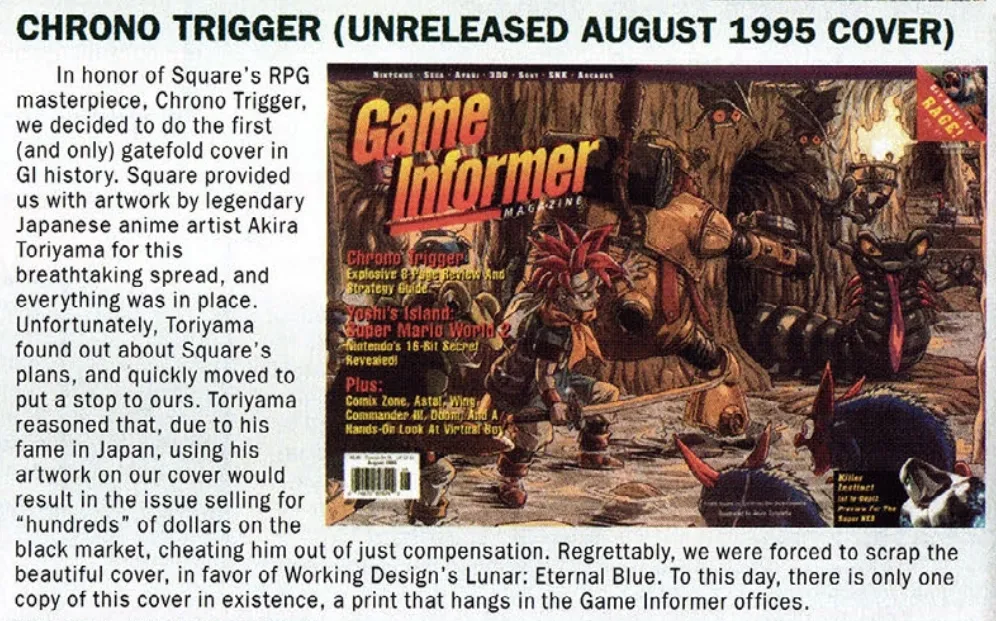
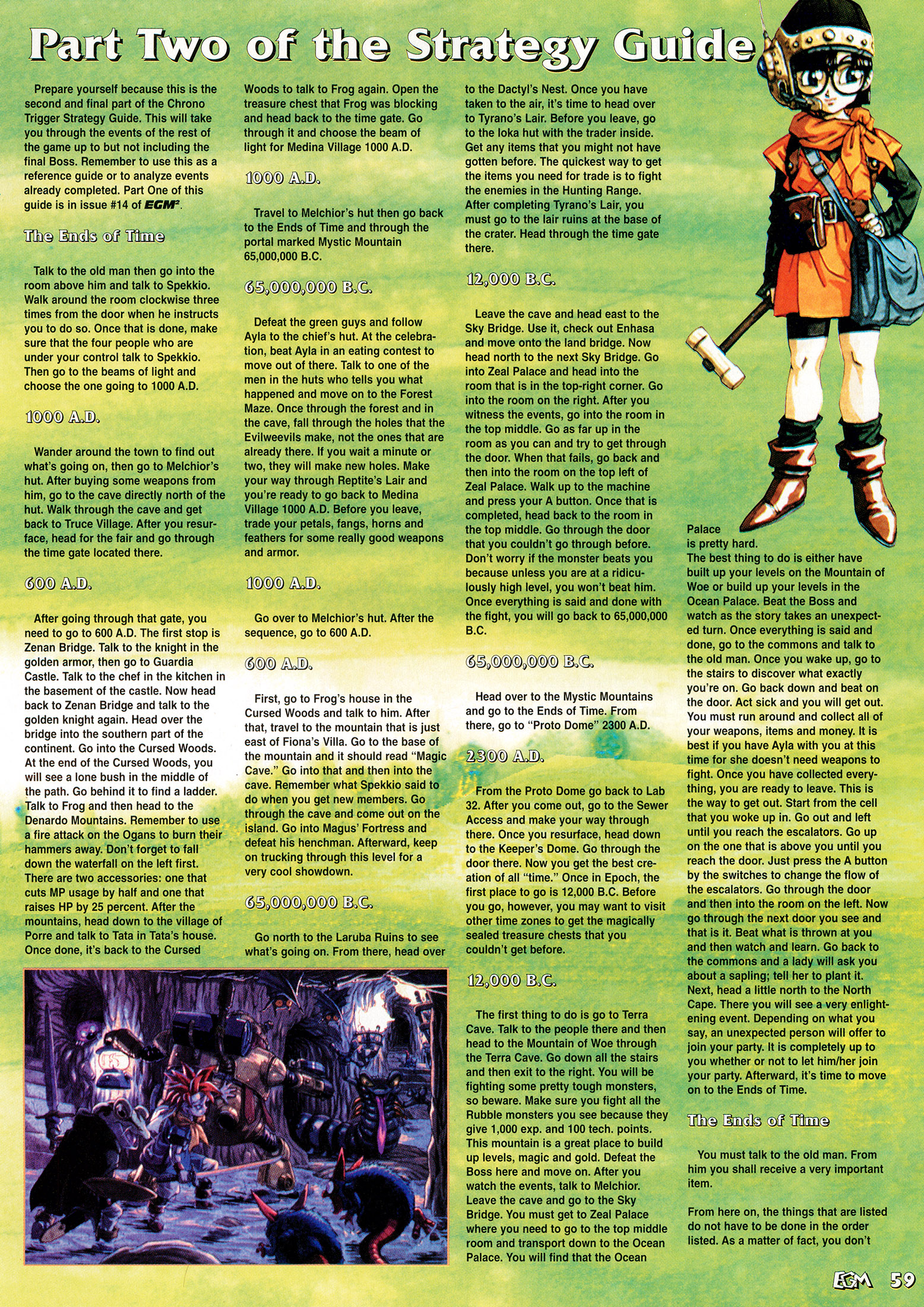
The August issue was originally intended to have an art piece by Akira Toriyama featuring the Chrono Trigger cast, but his company refused because they thought it would make the magazine very valuable and traded on the black market. This artwork actually appears within an Electronic Gaming Monthly Chrono Trigger guide later this year, and does not seem to have been sold on the black market.
- Many video game companies are at war for your money. CD-ROM games can be made cheaply, but cartridges are expensive to make. CD-ROM drives are prone to breaking.
- The 3DO was made to be a multi-media device that could control your TV and stereo. It didn’t take off despite the supposed multi-media craze. It is now a cheaper video game system rather than an expensive multi-media device.
- 1995’s Winter CES was the most boring CES yet. Everyone said they’d have more to show at E3. Game Informer started the Only In Japan section to feature Japanese games. 16-bit systems will go down in price while some of the best 16-bit games are released. The PlayStation will bring in older people who have never played games.
- He was skeptical that Sony could make a game systems that wasn’t for multimedia meatheads, but they are doing very well. The PlayStation’s black disks helps cut down on piracy. Sony can require third parties to spend more on advertising.

EGM’s September 1995 issue includes the same Akira Toriyama artwork, with different coloring. - Game Informer has the best staff amd cares about the magazine. So many in the video game industry just want to make money rather than making a good game. No one at Game Informer has an agenda, they play the games they review, and they tell the truth.
- Hardware specs aren’t important. The Saturn has a larger CD-ROM buffer, but there’s no telling how much it matters. What matters are the games.
- They’re back from E3 and the Saturn had a surprise release. The PlayStation will cost $299, while the Saturn is $399 or $450 with Virtua Fighter. The Nintendo 64 has been delayed. The Jaguar CD and 3DO M2 are coming. Seal performed at Nintendo’s party, while Michael Jackson was at Sony’s.
- The cover of this issue of Game Informer was going to be art made by Akira Toriyama, but his company refused because using his art would make the magazine worth four times as much and would be sold on the black market. They threatened to sue if they used the cover.
- Integrated Circuits can now do complex calculations. It’s been 24 years since Pong. Video game systems have to become more advanced. You can still play your old games.
- For the third year in a row Game Informer has written everything there is to write about Mortal Kombat. Top Ten NES Games They Never Want To See Again: #1: Taboo, The Sixth Sense.
- They would like feedback to make the magazine better. They can’t make it bigger. One responder will win a Sony PlayStation.
- The copy of Mortal Kombat 3 they received was 95% done and they had to figure out all the moves themselves. They found some codes but they were so simple they knew they would be different in the final version, so they didn’t print them.
Game Players
Game Players was the result of a merging between Game Players Nintendo Guide and Game Players Sega Guide. It seems to be aimed at a younger audience than most of these magazines, with more of a focus on humor and with a lighthearted tone. This is one of the few magazines to feature a picture of the review crew. There’s a larger focus on the staff in general.

Some issues included little extras, like posters or trading cards.
Game Players had three different people work on the editorial this year: Mark Higham, Chris Slate, and Bill Donohue.
These editorials focus on games that are featured in the issue and sometimes about the magazine. They are generally pretty breezy and short. It often feels like writing the editorial was something no one wanted to do and no one had any ideas for.
- Their celebrity spotlight is about people at Sega, Nintendo, 3DO, and Atari. They’ll talk about their hardware, marketing, and upcoming games.
- Eternal Champions may be the bloodiest game available. They have a preview of Virtual Boy this issue. This is Mark Higham’s last issue.
- It was a scramble to get everything done after the holidays and before Winter CES. They also have several exciting reviews.
- It’s quite a month for fighting games, with X-Men: Children of the Atom, Mortal Kombat III, and Killer Instinct.
- It’s a slow time of year, but they’ve been busy redesigning the magazine and rearranging the office.
- The redesign is done. Their goal is to cover all video games, not just the big players.
- This issue has news on the PlayStation from E3, plus Killer Instinct, and Donkey Kong Country 2.
- They finally have Saturn and PlayStation reviews. Also a Killer Instinct review.

A pack of included trading cards, which had games featured on the front. - They are giving away a Mortal Kombat III arcade cabinet. Their cover story is about Mortal Kombat3. You can also win the shield prop from the Mortal Kombat movie.
- This is the mother of all issues. There is coverage of Loaded and Toshinden. They are introducing half page reviews. The Cleansing ends this month in the Subscriber Newsletter.
- Bill Donohue has been helping with the editorial, but not this month. The Saturn is moving in the right direction. They have screenshots of Toshinden 2, which may come to PlayStation and Saturn at the same time. Their new production coordinator is Roger Burchill.
- He’s wearing a cape. They have a report on the Amusement & Music Operators Association Show. Donkey Kong Country 2 has been released.
GamePro
GamePro had over half a million readers at this time and claims to be the #1 video gaming magazine. GamePro made its writers into characters represented with an illustration, such as Bruised Lee, Bacon, Captain Squideo, Scary Larry, and Tommy Glide.
April issues had a LamePro feature. These weren’t like EGM’s April Fools’ pranks, these were pretty obviously fake games getting previews and reviews.
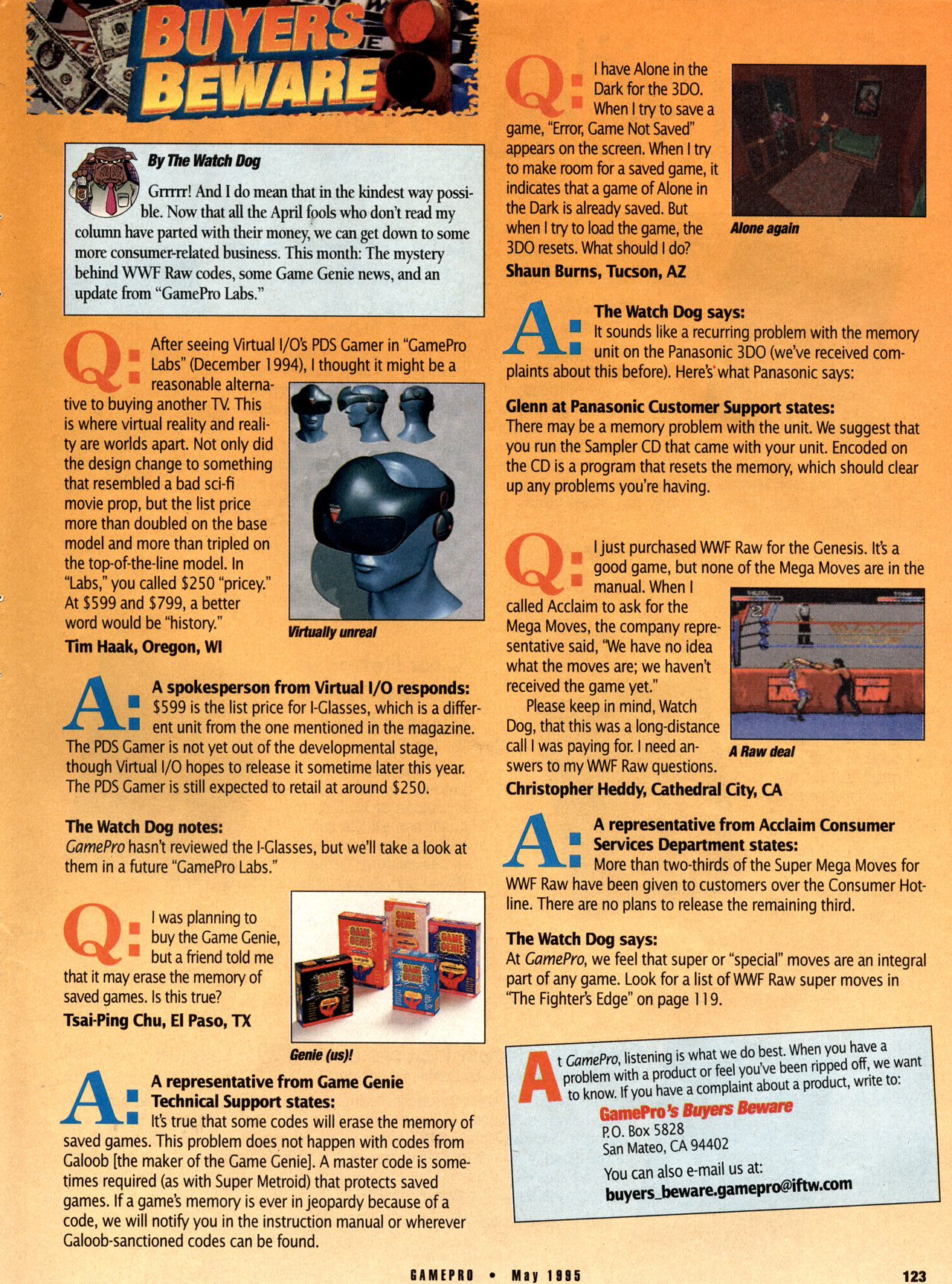
There was an emphasis on helping players, with ProTips under most screenshots in reviews and a substantial strategy section. There was a Buyers Beware page written by Watch Dog where they answered consumer questions and often got statements from publishers and hardware manufacturers. They also ran a pay-per-minute tip line and sold official strategy guides.
The founder of GamePro, Pat Ferrell, pitched the idea of a trade show dedicated to video games to the new Interactive Digital Software Association, and that became E3.
These editorials are credited to “The GamePros”. LeeAnne McDermott and Wes Nihei were editors-in-chief in 1995, so these may have been written by them.
These editorials are generally about industry news and issues. I didn’t realize GamePro claimed to be the most subscribed-to gaming magazine in the U.S. at the time until I read the January editorial. It may not be true, see the Nintendo Power section below.
GamePro also says it will start covering PC games, but it amounts to little for now.
- There are bad games that rely on being from a recognizable series. Games like Earthworm Jim, Sonic, and Donkey Kong Country actually do something different. GamePro has 502,283 subscribers, making it the #1 video game magazine in the U.S.
- Games have been mostly made for men, because that’s what sold. There should be more female protagonists to attract more female gamers. Games like Alien III, Street Fighter, and Super Metroid with strong female characters are a first step.
- GamePro is now publishing ESRB ratings. The ESRB was started because senators threatened to pass a law if the industry didn’t do something. GamePro believes that more information is better.
- The N64, Saturn, and PlayStation were the talk of the Winter Consumer Electronics Show 1995. Sony and Sega stayed at the same hotel and pulled pranks on each other. People had opinions on whether the Ultra 64 would really be released this year and if it would be $250.
- You can e-mail GamePro now. The Internet is a computer network. There’s a guide to finding video game information online in this issue.
- There’s a lot of buzz about E3 and the N64, Saturn, and PlayStation. All the hardware companies are making big promises. The new systems should be able to handle first-person games like Doom. They are covering some PC games because some will be ported to consoles.
- Games are really expensive, up to $100. The Jaguar and 3DO had to have price reductions. There is uncertainty about the Saturn and PlayStation’s prices. The Ultra 64 will be cheaper, but the Virtual Boy seems expensive for a black and red experience.
- We should cool our hype for the next generation of systems until they come out. There was hype for the SNES CD and Edge-16, which never came out. Sunsoft is disappearing despite being at Winter CES.
- GamePro needs to include ads to make money. At least they can be interesting. Try examining their art.
- They aren’t sick of Mortal Kombat 3, even if it wasn’t as large of a leap as they wanted. The newer versions fixed some things.
- The cost of gaming is a concern, but remember that you can still rent games. Think carefully about which of the new systems to buy.
- How gamers spend their money sends a message to publishers. Many sequels are bad because they just repeat what the previous game did.
Next Generation
Next Generation was sort of a U.S. version of Edge by the same publisher and some of its contents originally appeared there. Its very first issue was January 1995. Next Gen was very focused on hardware and had a serious, adult tone. It probably had the most interviews of these 10 magazines and talked a lot about the people who made games and ran companies.

There was a focus on Japanese imports. While Game Players put their editor’s names and pictures everywhere, Next Generation was the opposite, only a few features had a byline. There were several features comparing the hardware of each system. This was the only magazine we’re looking at without a strategy, tips, or codes section.
This first issue’s letters section is mostly people in the gaming industry congratulating them on the launch of the magazine.
These editorials are not credited to anyone, but Neil West seems to be the senior editor, so they may be his words.
Next Generation was always very concerned with the future and these editorials reflect that, many deal with how the hardware makers are doing and where the industry is headed.
- If you’re reading this you want to know everything about video games. You’ve been playing games a long time and you’re sophisticated. There’s a revolution going on with 32-bit systems coming. Play-by-cable is almost here, Hollywood is invading, and virtual reality is looming.
- The first issue sold out within days in many places. The Internet has unprecedented praise. Support is unanimous. Gaming on the Internet is the future. It’s natural that games will leave behind physical media and take to cyberspace. Imagine 1,000 player combat. They profile six forms of network gaming in this issue.
- Everything about the PlayStation’s launch is right. They’ve squeezed everything from the CD format. Namco has taken massively complex arcade games and put them onto PlayStation in a few months. Namco can now get back at its adversary, Nintendo.
- Atari has been a fixture in video games. Atari is a survivor that has survived boom to bust, and has over 70 patents. Atari takes risks and the Jaguar attempts to enter the 32-bit market before Nintendo, Sony, or Sega.
- Nintendo unveiled Project Reality on August 23, 1993 and said it would be done by 1995. It was renamed to Ultra 64, but has stayed quiet. This issue pieces everything together to tell the whole story.
- There’s a gold rush mentality with PC game developers, every new game has to push the envelope. Some games are a quantum leap, like Alone in the Dark and Doom. Heart of Darkness and Crossfire may be next.
- The Ultra 64 has been delayed, Saturn’s release was rushed, PlayStation is expensive. The 3DO could swoop in if it cost $199 or $249.
- With the release of the Saturn in May, gamers have to choose if they want to wait for the PlayStation or Ultra 64, or buy a 3DO now. There’s a lot of demand for new consoles. Imported Japanese PlayStations and Saturns have sold for $800. The Saturn is alone so far. What did its early launch cost Sega, and why are people skeptical?
- PlayStation’s release heralds a new chapter in video game history, and represents a coming of age. Video games make more money than movies. Will creativity or profit drive the industry?
- 16-bit sports games had to fit on a 2 MB cartridge, but Madden NFL ‘96 barely fits on a 650 MB CD-ROM. The code is not much larger, but there is now 30 minutes of video, 20 minutes of audio, motion captured animation, stadium renders, and logos and uniforms. And it’s far from everything the PC, PlayStation, and Saturn have to offer.
- Yu Suzuki is the Shigeru Miyamoto of Sega. He changed gaming forever with Virtua Racing. Virtua Fighter is arguably the most important game of the 90s, blending state of the art technology with solid gameplay. It’s probably art. Sega’s future rests on Yu Suzuki. This issue has the top 75 most influential people to gaming.
- There will be 11 next generation systems soon, and the market can’t support most of them. After a year of research they’ve compiled a 34 page roundup of each system so you can decide which you should buy.
Nintendo Power
Nintendo Power was the official Nintendo magazine of North America and grew out of Nintendo Fun Club. It was made by Nintendo of America alongside Japanese publisher Tokuma Shoten until the May 1995 issue when NoA started handling the magazine itself.
There were over a million subscribers when NP got its start in 1988. There are unsourced claims on RetroMags that it had an audience of six million in 1990 and over a million in 1996. Either amount would be much more than GamePro’s half a million, which claimed to be the #1 gaming magazine.
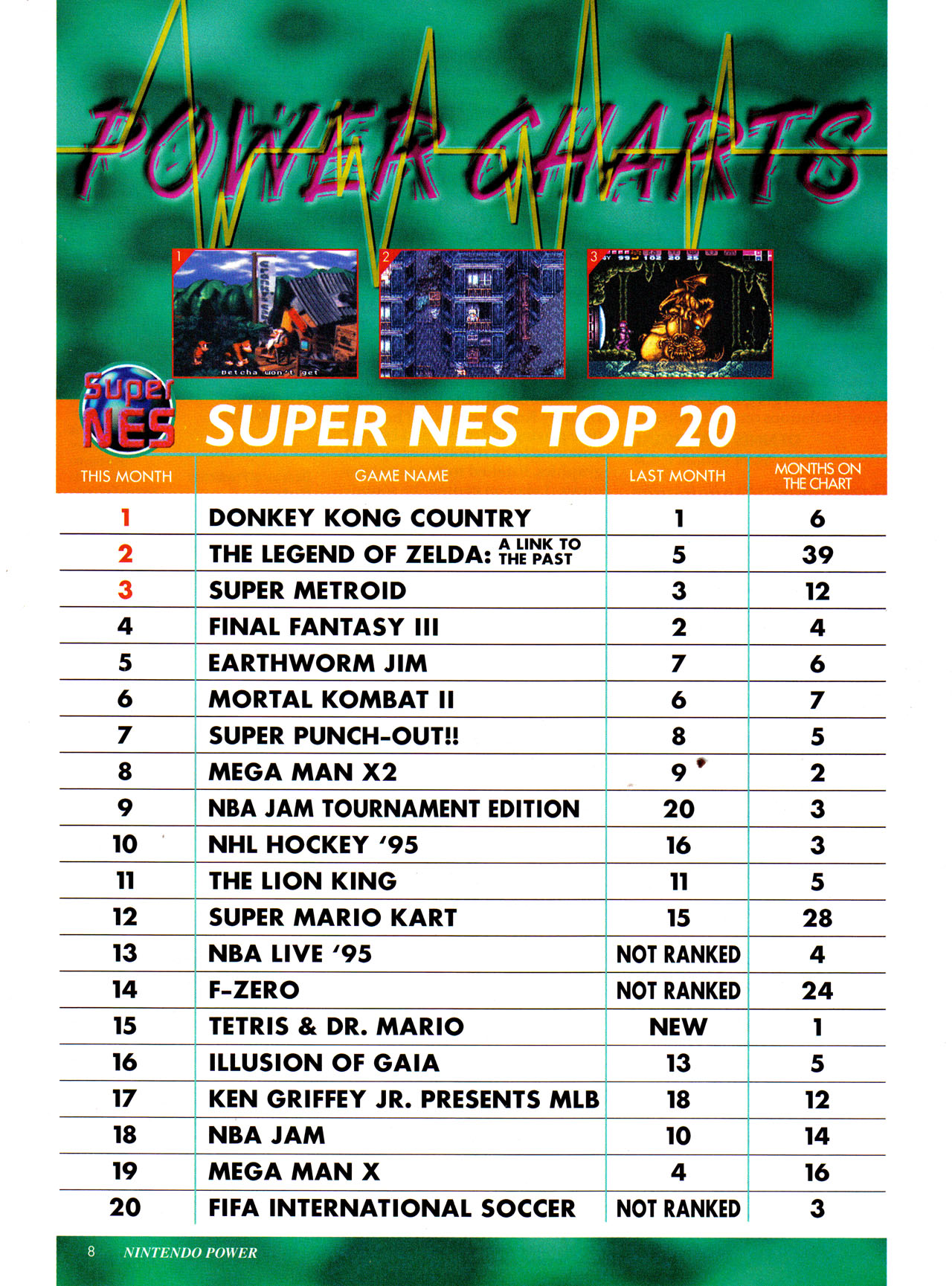
Nintendo Power endeavored to protect Nintendo’s image by being appropriate for all ages and as a result can feel a bit childish. It had a focus on community, with the letters section being full of kids sharing their experiences with games. They answered specific gameplay questions in Classified Information. The Arena was where there were challenges for who could get a high score or the best time in a game, and of course there were the Power Charts. Every issue let readers vote on their favorite games, and the next issue would rank the results.
Around this time Nintendo Power included promotional VHS tapes to subscribers. A Journey Through Yoshi’s Island and The Invasion of Nintendo released were included during 1995.
Nintendo Power didn’t have an editorial in 1995, and wouldn’t for many years.
Sega Visions
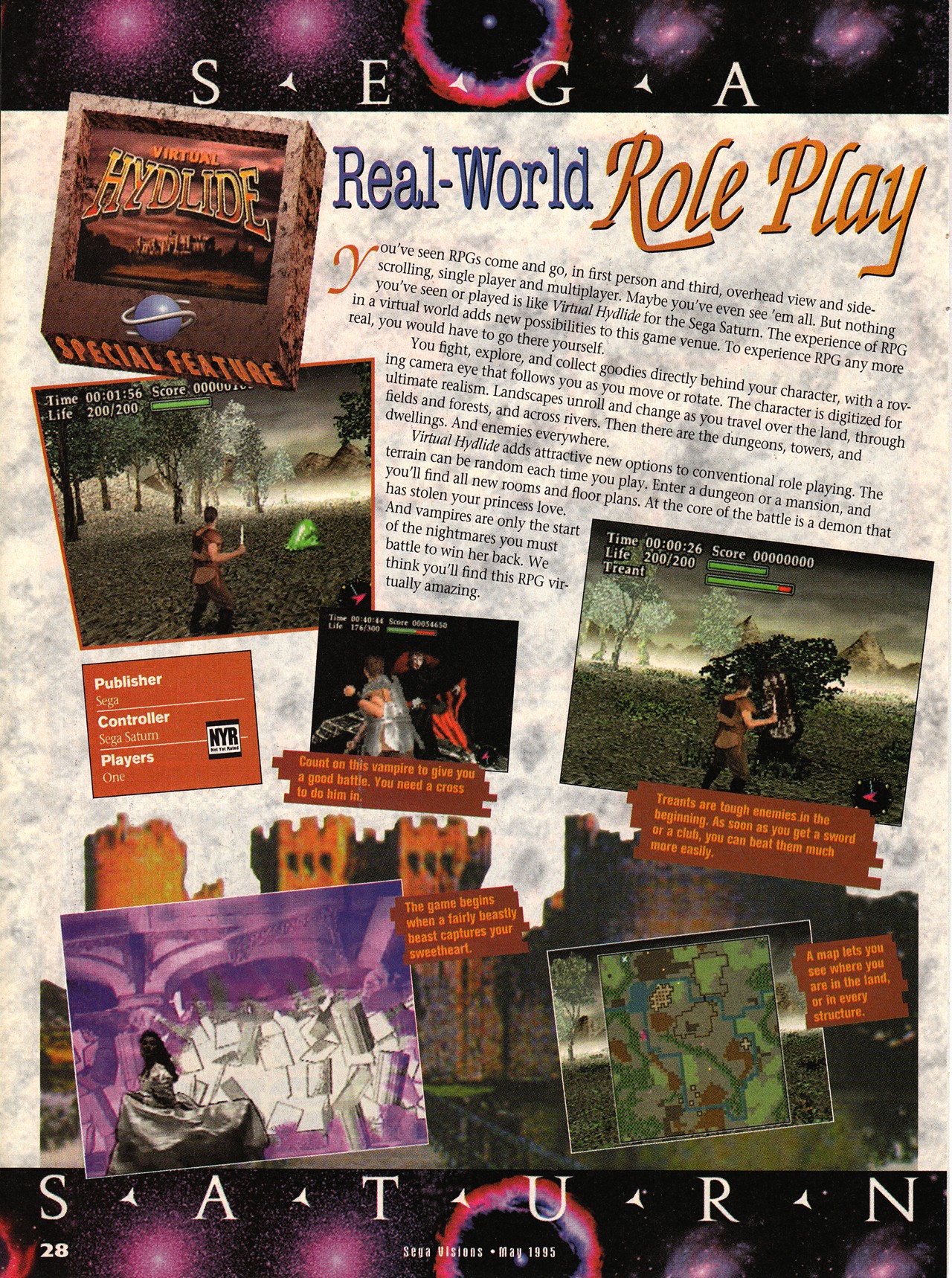
Sega Visions was the official Sega magazine. Registering certain Sega products would get you two issues free and then you’d be prompted to subscribe if you wanted more.
In many ways it feels like Sega Visions was only made out of obligation. It always released sporadically, sometimes with large gaps. There’s a number of inconsistencies between each issue. There were only four issues released in 1995, with the final issue being September’s. There is no mention in the issue that this was the last one.
That said, I don’t find it quite as horrible as it’s made out to be. It’s a bit basic, there’s few interviews, and the news is mostly focused on Sega, but there’s also plenty of previews and reviews of third party games.
Sega Visions also didn’t have an editorial.
VideoGames: The Ultimate Gaming Magazine
In September 1993 VideoGames & Computer Entertainment became VideoGames: The Ultimate Gaming Magazine. Chris Gore took over as editor-in-chief and it no longer covered computer games. Chris’s last issue seems to have been December 1995. The last issue of the magazine was September 1996’s.
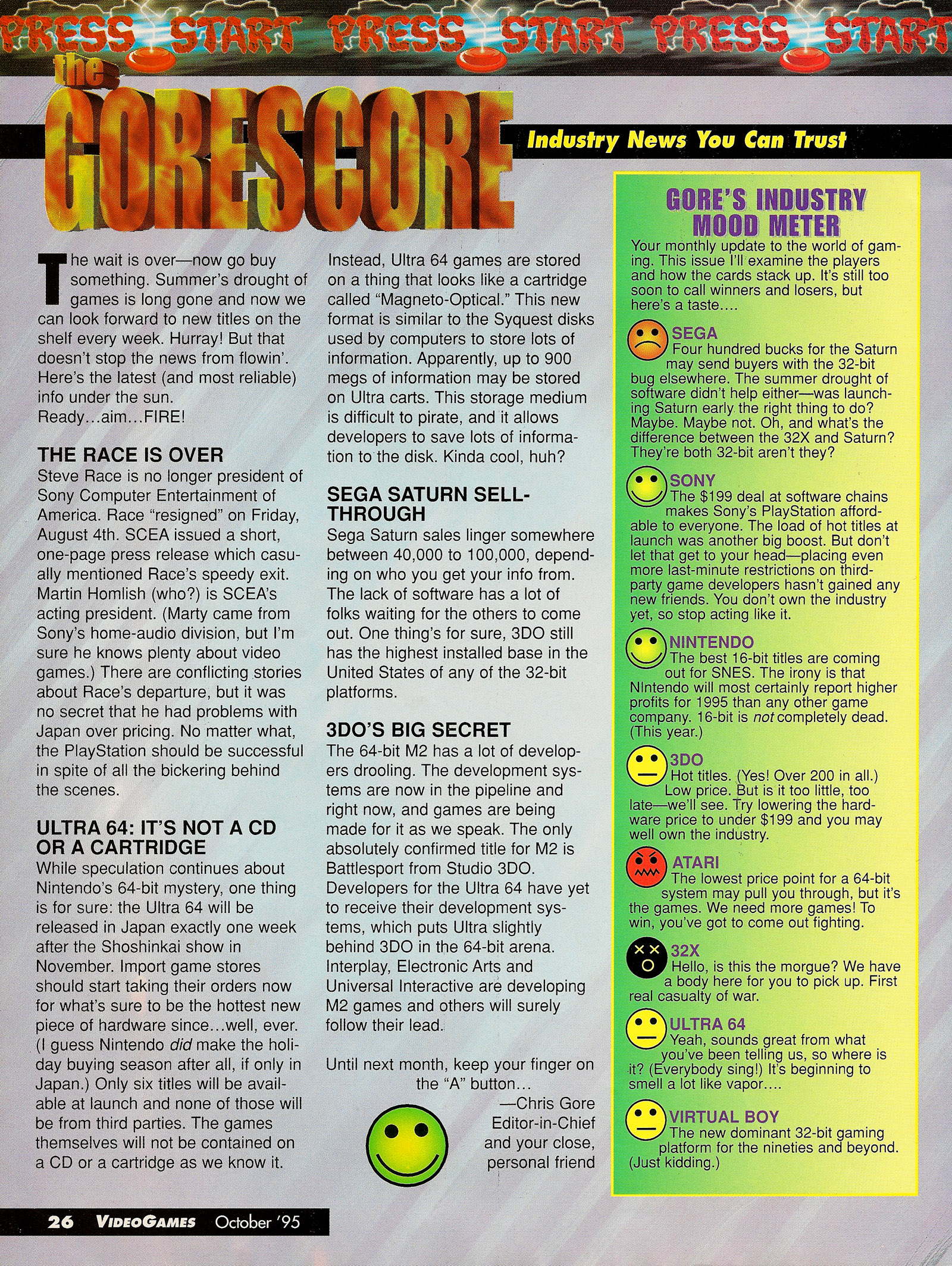
This is a difficult magazine to get a handle on. Little has been written about it, it didn’t seem to have many subscribers, and it was short-lived. The art sent in by readers suggests a young audience.
There’s a lot of space given to tips, codes, and strategy for a shorter magazine. Several sections come and go, including previews of all things. Sometimes there’s a section on gaming zines, which no one else was covering. Dan’s Dream Game Gallery encouraged readers to send in drawings of games they’d come up with.
Editorials were written by Chris Gore and Chris Bieniek. Some of these are about the magazine but they are mostly focused on the gaming industry. There’s some good information here about the economics of the game industry, things that can become forgotten over time. Another over estimation of how many games the N64 would launch with here. Chris also does the Gore Score which is part news, part editorial, and part rumors.
- He has one of the best jobs in the world. They judge games based on the capability of the hardware they are on, the playability, the graphics, and the sound and music. They take their reviews seriously, so use them when deciding what to buy or rent.
- Bandai and Apple are teaming up to make a new gaming system, but we already have quite a few, with more on the way. Sega will be supporting seven of them. Many thought the 32X would upgrade their old games to arcade quality. It will become difficult to find the best version of a game on many systems. The crash of 1984 happened primarily because of bad games. E.T. ended up in a landfill. Confusion over the many game systems could cause another crash.
- This will probably be the last good year for 16-bit consoles. It took 3DO a year and a half to sell 500,000 units. People get annoyed buying a new system every three years, so they will do their research about the new systems coming out. Tom Kalinske of Sega said their two 32-bit systems are like an economy car and a luxury model.
- They haven’t been running a mail section for a while because most of the letters are things like asking for the fatalities in Mortal Kombat II. Write in if something gets a reaction from you.
- There’s a rumor that another magazine reported on that Ultra 64 has always actually been CD-ROM based. The truth is that it is cartridge based, but a CD-ROM add-on will be released within a year. Cartridges will likely be phased out within six months. Game manufacturers like Working Designs can make discs, including packaging, for two or three dollars. Cartridges can cost $20. His educated guess is the Ultra 64 will launch with five games.
- Their logo is now brighter and bolder. There are more pages. The Saturn will launch with 20 games, and this issue reviews four of them. Sega understands gameplay. All of the next generation systems have nice graphics, but a lot of hot games are only coming to Saturn.
- He was at the last save point in Donkey Kong Country and messed up entering the extra lives code and accidentally deleted his save. He keeps coming back to DKC. It’s like Star Wars, it raised the bar.
- Video games cost $50-$80. CDs cost a few dollars to make. It would be worth paying $400 for a system that has $20 games. Third parties are charged a $4-$10 licensing fee. The Lion King and Forest Gump will sell over 10 million copies, but the last game to do so on one platform was Super Mario Bros. 3. Licensing fees should be lower, and get lower if a game sells one million copies.
- Super Mario Bros. is 10 years old. It was a lot of attention to detail and personality. Nintendo was the first to have a system mascot. Sonic was a copy of Mario. Mario was shamed after a horrible movie, but he’s king of the mascots again.
- The battle has begun with the Saturn and PlayStation released. The best exclusives will be important. They both have a great fighting game, racing game, and 3D platformer. PlayStation costs $100 less but has no pack-in game.
- After last month’s editorial he received an angry phone call from a 3DO owner. This person said that the M2 will allow the 3DO to upgrade to 64-bits. It occurred to him that neither PlayStation nor Saturn have caught up to 3DO’s 700,000 sales and that the 3DO is outselling the Saturn.
- Why are there so many game platforms? Couldn’t Street Fighter: The Movie, Virtua Fighter, or Jumping Flash have been multi-platform? If there weren’t expensive licensing fees games could be cheaper than the $4-$20 they are. Some companies are considering moving to PC since there are no licensing fees. Maybe the leaders at Sega, Nintendo, Sony, 3DO, and Atari could decide on a single, common format.
Lead Times
It wasn’t always clear how much time there was between an editor writing something and subscribers being able to read it. The first E3 took place May 11th to the 13th. Electronic Games and GamePro have their E3 coverage in their June issues. GameFan, EGM, Game Informer, Game Players, Next Generation, and Nintendo Power cover the event in their July issues. VideoGames: TUGM mentions a few things that happened in their July issue but the full feature is in their August issue. Sega Visions did not cover it at all, despite Sega being a driving force behind starting the expo. If they had covered it, it would have to have been in their September issue, which was their last.
Pages
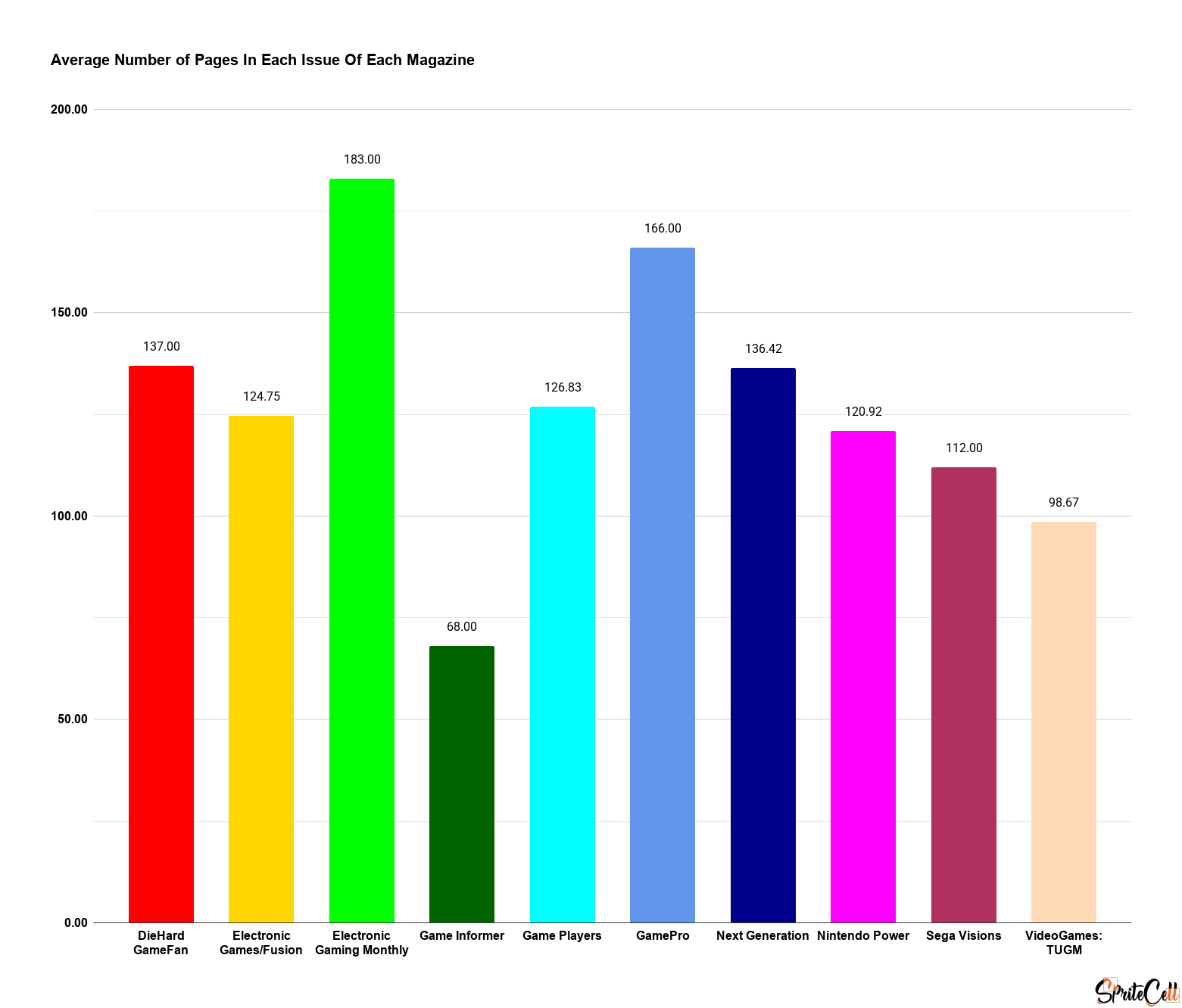
For page counts I didn’t just go with how many files were in each issue’s folder. Some magazines came with little extras or fold outs. I tried my best to only count pages that were physically attached and weren’t supplements meant to be torn out. The total number of pages among all issues was 13,969.
There is a large disparity between the page counts of our magazines. GamePro and EGM covered all sorts of games and were popular, which probably explains why they are so big. While EGM mostly stuck with 148 pages there were a few issues with a lot more, and in fact EGM’s 292 page January issue is the largest of the 112 issues included in this study.
Nintendo Power and Sega Visions by comparison have fewer systems to cover, so need fewer pages.
FuncoLand likely didn’t have much money to put a ton of content in Game Informer and viewed it more as a bonus for club members, but that’s not the case with VideoGames: The Ultimate Gaming Magazine. It was multiplatform, it even reviewed handhelds unlike some of these other magazines and yet most of its issues were kept to 100 pages. Part of the reason it has so few pages is its lack of ads.
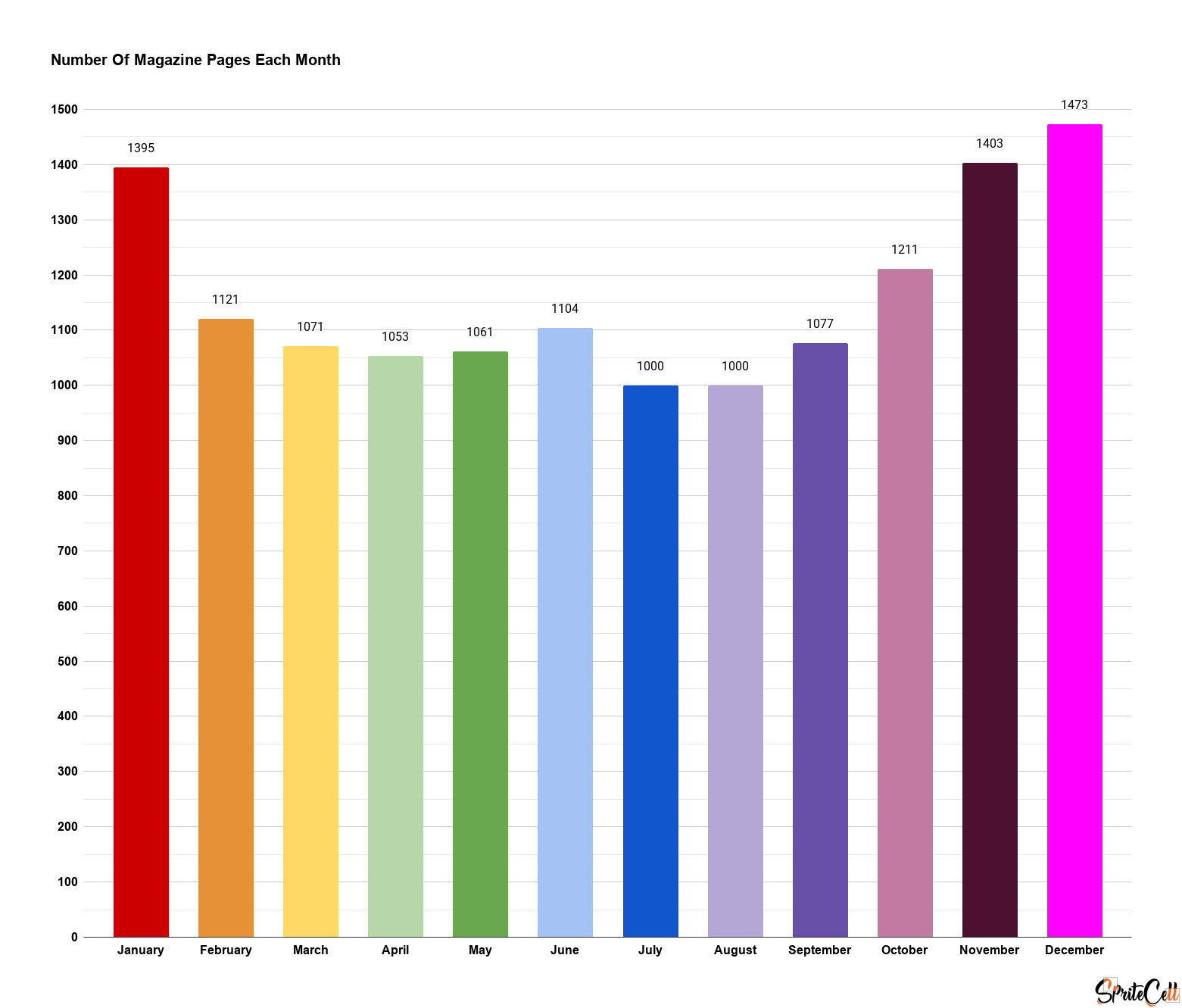
Sega Visions was not included here since it only released four issues.
As more games were released towards the end of the year more pages need to spent talking about them. Remember, you’d likely be reading the January issue in December.
February through September remains remarkably consistent, though you might expect the beginning of the year to be the slowest rather than July and August.
I would expect issues around May to get more of a bump for E3 coverage as it grows larger, but we don’t see that with the first.
Gaming Magazine Covers
A magazine’s cover is meant to get newsstand browsers to try out a magazine as well as to feature something nice for subscribers to look at and get them excited. These covers can tell us more about what kind of person each magazine was trying to appeal to and what tone it was trying to set.
The scans of these covers are really inconsistent in their dimensions and how much of the left side is included. I did my best to scale and arrange them without cutting anything off, but sometimes there had to be gaps.
DieHard GameFan
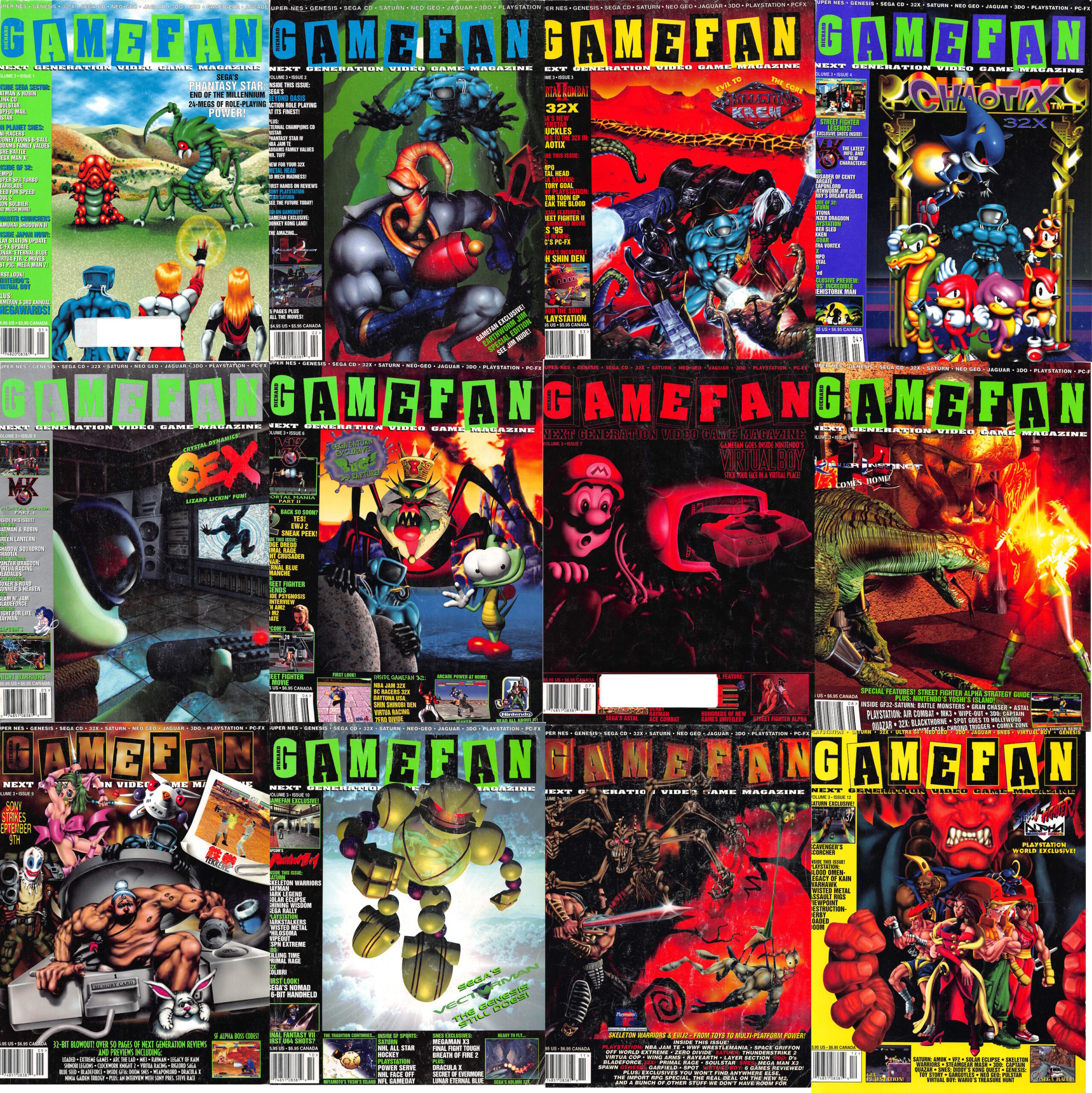
DieHard GameFan featured the wordmark in different colors each issue. A list of the game systems the magazine covers ran along the top and there are banners on the left or bottom listing games.
Many of these covers featured original art by Terry Wolfinger with some 3D renders mixed in. They were generally busy and attention-grabbing, and scream “the 90s” to me. Monitaur, the TV-headed mascot of GameFan, appeared on several of the covers. Many of the games featured didn’t appear on any of the other covers we’re looking at. Only GameFan and Nintendo Power had a Virtual Boy-focused cover in 1995.
I had a lot of trouble identifying the ballerina-like woman in pink on the September cover, but it seems to be Ellis from Battle Arena Toshinden.
Electronic Games/Fusion
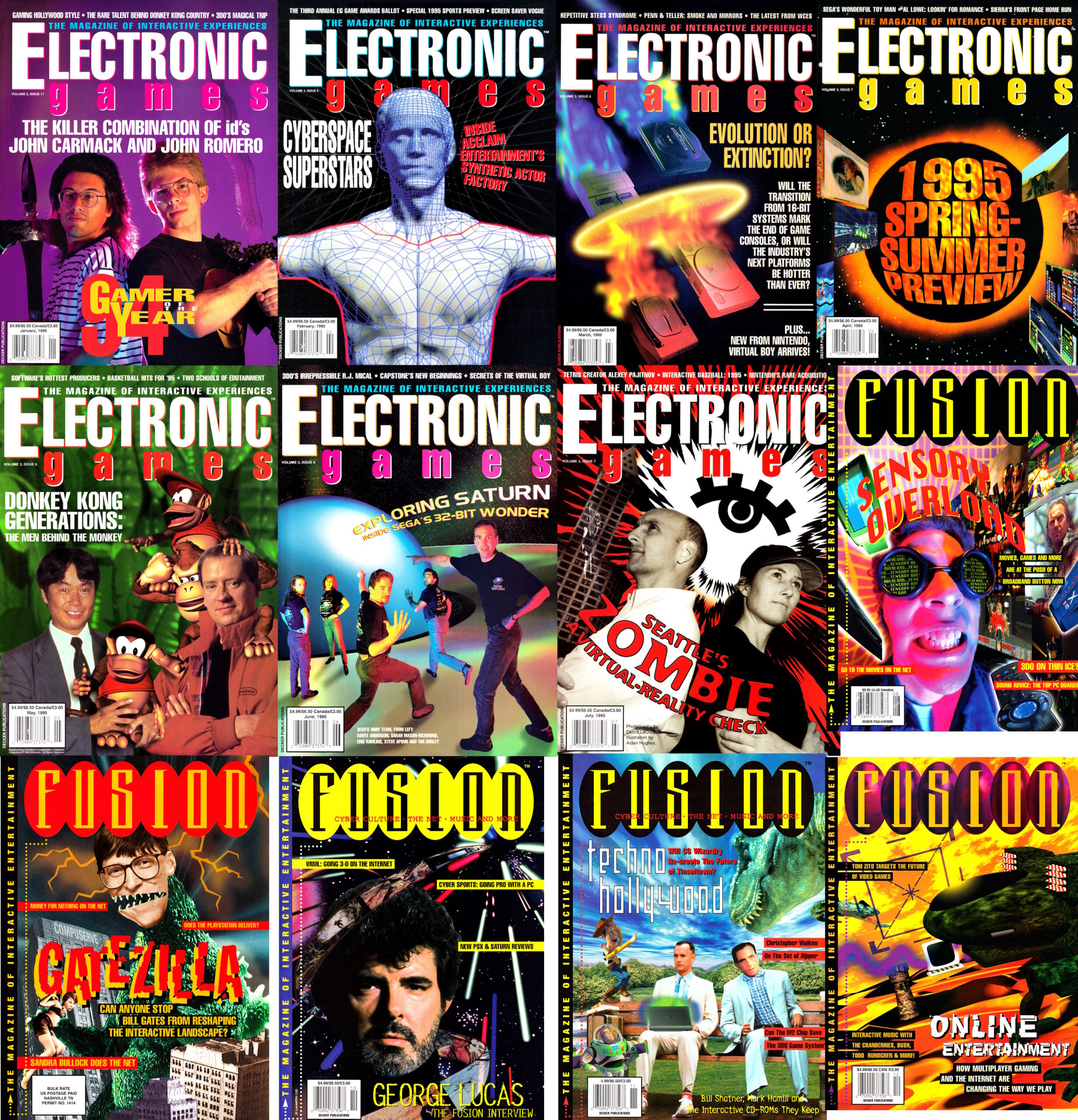
Electronic Games and Fusion also changed the color of their wordmark each month. EG’s top banner advertised a few of the features in this issue, while Fusion did away with it. Electronic Games had simpler covers compared to Fusion’s busy collages. There are no screenshots.
Electronic Games and Fusion were the only magazines included here that feature photographs of people and overall it put more emphasis on interviews than even Next Generation. I would describe some of these as the ugliest covers included here. The clumsy way Shigeru Miyamoto and Tim Stamper were composited with renders of Donkey Kong, Diddy Kong, and…Diddy Kong has driven me crazy for years. They followed this up with five Sega employees standing and pointing awkwardly, and then the founders of the new game studio Zombie. The first issue of Fusion featured one of the editors of the magazine, Dean Hager, wearing goggles that say “SENSORY OVERLOAD” on them. So many of these featured no recognizable people, games, or concepts that would have drawn in people browsing a newsstand.
Uniquely among this set of gaming magazines, no cover is really centrally about a game (maybe MechWarrior 2 in December) and there’s only a few games specifically named on any covers.
Electronic Gaming Monthly
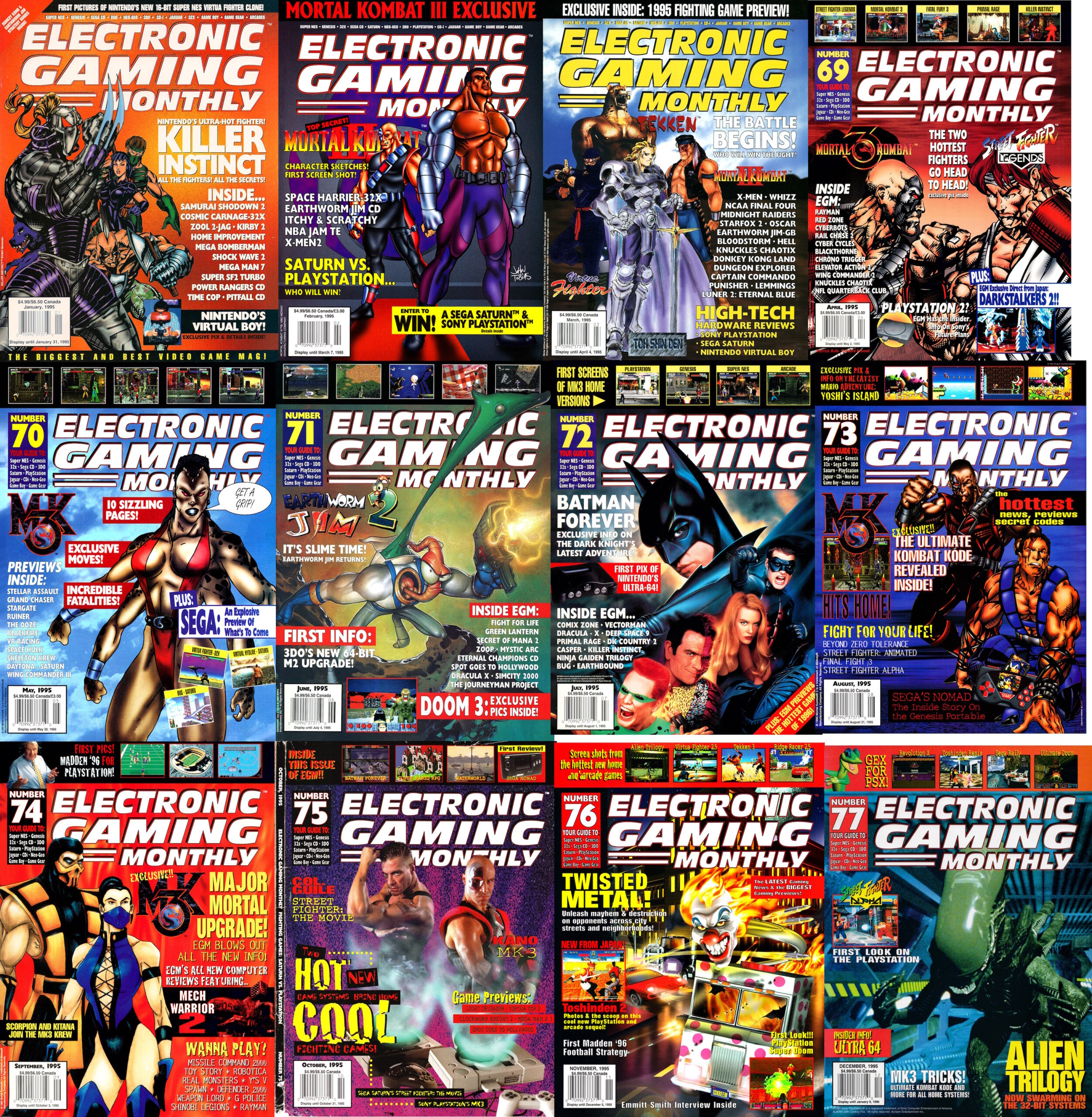
While the wordmark is always white, many of EGM’s covers had a strong background color. The top banner lists systems for a few issues before becoming a screenshot gallery.
Eight of these covers featured a fighting game. It doesn’t even matter if a new game was being released, any excuse was enough. Mortal Kombat 3 makes seven appearances. The first part of the year has a lot of text listing games.
I think a couple of these are original art, like January, but I wasn’t able to identify who made it.
Starting with issue 69 EGM was one of the few magazine to prominently display the issue number on the cover.
Game Informer
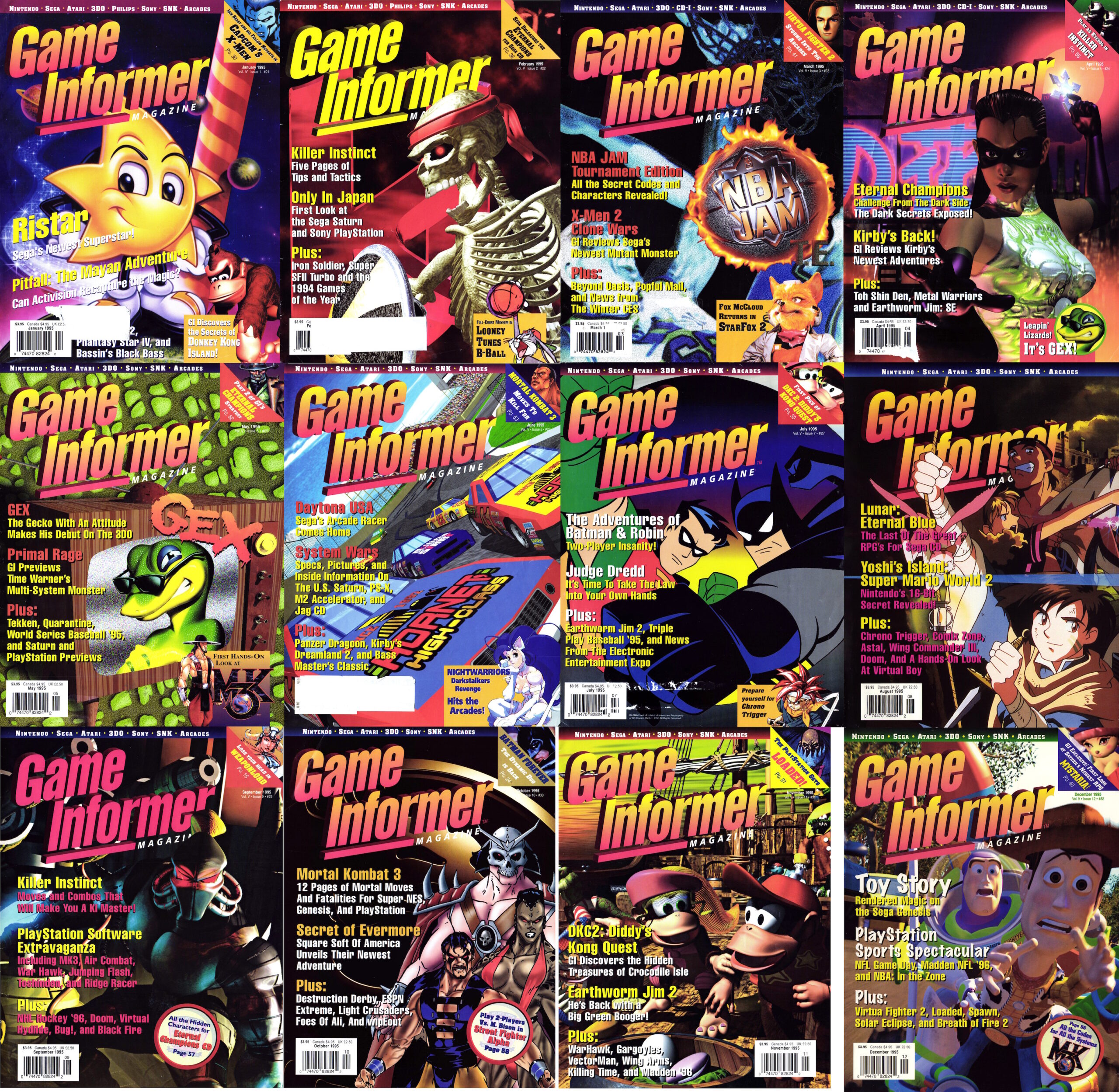
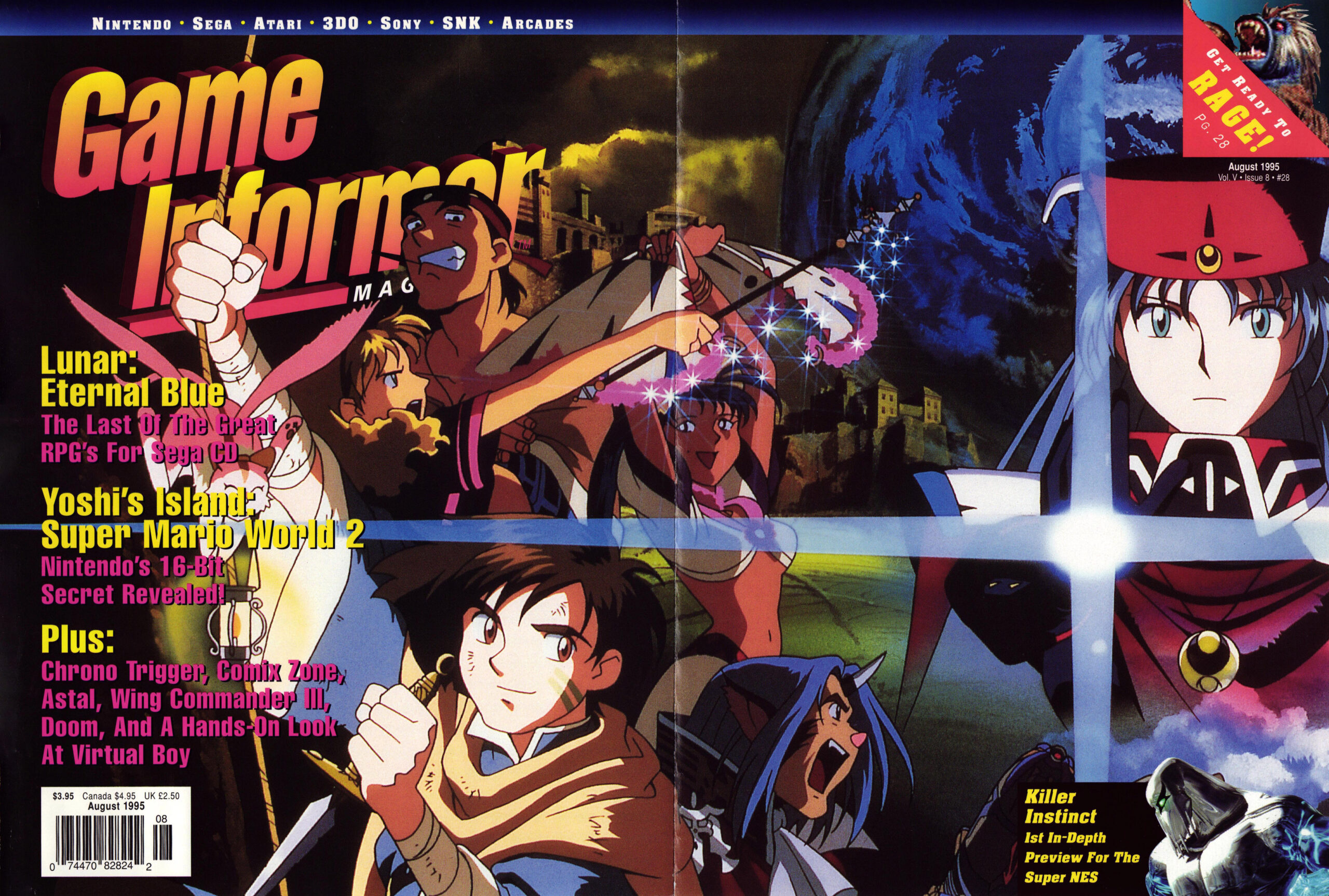
The wordmark changes colors, but just a bit, keeping to warm hues. The top banner does not list individual systems covered, but rather the companies that make them, plus arcade. Each cover has a headline naming the game featured on the cover, another feature in this issue, and a “Plus:” headline with a list of some games. This is overall more standardized than other covers. There are no screenshots.
Game Informer was sold on newsstands during this period, but it seems likely that most readers were subscribers, making it less important to have eye-catching covers. Game Informer kept their covers pretty simple, with a large piece of official art and and sometimes a logo in the background. Most issues had a teaser for something in the magazine in the top right corner and bottom right corner, but for some reason the Donkey Kong Country 2 cover was an exception and even moved the bar code.
As discussed in the editorial section, the August issue was originally going to have Chrono Trigger art by Akira Toriyama, but it was replaced by a Lunar: Eternal Blue cover.
Game Players
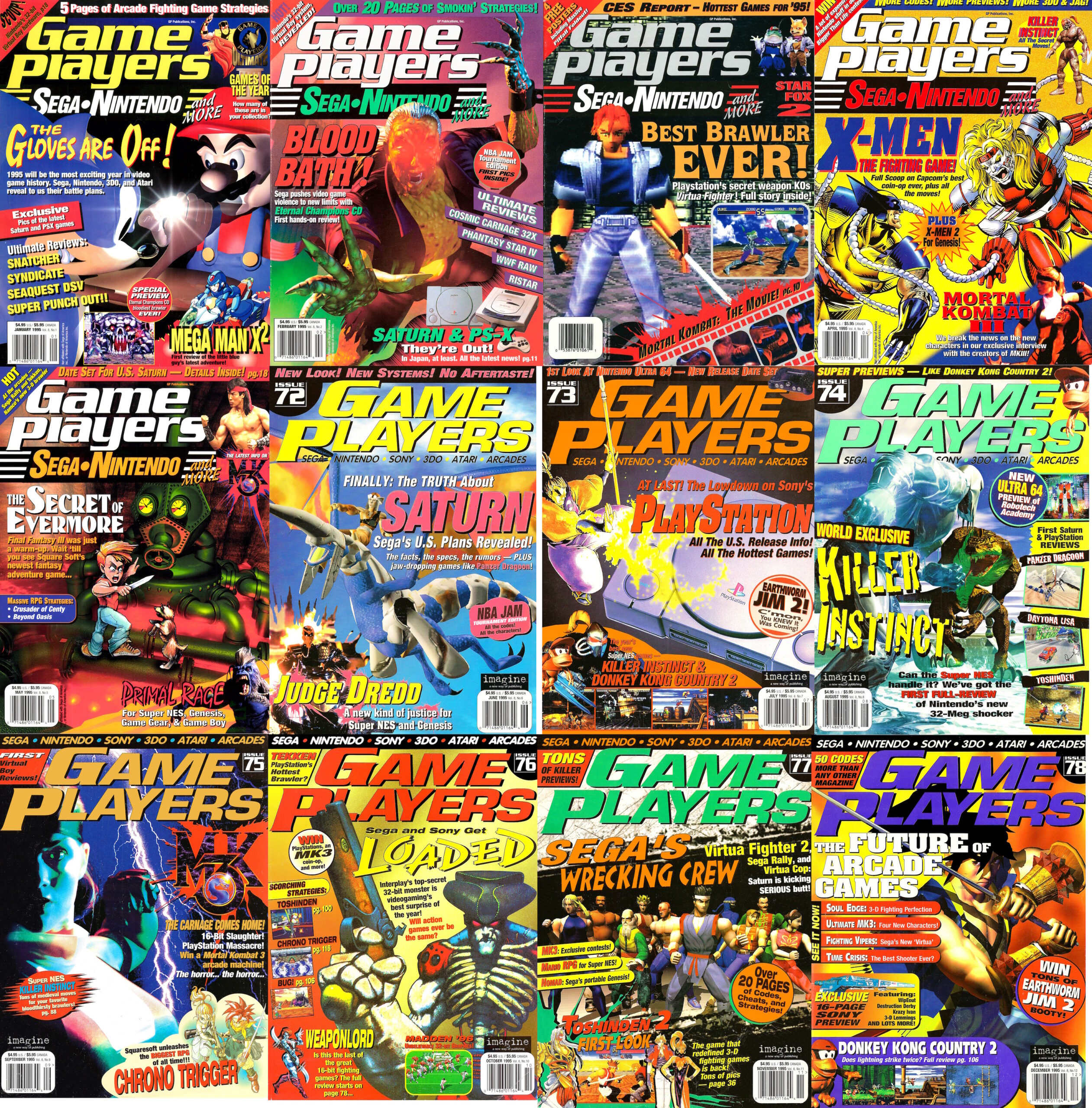
“Game Players” appeared in a variety of colors on the covers of its 1995 issues.
This magazine seemed to feature official art assets, other than the January issue. The 3D render featuring Mario and Sonic arm wrestling is pretty scrungy looking, but does have a lot of detail, like Mario’s reflection on the table. It’s credited to Jon Savage and is named “Clash of the Titans”.
The June issue brought a redesign to Game Players’ covers. “Sega Nintendo and more” below the wordmark was replaced with a top banner listing the hardware companies who were featured. Issue numbers started on the left before moving to the right.
There was generally a second game featured on the bottom, often with screenshots. The bar codes moved around as needed.
GamePro
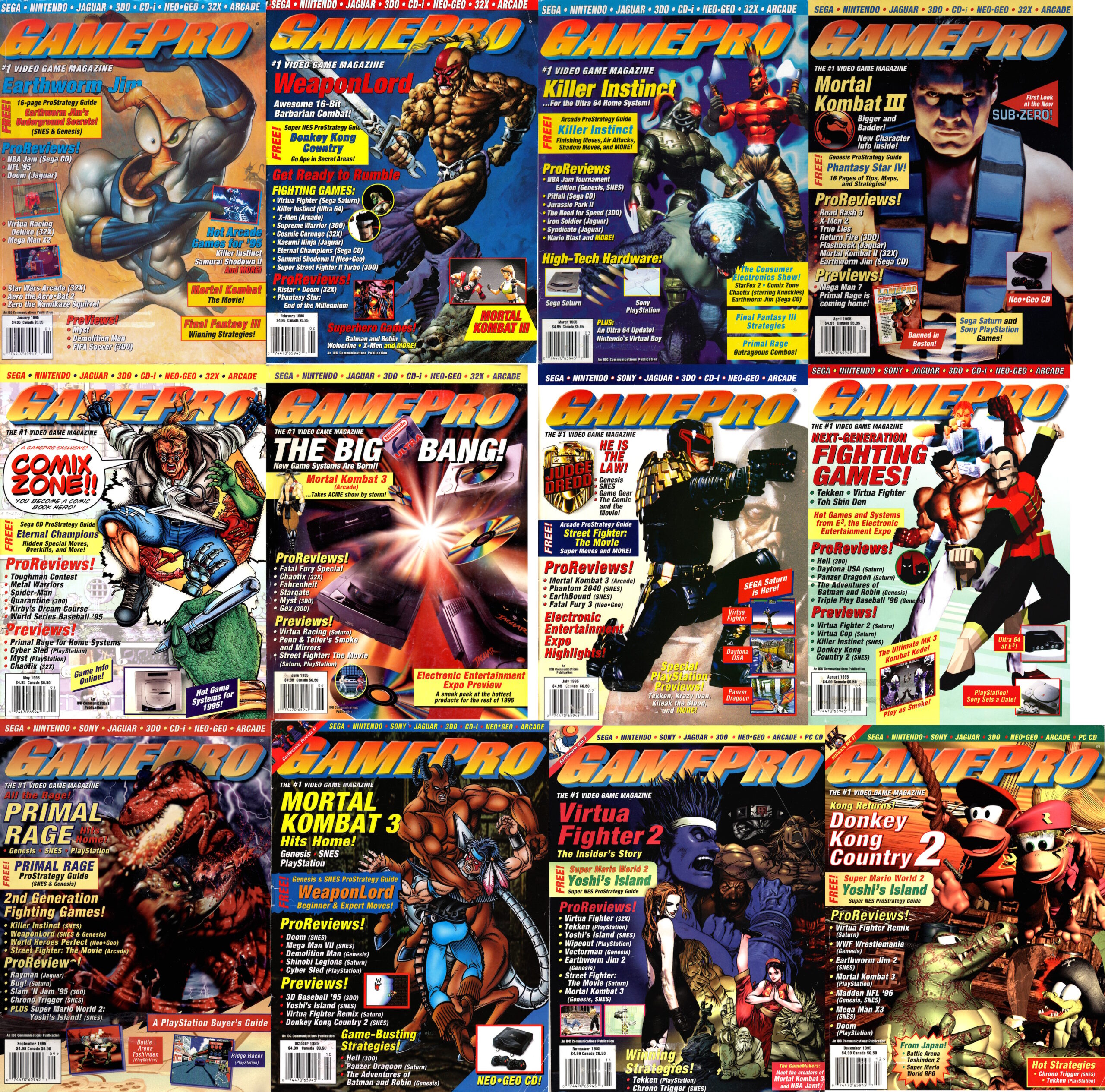
GamePro kept its wordmark consistent, though it’s hard to tell if the saturation varies a bit, or if the scans are just of differing quality. “The #1 Video Game Magazine” appeared on every cover below the wordmark.
There was a top banner advertising the gaming systems discussed within. November and December added “PC CD”, though there really wasn’t much coverage of PC games, and no reviews of them.
It seems every cover featured official art assets for a single game. Many more games were listed under ProReviews! and Previews!. There were occasional screenshots. Most covers featured a “FREE!” banner that advertises a ProStrategy Guide, making the handful of pages dedicated to a basic walkthrough sound more like a full strategy guide.
Seven fighting games were featured.
These covers had the most exclamation marks.
Next Generation
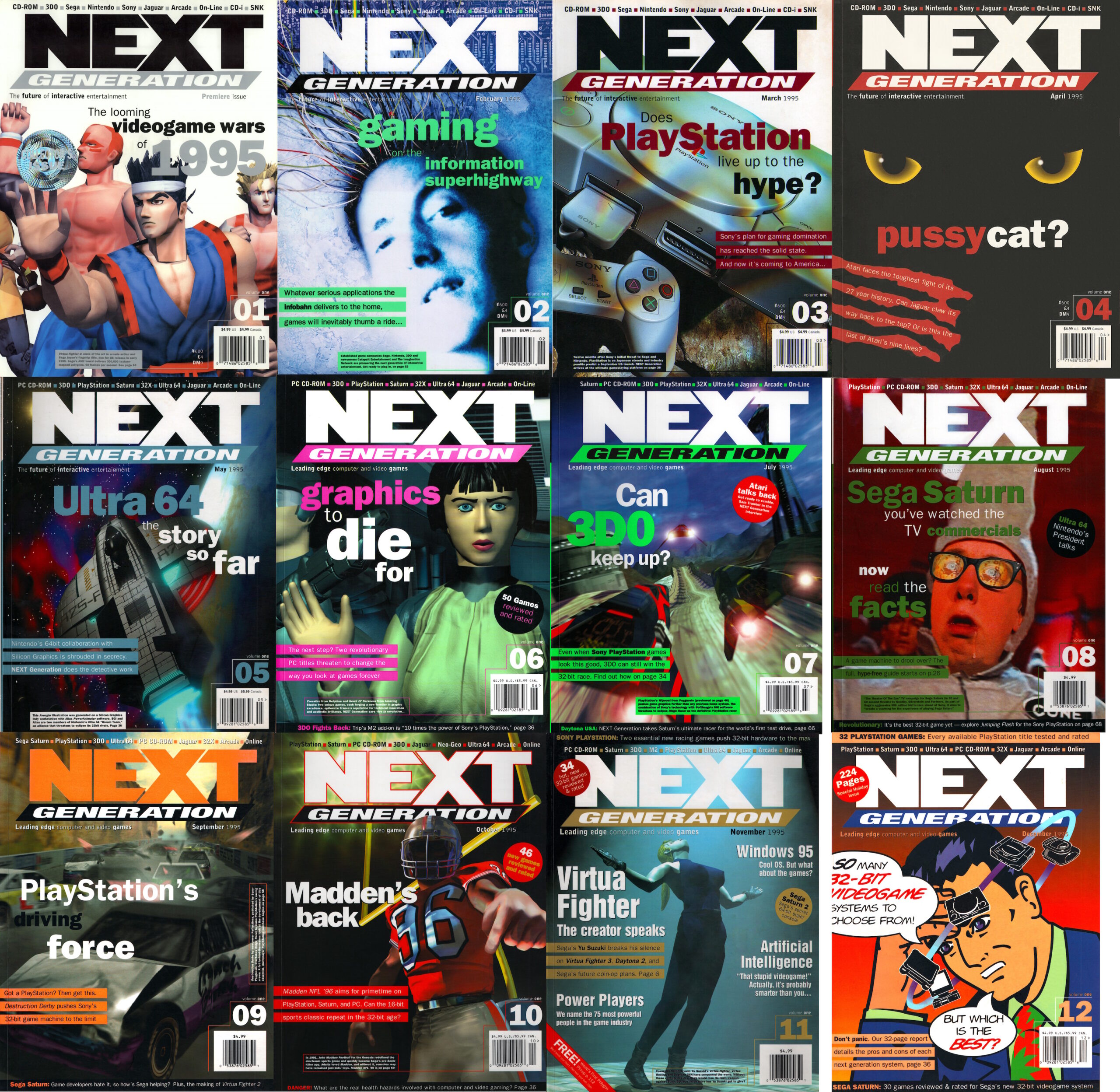
NEXT appeared as black, white, or orange, while GENERATION had a variety of colors and generally complimented something else on the cover.
These covers were pretty sparse compared to the other magazines. There were no screenshots and there was less text overall. There were three or four lines of text on a colored background and a blurb about the cover in tiny text on the bottom.
Next Generation spent a lot of pages this year comparing the different systems to each other and interviewing leaders of the hardware companies. This focus was reflected in several of the covers.
The August cover was odd, featuring a still from a Sega Saturn commercial. It was one of many strange ads for the Saturn, but putting it on the cover of your magazine feels like an ad for an ad, and it even used precious space to name the agency that produced it.
The top banner changed from company names to system names, and On-Line changes to Online as we all eventually settled on. CD-i disappeared after a few issues. November had both 3DO and its planned but cancelled successor M2. There seemed to be little consistency to the order these appeared in.
Only a couple sports titles were featured on any of the covers we’re looking at and we see Madden NFL ’96 on October’s issue here.
I wonder if EGM and Game Players added issue numbers to make themselves seem more established. Next Generation had them from the start.
Nintendo Power
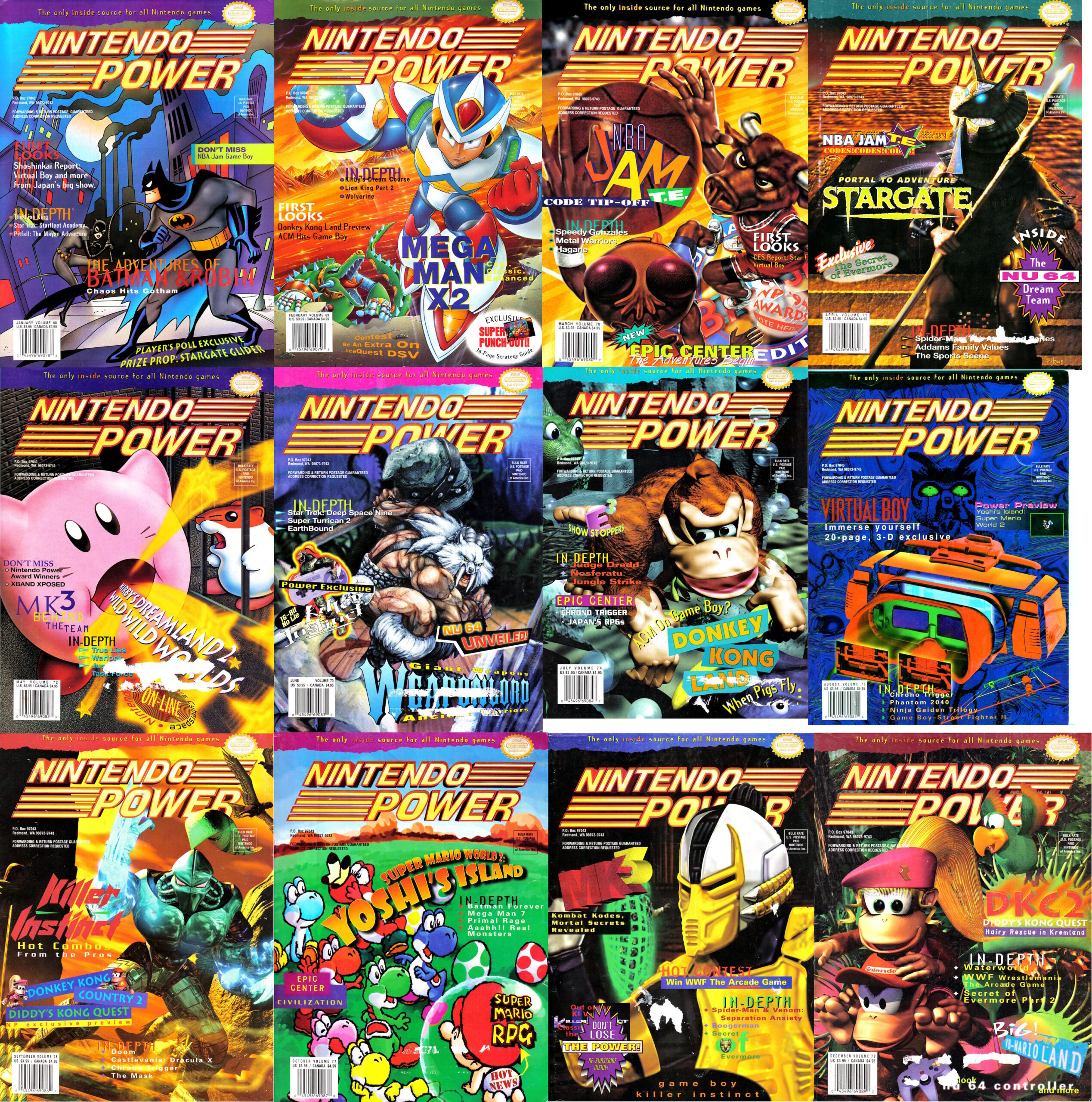
Nintendo Power was rendered the same way on every cover. A top banner reading “The only inside source for all Nintendo games” appeared next to the Nintendo Seal of Quality on every issue as well. The In-Depth heading on every cover listed games that have a walkthrough featured in that issue.
Kirby’s Dream Land 2 and Donkey Kong Land were the only handheld games featured on the covers we are looking at. Only half of the covers feature a Nintendo-developed game or piece of hardware.
We see mostly official art assets here, but I think the NBA Jam and Kirby’s Dream Land 2 illustrations were original. The Virtual Boy cover featured an edited screen from Teleroboxer, and the Mortal Kombat 3 cover used a less edited screenshot as the background.
There was a fair amount of text overlap, which I suppose was done for stylistic purposes, but it could be hard to read when there was poor color contrast between the text and the background. Very similar purple starburst shapes were used on two covers.
Sega Visions
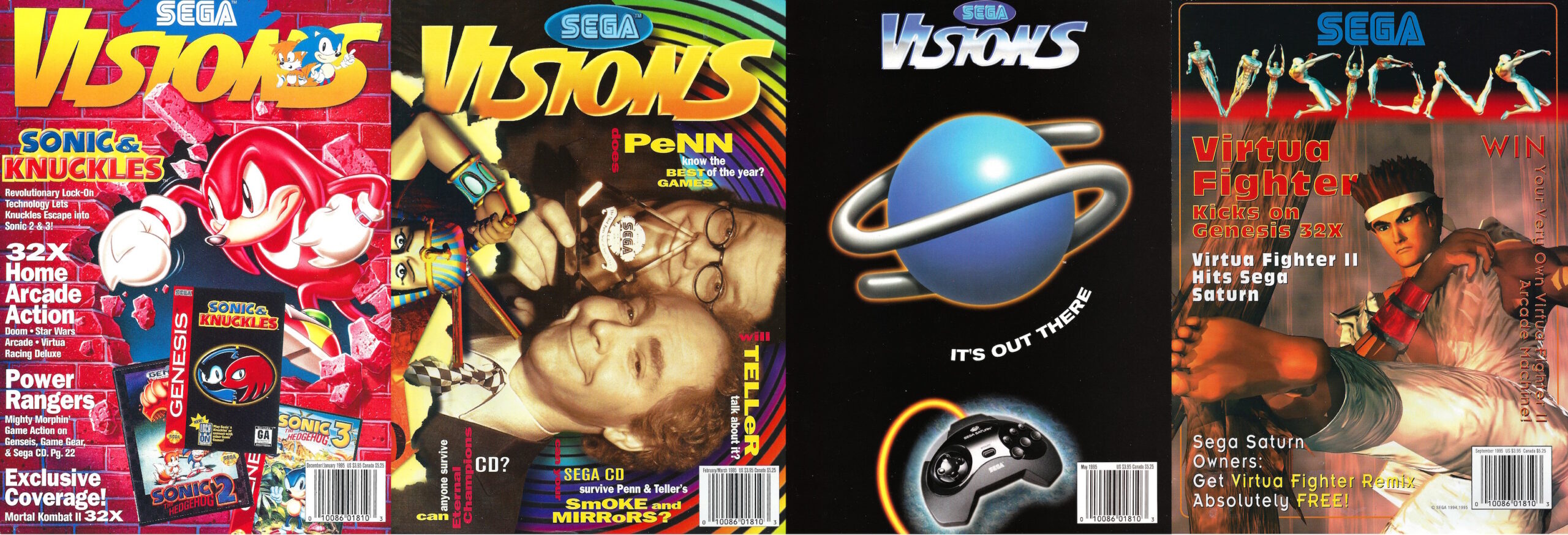
The Sega Visions wordmark managed to have a different appearance in each of the four issues published in 1995. The September issue featured muscular men posing to form the word “visions”. It doesn’t seem to be related to Virtua Fighter and I could find no connection with any Sega game.
There wasn’t much consistency at all between these covers, even the fonts vary. The May issue went for a plain black cover with the Sega Saturn logo and the controller. Something bold and empty like this could have made the Saturn out as a big event that didn’t need to be explained. I think the words “Sega Saturn” should appear larger than the small text on the controller, and it should feature the system instead of just the logo.
Sega Visions had the dubious honor of being the only magazine here to run a cover story on a game that would ultimately not release, Penn & Teller’s Smoke and Mirrors. The sideways orientation would have been attention grabbing and fit with the subject, at least.
VideoGames: The Ultimate Gaming Magazine
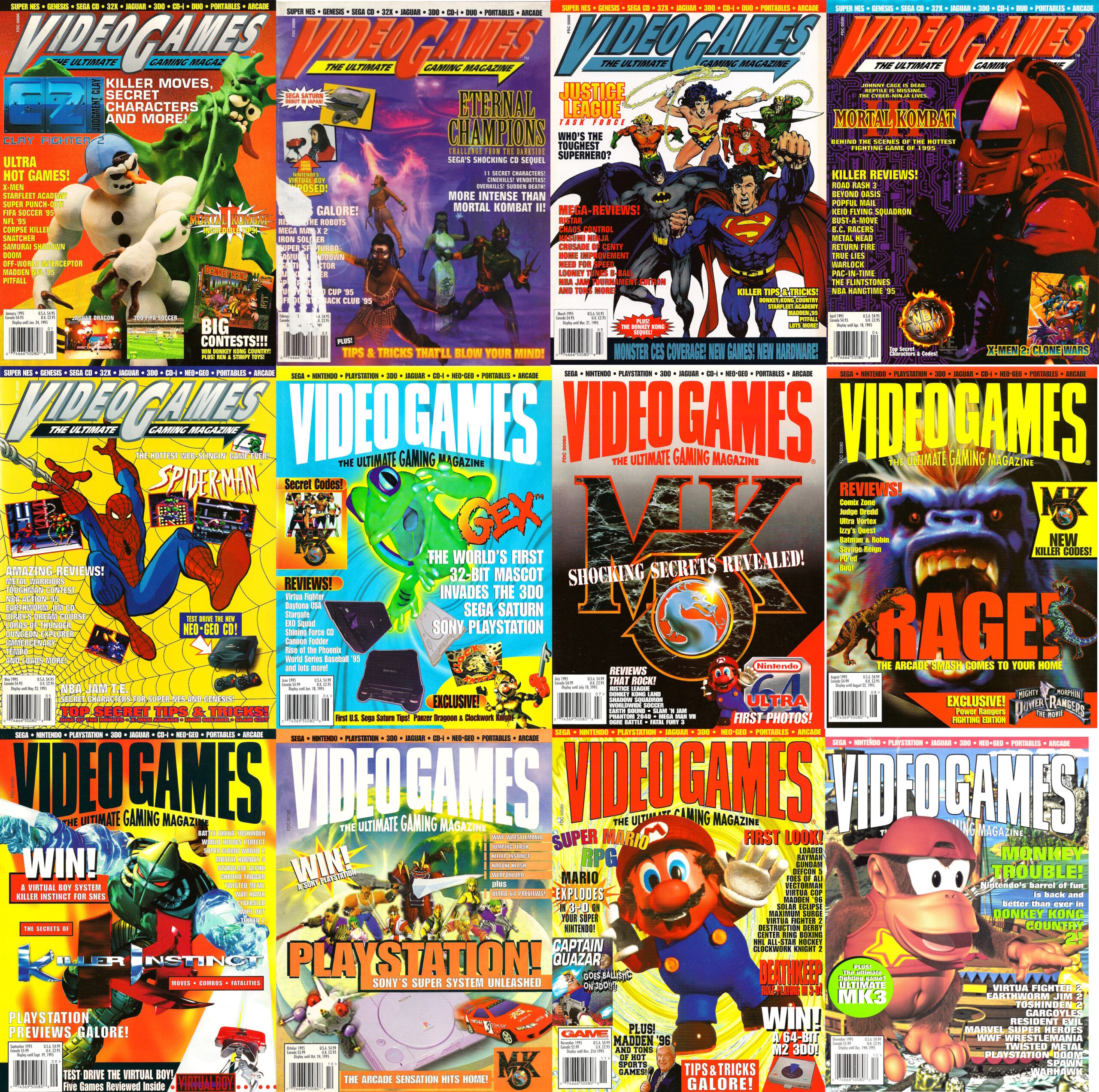
VideoGames: The Ultimate Gaming Magazine used many different colors for their wordmark, and sometimes the first part was a different color than the second part. The wordmark changed partway through the year. The top banner had some changes as well, using “Sega” and “Nintendo” instead of individual system names. This was the only magazine in this study to proclaim “Duo”, as in TurboDuo, coverage.
These covers mostly featured a big piece of official art with a simple background. The July cover featured a small Mario in the corner advertising pictures of the Ultra 64. The November issue used this same Mario, which I think is original artwork, to advertise coverage of Super Mario RPG.
VG:TUGM loved to include lists of games and had a large number of exclamation marks. There were some sensational claims about secrets, exclusives, killer reviews, killer tricks, and contests.
Seven of the covers this year were for fighting games.
Overall Cover Stats
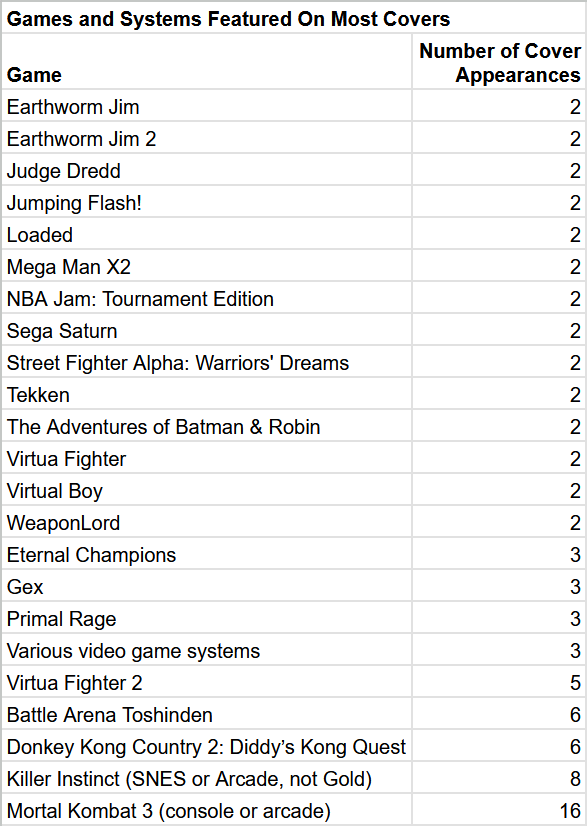
For this count I included the obvious central focus of each cover as well as anything with fairly large text and an image. It was difficult to judge in some instances. It was also difficult to discern sometimes if a specific game was being featured, or the overall series. These have to be pretty explicit to count, so the heavily edited Teleroboxer on Nintendo Power’s Virtual Boy cover does not count as Teleroboxer representation.
Overall, fighting games dominated covers this year. There were a few platformers, RPGs, and sports games featured.
Gaming Magazine Reviews
How Magazines Handled Reviews
A big part of this project was comparing each magazine’s scores against each other, so I devised an “adjusted score” for each. This adjustment turns each magazine’s score into a value between 0 and 100. I discuss how each score was adjusted in this section.
There may be minor exceptions to some of the things I state here, like a single review might be longer than the rest.
DieHard GameFan

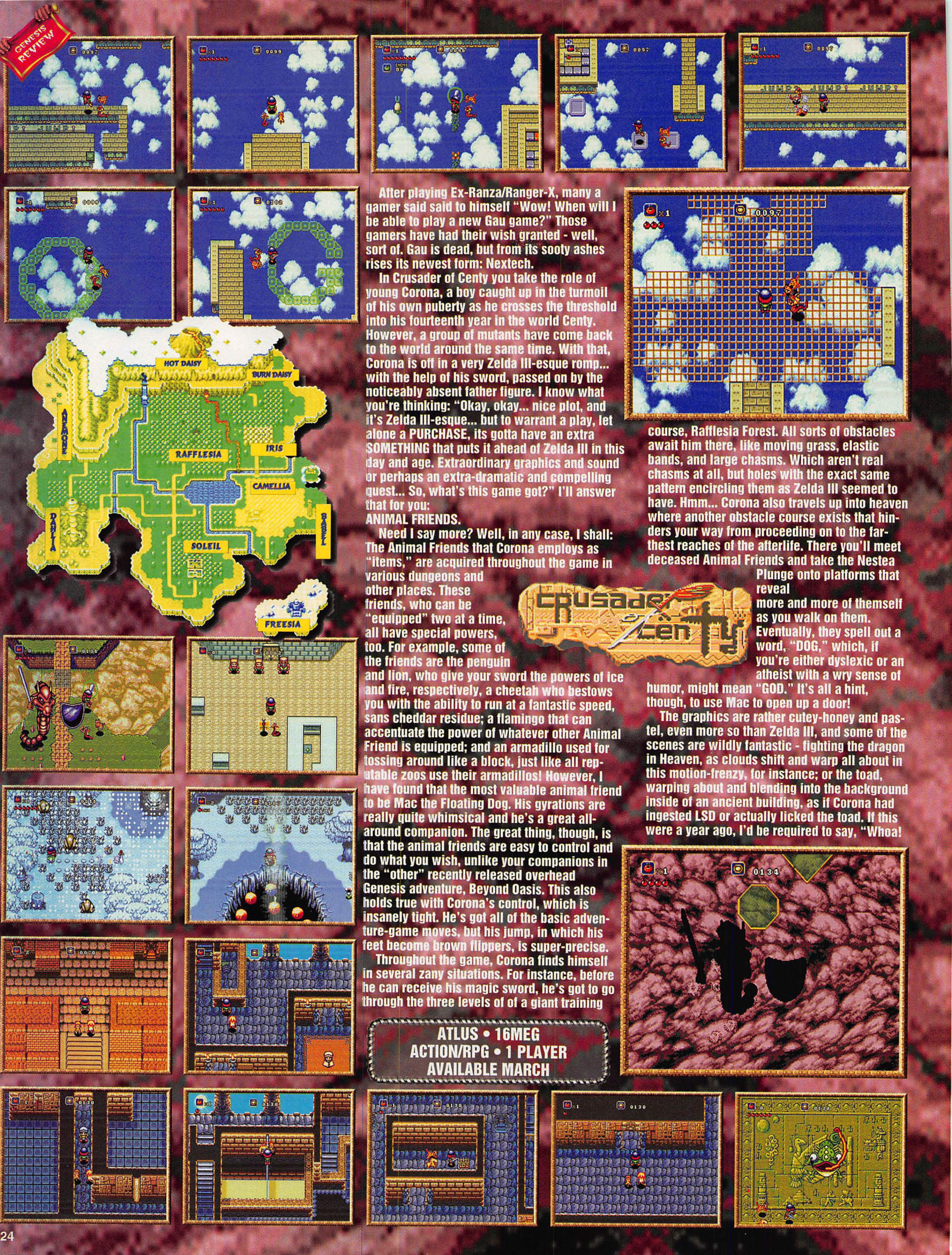
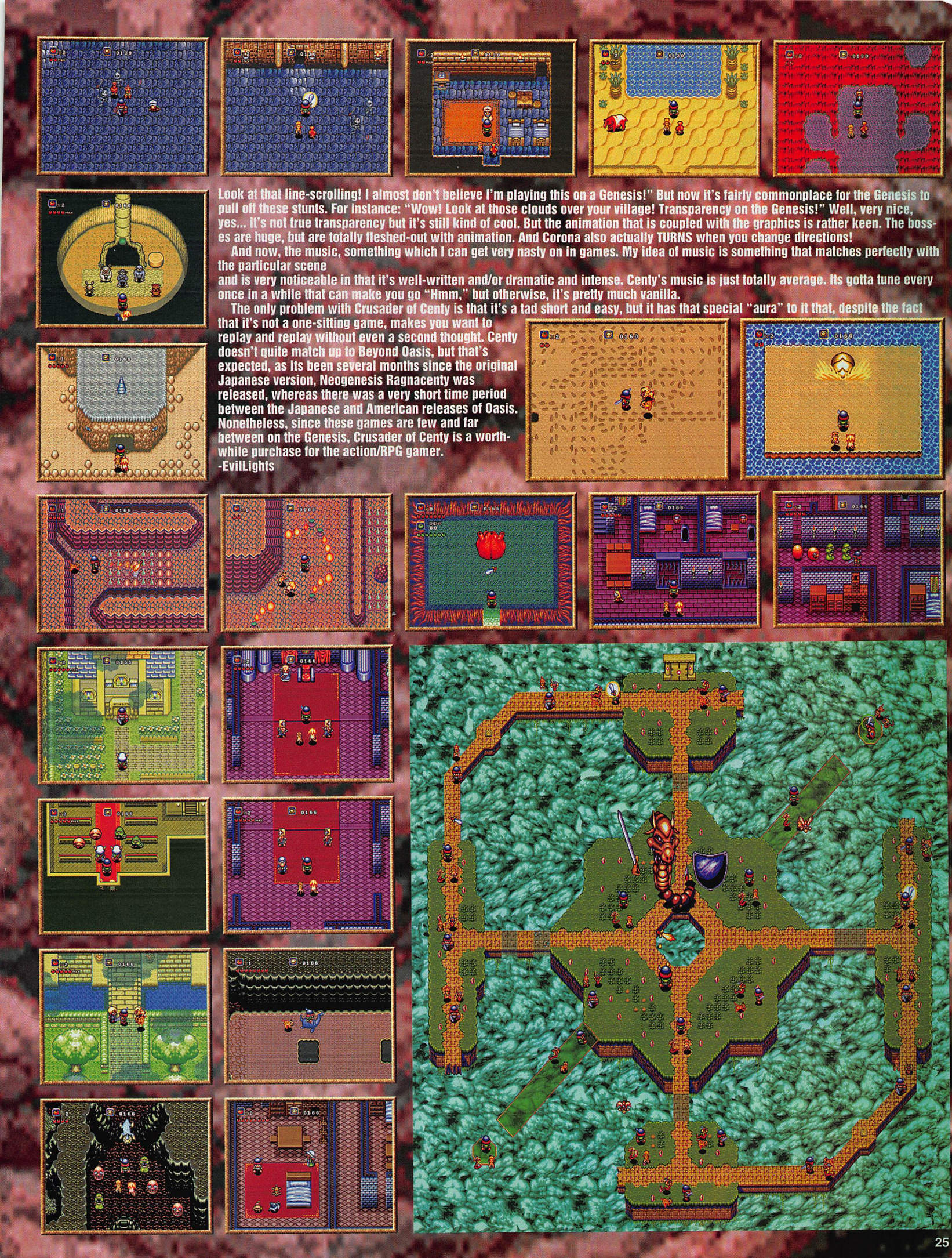
DieHard GameFan called its review section Viewpoint and it was broken into two parts. The first part displayed the name of the game, the system, the publisher, the number of megabits, the genre, and the number of players. There were three columns, each containing a different reviewer’s short thoughts on the game, their score 1-10 (0 may be possible) for graphics, music, control, play mechanics, originality, and overall. There was a single screenshot of the game in this first part.
For the second part each game also had a full page review, written by one of the reviewers who scored the game. The same basic information was provided, but the scores wasn’t given here. These pages had a lot of screenshots, often with borders, and a background that seems to be a blown up portion of a screenshot. These often made the text hard to read. There were worse examples than what is pictured. Some games seem to be featured in the first part but don’t have a corresponding second part. The chaotic organization of the magazine also made it difficult to find the corresponding second part.
For the adjusted score I averaged each reviewer’s overall score.
Electronic Games
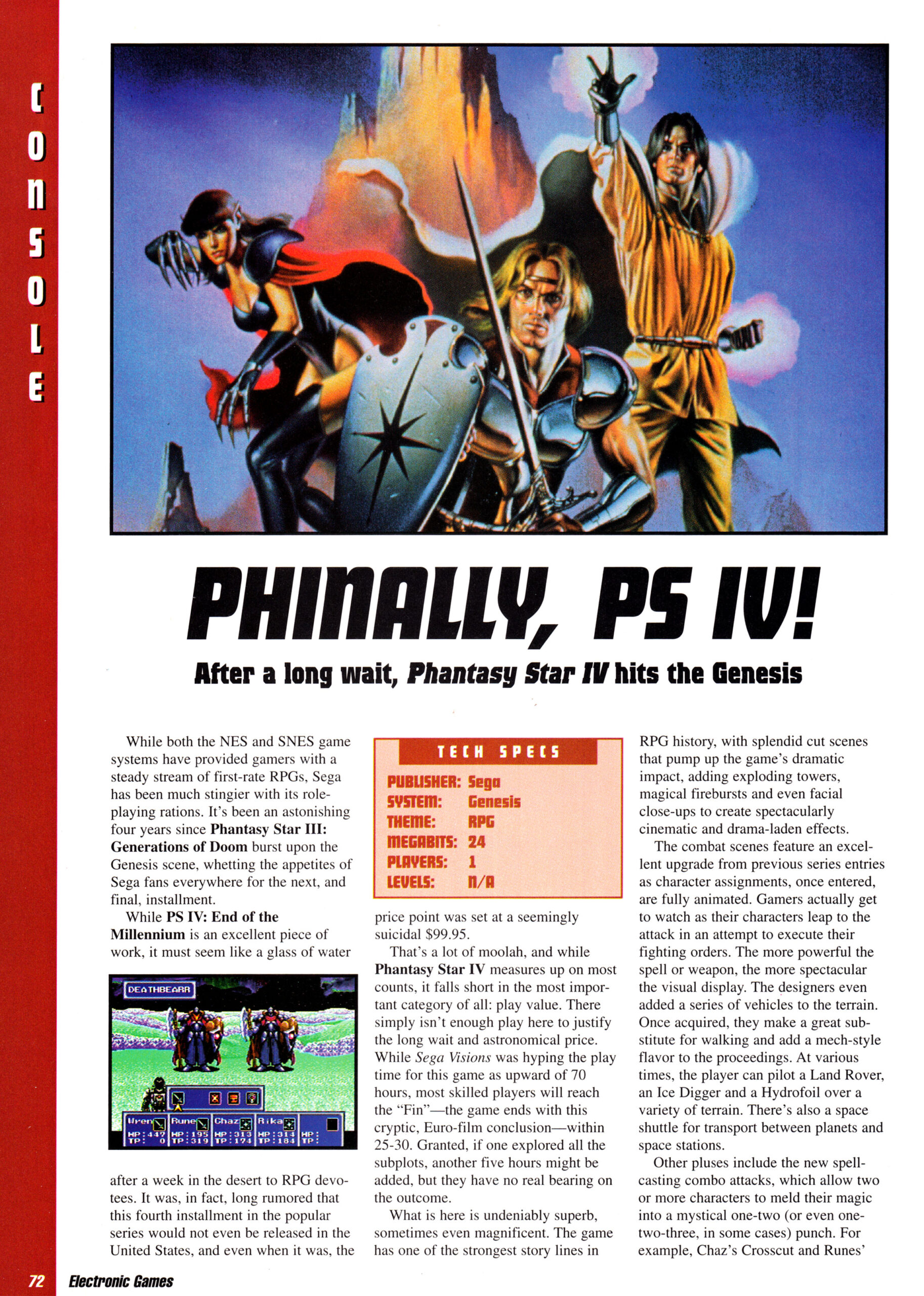
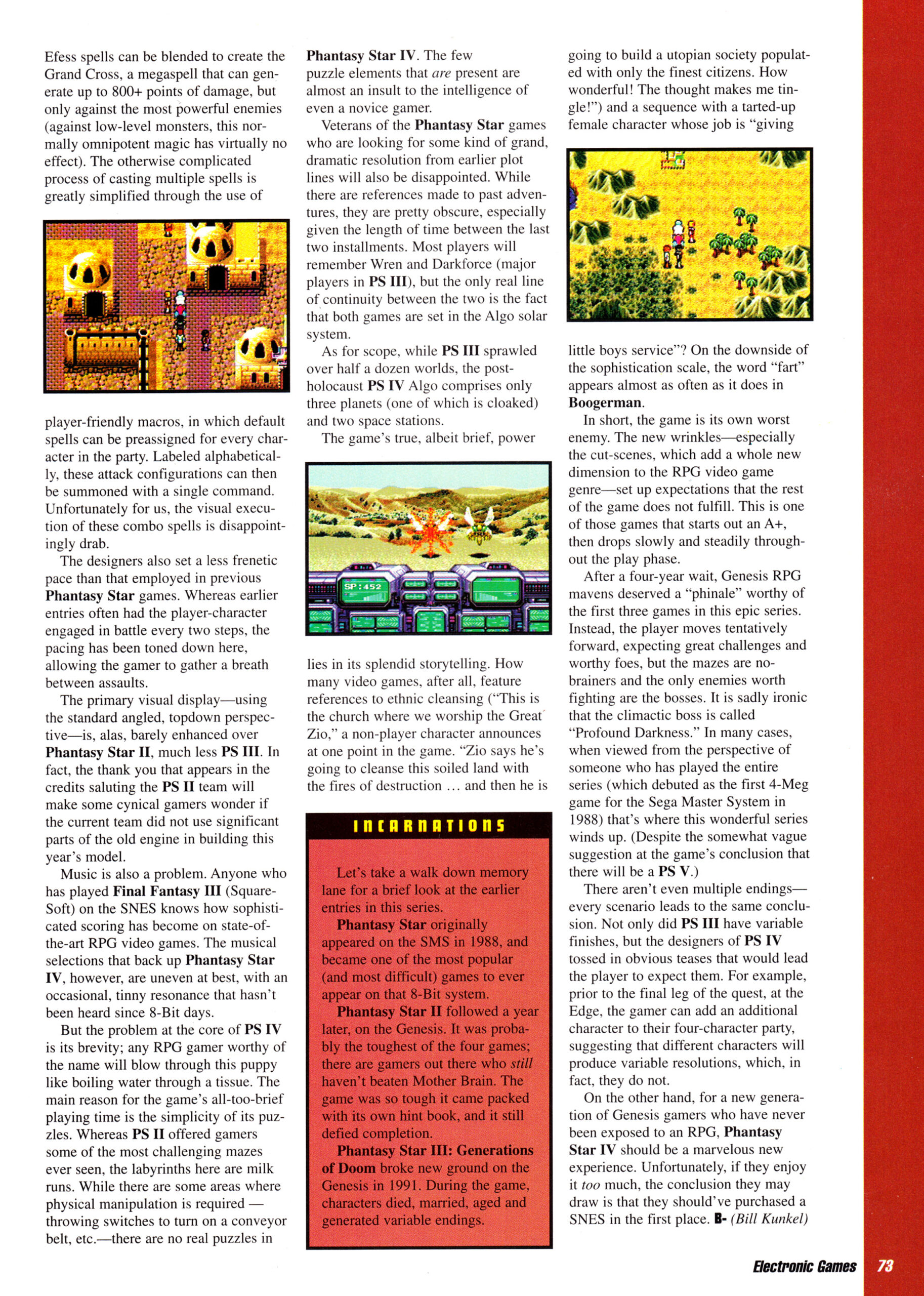
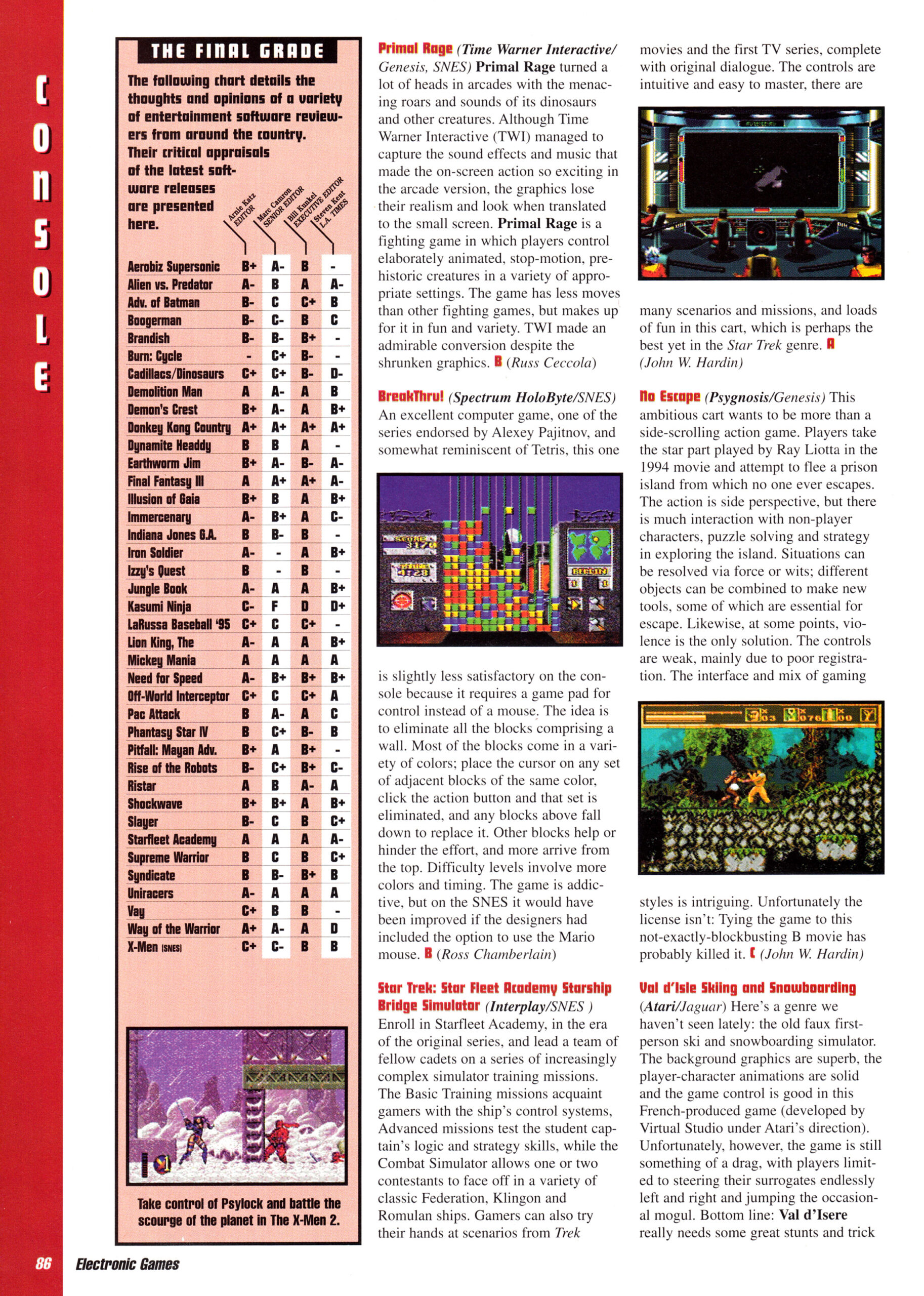
Electronic Games used a Tech Specs box to display the publisher, system, theme (essentially genre), megabits, number of players, and number of levels. That last one was quickly losing relevance by 1995, but several magazines still made sure to tell you.
The game’s full name was not necessarily present in the title but was usually present in the text of the review. Full length reviews could be one or two pages long and with only a handful of screenshots these are among the longest reviews we’ll be looking at. The backgrounds were a simple white. The end of the review had the author’s name and a letter grade from A+ to F. These reviews were separated into console, computer, portable, and edutainment sections.
At the end of each of these sections were a number of mini reviews that sometimes had a single screenshot. The mini review section also had a “sidebar” of reviews that at first glance resembles other magazine’s lists of games reviewed in past issues. Up to three other reviewers would score a game without any written review in the magazine. Written reviews had their scores included too, but the games in these lists only showed up at least a month after a written review. Sometimes the additional scores appeared one at a time over several months. What’s really frustrating is that there was usually no system mentioned in these sidebar scores, even for games released on multiple systems. I couldn’t use a lot of these scores because I had no idea what system they were being reviewed for. The four people included in these sidebars were always the same, but didn’t represent all of the reviewers, so it’s like some reviewers’ scores are considered more important.
Fusion
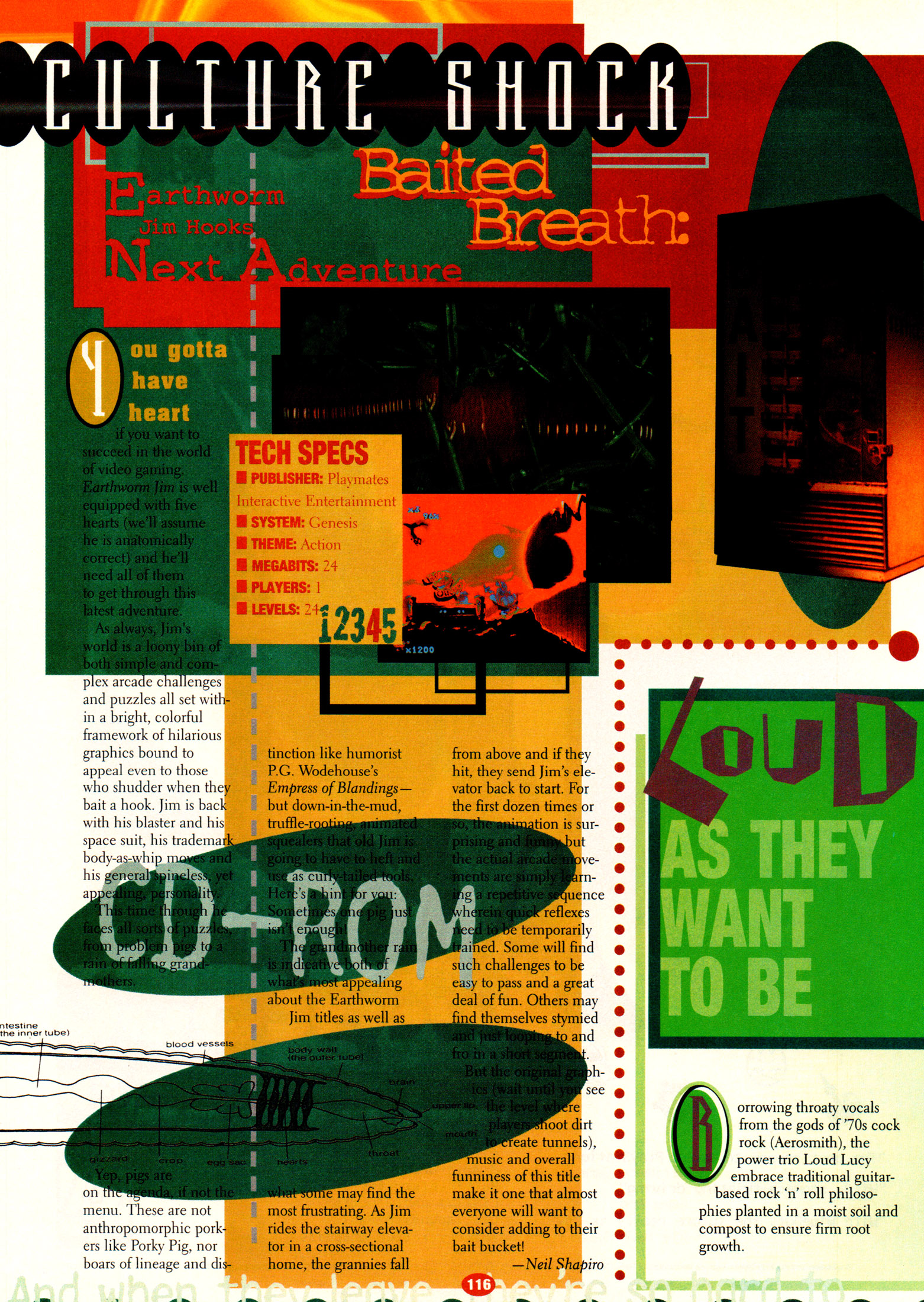
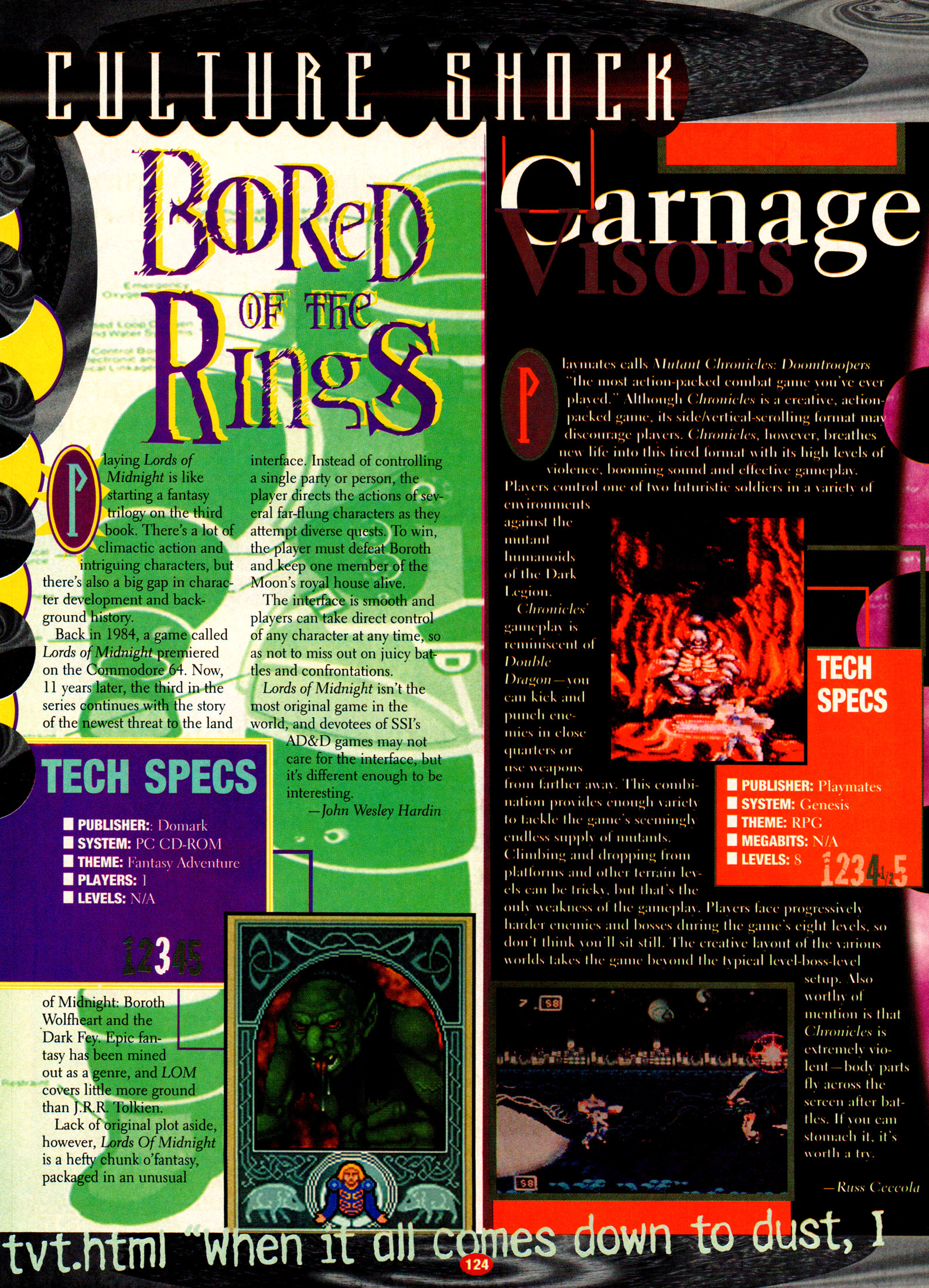
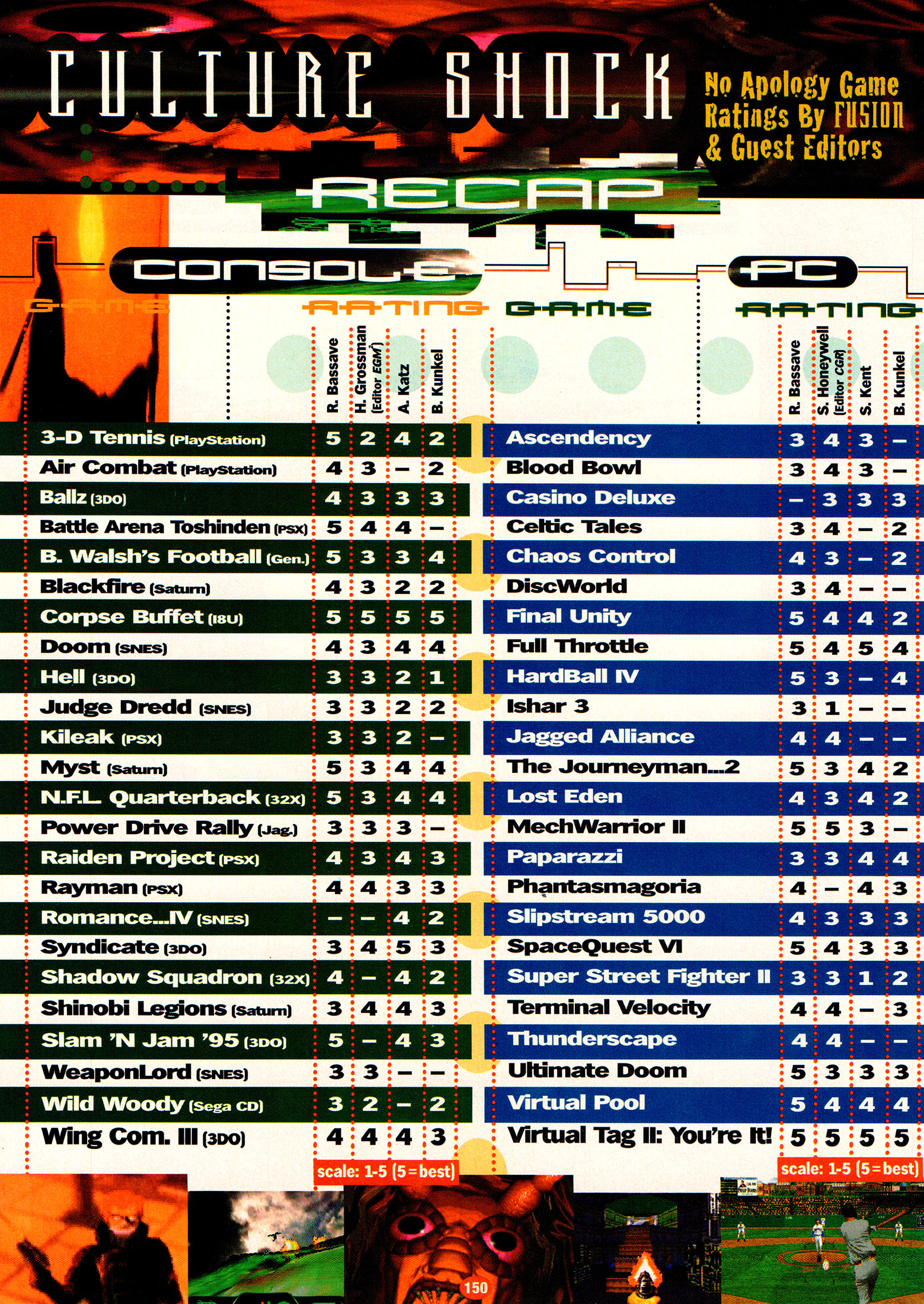
While the first issue of Fusion was relatively restrained and continued to use letter grades, the next issue switched to number grades, 0-5, with halves.
The graphic design got an overhaul and resulted in some of the least legible magazine pages I have ever seen, with game, movie, and music reviews tossed together with no organization. Reviews were no longer either one or two pages, but something like a third of a page to one page.
There were no more mini reviews, but the “sidebar reviews” returned as a whole page. They don’t seem to include any of the letter grade scores from previous issues. In fact, some of these games never got a written review previously.
There were a number PC titles reviewed by these magazines that were not games, like an animated The Emperor Has No Clothes made for children, or the band Yes’s interactive software. These were not counted for the purposes of this study.
For the adjusted score based on letter grades I went with Metacritic’s method of converting letter grades to a score out of 100. This definitely isn’t perfect, but no system would be. For the number scores I multiplied by 20. I then averaged everyone’s scores. There were a few games to be reviewed by five people, tied with Electronic Gaming Monthly for the most.
Electronic Gaming Monthly
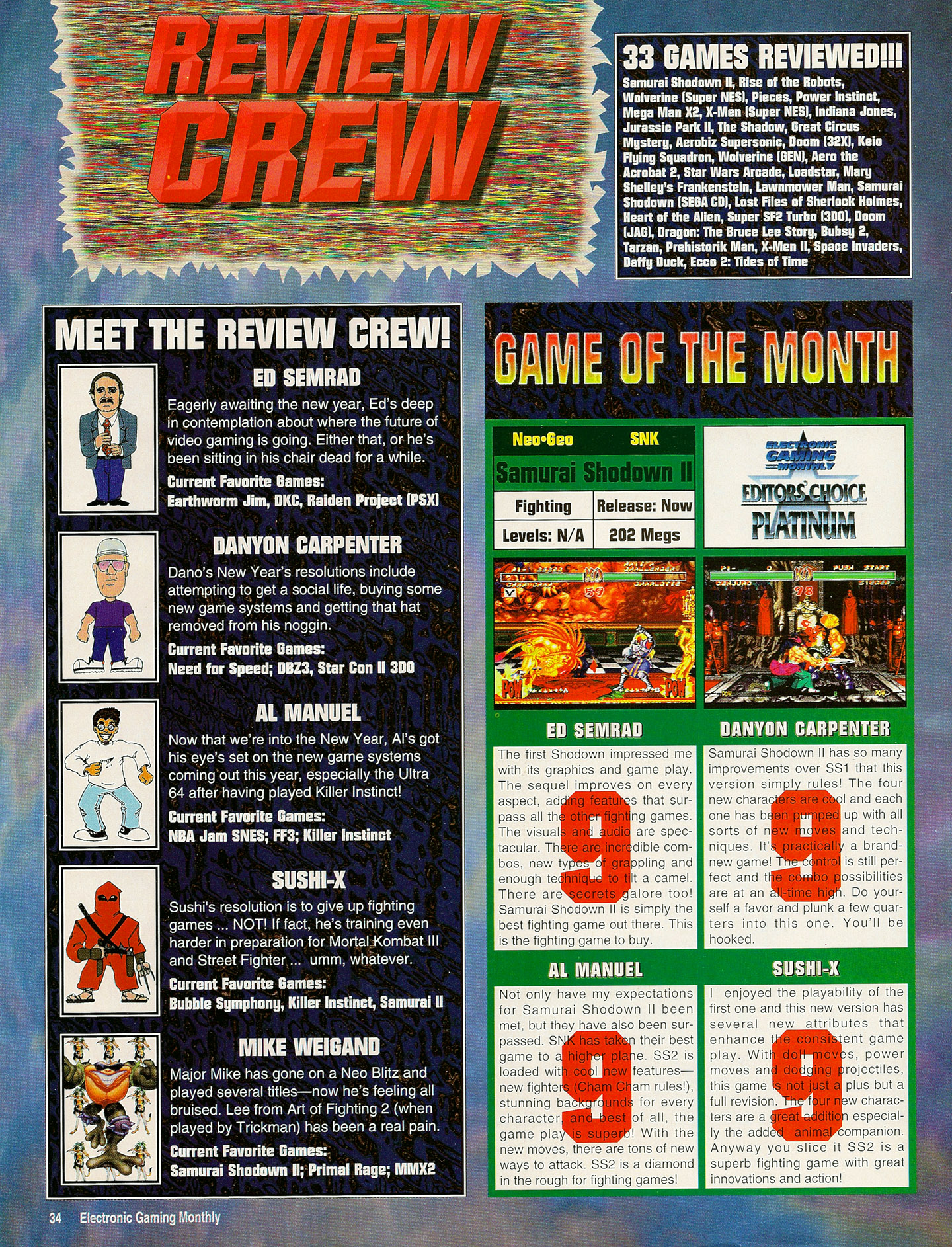
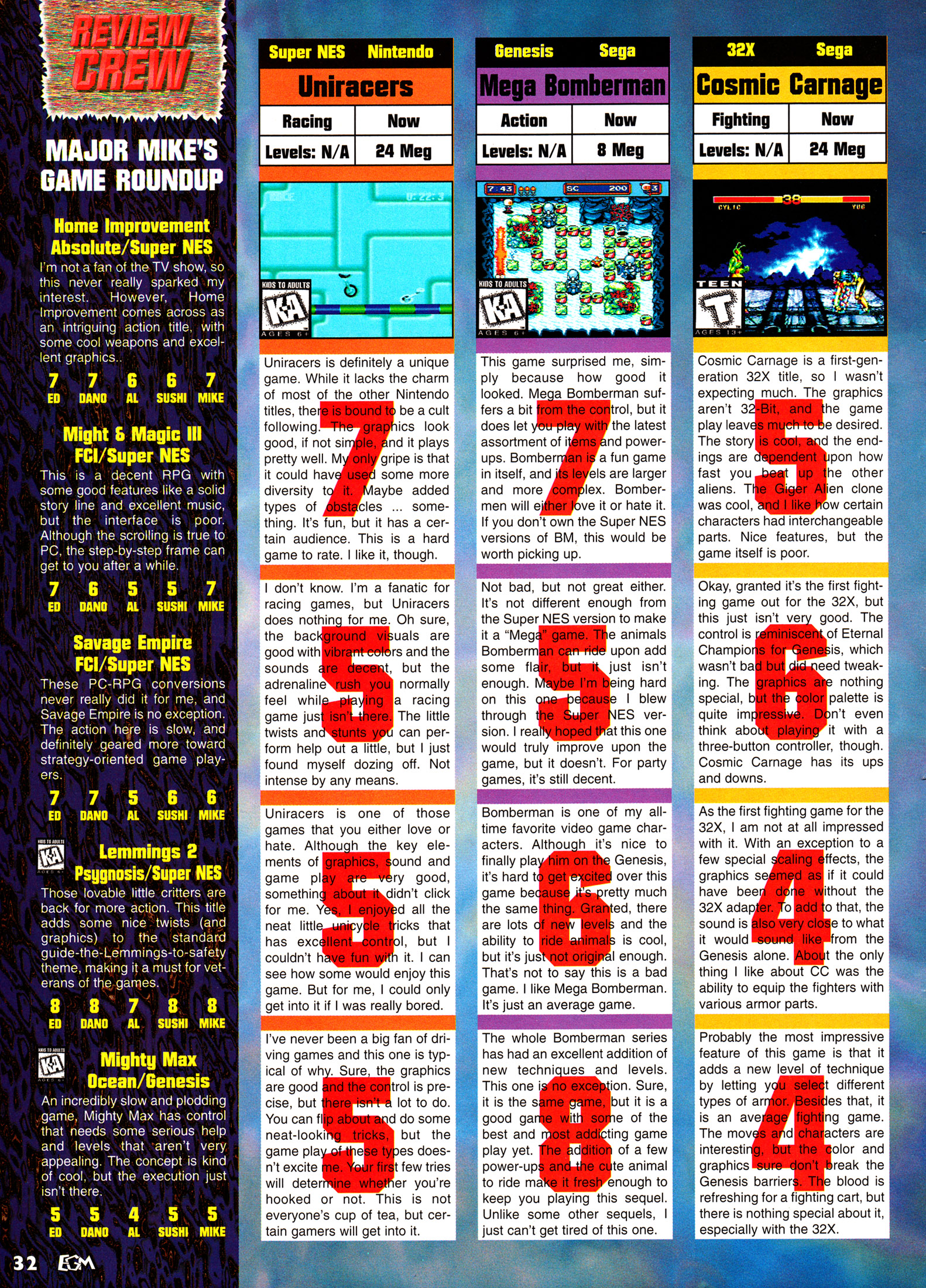
In the early part of 1995 EGM had four people write a short review and score games on a 1-10 scale (0 may be possible). These all stated the name, system, and publisher of the game. Below that was a box showing the genre, when the game would release, the number of levels, and the number of megabits. There was a single screenshot for each game that showed the ESRB rating in the corner, one of the few magazines to do so in the reviews section.
There were five reviewers on staff, but four of them did all of the larger reviews, and they were presented in the same order. The shorter reviews, called “Major Mike’s Game Roundup” included all five reviewers scoring the game and a very short amount of text, presumably written by Mike.
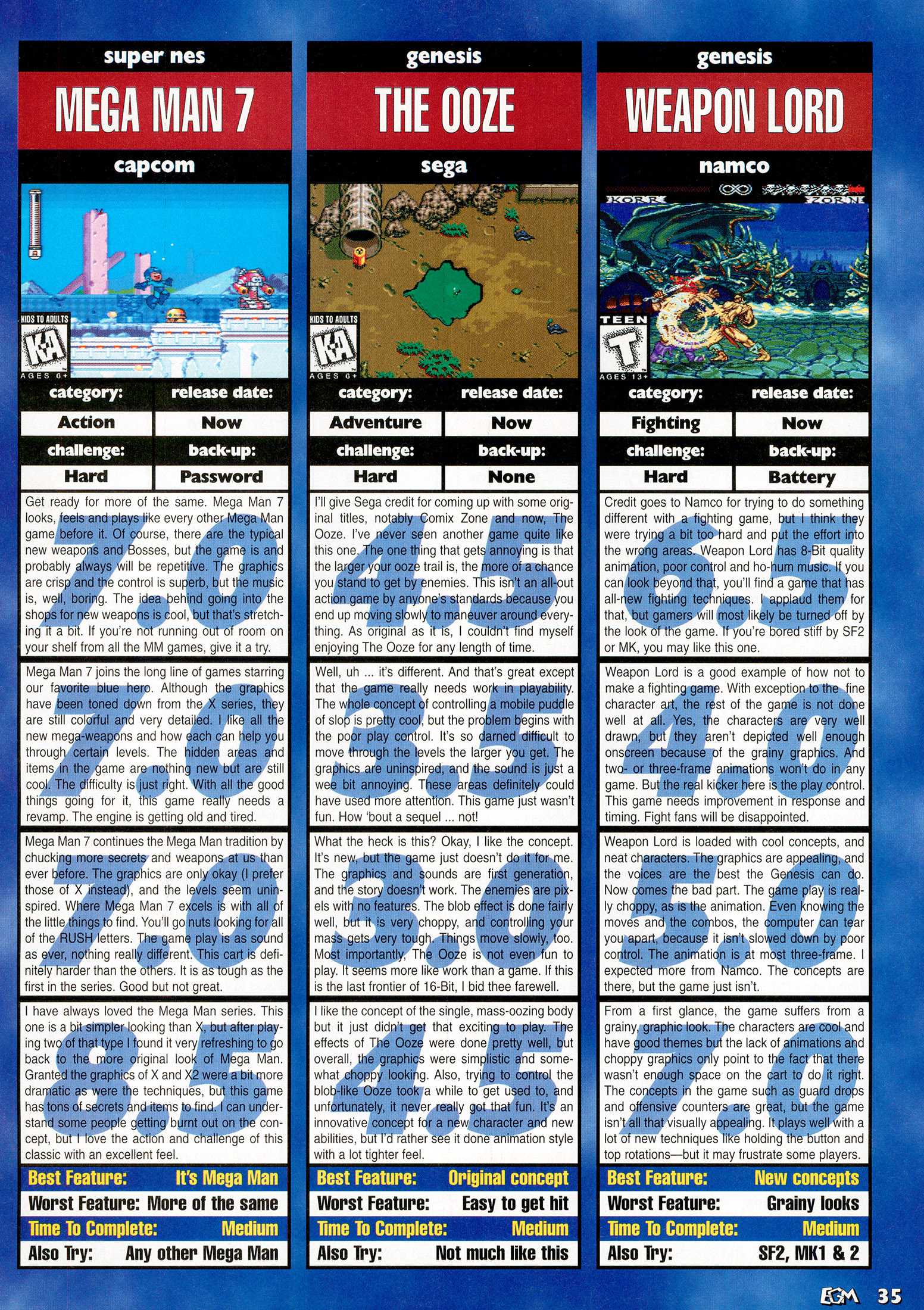
The April issue refreshed the review section a bit. There were no more short reviews. What I would call genre is called “category”. The number of levels and megabits were no longer included, but the challenge level and saving method were. Scores could now include halves. Additionally the bottom had categories for best feature, worst feature, time to complete (not measured in hours, who knows what “long” means), and a suggestion for another game like this to try.
For the adjusted score everyone’s scores are averaged and then multiplied by 10.
Game Informer
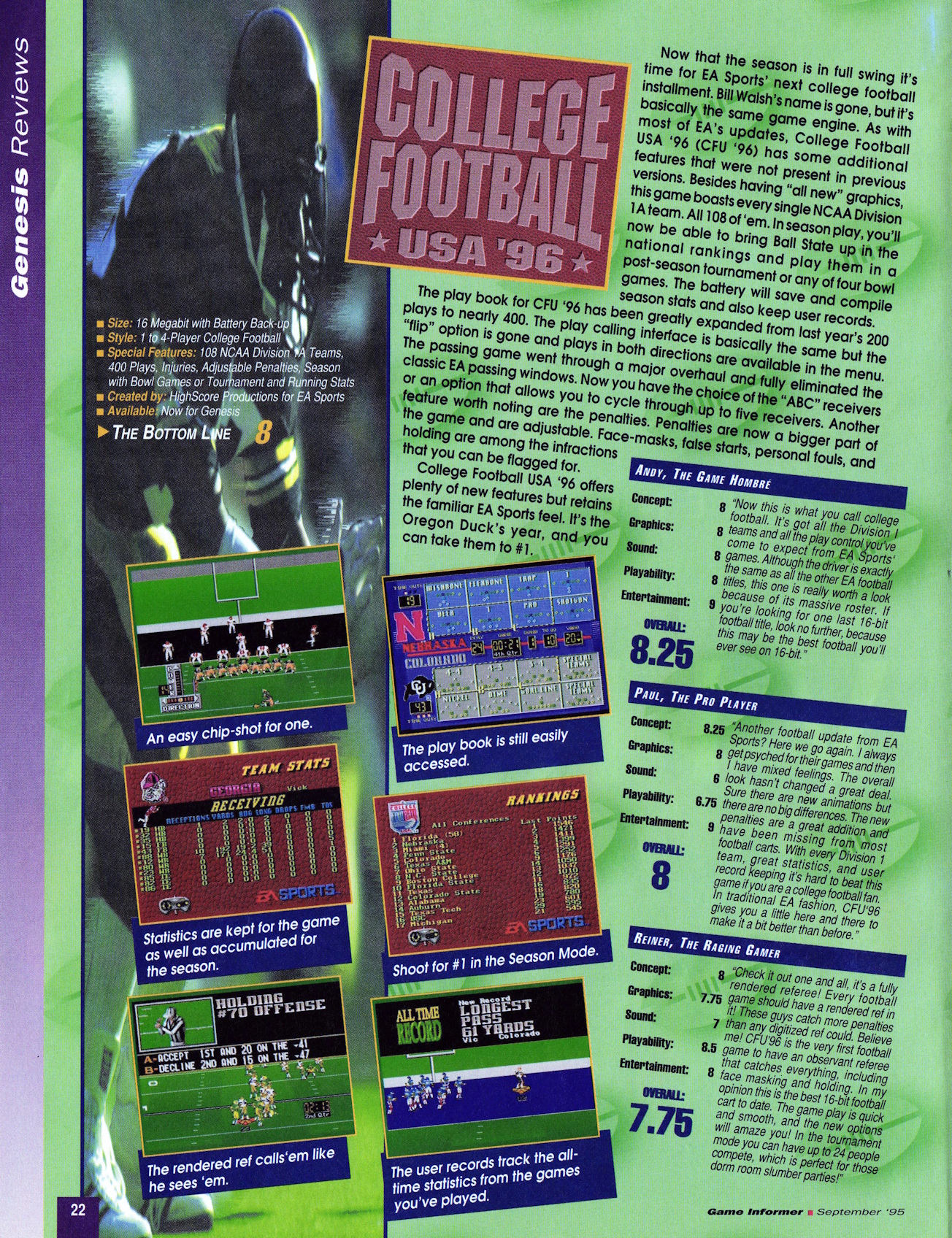
Standard Game Informer reviews could be half a page to two pages long. The main reviewer gave their “Bottom Line” score from 1 to 10, with quarters possible. The editorial section explained what each number whole number meant. Two or three other reviewers wrote a shorter summary of their thoughts. The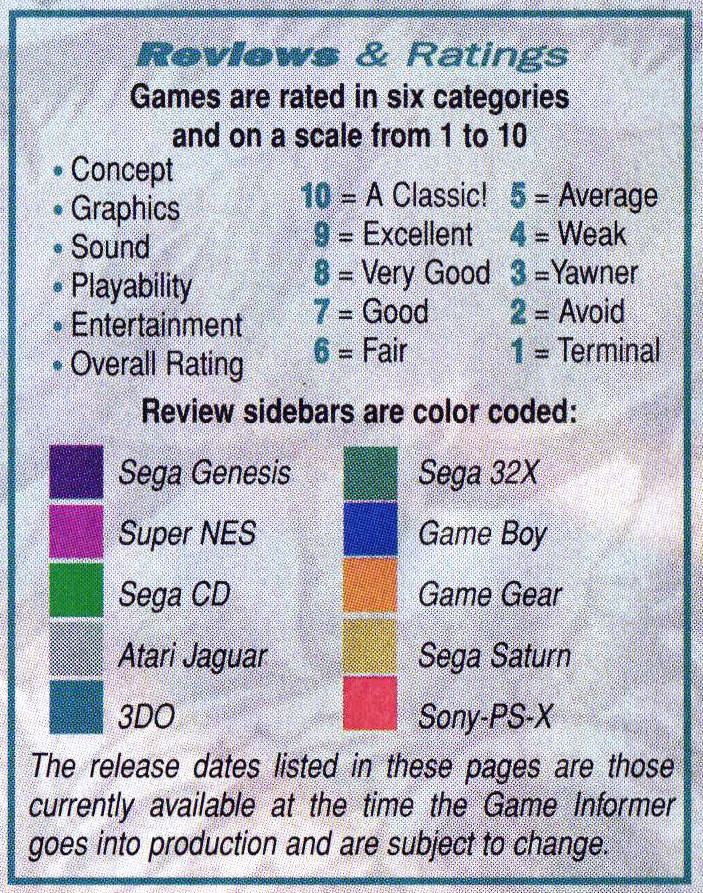 smaller reviews also had scores for concept, graphics, sound, playability, and entertainment. The main reviewer was not named. It’s odd that the smaller reviews provide scores for more aspects of the game and also got their name attached.
There was a side banner indicating what platform the game was being reviewed for. There was a section that stated the size of the game, the style (essentially genre, but no one wants to say genre), special features (it can be a bit odd what is highlighted), a created by that lists the developer and publisher (only a couple of these magazines mention the developer, and a lot of publishers were credited with making games at the time), and when it was to be released.
Reviews had several screenshots with captions. Backgrounds could be something from the game, stock art, or something seemingly made in-house. The backgrounds occasionally made the text hard to read.
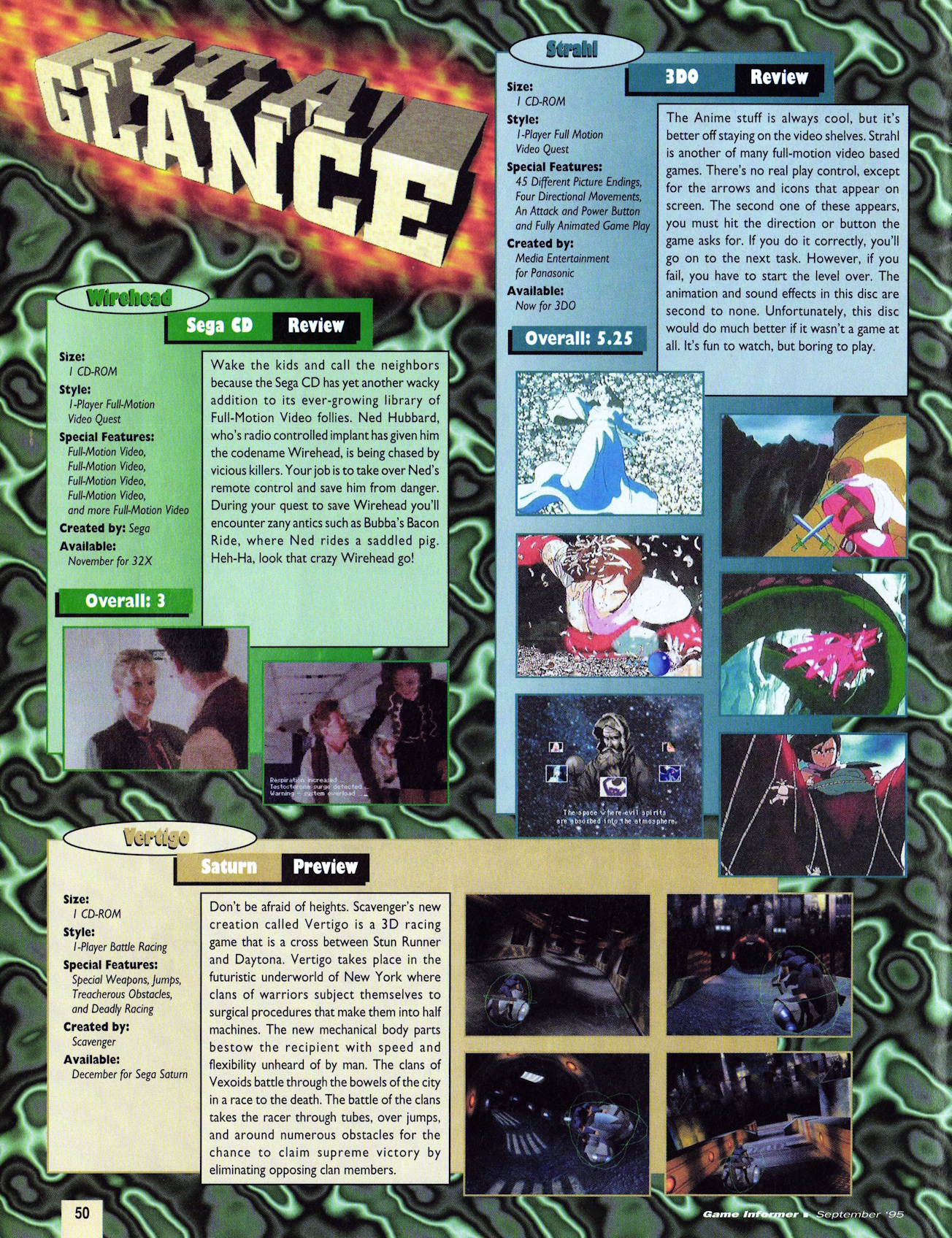
There was also an at a glance section with short reviews. The reviewers were not named and they are about the size of the smaller reviews in non-at a glance reviews.
For the adjusted score all scores are averaged and then multiplied by 10.
Game Players
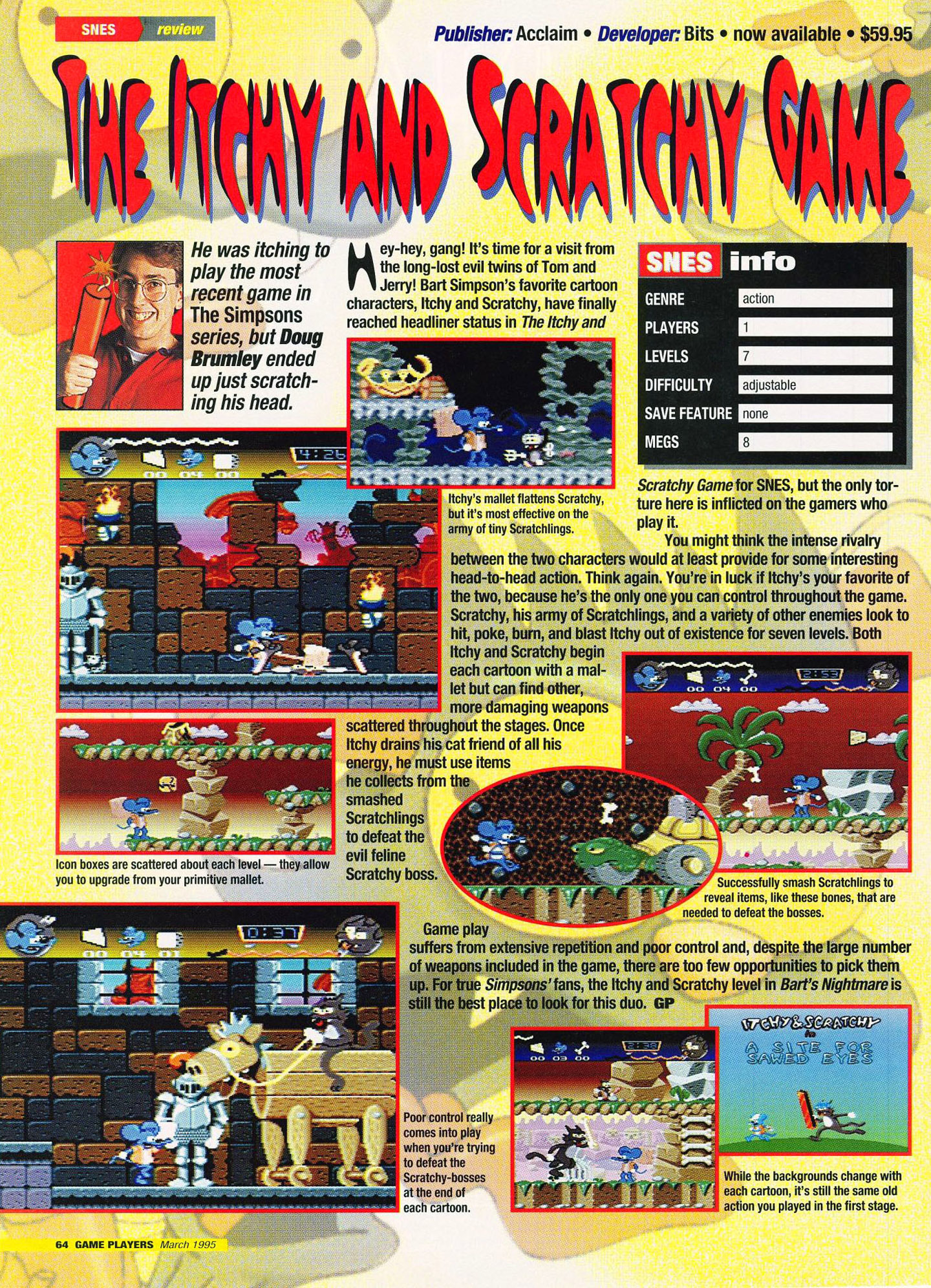
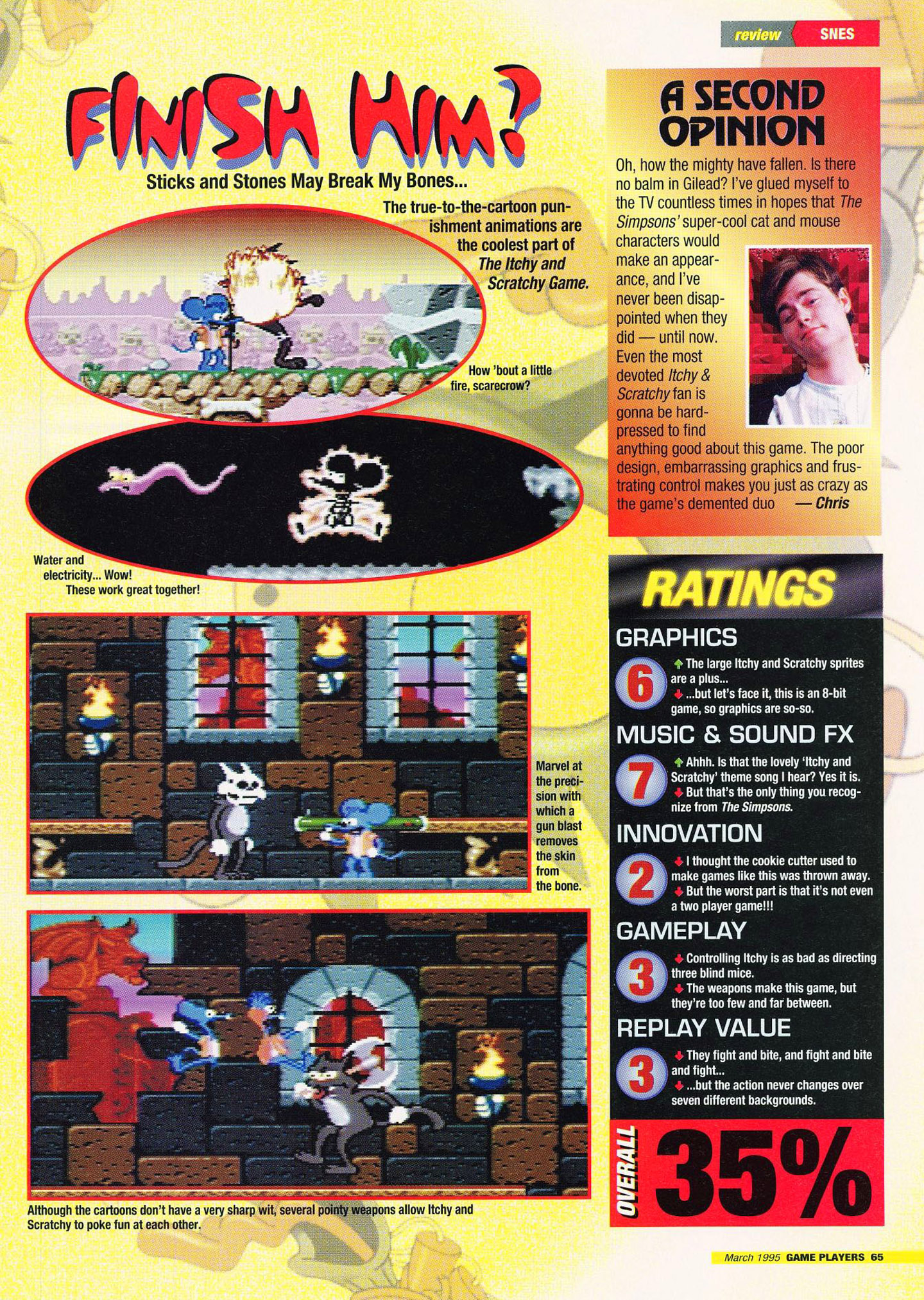
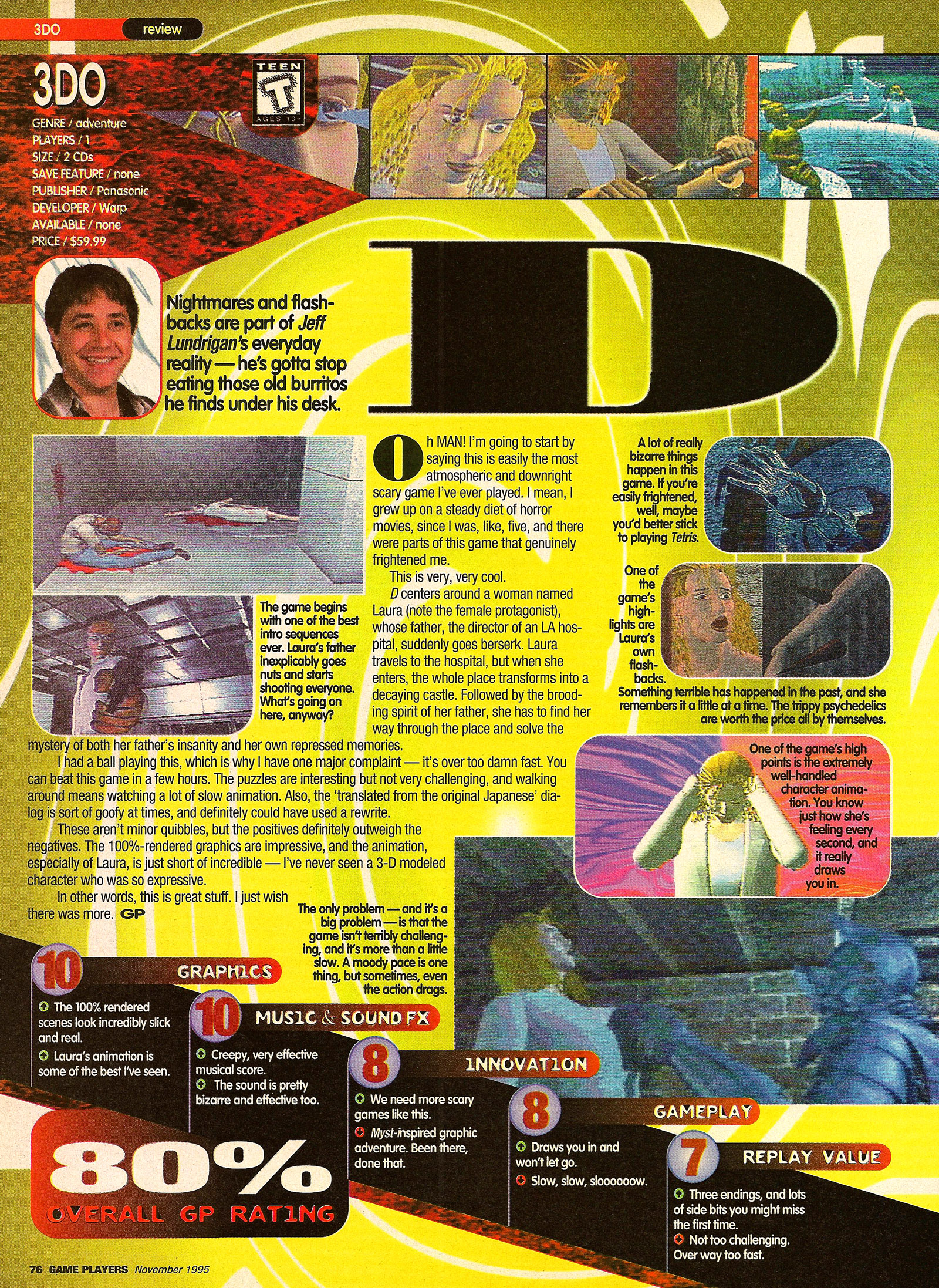
Reviews in Game Players could be half a page, a full page, or two pages long. There was a photograph of the reviewer sometimes edited to relate to the game in some way. I think there was a unique picture for each review, which seems like a lot of work.
The genre (actually called as such), number of players, number of levels, difficulty, save features, and size were listed in an info box. A top banner displayed the release date, developer and publisher, and price. Partway through the year these were rearranged and the number of levels and difficulty were dropped while the ESRB rating was added.
The reviewer gave a 1-10 score on graphics, music & sound FX, innovation, gameplay, and replay value. These each had two short blurbs describing why they were scored that way, with an up or down arrow to indicate if it was a positive or a negative. The Overall score was given as a percentage. Some reviews had a second opinion where another reviewer gave their take. These second opinions did not come with a score.
Screenshots took up quite a bit of space. The background was often noisy but they did a good job of lightening it so the text is readable.
Handheld and sports games had their own sections.
For the adjusted score nothing needs to be changed, the overall score is used.
GamePro
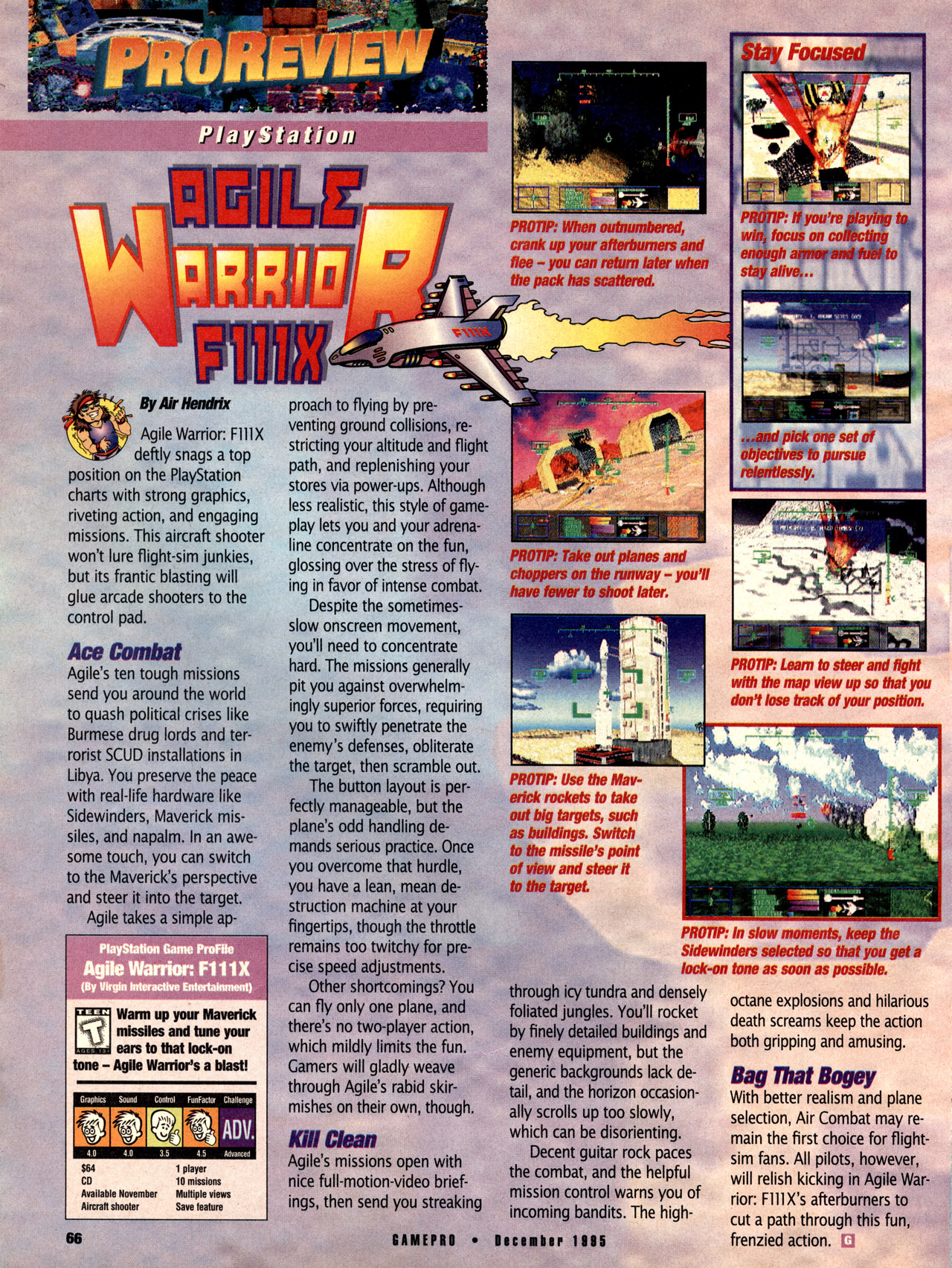
GamePro used illustrated avatars and pen names, like GameFan. These reviews could be quite small or up to two pages. The same ProReview logo was used on every page with a review. There were sections for each system as well as sections for RPGs (Role-Player’s Realm) and sports (The Sports Page).
There was a “ProFile” box with various information. This displayed the system, game name, ESRB rating, a short summary, score, difficulty level, cost, the size (or just “CD”), release date, genre, how many players, number of levels, and listed some features. It listed the publisher but described the game as being made by them.
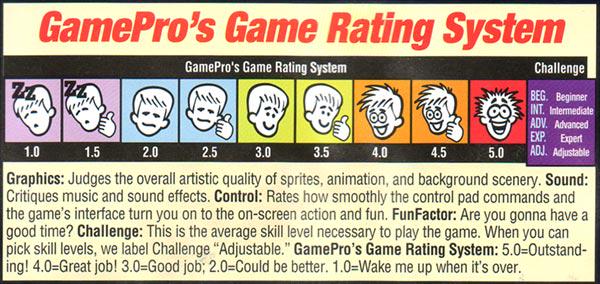
Games were scored in four categories: graphics, sound, control, and funfactor. These were scored 1 to 5 (0 and 0.5 did not seem to be possible), with halves. There was a cartoon head that went along with each number, with a thumbs up added for .5s.
Reviews seemed to always have some sort of official art and official logo, as well as a number of screenshots. The captions of these screenshots were the heavily-parodied ProTips. Many of these ProTips featured obvious or questionable advice. Backgrounds were kept light enough to make the text easily readable.
For the adjusted score I torn between just using the FunFactor, which seems like sort of an overall score, and adding all the scores, but I ultimately went with adding them together. There were still some perfect scores. This results in a score out of 20, so I multiplied by 5.
Next Generation
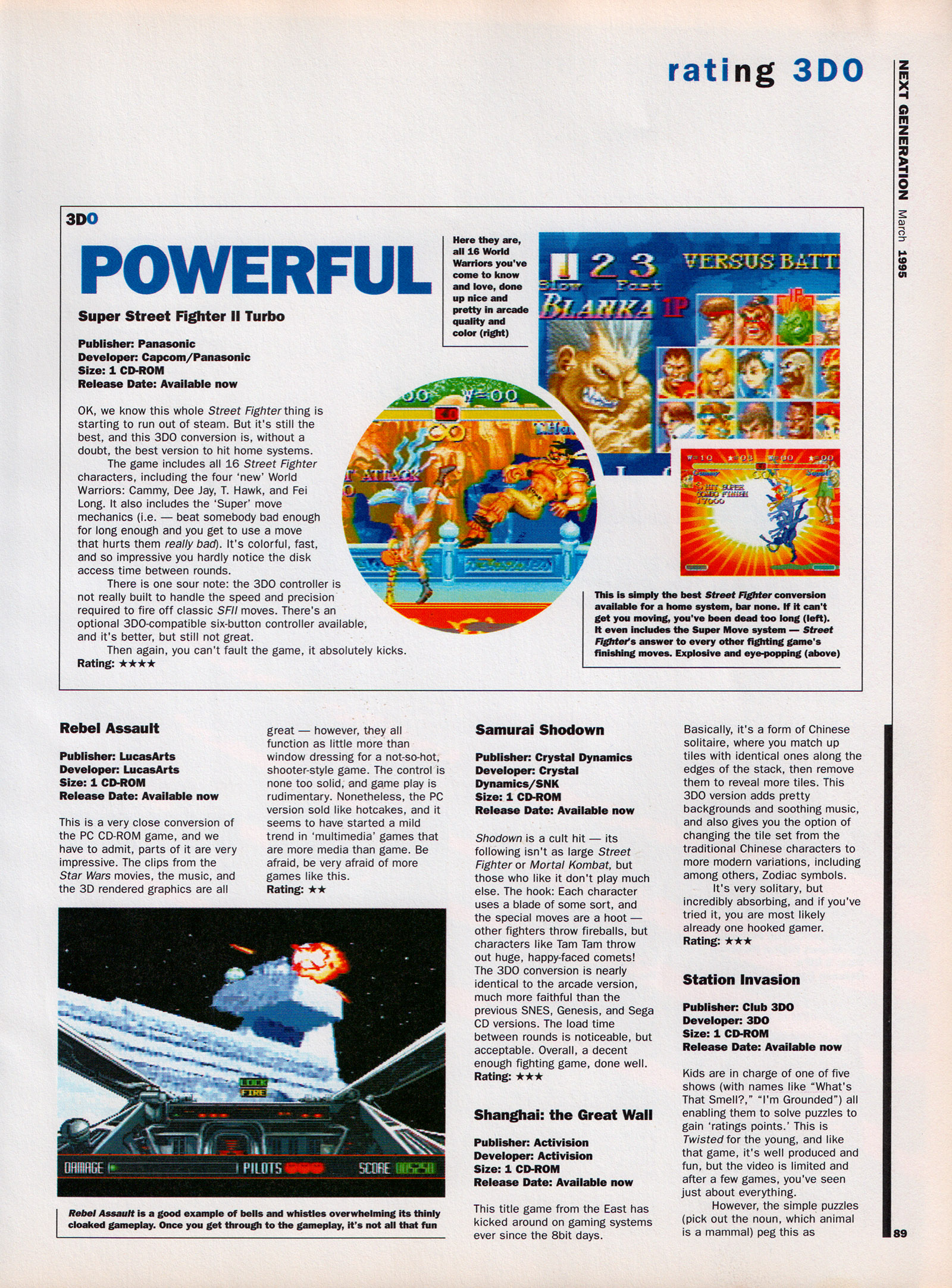
Next Generation reviews were generally very short, the longest was a whole page. Game name, system, developer, publisher, size, and release date were included at the start of each review. At some point in the year the size and release date were dropped. Longer reviews had a single word “headline”. Reviews were sorted by system.
Reviews were 1 to 5 stars, no halves. These were described in the beginning of the review section as follows: Bad, Average, Good, Excellent, and Revolutionary. No names were attached to reviews.
Many smaller reviews didn’t have any screenshots, but larger ones could have a few, sometimes with captions. Plain white backgrounds were used.
For the adjusted score I just multiplied by 20.
Nintendo Power
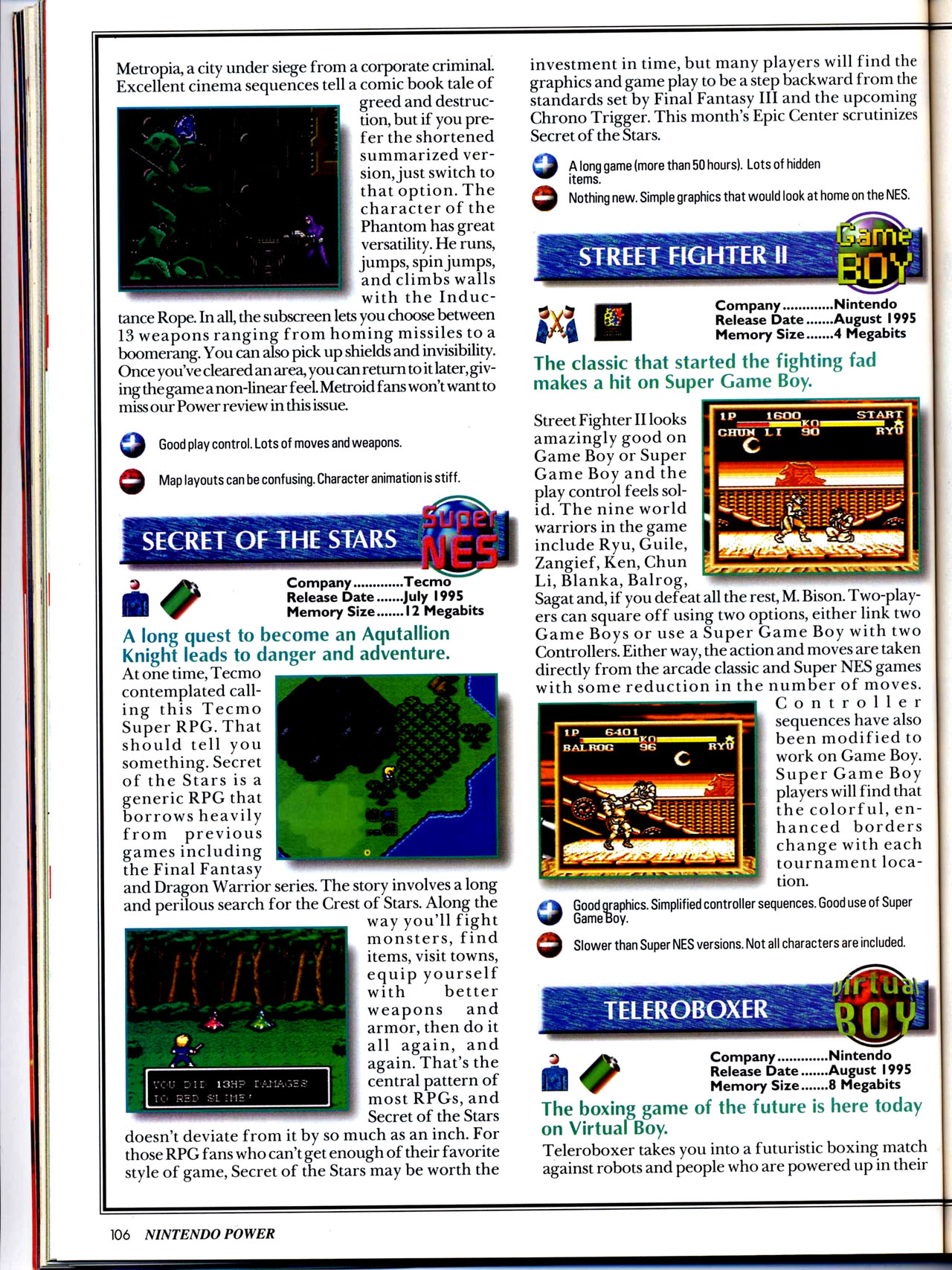
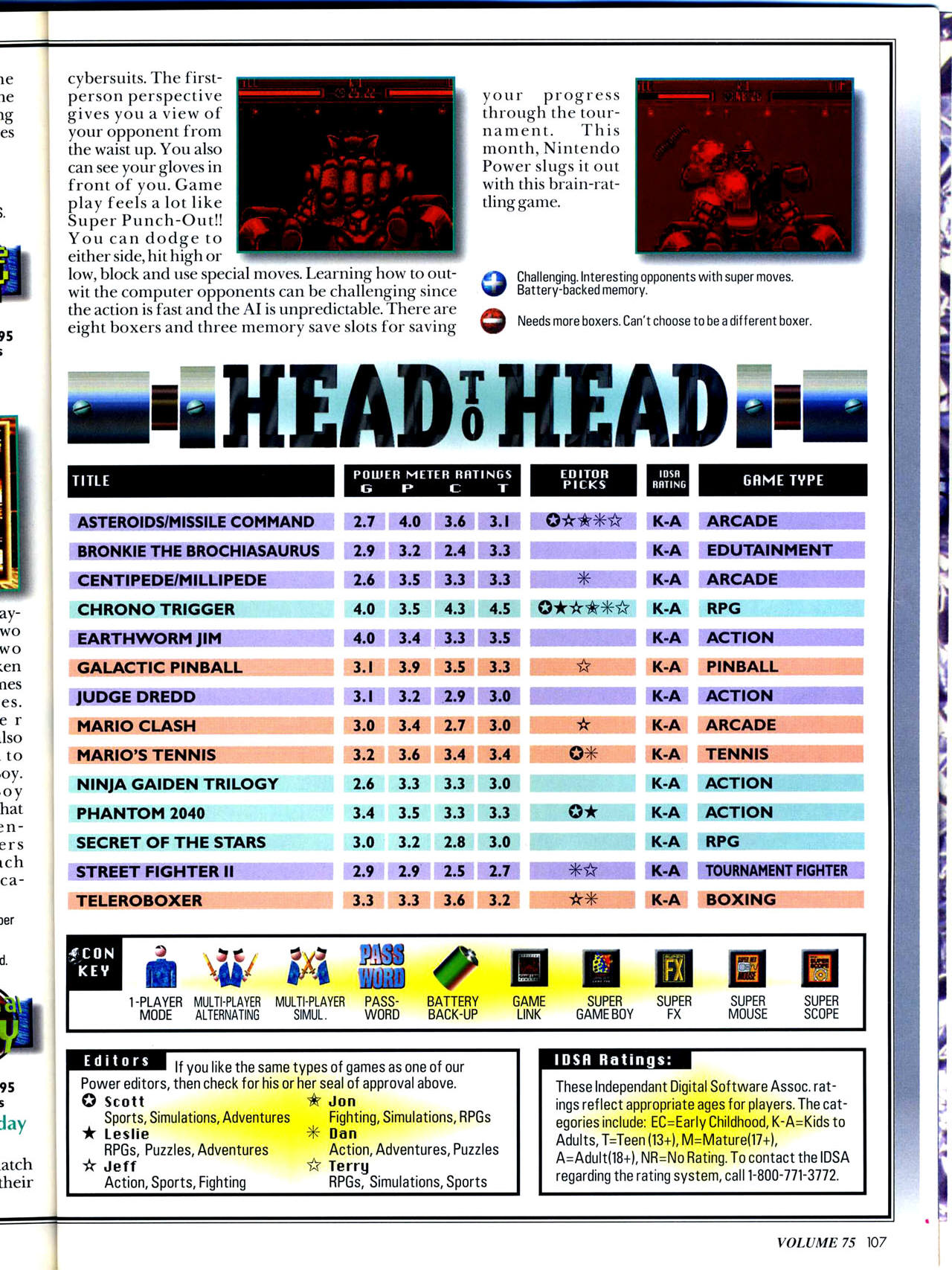
There were two parts to reviews in Nintendo Power. In the first part was a short written review with one or two screenshots. Game names were written in text and the system was indicated with a graphic. The company (publisher), release date, and size were listed. There were a number of unlabeled symbols indicating various aspects of the game. At the end of the review was a few positives and negatives. The reviewer’s name was not listed.
At the end of the reviews was a “Head To Head” section that listed more information about the games reviewed in that issue. Each game received a score from perhaps 0 (I couldn’t find evidence of any score below 1.5) to 5, with a tenth of a point of precision in four categories. These categories were seemingly only labeled G, P, C, and T in 1995, but looking at future issues they were defined as graphics and sound, play control, challenge, and theme and fun. The ESRB rating was also listed, as was “Game Type”, which really meant genre. Six reviewers had their own symbol for giving their “seal of approval” to a few games each month. There was also a key for the mysterious symbols included in the reviews.
Games were listed in alphabetical order, with no regard for systems. Plain white backgrounds were used.
Fun seems like it might be the actual important score, but since it’s combined with theme and not given any special attention I have summed each score for a total out of 20, which was then multiplied by 5 for the adjusted score.
Sega Visions


There were two review sections, the first was called “Review THIS!”, but there were no scores and a fair amount of space was given to tips for playing the game. These reviews were one or two pages long and the author was not disclosed. The December-January issue only had Sega CD games in this section.
These reviews used logos to display the game name. There was a block of text that described the game and an overview box. You could find the reviewer’s opinions in either one of these areas, or both. The overview box displayed the publisher, what controllers the game was compatible with, the number of players, and either an ESRB rating or the short-lived Videogame Rating Council’s rating. Some kind of game related art asset was used as the background, but kept light. After the December-January issue there was a bit of a redesign. There was no longer an overview box. Full color art was used and text generally had a readable background under it.
There were many screenshots, often with tips for how to handle the shown part of the game. There were a few Hot Hints listed.


Additionally, there was separate fast takes section. These Fast Takes reviews did have scores, from 1 to 5, labeled Swill, Sorta Swell, Swell, Seriously Swell, and Staggeringly Swell. Games were also scored on graphics, sound, controls, challenge, and overall fun. The same basic information about each game was provided, and there were still hot hints. There were exactly two screenshots. The December-January 1995 issue was the debut of this section and the first time Sega Visions had scored games. The September issue, the final Sega Visions, did not have a Fast Takes section.
For the adjusted score I used the Overall Fun score and multiplied it by 20.
VideoGames: The Ultimate Gaming Magazine


VG:TUGM had a clear system label in the corner and used official logos to display the name of the game being reviewed. There was an info box that displayed the logo of the publisher and states the developer. The publisher’s very important phone number was displayed as well as the number of players and the size in megabits.
These reviews featured a lot of screenshots, occasionally with a caption, sometimes blown up and used as backgrounds in a way that made the text hard to read.
The main reviewer gave games a 1-10 overall rating (0 may be possible) and also scored the graphics, sound/music, and Playability. Zero to three other reviewers also wrote a short blurb and provided a score.
There was a section for each system, but there were also sections for RPGs and sports games. Additionally there were “capsule” reviews, which were shorter, had a single screenshot, and only a single reviewer.
For the adjusted score I averaged each reviewers overall rating and multiplied by 10.
Gaming Magazine Reviews By The Numbers
A total of 3,060 scores were recorded for 1,142 games for 16 gaming systems in these 10 magazines during 1995. Including racing and wrestling, sports games were 212 of those, or 18.6%.
When a magazine reviewed an import and then later reviewed the official North American release those are counted as two separate reviews and are averaged. PC here refers to DOS, Windows, Mac, or any other game played on a personal computer.
Number Of Games Reviewed Per System
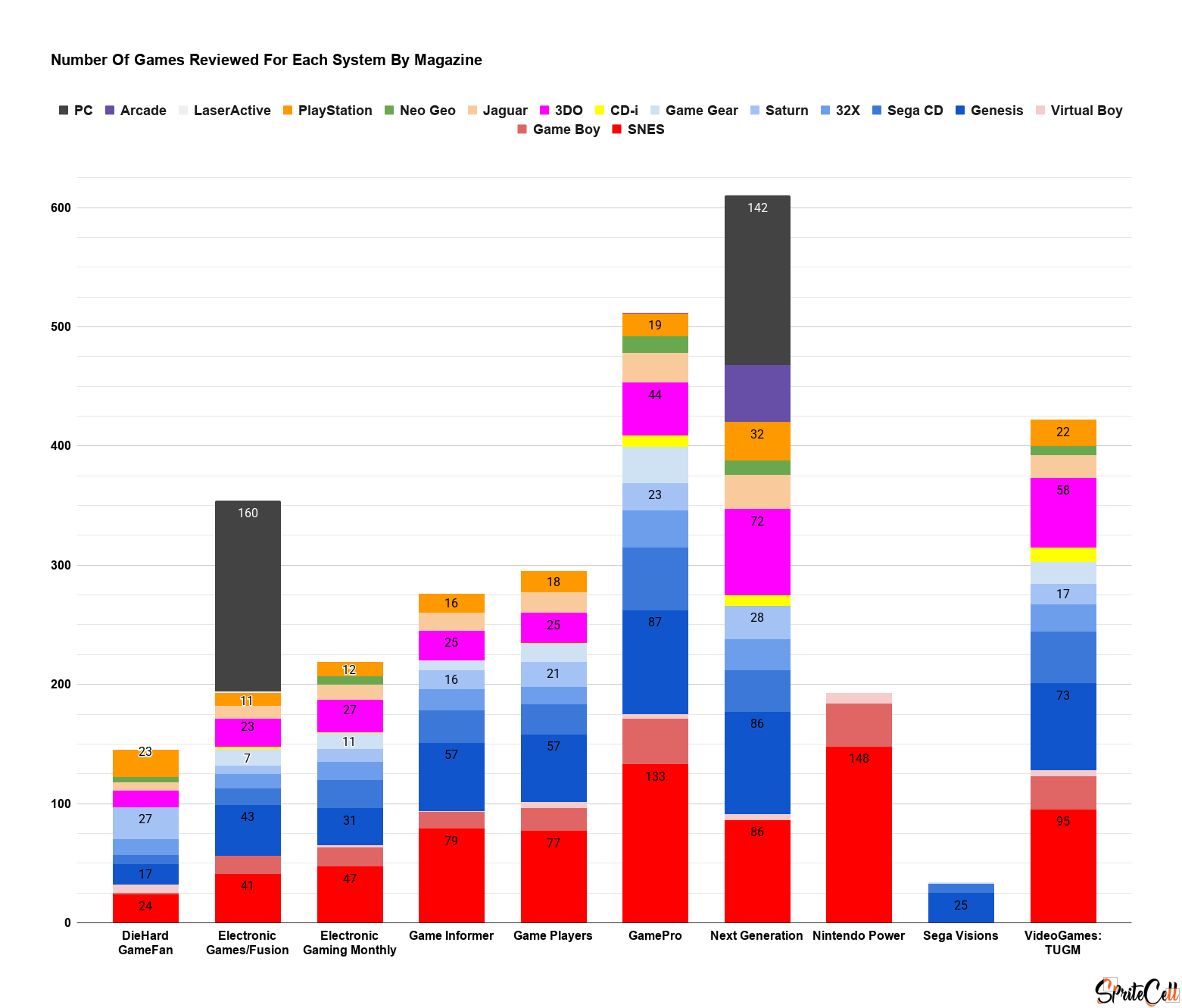
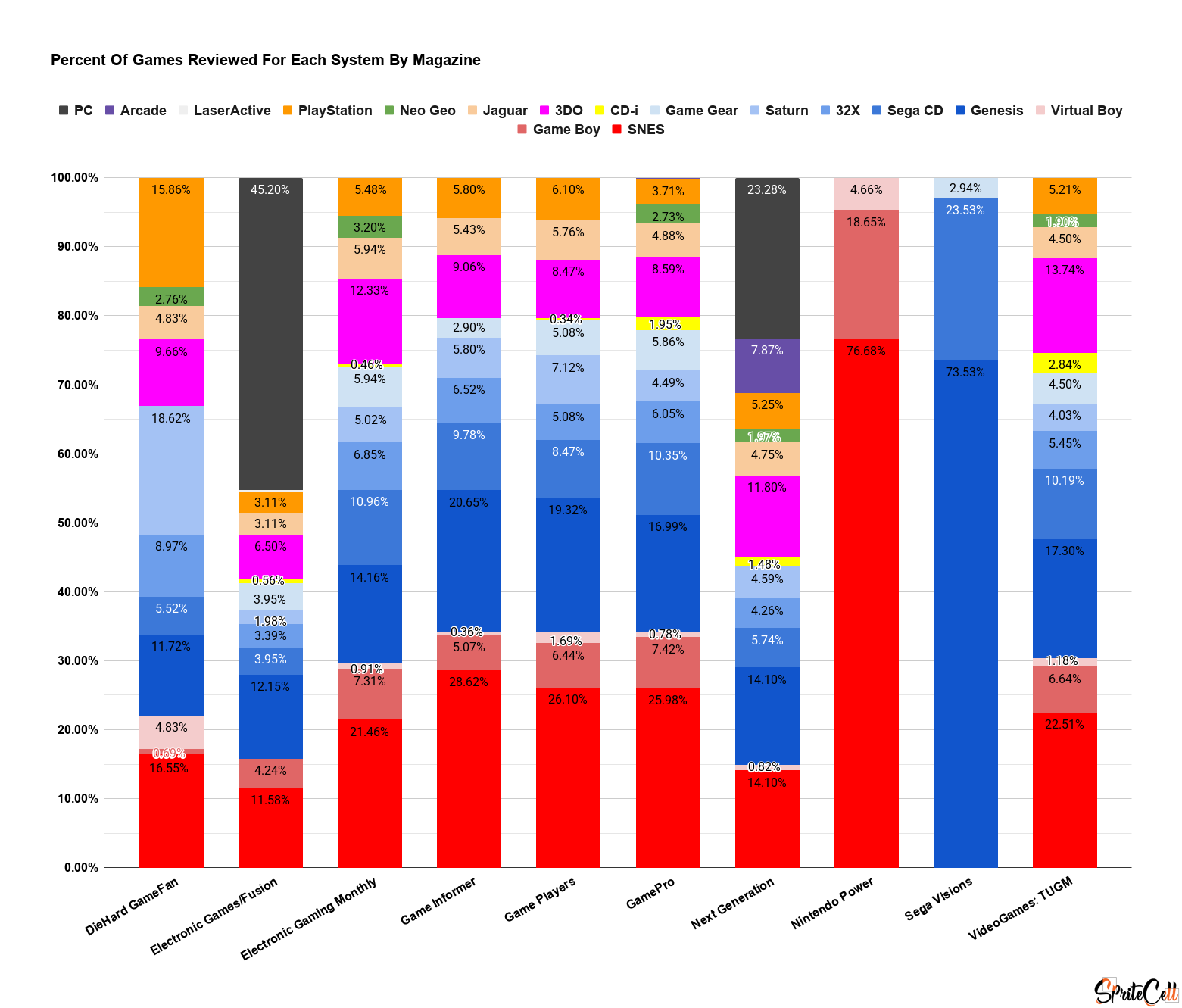
Next Generation really comes out of the gate swinging, publishing 100 more reviews than GamePro. They didn’t even cover Game Boy or Game Gear, but did review quite a few PC games. One wonders why they reviewed Japanese Arcade games based on anime properties that had no chance of ever being released elsewhere.
DieHard GameFan didn’t review handhelds as a rule, but made an exception for Donkey Kong Land.
Nintendo power reviewed 9 Virtual Boy games, the most of anyone in 1995.
LaserActive used LaserDiscs to play games and the sole review was in Electronic Games. They gave Don Quixote: A Dream in Seven Crystals a C.
Sega Visions of course only had 4 issues and their unscored reviews are not counted here. They never gave a score to a Saturn game, or to a 32X game within the included issues.
SNES games received more reviews total than any other system this year at 730, well ahead of the Genesis’s second place at 476. The PlayStation and Saturn were nearly tied at 153 and 150.
Average Scores
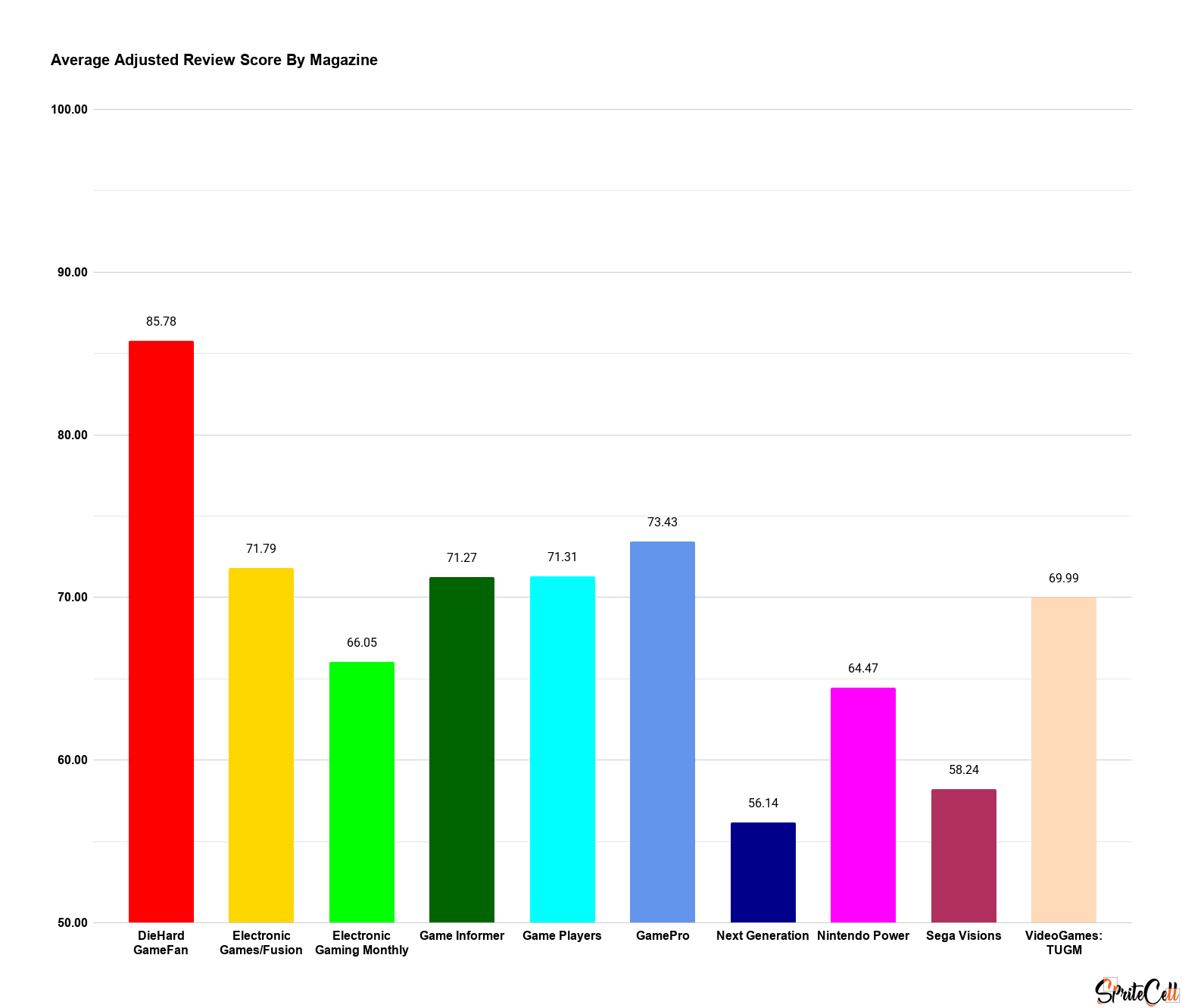
While adjusted scores are never going to perfectly capture the differences in magazine scores, we can at least see some big differences in how scores were handled among magazines. When I looked at every publication’s average Metacritic metascore for games the scale ran from 59 to 86 with a mean and median of 75. Next Generation and Sega Visions ended too soon to be included on Metacritic, but if they were they would have the lowest scores. Next Generation’s sister magazine Edge also has very low scores overall.
GameFan didn’t review many games, but they tended to score them very highly.
You might expect the official Nintendo and Sega magazines to have some of the highest scores, to make their systems look like they have the best games, but they are actually pretty stingy.
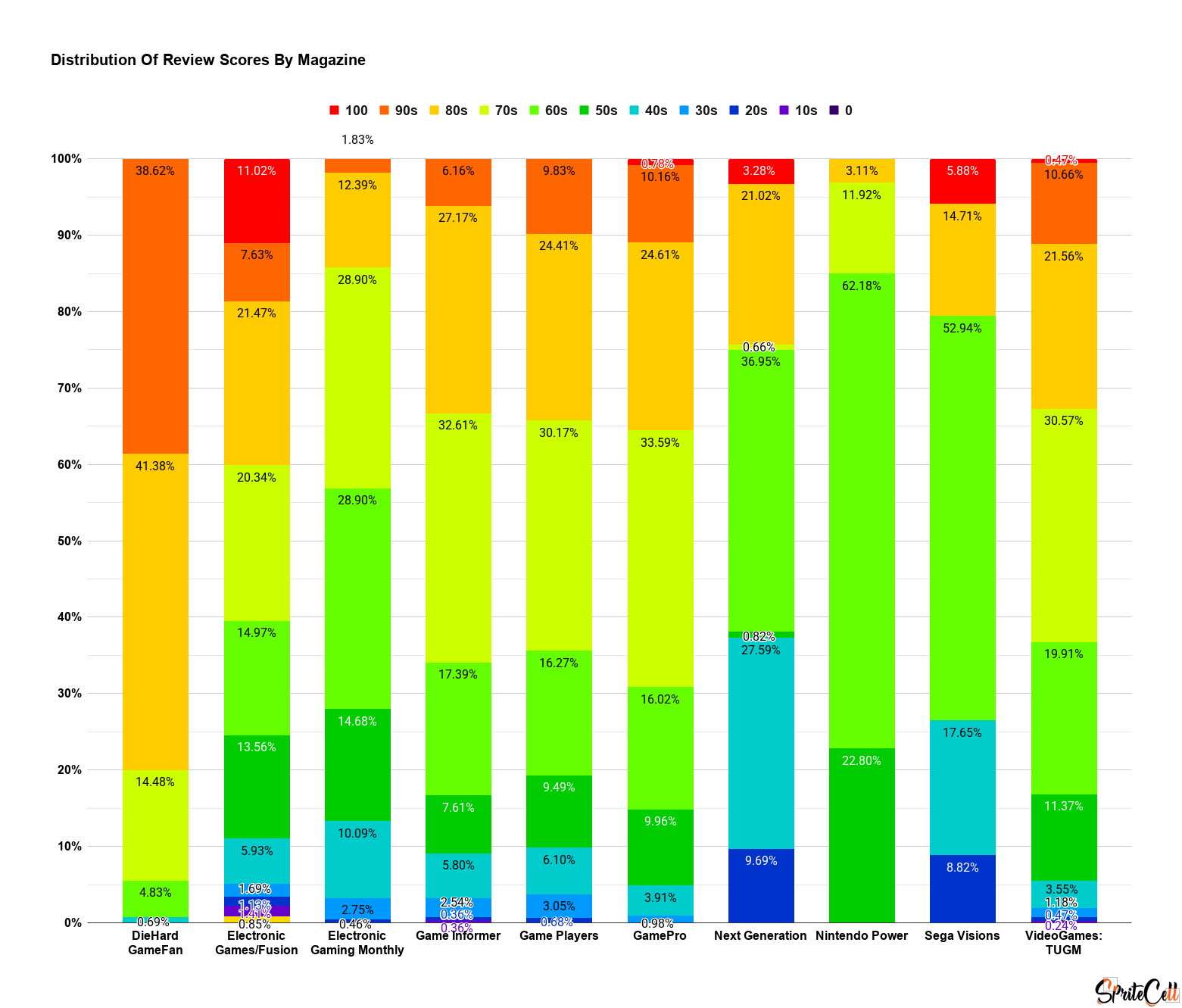
Five magazines gave at least one perfect score to a game in 1995, though that is likely more common when you have a 1-5 scale than when you have a 1-100 scale. Also, if multiple people review a game for a magazine only one of them has to give it less than a perfect score to make the magazine’s overall score less than 100. There were 66 total individual perfect scores.
Even though this is an apples to oranges comparison we can see how some outlets use more of the scale than others: Nintendo Power’s scores have a range of 35, while Electronic Games/Fusion gave both a perfect score and a 0. Review outlets have really never tended to use the entire scale. Less than 4% of scores are below 30.
Average Scores By System
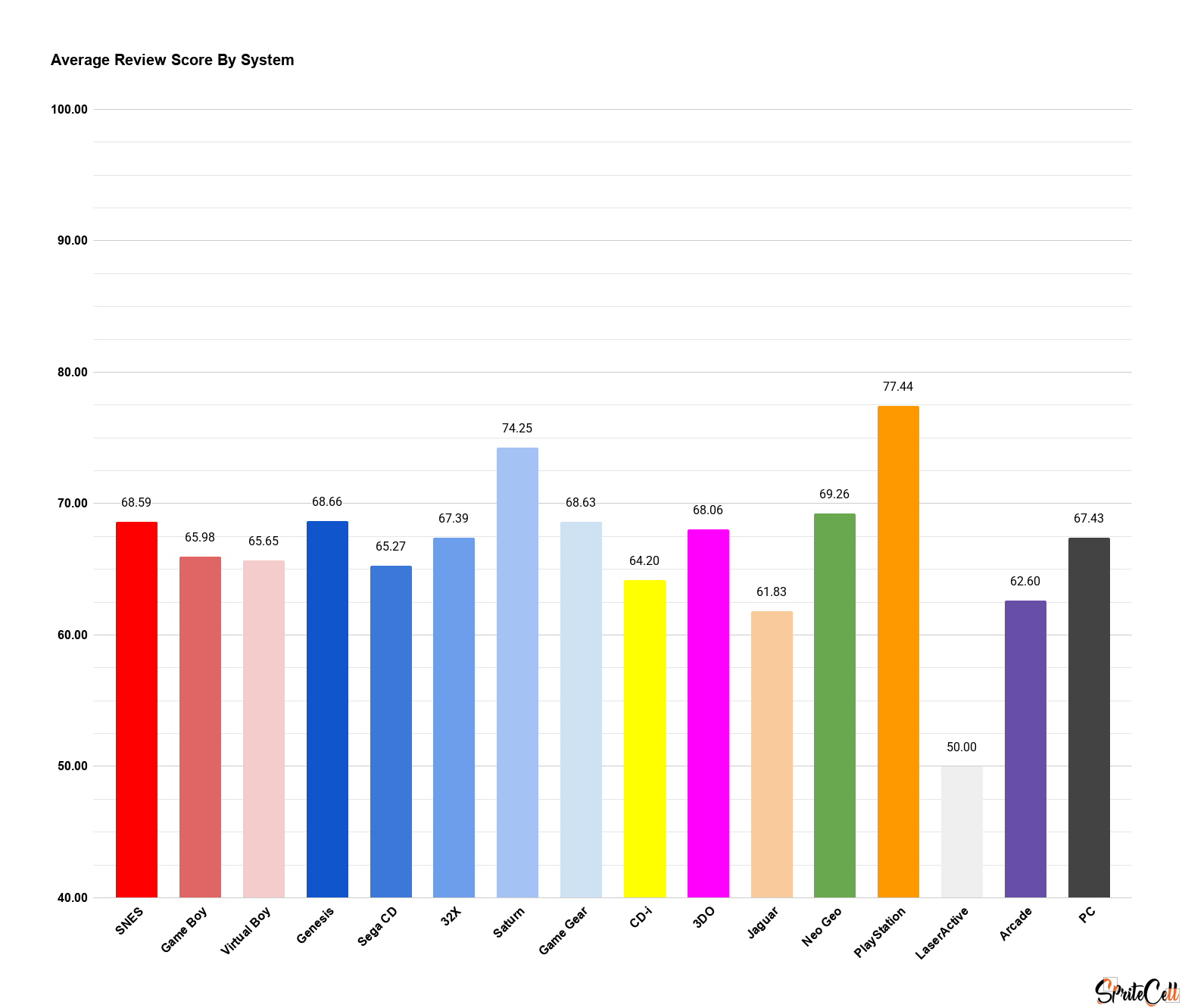
This isn’t a great comparison, since each magazine not only has a different scoring system, but each magazine focuses on different systems. For instance, Nintendo Power’s low overall scores and high number of Virtual Boy reviews doesn’t help the system’s performance here.
Game Boy (with one exception) and Game Gear are not reviewed by the lowest or highest scoring magazine, so maybe it evens them out a bit.
Looking at how each individual magazine scored each system is more of a fair comparison.
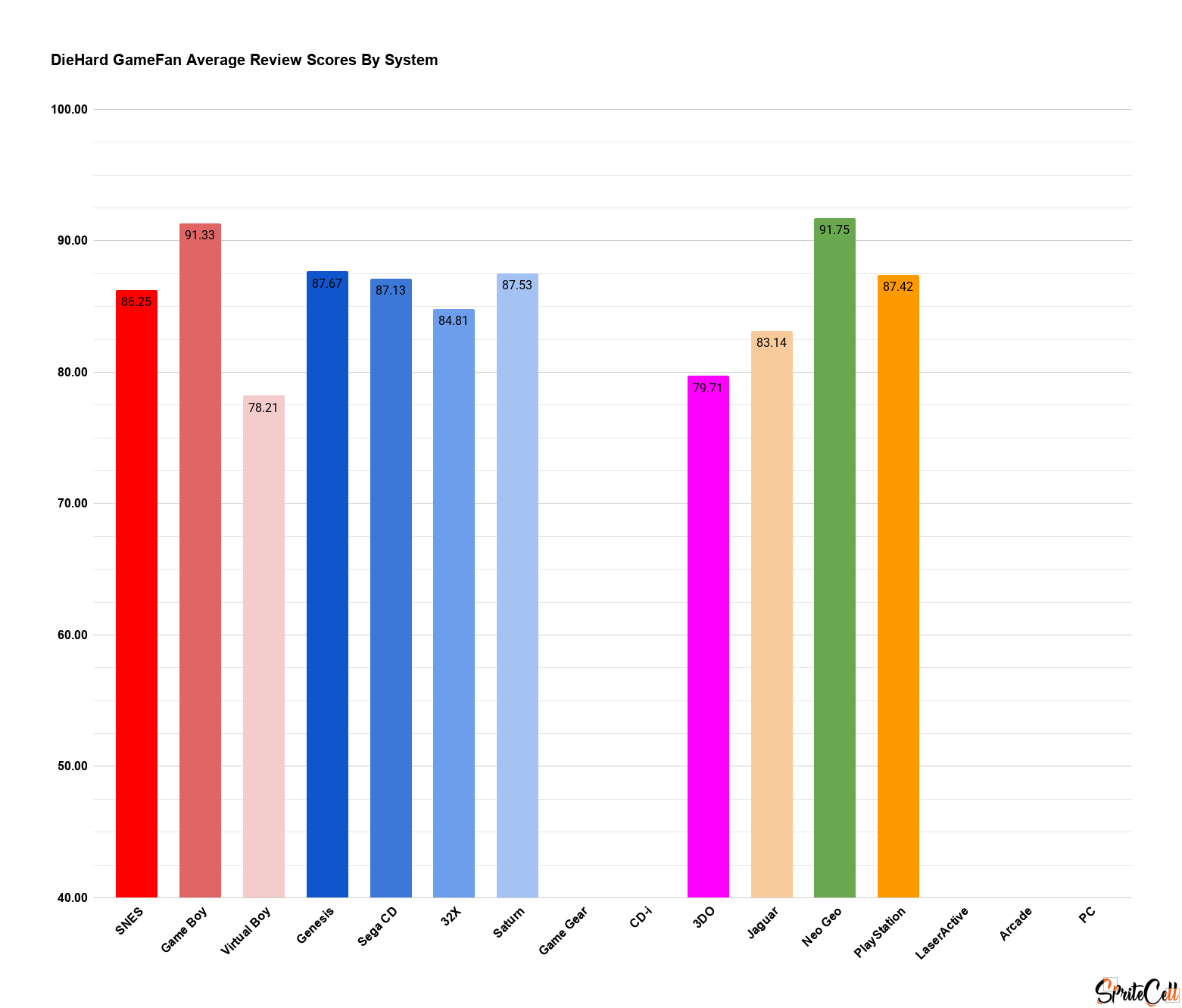
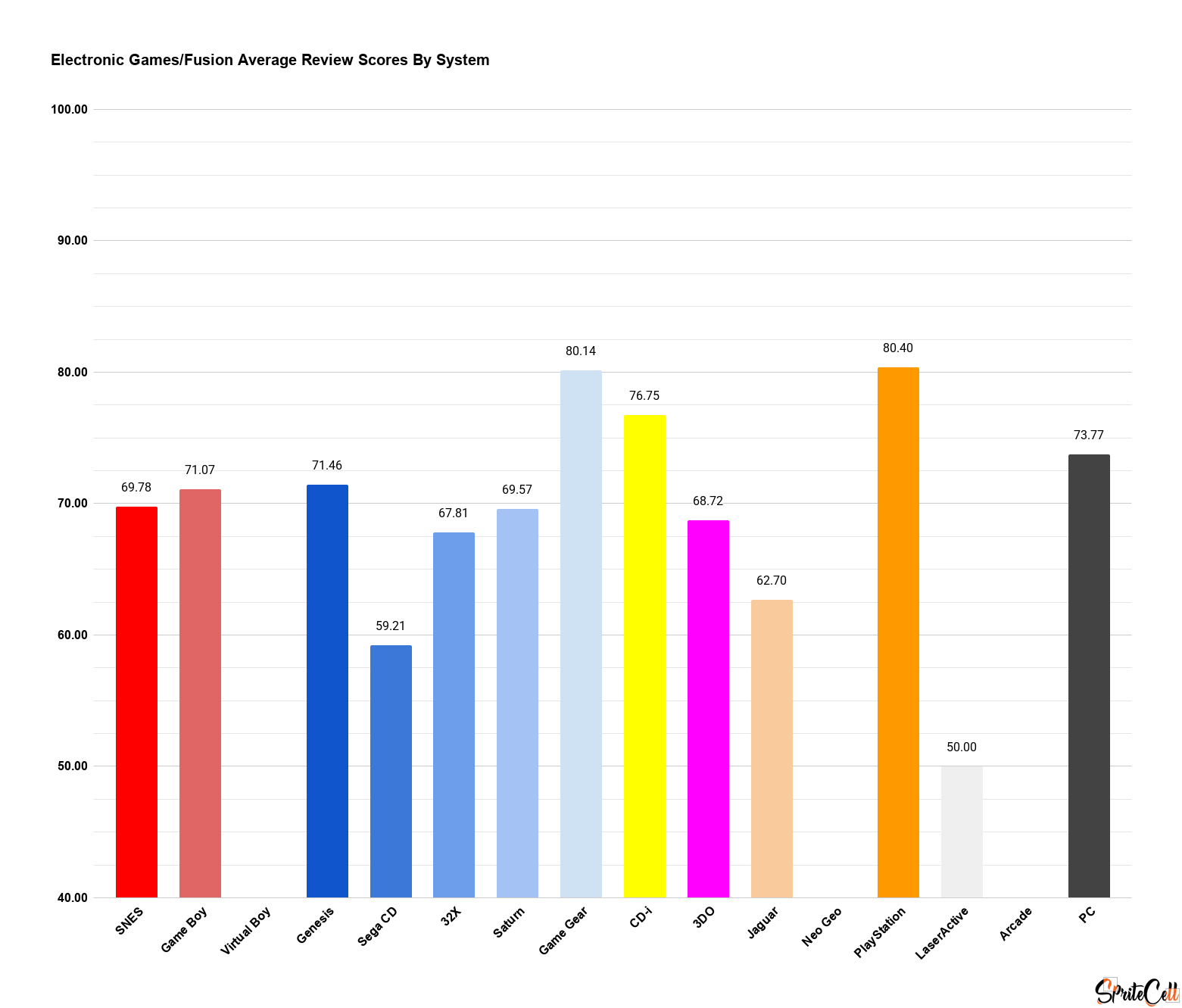
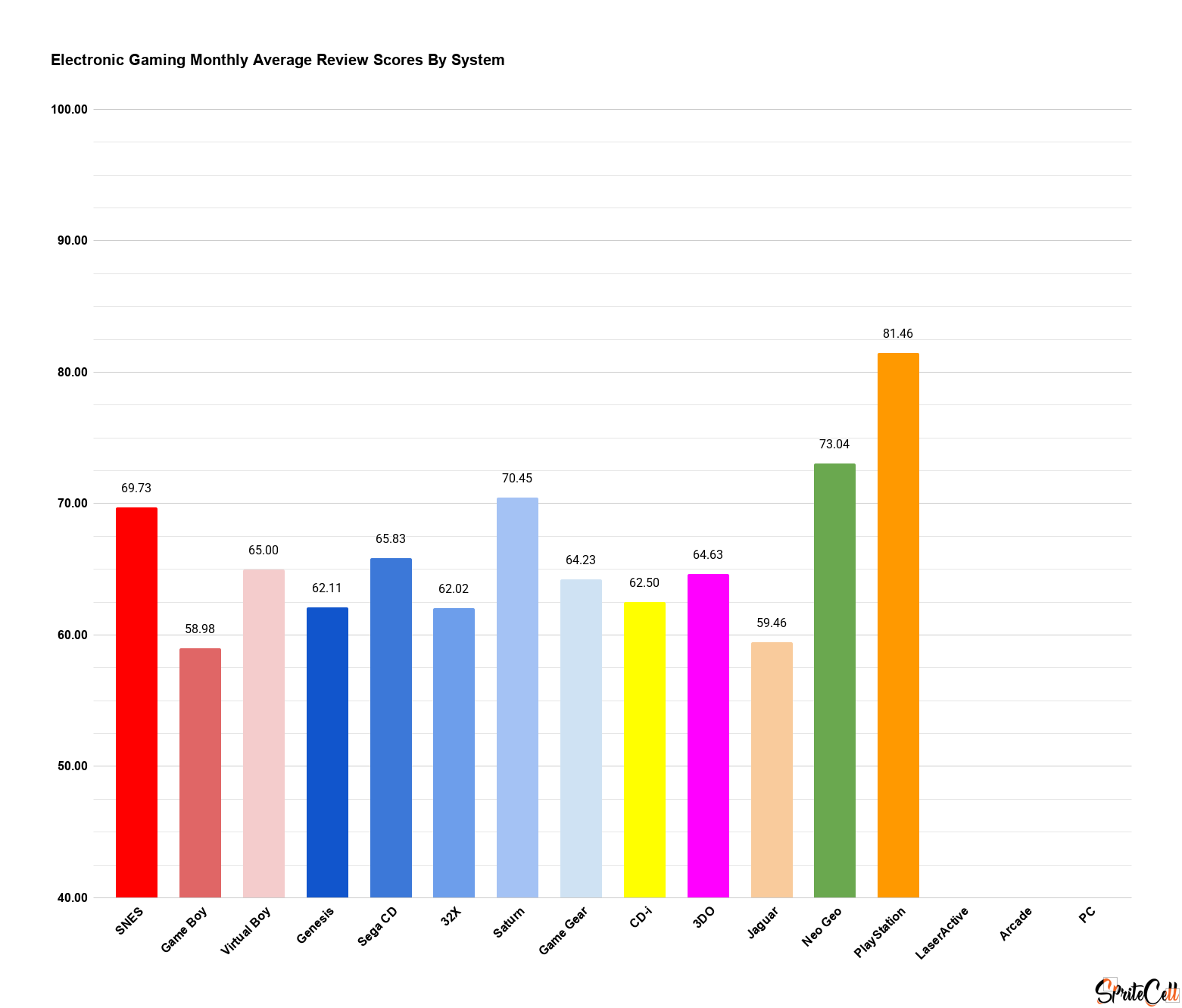
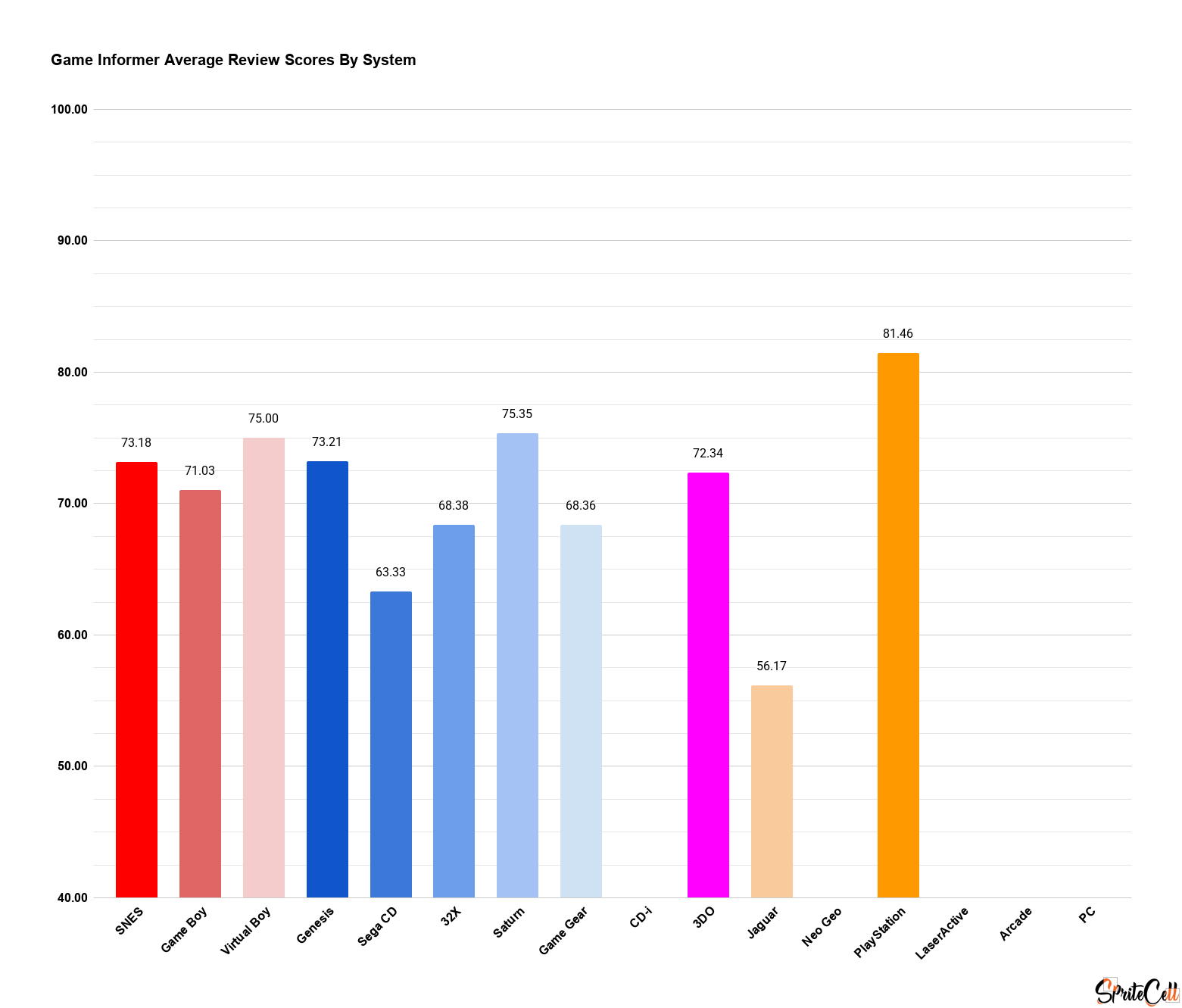
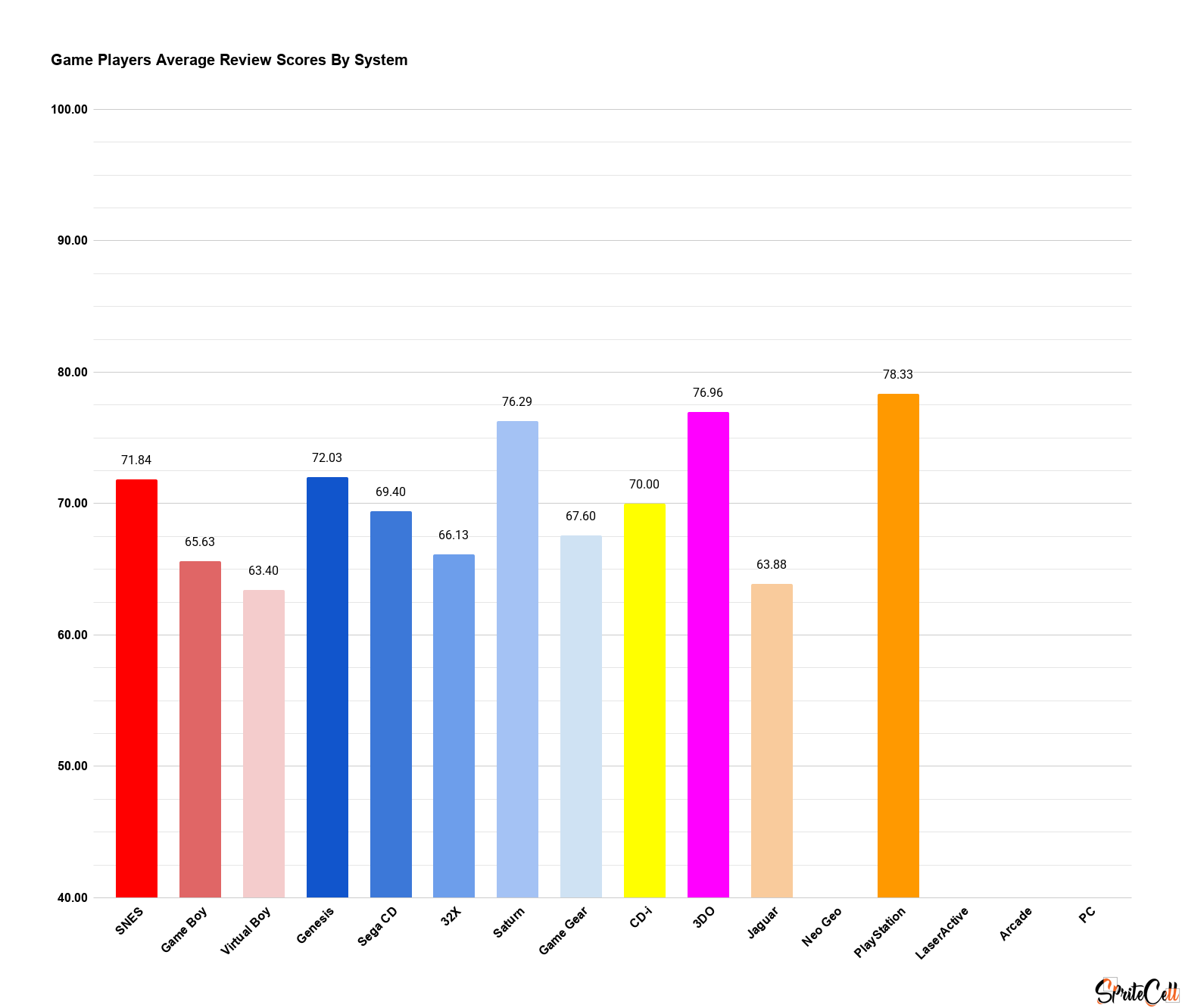
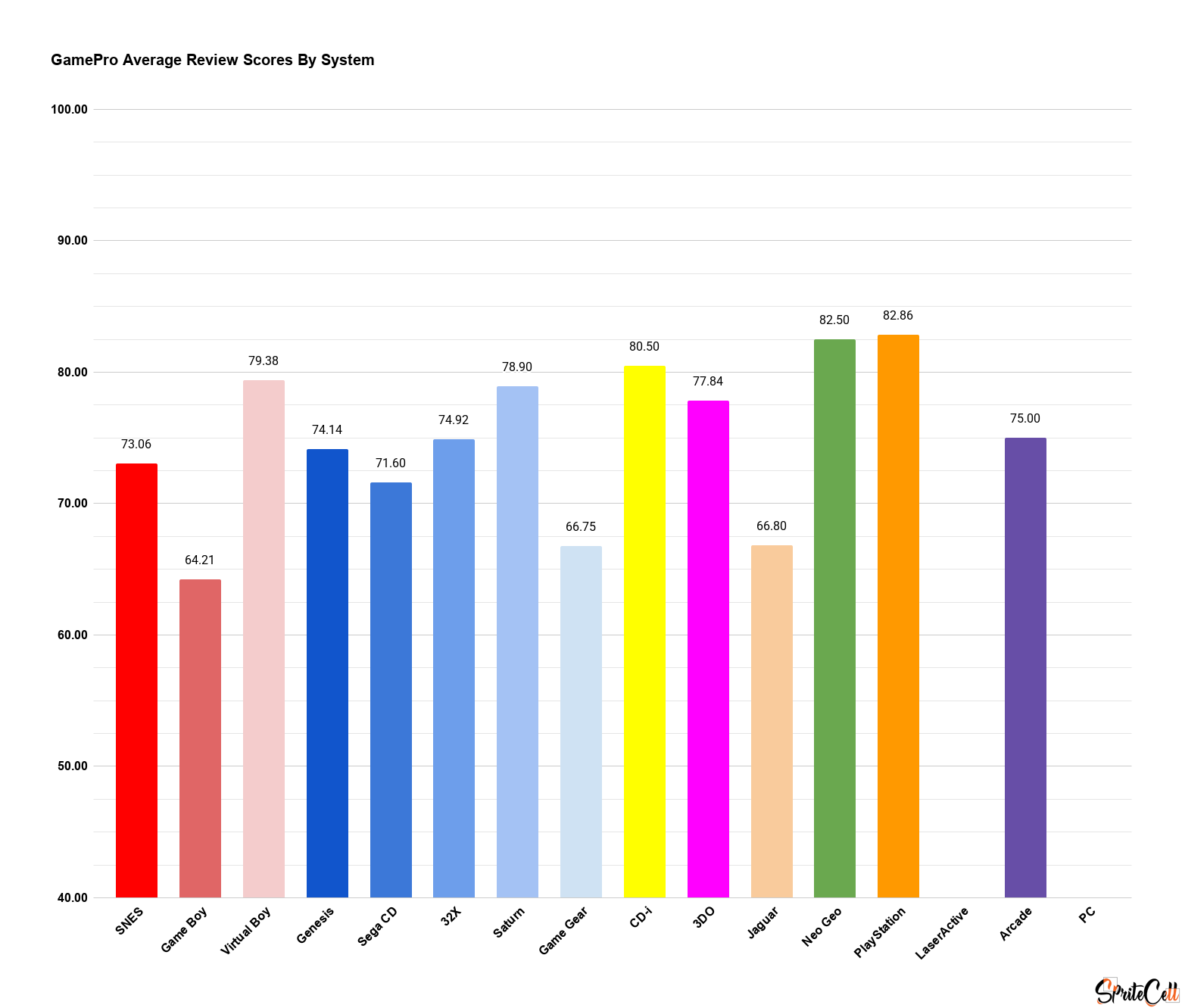
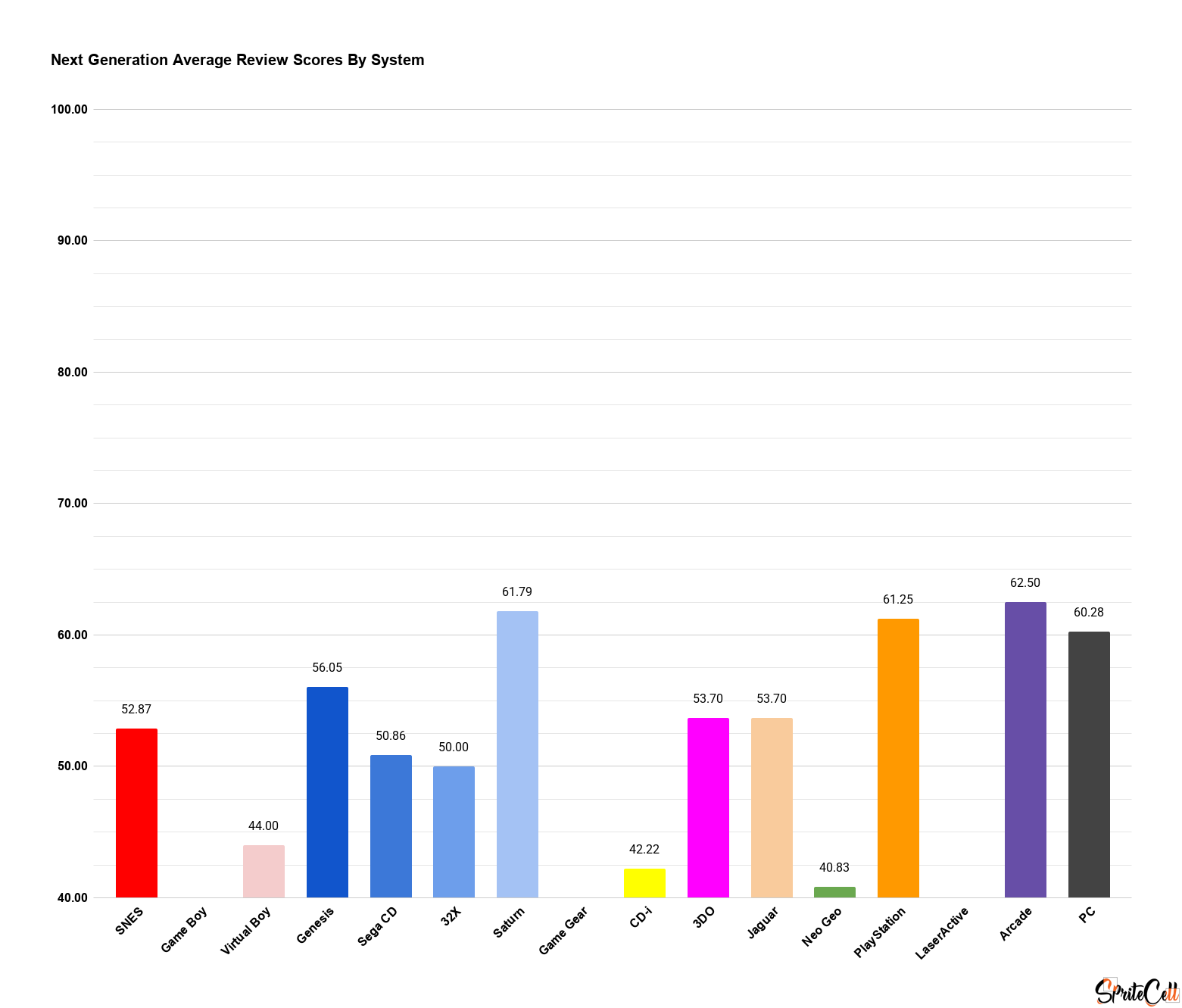
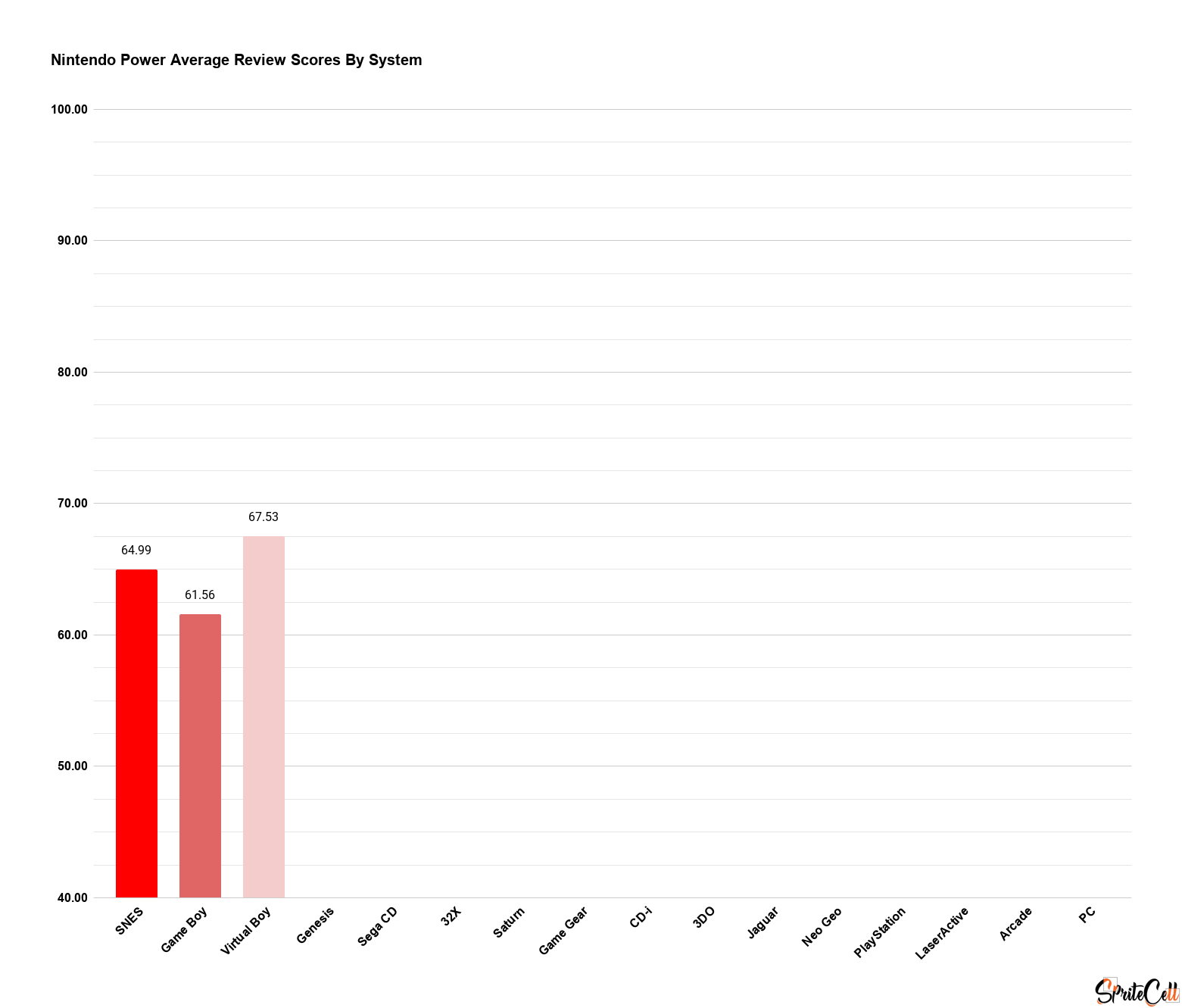
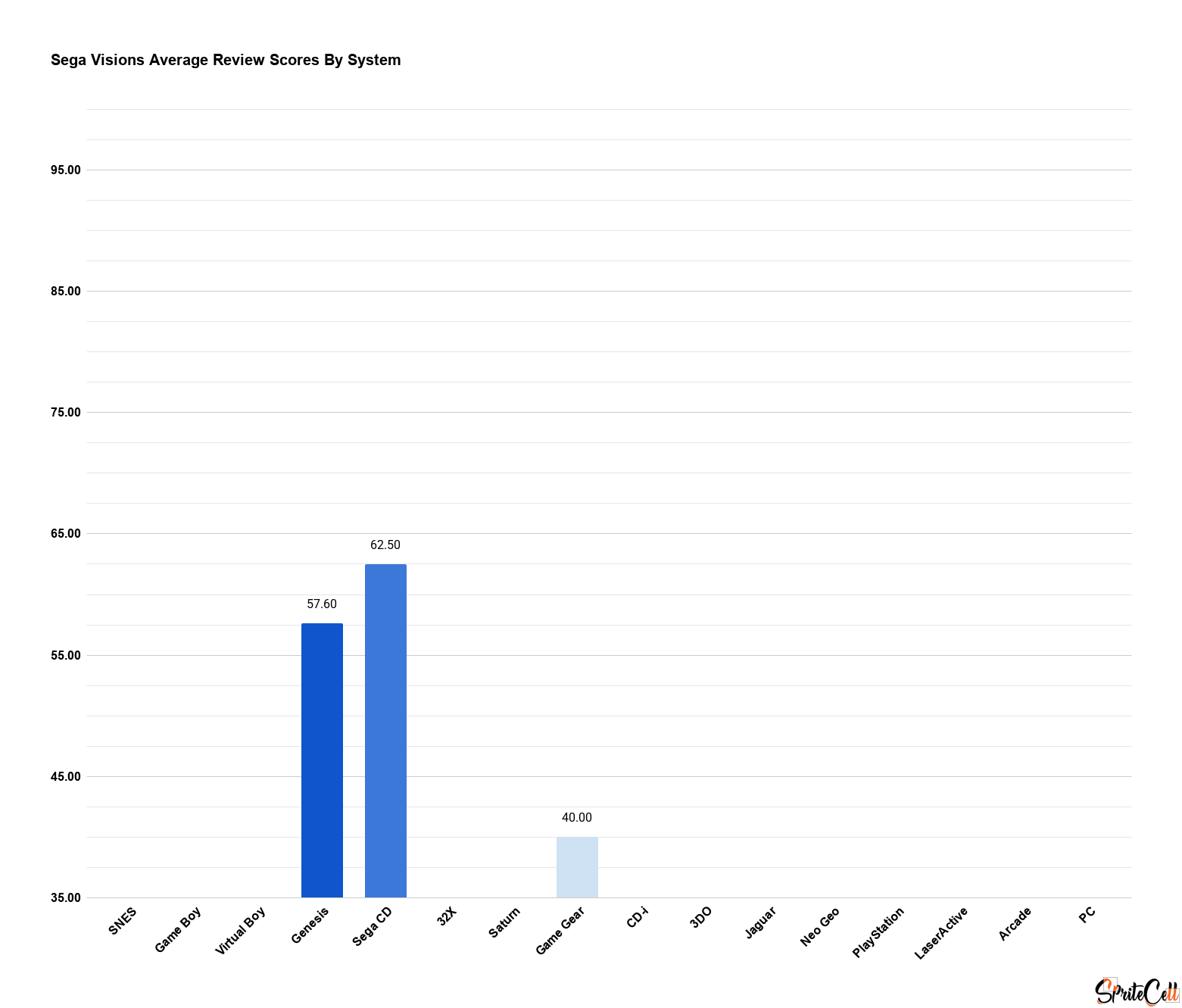
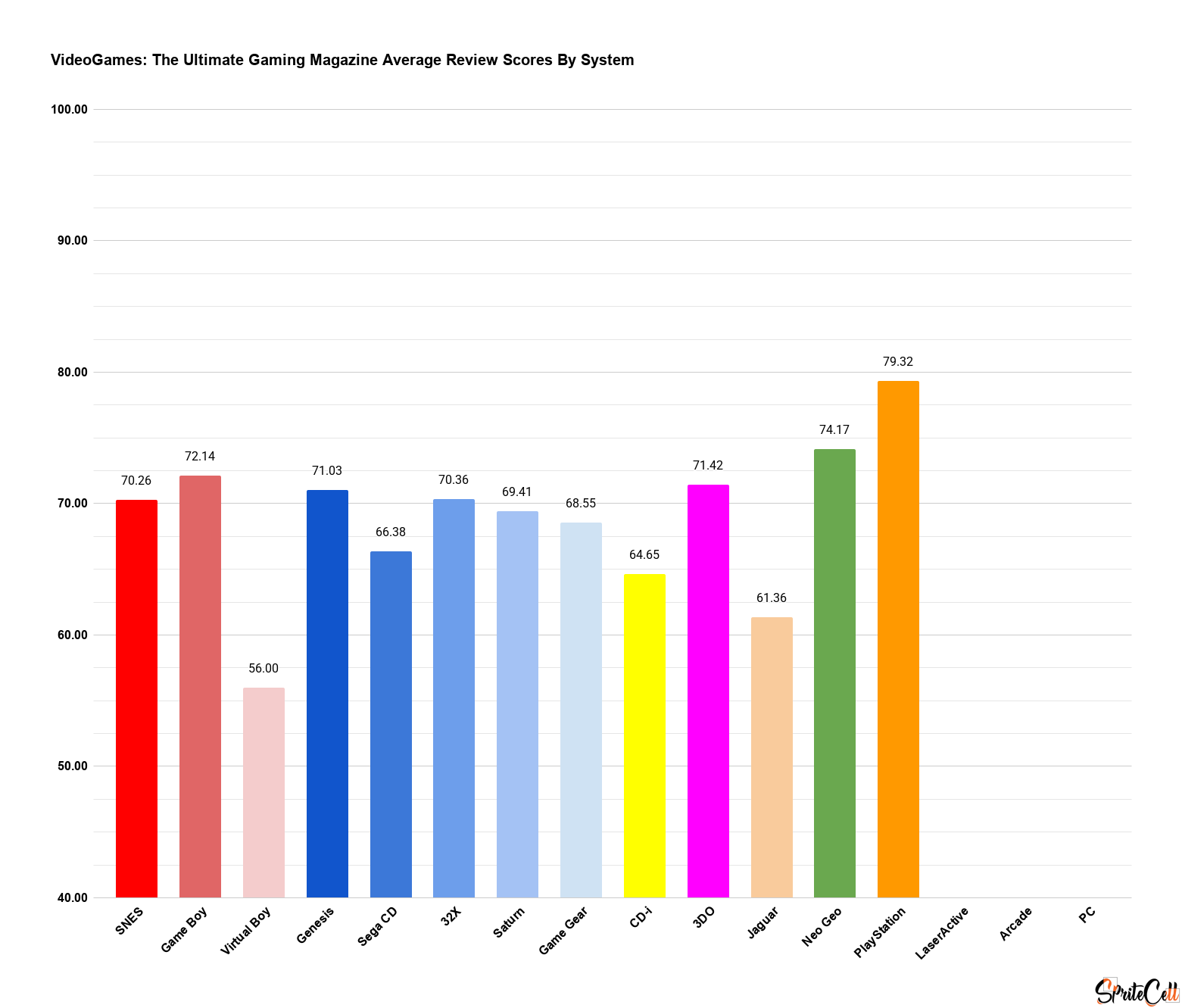
From this datae, among magazines that reviewed both, Genesis comes out on top over SNES 7 to 1, Game Gear triumphs over Game Boy 4 to 2, and PlayStation defeats Saturn 6 to 2. That’s right, Yoshi’s Island, Donkey Kong Country 2, and Chrono Trigger weren’t enough to bring the SNES average up, there were just too many games released for the system this year.
Reviews By Month
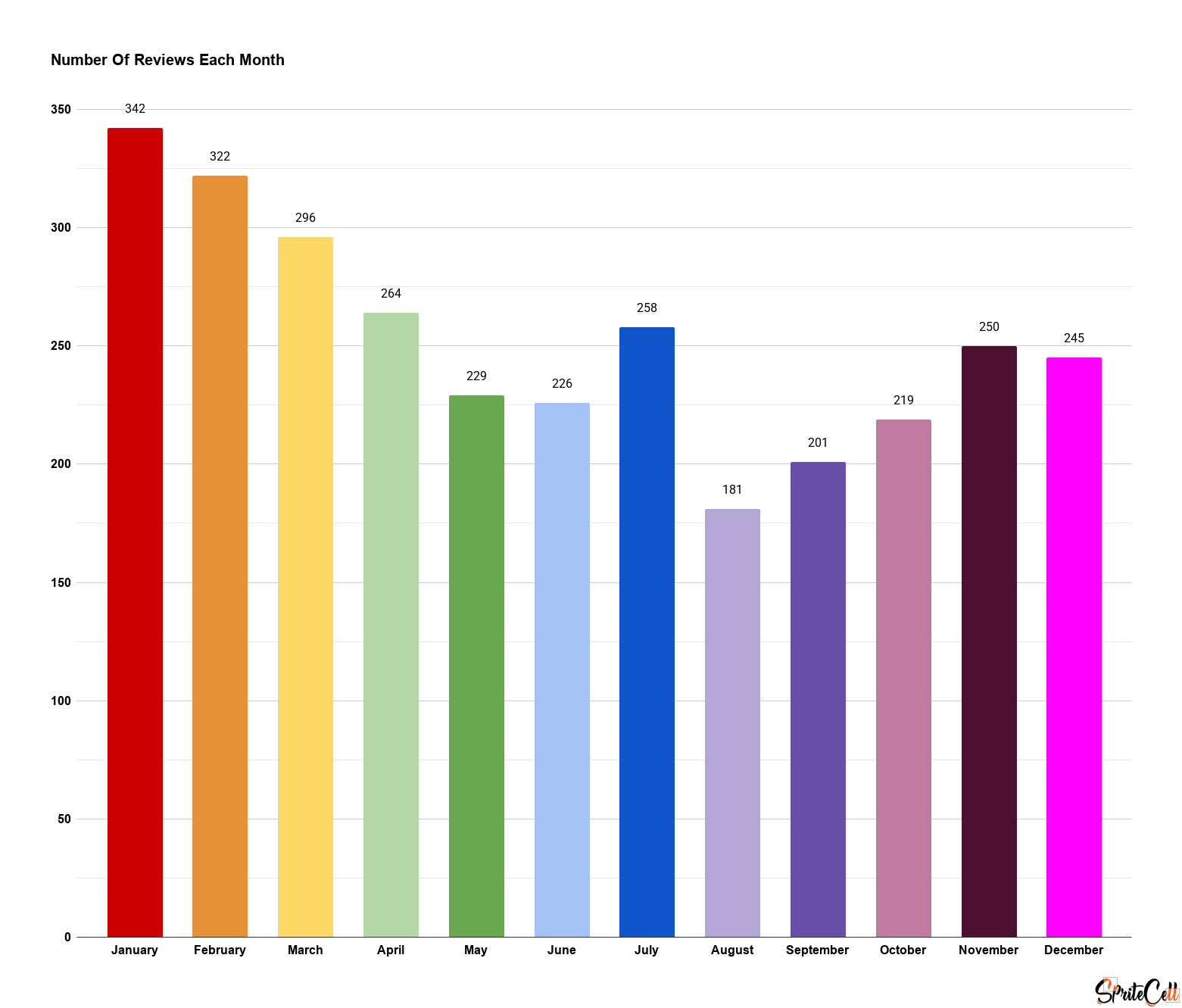
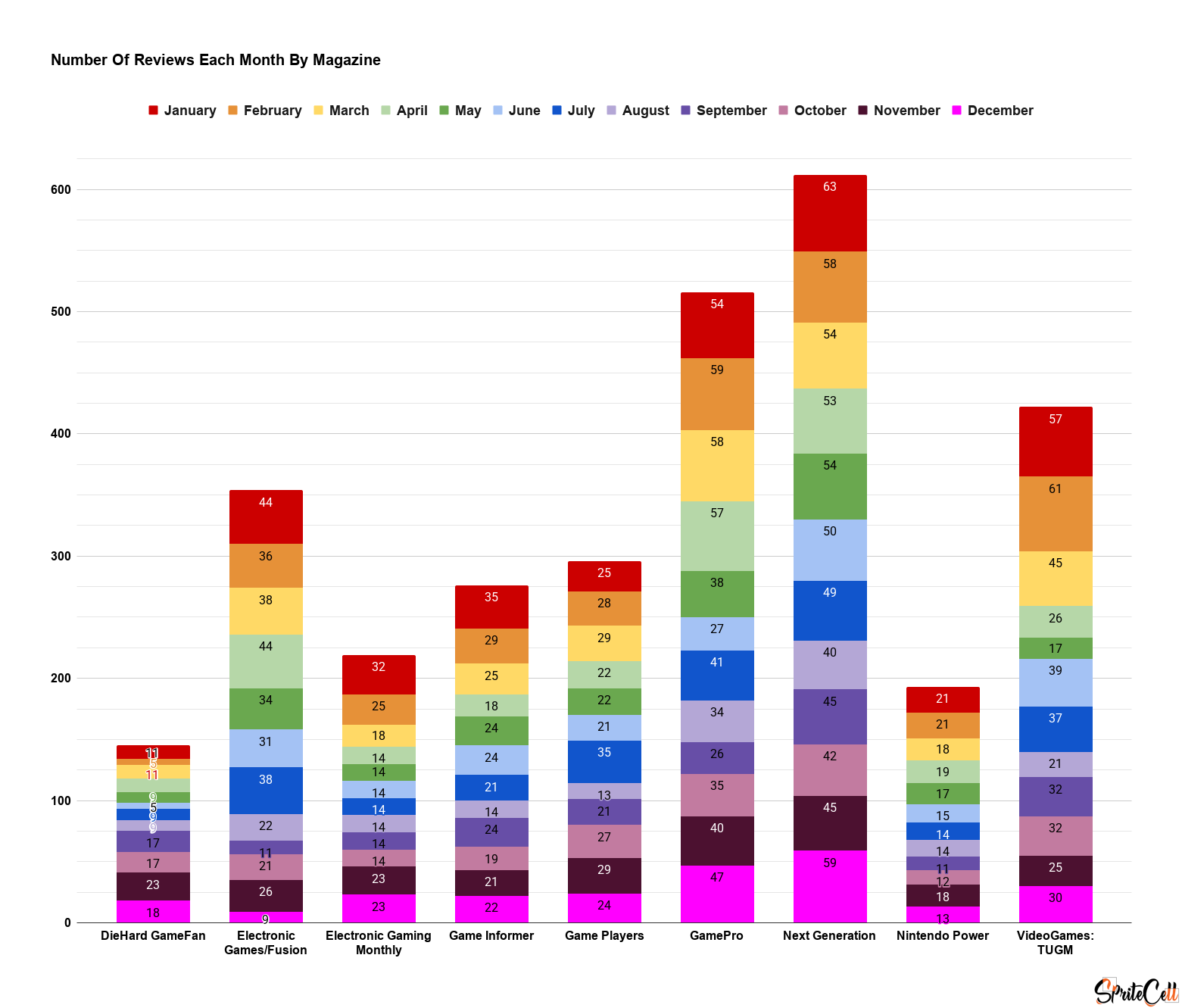
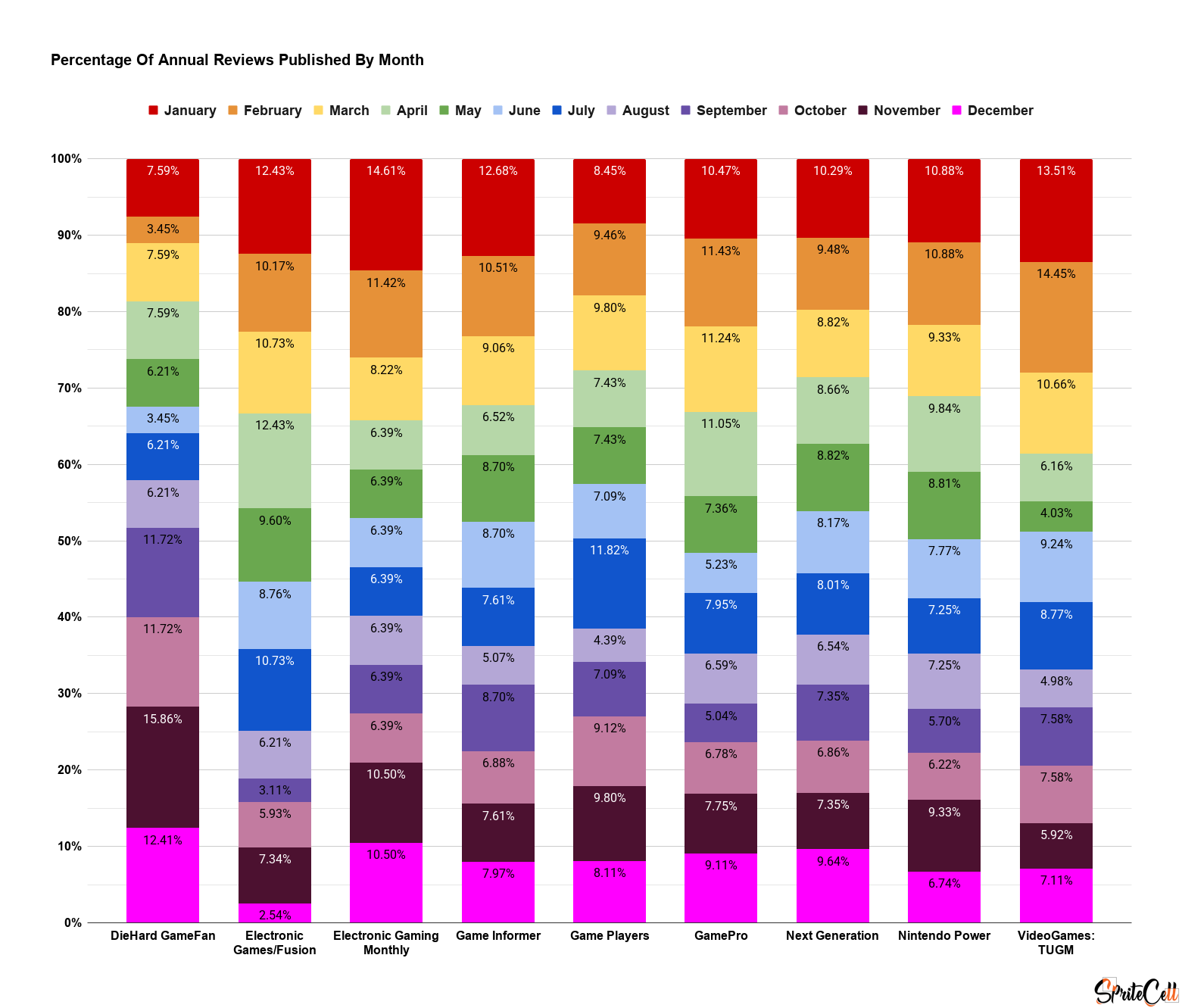
The video game industry had established a pattern of releasing a lot of games near the end of the year to be bought as Christmas gifts, but that only somewhat translates to lots of reviews appearing in those month’s issues. January through April see the most reviews in these magazines overall. I can’t fully explain this, but the practice of postdating magazines a month or so ahead of when they appear on shelves must contribute a bit. These publications also often reviewed games several months after they came out, so they may have been working through the end-of-year backlog for a while at the start of each year.
Some magazines have large variances month to month, while others keep it pretty consistent. We can see how much less space Fusion dedicated to reviewing games than Electronic Games.

A few things make this graph a bit unreliable. Magazines postdate their issues, so you see the February issues when you’re browsing the newsstand in January, maybe even the March issue towards the end. They also probably have a pretty consistent date within the month that they have send their files to the printer, but that date must be different for each magazine. Games also had loose release dates at this time in history. While some have exact and known dates, for many others we just have an idea of the month they started showing up on shelves. I’ve recorded magazine issues as the first day of the month and games with no more precise release dates than a month the same, both have a good amount of possible error. Games for which only a release year is known were not included. I’ve used North American release dates for all games, even the ones that were imported.
Looking at individual games reveals some release dates that are likely wrong on Wikipedia, where I got most of my release date information. Bubsy II was unlikely to have actually released in August 1995, as reviews appeared in January issues, and indeed MobyGames says it released in 1994.
A magazine could potentially review a game before it is officially released by getting a review copy from the publisher (which sometimes had the issue of magazines being given non-final builds of games and different magazines having different policies as to whether that can be reviewed) or by importing a copy, mostly from Japan.
When I made this graph I really didn’t expect any magazine to review games before release on average, but a large percentage of DieHard GameFan’s reviews were of Japanese imports. Electronic Gaming Monthly definitely had a fair number of import reviews as well.
Sega Vision’s inconsistent release schedule was always going to mean they were behind.
Most of VideoGames: TUGM’s E3 coverage was in their August issue, suggesting they may have postdated their magazine more than anyone else. If so, their reviews only appear to be delayed, actual readers at the time would be reading reviews of fairly current games.
Next Generation was just starting as a magazine so we would expect them to play catch up with older games to some degree.
Electronic Games/Fusion seems to not be concerned with reviewing the newest games, or perhaps had trouble getting review copies.
Aircars for Jaguar was an anomaly, reviews appeared in as early as February issues but it was delayed and then cancelled due to poor reception. ICD, the makers of the CatBox peripheral for the Jaguar, would buy the rights and release 200 copies in June of 1997, making reviews over two years ahead of the release. Six of these magazines reviewed it.
The infamously bad Dragon Ball Z: Ultimate Battle 22 was an early PlayStation release in Japan. Next Generation reviewed an imported copy (2/5) and the North American version wouldn’t be released until 2003, over seven years later. If you removed it from Next Generation’s data their average would be -58.70.
Highs, Lows, Differences Of Opinion
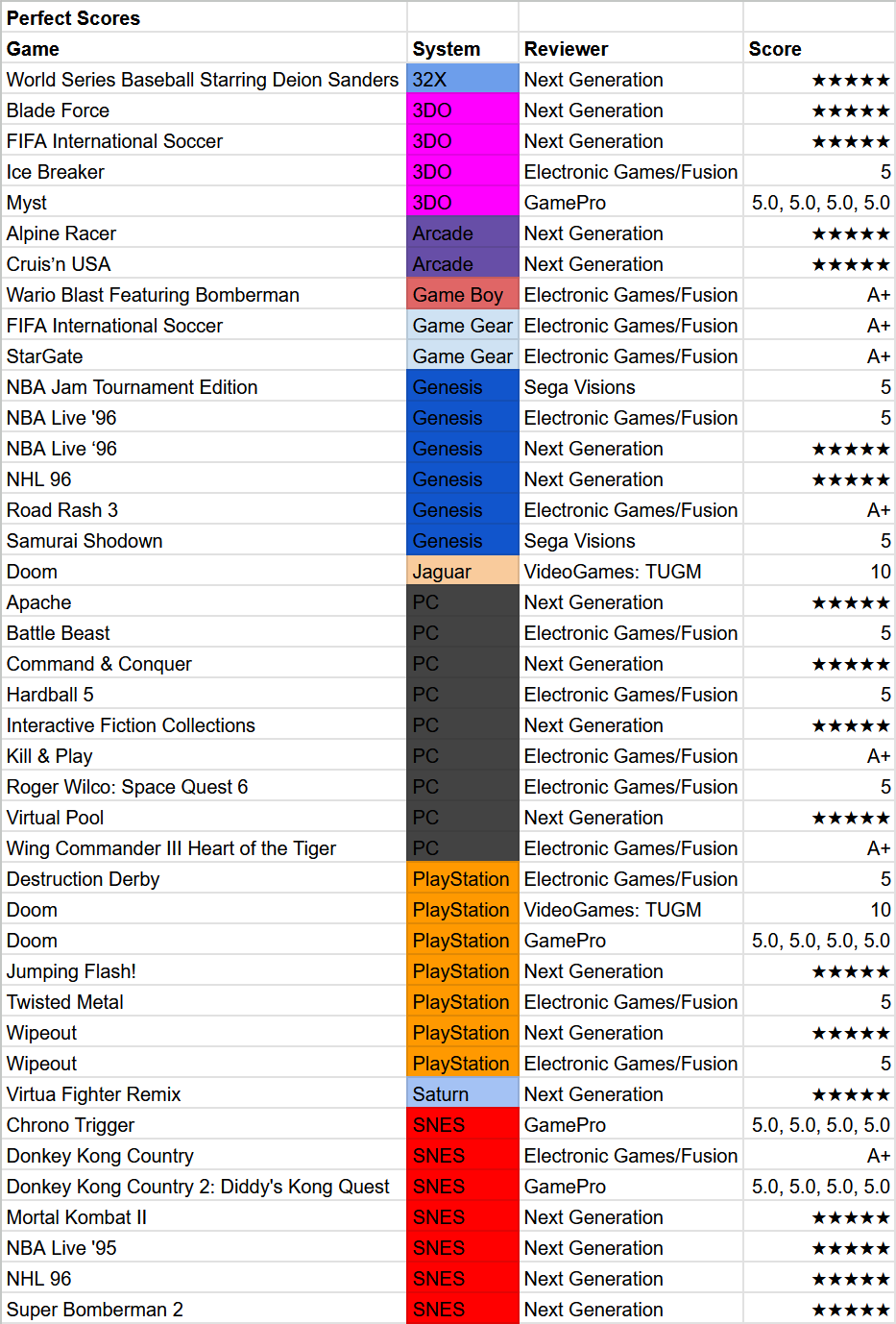
While there were 66 perfect scores according to how I have handled adjust scores, I am not including Electronic Games’ A’s on this list, but I am including their A+’s.
NBA Live ’96 for the Genesis, Doom for PlayStation, and Wipeout for PlayStation were the only games to snag a perfect score from two magazines. There are some differences between NHL 96 on the Genesis and the NHL 96 on the SNES, but you could count them, too. Sports games in general dominate, but there’s also several fighting games, racing games, and quite a bit of vehicular combat.
The only game to get multiple perfect scores from a single magazine was Doom on Jaguar, with two reviewers for VideoGames: TUGM.
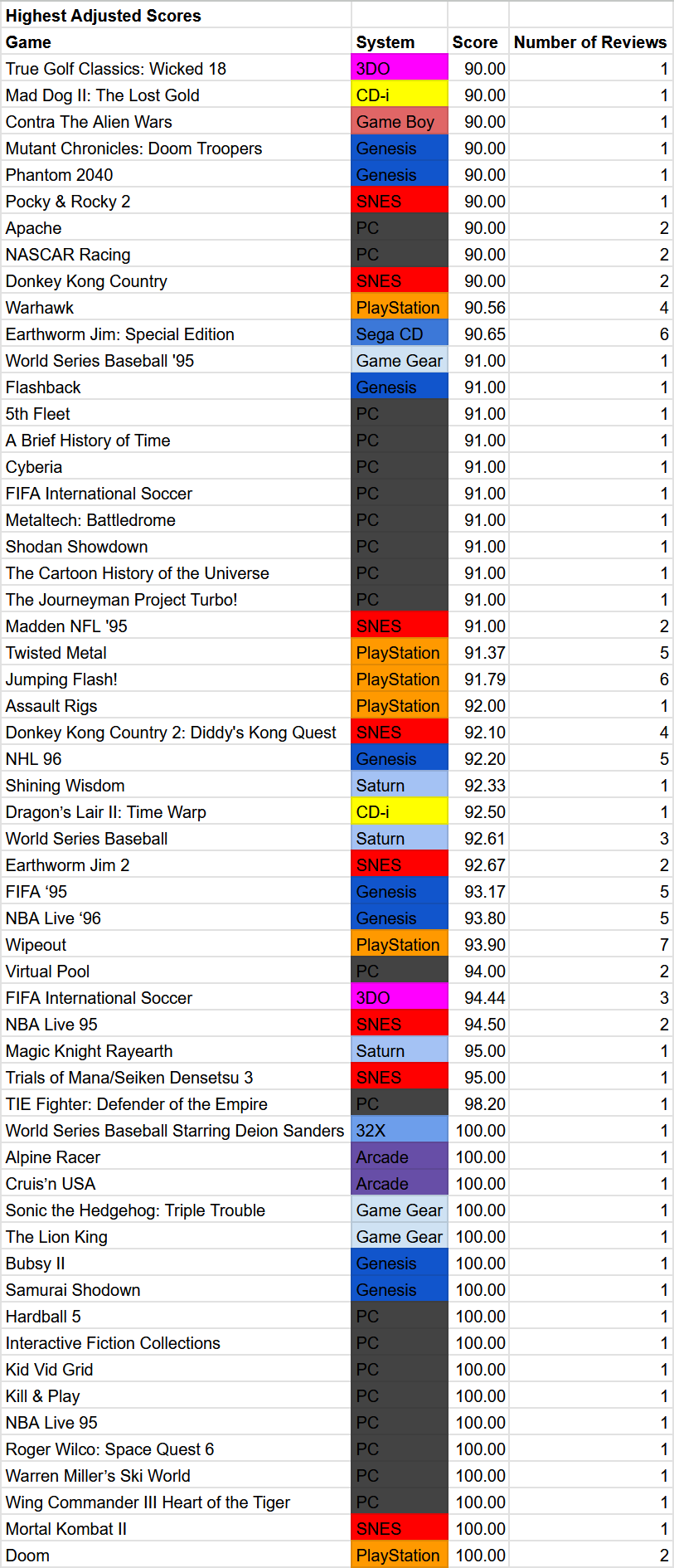
What was the best reviewed game of 1995? You could give it to Doom for PlayStation, but two reviews seems a bit low. FIFA International Soccer ended up with very high average adjusted score and was reviewed thrice. But Wipeout has more reviews than anything else that averaged at least a 90, so I am giving it the crown. It does of course help that it was not reviewed by Nintendo Power or Sega Visions.
This chart does include Electronic Games’ A’s, and they are the sole reviewer for quite a few of these games.
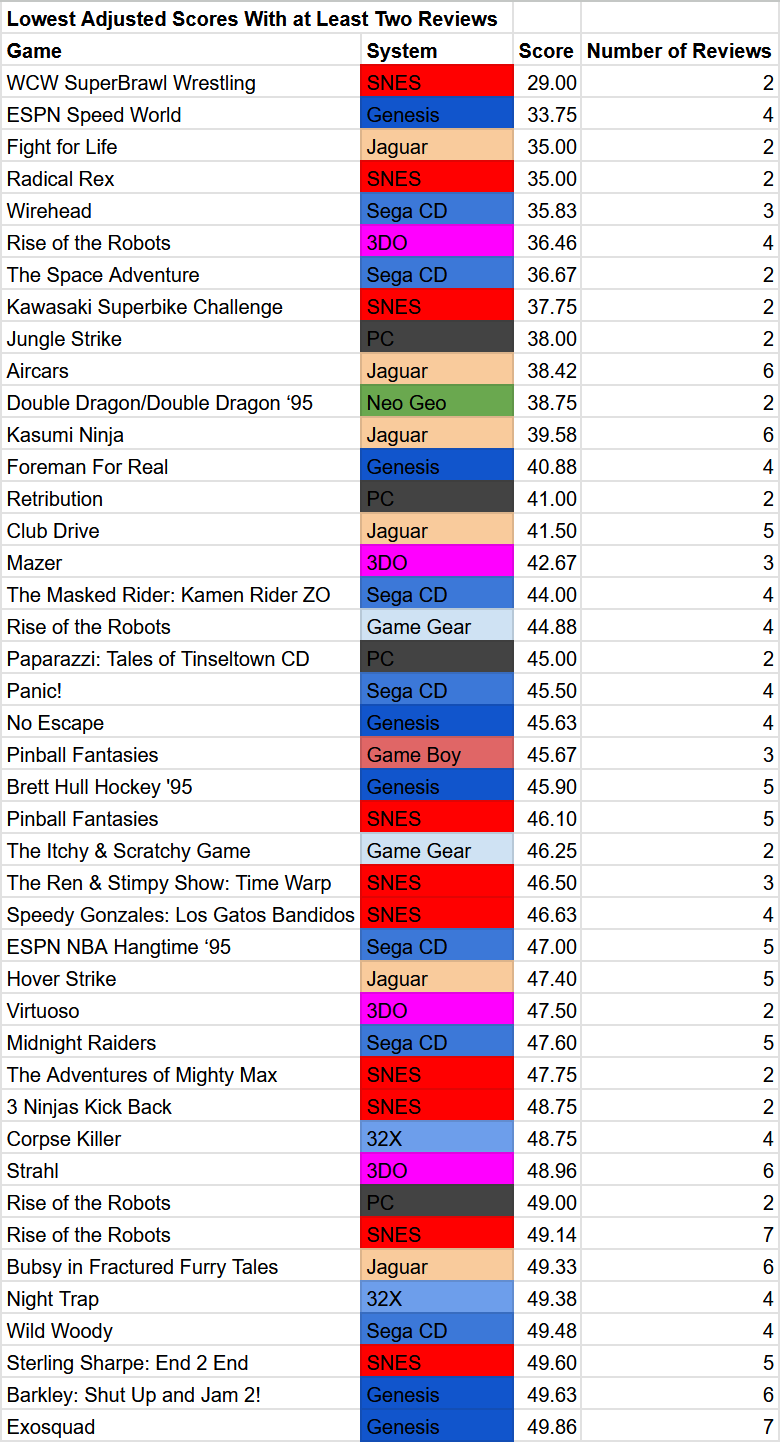
I know I’m making a lot of little rule changes, but Next Generation and Electronic Games/Fusion were the sole reviewers of so many games, so here are the games that got the lowest average adjusted scores and were also reviewed at least twice. A few games not reviewed by either of those two that only got a single review are Plumber’s Don’t Wear Ties (VG:TUGM gave it 1/10), Troy Aikman NFL Football (Sega Visions gave it 1/5), Earth Defense (VG:TUGM gave it 3/10), Uncharted Waters: New Horizons for Genesis (Game Players gave it 35/100).
Quite a few sports games here on the bottom, as well as several games based on TV shows.
Rise of the Robots makes it on this list three times.
These are the poor reviews that caused Aircars to be cancelled.
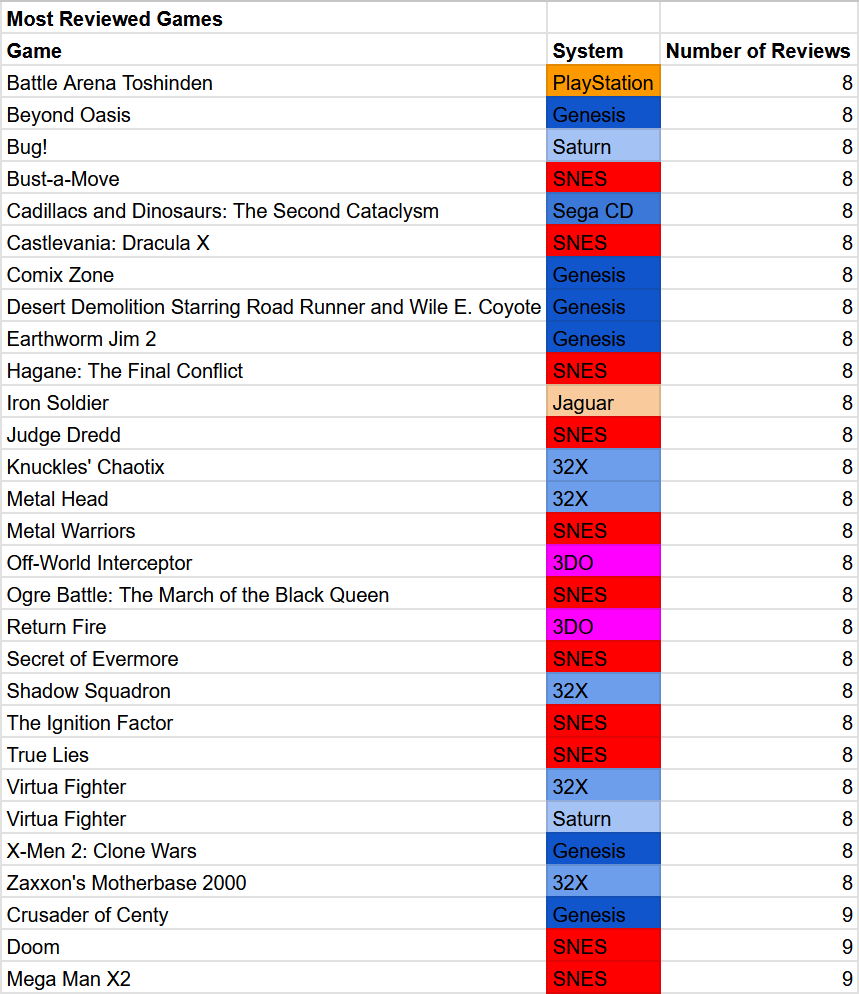
Since Nintendo Power and Sega Visions only cover Nintendo and Sega games respectively, the most magazines a game could be reviewed in was nine, and only three games manage it. Doom was a cultural phenomenon and there was interest in the home ports. Mega Man X2 was a sequel to a popular game and part of a long running series. Crusader of Centy is a bit of surprise, I’m sure there was a demand for Zelda-like games on Sega systems, but it’s not part of a series and it’s remained fairly unknown through the years.
Chrono Trigger misses the list at seven reviews. It was released in August so GameFan and Fusion should have had opportunity to review it, but didn’t. Electronic Games/Fusion weren’t keen on reviewing quite a few big SNES games including Secret of Evermore, Castlevania: Dracula X, and Ogre Battle.
I was quite surprised that only a single PlayStation and two Saturn games made it to eight reviews. Getting an exact list of the launch titles of each is a surprisingly difficult task, so we’ll be a bit loose with the definition. Looking at PlayStation’s launch first it’s surprising that Street Fighter: The Movie for PlayStation got zero reviews. I guess these magazine didn’t feel like they needed to after covering the Saturn version earlier. NBA Jam Tournament Edition had two reviews, though it had already appeared on a few other systems and was just a slightly different version of NBA Jam. Zero Divide had two reviews in this time period but the majority of the reviews it received seemed to come in 1996 for some reason. Power Serve 3D Tennis and ESPN Extreme Games may have been seen as fringe sports games with four reviews each. The Saturn launch titles all had at least five reviews. Those Saturn launch titles with five reviews were Pebble Beach Golf Links and Worldwide Soccer: Sega International Victory Goal Edition.
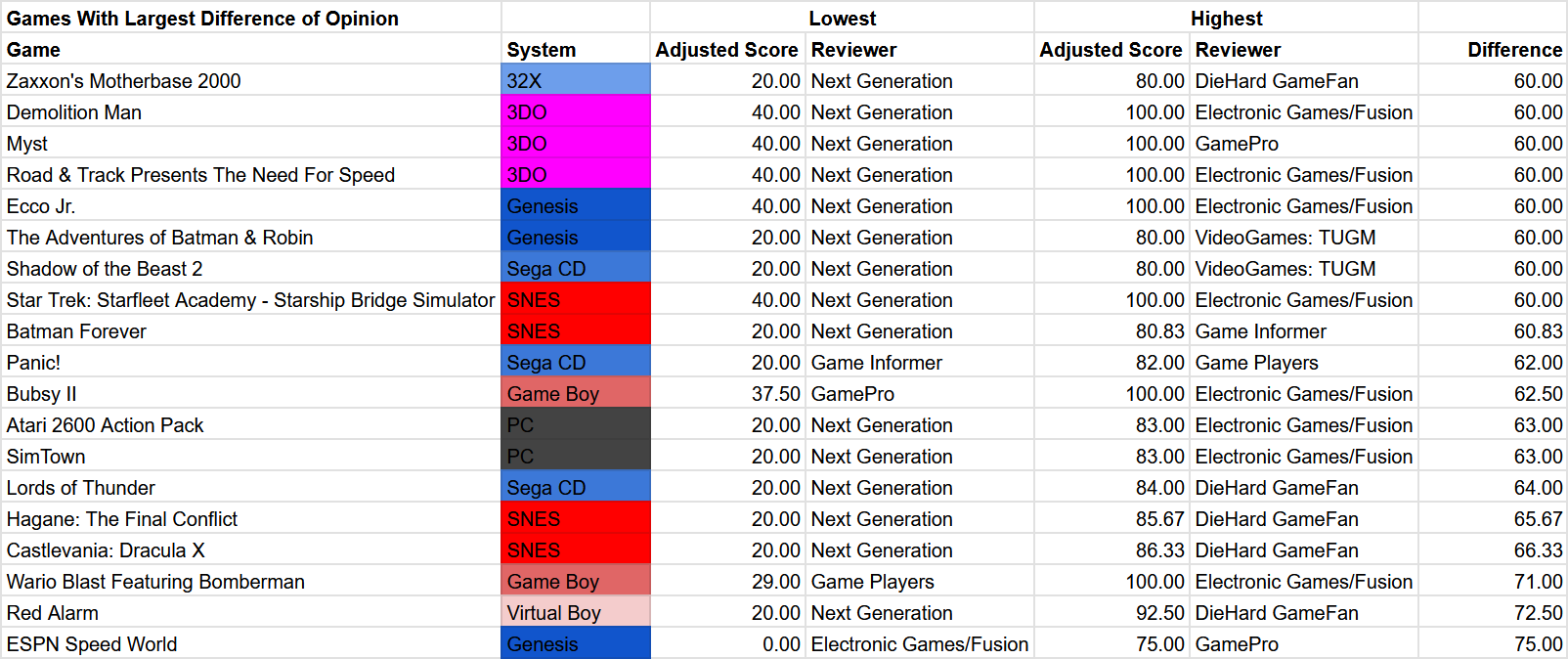
Since we’re again comparing different review systems this is just for fun, but it does highlight just how much variance there was with scores back then. Nowadays a difference of 50 would be remarkable.
Most of the low scores of course come from Next Generation, while the highs are mostly Electronic Games/Fusion or GameFan.
Reviewed But Unreleased
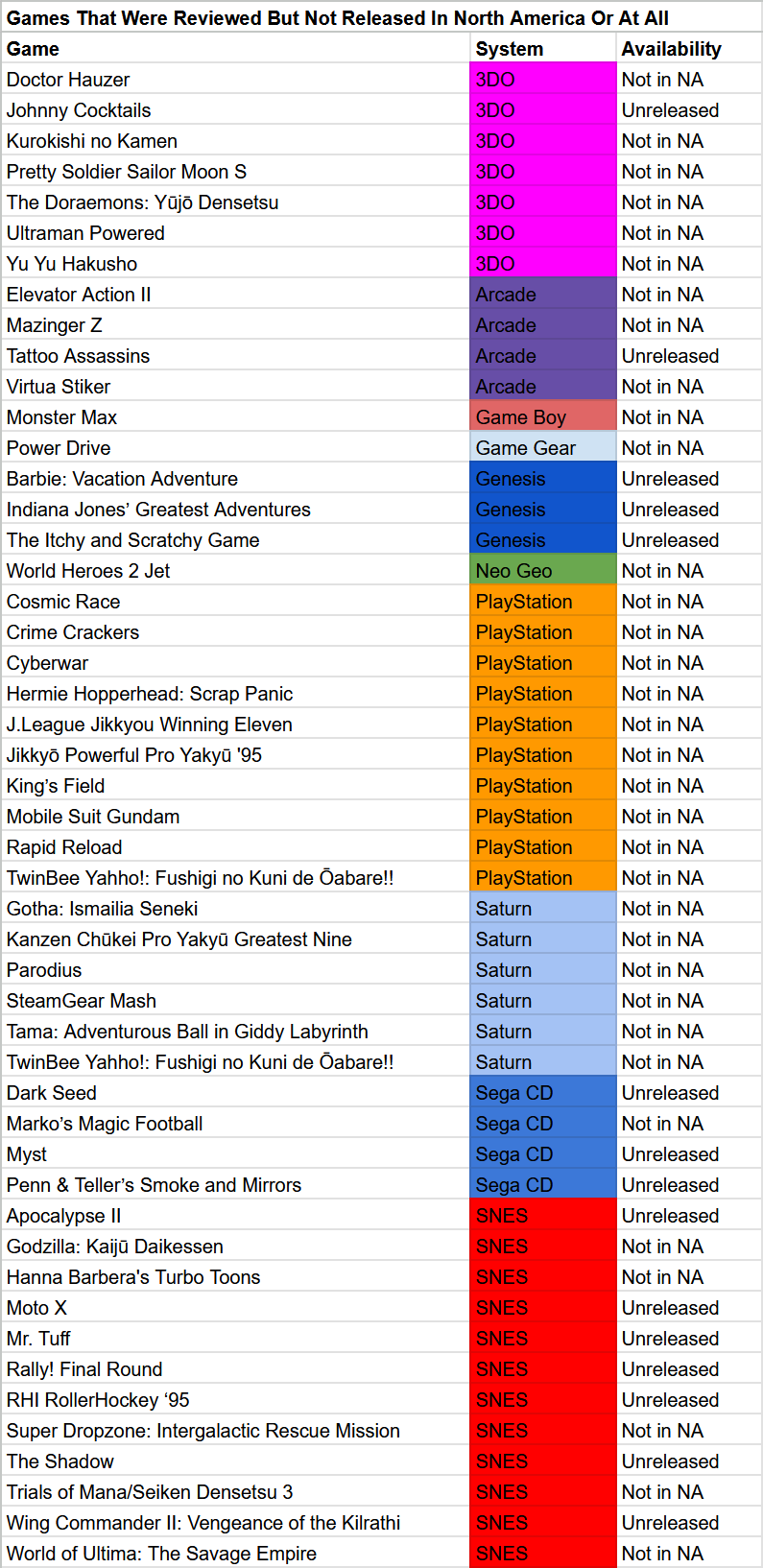
Many magazines reviewed imported games to give an early look to readers at what was coming in the future, but quite often those games were never released. The non-Japanese games are mostly from Electronic Games/Fusion, while Next Generation and GameFan imported a lot of Japanese games.
Trials of Mana was eventually released in North America, and Barbie: Vacation Adventure has recently been released as part of Barbie Rewind.
Gaming Magazine Advertisements
Magazines depended on ads to make money and keep subscription prices low. These ads all wanted to be memorable and eye-catching to entice readers to buy things, and some of them have lived on lived in infamy long past the end of their campaigns.
To record this advertisement information I looked at every page of every issue of our 10 magazines twice.
First, I looked for every ad that included a game and counted that game as having been advertised in that magazine that month. A game could not be counted twice if it appeared in two separate ads in a single issue. This only includes ads that were put there by the publisher or hardware manufacturer, not ads for stores like KMart that have games featured in them. Some ads are for one game and can take up multiple pages. Some ads are for over a dozen games. A game had to be named for it to count, even if it is only named in later issues (you’ll know what I mean by this later). This is really only relevant to a Game Boy Color ad that featured several screenshots of unidentified games.
Second, I looked through every page of an issue again and counted how many total pages were ads. These ads can be for games, gaming hardware, or anything else, including things like trading cards, Blockbuster, or Clearasil. This can include a sweepstakes or contest with games or game systems as the prize, held by an entity other than the magazine it appears in. There were many game sweepstakes held by the magazine in cooperation with a publisher that I did not count as an ad. I also did not count magazines directly selling games or game-related merchandise as an ad. Ads for the magazine the ad appeared in do not count as ads, but ads for other magazines do. I eyeballed how much of a page an ad took up to the nearest quarter or third rather than measure them.
Something I hadn’t really considered before I did this was just how many ads seem to be placed by hardware makers to show off what games are available on their systems. Did publishers have to pay anything to be included in these? It may have changed some publisher’s plans when they found out they were going to be included in one of these.
Advertising By Magazine
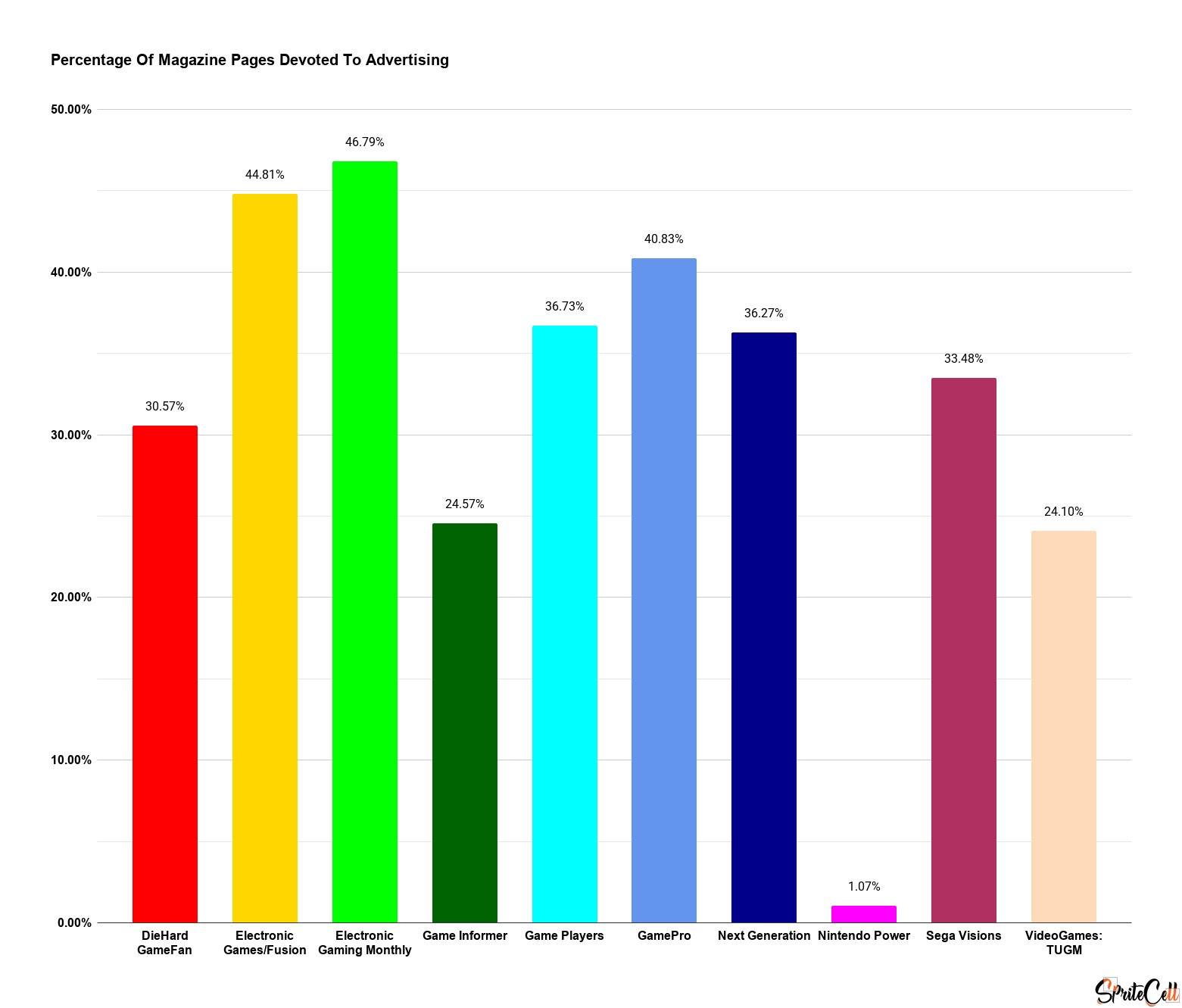
There is likely a correlation between how well a magazine is selling and how much of it is dedicated to advertisements, but there are also a number of other factors at play.
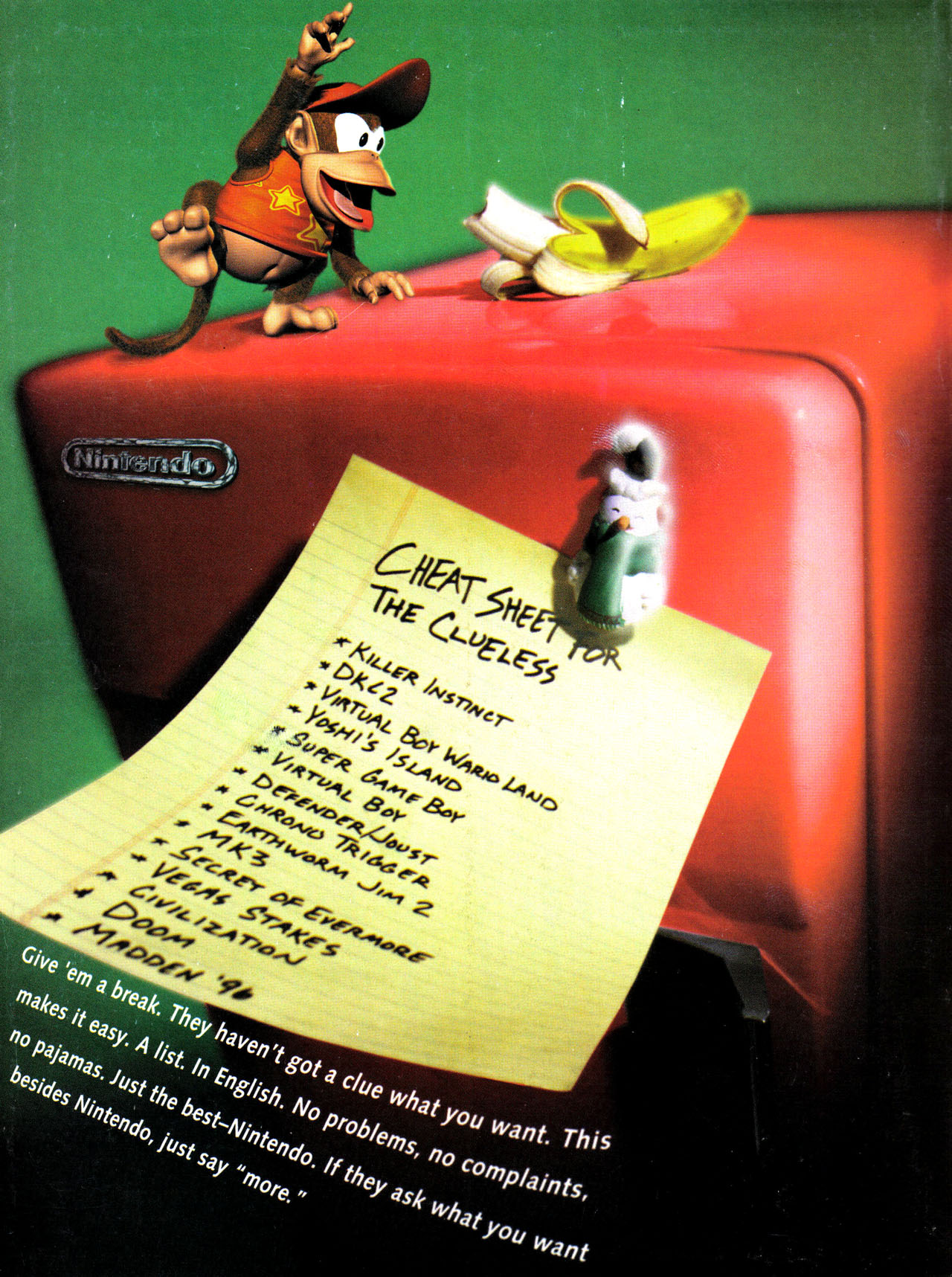
The FuncoLand Fun Club must have been subsidizing Game Informer, as well as driving people into the store to buy games they see featured, which allowed them to keep the number of ads low.
GamePro was perhaps #1 video game magazine in the U.S. at the time, and it had one of the highest percentages of ads. I didn’t keep count of this specifically but it likely had the most non-game ads, especially for trading cards
I have to say I’m surprised Electronic Games/Fusion managed to pack in so many. It was the only magazine to feature ads for adult PC software. Electronic Games/Fusion and Next Generation attracted a lot more PC-only game ads since they reviewed them.
In one of their editorials DieHard GameFan said that they had to raise prices to stay below 40% ads, which they definitely did manage, being one of least ad-filled magazines.
VideoGames: TUGM always seemed a bit dysfunctional and their small amount of advertisers may indicate they were struggling to sell copies. They had a unique system to get readers to engage with ads, which is described in the Miscellaneous Information section.
Next Generation didn’t seem to have any problems finding advertisers for their new magazine. I imagine it would be hard to convince publishers to pay for ads in a new magazine that might prove to be unpopular. I didn’t make graphs breaking down the ad percentage of each magazine each month, but Next Generation’s first issue was 33.6% ads, slightly above its overall average.
I have fond memories of being a Nintendo Power subscriber during this time but somehow it has escaped me that they essentially didn’t have ads until 1998. There is a page and a half at the end of each issue that resembles an ad but was clearly made in-house. These don’t solely advertise first party games though, and I decided to include them.
Advertising By Month
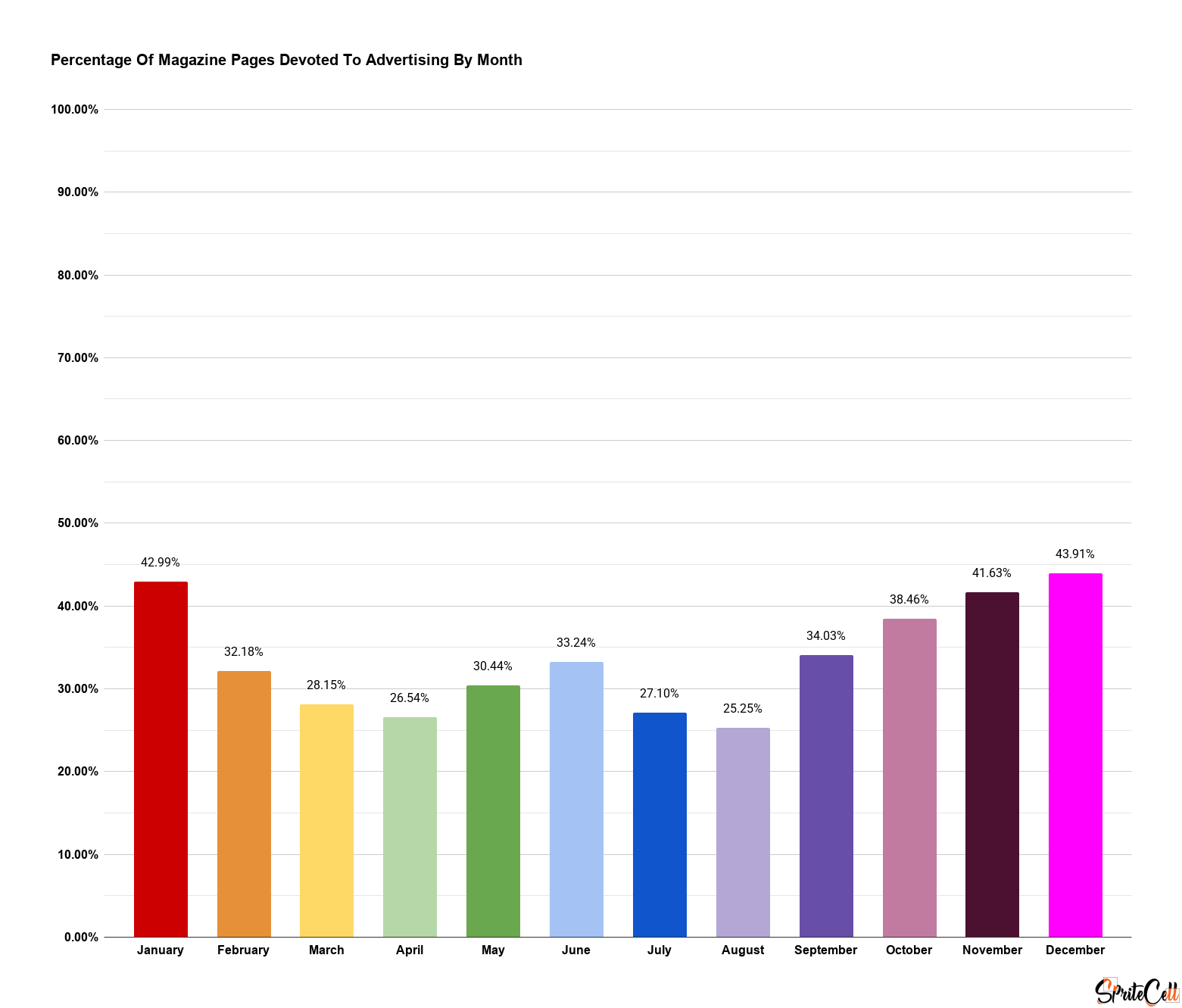
There’s a clear increase in the number of advertisements run in each magazine as the holiday shopping season approaches, and a relative drought in the summer months. July and August not only have the fewest pages but also the smallest share of advertising.
Advertising By System
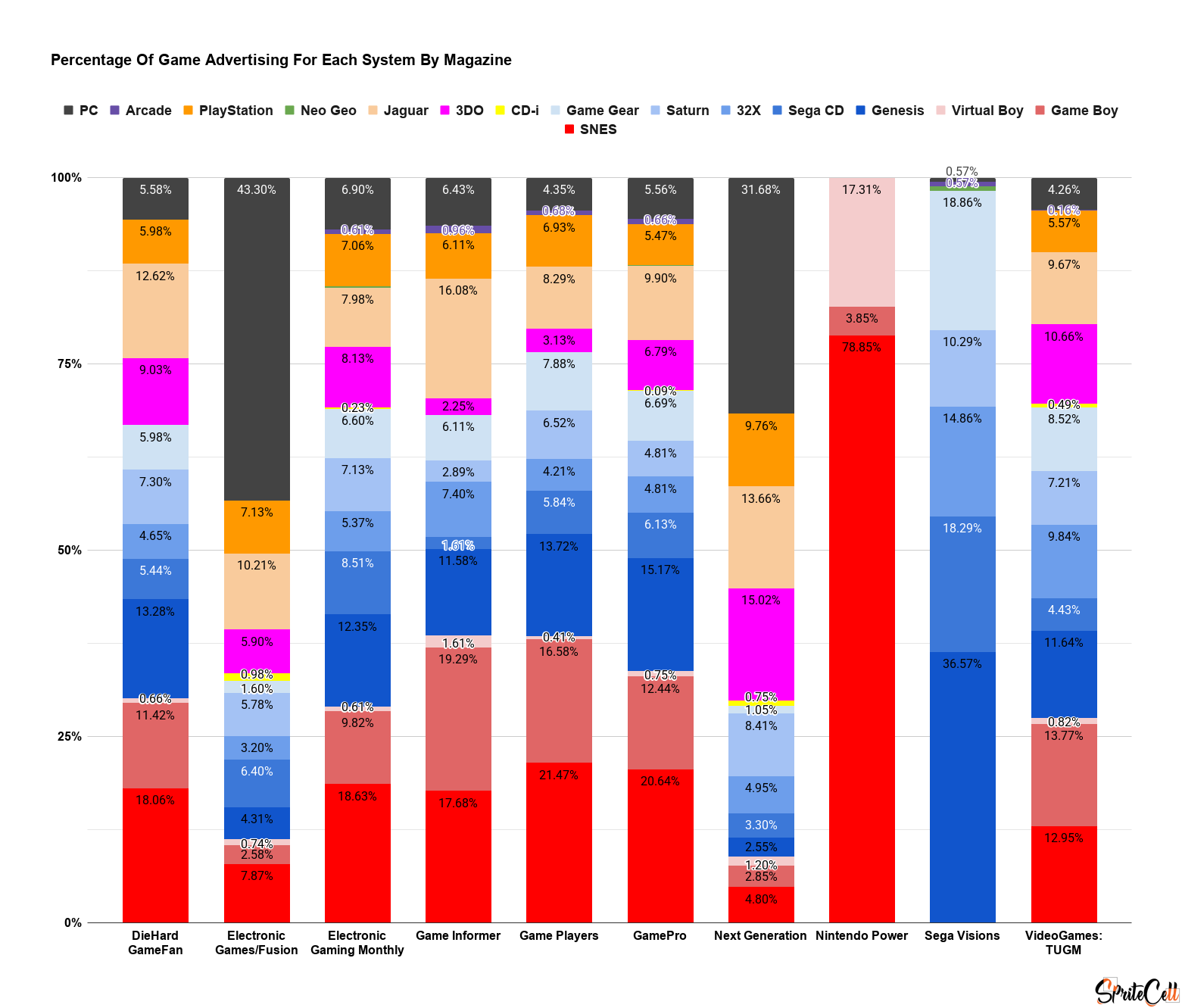
Many of the ads for multiplatform games in Sega Visions also appeared in other magazines, but the non-Sega platforms are not listed in their version. Although Sega had a strong arcade presence they didn’t use their magazine to advertise their arcade games. Lethal Enforcers II was the only arcade game to be advertised in Sega Visions, a game by Konami. Viewpoint for Neo Geo was also allowed.
Very few of the PC game ads outside of Electronic Games/Fusion and Next Generation are exclusive to PC.
Next Generation wrote a lot about the 3DO and ran more ads for 3DO games than any of the other magazines here. 3DO’s CEO Trip Hawkins was at least mentioned in every issue other than October this year. The November issue had a feature on the 75 most important people in the gaming industry, and Trip Hawkins was included.
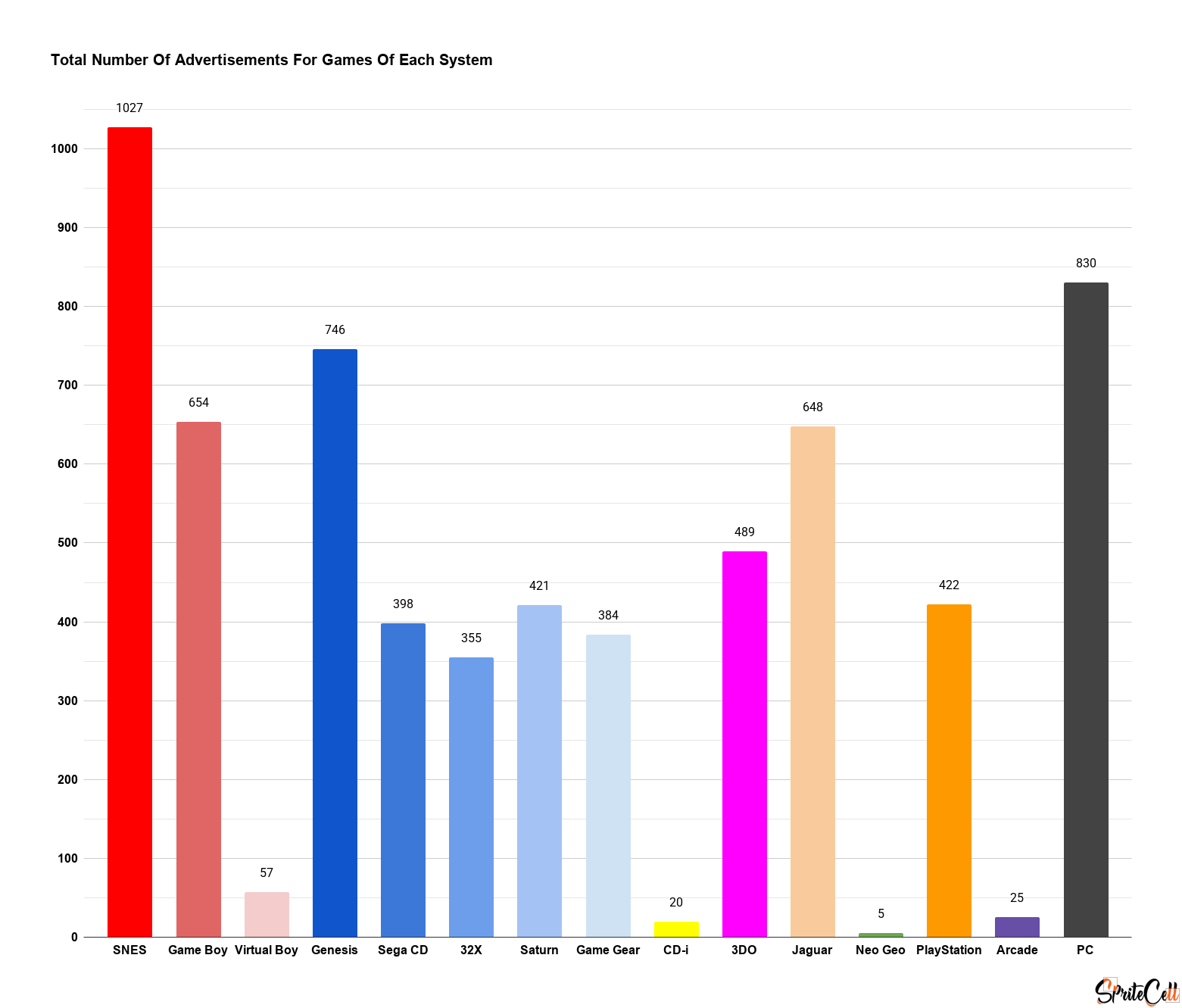
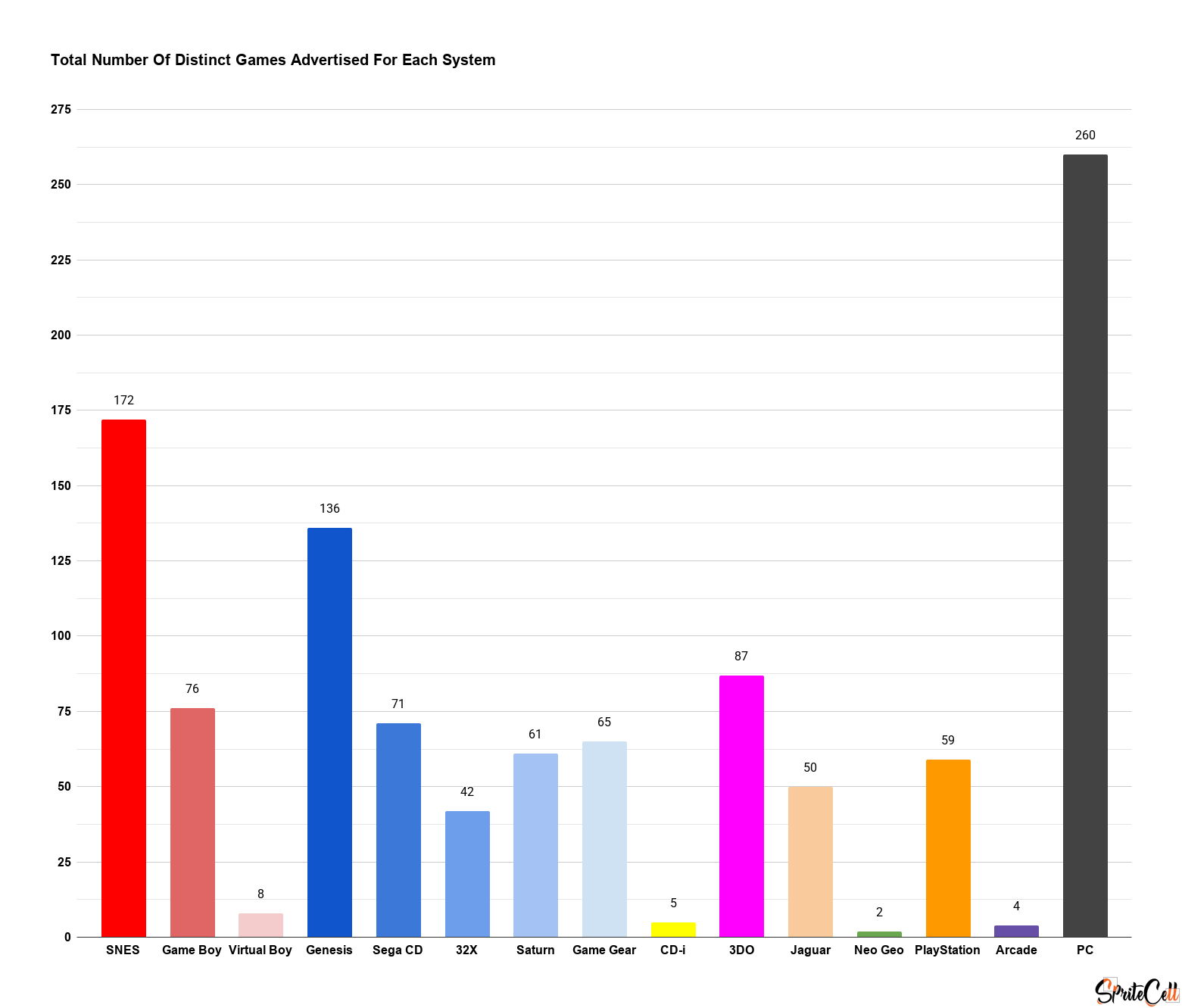
Although there were more ads for SNES games than Genesis and more ads for Game Boy games than Game Gear, there are still more ads for Sega overall than Nintendo.
Atari ran the same handful of ads that featured a dozen or so Jaguar games in many issues, making their total ads relatively high compared to the total number of games featured. There were many 3DO ads like this, too. It’s surprising that Atari managed to buy so many ads for Jaguar games, more than the PlayStation or Saturn.
PlayStation and Saturn were neck and neck in terms of the amount of advertising they were putting out
There was very little advertising heralding the launch of the Virtual Boy. Mario Clash was oddly absent from Virtual Boy ads, only appearing once.
The arcade games advertised anywhere this year were the aforementioned Lethal Enforcers II as well as Mortal Kombat 3, NHL Open Ice Hockey, and Samurai Shodown II. The two Neo Geo games were The King of Fighters ‘95 and Viewpoint.
Most Advertised Games
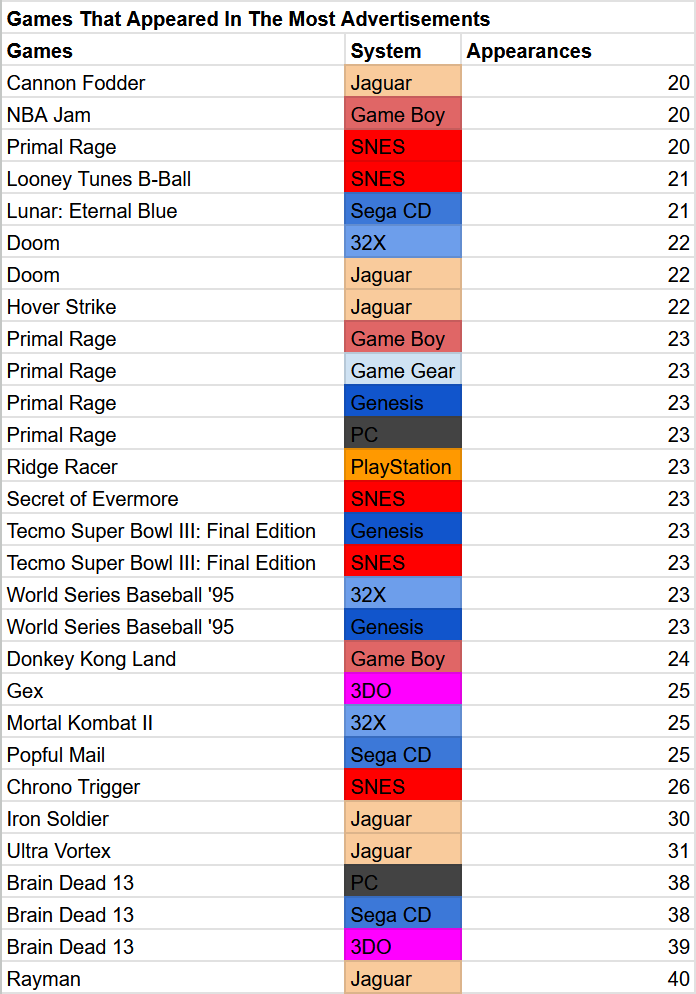
The maximum here would be 112, as that is how many issues there were total.
I was surprised sometimes how an ad would only be for one specific platform when the game was available on several. If you’re making an advertisement for Mortal Kombat II on the 32X, why not throw in a “also available on”, even if those other versions were a bit older? There were ads for MKII on seven systems this year, and it was also competing with ads for Mortal Kombat 3 on eight different systems. Zoop wasn’t afraid to list eight systems in one ad.
Popful Mail is somewhat infamous for being expensive in the second hand market. There likely weren’t many copies made, yet they advertised it a whole lot.
Bug! just missed this list at 19, the most of any Saturn game. Despite being on the market for only a portion of the year the PlayStation’s Ridge Racer was one of the most advertised games this year.
Being featured prominently in Atari’s Jaguar ads as well as having its own separate advertising campaign is enough to put Rayman on top.
And then there’s Brain Dead 13.
Starring Fritz
One of the first things I did for this project was to record what games were advertised in the January 1995 issue of GamePro.
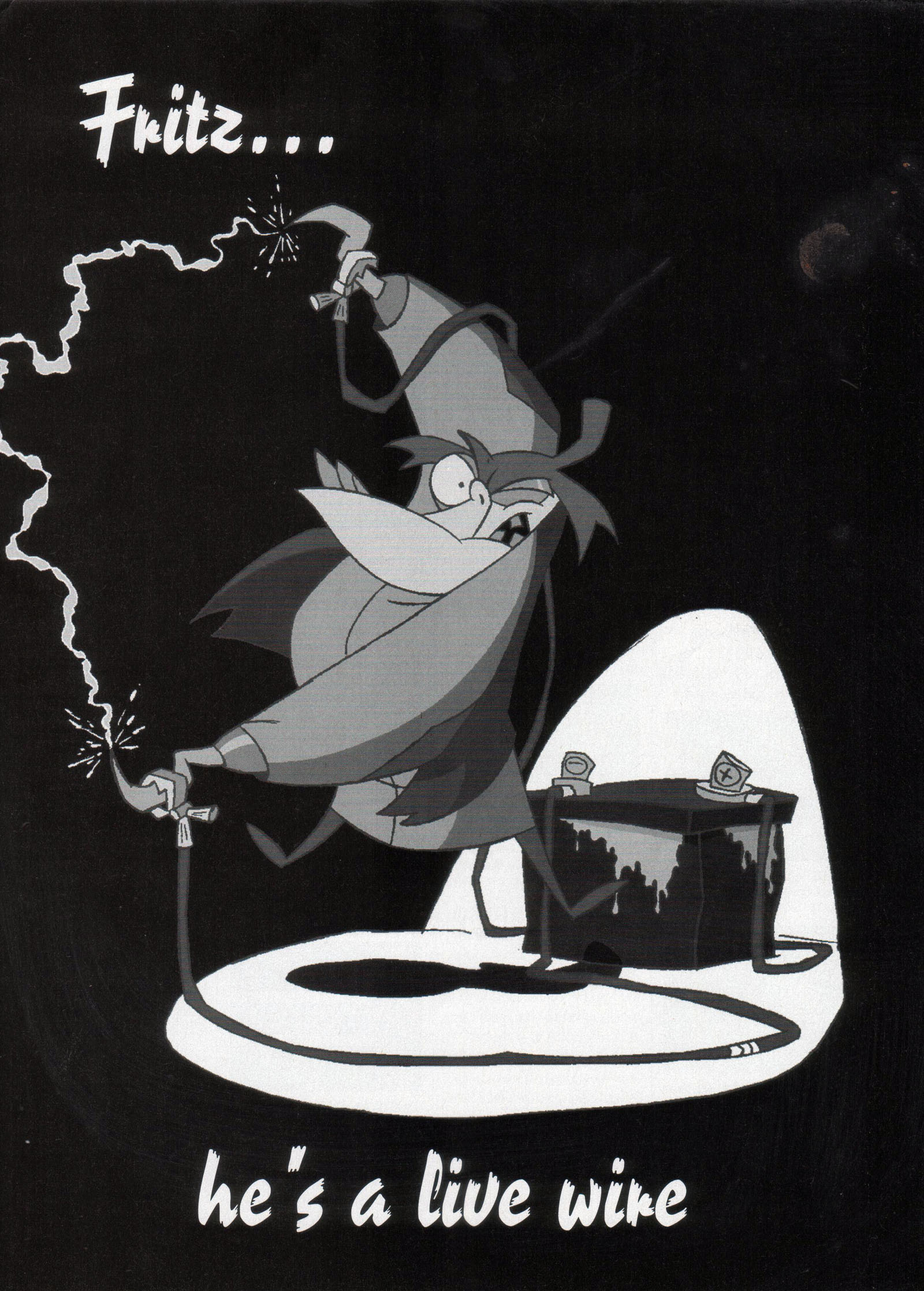
On page 113 was some cartoon character named Fritz. I had no idea what this was. Was this an ad for a game? Some kind of GamePro joke that I never heard of? I didn’t know how to record it and I started to question if this was worth doing if I was going to keep running across inexplicable pages like this.
There was a second Fritz page later on, a totally different illustration. He was stealing ice cream from a baby. I thought this surely can’t be an ad for a game, surely someone would include the name of the game they want to advertise.
The February issue had two more unique illustrations, still in black and white. Standing on a hook hand, foaming at the mouth. Posing with screw hands. Two months in a row. Why was someone paying to show off this character?
The March issue finally answered my questions. A bright yellow ad that proclaims Fritz is armed and dangerous, and he appears in a game called Brain Dead 13, by ReadySoft. I looked up some gameplay and turns out it’s an FMV game with some nice animation. You occasionally make choices about where to go or what to do with a button press, and if you choose incorrectly you’re shown one of many elaborately animated death sequences. Some of the people who made Dragon’s Lair, Space Ace, and their sequels and ports also worked on Brain Dead 13. Fritz isn’t the only antagonist, but you’d hardly know that looking at these ads.
As I continued looking at more magazines I kept seeing Fritz. This was a huge campaign, definitely the largest of 1995 in terms of unique content made for it. I wanted to make a chart showing every ad for Brain Dead 13 in any magazine during 1995. After I added Computer Game Review and CD-ROM Entertainment, I realized there were several more magazines that didn’t have complete scans available, so I came to my senses and decided that was enough.
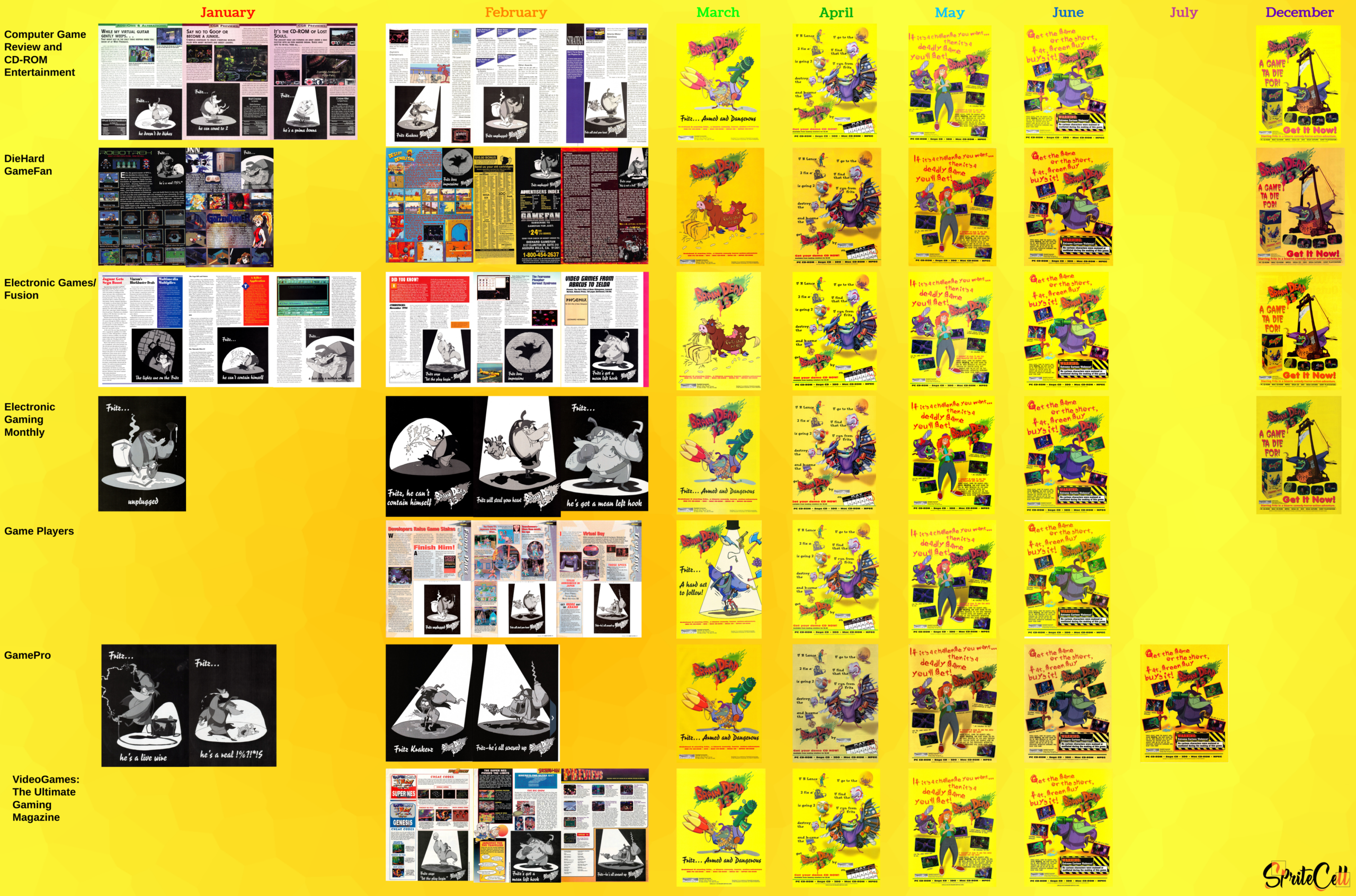
A cursory search didn’t reveal any of these ads in 1994 or 1996 issues, so this seems to be solely a 1995 ad campaign.
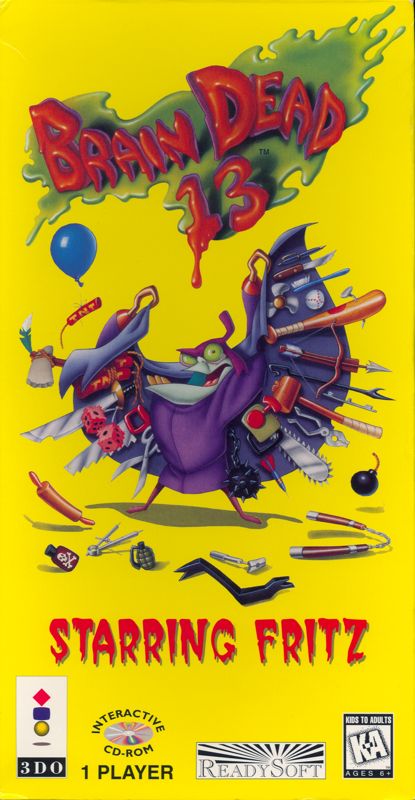
January and February started with black and white images of Fritz doing something and a caption. There was a focus on Fritz being gross and weird. These were either a full page or about a quarter of it. No magazine ran any of these twice and I saw 16 unique variations. There are least two more that appeared in other magazines (Crooners and Heavy Thinker), as seen on the MobyGames Brain Dead 13 Promos page.
March and further ads changed to a yellow background and actually tell the reader what these ads they’ve been seeing for two months are for. The three March ads show that Fritz has a large arsenal of weapons and likes to bite cows. I’m sure these yellow pages were all supposed to be the same shade, but fading ink and inconsistent scanning procedures has left us with quite a variety of yellow.
April and subsequent months changed to using the same ad in each magazine. April told a bit more about the story. A calendar with the day May 6 is circled, which does seem to be the original release date. This was pushed back to December and January. Most of the ads I saw in magazines didn’t include a specific release date at all. I’m sure the deals for these ads were made well in advance, so it must have been painful knowing that an incorrect release date was going to be appearing all over magazines and not being able to do anything about it.

May had the only ad to prominently feature Lance, the protagonist. He’s being chased by Fritz and this time there’s screenshots of the game.
June and July again featured Fritz and several screenshots. Fritz was apparently going to shoot himself in the head with a water pistol if you didn’t buy the game.
December had Fritz gleefully being decapitated along with a picture of the box, which of course said “Starring Fritz”. The PlayStation and Saturn versions were added to the list of platforms. A generic game box was included, meant to give you an idea of what it would look like on shelves. Several ads used something like this rather than showing the reader the box art of each version. This December ad included text that read “Get It Now!”, which was only true for a few of the listed platforms.
Despite the delay Brain Dead 13 had crashing issues on a few platforms. The original printing of the PlayStation version didn’t work at all. The video quality was heavily compressed for the versions that came on one disc. The Sega CD version would have been one of the last games for the system but it was never released despite being prominently featured in these ads. Reviews were mostly negative.
The campaign deserves credit for being eye catching and trusting people to be curious about a mysterious character who keeps showing up in ads. ReadySoft was so proud of Fritz. They really pushed him hard, but Dragon’s Lair type games had fallen out of favor.
Looking At Some Ads
I’d like to take a look at some notable ads in this section. You can feel the 90s edge in some of these and a lot of them focused on convincing players that their game was very difficult. Something to watch for is how often these ads suggest the game will cause you physical harm.
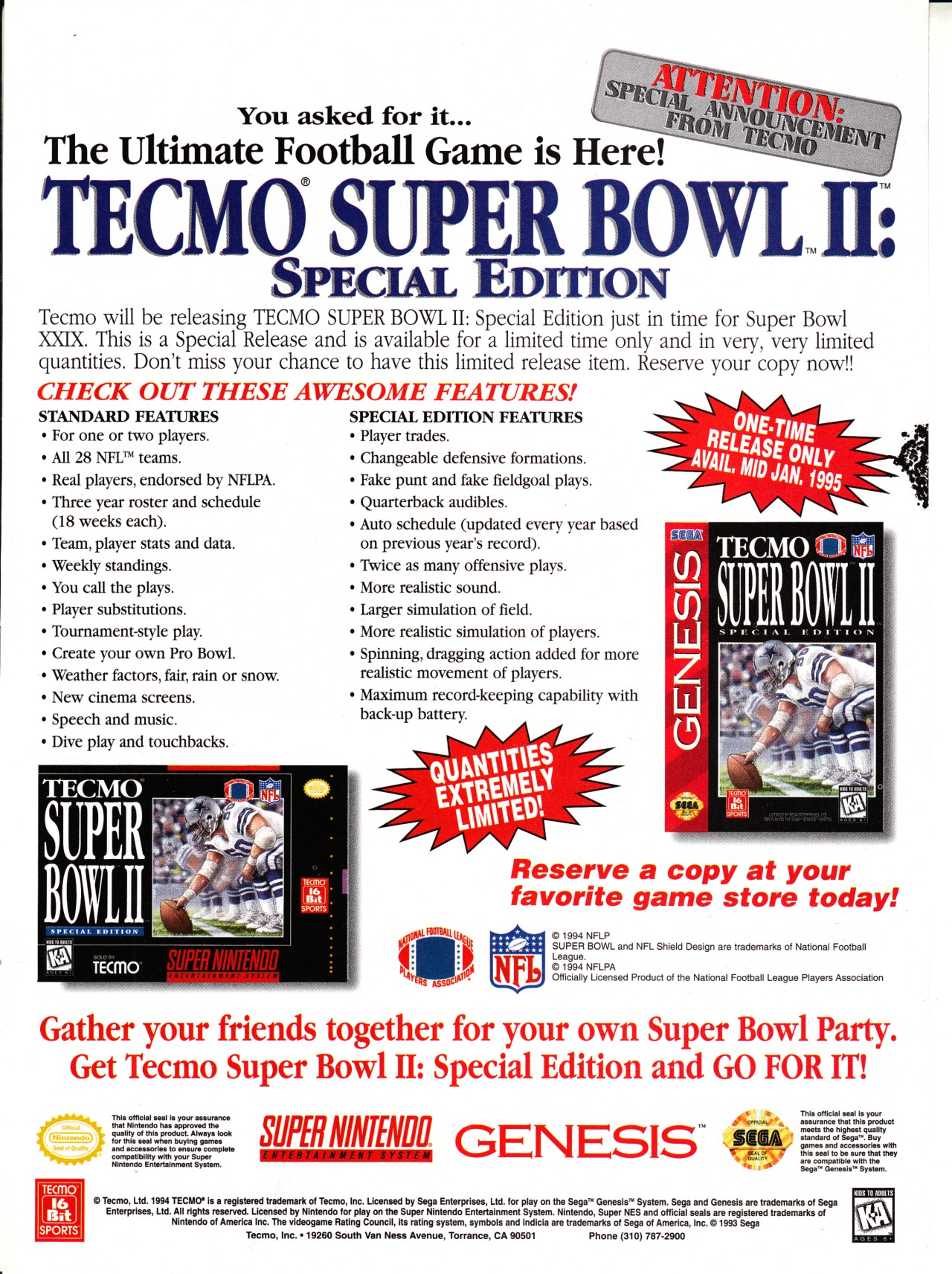

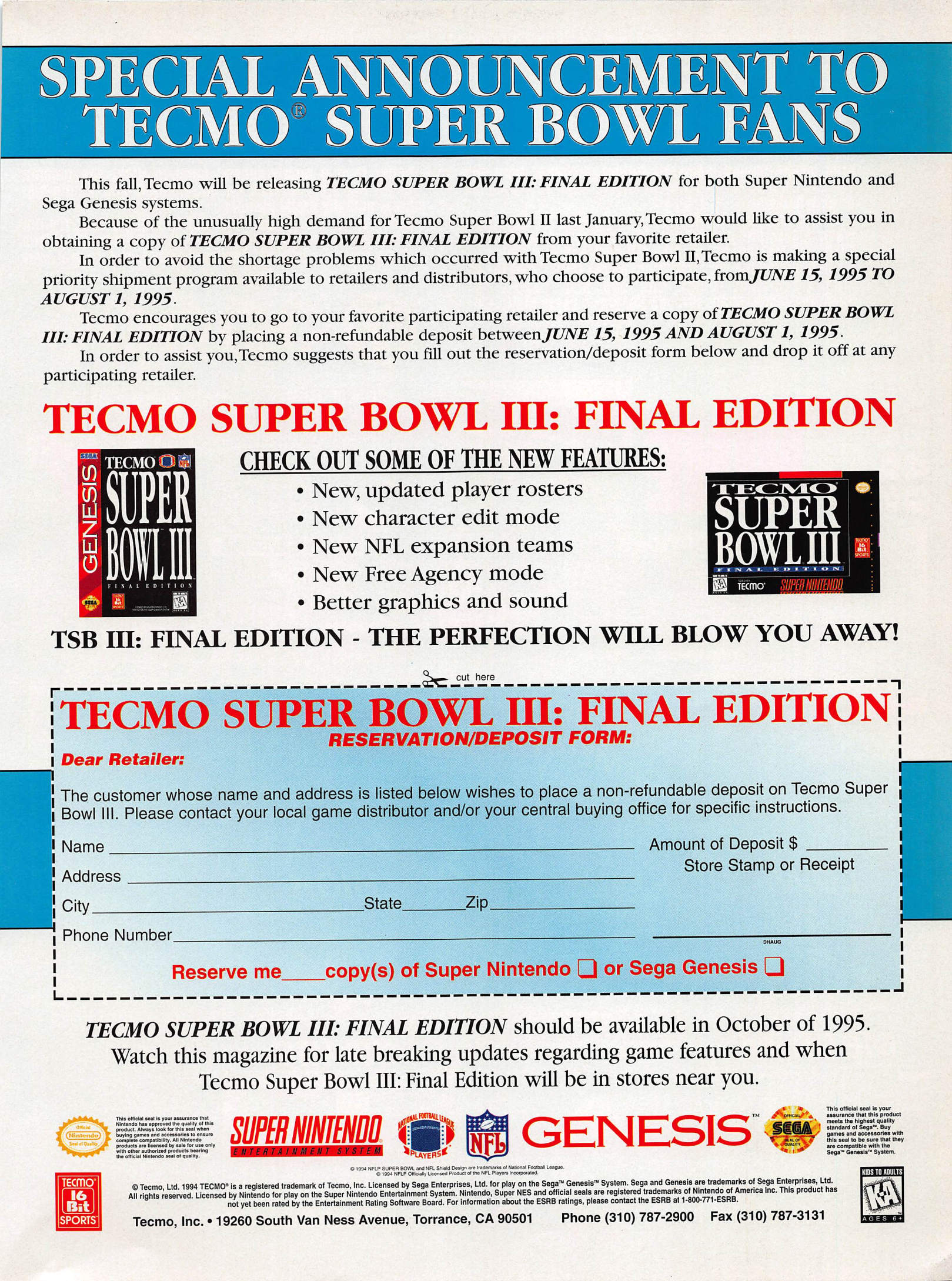

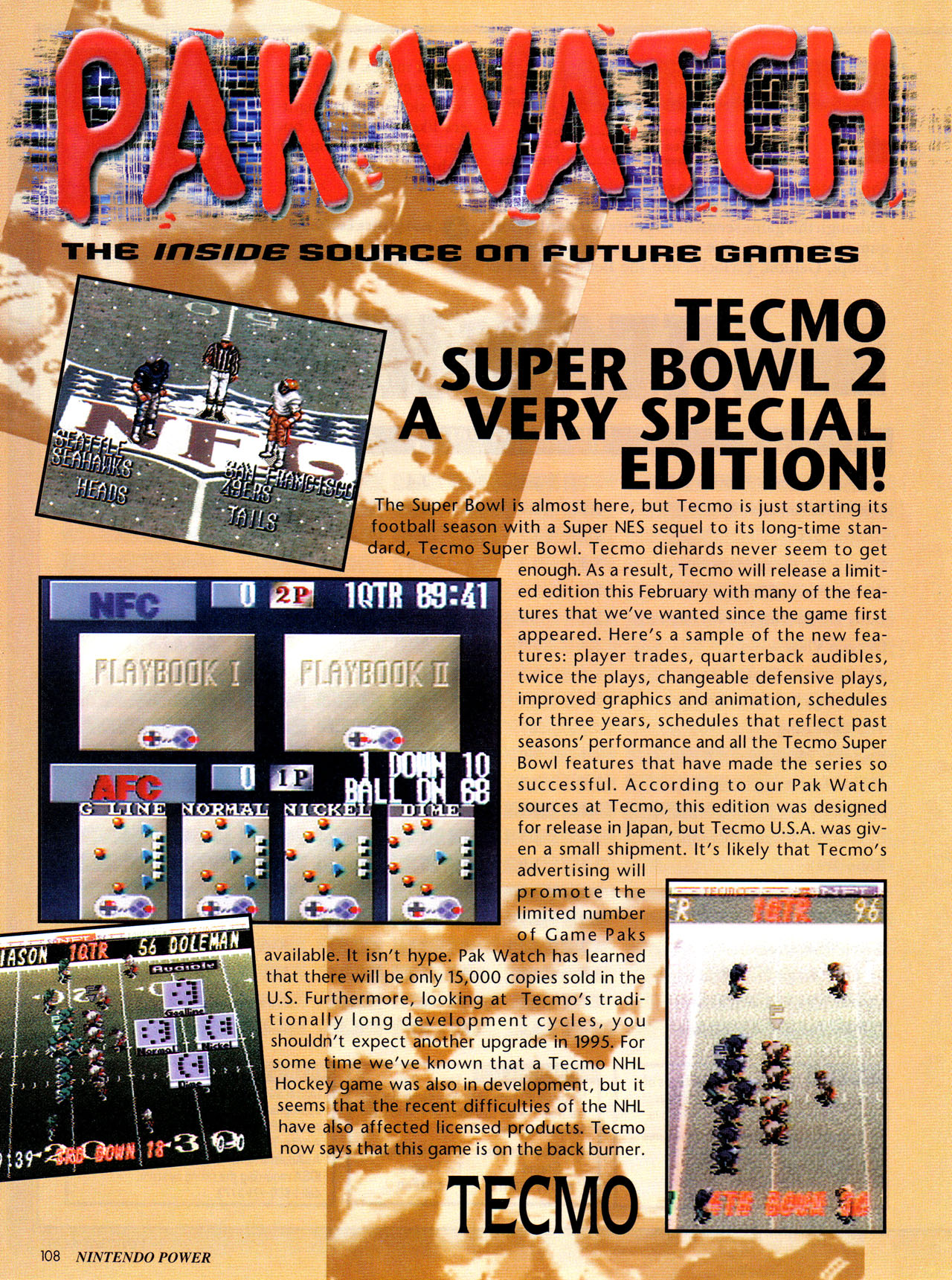
Tecmo Super Bowl II: Special Edition had a very wordy SPECIAL ANNOUNCEMENT FROM TECMO in February to let gamers know that they were not making many copies of the game. This was followed up with a wordy May ad apologizing to TECMO GAME PLAYERS for making so few copies, they just had no idea there would be so much demand. But don’t despair, Tecmo Super Bowl III: Final Edition is coming and there’s a SPECIAL RESERVATION FORM so you can make sure you get one. August magazine issues had a SPECIAL ANNOUNCEMENT TO TECMO SUPER BOWL FANS with the TECMO SUPER BOWL III: FINAL EDITION RESERVATION/DESPOSIT FORM included that you could cut out and present to a retailer, along with a non-refundable deposit. Thankfully, Tecmo had made a special priority shipment program to make sure you could get a copy of Tecmo Super Bowl III: Final Edition. This was followed by a wordy November ad for Super Bowl III: Final Edition with another list of features but also an ominous warning to make sure you buy a copy soon because so many people are buying it. Just $69.99, or a different price.
In January Nintendo Power claimed that Tecmo was originally only going to release Super Bowl II: Special Edition in Japan, but decided to give North America 15,000 copies of the SNES version. This seems odd for an American Football game. What I think is some kind of estimate by Sega of America puts the sales of the SNES version at 30,000. Game Data Library doesn’t have any sales data for it in Japan, suggesting there were very few copies sold there.
Why spend so much on ads for a game with such a tiny print run? Was it all a ploy to sell more copies of Super Bowl III later in the year?
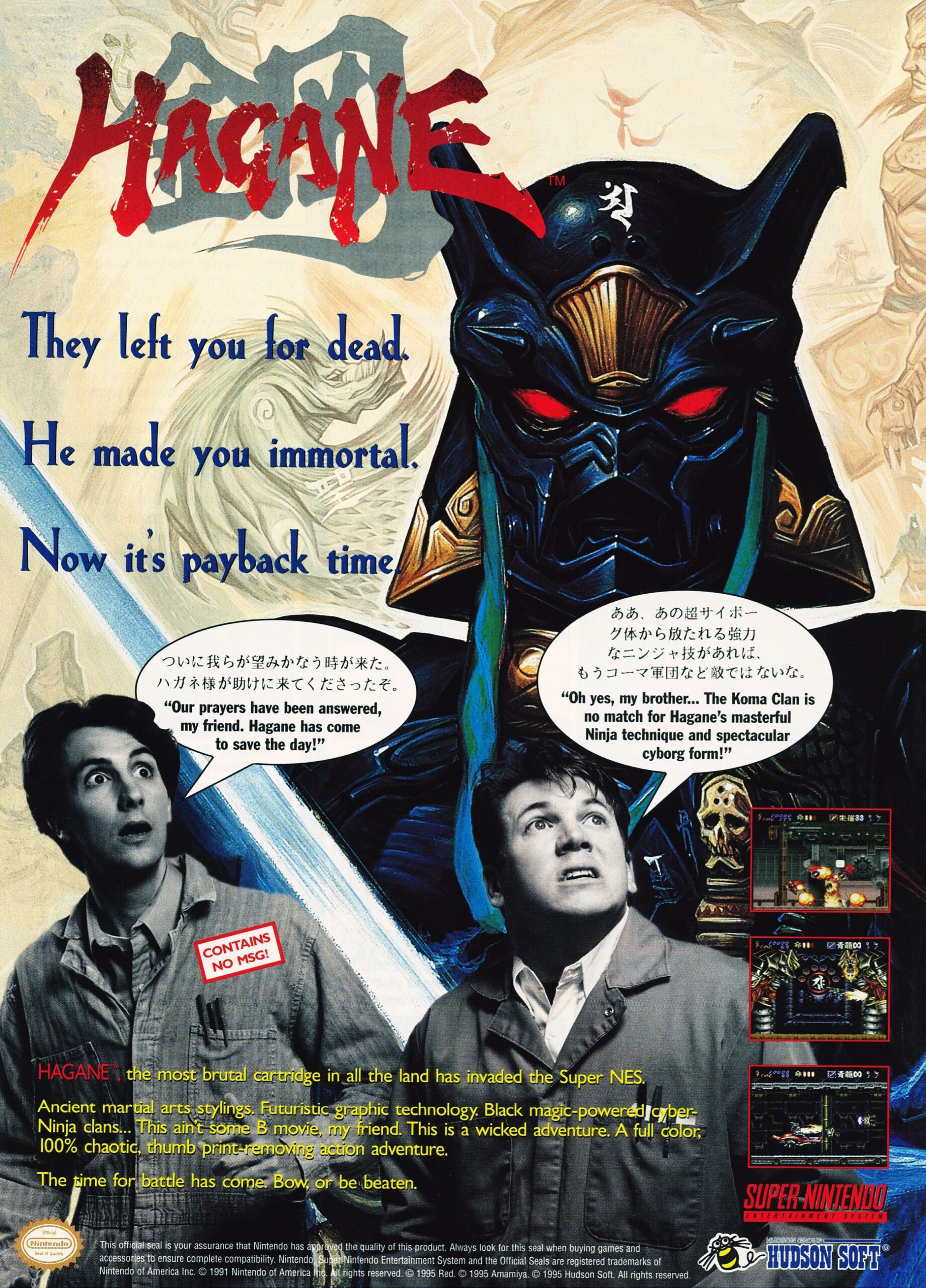
I was surprised to see ads for Hagane: The Final Conflict. There were also very few copies of this made. A complete copy goes for thousands of dollars today. I think they’re going for an old, poorly dubbed Godzilla movie thing here. They don’t limit themselves to just Japanese stereotypes here though, with a declaration that the game “contains no MSG”.


Doom: It wants you to be dead. There were quite a few distinct ads for Doom and The Ultimate Doom.

Zoop: It will damage your organs.
Twisted Metal asks you picture Los Angeles in the year 2010, and also running over a dog.


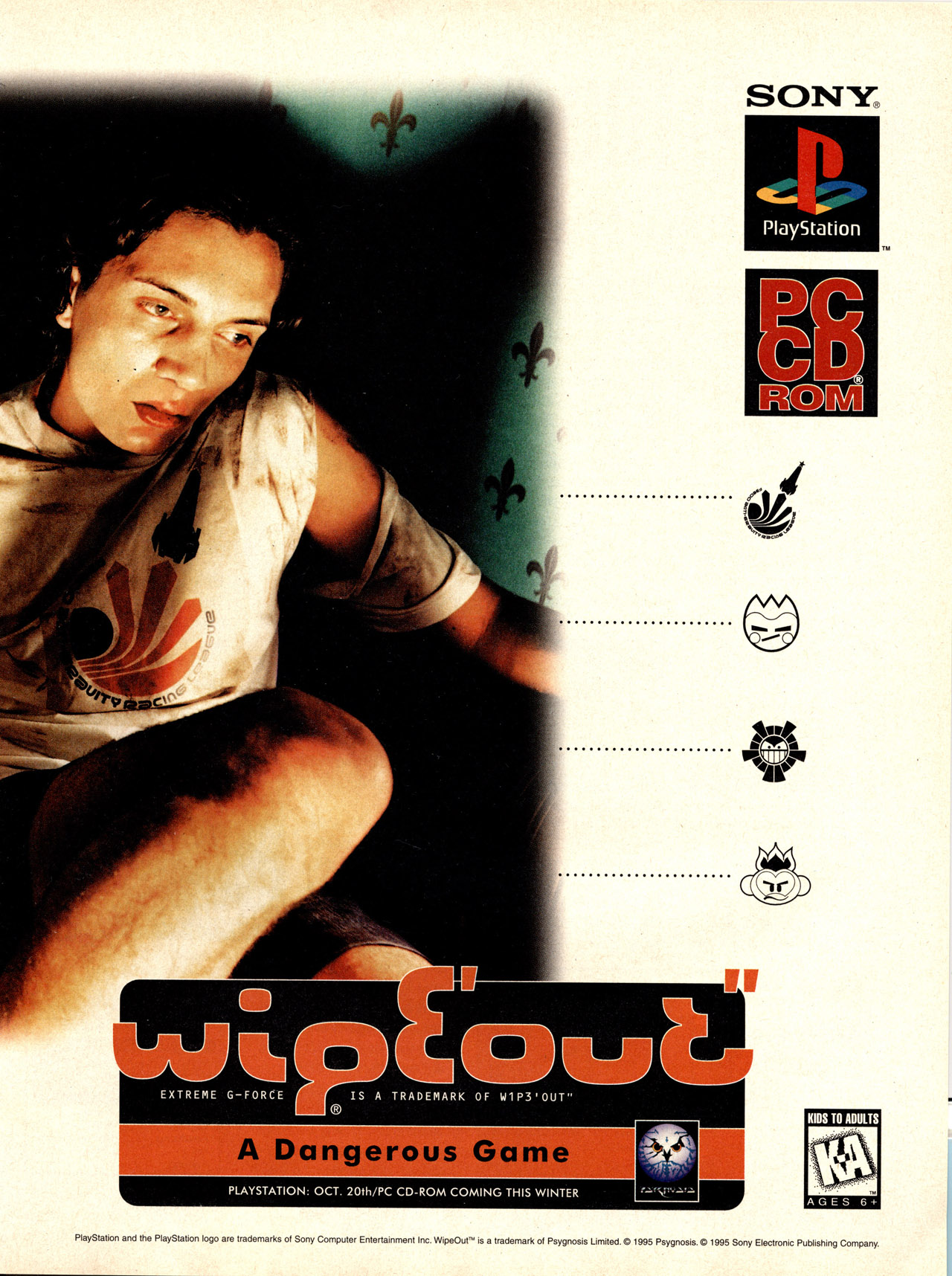
They sure don’t seem to enjoy playing Wipeout. Both versions of this ad appeared in various magazines in 1995. There seems to be a third version as well, featuring the more despondent looking people on the right, but with even more blood than on the left but I didn’t see it in any of these magazines. There was some controversy surrounding these and you can read more about it on Voletic, where they interview the person who designed them.
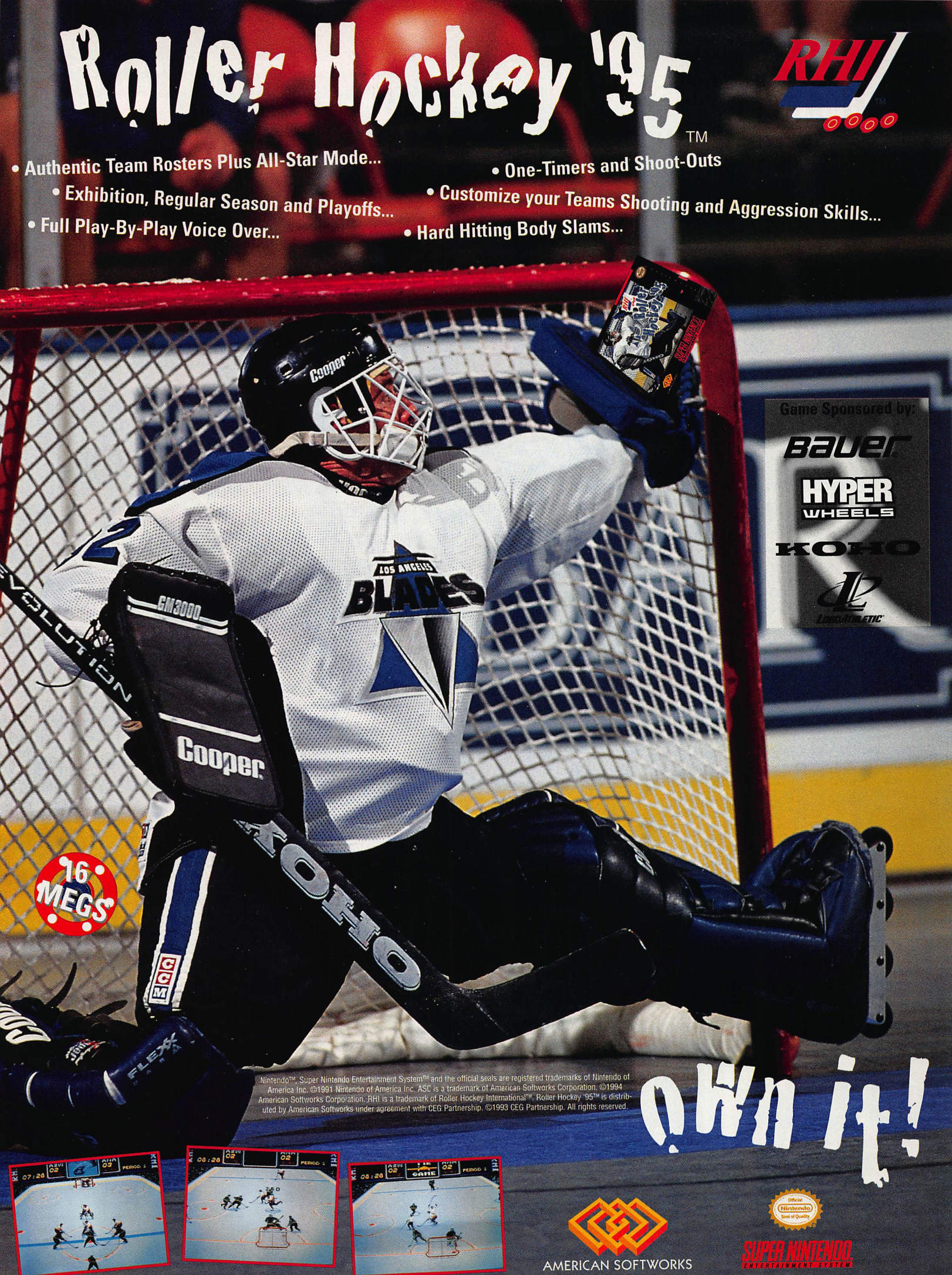
Even cancelled games had ads.
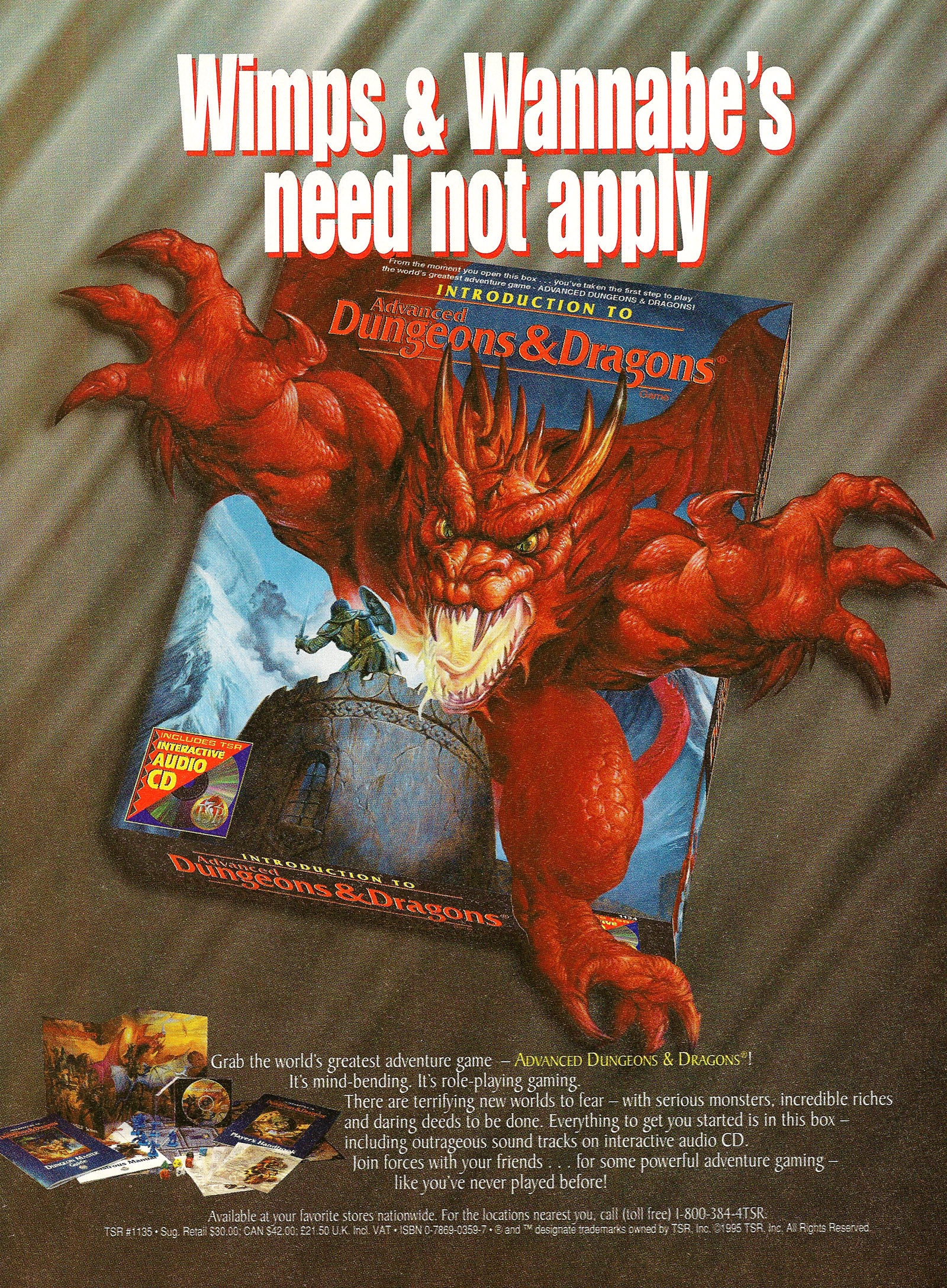

“Wannabe’s” doesn’t need an apostrophe and “existance” is spelled incorrectly.
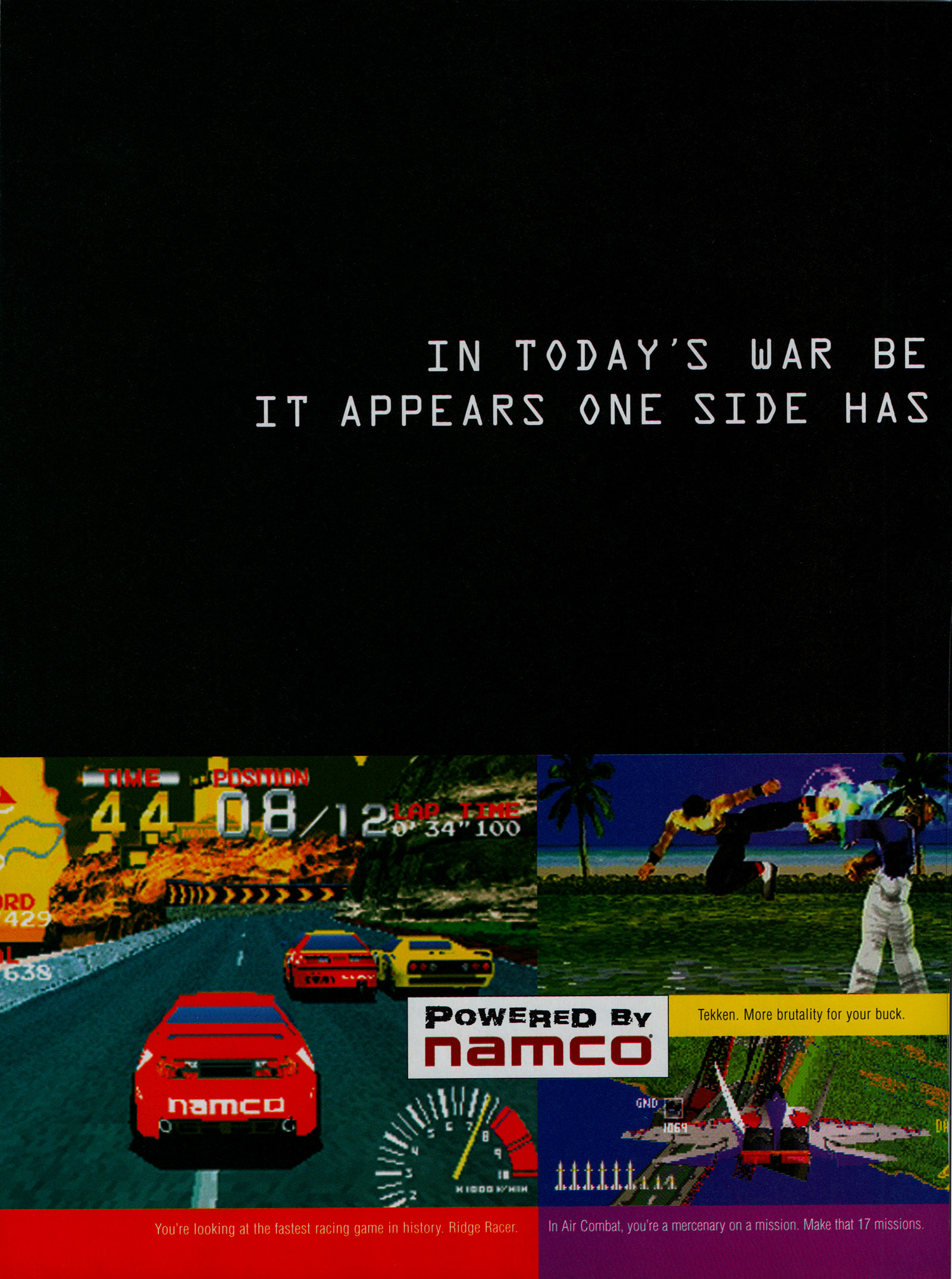
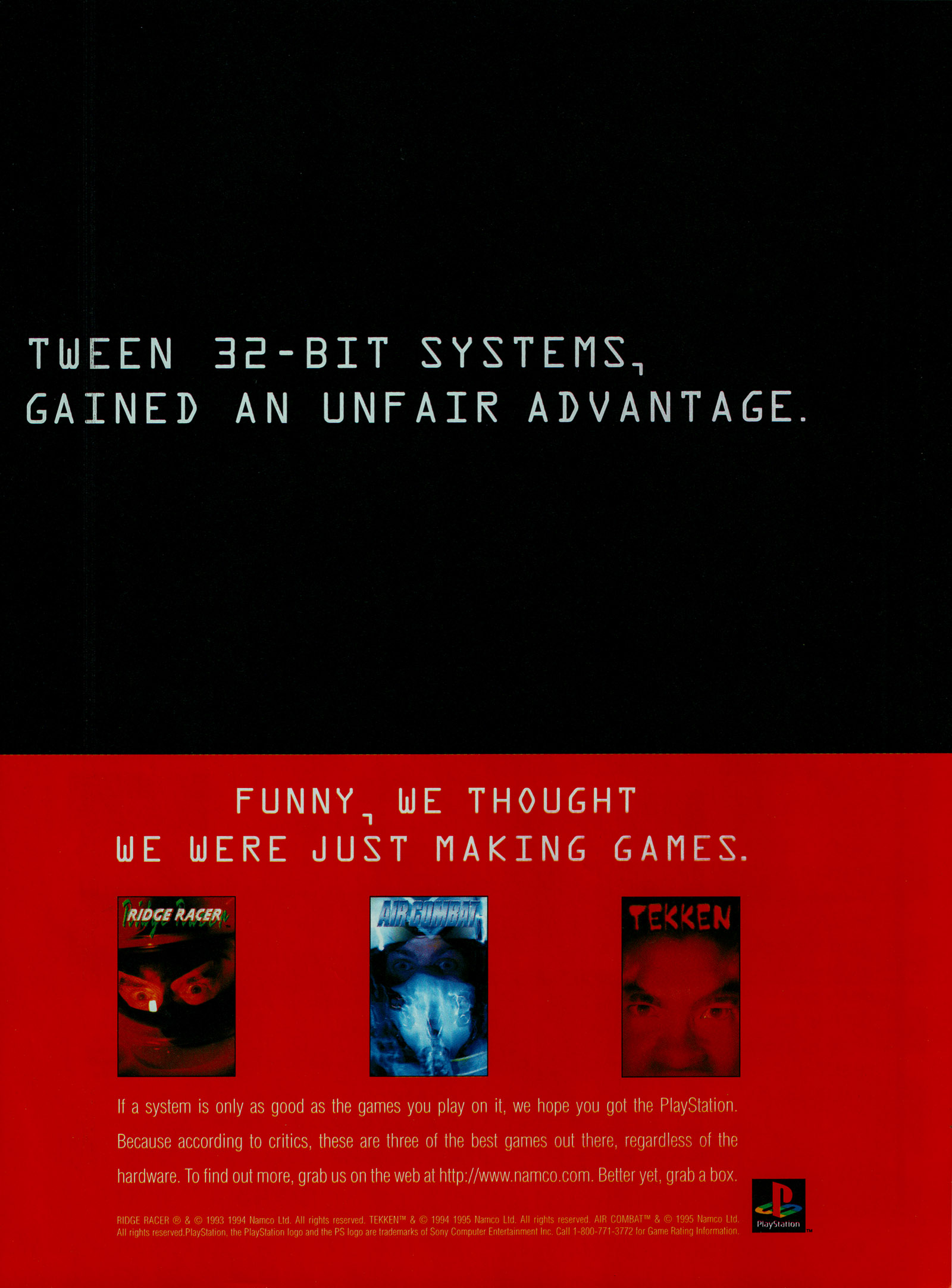
These Namco ads were everywhere and made the questionable decision to feature something that you might assume was the actual box art, but wasn’t. Including actual box art was not that common.

Some ads didn’t even include the name of the game being advertised anywhere. These weren’t like Brain Dead 13, there was no campaign leading up to a reveal.

Izzy’s Quest for the Olympic Rings (which isn’t named in full anywhere) does not feature dogs. I get the connection between dogs and searching, but it feels like I’m being threatened. The ad copy also makes it sound like finding these rings is a chore that you’ll only do begrudgingly.
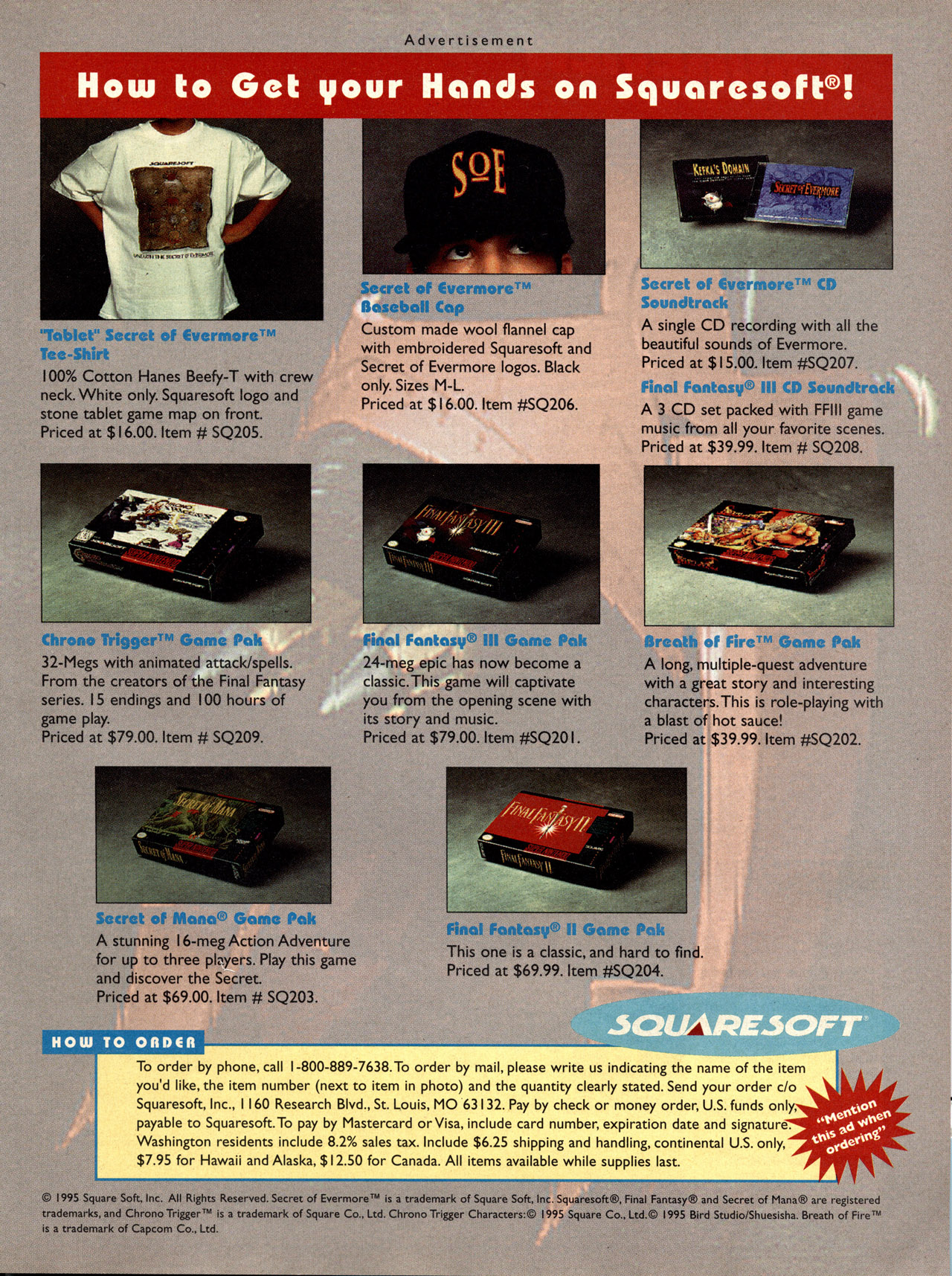
We often picture going to a retail store to buy video games during this era, but there was a lot of phone and catalog ordering going on. Check out The Video Game Catalog and Circular Ad Archive for more of what games used to cost.
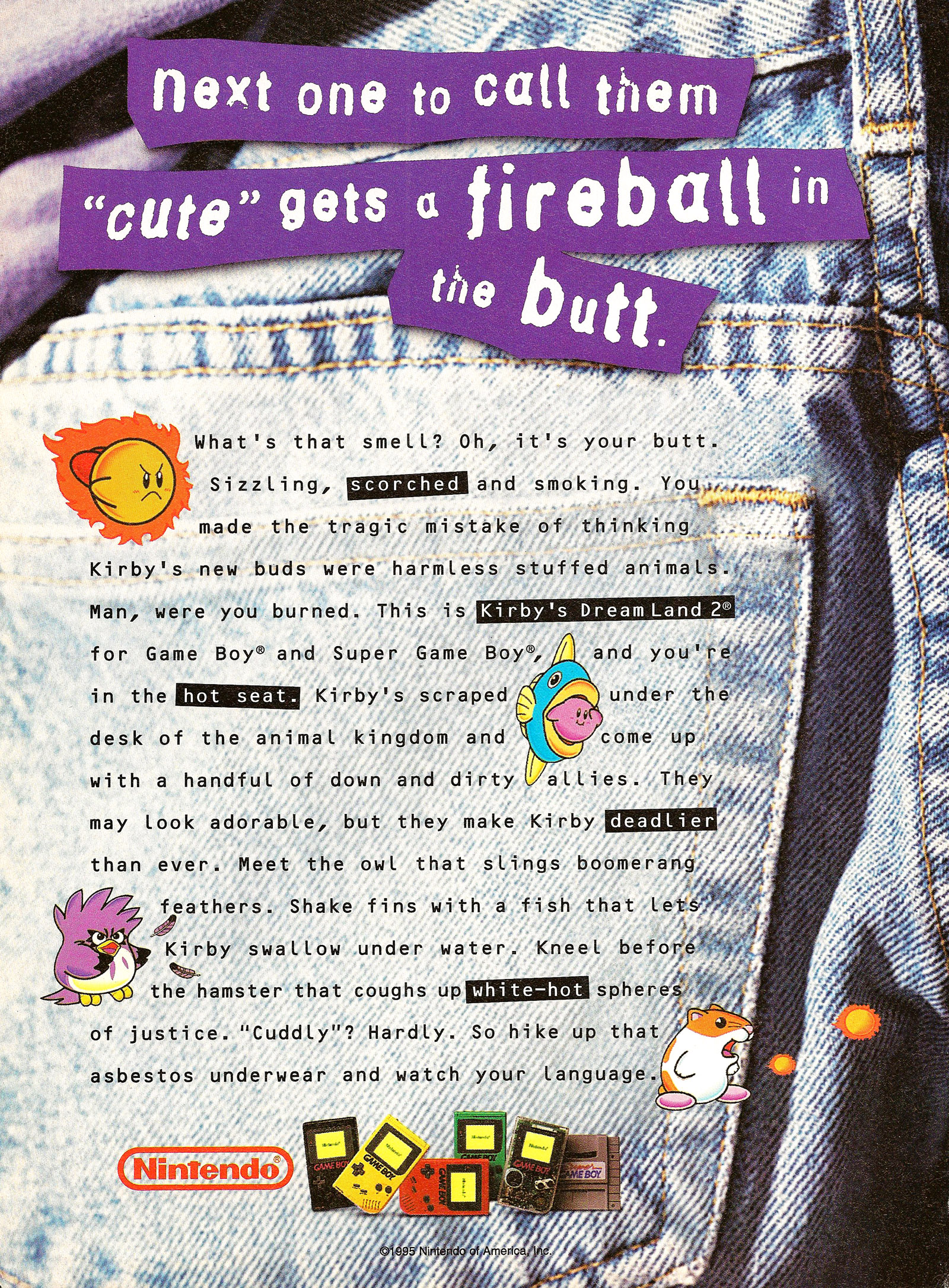
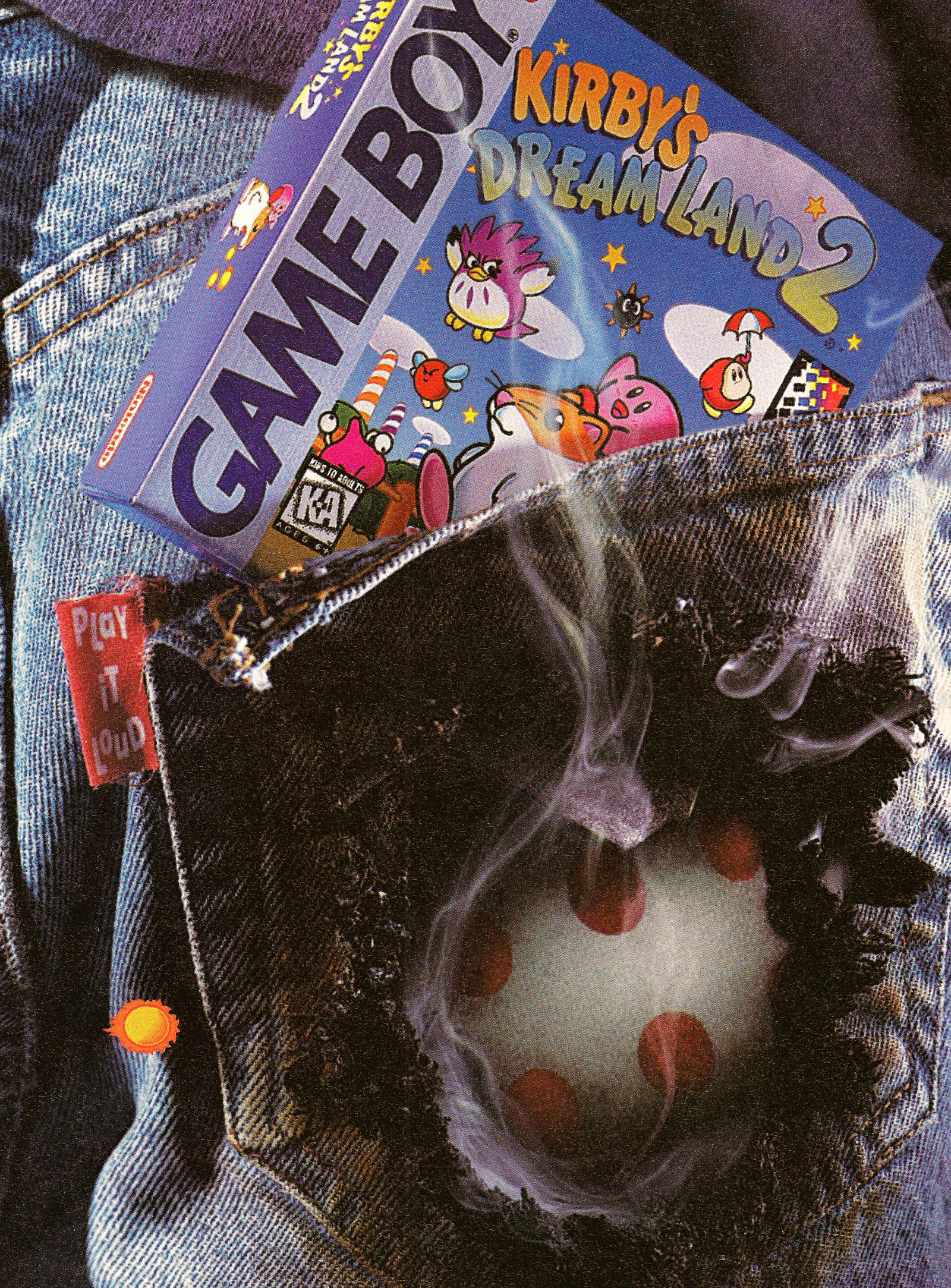
Please don’t think Kirby is cute. He’s actually really strong and tough.


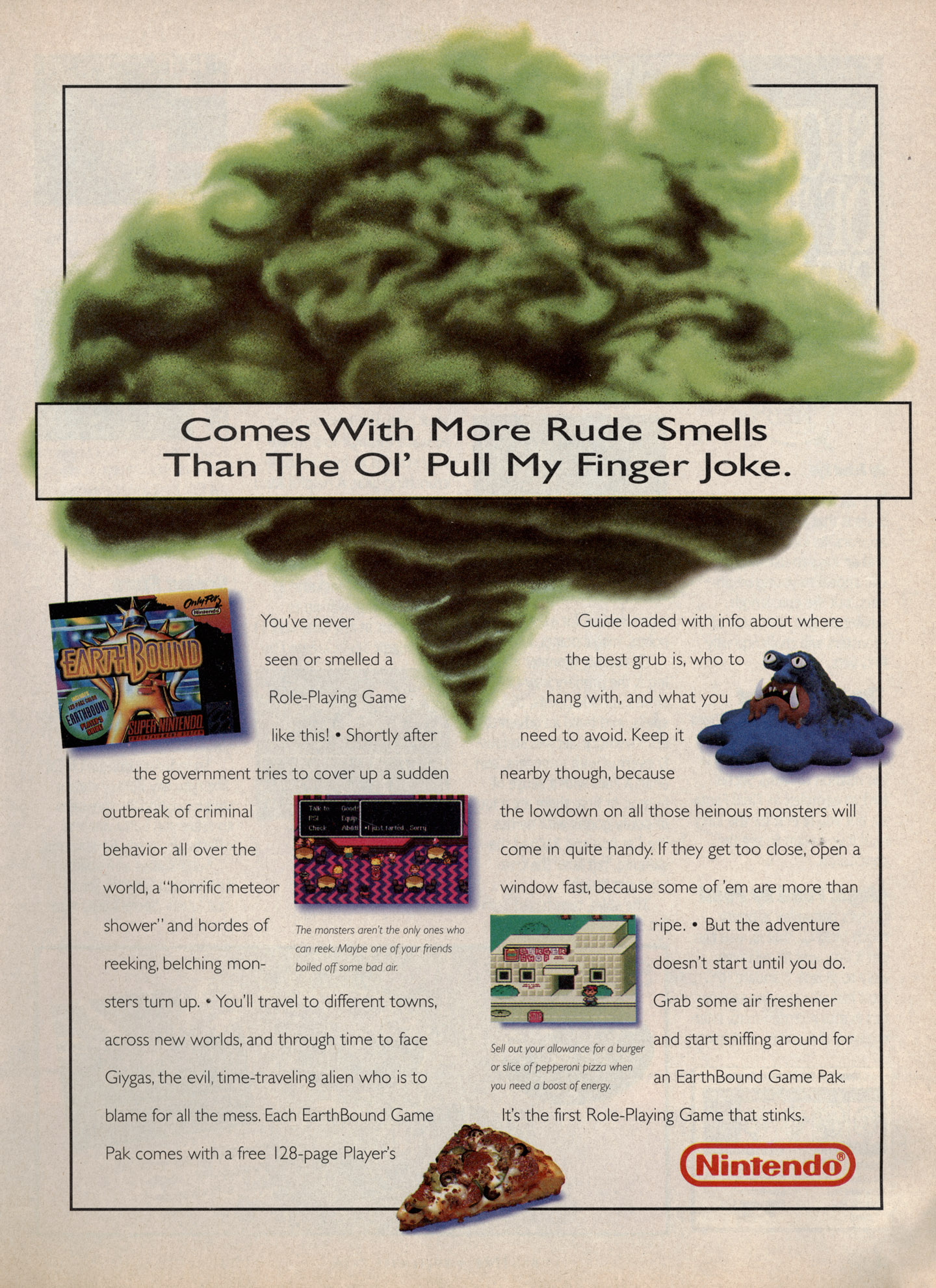
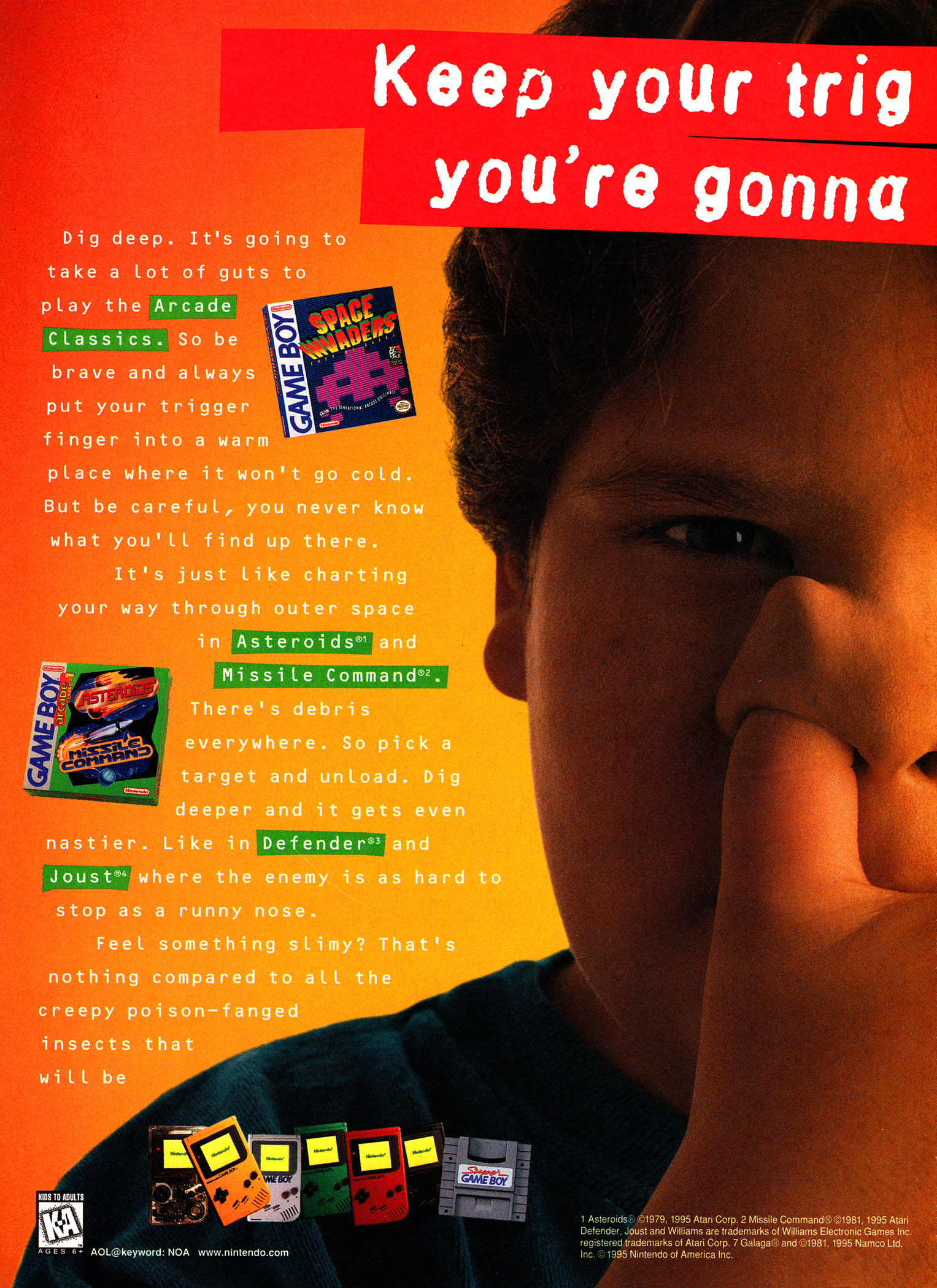
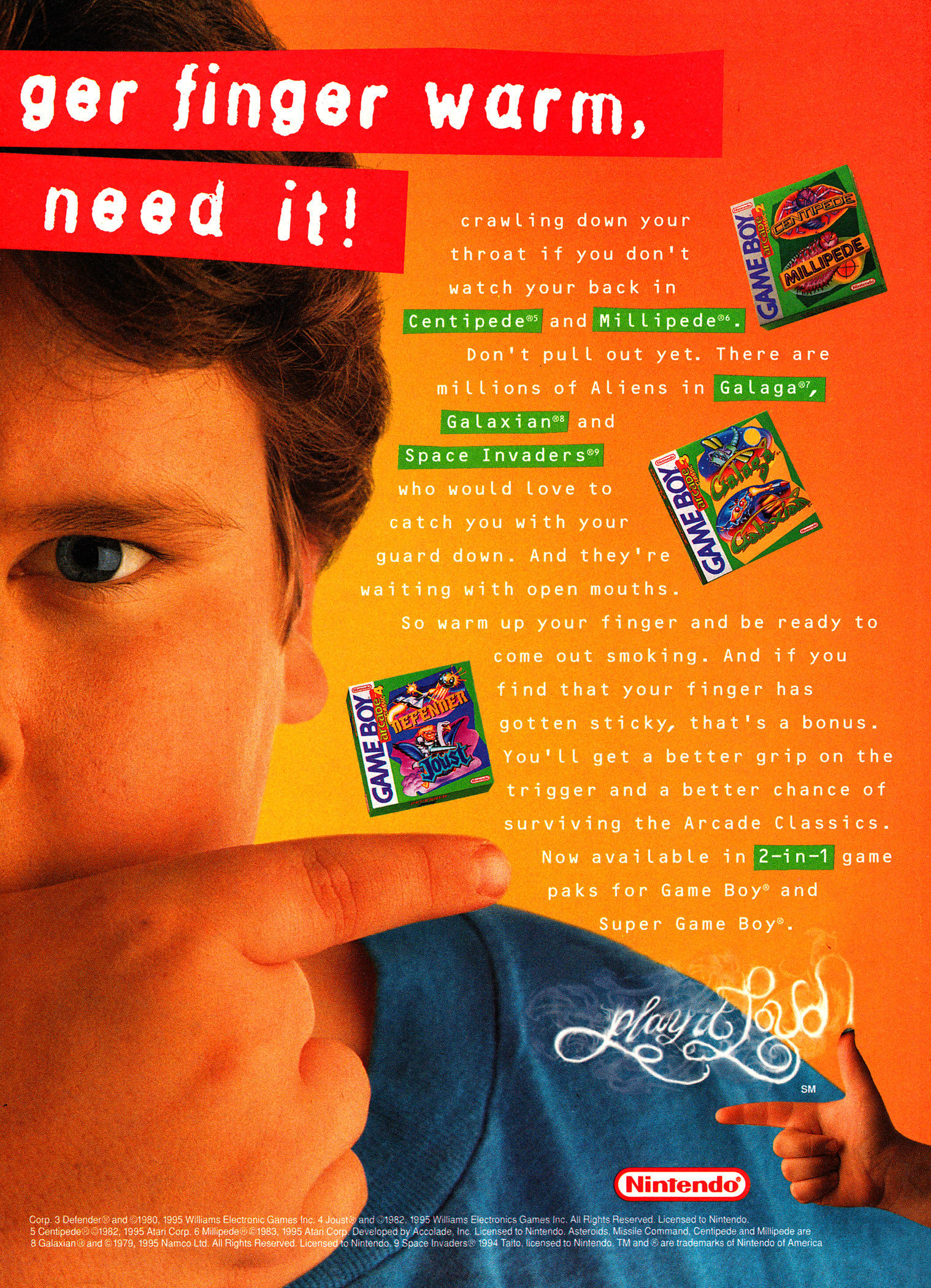
Nintendo’s ads were often a bit gross.

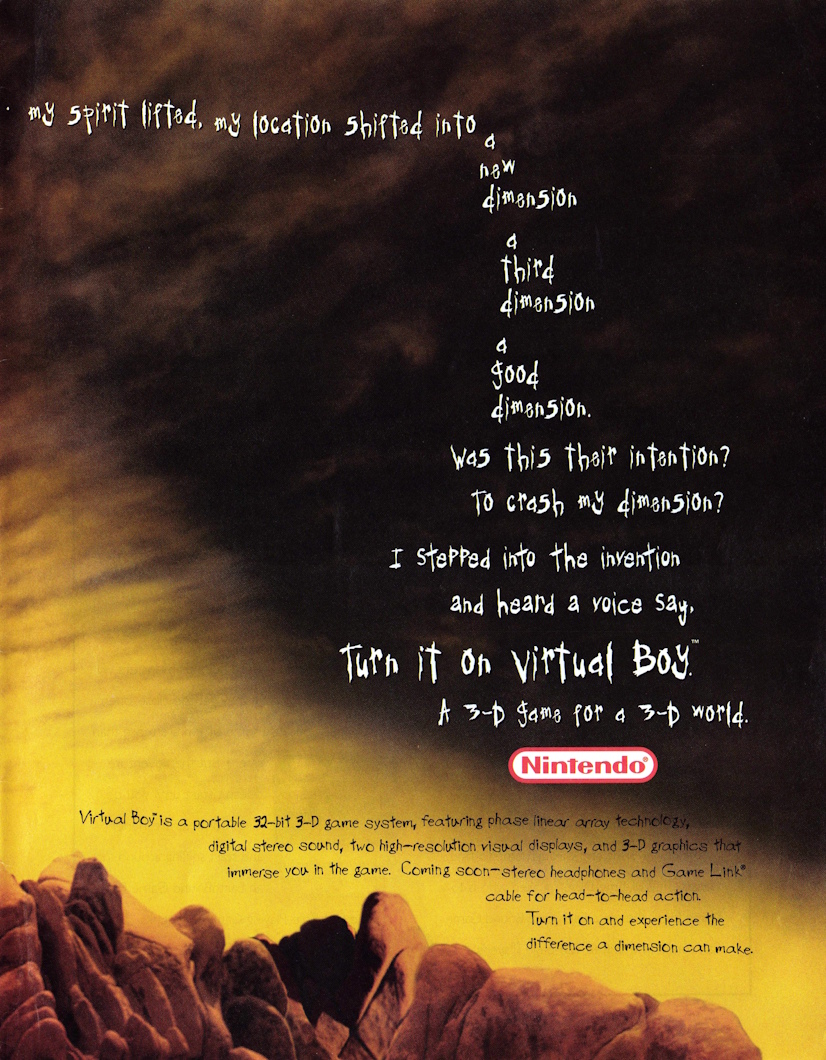
I really don’t know what Nintendo was going for with these Virtual Boy ads that feature people in rocky “wastelands”. Really the only selling point is saying it’s “3D”. No games are mentioned, no screenshots are included.
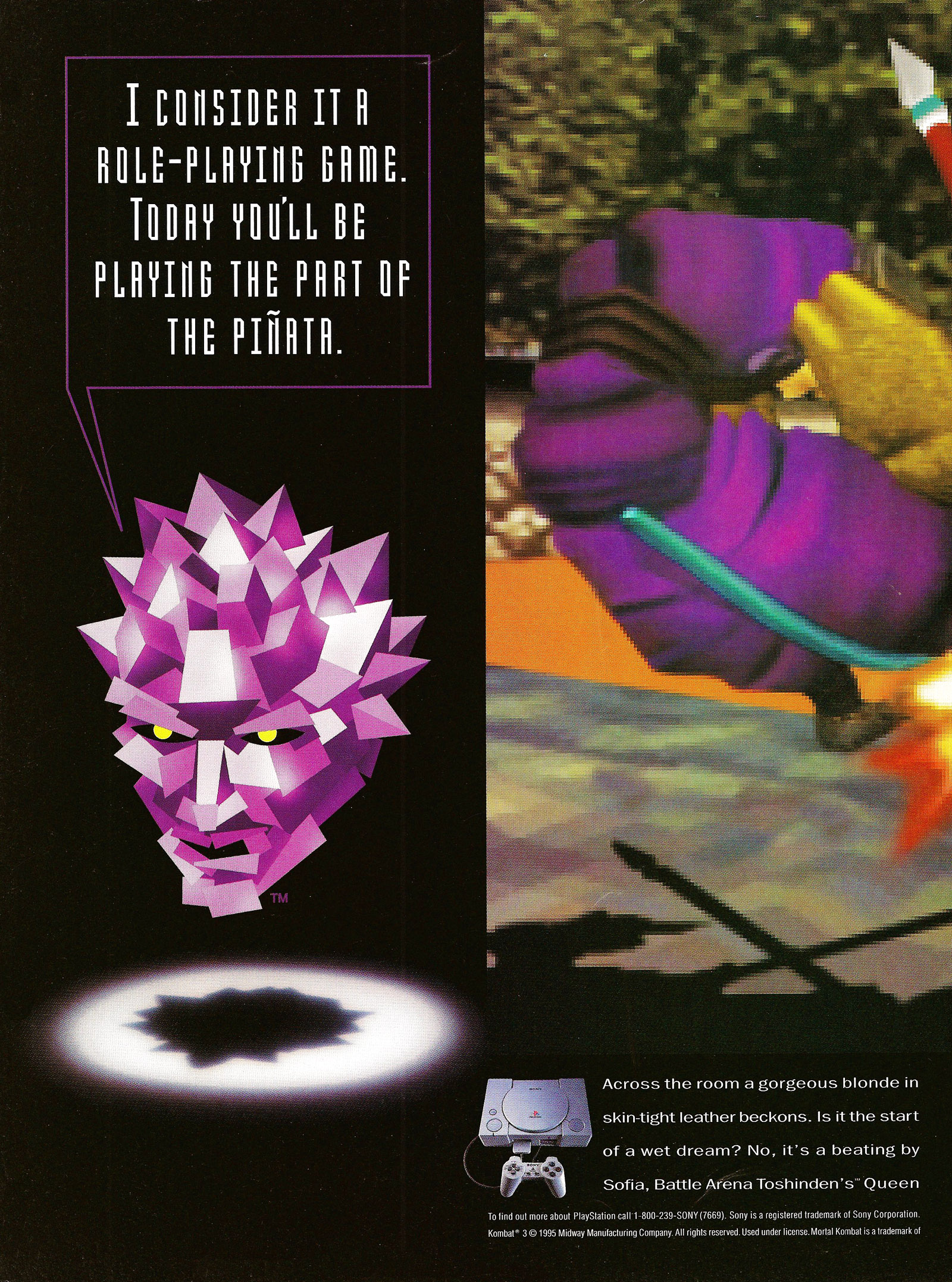
Sony’s short-lived mascot Polygon Man makes an appearance in Battle Arena Toshinden ads.
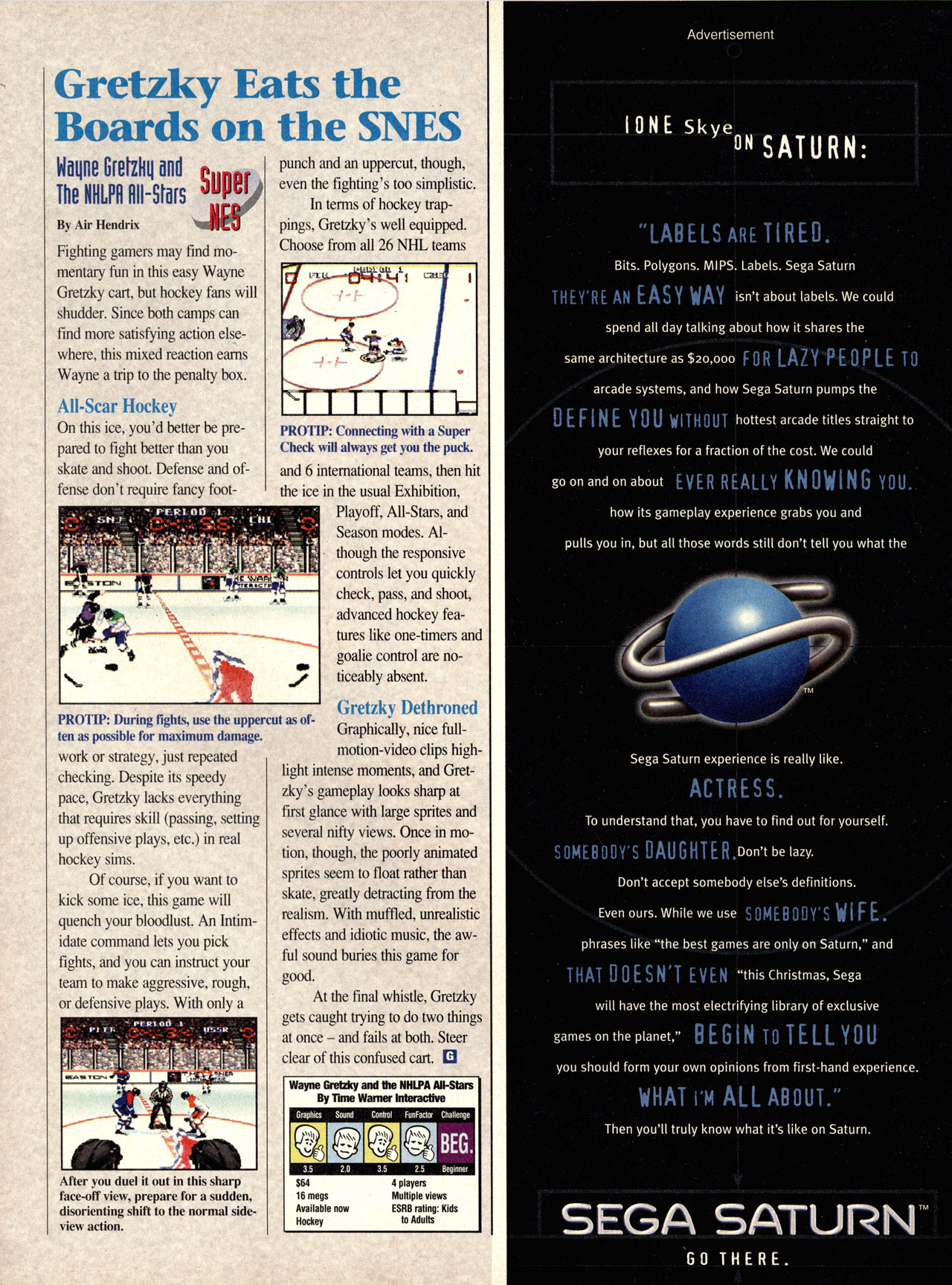
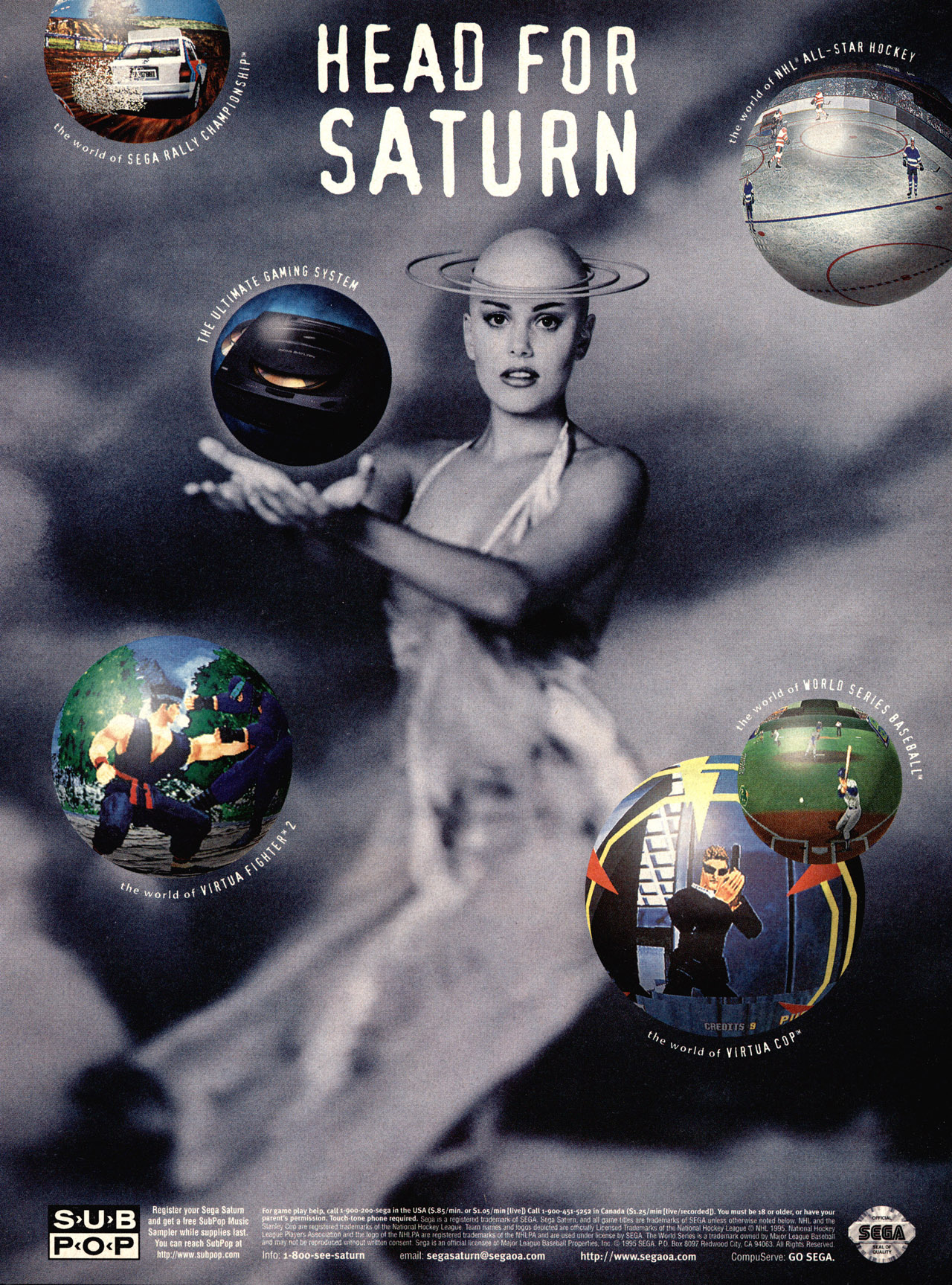
Saturn’s magazine ads were almost as odd as their commercials.

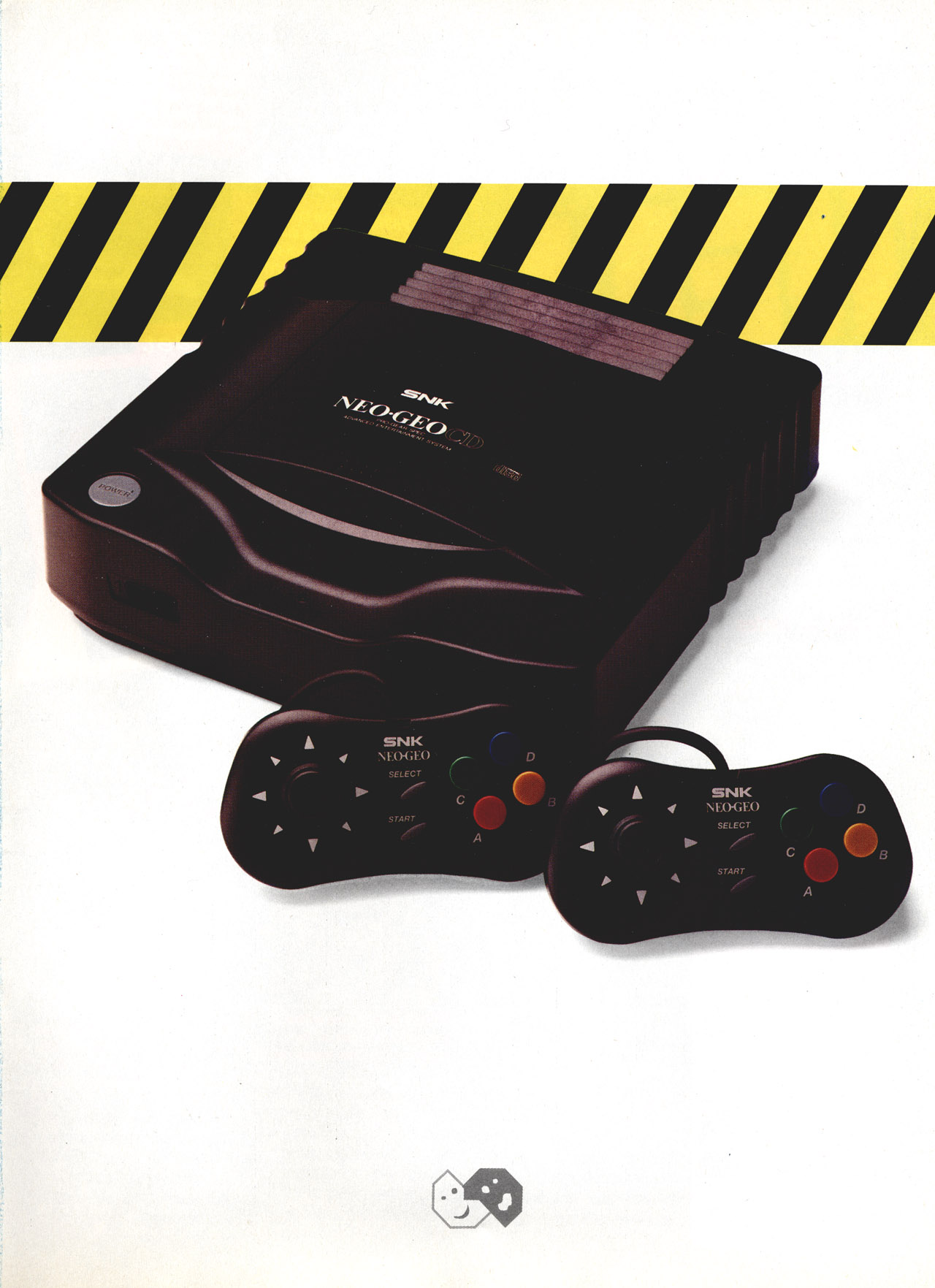
These Neo Geo CD ads ran in several magazines. Nothing about the games, nothing about the system’s capabilities.
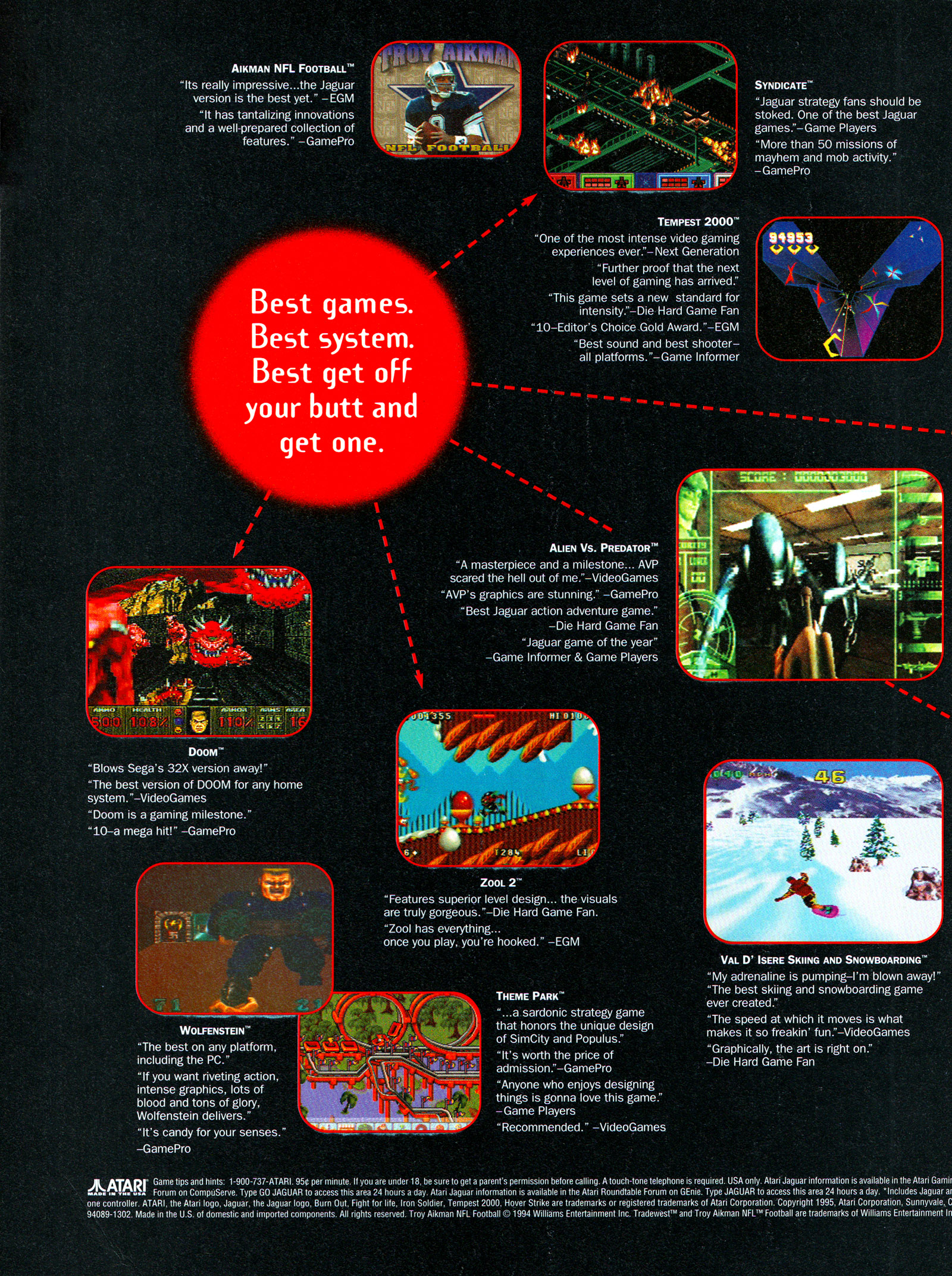
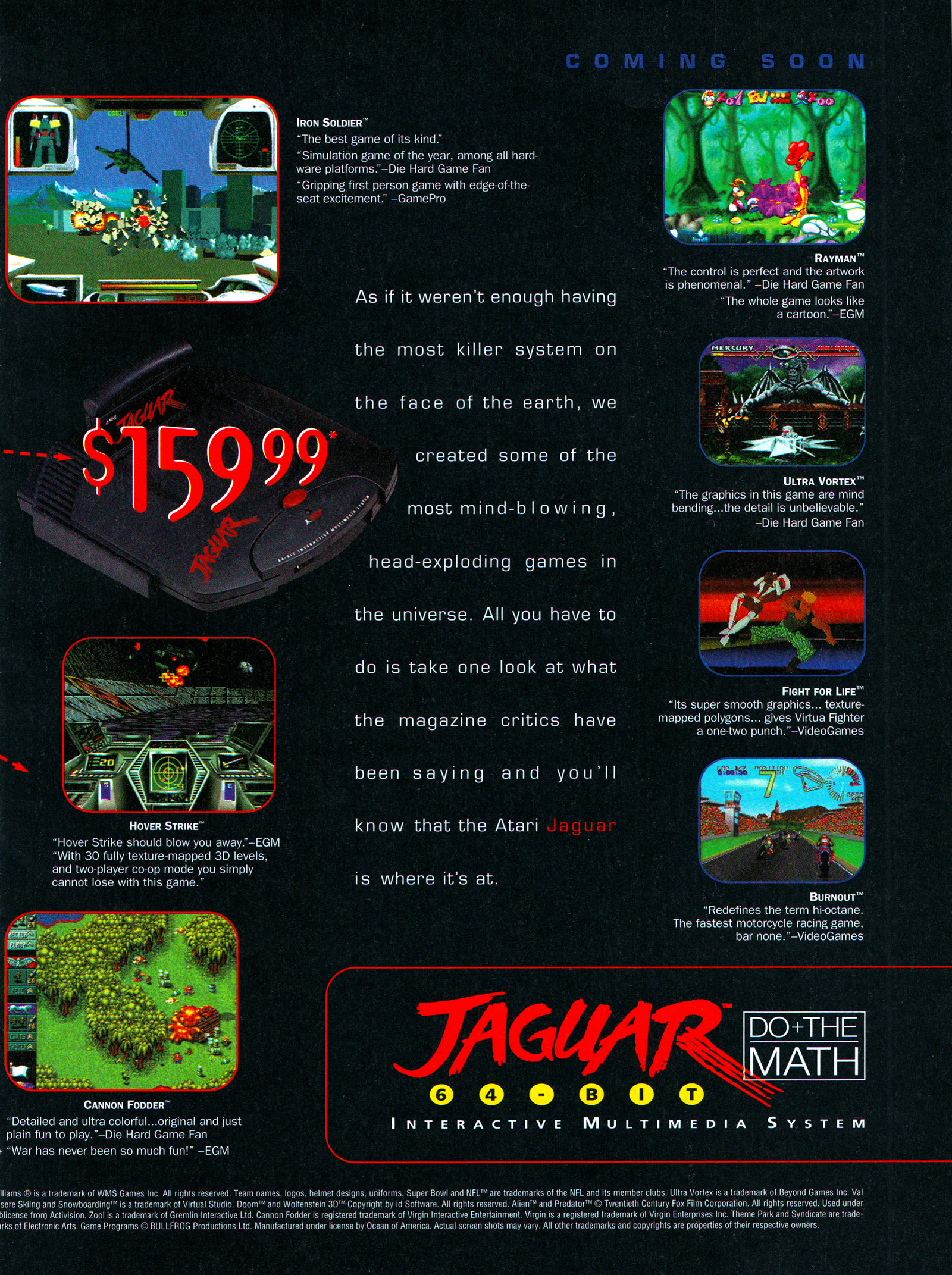


Jaguar and 3DO ads on the other hand are all about showing off lots of games.

This ad for The Ultimate Gaming Rig!! was all over gaming magazines in 1995. It may look innocent enough, but it was actually a scam.
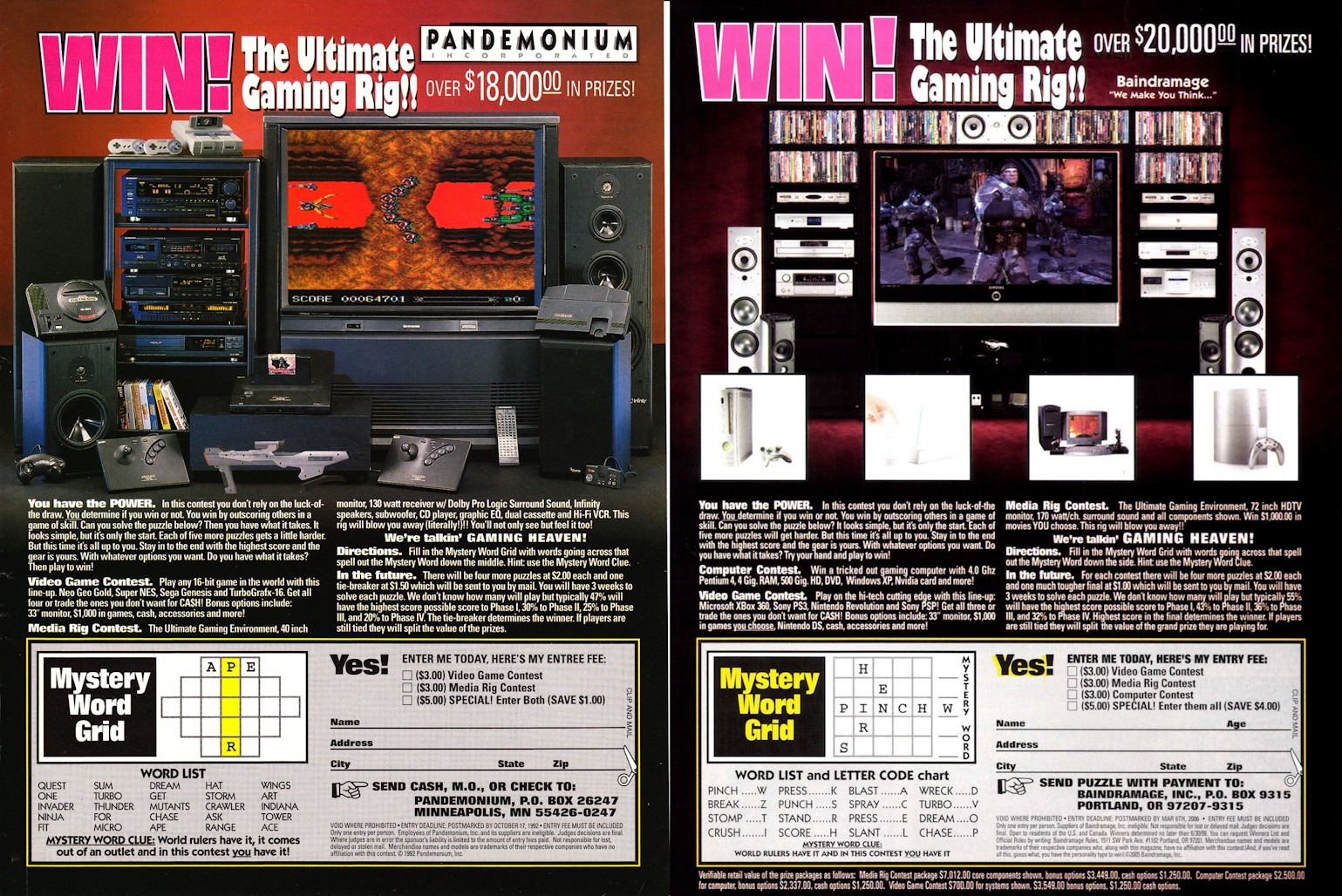
I asked Chris Chapman to check his gaming magazine collection and he found 170 occurrences of this ad, starting in 1992 and going all the way to 2006. It was even present in some UK magazines.
The exact prizes are never stated, but various video games, game systems, CD players, speakers, VCRs, and TVs are mentioned and shown. These prizes change over the years to stay appealing. The company name and address changes over time.
Participants are tasked with solving a word puzzle and sending their answers and a few bucks to a given address. Those who send correct answers are then mailed a new, harder puzzle and can mail their answers and some more money to stay in the game. Fewer and fewer people made it to each round and losers got no prizes. Sometimes these puzzles had deadlines that were in the past by the time players received them. The final round had an empty grid to fill in, but you got more points for using rarer letters and the winner would be the person with highest score. There was a huge range of possible answers and scores so you could do your best but you wouldn’t know if you had the best score or not. The contest runner could always claim that someone else had done better than you.
It seems that a number of people had complaints about this contest. Several seemed to be able to contact the contest runner on the phone and were given various excuses. There is one person who claims to have received around $6,000 of the approximately $50,000 worth of prizes they had won, but the specific company running that contest went bankrupt and they weren’t able to get the full value of their prize. In 2021 this person returned to a 17 year old thread on Cheap Ass Gamer saying that the contest runner finally sent them a check for the full amount that they were owed.
Miscellaneous Information
This last section just has some miscellaneous things that I found interesting while reading these magazines and which didn’t fit elsewhere.

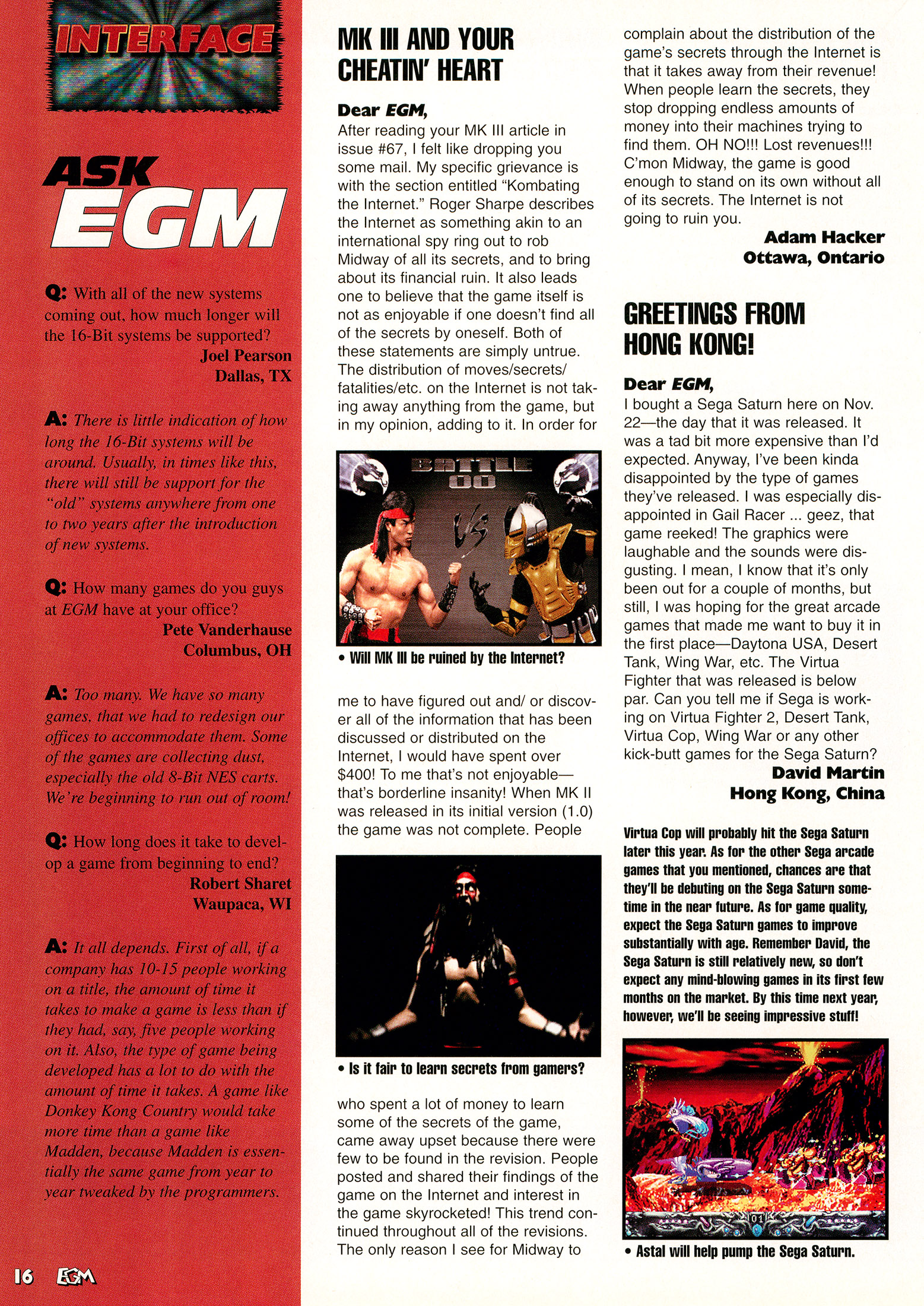
EGM, February and April.
Apparently there were different versions of Mortal Kombat II and Killer Instinct which had different inputs for the special moves, to purposefully make it difficult to memorize them. With Mortal Kombat 3, Midway was considering more drastic measures with even more versions because reading move lists on the Internet was supposedly hurting the life of the game and cheating players out of the fun of discovery. Adam Hackter wrote in with his thoughts on this short-sighted idea.
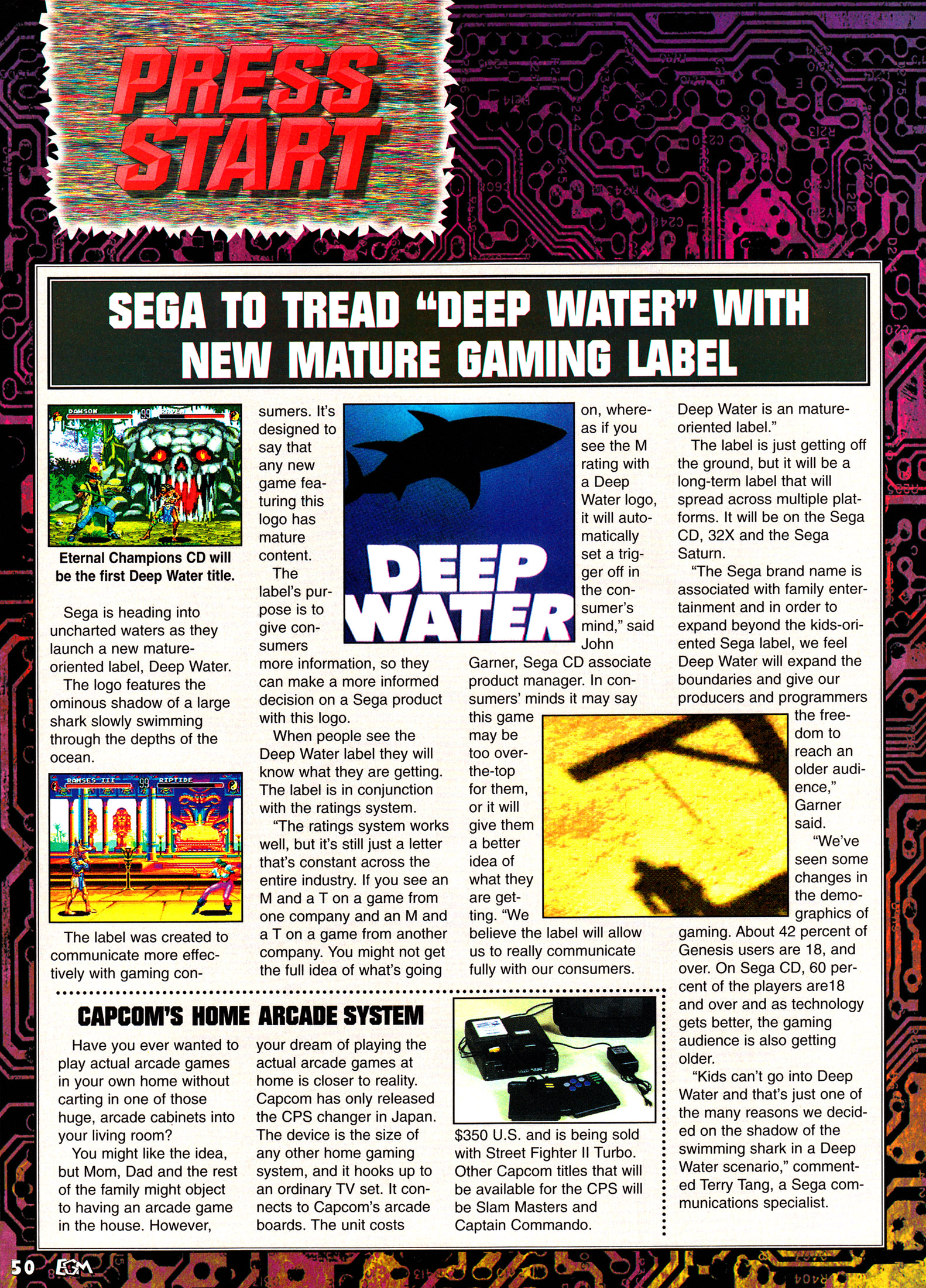
EGM, February.
Only Eternal Champions and Duke Nukem 3D ended up using this Deep Water label for games that was meant to convey mature content beyond an M rating. Sega was throwing a lot at the wall in this time period and little of it stuck.
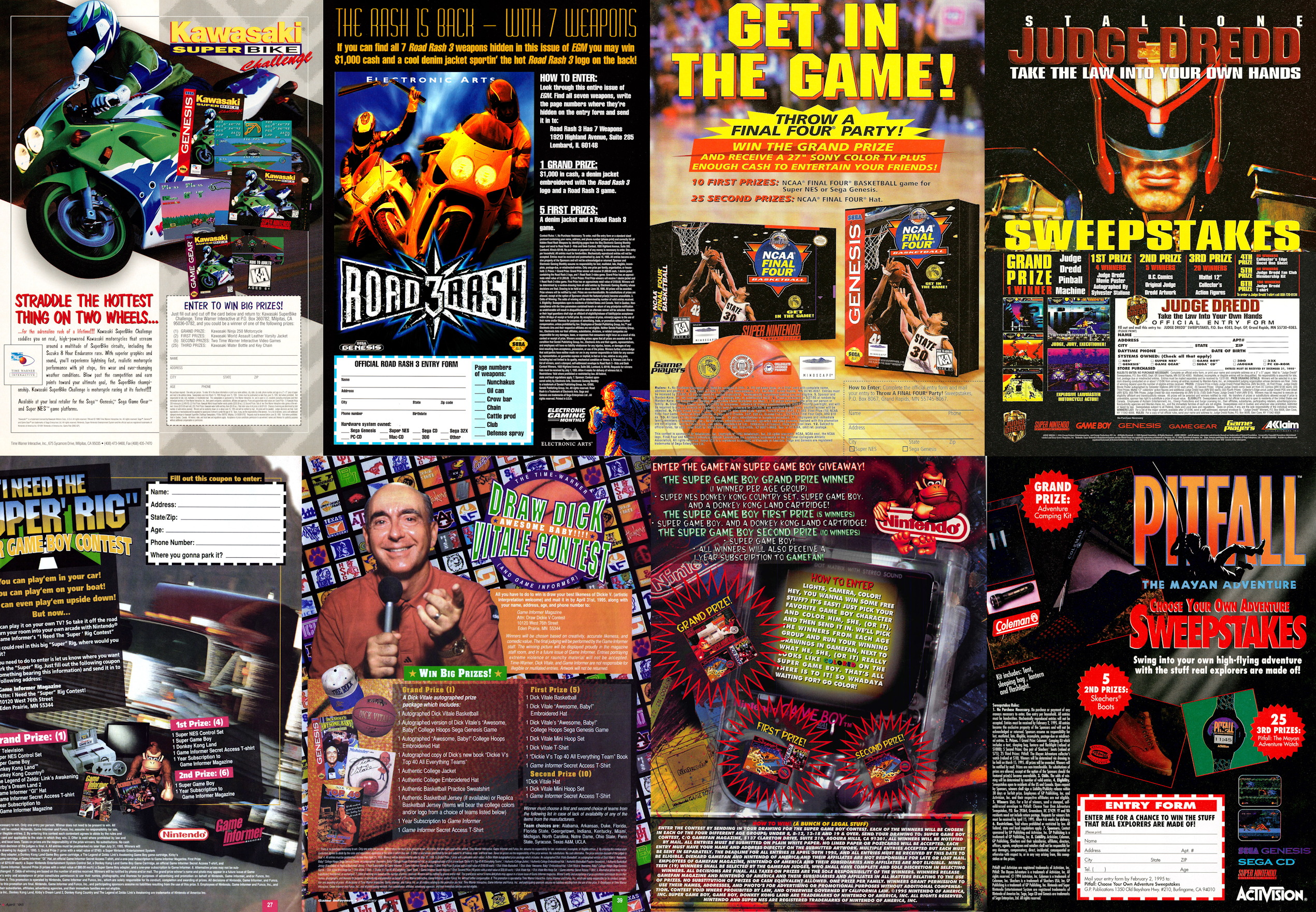
EGM, April, May/Game Players, January, April, July/GameFan, April/Game Informer, February, April.
There were so many sweepstakes for so many games.


VideoGames:TUGM, June.
On the bottom of each ad in VG:TUGM was a number. You could circle the numbers on the advertiser index corresponding to the ads that you are interested in and mail it in to the magazine. Participants had a chance to win a prize and they would also subscribe you to each company’s mailing list, so you can get more ads from them in the mail. I imagine these companies paid VG:TUGM some amount of money for these addresses, but I’ve never seen anything like it in any other magazine. It seems like this should have helped draw in more advertisers, but it apparently didn’t.
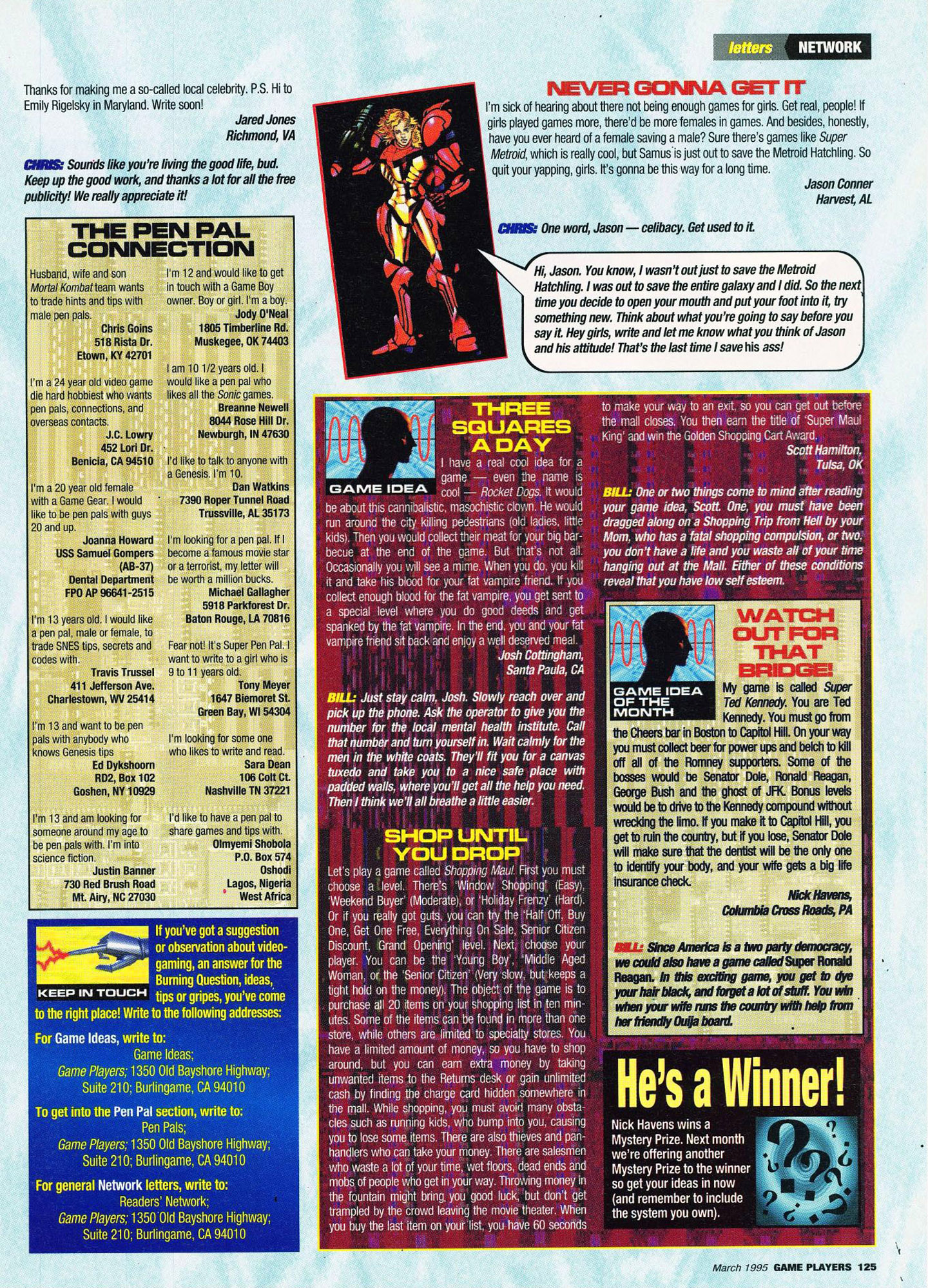
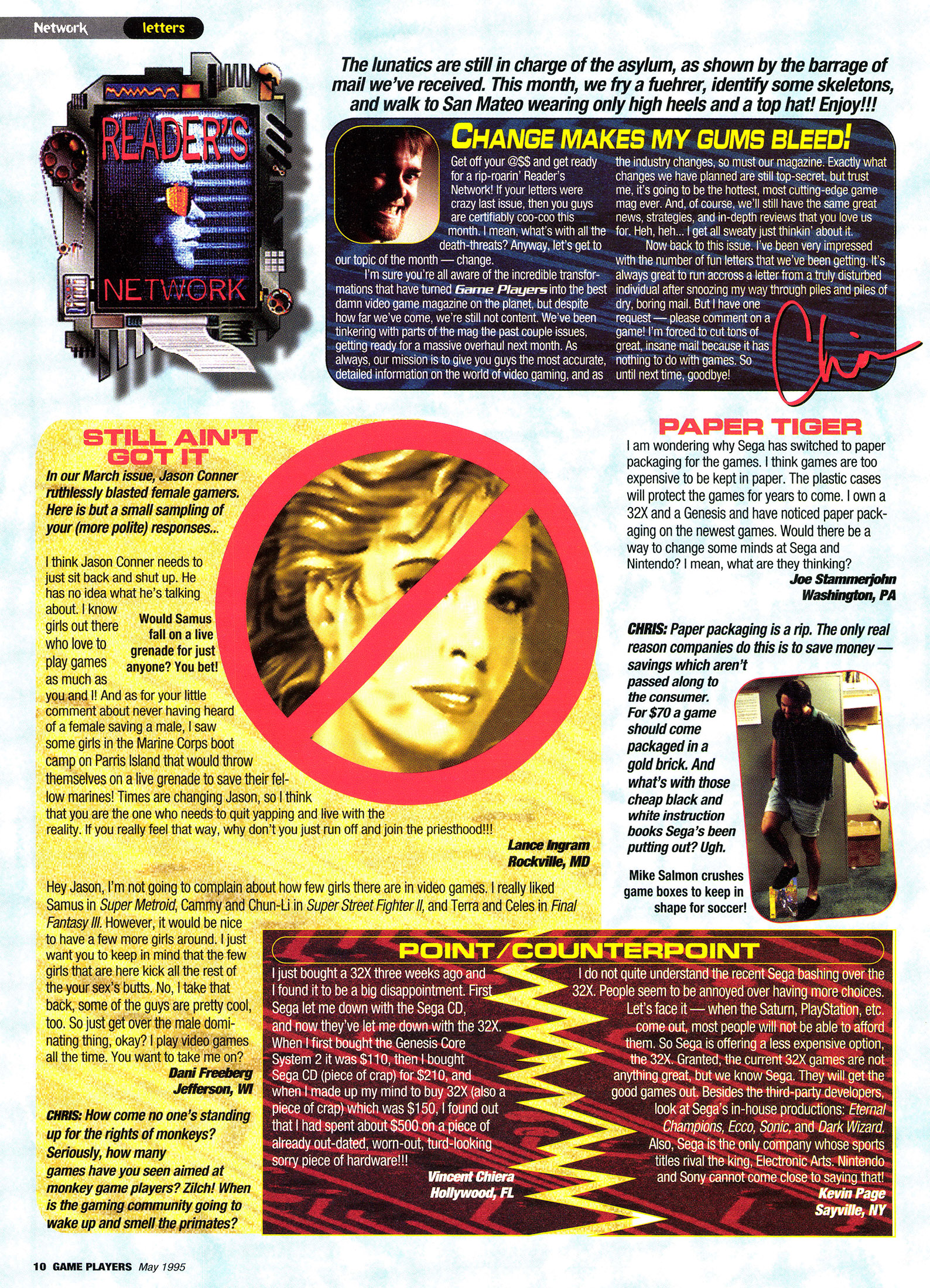
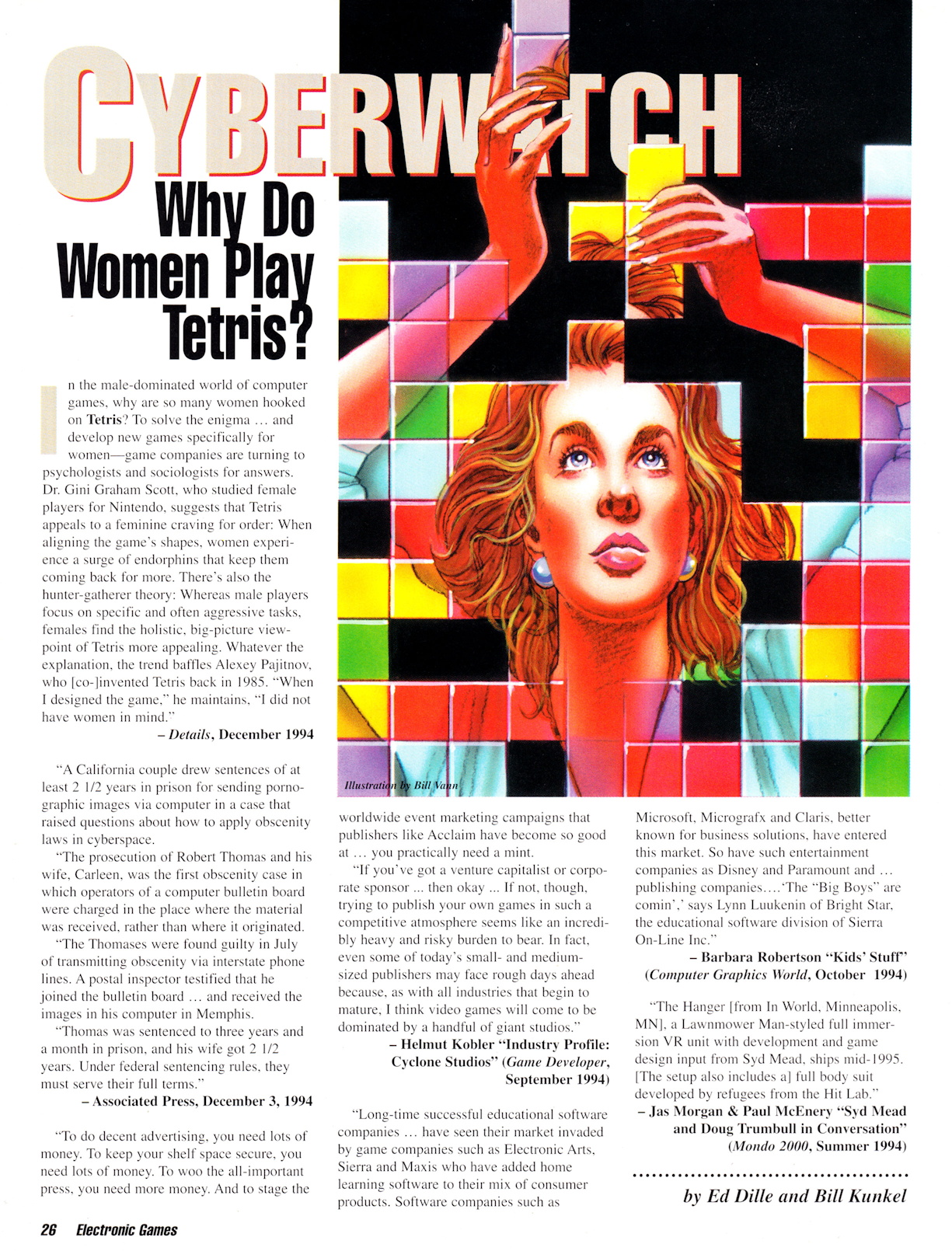
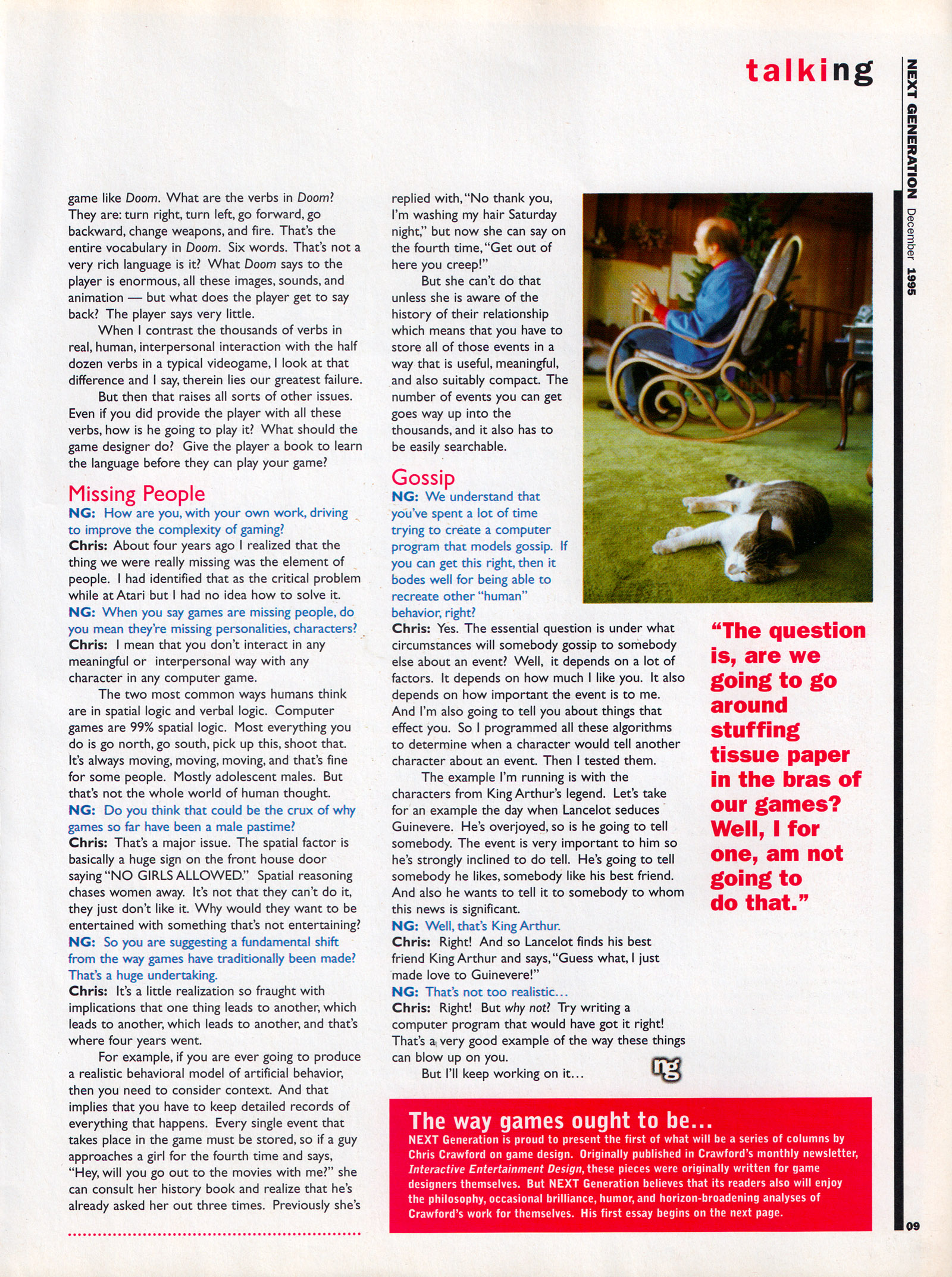
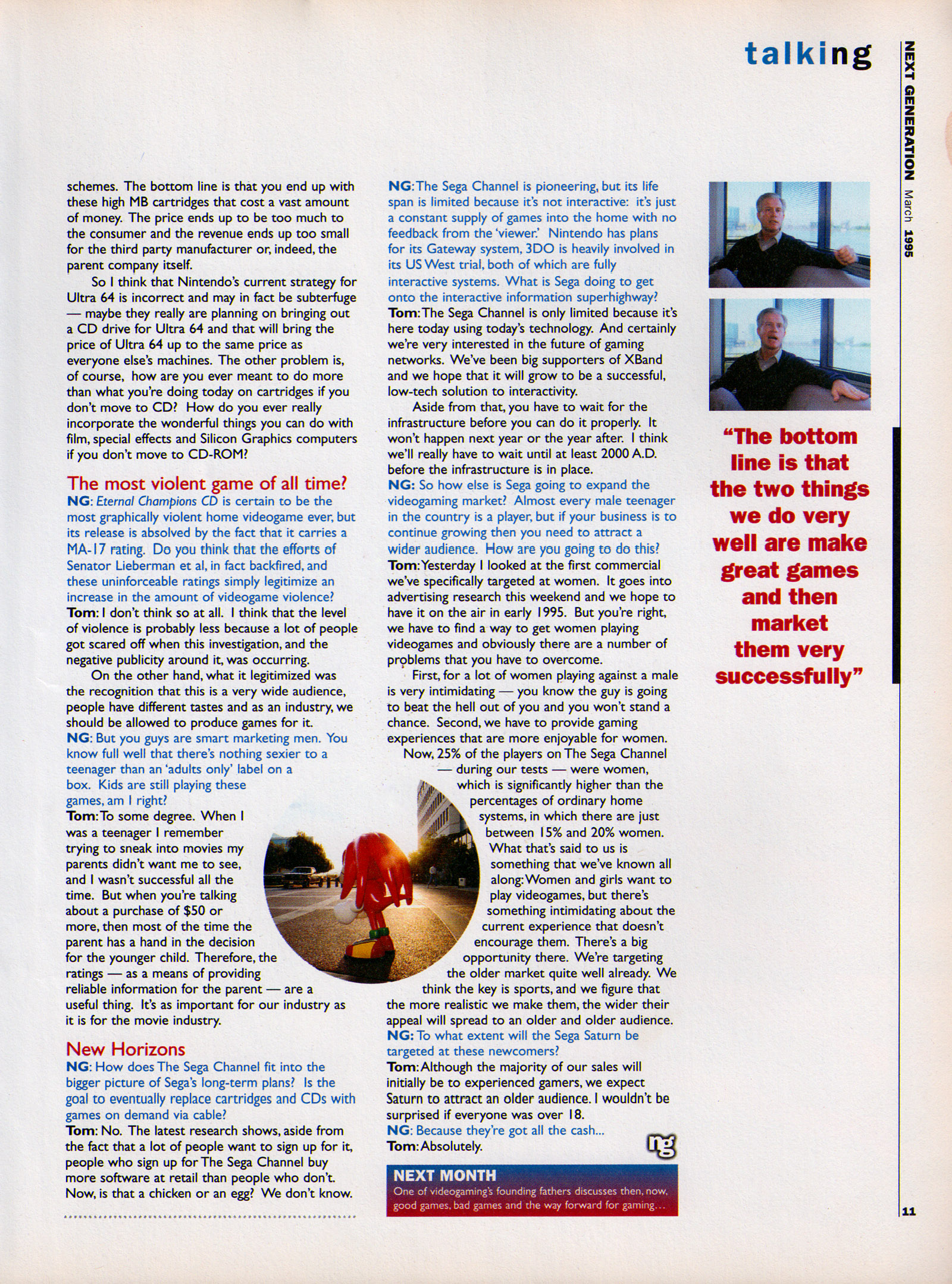
Game Players, March and May/Electronic Games, February/Next Generation, December (talking to Chris Crawford)/Next Generation, March (talking to Tom Kalinske). Women were a hot topic this year. Female characters in games, playing as them, how they are portrayed, how to get more women to play games, the women who do play games and what kind of games appeal to women.
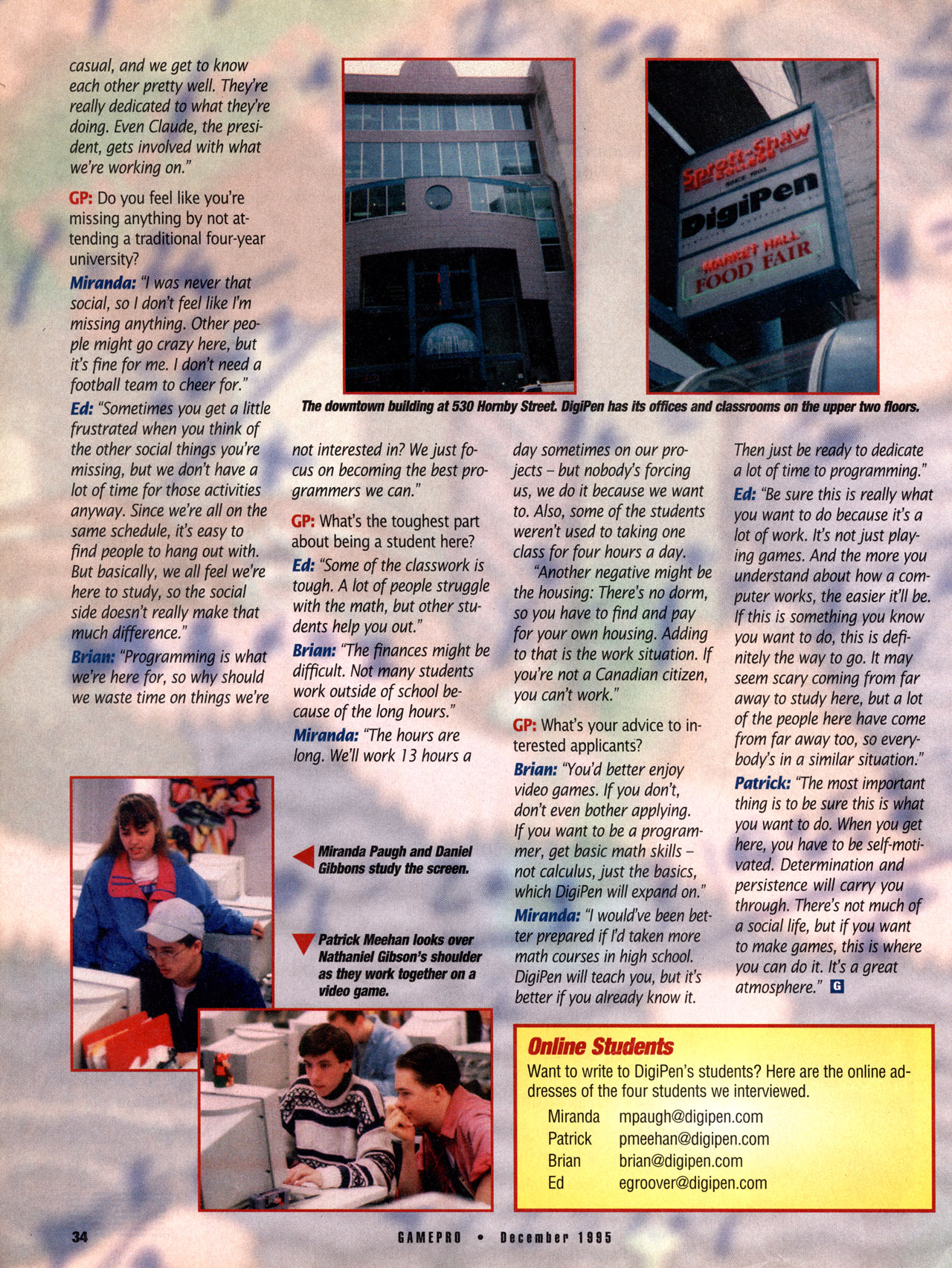
Next Generation, June/GamePro, December.
DigiPen was the first college to focus on video game development. I saw some letters from readers asking about how they could make video games some day, so it seems like a natural thing for magazines to cover DigiPen.
I think this GamePro article is saying that Miranda was the first female student at DigiPen, who enrolled in either the first or second year. Whichever it is, the Miranda being interviewed here is the founder of The Mega Man Homepage, which has been running for over 30 years. She has also worked on the art in several games, including the Dragon Ball Z games on the Game Boy Advance.
Lastly, from Next Generation’s June issue:
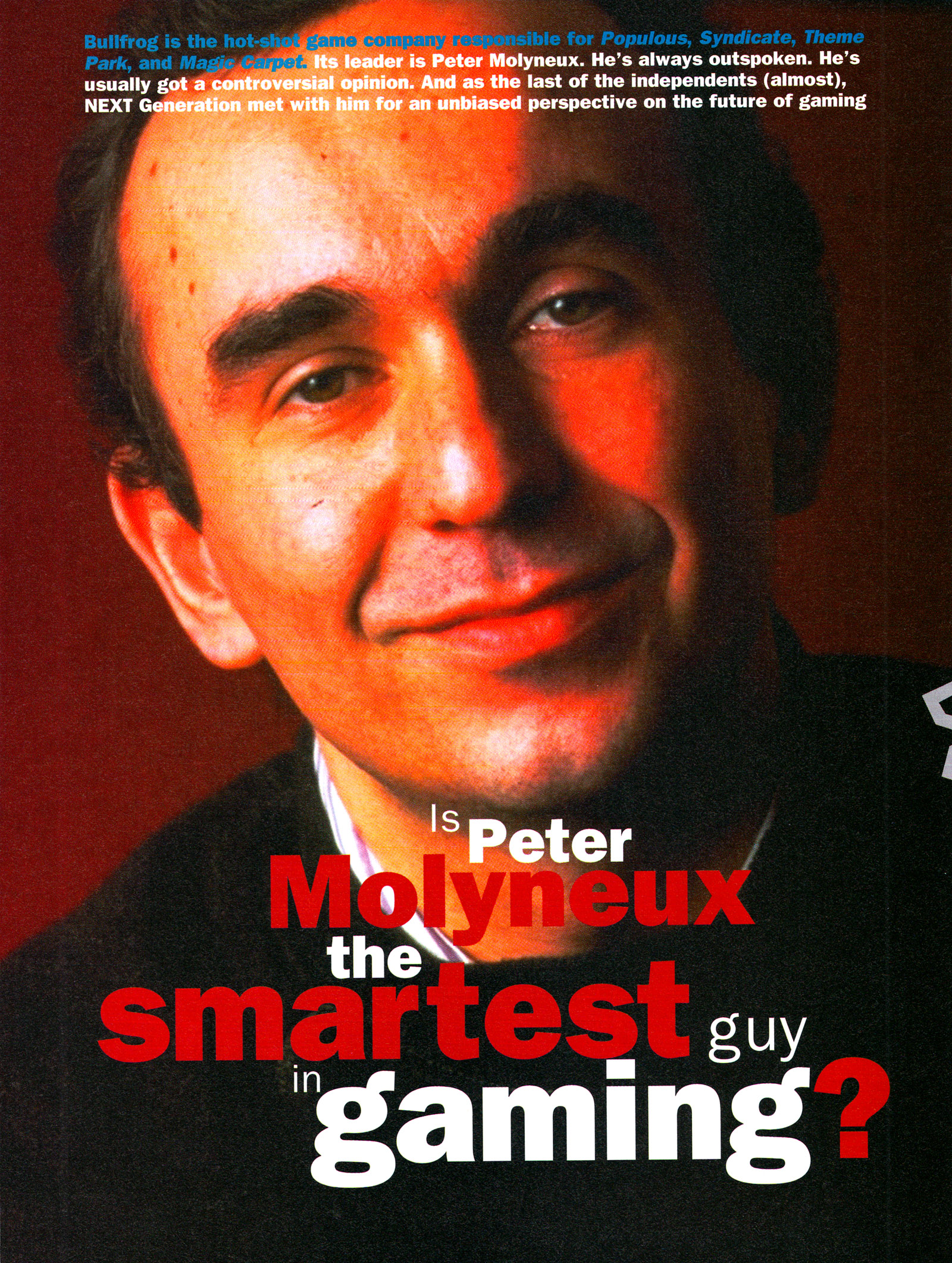
No.
Sources
Scans
https://library.gamehistory.org/repositories/2/archival_objects/1213
https://archive.org/details/gamefan-magazine
E3, CES
https://segaretro.org/Winter_CES_1995
Game-Specific Information
https://segaretro.org/Wheel_of_Fortune_(Mega-CD)
https://segaretro.org/Marko%27s_Magic_Football
https://segaretro.org/R.B.I._Baseball_%2794
https://segaretro.org/3_Ninjas_Kick_Back_/_Hook
https://segaretro.org/Compton%27s_Interactive_Encyclopedia
https://segaretro.org/Myst_(Mega-CD)
https://segaretro.org/Mallet_Legend
https://en.wikipedia.org/wiki/AirCars
https://nintendo.fandom.com/wiki/Archer_MacLean%27s_Super_Dropzone
https://snescentral.com/article.php?id=0135
https://gamefaqs.gamespot.com/3do/584432-mathemagics/data
https://www.gamesthatwerent.com/2013/02/apocalypse-super-nintendo/
https://www.mobygames.com/game/2083/brain-dead-13/cover/group-18336/cover-44312/
Magazine information
https://www.retromags.com/publications/united-states/gamefan/
https://www.retromags.com/files/file/4924-die-hard-game-fan-volume-1-issue-08-july-1993/
https://en.wikipedia.org/wiki/Electronic_Games
https://www.retromags.com/publications/united-states/electronic-games-1992/
https://www.retromags.com/publications/united-states/electronic-gaming-monthly/
https://www.forgottenworlds.net/egm-and-sendai
https://www.retromags.com/publications/united-states/fusion/
https://videogameobsession.com/videogame/mags/GameInformer/
https://www.retromags.com/publications/united-states/game-informer/
https://www.newspapers.com/article/star-tribune/59941455/
https://www.retromags.com/publications/united-states/game-players-1989/
https://www.ebay.com/itm/137232127968
https://www.retromags.com/publications/united-states/fusion/
https://www.retromags.com/magazines/usa/gamepro/
https://www.retromags.com/publications/united-states/gamepro/
https://www.retromags.com/statements_of_ownership/gamepro_1995/
https://www.retromags.com/publications/united-states/next-generation/
https://www.retromags.com/publications/united-states/nintendo-power/
https://www.retromags.com/publications/united-states/sega-visions/
https://web.archive.org/web/20120709052655/http://www.1up.com/do/blogEntry?bId=9009373
Systems and Sales
https://atari-explorer.ctrl-alt-rees.com/jaguar/jaguarend.html
https://www.neogaf.com/threads/retro-sales-age-thread.981407
https://www.wsj.com/articles/SB835915768416880000
The Ultimate Gaming Rig
https://www.reddit.com/r/AMA/comments/ksrn1/ama_request_somebody_who_actually_won_the/
https://www.youtube.com/watch?v=syNIM7LOpDk
https://www.youtube.com/shorts/uL3-fnJA_f0
Images
https://www.mobygames.com/game/2083/brain-dead-13/cover/group-18336/cover-44312
https://chrono.fandom.com/wiki/Epoch?file=Epoch_-_Winged.png

https://in.pinterest.com/pin/871446596635643281/
https://en.wikipedia.org/wiki/Sega_Saturn#/media/File:Sega-Saturn-Console-Set-Mk2.png


https://www.nintendo.com/us/store/products/virtual-boy-for-nintendo-switch-2-120829
https://mortalkombat.fandom.com/wiki/Cyrax/Gallery?file=Cyrax_versus.png

Other Information
Every individual issue of DieHard GameFan, Electronic Games, Fusion, Electronic Gaming Monthly, Game Informer, Game Players, GamePro, Next Generation, Nintendo Power, Sega Visions, and VideoGames: The Ultimate Gaming Magazine from 1995, as well as several issues outside of 1995
Finding some information was accomplished by searching the Video Game History Foundation’s Digital Archive
https://nintendo.fandom.com/wiki/List_of_Nintendo_promotional_videos
https://rhymeswithmelon.wordpress.com/2011/09/15/nuke-com-reunion/
https://bsky.app/profile/savestate.site/post/3mx7w24lmes2r
https://www.gamingalexandria.com/wp/2021/06/video-game-sales-1972-1999/
https://segaretro.org/Sega_Web
https://segaretro.org/Rock_the_Rock
https://www.digipen.edu/about/our-history
https://en.wikipedia.org/wiki/DigiPen_Institute_of_Technology
https://www.mobygames.com/person/67022/mandi-paugh/
https://www.ign.com/articles/1996/09/28/k-b-toys-tells-its-side
https://data.worldbank.org/indicator/IT.NET.USER.ZS?locations=US